Showing posts sorted by relevance for query Buffalo National river. Sort by date Show all posts

Monday, November 6, 2023

History repeats itself on Arkansas' Buffalo River

I grew up on chatter about the Buffalo National River, the nation's first national river, which was designated in 1972.  I grew up on that chatter because I grew up five miles from the river, in Newton County, Arkansas, home of the river's headwaters.  

My parents talked in my early childhood about their friends--the parents of my friends--whose land was condemned by eminent domain to become part of the park's land, owned and controlled by the federal government.  

While I was still a tween and teen, I saw the establishment of canoe rental enterprises in Jasper and surrounding communities, businesses that had been granted concessions by the National Park Service.  The county attracted growing numbers of tourists as it was remade into a regional ecotourism destination.  (Read more about that here and here; this is just some of my coverage of an industrial hog farm that threatened the river for several years starting in 2013). By the time I was in college and law school at the University of Arkansas (Fayetteville), 80 miles to the west, I had become a tourist on the river myself, consuming (in a sense) the very rurality in which I'd grown up, the very wilderness I'd taken for granted.  (See more photos of Newton County, including the county seat, Jasper, here and here).  

Decades on, I saw the proliferation of vacation rentals--even buildings like a beauty salon in Jasper converted to an AirBnB.  Though I've not seen any news reporting or data on the topic, folks in Jasper have told me that the widespread conversion of buildings to short-term rentals has resulted in a housing shortage.  Of course, that's happening in lots of rural communities, and urban ones, too.

In the past few weeks, the Buffalo has suddenly burst back into the news, once again in relation to its status as a national river.  The reason:  two grandsons of Sam Walton, the legendary founder of Walmart Corporation, have been working behind the scenes--apparently in cahoots with Governor Sarah Huckabee Sanders and U.S. Congressman Bruce Westerman--to get the river re-designated from a National River to a National Park Preserve.  

I first saw this news on the front page of the Arkansas Democrat Gazette on October 7, but it didn't seem to break through the standard media humdrum until KUAF, the NPR station associated with the University of Arkansas, two counties over ran this program on Oct. 16.  After that segment, things started popping on social media, and the next thing I knew, I was seeing reports on X (formerly known as Twitter) of a town hall held in my hometown on Thursday, Oct. 26.  Though only about 550 folks live in Jasper, twice that many reportedly showed up at the Jasper School cafeteria, which photos show at overflow capacity.  Another couple thousand folks were said to have attended the meeting on Zoom.  

Meanwhile, the Madison County Record, a weekly newspaper in neighboring Madison County, which lies to the west, between Washington County (where the land grant University of Arkansas is) and Newton County, has been credited with breaking the story of the proposed  re-designation of the Buffalo River.

Historic building in Kingston, Arkansas, just off the square.
(c) Lisa R. Pruitt 2023

That is, apparently it was the Madison County Record that first reported that the Walton Family was buying up land in Madison County with an eye to its long-term appreciation if the Buffalo National River becomes a bigger deal. I can't find that coverage online, but here's more from the Arkansas Democrat-Gazette on Walton land purchases in Madison County, including a building on the Kingston town square bought under an alias with a Nebraska address in December, 2021.  The Waltons, via the spokesperson for their Runway Group, have issued this statement about the Kingston property: 
Kingston Community Library
(c) Lisa R. Pruitt 2023

As part of a restoration effort, members of the Walton family acquired three historic buildings on the square in downtown Kingston, intending to update them and open their doors to the community. While we don’t yet have a timeline for the opening, we will share more when we do.

Though Kingston is in Madison County, its school is part of the Jasper School District. You can see a photo of downtown Kingston here.  (And there is a darling, tiny and well-cared-for library on the town square in a squat wooden building that presumably has not been purchased by the Waltons, but lies amidst the three they now own).

Of note is that the Madison County Record has made free its coverage of the Buffalo River re-designation, including this about the community meeting in Jasper on October 26.  What follows is from publisher Ellen Kreth's reporting: 

After a town hall meeting last Thursday, proponents of turning public land around the Buffalo National River into a national park preserve said they would step back from the idea. The following day, a website touting the benefits of re-designating the land was taken down.

But opponents of the idea are not backing down and don’t trust that efforts to re-designate the land are no longer ongoing.

Misty Langdon, owner of Steel Creek Cabins, who organized the town hall meeting, said proponents have poured too much time, resources and money “into this project that seems to be linked to Bryan Sanders [Gov. Sarah Huckabee Sanders’ husband],” to just walk away.

In July 2022, the Runway Group approached U.S. Rep. Bruce Westerman, R-Ark., who represents Arkansas’ 4th Congressional District and chairs the Natural Resources Committee, with the idea of making public land around the river a national park preserve.

Grandsons of Walmart founder Sam Walton and co-founders of the Runway Group, Steuart and Tom Walton are investors in real estate, outdoor initiatives, conservation, recreation, hospitality and businesses in Northwest Arkansas.

* * *

The Runway Group also has been linked with working with the governor’s office and the First Gentleman on the possibility of re-designating public lands.

Last Friday, Runway Group’s Vice President of Corporate and Community Affairs Krista Cupp said the group watched the town hall meeting. She reiterated they are not going forward with any proposal for re-designation. There are “no next steps,” she said.

“We wanted to explore a new idea for our home state together. However, this is not our decision to make. There is no new action being taken,” a statement issued earlier by the Runway Group said.

Cupp said when the group approached Westerman, it didn’t present a proposal to re-designate the land but simply asked if the idea was worth exploring.
Kingston Community Library 

Two Westerman staff members attended the town hall in Jasper, and his office issued a statement including this: 

Although it is in the purview of the House Natural Resources Committee to advance legislation to designate National Parks, I’ve made it clear I would not support any proposition that does not have grass roots support from those that live, work, and raise their families in the Buffalo River watershed.

As the Representative for Arkansas’s Fourth Congressional District, my first priority is advocating on behalf of my constituents. I will continue to listen to the thoughts and concerns of Arkansans that would be impacted by any change in designation. 

Westerman said he had no plan to write or introduce any legislation that would re-designate the land. 

While the Madison County Record story says the meeting was convened by Misty Langdon of Steel Creek Cabins, another report says it was convened by a non-profit that appears focused on preserving the area's history, the Remnant Group.  

Here's part of a column by Jared Phillips, a Washington County farmer who teaches at the University of Arkansas, writing about what's at stake with the proposed re-designation. 
This push by the heirs of Sam Walton to take control of Arkansas’s resources nakedly shows their true aim: control, not philanthropy. The news surrounding the proposal to change the designation of the Buffalo National River, alongside the reported purchase of Horseshoe Canyon, continued land grabs along the Kings River and more amount to only one thing: the wealthiest in the region are pushing the rest of us out. Removal by way of development and recreation is still removal.

The thing is, claims that this development will ease poverty and boost economic vitality in rural areas is suspect at best. Across the nation, developing rural outdoor recreation areas doesn’t produce a meaningful decline in poverty rates at a county level. In fact, in many cases — and Newton County is one — when poverty rates go down in these areas, it has less to do with a wage increase or better opportunity. Economic indicators look better simply because poor folk can’t afford to stay in their place any longer and must leave. That’s why we’ve seen both a drop in poverty in Newton County and a drop in population. The claim that this sort of transition brings about wholly positive things is, on its face, untrue.

The current conversation about the Buffalo isn’t actually about the river. Bike trails, art parks, high-brow museum expansions — it’s not really about that. It’s about the future of the Ozarks. All of us, old stock and new, need to ask ourselves if we are truly represented in the decision making that is shaping — often literally — the next generation’s hills.
And if we’re honest, the only answer is that we’re not. If we truly were, we’d see regional efforts to push the wealthiest and the powerful to put their money where their mouth is. We would see meaningful, long-term action to effectively address economic injustice and food security in the region. To address worker safety. To thoughtfully and wisely engage in land planning that preserves working, welcoming landscapes instead of putting fences around elite, enclosed playgrounds built on the bones of our grandparents.

Instead, what we have is an idle class dictating the region’s future according to their own wishes.

A 2021 column by Phillips and published in the Democrat-Gazette echoed some similar themes and challenged the notion that a rising tide lifts all boats.  Read it here.  

Then, yesterday, Arkansas Democrat-Gazette columnist Rex Nelson wrote in favor of the proposed National Park Preserve, offering a perspective that runs squarely counter to that of Phillips. The headline, "Loving it to death," is a reference to tourists loving the Buffalo River so much that they come in such great numbers that the current infrastrcture, e.g., parking lots, toilets, is overwhelmed.  Interestingly, Nelson vouches for the Walton brothers--declaring their motives "pure."    

In addition to their distrust of government, those who live in these hills distrust outsiders. They’re concerned by the large amounts of land being bought by entities associated with brothers Tom and Steuart Walton of Bentonville. I know the Walton brothers, and I want to make one thing clear: Their motives are pure. They realize that our state’s ability to attract and keep talented people in the decades ahead will rest in part on our protecting and enhancing outdoor recreational attributes.

The Walton brothers could live anywhere in the world and do anything they want. But their focus these days is on enhancing quality of life in Arkansas. Other states should be so lucky. Their involvement in the Coalition for Buffalo River National Park Preserve doesn’t worry me. It gives me hope that this effort will succeed.

Here's a competing column from Mike Masterson arguing that the river should be left as it is.  And here's a column from John Brummet, political columnist writing for the Democrat-Gazette, "Selling the state down the river?"  Brummet, too, is skeptical of the wisdom of a re-designation and of the motives of Governor Sanders and the Walton brothers.  

Here's a post on how to bring oldtimers and newcomers together in places like Newton County.  And here's a post, in the context of an industrial hog farm controversy a decade ago about how the interests of folks in Fayetteville and the wider northwest Arkansas region are often seen as being at odds with those of the rural, Newton County locals.  And that reminds me:  I've not seen anyone talking about how many of the folks who showed up at the Oct. 26 meeting were "locals" from Newton County--as opposed to "environmentalists" or "conservationists" from the wider region.  

Postscript:  Here's a Nov. 8, 2023 update from the Madison County Record reporting that the Newton County Quorum Court (essentially a county board of supervisors) had voted unanimously to oppose any re-designation of the Buffalo National River.  A quote follows: 

Newton County Quorum Court members passed a resolution at their Nov. 6 meeting opposing “the changing of the name designation or expansion of the Buffalo National River, and any further negative impact on the agricultural lands or infringement on private ownership on the Buffalo National River Watershed.”

The vote was unanimous with approximately 25 citizens in attendance.

Justice of the Peace Jamie Mefford said the court wanted to show its opposition to any name change, park expansion, private land rights restrictions and any agricultural restrictions.

The Newton County Times currently has yet to post anything about this on its webpage.  Sad when the neighboring county newspaper is able to cover a county's news faster than its own paper can.  

Friday, September 10, 2021

Law and Order in the Ozarks (Part CXXXIV): Crime in the Buffalo National River

Two stories of crime in the Buffalo National River Park caught my eye in several editions of the Newton County Times, my hometown weekly newspaper.  They are both dateline Fort Smith, where the federal court for the western district of Arkansas sits.  

This is from the August 9, 2021 issue under the headline, "Two Arkansas men plead guilty to damaging historic mines in Buffalo National River."  The subhead notes that the men sold what they got from the mines at a "rock shop" in Alpena, which straddles neighboring Boone and Carroll counties.  Note how long it took for this case to get to court--the men were first observed by a park ranger more than five years earlier:  

Two men pleaded guilty last week to felony violations of the Archaeological Resources Protection Act, in connection with their illegal excavations of archaeological sites in the Historic Rush Mining District of Buffalo National River, and the sale of stolen geological and mineral specimens at a store in Alpena. U.S. District Judge P.K. Holmes III presided over the July 27 change-of-plea hearings, in which Nathan Bradford LeMay, 35, of Hot Springs Village, and Justin Charles Baird, 32, of Hot Springs, each pleaded guilty to the first count of the three-count indictment in which both were named.

According to court documents, on multiple occasions in 2015 and 2016, LeMay and Baird traveled to the Historic Rush Mining District, in Marion County, Arkansas, to dig for mineral and geological specimens to sell at LeMay’s business, Alpena Crystals. The pair’s plans went awry on Feb. 14, 2016, when a U.S. Park Ranger observed them camped in Buffalo National River, which is a United States National Park.

Noticing evidence of their excavations, the Ranger obtained consent to search their campsite and vehicles, recovering digging tools and containers of geological specimens. Two days later, officers were sent to several mines in the area to assess whether or not they had been entered. The Monte Cristo Mine, a gated, locked and controlled mine along Clabber Creek, was observed to have been broken into. Trash, water bottles and other items were located both just inside and outside this mine. On the Rush Creek side of the same mountain, drag marks in high grass, from the Morning Star/Ben Carney Mine, down to Rush Creek and the parking lot, indicated large heavy objects had been dragged down the mountain to the parking area.

A subsequent investigation by the National Park Service, assisted by local law enforcement and the Carroll County Prosecuting Attorney’s Office, established the full extent of the pair’s illegal excavations. LeMay and Baird had excavated and damaged 22 areas within those mines, removing mineral and geological materials, and damaging the historic sites—which add to the knowledge of the mining community in the Ozarks as the industry transitioned from crude mining techniques to modern methods. Dr. Caven Clark, an archaeologist with the National Park Service, now retired, conducted a resource damage assessment, determining that the cost of restoration and repair to the site was approximately $22,241.

Both men were indicted by a federal grand jury in March 2020. In addition to violation of the Archaeological Resources Protection Act, which prohibits excavating, damaging, altering and defacing archaeological sites and resources, both men were also charged with theft of U.S. property and damage to government property. ...  Before the [two defendants] announced their intentions to plead guilty, the case had been scheduled to be tried beginning on July 26.

As a result of their guilty pleas both LeMay and Baird face up to two years in prison and fines of up to $250,000. Additionally, both men have agreed to pay $22,241 in restitution as a shared obligation.

The earlier story is from May 10, 2021.  The headline is "Man sentenced for setting fire within BNR."  Here's an excerpt: 

A Harrison man was sentenced on May 5, to five years in prison followed by three years of supervised release and ordered to pay $12,494.14 in restitution on one count of willfully and without authority and consent of the united states set on fire timber, underbrush, grass and other inflammable material upon a public domain within the Buffalo National River. The Honorable US District Judge P.K. Holmes, III, presided over the sentencing hearing in the United States District Court in Fort Smith. 
According to court documents, In March 2020, Jacob Edward Walls, 29, was indicted by a federal grand jury, of setting a wildland fire within Buffalo National River, in Newton County, near Pruitt, on Feb. 5, 2019. Federal investigators determined Walls set a fire within the park, which threatened nearby private structures and lands, and subsequently fled the area. 

The Newton County Sheriff's office assisted federal authorities in the case.  

Thursday, March 7, 2013

State and fed officials tangle over industrial hog farm in Buffalo National River watershed

In August, 2012, the Arkansas Department of Environmental Quality (ADEQ) approved a 670-acre, 6,500 hog farm along a tributary of Big Creek, just five miles from the Buffalo National River (BNR)--and it did so without input from the National Park Service.  Now, according to the Feb. 27, 2013, issue of the Newton County Times, the Park Service has joined local conservation groups in objecting to the corporate farm, which is locally owned but will operate under a contract with Cargill.

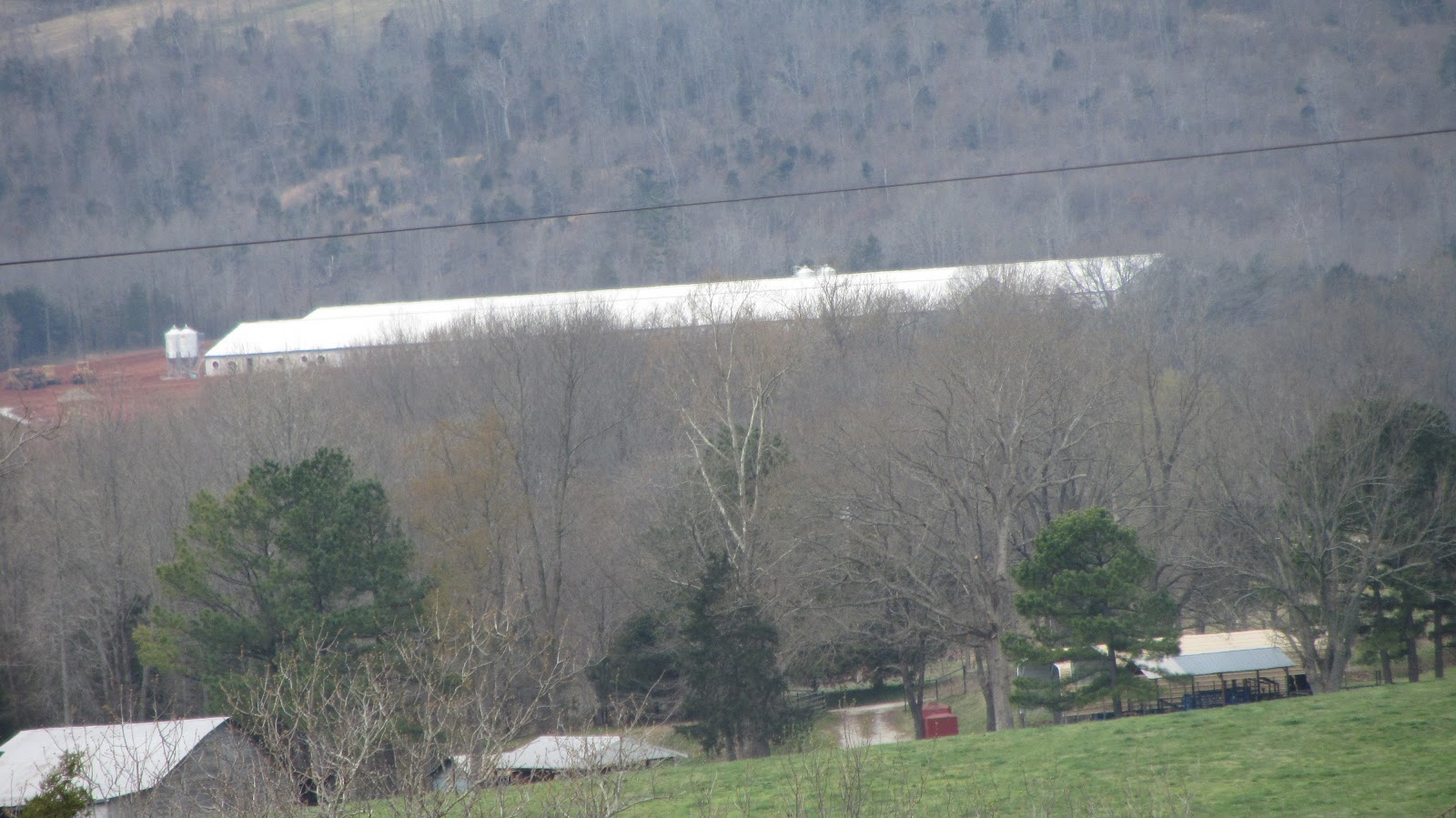
Big Creek Valley, Newton County, Arkansas, area
of proposed industrial farm.  April, 2011.
Officials with the National Park Service say they didn't learn about the plan until after the permit was issued last August.  The Times quotes Buffalo National River superintendent Kevin Cheri,
We are key stakeholders in any decision.  ... We didn't find out until the permit had been taken out and a loan given for the farming operation. ... Why didn't they notify the first national river about this?  We're only five miles from the facility.  
Cheri reported that his agency learned of the proposed farm when local property owners and members of the Ozark Society asked his office about it.  The paper further quotes Cheri:
We're behind the curve and trying to get more information ... so we can articulate our concerns, and take it to the next level, if that is what is needed.  We want to be assured this is not going to cause any contamination of water and affect public health.
What I find shocking about how ADEQ handled this matter is that they published public notices of hearings about the farm only in the Arkansas Democrat-Gazette, in February and April of 2012.  ADEQ did not publish any notices in either the Newton County Times or the newspaper for neighboring Boone County.  I would guess that the number of Newton County residents who regularly read the Arkansas Democrat-Gazette is very low.  (See more about Newton County demographics here; 79% are high school graduates and only 12% have a bachelor's degree or more).  ADEQ reports that it held six public meetings received comments from 13 individuals, organizations and corporations.  It does not specify, however, whether any of those offering comment were residents of Newton County, or of neighboring Searcy County, which the Buffalo River runs through not far downstream from Big Creek.

The plan that ADEQ approved includes two "shallow-pit confinement barns" and "collecting states [sic] in two story ponds, then spreading it on a 670-acre farm." The Ozark Society, which reviewed the permit, reports that it approves "17 separate hog waste application fields, 11 of these [  ] adjacent to Big Creek."  The permit specifies:
a buffer zone of approximately 100 feet between Big Creek and the hog waste application fields.  The facility's treatment facility consists of in house shallow pits with a capacity of 759,542 gallons, a settling basin with capacity of 831,193 gallons and a holding pond with capacity of 1,904,730. 
This amounts to 2,090,181 gallons of manure, litter and wastewater generated per year.  This is approximately 5,727 gallons per day spread on fields (630.7 acres).  On average, 9.1 gallons per day would be spread on each acre or 75 pounds per day per acre. 
The permit does not allow discharge of the waste, but rather it must be applied to the owner's fields.  If an overflow occurs, the permittee must test the pond, but has 30 days in which to report the overflow and likely run-off.  All of the fields and facilities are above the 100 year flood level.  The fields will be used for hay and pasture.    
The permit states that "land application areas will receive application at rates consistent with infiltration capabilities of the native soil so that there is no runoff."

Buffalo National River near Ponca
The Ozark Society stated on its website that it "has no desire for this farmer to lose the right to develop his land" and noted that he has operated a successful hog farm near Jasper for a decade with no citations or permit violations.  Nevertheless, the Society asserted that "the water quality of our rivers is at stake" and that it ADEQ should have the "long-term goal" of "deny[ing] permits for any animal or poultry factory farms in the watersheds of major rivers and streams, especially the Buffalo National River, our first National River and a designated Extraordinary Resource Water stream." The website notes the "significant economic issue" given that the BNR "attracts more than a million visitors each year, contributing millions of dollars to the economy of Arkansas."

At the end of its story, the Newton County Times notes that one of the farm's co-owners and its vice president, Richard Campbell, is a justice of the peace/member of the Newton County Quorum Court (the Arkansas equivalent of a Board of Supervisors).  The Newton County Wildlife Association, which also opposes the factory farm, has suggested that the Quorum Court consider this controversy.

No timeline for the opening of the farm is indicated, though the story makes a mention of the farm seeking funding, presumably for start-up costs.

Sunday, July 17, 2022

Smithsonian Magazine features Buffalo National River at 50 (and my hometown)

Buffalo National River
Between Ozark and Pruitt
(c) Lisa R. Pruitt 2015
Boyce Upholt's story, "What Makes the Buffalo River the Jewel of the Ozarks?," is a profile of the nation's first and only national river at the 50th anniversary of its founding.  Along the way, you get a few visual and verbal vignettes of Newton County, where I grew up, along with two photos of Jasper, the county seat where I went to school.  Photos accompanying the story are by Rory Doyle.  Photos shown on this post were taken by me when I floated the river with my mother and my son in 2015.  

Here's the lede for the Smithsonian Magazine story: 
Three Generations 
of Pruitts at 
Pruitt, Arkansas, BNR

If smoothed out flat, the rough mountainous terrain of Newton County, Arkansas, would prove “bigger’n the whole state of Texas,” a local resident once proclaimed to a folklorist. That may be an exaggeration, but the wrinkles of the topography have certainly kept this corner of the Ozarks quiet. Fewer than 8,000 people live scattered across Newton County’s 820 square miles. The place is mostly known for a waterway. Near the county’s western border, a trickling stream grows into the Buffalo River.
For a long time Arkansans couldn’t agree on what the river should be used for, and some even fought over it. In the 1940s, with the local timber felled and the zinc and lead operations floundering, state tourism officials started promoting Newton County as a wilderness destination. The county was home to nearly half of the Buffalo River watershed, and outdoors enthusiasts considered the mountain stream one of the finest in the region, if not the country; it was a rare, free-flowing waterway, perfect for rafting or canoeing. Some local leaders wanted to turn the watershed into a national park. Others wanted to dam the river, which could provide hydroelectric power and form the kind of placid lake that had spurred the development of lodges, restaurants and retirement homes elsewhere in the Ozarks.
(c) Lisa R. Pruitt 2015

Upholt further details the history of the river's designation--including local resistance.  He also talks about the industrial hog farm built in the watershed in 2013, which the state eventually bought out and closed in 2019.  I wrote about that matter in the Journal of Rural Studies in 2016, and you'll find many posts about it here on Legal Ruralism.  
Buffalo National River
Near Ozark Campground
(c) Lisa R. Pruitt 2015

Tuesday, June 24, 2025

Buffalo National River watershed finally gets permanent protection from industrial agriculture

I've written a great, great deal about the Buffalo National River over the years, including when a hog CAFO was sited on the banks of one of its tributaries in 2012.  After a great deal of wrangling, that CAFO was ultimately bought out by the State of Arkansas for $6.2 million under former governor Asa Hutchinson.  

Here's an excerpt from a post about these recent events on Arkansas Outside, which explains that .  

The Arkansas Legislative Council on Friday gave final approval to a permanent moratorium on medium- and large-scale hog concentrated animal feeding operations (CAFOs) within the Buffalo National River watershed, cementing over a decade of advocacy from conservation groups and marking a significant milestone in the state’s environmental policy.

The decision, passed without debate, follows years of temporary protections and stems from heightened concerns about the impact of industrial swine farms on water quality in the nation’s first designated national river. The new rule permanently bans CAFOs, as defined by the Environmental Protection Agency, that are medium or large in size, based on animal count and waste production.

Environmental groups, including the Buffalo River Watershed Alliance, the Ozark Society, and the Arkansas chapter of the Sierra Club, hailed the decision as a crucial step to safeguard the river’s karst terrain, which is particularly vulnerable to groundwater pollution.

The move follows years of public outcry sparked by C&H Hog Farms, a large-scale swine operation permitted in 2012 under a general permit process that lacked public input. The farm, located near the town of Mount Judea, drew criticism and concern after manure from thousands of hogs was applied to fields near tributaries that feed the Buffalo.

* * * 

Agricultural interests, including the Arkansas Farm Bureau and the Arkansas Cattlemen’s Association, opposed the permanent moratorium. In comments to the state, they argued the ban was based on public perception rather than scientific evidence, and they warned of regulatory overreach that could limit farmers’ land use rights.
* * *
The rule change came under the broader context of Senate Bill 290, legislation initially intended to overhaul the state’s rulemaking process. The bill was amended during the legislative session to preserve moratoriums on CAFOs in the Buffalo River and Lake Maumelle watersheds. Future bans will now require legislative approval, reducing the ability of state agencies to act independently.

Governor Sarah Huckabee Sanders, who has expressed support for protecting the Buffalo River, reportedly threatened to veto the original version of the bill until amendments preserving the moratorium were included.

Read more about this year's legislative wrangling over the Buffalo and CAFOs here.  

Friday, May 17, 2013

Conservation groups to sue USDA over hog farm loan

The May 8, 2013 issue of the Newton County Times reports on a press release indicating that "a coalition of conservation groups" will sue the U.S. Dept. of Agriculture regarding the Farm Service Agency's loan guarantee for C & H Farm, an industrial hog farm on Big Creek, a tributary to the Buffalo National River.  Read earlier blog posts about the hog farm here and here.  The coalition apparently intends to argue that the decision by the FSA "was not properly examined and may violate the Endangered Species Act."

The Buffalo River watershed is "home to over 300 species of fish, insects, freshwater mussels, and aquatic plants, including the endangered snuffbox mussel, the endangered Gray bat, and the endangered Indiana bat." A spokeswoman for the Southeast Region at National Parks Conservation Association stated:
This factory farm will produce massive quantities of waste just six miles from the Buffalo River, and that waste will be spread on land that is right next to one of the Buffalo's major tributaries.  We are talking about one of the most beautiful areas in the country.  To think that our government would allow this hog factory in the watershed without examining its impacts is unconscionable.
The Farm Service Agency of USDA guaranteed 90% of the loan to C & H Farm.  That loan was used to purchase 23.43 acres in Mount Judea, Arkansas, and also for the construction of two barns. Those barns will house more than 6500 swine.

Robert Cross, president of the Ozark Society is quoted in the story:
This is the greatest threat to the Buffalo River since the Corp of Engineers damn proposal that we were able to thwart 50 years ago.  The porous limestone and karst that underlies all of the soil in the Mt. Judea region provides a direct passageway for leakage from the waste holding ponds and for untreated recharge from the waste application fields to reach the groundwater and thus Big Creek and the Buffalo River.  The risk for contamination of the Buffalo River is unacceptably high.  
Hannah Chang, an attorney with Earthjustice, is also quoted:
The letter we are sending today is a notice to the Dept. of Agriculture that its Farm Service Agency failed to undertake the consultation that is required to ensure that endangered species are not harmed as a result of the agency's action. 
Lastly, Jack Stewart of the Buffalo River Watershed Alliance is quoted:
Our aim is to prevent this farm from going forward without a thorough examination of the consequences--consequences that could result in irreversible damage to one of America's most treasured places, the Buffalo National River.
Earthjustice and Earthrise are representing the Buffalo River Watershed Alliance, the National Parks Conservation Alliance, and the Ozark Society in sending the the notice of intent to sue the USDA.

Wednesday, July 30, 2014

Time for an update on the hog CAFO in Newton County

I have written frequently in the past 18 months or so about the industrial hog farm on Big Creek, in the Buffalo National River watershed in Arkansas.  Read more here, here, here and here.  That operation, C & H Hog Farm, was approved by the Arkansas Department of Environmental Quality (ADEQ) without notice in any area newspaper or, for that matter, to the National Park Service.  The only notice given was on the ADEQ website.

Ever since folks in Newton County realized the CAFO was under construction, local and regional groups of concerned citizens have been trying to get it shut down.  Among other things, they filed a lawsuit against the U.S. Dept. of Agriculture "Farm Service Agency and the U.S. Small Business Administration for their inadequate review and improper authorization of loan guarantee assistance to C & H Farms."

Efforts are also underway to change Arkansas law so that no more operations of its kind can be sited in the Buffalo River watershed. That watershed includes parts of Madison, Newton, Searcy, Boone, Pope, Marion, Van Buren, Stone and Baxter counties) As of May, 2014, the Arkansas Pollution Control and Ecology Commission (APC & EC) "enacted a 6-month moratorium on issuing new permits for large confined animal operations in the area of the" river.

In June, APC & EC held a hearing in Harrison, in neighboring Boone County, about proposed changes to APC & EC regulations 5 and 6 on "Liquid Animal Waste Systems" and "Regulations for State Administration of the National Pollution Discharge Elimination System," respectively.  These changes proposed would apparently make the moratorium on CAFOs in the Buffalo River watershed permanent.  The usual suspects showed up, including Gordon Watkins, an organic farmer in Newton County who leads the Buffalo River Watershed Alliance (BRWA). He reported that the Alliance had grown to about 1000 members this year, growth largely attributable to interest in this issue.  Needless to say, the Alliance supports the permanent moratorium.

Also speaking at the meeting were two farmers form Benton County, which presumably would not be affected by the moratorium because that county is  not in the Buffalo River watershed.  Nevertheless, the farmers traveled to Harrison to speak against the proposed amendments and permanent moratorium. One of them, a diary farmer, said:
We rely on science and technology to produce a healthy product and protecting our environment for our family, our community and our cows.  This rule making sets a very negative precedent, and is not based on science.  This year it's hog farms.  Next year it could be poultry, dairy or beef.  I am pleading on behalf of family farmers for you to consider delaying all rulings until the research takes its course.
Clearly, this farmer is concerned about a slippery slope that could mean added regulation of her operations in the future.  One Newton County residents also spoke in opposition to the changes.  He  closed with:
We don't need further restrictions that destroy our freedom and our lifestyle.
Another spoke in favor of the proposal, focusing on the need to protect property values, jobs, and clean air.  He also expressed concern about well water contamination and the need to keep the promise "to our children, and to their children, that special places like the Buffalo will be preserved for them to experience."

Neither the temporary moratorium nor the changes under consideration will impact the permit under which C & H Farm operates, which was issued in August, 2012, and which will expire in October, 2016.

A few days before the hearings in Harrison, the National Parks Conservation Association (NPCA), the Ozark Society, the Arkansas Canoe Club and the Buffalo River Watershed Alliance hosted a day-long media event. The event was on the lower Buffalo, between Grinder's Ferry and Gilbert, a segment below where Big Creek flows into the national river and therefore the stretch that would be most affected by pollution from C & H Hog Farm.  Among those participating in the event, which included an aerial tour over the hog farm, was Dr. John Brahana, a retired hydrologist with the University of Arkansas and Bob Allen, Piney Creeks Chapter president of the Arkansas Canoe Club.  The Newton County Times June 11, 2014 issue quotes Allen speaking to the media:
We all want to eat bacon but we can't raise it in the watershed of the Buffalo River.
Brahana reported rumors that Cargill, which has the contract with C & H Farms, "wants out of the situation."  In addition, he reported, Teresa Marks, head of ADEQ, "ways out of her job and the governor wants a resolution of the problem."  Brahana reported that "he has taken some 40 samples from wells, springs and creeks in the area around the hog farm and has found dangerous concentrations of hazardous materials. He added that he introduced non-toxi dye into the ground across the road from the hog farm.  About 30 hours later, he said, it showed up in Big Creek."

Emily Jones, Southeast Program Manager for NPCA said that her organization filed the lawsuit against USDA and the Small Business Administration only after attempts at dialogue with the ADEQ authorities failed.

Tuesday, October 1, 2013

Law and Order in the Ozarks (Part CXXII): Locals tangle with feds over roads, cemeteries

Several recent issues of the Newton County Times have mentioned a dispute between a local cemetery board and the National Park Service regarding Shaddox Cemetery, which is contiguous to the Buffalo National River Park.  The most recent issue, from Sept. 25, 2013, indicates that an aide of U.S. Senator John Boozman was in Newton County to meet with members of the cemetery's board.  The dateline is Pruitt, previously home of a post office but now home to just a ranger station and a river put-in point.

Here's the history of the dispute, which goes back six years.  According to the cemetery board, elk (which were transported into the Buffalo National River a few decades ago) damaged the Shaddox cemetery in 2007.  The board sought relief from the National Park Service (NPS), but they declined to assist in any way.  The board proceeded to clean up the cemetery but then were notified by the park service that they must pay the NPS for disturbing an Indian burial ground.   The board later met with park service officials and the board has twice had the cemetery surveyed "to meet park service demands." According to the Sept. 25, report:
The board contends it followed a park service official's oral directions where to build the new fence, but the new fence did not satisfy the park superintendent upon final inspection because he said it crossed into park property. 
Since then the association has tried to buy, lease or trade for the 0.2 of an acre in dispute, but the park service has rejected the proposals, board members said.   
In the last letter from the park service, the association was notified that the park service wants the association to pay $72,000 for the 0.2 of an acre and damages to the park, and $18,000 to move the fence, which cost $14,000 to build.  
The cemetery association went before the Newton County Quorum Court at its September meeting.  The board asked the JPs to individually sign a copy of a Memorandum of Request prepared by the cemetery association.  JPs unanimously and individually signed the document and the cemetery board sent it to the Arkansas delegation in Washington and to the Arkansas General Assembly[,] as well as to the governor. 
The document asks these officials to "inform the Department of the Interior of local, state, and federal laws that protect us pertaining to this matter."   
Since then, a two-strand wire fence has gone up inside the fence built by the cemetery board.  Board members were made aware of this new fence by the person it contracts to keep the grounds mowed. 

Also, board members have photos of an unidentified individual in the cemetery conducting some type of underground scanning of the cemetery.  The Newton County Sheriff's Office was notified and a deputy reportedly escorted that person off the property.  They also said there is a photo of tire marks left on a war veteran's grave.  
Wow!  There is some heavy stuff here--with an Indian grave and a veteran's grave possibly having been desecrated.  I'm glad that Bozeman's staffer came to meet with the cemetery board and to see the desecration of the veteran's grave, which is shown in a photo.  But I'm also really disappointed in the federal government if this story is accurate.  Obviously, it would be interesting to hear the NPS's version of events, and I'm disappointed that the Newton County Times has apparently not sought it.

An earlier issue of the paper, from July 31, 2013, reports on another conflict between Newton County's government and the feds, once again embodied by the National Park Service.  This conflict is over roads, and the report indicates that the county judge (the chief administrative officer for the county, who is elected) has declared that he will not permit the National Park Service to "close or gate county roads," and further that he will not hesitate to have such gates knocked down if they are placed without his authorization.  The story also indicates that the county judge threatened to call the sheriff to escort an apparent agent or officer of the National Park Service off a roadway the agent/officer was blocking.  Here's an excerpt from the story headlined:  "County road work opposed by Park Service," dateline Carver, on the Buffalo National River:
A Newton County road was blocked last week by the National Park Service after the road was improved by the county road department making it easier and safer for large vehicles to navigate. 
Last Wednesday, July 24, Newton County Judge Warren Campbell notified that Newton County Times that the park service had the road blocked and he was in the process of having a park service enforcement officer escorted off the road who was stationed there after the road department removed several large rocks which the park service had placed there across the new section of road. 
The dispute was over a section of County Road 39 that connects with state Highway 123.  It goes past the Carver Cemetery and leads to the Gene Rush Wildlife Management Area.  Campbell said it is a heavily used local traffic route. It is used by the Arkansas Game and Fish Commission, utility companies, U.S. Postal Service and emergency vehicles as well as residents in the Bass and Cave Creek areas who use it as a shortcut to the highway that leads to Western Grove and U.S. 65.   
* * *  
Campbell cited state laws giving county judges sole jurisdiction over county-maintained roads and [said he] was in contact with state attorneys to seek a remedy to the park service's action.   
He told the park service's enforcement officer that he would have the county sheriff escort the officer off of the roadway where an unmarked white pick up was parked blocking the road.  The officer stated orders were given to write citations to logging trucks that were using the road. 
When the Times called the Buffalo National Park headquarters in neighboring Harrison, Chief Park Ranger Karen L. Bradford told the journalist:
An investigation is in progress and at this time we have no comment other than the road in question is not blocked to through traffic.  
Meanwhile, "Campbell said the park service and he have had issues over county roads since he took office and that he has to be constantly vigilant that the park service does not close or gate county roads."  Campbell cited the example of the closure of the "Blue Hole River Access," near the site of the current dispute.  He said it was popular with locals until the park service closed it at the park boundary.

In other news, the Compton Water Association received a loan for $23,175 from the Arkansas Natural Resources Commission Water, Sewer and Solid Waste Fund.  The loan is for 10 years at 2.5% interest and will be used, along with a grant of up to $67.5K from the same fund, to repair and upgrade the Fire Tower Road storage tank.

The David and Jamie Morgan family of Jasper are the Newton County Farm Family of the Year.  They have two sons, aged 12 and 8, both of whom are involved in the 4H Livestock Club.  They live in a home that has been in the Morgan family for 80 years, onWill Jones road, above Jasper.  The land they work has been in the hands of David's family "for generations."  David works off the farm, too, as a lineman for Carroll Electric Co-operative.  Jamie is a stay-at-home Mom.  They farm 208 aces, 90 owned and the remainder rented.  They raise cattle, Boer-cross goats, and hay for their own use.

Sunday, June 2, 2013

Both sides of hog farm dispute vie for public and legislative support

I have been writing for several months about the controversy surrounding an industrial hog farm that just began operation in Mt. Judea, Arkansas, in the Buffalo National River watershed.  (Read my most recent installment here).  That locale, along with the shoddy notice process followed by the Arkansas Department of Environmental Quality, is what created the controversy.  Now, both sides--agribusiness (e.g., Cargill and the Farm Bureau) on the one hand and environmentalists and activists (growing up in Newton County, we called them hippies, but now they are joined by liberal elites)--are trying to sway public opinion, along with the thinking and actions of lawmakers.  

The May 29, 2013 issue of the Newton County Times reports under the headlines, "Lawmakers learn about Buffalo" and "Demonstrators show for law makers' visit." A third front-page headline is "Law makers get facts on hog farm."  Coverage of the same events by the Buffalo River Watershed Alliance is somewhat more detailed and, shall we say, differently illuminating.  One headline, picked up from a column in the Arkansas Democrat-Gazette, is "Grassy Greeting at Jasper Protest."  Here's the gist of the news that both papers cover:

The Arkansas Joint Committee on Agriculture, Forestry and Economic Development convened in the Marshall High School Gymnasium on May 21 for "two-day hearing on the controversial C & H Hog Farm."  State Representatives David Branscum (R-Marshall) and Kelley Linck (R-Yellville) hosted the event.  About 100 attended the hearings, including members of groups opposed to hog farm because they believe it will have an adverse impact on the Buffalo River watershed.  Among those who spoke at the hearing were Kevin Cheri, Buffalo National River Superintendent, and Richard Davies, director of Arkansas Parks and Tourism.  The lawmakers even took a short float trip on the Buffalo, from the U.S. 65 Bridge to Gilbert.  The Newton County Times writes: "The evening meal was provided by Cargill, the company the hog farm is contracted to produce pigs, Branscum reported."  The Times also states that, for the lawmakers, "The main attraction was to float the river as many had never been to this area of the state."

The lawmakers also visited C & H Farm, where protocol required all to "take a shower upon entering and exiting the barns to prevent exposing the pigs inside from contamination or disease." That must have been interesting.

After the tour of the farm, the "law makers were invited to drive to the Ozark Cafe in Jasper for lunch courtesy of Arkansas Farm Bureau."  The paper further reports:
The law makers who accepted the offer were greeted by a throng of demonstrators lined up on the courthouse lawn along state Highway 7 many waving placards and chanting, "Save Our River," and "Hogwash!"  Law enforcement officers stood on guard on the sidewalk in front of the restaurant.
Deborah Ferguson, a Democrat who is state representative from the other side of the state, West Memphis, is quoted:
It is important that tourism and agriculture find ways to co-exist and she believes that can happen here. She said she was impressed with the technology being employed at the hog farm that is designed to protect the environment.
Another representative, Dr. Steven Magie, Democrat of Conway, noted that "some inter-studies" should be made of the farm before the next legislative session.
One remedy that needs to be made is the public notification process so that local public input can be made before permits are issued.
Interestingly, Magie is both a physician and a hog farmer.  Specifically, he is a supplier of gilts (young female domestic pigs that are used on gestation and farrowing farms to replace non-productive sows), including some to C & H Farm.

Coverage of the protest by the Newton County Times, a secondary story on the front page, indicates that the protesters came at the invitation of Don Nelms, an artist whose frequent subject is the Buffalo. Nelms apparently entered the Ozark Cafe while lawmakers dined there, but uniformed sheriff's deputies and Jasper Police officers (what, are there two of them?) prevented the protestors from entering, "at the request of the proprietor."  Nelms's wife estimated that about 50 people came to protest the hog farm.  Some protestors were locals, but others came from Fayetteville and elsewhere in the state.  "This is a concern all over the state," she said.

Mike Masterson wrote of the event for the Arkansas Democrat-Gazette under the headline, "Grassy Greeting:  Weeding out dissent."  His quote from a female protestor, described as a member of a "prominent Newton County family," helps explain that headline:
“I was part of the protest in Jasper in front of the Ozark Cafe while Cargill fed the state’s House and Senate Agriculture Committee members. We surely needed to let Cargill and others see some of the concern for the Buffalo National River. Many came early … and held very creative signs,” she said.  
“At one point I believe there were over 70. It felt good to get to be among others and chant … as [Cargill’s] guests filed into the cafe. We stood directly across the street in front of the Newton County Courthouse. 
“At 12 o’clock sharp, mowing and weed-eating was going on all around us. [My husband] went inside the courthouse to speak to the County Judge [Warren Campbell] about postponing yard work until later and expected to get to do so by phone, but the woman he talked with seemed to just disappear. The yard workers insisted their mowing needed to be done at this time! 
“One informed us he was a county employee and we could be guilty of obstructing their work,” she continued. “There was some risk for the bystanders who cooperated by moving. The mowers were old and didn’t have protective shrouds. No one was injured, though my son did feel something hit the side of his face from the weed-eater. 
“The worker who was weed-eating explained how they had to mow at that time because it was for the holiday [six days later] for the veterans and the flag and also it was shady on that side of the courthouse. Then he wanted to explain how safe CAFOs are and how Mount Judea is fine. He explained how he prefers to eat a CAFO pig instead of an outside pig who wallers about in everything. Those swine are just not clean in his opinion. He thinks the real problem is that some bathrooms are closed at the national park.”
Here is a video of the protestors on YouTube.  Here is the Democrat-Gazette news coverage of the law makers' visit and the protest in response.  All of this reminds me that I could file this post under my "Small-town Government Run Amok" series .... 

Sunday, April 5, 2020

Coronavirus in rural America (Part IX): Wilderness and other consumptions of the rural

Cover of spring tourism supplement to Newton County Times, dated March 25, 2020.
This cover is now obsolete as the businesses in Newton County, Arkansas, relying on
tourism dollars are shutting down because of closure of the 
Buffalo National River in the face of
the coronavirus crisis and need to self-quarantine/shelter in place. 
A topic that crops up with increasing frequency in rural scholarship is the phenomenon of "consuming the rural." That is, one thing urban folks value about rural places is the opportunity to visit them, to be tourists there, to be consumers of rurality.  Sometimes what urban dwellers value is small-town charm, cute shops, nice restaurants, and such in places like the Hudson Valley or Long Island, if you're a New Yorker.  In the region of northern California where I now live, this might mean a trip to the Sierra-Nevada foothills to one of many "preserved" gold rush towns like Nevada City or Sutter Creek (these are actually post-Gold Rush in some sense, I guess, because they tend feature Victorian architecture).  Wine tasting is also a popular activity in these California locales, as in many other rural places in regions around the country.  I've written about some of those places here, and I've written a few blog posts in the coronavirus era about urban residents rushing to these places to escape the fast spread of coronavirus, sometimes associated with urban density.

But something else urban dwellers value--as do many of their rural counterparts--is wilderness, which some conflate with rurality.  Indeed, "wilderness" is a tag or label I added to this blog not long after I started Legal Ruralism in 2007.  I theorized wilderness in relation to rurality here.

Now, the coronavirus pandemic takes me back to that topic, not least because of the impact it is having on my own home county, Newton County, Arkansas, which I have written about frequently here.  You'll get a sense of the place by reading posts at the link above, including here, here and here.  Bottom line:  it's a place with 8000 residents, most of them low-income.  It's a persistent poverty county, meaning it has had a high poverty rate since records of poverty began to be measured in the 1960s.

In the last two to three decades, however, Newton County's economy has become increasingly dependent on ecotourism, specifically that associated with the Buffalo National River, the first national park in the United States, whose headwaters lie in the county.

And therein lies the coronavirus "rub," if you will:  What happens (or should happen) in a place like Newton County when coronavirus is striking more populous places?  Well, apparently, a number of folks (relatively speaking) from around the country thought Newton County would be a good place to hide out, which eventually led full-time/year-round residents to protest--at least on FaceBook.  Here is the coverage by the Arkansas Democrat-Gazette's Bill Bowden:
The largest Buffalo National River resort has closed for a month because of overcrowding in the national park. 
"People aren't respecting the social distancing," said Austin Albers, co-owner of the Buffalo Outdoor Center in Ponca. "People are flooding the area in droves and honestly freaking out the local community." 
* * *
Albers said there have been hundreds of cars parked at some trail heads, and the license plates indicate they've come from all over the country. 
The story quotes Arkansas Representative Keith Slape (R-Compton): 
It's not your typical tourists. They are from Nevada, New York and New Jersey. Looking for a place to hide out until it blows through. Locals can't get groceries for tourists buying it up. They are also concerned that the virus may be brought in to them.
Interesting re groceries.  My mother in Newton County has had better access than I to hand sanitizer and yeast--both products in short supply in California for several weeks.  So, I'm not sure about the purported shortages in Newton County.  Also interesting re: New York, New Jersey and Nevada license plates.  I can't recall ever seeing license plates from ANY of these places in Newton County, which isn't to call into question Slape's veracity--but if it is happening now, it's relatively novel.  Mostly, Newton County and the Buffalo National River are regional destinations.  Also FYI, Slape was the Newton County Sheriff until a few years ago, so he knows it well and, in fact, lives relatively close to Ponca, near the river's headwaters.

Another issue, of course, is the local economy.  Establishments like the Ozark Cafe, a real institution on the town square in the county seat, Jasper,  remained open until earlier this week, though only for takeout.  Of course, the cafe's owners need the income, just like the canoe concessionaires and rental cabin folks do, but the fact that such establishments are open makes the county more likely to draw visitors, while also providing a service and income to locals.

The Buffalo Outdoor Center is of course more squarely serving visitors.  Albers, the co-owner quoted above, explained what his business was doing in light of coronavirus:
Albers said he took no new canoe rentals last week, and only provided canoes to people who had made reservations earlier or were staying in the resort's 27 cabins or 14 recreational vehicle spaces. 
Albers said the Buffalo Outdoor Center store will close Wednesday and remain closed until May. 
"We've shut down the canoe rentals, shuttles for the river operations," he said Monday.
Albers is taking no new cabin reservations for April, but cabins will be available to people who made reservations earlier. 
"We're allowing people who have current reservations to keep those reservations," he said. 
They can check in remotely, go to their cabin, self quarantine or go for a hike, he said.  
Albers said overcrowding became an issue over the weekend. 
"We're trying to be proactive in the community and also protect our employees and the guests, but the guests aren't protecting themselves," said Albers. "What has happened has scared our employees."
Here's a follow up story from the Arkansas Democrat-Gazette, and here is coverage from the Harrison Daily Times, owned by the same media company that owns the Newton County Times.  A quote attributed to the National Park Service follows:
This emergency closure is for the maintenance of public health and safety and is in direct response to guidance from state and federal health officials.  The health and safety of our visitors, employees, volunteers, communities, and partners is our number one priority.
The Harrison Daily Times story continues:
BNR were from out of state. Those visitors could be coming from “hot spots” for the virus outbreak across the country. 
In addition, the governor said some people were congregating in large groups against an Arkansas Health Department directive that people should avoid social gatherings with more than 10 people present. 
So, [Governor] Hutchinson said he was recommending to the Department of the Interior that the BNR be closed until the crisis subsides.

The National Park Service (NPS) said it is working service-wide with federal, state and local authorities to closely monitor the COVID-19 pandemic and will lift the closure as soon as possible. 
Let me put what has happened in Newton County in context by referring to what is happening nationally.  The Washington Post reported earlier this week that seven National Park Service employees have tested positive for the novel coronavirus as many national parks have remained open and folks have flocked there in recent weeks. Here's an excerpt from that story, leading with a quote from Stephanie Roulett, a spokesman for the National Park Service:
The NPS is working with our contractors and concessionaires to track reported cases of their employees as well.  
The Washington Post story by Darryl Fears, Juliet Eilperin and Dino Grandoni continues:
Last week, the superintendent of Great Smoky Mountains National Park, which straddles the border between Tennessee and North Carolina, said an employee tested positive. It was closed March 24. At Grand Canyon National Park, which drew large crowds over the weekend, a resident in the park’s housing complex on the South Rim tested positive.

Roulett said no Park Service employee at Grand Canyon has been diagnosed with covid-19. Officials in Coconino County, which includes the park, have asked it to be shut down.
Note the theme re the Grand Canyon that is similar to what happened in my home county:  local folks and local officials pressing the national entity (Department of Interior/National Park Service)  for the shut down.

Also, here's a breaking LA Times story by Kurtis Lee about more recent closures of national parks in the southwest--and consequences of same, including the struggles of travelers to get back to their homes in light of various travel restrictions. 

Anne Helen Petersen wrote this piece for Buzzfeed under the provocative headline, "This Pandemic is Not Your Vacation." An excerpt follows:
Wealth is not the cause of every concentrated outbreak dotting the United States. But it’s the common denominator of so much of its spread outside of major urban areas. It’s the reason why so many of the coronavirus hot spots in the Mountain West — Sun Valley, Idaho; Gunnison County, Colorado; Summit County, Utah; Gallatin County, Montana — overlap with winter playgrounds for the wealthy. The virus travels via people, and the people who travel the most, both domestically and internationally, are rich people.
In Idaho’s Blaine County, home to Sun Valley, more than half of the residential properties are second homes or rental properties, and more than 30,000 people fly into the regional airport during ski season alone. As of March 31, 187 people in the county of 22,000 have tested positive, including local emergency room physician Brent Russell. Two people have died. The town’s small hospital has two ICU beds and a single ventilator.
Petersen quotes what Dr. Russell told the Idaho Statesman:
People come here from all over the world. Especially this time of year. When I’m in the ER, I get people from New York, Washington D.C., San Francisco, Seattle. Every week there’s people from those places. Most likely someone from an urban area or multiple people from urban areas came here and they just set it off.
Here's an NPR story on some local government entities' decision to shut down short-term rentals.  Here is an example of that out of Whitefish, Montana in the Flathead Valley.  Here's a Forbes piece on the wealthy fleeing to vacation homes, which are often in rural areas.  Here's a story from Vox re: how coronavirus is likely to hit rural areas later--and also harder, the latter due to a lack of healthcare resources.

I must admit that, when it became clear that my family's spring break trip to Europe (starting April 4) would be canceled, our first thought was to swing through national parks in the West and Southwest to salvage the opportunity for family travel time together.  That said, we gave up that notion less than 48 hours after we conceived it.  That was a good three weeks ago, which is apparently much earlier than some folks gave up.

Lastly, while this is not about the wilderness end of the rural-urban continuum, it is another story of rural gentrification and the consequences in the age of coronavirus, this one for Europe.  So many more similar stories I could link to, so little time.  In any event, here's to wilderness--and our ability to safely consume it, with appropriate respect to locals--again soon.

Post script from April 13, 2020, Los Angeles Times:  "Wildlife is reclaiming Yosemite National Park: ‘The bear population has quadrupled’"  This story features extraordinary photos.

Thursday, May 26, 2016

My op-ed on the hog CAFO in the Buffalo National River watershed

This ran on Monday, May 23, in the Arkansas Democrat-Gazette under the headline, "For public health, governor must act to save river." 

Everyone loves the Buffalo National River, and everyone supports caring for this Arkansas treasure. Opinions vary sharply, however, on what such care requires.

An industrial hog farm in the Buffalo River watershed currently threatens the destruction of the state's most iconic natural resource and risks a public health crisis in one of Arkansas' most impoverished places. Gov. Asa Hutchinson must act now to prevent further damage to the Buffalo and to protect those living in its watershed. He can do so by ordering subsurface drilling to determine definitively the presence of swine-waste contamination.

The Buffalo has been called Arkansas' gift to the nation, and all of us are stakeholders in this national park. But some communities have more at stake than others. The Buffalo flows primarily through Newton and Searcy counties, two of the poorest in the state and, indeed, the nation. In its 2012 authorization of the concentrated animal feeding operation on Big Creek, a major tributary of the Buffalo, the Arkansas Department of Environmental Quality failed to acknowledge the depth and persistence of poverty in these Ozarks highlands counties. This poverty, as well as lack of meaningful notice of the permit application, made the siting of the 6,500-hog operation--just across Big Creek from Mount Judea School--a textbook example of environmental injustice. Concerned citizens have since pushed for close governmental oversight of the CAFO.

Now, evidence presented to the Arkansas Pollution Control and Ecology Commission in April indicates a "possible fracture and major movement of waste" beneath the CAFO's swine waste lagoons. This evidence is from Dr. Todd Halihan, an Oklahoma State University geologist with whom the Big Creek Research and Extension Team contracted to perform "non-invasive subsurface ... visualization." The Big Creek team receives state funds to monitor the CAFO's environmental impact, yet when Halihan's investigation suggested swine waste in the groundwater, it did not disclose it. Halihan's research saw the light of day only though Freedom of Information requests.

Halihan's findings demand a program of subsurface drilling to assess with certainty what is happening to the groundwater. The underground channels and conduits characteristic of the porous karst there can quickly transport E. coli, nitrates, and other toxins far and wide. If swine waste is reaching the groundwater, the health of area residents--many of whom rely on well water--is threatened.

Meanwhile, the CAFO is also undermining the region's economic well-being. The operation's owners initially promised to create local jobs and generate property-tax revenue, but the CAFO has done precious little of either. It pays just $7,000 in annual property taxes and, according to the CAFO owners, has created only eight jobs. Further, by undermining the health of the Buffalo itself, the CAFO is threatening the $56.6 million that ecotourism visitors spend annually, which generates nearly 900 jobs in gateway communities plus substantial sales-tax revenue.

Three years after the CAFO began operating, mounting evidence indicates that it is severely damaging the Buffalo. In addition to the threat of groundwater contamination, the swine-waste application fields along Big Creek are at "above optimum" levels of phosphorus, according to University of Arkansas Cooperative Extension soil tests. Storms churn up and release phosphorus-laden clay as turbidity into the Buffalo.

If the governor visited the confluence of Big Creek with the Buffalo, he would see the damage firsthand, visible as it is to the naked eye. Yet the Department of Environmental Quality appears to be in denial about this devastation, turning a blind eye to all data except that generated by the Big Creek team. But the team has a conflict of interest because it also consults with the CAFO on issues of sustainability. This conflict is well-illustrated by the team's failure to make timely disclosure of Halihan's troubling findings. In refusing to collaborate with those who should be natural allies in stewardship of the Buffalo, the state ignores available, objective scientific data that paint a more complete picture of the damage wrought by the CAFO.

Governor Hutchinson must act now to ensure the well-being of the Buffalo River watershed and its residents. No less than with Flint, Michigan's water crisis, the health of highly vulnerable citizens is at stake, and a governor has the power to protect them. In Arkansas' case, an executive order mandating a program of investigative drilling would kill the proverbial two birds with one stone, also helping prevent further ruination of a wilderness gem.

In his comments to the Pollution Control and Ecology Commission last month, former Congressman Ed Bethune cautioned, "if we turn out to be the people who have to report to the world that there's hog doin's in the Buffalo, it's going to be a sad day for Arkansas."

It will be an even sadder day if the governor's failure to investigate creates a public health crisis in the watershed.
* * *

My co-author was Marti Olesen, a 26-year resident of Newton County and a retired public school media specialist.

For more on the science at issue with respect to the hog farm and Dr. Hallihan's work, KUAF's Ozarks at Large series filed this excellent story.

Sunday, May 12, 2013

Industrial hog farm in the Ozarks a done deal, but no one seems to be responsible for it

Farrowing barn at C & H Farm, photographed from Mount Judea School. 
I wrote (here and here) a few months ago about a proposed industrial hog farm in Newton County, Arkansas.  The massive hog farrowing operation made news--even state and regional news, such as here and here--because of the unusually skimpy notice process followed by the Arkansas Department of Environmental Quality (ADEQ) in granting a General Permit for Concentrated Feeding Operations (CAFO) to C & H Hog Farm.  The permit and the process behind it also attracted attention--and ire from many local stakeholders--because the CAFO is in the watershed of the Buffalo National River.  Indeed, not even the National Park Service nor its officials overseeing the park locally received notice that the permit for the 6500-hog farm was being sought for a site just six miles from the scenic river, which is a popular tourist destination in the region.

Various formal and informal entities, including the National Park Service and some grassroots organizations, were soon up in arms over the decision.  The National Park Service wrote a letter to ADEQ in February articulating 45 irregularities in the permitting process.  ADEQ responded in late March with a 33-page letter, responding point by point to the discrepancies the National Park Service had enumerated.  ADEQ's executive director, Linda Newkirk, signed the letter, which she said responded as best the agency could to some of the "innuendo and conjecture" in the NPS letter.  Newkirk also stated firmly that ADEQ would not conduct an additional environmental impact assessment.  The permit was granted based on a "finding of no significant impact" by the Farm Service Agency.  ADEQ has authority to grant such permits under the National Pollutant Discharge Elimination System.

Meanwhile a group of concerned citizens associated with the Buffalo River Watershed Alliance lobbied the Arkansas Pollution Control and Ecology Commission in Little Rock on March 22, seeking to have the Commission revoke the farm's permit or otherwise intervene.  The Commission chair responded simply that ADEQ and C & H Hog Farm had followed the letter of the law.  Read more here.

Because the permit was granted in August, 2012, and the hog farm was nearly complete by the time it came to widespread public attention in February, prospects for stopping the facility--which by then was nearly complete--seemed slim.  In March, ADEQ announced it would hold a public meeting in Newton County in May, but that meeting was more to inform residents and to respond to questions.  ADEQ did not hold out any real likelihood that the decision would be reversed, stating:
We want to visit the community to provide information in person and hopefully answer some questions that have been raised about the operation and how our permitting process works.  
An overflow crowd gathered at that May 8 meeting, with law enforcement positioned to keep order and direct traffic.

ADEQ Director Teresa Marks stated at the meeting that the agency "didn't know [the permit applicant's notice of intent] would cause this kind of outcry," but that the agency had communicated some with the  county by way of response to many emails and phone calls about the permit.  Marks said that the same provisions "apply to general permits all over the state," with no exceptions for places like the Buffalo River watershed.  Acknowledging that many in attendance disagree, she said "You may feel that way and you have the right to talk to your legislators to make sure they treat [the Buffalo] differently."  

The headline for the story in the Newton County Times is "ADEQ explains limits of authority, and it reminds me of an earlier headline in which the Newton County Quorum Court (the Arkansas name for the county board of supervisors), disclaimed any responsibility for the farm, nor any power to stop it.  (Read more here). It's as if these lower scales of government--especially the state via ADEQ--are saying "the devil made me do it," and the devil in this case is the federal government which sets the environmental standards for such permits. Ironically, the federal government also oversees the Buffalo National River, which stands to lose greatly from the hog farm.

Signs in "downtown" Mount Judea, across
from the school, direct drivers to the hog farm.
Newton County Times coverage of this meeting does a better job than I have seen elsewhere explaining why the permit application process did not require local notice.  The story quotes an Arkansas Water Engineer, John Bailey, who explained that while state permits require notice in a local newspaper, this is a federal permit simply administered by the state and therefore requires neither notice in a local newspaper nor a public meeting.  The CAFO permit will have to be renewed in five years.  When the permit is up for renewal, the phosphorous index for the soil will be measured, and if it indicates over-application of manure, "a decision will have to be made based on either best management practices" or the inclusion of additional land on which the manure can be spread.

Marks remained firm at the meeting regarding the agency's refusal to re-visit any aspect of the process, including the details of the environmental impact assessment.  This is in spite of some contrary scientific opinions about how the 630 acres set aside for manure spreading are likely to "cope" with the manure generated by thousands of hogs.  The facility is already housing 850 sows and three boars, with the first litter of pigs expected in August.

Marks noted that a water monitoring station exists on Big Creek, just above its flow into the Buffalo.  She said inspectors will be available to respond to any complaints and that she expected this "to be one of the most closely watched hog farms in the United States."
Entrance to C & H Farm; just up the driveway is
a "No Trespassing" sign.   

The Times story featured a text box with quotes from the meeting, absent the context in which they were spoken.  A few of the more interesting ones follow:
  • Who's going to compensate the land owners near Mount Judea for the loss of property values?
  • There are industries all over the state that people don't want, but they are actually necessary.  So, what we [ADEQ] try to do is to make sure there's no environmental harm that comes from these industries.  We don't regulate odor.
  • The minimum distance a hog farm should be from a community or school should be at least five miles.  I see the school system closing down because of air quality.   (Read more here on the proximity of the hog farm to the Mount Judea school).

Earlier on the day of the ADEQ meeting, the Buffalo River Watershed Alliance held a public meeting at the Buffalo Theater on the Jasper square.  They presented a film about commercial hog farming to a packed house and had a panel discussion about the health risks, economic impact on property values, inadequacies of the permit process, and the lack of transparency regarding the CAFO permit process.

Photos of C & H Hog Farm and neighboring area by Lisa Pruitt, April, 2013.