Showing posts with label Canada. Show all posts

Saturday, February 28, 2026

Waterlogged boundaries, the case for bioregionalism, and its unfortunate demise

Fording a river, Grouse mountain, British Columbia, Summer 2021

If you’ve ever been in the Pacific Northwest, you've seen the local “uniform.” Amongst the water-resistant (nothing is waterproof!) Carhartt pants, flat-billed trucker hats, and colourful spectrum of flannels, there is a waterproof jacket in the armoury. This jacket must have a hood so that you do not need an umbrella, a sin that only a tourist would make.

A bad idea, Squamish mountain, British Columbia, Spring 2022

The jacket is necessary because in the wet winter months, any person caught on the scenic trails of Squamish (known for the Chief, one of the largest granite domes in the world) would think that Noah’s flood was upon him, that the sun would never reappear, and that rain has so consumed reality that any imagination of the world can only find a cloudy mist covering a canopy of pine trees. In short, the water cycle of the PNW calls for the jacket.

In contrast, in a place like the Central Valley, deciding how to dress requires taking into account the overhead sun and the dust. Therein lies the non-ironic donning of cowboy hats and boots respectively (A recent blog post about western apparel is here). Continue further east on the Interstate 70 past the plains and the Mississippi river and you will find the habit of tucking long sleeve shirts into pants, which are then tucked into socks, a necessity in the tick laden bushes of Appalachia. (A study from Nebraska Medicine about the migration of tick populations west).

Each of these clothing outfits make sense in the place where they are adopted. Sartorial culture reflects the ecosystem hydrological and biological of the region where people live. This understanding is one key tenet of bioregionalism. Bioregionalism (defined by one non-profit here) is a philosophy which holds that political systems should reflect naturally definable, local regions rather than artificial political boundaries. (Read more about this philosophy as taught by a Bay Area theatre here). Bioregions are drawn by the natural lines drawn by watershed boundaries, topography, as well as the socio-cultural human histories of the area.

10% water capacity, Lake Hensley, California, 2025

Bioregionalists seek several core goals: including matching political boundaries with the aforementioned bioregions; prioritizing the usage of local resources and materials; and building regional sustainability and supply chains rather than global ones. This local focus benefits the making of policy that is suited to local ecological needs, rather than the difficulty of federal or state systems that cannot possibly take account of all local conditions and ecosystems. (Read more about federal funding to rural water systems here)

Current political divisions force rural and urban communities into statewide policy frameworks that, through competing interests and compromise, can poorly fit all. Agricultural water use in arid basins is legislated alongside, and often in, coastal zones where the flow of rivers can power 98% of electrical grids (read more about BC Hydro here). Or consider the current issue of the banning of or restriction of gasoline vehicles being impractical in rural regions that remain dependent on generators and gasoline vehicles (read more here).

Currently, the rural-urban divide is often framed within a structural power antagonism, where cosmopolitan elites- with vastly greater urban resources- intrude on traditional rural communities. The physical distance between these two groups sharpens these perceived differences. These urban elites live far from rural denizens, often in ecosystems that are vastly different. Consider the common epithet, “coastal elite.” (Read more about water disagreements between the rural and the urban here and here).

As the reasoning goes, how could someone in the Bay understand the water struggles of the Central Valley? A bioregionalist approach would instead link governance between metropolitan and rural communities wherever and whenever they are linked by watersheds and water cycles requiring literal downstream cooperation.

Of course, bioregionalism is not without flaws. Even from this brief inventory of bioregions, readers will see issues with assuming histories and shared interests in fluid boundaries that are anachronistic, ambiguous, and would be contentious and complex to draw. Land-based identity idealizes lives that are pre-urbanization, occasionally even pre-industrialization, and is often isolationist and exclusionary of any political change as a result.

In a globalized economy, high technology requires supply chains that cannot be localized efficiently, or at all. Anything that would require national coordination (national defense, macroeconomic policy, large scale infrastructure projects) would be difficult if not impossible under bioregional governance. Of course, there is also the potential of extreme inequality between natural resource-rich and natural resource-poor regions. Without national redistribution and the needs of national and global economy, spatial inequality would be all but guaranteed.

I finish with a point about Cascadia, the former bioregionalist movement stronghold within the PNW that spanned from Juneau, Alaska to San Francisco. Prior to the 47th American president, most money spent within Cascadia, (defined here, as in my heart, as Oregon, Washington, British Columbia), remained within Cascadia. Now with rising tensions between the United States and Canada, this seemingly unbreakable cross-border relationship is strained by the Canadians' general boycott of American goods (read more). Alas, the Cascadian identity, nascent if it ever truly existed, has yielded to national lines for now.

Superbloom, California, 2017

Monday, February 23, 2026

The disappearing place

British Columbia's Picturesque Highways, 1942
Photo Credit: Blizzy 63 Flickr 

Name: Helen Claire Frost

Identifying Characteristics: Caucasian female. Blue eyes and brown-blonde hair. About 5 feet 5 inches. 125 pounds. 

Occupations: Table busser, berry picker, painter, laborer. 

Status: Missing for 55 years, 4 months, and 7 days. 

In the fall of 1970, Helen Claire Frost slipped her arms into the sleeves of a navy nylon parka, wiped cold coffee from the corners of her mouth, and set out for a short walk from the Prince George apartment she shared with her sister Sandy. Authorities know she made it as far as the Husky gas station. They know she was four days shy of her eighteenth birthday. They know she had recently given birth to a daughter, Sandra Jeanette.

What they don’t know, is what happened next.

Theories flourished. Runaway. Suicide. Accident. Homicide. Answers, however, proved less abundant. In 2009, Sandy Frost disclosed that her father had told her, “I really hope I know what happened before I die.” Dennis Roy Frost died on July 20, 2014. Helen remains missing.

Highway of Tears Corridor
Photo Credit: OpenStreetMapContributors

The highway of tears

Chronologically, Helen is the first recorded disappearance along what Florence Naziel coined as “The Highway of Tears” in 1998. Described as a warm and eccentric Elvis-loving character with bleached blonde hair and a fondness for leopard print, the term came to the Wet’suwet’en mother and grandmother during a vigil walk in memory of the disappeared.

Specifically, it refers to a 720-kilometer-long span of Yellowhead Highway 16 that connects the towns of Prince George and Prince Rupert in British Columbia, Canada. Since 1970, this tract of land has been the site of eighteen documented disappearances, although local indigenous groups believe the number is closer to fifty. As of 2026, nearly every case remains unsolved.

Highway 16
Photo Credit: Kevin Dooley

“Another drunk Indian”

A series of explanations has been proposed to elucidate how this small stretch of pavement became a place of nightmares, how an entire country came to cultivate a years-long toleration of crime and stifled progress. Rampant poverty leads to low rates of vehicle ownership, making hitchhiking the only form of mobility for many rural British Columbians to access work, school, and medical treatment. Additionally, the region is plagued by drug abuse and domestic violence, scars of the now infamous Canadian Indian residential school system.

Royal Canadian Mounted Police (RCMP) Reserve Constable Wayne Clary, who has worked these cases for decades, believes racism has played the central role: 
“Racism? Absolutely. Along Highway 16, we have vulnerable women because of what the Canadian government did to Indigenous peoples and their history. How they tore out a generation, how they weakened a family structure [through residential schools] - that doesn’t get fixed overnight.”
In the words of Assembly of First Nations Regional Chief Terry Teegee, the stench of death in rural BC blossoms from the earliest roots of colonialism: “This goes along with 152 years of colonization. Our women are looked at as ‘another drunk Indian’."

TCH-Yellowhead 16
Ryan Craig

The finding place

There are still those who are trying to change the narrative surrounding Highway 16, from a place of loss to a place of resilience. In 2005, the RCMP founded the Project E-Pana Task Force to determine whether a serial killer, or killers, is responsible for murdering young women traveling along major highways in BC. In 2023, billboards sponsored by the families of the missing and murdered were erected along the highway to raise awareness and warn women not to hitchhike. In 2025, five cell towers were installed along the corridor to aid resource extraction efforts, which activists hope will have the unintended benefit of improving communication and safety for travelers.

Highway 16
Photo Credit: Gripso_Banana_Prune Flickr

The lost ones

More than fifty years after Helen Frost vanished into the chill night air, Chelsey Amanda Quaw’s body was discovered in a wooded area just north of Highway 16, one month after she disappeared while stepping outside for a cigarette. Her murderer has yet to be found.

To some, she will just be a name on a list. Another entry in the ‘quirk’ that is Highway 16. But she was also a beloved member of her Saik’uz First Nation community. A daughter and sister whose family will miss her dearly. Mary Teegee, a leader from the Highway of Tears Governing Body, laments that efforts to solve the case appear to be conforming to old patterns:
“Why were there not RCMP helicopters, why weren't there RCMP dogs, why wasn't there more RCMP boots on the ground?...I don't think that Pam [Heron] should have had to prove that Chelsey was not a drug addict...Imagine if this was a young white girl out of West Vancouver. Would the mother have to be [calling for] more RCMP involvement, for more of an investigation?"

Tuesday, October 17, 2023

Tribal co-management of National Parks (Part III): Grand Portage National Monument

The Grand Portage Band of Lake Superior Chippewa call the Grand Portage area Gichi-Onigaming. The Grand Portage Band are Ojibwe or Anishinaabe people. The Band's website refers to their people as Ojibwe, so that is the term I use throughout this article. It is worth noting that not all Anishinaabe people prefer to be called Ojibwe.

Jeff Rosenthal/Wikimedia Commons

Grand Portage National Monument is on the northwestern shore of Lake Superior, seven miles south of the United States-Canada border, and 36 miles north of Grand Marais, Minnesota. The Grant Portage National Monument lies within the Grand Portage Indian Reservation, the sovereign territory of the Grand Portage Band of Lake Superior Chippewa.

Of all the parks I am covering in this series, this is the one that is closest to my home, in Chicago. (See Part I here, and Part II here) For these posts, I rely heavily on the Administrative Histories of the parks that the National Park Service (NPS) puts out. So far, Grand Portage is the only one with a very recent (2023) administrative history that prioritizes Indigenous history and viewpoints. Check it out here.

Grand Portage National Monument is a long, skinny piece of land with two larger land bases on either end. The majority of the park is the Grand Portage trail, a valley that connects lake superior to the Pigeon River. If you've never been to Minnesota, you might not know that it is the "Land of 1,000 Lakes." This refers primarily to the literally thousands of lakes that make up the boundary waters between the United States and Canada. The Grand Portage Trail enabled Indigenous peoples and fur travelers to portage their canoes and cargo from the Great Lakes to the Boundary Waters, facilitating travel west. 

Grand Portage National Monument was established in 1958, on land that was largely granted to the Grand Portage Band of Lake Superior Chippewa through treaty in 1845. However, the Grand Portage Trail had been important to both European and Ojibwe people for hundreds of years. The French began using the trail to bring their fur trade farther west at the end of the 17th century. The Ojibwe traded with the French— fur for guns. They used those weapons to expand their territories. When the French territories in North America passed to British control, the Grand Portage Trail became increasingly important. It was the most practical avenue for fur traders coming from Montreal to access the west. Eventually, the fur trade moved farther north, and left the Grand Portage Trail. 

The late 19th century saw several rounds of treaties ratified between Ojibwe peoples and the United States. The Grand Portage Reservation was established in 1854. The reservation protected that portion of Ojibwe lands from mining prospectors and logging companies until allotment. In the 1920s, the Minnesota historical society took an interest in the Grand Portage trail as part of Minnesota's fur trading history. They attempted to buy several sites, but could not do so because the land was on the Grand Portage reservation. 

Conservation efforts picked up speed in the 1930s, after the passage of the Indian Reconstruction Act (IRA), which ended allotment, promoted self-governance, and established a loan program to promote Tribal business. To receive the benefits of the IRA, Tribes had to opt-in by adopting a constitution. Minnesota Ojibwe peoples opted in and adopted a constitution and bylaws, becoming the Minnesota Chippewa Tribe. The larger Tribe also adopted separate charters for each band, including Grand Portage. 

Also in the 1930s, the United States protected more than a million acres of land in northern Minnesota as the Boundary Waters Canoe Area Wilderness (BWCAW). Nearby Isle Royale was made a national park not long after to act as a jumping-off point for tourists visiting the area. After WWII, the NPS revisited an old idea of establishing a protected site in the Grand Portage area to connect Isle Royale and the BWCAW. The Grand Portage Tribal Council was initially reticent, as they were struggling to undo the creation of two areas of protected wilderness on the Reservation that were impeding development. Eventually they were convinced to embark on the project with the National Park Service. The Tribe's interest was in attracting revenue and jobs to the Reservation, while the Park Service sought to preserve the wilderness and fur trading sites.

The final agreement retained Tribal ownership of the land but granted the NPS a covenant to that land for purposes of a national historic site. The land was designated a national historic site in 1951. However, President Truman ordered spending on the development of the site to be capped at $2,200 (approximately $26,000 today) per year because the federal government did not own the land. In 1953, the Tribal Council reluctantly agreed to cede the land to the Federal Government. The agreement was not finalized until 1958 because it took that long to get the required agreement among tribal members for the land transfer. In 1958, Congress passed Public Law 85-910, establishing the Grand Portage National Monument. The law expressly provided for the co-management of the National Monument, even including a reversion to the Tribe if the NPS ever abandoned the park. 

Throughout the 1960s, however, the NPS failed to develop the monument to the extent that it would attract tourists and improve the Grand Portage economy. In 1969, a fire destroyed a number of buildings in the monument, including a reconstruction of the Great Hall that had once stood in Grand Portage. 

In the 1970s, the Park Service and the Tribe adopted an ambitious development plan. Parts of the plan were completed, but the coordinators ran into funding issues once the Reagan administration took office. Park development stalled, and the Department of Interior even briefly listed Grand Portage as a Park that should be removed from the Park Service's holdings (this idea was quickly scrapped after Congressional protest).

 Meanwhile, the Tribal Council turned to gaming in a continued effort to bring revenue and jobs to the community. They opened a resort complex in 1975, and added a casino in 1990. The success of the casino spurred economic growth and employment opportunities on the Reservation. The NPS applauded the growth, but worried that the casino would clash with the historic and environmental conservation projects. After failing to provide for real economic growth for twenty years, the Park Service looked bad complaining when the Tribe found a different way.

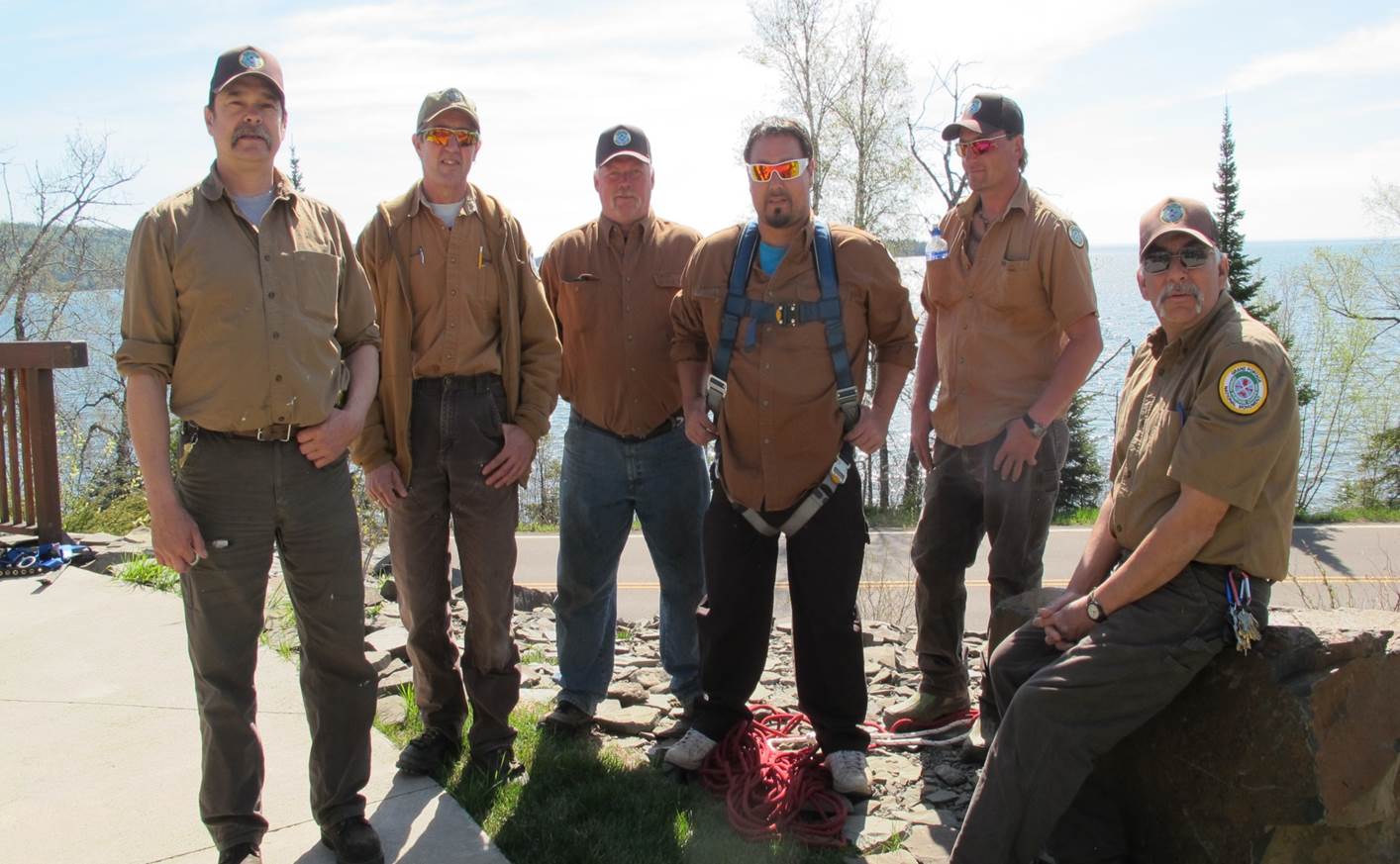
In 1998, the NPS and the Grand Portage Band entered into a co-management agreement, the first co-management agreement to involve primary operations at a national park. The Grand Portage Band was put in charge of all maintenance work at the monument. The Band's workers are allowed to dress in their Band uniform, as opposed to the NPS's green and grey uniforms. The co-management agreement has also led to the development of programming for teen Tribal members to learn how to build birch bark canoes, plant traditional gardens, and repair bridges. 

In 2021, Heather Boyd was appointed Superintendent of Grand Portage National Monument. She is  a member of the Red Cliff Band of Lake Superior Chippewa and the first Anishinaabe woman to manage the National Monument. Though Grand Portage is not her Tribe, moving there felt like a homecoming. Speaking to Minnesota NPR, Boyd said:

When I first started with the Park Service, I wasn’t promoting my heritage and my culture because it didn't feel right. Here, I feel like I’m empowered to do that. It feels awesome.

Saturday, April 1, 2023

Canadian report on 2020 mass shooting in Nova Scotia implicates rural-specific law enforcement failures

Ian Austen reports for the New York Times on a Canadian government report investigating law enforcement failures in a mass shooting in rural Nova Scotia in April, 2020.  Here's an excerpt from Austen's story focusing on why and how rurality mattered to law enforcement failures:  

Though the [Royal Canadian] mounted police [R.C.M.P.] is a federal force, it patrols rural Nova Scotia under a contract with the province. The commission found that staff shortages meant not only that the Mounties often failed to provide the number of officers called for under the contract, but also that the force paid little attention to rural policing and the needs of rural communities.

“The R.C.M.P.’s career model undervalues rural general duty policing,” the commission wrote. “The approach creates a disconnect between R.C.M.P. members and the communities they serve.”

Tuesday, March 1, 2022

On rural resentment and pain, and its link to the trucker strike

I am a huge fan of Thomas Edsall, who writes regularly for the New York Times, but I missed this column earlier this month until today.  The headline is provocative, "There's a Reason Trump Loves the Truckers."  As is typical of Edsall, he marshals recent academic research on a topic.  You have to get pretty deep into this column to get to the rural part of this one, which otherwise focuses on class and regional inequality, but I'm just going to highlight below those rural bits.  The rural bits, by the way, could also be framed as regional inequality.  
I asked Rodríguez-Pose whether the truck protests in Canada are a harbinger of future right-wing populist protests, and he pointed to developments in France in his emailed reply:
In France, the phenomenon of the “gilets jaunes” (or yellow vests) is clearly an example of the “revenge of the places that don’t matter.” This is a movement that emerged as a result of a severe hike in diesel taxes in order to pay for the green transition. But this was a decision that many people in small town and rural France felt imposed significant costs on them. These are people who had been encouraged just over a decade before to buy diesel cars and, in the meantime, had seen their public transport — mainly buses and rail lines — decline and/or disappear. Most of them felt this was a decision taken by what they consider an aloof Parisian elite that is, on average, far wealthier than they were and enjoys a world-class public transport system.
The pitting of a populist rural America against a cosmopolitan urban America has deep economic and cultural roots, and this divide has become a staple of contemporary polarization.

“Urban residents are much more likely to have progressive values. This result applies across three categories of values: family values, gender equality and immigration attitudes,” Davide Luca of Cambridge University; Javier Terrero-Davila and Neil Lee, both of the London School of Economics; and Jonas Stein of the Arctic University of Norway write in their January 2022 article “Progressive Cities: Urban-Rural Polarization of Social Values and Economic Development Around the World.”

* * * 
Luca and his colleagues emphasize the divisive role of what Ronald Inglehart, a political scientist at the University of Michigan who died last year, called the “silent revolution” and what Ron Lesthaeghe of the Free University of Brussels describes as the “second demographic transition.”

Citing Inglehart, Luca and his co-authors write:
when people are secure, they focus on postmaterialist goals such as “belonging, esteem and free choice.” The possibility of taking survival for granted “brings cultural changes that make individual autonomy, gender equality and democracy increasingly likely, giving rise to a new type of society that promotes human emancipation on many fronts.”
The urban-rural conflict between postmaterialistic values (shorthand for autonomy, environmental protection, sexual freedom, gender equality) and more traditional values (family obligation, sexual restraint, church, community) is most acute in “high income countries,” they write. This suggests, they continue, “that only more advanced economies can provide cities with the material comfort, and probably the right institutional environment, to make progressive values relevant.”

I'm thinking "postmaterialistic values" sound like what Rob Henderson calls "luxury beliefs"--those that folks with other pressing problems (think Maslow's hierarchy of needs) in their lives solved then have the time to worry and think about. 

In an email, Luca elaborated:
There is a strong correlation between my analyses (and similar lines of research) and trends highlighted in second demographic transition theories. Some of the factors driving the second demographic transition are definitely linked to the development of “self-expression” values, especially among women.
Cities, Luca argued, “are the catalysts for these changes to occur. In other words, cities are the loci where self-expression values can develop, in turn affecting reproductive behaviors and, hence, demographic patterns.”

Social capital is by no means the only glue that holds right-wing movements together.

The Rodríguez-Pose and Luca papers suggest that cultural conflict and regional economic discrepancies also generate powerful political momentum for those seeking to build a “coalition of resentment.” Since the 2016 election of Trump, the Republican Party has focused on that just that kind of Election Day alliance.

Shannon M. Monnat and David L. Brown, sociologists at Syracuse and Cornell, have analyzed the economic and demographic characteristics of counties that sharply increased their vote for Trump in 2016 compared with their support for Mitt Romney in 2012.

In their October 2017 paper “More Than a Rural Revolt: Landscapes of Despair and the 2016 Presidential Election,” Monnat and Brown found that “Trump performed better in counties with more economic distress, worse health, higher drug, alcohol and suicide mortality rates, lower educational attainment and higher marital separation/divorce rates.”

There's so much more to Edsall's column, which I'll try to get to in another post focusing more on class than geography.  

Meanwhile, here's another New York Times column on the Ottawa trucker's strike, this one by Ross Douthat and focused on class.   

Cross-posted to Working Class Whites and the Law.  

Wednesday, April 22, 2020

Canada's worst mass murder, this weekend in rural Nova Scotia

I've been pondering the relevance of rurality to this horrendous event since news of it broke on Sunday, and I've not yet reached any clear conclusions.  Prime Minister Justin Trudeau offered these thoughts on the impact on Nova Scotia, population 923,598 because of the high density of acquaintanceship there, as reported by the Associated Press:
Canadian Prime Minister Justin Trudeau noted how close-knit the small province of Nova Scotia is. 
“The vast majority of Nova Scotians will have a direct link with one or more of the victims. The entire province and country is grieving right now as we come to grips with something that is unimaginable,” Trudeau told a news conference.
Nova Scotia's population is small, but it is the second most densely province in Canada, which of course still doesn't make it very densely populated.

It seems the perpetrator first killed his former paramour and her new boyfriend, but that's not a particularly rural phenomenon.  The killing spree the murderer went on after that was arguably not mitigated, not stopped because of the relative lack of police presence.  I have written previously of the government/law/the state's struggle to adequately monitor large rural swaths, rendering them relatively lawless. Those are the sorts of swaths of territory that the killer covered as he murdered the next 20 people, apparently disguised as a member of the Royal Canadian Mounted Police, which is itself extraordinary.  The crimes took place in five different population clusters or villages, at 16 different locations.

Here's the New York Times report from today, and here is the NPR story. 

An excerpt from the NPR story follows:
During the attack, which lasted 12 hours, the suspect, identified as Gabriel Wortman, 51, wore an authentic RCMP uniform and one of the cars he used "was a very real look-alike" for a police vehicle, authorities said. 
* * * 
Since the attacks, questions have arisen over why the RCMP used Twitter to alert the public to the manhunt for the shooter, instead of activating the province-wide Alert Ready system. 
The warning system - which blares a siren by cellphone - was last used April 10 to warn people to stay home during the Easter weekend to prevent spread of the coronavirus, according to Canada's National Post newspaper. 
At a news conference on Monday, Chief Superintendent Leather said the force believed that Twitter was "a superior way to communicate" but will take a close look at that reasoning as part of its investigation.
The failure to use the warning system reminds me of recent reports of out New Zealand, where authorities chose to use the noisy and abrupt warning system to catch residents' attention re: the coronavirus shelter-in-place order.

The New York Times story provides profiles of many of those killed and focuses on the struggle to achieve socially-distanced funerals for the nearly two dozen who died this past weekend.

Tuesday, October 22, 2019

Rural-urban divide shows up in Canadian politics, too

Here's the Washington Post story following on the Canadian election this week.  Here's an excerpt from Henry Olsen's story: 
The urban-rural split, however, was the bigger reason for Trudeau’s reelection. The Liberals lost many seats to the Conservatives in rural areas and historically right-wing Alberta. But the Tories ran into a Liberal wall when they tried to win suburban ridings in Toronto, Winnipeg, Ottawa and Vancouver.
* * *

Conservatives won nearly all their top 24 targets in Alberta or rural regions. They picked up three seats in the rural province of Saskatchewan and gained rural-based seats elsewhere in Ontario, New Brunswick and Nova Scotia. But when it came to places near Canada’s major cities outside of Alberta, voters preferred Trudeau’s Liberals.

Friday, March 10, 2017

Crossing through rurality to get to Canada

During the 2016 presidential campaign and following the election results, I heard countless jokes about people wanting to move to Canada. On election night, the Canadian immigration website crashed. Most of the conversations I encountered were in jest, but now emigration from the US is becoming a reality, especially for those who feel targeted by Trump's anti-immigrant policies.

There has been so much hype and talk about the security of our southern border and keeping people out, but who is paying attention to the people fleeing at our northern border? Answer: the residents of Champlain, NY.

Champlain is a rural Upstate NY town on the border with Canada. Its population floats right around 5,700. Roxham Road, about four miles from the center of Champlain, leads almost all the way to the Canadian border. This little road in this little town has become the hot spot for Muslim immigrants looking to get out of the US and into Canada. One taxi driver told The New York Times that "in recent weeks, riders have been asking him — two, three, sometimes as many as seven times a day — to bring them to the end of Roxham Road."

Most of these migrants are originally from Muslim majority countries like Turkey and Yemen. Most of them are seeking asylum. The taxi driver who spoke to The Times heard stories from his passengers about being afraid to return home, being afraid to stay in the US, and being afraid of what would happen once they got to Canada.

This new traffic has not gone unnoticed. The residents of Champlain have been observing the families arriving by taxi. Taxis then drop off families where the road ends and the trek through the snow and across the border begins. An increase in taxi traffic along a rural road like this is obvious to the people who live there.

Many of the residents along Roxham Road report either not being engaged in politics or being too frustrated to have voted. The Champlain community seems to empathize with the migrants and to understand that these families are making the journey along Roxham Road and into Canada because of Trump's rhetoric and recent policies. There are some mixed feelings among those residents. One man said that "He understood the president’s motivation" but at the same time, seeing the migrants pass by his home "made him question the 'way he went about it.'" Another resident was less forgiving, but didn't place blame on the families coming through Champlain. Yet another sympathized because of the young children she saw tagging along with their parents as they headed for the border.

Another rural spot seeing an uptick in immigrants traveling through on their way to the Canadian border is Noyes, Minnesota. Emerson (population: 700), on the Canadian side, is familiar with people crossing the border without legal authorization. Just like in Champlain though, the increase in traffic since Trump was elected has been apparent. Emerson police and immigration officials, worried about the dangerously cold and snowy conditions, have had to plan for increases in arriving immigrants.

For their part, Canadian officials seem to be turning a blind eye in a way. The US and Canada have an agreement to not allow asylum seekers to cross between the two countries. However, if a person is able to make it onto Canadian soil before they are arrested, officials will allow them to begin the asylum process. Officers of the Royal Canadian Mounted Police (RCMP) wait on the opposing side of Roxham Road to help the people crossing get out of the water and snow they have to cross and set them off on the path to Montreal to initiate their asylum claims. Some immigrant and human rights advocates have called for the agreement to be suspended in light of Trump's new policies.

The trek through rurality during these winter months is not an easy one. Unfortunately, many refugees no longer feel that the United States is a refuge, and it's a journey they are willing to make.

Friday, December 16, 2016

On the rural crime of ... something related to fish bait

The headline out of the Grand Forks Herald yesterday was, "'It's a witch hunt': Federal agents raid Minn. bait shop, seize thousands of baitfish."  Having read the entire story, I'm not at all clear what the possible crime is, though it appears to be linked to the provenance of the bait.  Here's the lede:  
U.S. Fish and Wildlife Service agents raided the Great Outdoors Bait Shop in Ely on Dec. 1, seizing more than 6,000 ciscoes along with the shop's computer files, tax records and banking records, said Jim Maki, the shop's owner.

Ciscoes, a baitfish popular with winter anglers, are typically netted each fall near Prairie Portage on Basswood Lake, in the Boundary Waters Canoe Area Wilderness on the U.S.-Canadian border east of Ely. 
Maki said that eight to 10 special agents with the U.S. Fish and Wildlife Service entered his shop that day, asking him repeated questions about whether the ciscoes he sells came from the U.S. or Canadian side of the international border.
Maki, who has run the bait shop for 34 years, is quoted responsible for the "It's a witch hunt" quote.  He explained that the ciscoes are used to fish for northern pike and lake trout, and sell for $9/dozen.
That's the big-money thing for the winter.  I'm shot now for the winter if I don't get the ciscoes back.
That said, Maki explained that he might buy smelt if he can't get his ciscoes back.

Monday, May 9, 2016

Wildfire turns on "urban" Fort McMurray, in western Canada

The Canadian wildfire that began in the boreal forest, in the midst of the tar sands regions, has been raging for several days now, driving evacuation of all of Fort McMurray, population 80K.  One of the best stories I've read about the natural disaster was in the New York Times today, "Fort McMurray, a Canadian Oil Boom Town, Is Left in Ashes."   What I like about this story--as a ruralist--is that it puts the situation of Fort McMurray in economic context:
Fort McMurray, or Fort Make Money, as some Canadians nicknamed it during its recent boom years, was the kind of place where second chances and fat paychecks beckoned. 
Those who settled there were trained engineers, refugees from war-torn countries and strivers from across Canada and beyond, drawn to a dot on the map in northern Alberta, a city carved out of boreal forest in a region gushing with oil riches. 
Even after the price of crude began to collapse in late 2014, erasing thousands of jobs, many residents managed to hang on, tightening their belts while waiting for the good times to return. 
Reminds me of Williston, North Dakota, in terms of the energy boom and the demographic attracted.  read more here.

Read more about the fire here, here and here.

Saturday, November 7, 2015

Environmentalists' victory lap over Keystone XL Pipeline fails to acknowledge rural angle, protests

President Obama announced yesterday the rejection of the 1,179 mile Keystone XL pipeline, the wildly controversial "bit" of infrastructure that would would have snaked from the tar sands of Alberta, Canada to the U.S. Gulf coast, giving Canadian oil access to refineries there.  Read the NPR coverage here and the New York Times coverage here.  The NYT lede is here:
President Obamaannounced on Friday that he had rejected the request from a Canadian company to build the Keystone XL oil pipeline, ending a seven-year review that had become a symbol of the debate over his climate policies.
One of my favorite quotes from Obama's speech follows:
It has become a symbol too often used as a campaign cudgel by both parties rather than a serious policy matter,” he said. “And all of this obscured the fact that this pipeline would neither be a silver bullet for the economy, as was promised by some, nor the express lane to climate disaster proclaimed by others.
The NYT story quotes Bill McKibben, founder of 350.org, an environmental activist group which campaigned against the pipeline:
President Obama is the first world leader to reject a project because of its effect on the climate. That gives him new stature as an environmental leader, and it eloquently confirms the five years and millions of hours of work that people of every kind put into this fight.
What is striking to me is that neither of these stories makes any mention of the enormous grassroots effort against the pipeline, a grassroots effort by farmers and other landowners, primarily in Nebraska, where the pipeline would have threatened the Oglala Aquifer.  I have covered that activism extensively on Legal Ruralism, including here, here and here.  Further, the New York Times has covered that activism, including in a major story in the New York Times Magazine las year and also in the 2013 op-ed here.  

Thursday, June 11, 2015

Technology (time) won't (always) trump (rural) space

I argued that rural spatiality limits law and the state in my 2014 piece, The Rural Lawscape:  Space Tames Law Tames Space.  Now we have a great example of it in the news:  the escape from the high-security Clinton Correctional Facility in upstate New York, near the Canadian border.  Here's an excerpt from a piece on the manhunt, by North Country Public Radio:
Take a look at an incredibly detailed topographic map of Clinton and Essex counties, where the search is underway. It won't take long to realize just how difficult that search is. Incredibly remote communities scattered among mountain valleys, huge expanses of empty forest, old farm meadows and swampland. 
"We're covering a very large expansive area," says Capt. John Tibbets, one of the men leading the search near the town of Willsboro. "It's lot of low-lying brush. There's a lot of wooded areas. There's a lot of abandoned outbuildings." 
Along the dirt road, through the foothills of the Adirondack Mountains, men and women in body armor move almost shoulder to shoulder across a field. A helicopter prowls overhead.
* * * 
[F]ugitives could be hiding amid the brush just feet away without ever being seen. The foliage is that dense. The only solution, state police say, is to go over this terrain almost inch by inch.
Reporter Brian Mann closes with the cliche about looking for a needle in a haystack.  The helicopter (technology) may be helping, but the men are still missing seven days on… Like I said, "space tames law tames space."  Case closed.

A related New York Times story is here.  

Wednesday, December 17, 2014

The impact of rural lack of anonymity on environmental (in)justice controversies

That was one of my takeaways from this NPR story about the Keystone XL Pipeline controversy in Nebraska.  Melissa Block describes and quotes several residents of York County, Nebraska, population      13,883, some pro-pipeline, some against.
[A]s loud as the Keystone debate has been in Washington, D.C., and in the courts, Jenni Harrington says it's talked about in hushed tones in Nebraska's blustery York County, about an hour from the capital, Lincoln.
Harrington has deep roots in York County, where the Keystone KL pipeline would cross her family's land.  Harrington lives on the farm her great-great grandfather homesteaded in the 1860s.  Block quotes Harrington, who runs a nursery. 
When somebody wants to talk about it when they come into the nursery, they come behind the counter and kind of whisper in my ear and say, 'What's going on with the pipeline?' 
* * *  
We've been taught that it's our job to take care of the land. If we don't take care of our natural resources, life on this planet is gonna be a short time.
Harrington's family built a small barn, the so-called energy barn, which sits by the side of road.  It's made of native ponderosa pine and topped with solar panels, a windmill spinning out front.  The point is to draw attention to clean energy as an alternative to the Tar Sands and the Keystone XL that would transport the crude.

Block's story also features Chuck and Miriam Peterson, who support the pipeline.  The Petersons, too, are long connected to the land; Chuck's great-great grandparents also came here in the late 1800s.  The proposed pipeline would not cross the Petersons' land, but it would run just about a mile away.  Though the are strongly pro-pipeline, Miriam says they try not to talk too much about it:
A small community, often you're a little careful because you don't want to break any relationships either over that.  …  I'm appreciative of people wanting to conserve things and be careful with the resources we have.  But as often happens with any kind of a controversy, there's so much misinformation on both sides, and they don't listen to each other.
That's small-town lack of anonymity for you.  

The last quote that I find especially interesting in this story is from Bill Dunavan.  Along with his wife Susan, he feels he has been bullied by TransCanada into granting a lease for the pipeline across their 80 acres.  But the Dunavans are part of a small, well organized minority of land owners who are resisting.  Here's  Bill Dunavan's depressing quote:  
It would emphasize the fact that we're probably not only flyover country, but we're 'burrow-under country,' with no regard to the people that live here.
It reminds me of this blog post from a student writer a few years ago, and this one by me in 2011 about the pipeline's path being through "places of low consequence."  I'm afraid there is more than a smidgen of truth to it.

But back to the issue of how local pipeline politics have played out, Block writes:
As divisive as the fight over the pipeline has been, it has also built community. For years, the Dunavans thought they were the only ones against the project. Now, they've found allies among their neighbors.
Susan Dunavan makes the point thusly:  
We all believe that our land is sacred, our water is sacred.  We don't want a quick monetary, economic ... 'fix.' Let's look at the big picture. The big picture is like, forever. I want to pass this on to the next generations.
It's a laudable sentiment, and one I hope the federal government will respect.

Sunday, May 18, 2014

Newcomer (woman!) rallies Nebraskans to oppose Keystone XL

I've written quite a lot about the Keystone XL pipeline in the past few years, and this story in today's New York Times Magazine invites me to write about it again. This story is "Jane Kleeb v. the Keystone Pipeline," and in it Saul Elbein reports on the efforts of Ms. Kleeb to rally fellow Nebraskans to prevent the now infamous pipeline from snaking through Nebraska, across 275 miles and through (well, below) 515 private properties.  Elbein gives Kleeb plenty of credit for stopping the pipeline--or at least getting its route changed--starting with her attendance at a U.S. State Department Hearing on the Keystone XL.  That was in 2010 in York, Nebraska.  Elbein summarizes:
But what has kept the pipeline out of the ground so far, more than anything, has been Kleeb’s ability to convince mostly­ conservative farmers and ranchers that they are the ones being asked to bear all the risk of Canada’s energy expansion. If something goes wrong, she says, they’re the ones who are going to suffer. Kleeb didn’t need to persuade all of the people in the room to be angry — many of the state’s landowners are plenty wary of what they see as the pipeline’s risks — but she has organized them to take on Trans­Canada and more or less their state’s entire political power structure. 
Kleeb describes her résponse to what she heard from farmers and ranchers at the York meeting (several of whom are quoted in Elbein's story):
All I could think about in that room was how they reminded me of [her husband] Scott’s family, the folks I fell in love with. Farmers and ranchers don’t think politically. I felt like I had to help. 
Earlier in his profile of Kleeb, Elbein had described how the Nebraska transplant, raised by Catholic, Republican parents in "exurban South Florida," had taken to life in rural Nebraska after marrying Scott Kleeb, a Democrat who has run unsuccessfully for both the U.S. Congress and Senate from the state.  Basically, she was taken by Nebraskans' "homesteader-like sense of collective responsibility."

Elbein quotes Kleeb:
It didn’t matter if it was 2 a.m. and driving snow.  If your neighbor called to say they had a cow out or a fence down, you went to help.
And so Kleeb came to the realization that the way to "sell" opposition to the pipeline was not with an environmental message, e.g., "Save the Sandhill Cranes."  Rather, the message should be "Save the Neighbors."  So far, it's working.

A prior post about Nebraskans protesting the Keystone XL pipeline is here.  It talks about a particular down-home way Nebraskans have of doing things, of influencing people, politely.  There's some of that in this story focused on Jane Kleeb, too, as where she talks about jack-o-lantern carving outside the Governor's Mansion and a barn raising, both by anti-pipeline activists.  She explains, though, that what is significant is less the specific activity than the collective effort:
You’re asking people to be involved. They love that — it’s part of our human nature. People want to be asked to do something bigger than themselves.
Meanwhile, Elbein explains the relevance of state law (as opposed to federal, U.S. Dept. of State approval) to the pipeline:
Pipelines carrying oil, unlike those for natural gas, are mostly regulated by the states. In all but Colorado, pipelines generally get the right of eminent domain — but most states can restrict that right, determining whether pipelines are in the public interest and what routes they can take. In 13 states, including Texas, Louisiana and Oklahoma (and, until recently, Nebraska), there is no such approval process. If a company wants the land but the owner doesn’t want to make a deal, it can deposit its estimated fair value with a court and start building. If a landowner wants to challenge the company, he has to square off in court against a multibillion-dollar corporation.
One of Kleeb's disciples, if you will, is rancher Randy Thompson, of Merrick County, who had these comments about eminent domain and state law.  Referring to TransCanada's agents, Thompson said:
They came out here with this great sense of entitlement, and we were just supposed to get out of the road. They said all the neighbors had signed, and if we were smart, we’d sign now — or we’d get a lot less money. These guys just treat you like bugs they can squash.
Thompson wrote to the state's governor, Dave Heineman (Rep.), and in response he got back a pamphlet about the pipeline.  Thompson was advised by his lawyer that he had few options.  Thompson comments:  
I wasn’t going to let them roll over my parents like that.  
When Thompson heard about the meetings Kleeb was organizing, he attended one.  

So what is Kleeb's secret--other than engaging people in collective action like barn raising?  Kleeb explains that she doesn't talk about the environment or climate change, instead talking "about the land." Of big donors, like Tom Steyer of California, she says they 
crave a more authentic voice. … We have a connection to rural communities that many other progressive groups just don't have.
To this, I can only say, "duh."  But how do I feel about wealthy urbanites (even progressive ones) trading on rural livelihoods?  I'm not sure.  I'd feel better knowing that the Randy Thompsons of the world were going to be able to keep ranching in Nebraska.  And I'd feel better about the Randy Thompsons of the world keeping their ranches if I knew they treated their laborers fairly and supported their local communities.  

Sunday, February 2, 2014

Rural insularity in Canada

Ian Austen reports today from L'Isle Verte, Quebec, where 32 elderly residents died in a retirement home fire a few weeks ago.  He focuses on the community's response to the disaster, as reflected in the headline, "Stunned by a Tragedy, a Village in Rural Quebec Turns Inward." Austen writes:
Nearly everyone in this town of 1,425 people has been affected in some way: the families of those who died; the police officers who arrived in the early morning hours and crawled down hallways to avoid smoke, dragging elderly residents out on their backs; the firefighters who doused the blaze with water, the spray instantly freezing in the minus-8-degree cold, entombing the bodies in more than two feet of ice. 
For the province of Quebec, the tragedy evoked a particularly horrible sense of déjà vu. It came nearly seven months after a runaway oil train exploded into a fireball in Lac-Mégantic, Quebec, killing 47 people in a town of 6,000 some 245 miles away. 
Indeed, Austen considers briefly the similarities and differences between the L'Isle Verte and Lac-Megantic disasters.  Among the differences, Austen notes:
The stunned reticence [in L'Isle Verte] contrasted sharply with angry volubility in Lac-Mégantic. There the cause was clear: a speeding train on a rundown railway, whose unrepentant owner provided a target for blame that residents were eager to share with the world.
Austen explains that the cause of the L'Isle Verte fire is still unknown, and residents of the town, "richer in history and natural beauty than economic opportunity," are shunning the media intrusion.
At a news conference for local reporters in the back of a motel banquet room on Monday, Mayor Ursule Thériault was blunt. “L’Isle-Verte would be better without journalists,” she said. Another municipal official urged residents not to answer their doors for journalists or, better still, to leave town until the last of the television network satellite trucks have driven away.
Austen quotes police Lieutenant Michel Brunet who was stationed in Bas St. Laurent, the region that includes L'Isle Verte, early in his career as saying "the locals had always kept to themselves, reluctant even to speak with police officers looking into crimes where they were victims.  The villagers’ recovery from this disaster, he said, will come from within themselves."
They’re very close to each other.  They have real solidarity.

Wednesday, December 18, 2013

Urban-rural partnerships help make Shanghai schools some of the best in the world

This editorial in today's New York Times highlights U.S. educational failures and then holds up three models from which the U.S. might learn:  Finland, Canada, and the Shanghai area of China.  The headlines for each country/region indicate what the NYTimes finds so laudable and key to the place's educational success:
  • Finland:  Teacher Training
  • Canada:  School Funding
  • Shanghai:  Fighting Elitism 
I am going to focus here on China because the specific mention of rural-urban difference there (although when it comes to improving rural education, we could certainly learn a lot from the Canadian model of more centralized, less localized funding.)  Here is how the editorial board summed up what Shanghai is doing so well.  Note the references not only to rural schools (and I'm not sure how Shanghai, as a city, has authority over "rural" schools), but also to the issue of rural-to-urban migration in China.
One of its strengths is that the city has mainly moved away from an elitist system in which greater resources and elite instructors were given to favored schools, and toward a more egalitarian, neighborhood attendance system in which students of diverse backgrounds and abilities are educated under the same roof. The city has focused on bringing the once-shunned children of migrant workers into the school system. In the words of the O.E.C.D, Shanghai has embraced the notion that migrant children are also “our children” — meaning that city’s future depends in part on them and that they, too, should be included in the educational process. Shanghai has taken several approaches to repairing the disparity between strong schools and weak ones, as measured by infrastructure and educational quality. Some poor schools were closed, reorganized, or merged with higher-level schools. Money was transferred to poor, rural schools to construct new buildings or update old ones. Teachers were transferred from cities to rural areas and vice versa. Stronger urban schools were paired with rural schools with the aim of improving teaching methods. 
The Times description goes on to note that strong Shanghai schools have been given administrative responsibility for weak schools.  In short, Shanghai educational officials are expecting that the "ethos, management style and teaching" of the strong schools can be transferred to the weak ones--and it sounds like a lot of that transfer from strong to weak is across the urban-rural divide.  

I am sure the reforms are all more complicated than depicted in this brief description, but the results speak volumes:  Shanghai's students were first in the world in math, science, and literacy in last year's  international exams.

N.B.  This was the most-emailed story in the New York Times for much of today.

Friday, December 13, 2013

Canada to curtail urban postal delivery, leaving rural services (apparently) in tact

Ian Austen reported on Wednesday for the NYT:  
Though Canada would become the first Group of 7 country to end all residential mail delivery in cities and older suburbs, Canada Post shares many problems with postal services in the United States and elsewhere, including rapidly declining mail volumes and high wage and pension costs. Along with the service cuts, the government-owned service said it would eliminate 8,000 jobs, mostly through attrition.
What is interesting from a ruralist perspective is what Canada plans to do about its postal service budgetary crisis:  curtail metropolitan delivery, NOT close rural post offices.  The latter, of course, is what the U.S. has periodically proposed in recent years. Read more here, here, here, and here, for example.  What's odd about this news report--especially in light of the relatively recent controversy over rural post office closures in the United States--is that Austen's report never mentions the rural at all.  The implication, I guess, is that rural service will not be affected.  Or maybe it is just so unimportant as not to be worthy of mention. Hmmm.

Rather Austen quotes Professor Dwayne Winseck, who teaches communications at Carleton University in Ottawa, for a more general proposition--that the decision to end postal delivery is a "pivotal moment" in Canadian history:  
The whole notion of a universal correspondence service is a pretty important one. It’s quite a comedown for a national postal system.

Friday, October 11, 2013

Literary Ruralism (Part VI): Alice Munro wins Nobel Prize in Literature

Here's the lede from yesterday's New York Times story announcing her prize:
Alice Munro, the renowned Canadian short-story writer whose visceral work explores the tangled relationships between men and women, small-town existence and the fallibility of memory, won the 2013 Nobel Prize in Literature on Thursday.
Like most everything I have read or heard about Munro's work since the prize was announced, this piece notes that she frequently set her work in small towns.  For example, a fuller feature on Munro in today's New York Times includes this description:
Set largely in small-town and rural Canada and often focused on the lives of girls and women, her tales have the swoop and density of big, intimate novels, mapping the crevices of characters’ hearts with cleareyed Chekhovian empathy and wisdom.
Great to see a source like the New York Times recognizing that you can have swoop and density in small-town and rural places.  The media--and popular culture--so often present these places and their denizens as simple, cardboard cut-outs.

Munro lives in Clinton, Ontario, population 3,082.  She had earlier this year announced her retirement.

Saturday, September 28, 2013

Federal judge in Idaho sides with Nez Perce to stop transport of tar sands equipment

The New York Times reported yesterday on the decision by federal district judge B. Lynn Winmill to prohibit the transport of "megaloads" of extraction industry equipment through the tribal lands of the Nez Perce Indians in north central Idaho.  The equipment would pass through the area en route to tar sands extraction and processing sites in Canada.  The tribe's argument, with support from Idaho Rivers United, is that the Clearwater River there is protected by federal law and by old, essentially untested treaty rights of the Nez Perce, even though much of the river corridor is outside the reservation.  Judge Winmill's ruling "halted further transports until the tribe, working in consultation with the United States Forest Service, could study their potential effect on the environment and the tribe’s culture."

Kirk Johnson's report on these events for the NYT appeared under the headline, "Fight Over Energy Finds a New Front in a Corner of Idaho."  The dateline is Lapwai, Idaho, population 1,137, and the seat of Nez Perce governance.  Here's an excerpt:
The Nez Perce Indians, who have called these empty spaces and rushing rivers home for thousands of years, were drawn into the national brawl over the future of energy last month when they tried to stop a giant load of oil-processing equipment from coming through their lands.  
* * * 
When the hauler’s giant load arrived one night in early August, more than 200 feet long and escorted by the police under glaring lights, the tribe tried to halt the vehicle, with leaders and tribe members barricading the road, willingly facing arrest. 
In fact, 28 members of the tribe were arrested.  In defending their actions, the chairman of the tribal executive committee, Silas Whitman, explained:
The development of American corporate society has always been — and it’s true throughout the world — on the backs of those who are oppressed, repressed or depressed.  We couldn’t turn the cheek anymore.  
Meanwhile, Johnson reports, the tribe is galvanized by their solidarity, even as they have taken some legal risks. 
Staking a legal case on treaty rights, though victorious so far in Judge Winmill’s court, means taking the chance, tribal leaders said, that a higher court, perhaps in appeal of the judge’s decision, will find those rights even more limited than before.
Johnson's story makes the point that the impacts of extractive industries are no longer seen as purely local.  It is no longer the case, he writes, that "what happens in oil country, stays in oil country."  

Don't miss the very striking photos/slide show accompanying this story. Here's a Sept. 13 story about the judge's ruling.  

Thursday, August 29, 2013

White supremacist puts down roots in North Dakota

John Eligon reports in today's New York Times form Leith, North Dakota, population 16 (or 24, depending on your source), where white supremacist Craig Cobb has been buying up parcels of land since last year.  Eligon reports that Cobb plans to turn the place into a white nationalist center, and that he has transferred some of the lots he has purchased to fellow white nationalists. Eligon writes:
In the past two years, Mr. Cobb, a longtime proselytizer for white supremacy who is wanted in Canada on charges of promoting hatred, has bought a dozen plots of land in Leith (pronounced Leeth) and has sold or transferred ownership of some of them to a couple of like-minded white nationalists. 
He is using Craigslist and white power message boards to entice others in the movement to take refuge in Leith, about two hours southwest of Bismarck. On one board, he detailed his vision for the community — an enclave where residents fly “racialist” banners, where they are able to import enough “responsible hard core” white nationalists to take control of the town government, where “leftist journalists or antis” who “come and try to make trouble” will face arrest. 
* * * 
It is all people are talking about, in bars and in their homes, at funerals and at church. They are poking around on the Web to read Mr. Cobb’s positions for themselves. A stream of cars creep through the streets where horses occasionally trot, their passengers hoping to catch a glimpse of some action or take a peek at Mr. Cobb’s peeling, two-story clapboard home. Sheriff’s cars, too, are making more rounds.
Cobb said he was working in the state's booming oil fields until last week, when he lost his job after the story broke regarding his plans for Leith.  

Amazingly, Leith is large and organized enough to have a mayor, Ryan Shock, who says he and the city council have put in place a "suicide pact."  Well, Eligon calls it a "doomsday plan":  
If enough of Mr. Cobb’s friends move in to gain a majority that could vote out the current government, the Council would immediately dissolve the town.
Leith is in nonmetropolitan Grant County, population 2,394, in southwest North Dakota.  The population is 97.3% white, and the poverty rate is a shockingly low 12.4%.  One of very few African Americans in the county lives in Leith, and he features in Eligon's story, as do religion and community.  It's worth a read in its entirety.