Showing posts with label religion. Show all posts

Friday, March 20, 2026

Rastafari roots of plant-based eating

An Ital meal of rice, ackee, callaloo, and veggie chunks.
In considering a vegan diet, I imagine a young, progressive urban consumer motivated by environmental or animal welfare concerns. In other words, someone who likely shops at a Whole Foods. In the West, veganism is packaged as something performed through individual consumer choices. That framing obscures the structural conditions shaping diets, and reinforces the mistaken belief that veganism is a modern invention. The “Ital” tradition complicates the popular narrative of modern veganism. Long before plant-based eating carried a price premium in Los Angeles, it was ordinary in the hills of rural Jamaica. 

The Rastafari movement began in the 1930s in Jamaica among the working poor who had been devastated by the global financial crash of 1929 and prolonged colonial mismanagement. These forces created mass unemployment and rural-to-urban migration into the slums of west Kingston. Rastas fled to the rural mountains where they could access land and practice self-governance without persecution.  

Leonard P. Howell, an early Rastafari leader, drew on the practices of Hindu indentured laborers in Jamaica to promote what became known as Ital living. The word “Ital” comes from “vital,” dropping the first letter to emphasize the pronoun “I”. This linguistic practice signals unity with the speaker, the listener, and Jah (God). Ital eating is an expression of “livity,” a Rastafari concept that the individual can embody and express spirituality through the practices of daily life.  For Rastafarians, Jah exists in all of creation, including plants, animals, and people. As such there is a divine force or energy in everything. 

What one puts in one’s body either enhances or degrades this life force. Food that has been processed or chemically altered is considered corrupted and further from Jah’s creation. Life force does not begin at the moment of consumption. Powell’s research participants described farming, cultivation, and conservation as the literal pouring of one’s energy and emotion into the earth. The sincerity of this effort determines how the earth responds and reciprocates that energy. 

Rural Rastafari food is shaped by what the land yields. Coconuts are naturally abundant across Jamaica. They are cracked, drained, grated, and squeezed into milk that forms the base of most dishes. Vegetables and aromatics are sautéed in coconut oil. The food typically contains beans, spices, chili peppers, and the coconut milk, stewed for hours over low heat and eaten communally. A strict Ital diet rejects salt as “a needless adulteration” of what Jah placed on the earth, so herbs and dry seasonings are key. Scotch bonnet peppers, thyme, lemongrass, allspice, and nutmeg build complex flavor without salt

The one-pot stew is a practical response to the rural conditions of Rastafari life. Land access is limited, so the range of available produce is narrow. A single pot stretches what is on hand to feed the community. Cooking takes place outside in clay pots often balanced over a wood fire by three stones. Metal cookware is avoided on the belief that it harms the body. 

In Saint Lucia, a young Rasta farmer described conversing with plants throughout their life cycle to transfer positive energy to them. He explained that during planting one must ensure a positive heart is present because this very energy will be transmitted to the earth. The same is true of cooking. Ital food involves preparing food with a clean heart to transfer life force into the food. Food must be cooked slowly, with intention and gratitude. This preserves and transmits the life energy that began in the soil. Food is not just physically nourishing; it is also spiritually nourishing.

Food that is rushed or processed severs the energy force and transmits a lower form. It follows too that food grown under corporate conditions is spiritually degraded. Jahson Peat, who runs a vegan restaurant in London called Zionly Manna, presents Ital as a process of relearning that strips away the method of eating brought about by colonialism. This is inseparable from a rejection of capitalism itself. Commitment to Ital eating is tightly linked to a broader turn away from the imported industrial and materialist ways of life, which are all combined under the Rastafari concept of “Babylon.” 

By contrast, mainstream veganism operates according to market logic. It converts diet choices into an ethical identity. For some, it is an exercise in personal branding, where what you eat signals who you are. This channels genuine ethical concerns for animals and the environment into demand for plant-based products. In this sense, the market-based vegan movement can be seen not as a challenge to the current food system, but a force that risks expanding it further, as seen through the IPO of Beyond Meat. The growth of this plant-based segment does not depend on replacing meat consumption, only on expanding overall consumer demand. The Ital diet is not a consumer identity. It seeks to reject the economic system and the very notion of consumerism upon which it relies. 

However, Ital does not operate entirely independent of market forces. Jaffe’s concept of “Ital chic” describes the convergence of middle-class consumerism and the Ital diet. In Kingston, Rasta symbols have been used to market artisanal soap lines and premium vegetable products. When a brand sells coconut-milk products with Rasta packaging, it co-opts a tradition built on self-sufficiency and places it inside the very market that tradition was designed to reject. This dynamic is similar to that explored in a blog post from this semester about rural tourism. It noted that rural culture is often packaged to meet consumer expectations, with authenticity operating as a selling point. 

Plant-based eating did not begin with a farmer’s market or with a marketing campaign. It owes some of its roots to rural Jamaica, where people grew what the earth offered based on a theological conviction. That story deserves to be remembered before it is repackaged.

Friday, July 11, 2025

Small-town government run amok (Part XIII): Is Kerr County partly to blame for the high death toll at Camp Mystic?

I've already written this week about the catastrophic flooding in Kerr County, Texas.  What I am going to highlight in this post is recent reporting from the New York Times on the 2019 decision by Kerr County to let Camp Mystic build additional structures--including cabins for campers--in places that were at risk of  flooding.  (This is on top of the county's decision not to invest in a warning system, which is discussed in my prior post).

Why would the county do that when, as one expert suggested, the proposal to construct more buildings was a good time to re-evaluate the risk level associated with the existing structures?  Perhaps what the journalists are suggesting here is Kerr County officials simply trusted the camp as a long-time landowner and patron of the county.  Perhaps what is being suggested is the turning of a blind eye.  I wonder what sort of property taxes and other types of revenues Mystic and the otter camps provided to the county? 

Here's an excerpt from the NYT story: 

In 2019, Camp Mystic...underwent a substantial expansion. Camp owners received approval from local authorities to build a new group of cabins over the hillside to the south, in an area known as Cypress Lake. But even there, flood maps show, some of the new cabins were in areas at risk of flooding.

* * *  

At the same time, Kerr County officials were considering how to manage floodway areas, including those at Camp Mystic.


The county said that floodways were to be considered “an extremely hazardous area due to the velocity of floodwaters which carry debris, potential projectiles and erosion potential.” It adopted rules in 2020 to limit new construction or substantial alterations in floodways to ensure that structures could better survive flood events, and that these buildings would not result in raising floodwater levels in other parts of the river.

This NYTimes piece gives a sense of the local lore around the Eastlands, who owned and ran Camp Mystic.  This New York Times podcast, The Daily, also gives a sense of the beloved status of the camp and its long-time owners; the title says it all, "A Love Letter to Camp Mystic."   

Postscript:  Here is a July 12, 2025 NYT story that suggests FEMA over-rode Kerr County on the designation of parts of Camp Mystic as a flood zone.  An excerpt from Mike Baker's reporting follows: 

In the years before floodwaters killed more than two dozen people at Camp Mystic in Texas, regulators approved a series of appeals that removed many of the camp’s buildings from official federal flood zones, records show.

Flood maps developed by the Federal Emergency Management Agency in 2011 had placed much of the camp within a 100-year flood zone, an area considered to be at high risk of flooding. Camp Mystic successfully challenged those designations, which would limit renovation projects and require flood insurance, citing elevation calculations of a series of buildings that allowed them to be exempted from the federal restrictions.

Sarah Pralle, an associate professor at Syracuse University who has researched federal flood mapping, said she found the exemptions granted to Camp Mystic, a girls’ camp on the Guadalupe River near Hunt, to be “perplexing.” Some of the buildings were still very close to expected flood elevations, she said.

“I think it’s extremely troubling that it’s a camp for children,” Ms. Pralle said. “You’d think you want to be extra cautious — that you’d go beyond the minimum of what’s required for flood protection.”

Here is the Washington Post reporting similar conclusions on the role of FEMA.  

Here is the WSJ reporting on what happened at Camp Mystic, cabin by cabin.   You'll see here featured some aspects of the impulse to secrecy regarding arguable failures of a revered Texas institution.  

This excellent episode of New York Times "The Daily" on July 15, 2025, asks if the floods had to be as deadly as they were.  It includes some attention to the rural context. 

Tuesday, April 1, 2025

God, family, and Baylor Law School

One of the most exhilarating (and sometimes disheartening) experiences in an attorney's life is the period between submitting their law school applications and committing to attend a particular school. That time spanned from the Fall of 2021 to April 2022 for me. I fondly remember my first acceptance. I received an email just one week after submitting my application to Baylor Law School informing me that I would shortly receive my decision via mail. Days later, a package was placed on my front porch. Inside, I found my acceptance letter and an invitation to attend a fully expenses-paid trip to the school to tour and visit some classes. I was elated but also apprehensive.

Located in Waco, Texas, Baylor University is affiliated with the Baptist denomination. Although I was hesitant to attend a religiously affiliated school, having just left a religion that had dominated all aspects of my life up until that point, my interactions with the Baylor admissions team mostly alleviated those concerns. Several people told me that Baylor, while religiously affiliated, was welcoming to all people and beliefs. I was also concerned about the political environment. I thought that if the school was located in Texas, I would probably be an outsider with my newfound leftist beliefs. 

In an attempt to alleviate my concerns, an admissions dean from the school stopped by my city for dinner. I mentioned that while Baylor seemed like an excellent fit, and although the scholarship package was extremely generous,  I felt unsure about the religious and political components because I considered myself a left-leaning atheist. Regarding my concerns about religion, I was assured several times that, although Baylor had religious aspects, they primarily affected undergraduate students. Thus, they said, I likely would not even notice any religious influences. As for my political concerns, I was informed that political beliefs at Baylor were evenly divided, with all views being respected and treated with equal consideration. 

I made my visit one month later. The first red flag (or rather, a red flag with a blue starred X) that I had been honeypotted was the massive Confederate flag greeting me at the city limit sign. Compounding this, I was even more surprised when, upon meeting the Law School's Dean, he shook my hand, looked me in the eye, and said, "The three most important things in my life are God, family, and Baylor Law School. If you come here, know that one of my main priorities will be you." Later, when the Dean asked what other schools I was considering, and I mentioned Davis, the Dean scoffed, asking why I would want to attend a school full of "liberals." 

To describe my reaction as surprised would be an understatement.

 As the remainder of my visit progressed, going from breakfast, where a prayer was said over the donuts to "bless them for our body's nourishment" and "to protect our dear President Trump," to tour guides showing their plethora of religiously symbolic tattoos, my association of southern/rural people, religion, and political affiliation strengthened. In my mind, the South was synonymous with rural areas; rural people were often religious, and religious people were generally politically conservative. 

My association is likely incorrect. While 87% of Republicans are religiously affiliated, 77% of Democrats are also religiously affiliated, a not-too-stark difference between the parties. Additionally, only 60% of rural voters identify as Republican. To say that religion influences one's political party seems incongruent with the data. 

However, perhaps more research should be devoted to the connection between rurality and republican beliefs. Notably, from 1996 to 2010, rural people were primarily divided along partisan lines. However, since 2012, support for the Republican Party has steadily risen among rural people. While party support has remained unchanged in urban and suburban counties, the primary explanation for Donald Trump's recent rise to power is primarily attributed to rural residents. 

I am forever grateful that I attended Baylor before making my decision about which school I would attend. Moreover, although my visit did leave me with several stereotypes that I am now discovering are likely unfounded, I view it as an opportunity — an opportunity for growth to challenge and update my preconceptions. We are all on a journey through life, shaped by our experiences. As I soon move on from this current pit stop, which is law school, I am pleased by how these experiences have and will continue to shape my journey going forward.

Wednesday, August 14, 2024

Literary Rualism (Part XLVIII): Barbara Kingsolver's introduction to Aldo Leopold's A Sand County Almanac

Aldo Leopold Shack, near Baraboo, Sauk County, WI
(c) Lisa R. Pruitt 2024

A few weeks ago, on a field trip from the Rural Sociological Society's Annual Meeting in Madison, Wisconsin, I visited Aldo Leopold's shack in Sauk County, Wisconsin.  This is where Leopold's book, A Sand County Almanac, is set. Leopold wanted land in one of the sand counties, so designated, because the soil had become so degraded by how it had been farmed.   What I want to do here is highlight some bits from the new introduction by Barbara Kingsolver:  

After a reverent passage on wild places, [Leopold] concludes: “It is here that we seek—and still find—our meat from God.” The use of “meat” and “God” in a metaphor for deep satisfaction might irk some modern environmentalists, but the words will find purchase in the hearts of rural readers who are weary of being maligned for their loyalties to meat and God. Weary, also, of urban land-saviors who look to nature for spiritual balm or recreation, and presume a moral high ground over the folks who literally owe their survival to the land. People who hunt and fish to help stock their freezers are astute naturalists, of necessity, and most farmers are well aware that the fields and forests they steward are home not just to crops but to bluebirds and foxes, spring wildflowers and winter wrens. It’s hard to endure ham-fisted judgments against livestock slaughter and crop-spraying from people who have no fields to shepherd or weeds to fight. 

We listen and take our truths—all of us—from people we trust, who know us and have our interests at heart. This is a built-in bias of the human psyche, and the crux of the fix we’re in as we stand in nations divided against themselves. As long as we live in entirely separate worlds, without comprehension of the others’ language or daily grinds, the door between us is sealed. Not a word will pass from one side to the other. 

I’m unusually preoccupied with this deadlock, as an environmentalist who is also a country girl, raised in rural Kentucky, living now on a farm in the Appalachian Mountains. I love this landscape and my neighbors, but I can tell you that it has never been harder to be a rural person in America. Employment is scarce, schools are under-resourced, doctors and other crucial services are overstretched or nonexistent. The main streets of our little towns are rows of shuttered local businesses, all bankrupted by internet sales and box stores. Farm incomes have bottomed out, and just about every economic mover, from industrial employers to airline hubs to professional baseball leagues, have pulled out of the nation’s less-populous regions to concentrate their benefits in cities. Out here in the heartlands we’re still raising kids and crops to feed a nation’s appetites for food and labor, but we’re feeling pretty lonely about it. And invisible. Some 40 percent of Americans live in places that aren’t cities, but we show up virtually nowhere in American TV shows, movies, or major journalism. These are made in cities, by city people. If rural folk appear in mainstream culture, it’s generally in a voyeuristic hit-and-run piece on addiction and poverty, or a degrading caricature intended as entertainment. 

Imagine, then, the novelty of reading A Sand County Almanac, a rural man’s earnest, exultant accounting of his life in the country. He’s not singing his praises to some untouched parcel of pricey wilderness real estate; it’s just a worn-out little farm. Most of its native glory was driven out by previous owners who overcropped its topsoil down to naked sand, then abandoned it with debts to the bank. (xv-xvii)

And I love this next excerpt for its explicit reference to socioeconomic class: 

A written voice is an artifice, of course, even in nonfiction. It occurred to me to wonder whether this book’s class-crossing accessibility was a conscious, crafted choice. A look into his archives reveals a more complicated Aldo Leopold than the cheerful fellow who greets us from his “sand farm.” As an outdoorsy Iowa boy, he shipped off to the newly created forestry school at Yale, then wrote wistful letters home describing the nearby woods where he sought refuge from the classroom. And as early as that, he sounded less like a duck hunter than a sophisticated naturalist. From there, a forestry career took him to a wild and woolly West (in 1909, Arizona was not yet a state) where he climbed mountains on foot and horseback, carrying a sidearm as protection against bears and wolves. He assessed oaks and pines for the board-feet of lumber they contained, and he gradually came to see the forest behind the trees, with unprecedented clarity. Rising through the ranks of the U.S. Forest Service, he developed a comprehensive land-management program for the Grand Canyon and other important wilderness areas, and he applied his remarkable insights on predator-prey interactions to new theories of game and fish management. Eventually he joined the faculty of the University of Wisconsin as its first professor of wildlife management, to spend the rest of his life as a conservationist, educator, and founding father of modern environmental ethics and the science of ecology. It is remarkably to his credit that Leopold compressed this master class for all time into readable prose that glows with ease and optimism. He knew that compromises between humans and our habitat would never be simple. (pp. xviii-xix). 
The outhouse, so well designed that Leopold 
called it the Parthenon.

Then there's this about the character of rural folks and their relationship to urban folks: 

His gift was to wear his rural roots and humility on his sleeve, and respect the full range of his audience, wherever they lived—a knack that we modern environmentalists have largely lost. He knew how to talk to the good ol’ boys. 

In the heat of modern culture wars, a voice like this could risk getting canceled. Readers quick to judge might just see guns and camo. Some of his language might mark him as old-school, a product of the same era as the cabal of elderly men who now impose mine-and-drill politics on many nations—that is, the time when the earth’s resources seemed in endless supply. Like those men, Leopold was well-churched in the notion of earth-as-property. But unlike them, he found his way to a nuanced idea of the planet as an autonomous collection of lives. He managed to be more inclusive than the best of us.  (p. xix).  

 * * * 

For the urban reader, I hope you will let down your guard with this man as he sits on his rock in the stream, waiting for his trout to rise. If you take him for a redneck, listen anyway, because he’s wiser than most any two of us put together. He may help you see past the frustrating divides that plague the awfullest failure of our day, as we try to reconcile human subsistence with the needs of our damaged biological home. If you’ve lost all hope of finding a common language for that conversation, you might well find it here. (p xx) 

It's a fitting introduction for a classic and a staple of the conservation movement.  The book was first published in 1949, a year after Leopold died helping fight a wildfire near his shack--a shack which, by the way, had been the chicken coop for he farm's prior owner.  That owner had gotten so frustrated with trying to cultivate the land, that he burned his house down before selling the property. 

Tuesday, June 11, 2024

On seeing rural difference--and rural need--in relation to higher education

The Chronicle of Higher Education has recently been turning out quite a bit of content about rural institutions and rural students.  In short, it's been paying attention to rural difference in relation to a range of issues related to higher education.  

First, here's a feature on Building the Rural Workforce.  An excerpt follows: 

Rural workforces are typically specialized, focusing on engineering, manufacturing, or healthcare, to name a few. This makes education all the more important.

In this Multimedia Case Study, learn how colleges, like Zane State College in rural Ohio, are working to prepare rural work forces for success. Explore the virtual forum, audio takeaways, and written case study to gain insight into building programs that support rural work forces.

* * * 

How rural colleges meet the needs of nontraditional students

At Zane State College, a rural school in Ohio, 67 percent of students work while enrolled in classes.

At Patrick & Henry Community College in Virginia, students seek strategies to build and sustain their own businesses.

From workforce development initiatives to entrepreneurship boot camps, these two institutions have found creative ways to support their students and benefit the local economy.
Here's another bit of coverage featuring a video titled, "What counts as a rural college?" An excerpt from the description follows:

Weak educational achievement runs like a fault line through rural American economies. Eighty-five percent of American counties with low educational attainment are rural, and far fewer young adults in rural areas are enrolled in higher education than those in urban or suburban areas.

This educational disparity has far-reaching consequences, as the rural counties with the lowest levels of educational achievement have the highest levels of poverty, unemployment, and population loss.


Clearly, rural colleges — which include community colleges, religious and other private liberal-arts colleges, branch campuses of public universities, and tribally controlled colleges — are vital. And yet many grapple with shrinking funding and enrollments.

This piece is also being promoted under the heading, "The Changing Landscape of Rural America," per a recent promotional email.   

And here's a feature advertising a virtual forum that will take place later today, "College Partnerships to Fuel Rural Development."  Here's the description: 

Rural colleges are often hundreds of miles from other higher-education institutions, so they must form partnerships outside the sector to achieve their goals.

In this virtual forum, Liz McMillen, The Chronicle’s executive editor, will moderate a discussion on how to navigate rural challenges and effectively train the future work force, including:
  • Employee partnerships.
  • Nonprofit partnerships.
  • Rural-development efforts.

These first three items are very pragmatic, but the Chronicle also recently published a feature story out of exurban Kansas City, Missouri (Weston, population 1,756) under the headline, "A Small Town, Two Students, and Different College Dreams."  It's about two men from the high school Class of 2024, both pursuing higher education but heading in distinctly different directions.  One is Nolan Cook, who will head to a community college in Nebraska to train to become a John Deere mechanic.   The other is Luke Shafter, who will head to the University of Oklahoma's aviation school, where he will train to become a pilot.  

Cook comments on his decision:  

If it weren’t for the job training, he says, he wouldn’t have wanted to spend any more time in school: “We don’t have that much time here on Earth. Sitting in a classroom for another four years or six years wasn’t a happy thought for me.”

Cook is already working on fixing up the old house he plans to live in when he returns to Weston.  He has been deeply influenced by one of his teachers, who helped connect him to job training and part-time employment at a nearby John Deere dealer.   

Shafer had a different attitude, commenting, “it was always an expectation for me to go to college — always."  Later he is quoted, "I’d like to see the whole world, if possible. I’d like to climb Kilimanjaro.'”

I found interesting the roles of the families of these two young men in their decision making.  Cook's family appears to be more religious, as a photograph shows them praying over dinner.  Shafer's parents have more formal education.  Cook's father was a mechanic until he was injured.  Shafer's father is a judge; his mother also has a college degree. 

On the role of rurality and attachment to place, Shafer says he "understands why Weston 'has a way of holding people in and bringing people back,' but he has no plans to return home to settle down — at least not anytime soon."

This is a rich portrait of two young rural men and the forces compelling them to move in different--which is not to say opposite--directions.  After all, both are pursuing tertiary education, and that's more unusual in rural America than in urban locales.  

Postscript:  The Chronicle was promoting this video on "Reaching Rural Students" by email on June 12, 2024.  Here's a description of the item: 

A group of college recruiters from the Small Town and Rural Students [STARS] College Network traveled throughout rural southeastern America, making extra efforts to build and expand opportunities.

Here's an excerpt from it: 

The Small Town and Rural Students (STARS) College Network, a partnership of 16 colleges across the country, is dedicated to finding, reaching out to, and supporting [rural] students.... Founded two years ago, the network includes the California Institute of Technology and colleges including Columbia, Yale, Ohio State, and Vanderbilt Universities.

We want to help “small-town and rural students to get them to our colleges, but also through our colleges,” says John Palmer Rea, an admissions officer at Vanderbilt University and the STARS program director.

I like this quote from STARS recruiter Palmer Rea:  

There’s something to be said for all of those kinds of things you just learn by being in a small-town community, because a college is kind of a small town.

Monday, October 16, 2023

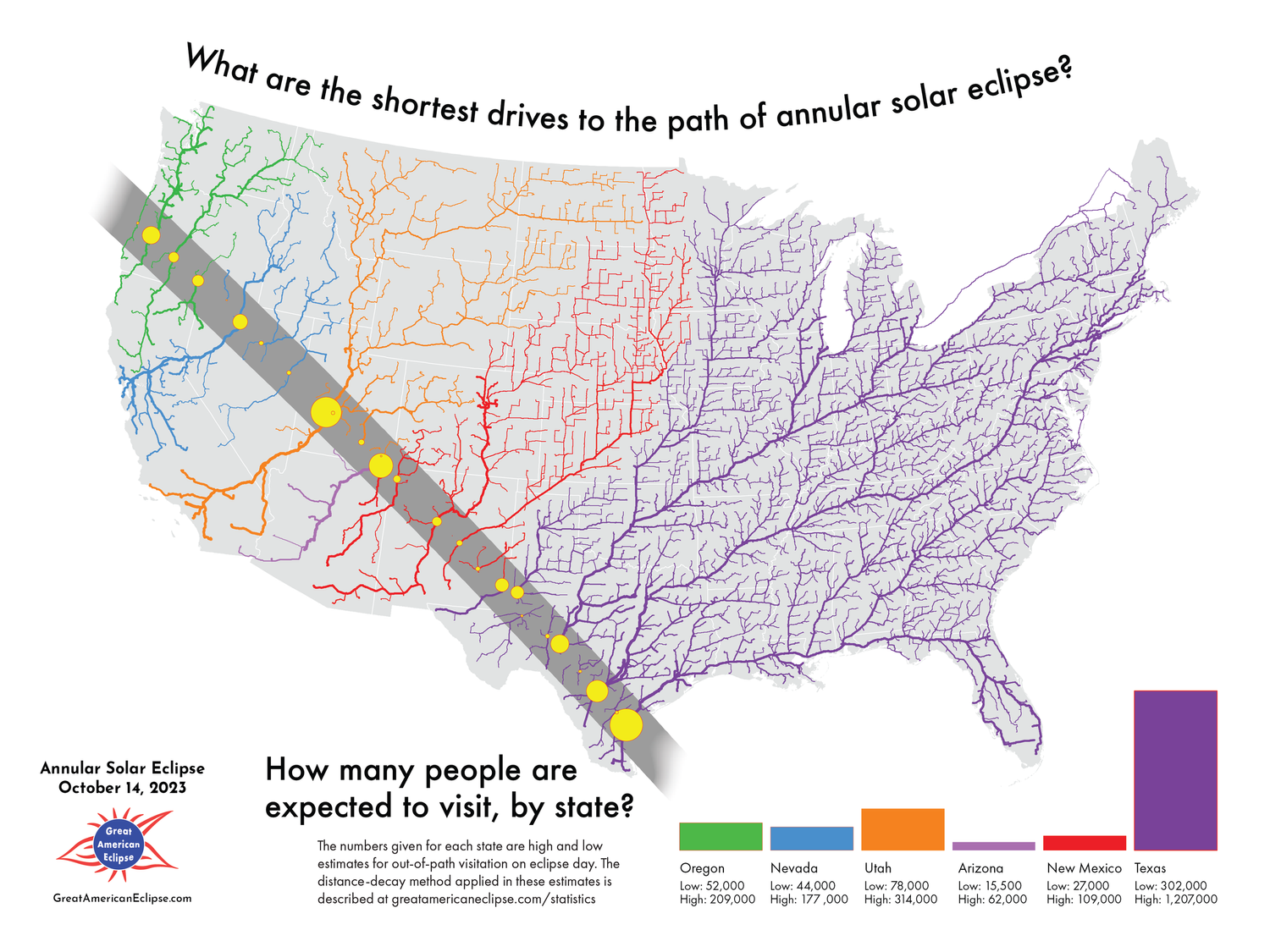
Ring of fire brings floods of tourists: hundreds of thousands travel across the American West to see an annular eclipse

This weekend, a rare annular eclipse crossed over the Americas. Beginning in Oregon around 9 am local time on October 14, the eclipse cut through the American Southwest and Yucatan Peninsula in Mexico before traveling over Central America, Columbia, and Brazil. States within the path of annularity prepared for an onslaught of ecotourists coming to experience the once-in-a-generation event. In the United States alone, an estimated half a million to two million people were expected to travel for the eclipse.

Travel Oregon, the state’s tourism agency, advertised the many opportunities for businesses along the path. Klamath County organized a week-long Eclipse Fest to celebrate. County officials issued a travel advisory on Saturday and collaborated with more than a dozen federal, state, and tribal agencies to handle a wave of ecotourists that were expected to temporarily double the county’s population.

Remote Modoc County, California, expected tourists to outnumber residents as Californians flocked to the only county in the state in the path of the eclipse. Hotels in the small town of Alturas, population 2,715, booked out for the weekend.

In neighboring Nevada, Great Basin National Park welcomed visitors with guided viewings, astronomy programs, and guest speakers from NASA, while the nearby town of Ely, population 3,924, hosted a 4-day Ring of Fire Eclipse Festival. Meanwhile, the state’s tourism agency directed visitors to the best viewpoints and state energy officials prepared for a temporary shift as the eclipse dampens solar energy production, which accounts for over a third of the power supply for the state.

The Utah Department of Transportation warned visitors and residents alike of heavy traffic, as an expected 300,000 travelers drove across central Utah roads and highways. Thousands of visitors flocked to Bryce Canyon National Park for clear skies to view the eclipse.

While other parks were filled with crowds, the Monument Valley Navajo Tribal Park was closed in keeping with sacred tradition. For the Navajo people, or Diné, as they call themselves, solar eclipses are a time for reflection and tranquility. The Navajo practice solemnity, not spectacle, out of reverence for the rebirth of the sun, which they regard as a father figure. Tribal educators instructed their people to pray in their homes and to avoid eating, drinking, sleeping, or looking at the eclipse, following centuries of tribal practice.

Just north of the Navajo Nation, the Bear Ears National Monument, which is co-managed by the Bureau of Land Management and indigenous tribes such as the Hopi and Ute, prepared for as many as 20,000 visitors. The Bear Ears Partnership informed tourists of the different beliefs held by those tribes, who view the area as sacred and encouraged them to visit with respect.

While the West relishes in the increased tax and travel revenues and returns to normal life, the Northeast, Midwest, and South prepare for future crowds of their own. A total eclipse will cut a path from Texas to Maine on April 8, 2024. While Indiana gets ready for what is expected to be the single largest tourist event in the state’s history, Ohio anxiously awaits the estimated $23 to 94 million in economic benefits that it hopes to gain from eclipse tourism.

You can read more about preparation efforts in Newton County, Arkansas, here. You can read about eclipse tourism during the last solar eclipse in 2017 here.

Friday, July 7, 2023

Literary Ruralism (Part XXXVIII): Jason Mott's Hell of a Book

Jason Mott's Hell of a Book is just that--in more ways than one.  I'm not surprised it won the National Book Award (2021).  

The most striking thing about the book, most readers would agree, is its insights into race in America, with particular attention to police violence against Black men. 

But another striking thing--at least to me as a ruralist who grew up in a tiny town in the American South--is the role of the small town in the story.  Indeed, more precisely, it is the role that growing up in a small town, Bolton, North Carolina (population 691), plays in the narrative.  Bolton, by the way, is not only the hometown of the novel's protagonist--the narrator telling the story in first person--Bolton is also the hometown of author Jason Mott.  Thus, Mott comes by his insights honestly.  

The book's opening vignette is set in a farm house, but the reader has no idea that this is of any significance until relatively late in the book, when the protagonist reveals his own small-town roots.  The author/protagonist returns there, which gives him an opportunity to comment on the impact of growing up in such a place.  Here are some representative excerpts, all from his return to visit his hometown after he becomes a famous author.  In the first, the narrator is entering Bolton with his agent, Sharon.  This excerpt at least hints at the attachment to place associated with rural America, as well as the major role played by religion:   

[Sharon] scans the small town as we pass. Coming through, we cross paths with nine churches over the course of the town. “Why does a town this small have so many churches?” Sharon asks.

“Because God needs the little people more than he needs anyone,” I say. There’s a knot in my stomach the size of Texas all of a sudden. I haven’t been back to Bolton in years, and with good reason. It’s a town with tendrils. And as soon as those tendrils get into your skin, you can never get rid of them. You can never get away. The truth of the matter is that I’d managed to get out of Bolton only because I snuck away under cover of darkness and something akin to invisibility. I never really fit into this town when I was a kid. I was always too much of something for the other kids I grew up with. I was too much of a bookworm. Too nerdy. Too weird. Too clumsy. Too skinny. Too black of skin. Too white of temperament. I never liked hunting and fishing enough. I never liked fighting or chasing girls enough. I never liked God or hated the devil enough. I never grew things in the garden. I didn’t eat okra and butterbeans. I couldn’t stand dumplings.

My family did the best they could to not make me feel like the freak that I always was. My cousins, God bless ’em, they loved me like I was one of their own even though I’d argue that I didn’t really belong to anyone. Especially after the emergence of my condition [elsewhere revealed as an overactive imagination that causes the narrator not to be able to distinguish between reality and the imaginary].

I can’t say exactly when it began, but I can definitely say that it’s linked to this small town of Bolton and my childhood. From what I remember, I’ve always been living in a different world. My therapist says that can’t be the case, not for the type of condition I’ve got. She swears that what I’ve got comes about only after a person has gone through some sort of trauma. And, typically, when you talk about this type of trauma, it’s got to be something beyond the scope of school bullying and general low self-esteem—both of which I had no shortage of in my youth.

My therapist and I have been through more than a few loops about what might have caused my imagination and persistent daydreaming to work the way it does.

“Can you think of any event that might have occurred?” she asks, over and over again, for the past five years since I’ve started seeing her.

“No,” I reply. “I had a pretty normal childhood. I grew up in a small town that nobody’s heard of in the ass end of North Carolina. Well, now that I think of it, maybe you could count that as a trauma.” (pp. 221-23)

This, too, is quite negative about small-town America, in particular small towns in the American South and how they treat Black folks:

Nestled in the sweaty armpit of Carolina swampland, surrounded by gum trees, and pines, and cedars, and oak, and wild grapevines, the town of Bolton is the land that time forgot. Go back far enough into the town history, and there used to be a railroad stop and a sawmill here. And that was at its pinnacle, somewhere around sixty years ago or so. Back then, the town had a population of maybe around three thousand people.

The main exports of Bolton are lumber and Black manual labor. The wood comes from the forests and swampland—all of which are owned by the local paper mill—and the labor comes from the town’s seven-hundred-odd residents. I wish that I could tell you that something more than those two chief exports comes out of Bolton, but there’s nothing else. Bolton isn’t a town that gives, but neither is it a town that takes. It’s the type of place that keeps to itself. It’s self-sustaining, the way the past always is. And though it changes a little now and again, the way an old piece of metal seems to change colors over the years as some thin patina comes along and begins to grow over it, at its core the town is the same that it has always been. And that’s how the people like it.  (pp. 220-21)

The next excerpt reminds me of the nostalgia associated with rural folks:

“There’s a field like that not far from my house too. Looks almost the exact same. My daddy said that it was where they used to grow cotton a long time ago. My daddy was always talking about the way things used to be back before I was born.”

“That a fact?”

“Yeah. It was like that was all he wanted to talk about. He used to have these books he would read to me on the weekend. These encyclopedias about Black people.” (p. 227)

Then there's this--also about religion--a familiar phenomenon for those who've grown up rural: 

Bolton Town Hall also doubles as a church because there is no separation of church and state in southern Black towns. God is everywhere, especially in the law. At least, He’s supposed to be. But I can tell by the tone and timbre of the people inside the walls of this small, ruined church that they’re beginning to believe less and less in the ability of God to come along and do the right thing in their lives. (p. 242)

This scene reveals both positive and negative associations with rurality in relation to the power and pain of memory: 

And one thing I always forgot is just how much I love the quiet of small towns and the long roads that seem to lead nowhere and everywhere all at the same time. Only a fistful of buildings to speak of. Houses that pop up like memories along the side of pavement and gravel sometimes. It’s a hell of a splendor.

But maybe it’s a good thing that I can’t remember everything the right way. I know what happened to my old man. But the old lady . . . something tells me not to think about that. It’s like the thought of having lost them both is too much to fit in my head so it chooses not to know either way. But there’s a catch to convincing yourself that you don’t know a thing: yeah, it keeps your life on track, but for the thing or person you’re choosing not to see or know, you’re taking away their whole entirety. And ain’t that something to do to a person? To a group of people? Ain’t willful ignorance a hell of a thing?

Being back here in my hometown, I think I can feel that box opening . . . and it terrifies me.  (pp. 253-54)

And then there's this, which shows Mott really knows a thing or two about the practicalities of living in rural America: 

“I wonder if there’s internet out here,” Sharon asks, eyeing the house suspiciously. “How in God’s name do people live like this? It’s barbaric.”

I can’t help but smirk. (p. 226).  

In any event, while the book is not primarily about rurality and the small-town phenomenon, Mott does show off his home-grown observations of rural culture and rural realities--as well as how urbanites (Sharon, the literary agent, is the quintessential city dweller of the northeastern variety) view them.  

Friday, May 5, 2023

The epistemology of progressive politics: why we shouldn’t be surprised when rural immigrants vote conservative, and why we shouldn’t assume that assimilation is the underlying reason

How did Donald Trump (Mr. Build-a-wall-and-make-Mexico-pay-for-it) garner a substantial share of the Latino vote in 2016 followed by an increase in share in 2020?

How did Myra Flores flip a longtime Democratic congressional district as a Mexican-born Republican candidate for Congress in 2022?

I’ve heard some folks suggest that it’s no wonder that many Latino Americans, particularly those in rural areas, vote for conservative politicians because by living in rural areas, they imbibe an “American” worldview. This removes them from the “immigrant experience,” which then alienates them from their cultural roots.

The implication is that assimilation into American society and culture is more closely associated with conservative politics than it is with progressive politics.

Such a notion is supported by the oft-vocalized sentiment at UC Davis Law that non-white Americans who subscribe to, or even sympathize with, political or philosophical conservatism are betraying their “non-whiteness” by adopting the mentality of the “oppressors” (a bizarre proposition that requires its own critical analysis). Non-white conservatives are thus derided as mere sycophants.

Based upon this conception, Latino Americans ought to be naturally aligned with progressive politics, largely because they are “non-white,” but, admittedly, also because of progressive immigration and economic policies that ostensibly benefit Latino communities.

I question why this should be the case. In fact, I find this perspective to be problematic because it is in contradiction with the epistemology of progressive politics. Furthermore, this perspective is also ironic because it runs afoul some of the core tenets of Critical Race Theory, which undergirds the progressive philosophy of race.

Mari Matsuda has long argued that Critical Race Theory must “look to the bottom” to utilize the “intellectual tradition[s] of people of color in America” as a “new epistemological source for critical scholars.” (Matsuda 325). By doing so, she argues, Critical scholars can tap into an invaluable resource that had been previously overlooked by legal philosophers. (Matsuda 325-26).

Thus, to assess whether an essential synergy exists between non-white Americans and progressive politics, we must consider the epistemological foundations of progressive politics and compare it to the “intellectual traditions of people of color in America.”

This is precisely where the irony lies: progressive political philosophy, rooted in a liberal moral matrix, is a uniquely Western philosophical framework. (See Helen Pluckrose & James Lindsay, Cynical Theories, 21-66 (2020)). By Western, here, I mean that the moral philosophy underpinning progressive politics exclusively arises from and within the intellectual milieu of Western Europe by Western European philosophers. This includes both progressive and libertarian bents of liberalism (e.g., Mill, Rousseau, and Rawls) as well as radical leftist movements (e.g., Marx, Engels, Marcuse, and Gramsci). Even Critical Race Theory itself is an offshoot of such Western thought (See Pluckrose & Lindsay, 111-134).

Jonathan Haidt explains in The Righteous Mind: Why Good People are Divided by Politics and Religion that the liberal moral paradigm is a unique anomaly found almost exclusively within “WEIRD” civilizations (western educated, industrialized, rich, and democratic). The liberal moral paradigm is one that emphasizes care/harm, liberty/oppression, and to some extent fairness/cheating, to the neglect of loyalty/betrayal, authority/subversion, and sanctity/degradation. On the contrary, Haidt found that the social-conservative moral matrix equally values each one of these moral concerns.

Returning to the example of rural immigrants in America, how then should we view the Latino American rural vote? If we take Matsuda’s approach, we must consider the “intellectual traditions” of Latino Americans. Isn’t one of the most important intellectual traditions of most Latinos that of the Church? Can’t the same be said about the majority of African Americans too? Doesn’t this shed light on why many folks within such groups may be inclined to vote along the social conservative moral paradigm?

The upshot is that being “progressive” in American politics is to be truly “westernized” and assimilated into the intellectual tradition of the Western world. It is the European Enlightenment that “liberated” us from the blind intoxication of religion. German Marxism “freed” us from the chains of private enterprise. Western European postmodernism relativized morality and allowed us to deconstruct all societal structures. All of this paved the way for Critical Race Theory, Queer Theory, Decolonial Studies, and the likes, to center identity politics as the core mechanism for identifying evil in the world.

Hence, radical progressivism, from an epistemological perspective, is as Western as it gets.

The most notable alternative framework to progressive liberalism is philosophical conservativism, which is rooted in the Judeo-Christian-Islamic tradition. This tradition simply cannot be reduced to the Western intellectual tradition; rather, it is eclectic

Thus, I find it comical that non-white rural immigrants can be criticized for "assimilating" into American culture when they profess social-conservative beliefs.

Nonetheless, the broader purpose of this post is to encourage us to properly analyze why non-white rural Americans may be attracted to conservative politics rather than writing off such folks with designations such as “pick-me,” “Uncle Tom,”Tio Taco,” or “Uncle Bobby”.

Monday, April 24, 2023

Rural Policing (Part 2): Community solutions

In my previous post, I discussed police shortages in rural areas, some adverse effects of these shortages, and the rise in sheriffs making individual determinations as to what laws they will enforce. 

I am extending the discussion from that post by exploring how communities, particularly those of color, have found their own solutions for the lack of adequate policing and general lack of resources. I also explore the "punishments" these communities receive while police officers are kept mostly unaccountable. 

I was inspired to continue this discussion after watching Check-It, a documentary in which a queer community forms a self-defense group after multiple people experience brutal attacks for their sexuality. While the self-defense group was initially characterized as a "gang" because of their brutal attacks on homophobic assailants, the group has now created a clothing label and funded a community center where they provide members with resources, help people develop practical skills, and organize fashion shows. Check-Its change was triggered when some of its members ended up in jail, causing others to realize that their violence inevitably kept some members in the cycle of poverty they all wished to escape. 

Key to the development of the Check-It community was the lack of adequate police response and even violence by the police against victims who sought help from them. Similarly, rural people take up arms to defend themselves because of a similar lack of adequate police responses to violent crimes, as I discussed in part I. Like those in Urban, D.C., many rural people believe their individual gun ownership will reduce crime rates.  It seems that police everywhere are failing people everywhere.

However, a crucial problem arises when abandoned groups of people take their defense and protection into their own hands: the court system fails them after every other part of the criminal justice system has done so. For instance, when queer people, and more predominantly people of color, engage in self-defense, they disproportionately end up in jail.

That was the case in Out at Night, a documentary discussing the lives of four lesbian women who each were sentenced to over eight years of prison for stabbing a man that charged at them after yelling homophobic epithets. Despite meeting all the elements of self-defense and having video and witness evidence, the women's self-defense claims were rejected, and all four women were charged with gang assault. 

This was also the case for Luke O Donovan, who ended up serving 2 years for pulling a knife on a group of men that attacked him and yelled derogatory remarks at him. Surely, these are not the only instances in which self-defense claims have resulted in the imprisonment of innocent people. 

Furthermore, it is often the case that women will end up in jail for fighting back against men who abuse them. This hole in the legal system can be particularly damaging to rural women who often face heightened instances of domestic violence. Exemplified by Brenda Golden, an attorney, and Muscogee Nation citizen, who had the police called on her for hitting her ex-husband with an ashtray after he would not stop abusing her. 

The horror of these instances is that, after being failed by the police, who cannot or will not help them, people take matters into their own hands and end up in jail anyway. This punishment happens at the hands of those who would not help victims in the first place. What's worse is that the root of this problem is not particularly clear or simple. Cynthia Lee's, Minnesota law review article suggests that self-defense's "reasonable person" standard is to blame for the horrors. While Phyllis Chesler suggests that the problem arises out of our gendered expectations, " Women are held to higher and different standards than men, who are expected to be violent; people do not expect and will not tolerate women to be violent, even in self-defense." 

The silver lining that comes from this issue is that communities find ways to help their members, even when the state and police fail to step in. This brings me back to Check-It, who seemingly came to the realization that self-defense measures can have varying results, instead, they turned their efforts to providing resources that help people change their lives. 

While rural members who take up arms and stay at home might not experience such devastating outcomes, similar resource centers are created in rural communities. This often occurs through churches, as exemplified in The Overnighters, (another documentary), where homeless rural people, including homeless LGBT+ people, seek refuge in their local churches.

It seems that community work is crucial to solving policing issues; something that marginalized communities have always known and provided for each other. How many problems could be fixed or reduced if we offered more funding for communities to provide better resources for themselves? And should we leave communities to resolve these issues alone? Or is a complete revamping of our criminal justice system? 

Thursday, April 20, 2023

Three stories of loss out of rural northern New Mexico

Several national media outlets have recently reported out of the rural reaches of northern New Mexico.  I collect these stories, all of some sort of loss, in this post.  

Jeffrey Fleishman of the Los Angeles Times reported last month out of Espanola, New Mexico, population 10,526.  The headline is "Can this town save itself from fentanyl addiction? The race to turn around a threatened community."  Excerpts follow, with the first about the place: 

Sitting amid tribal lands straddling the Rio Grande, Española appears stranded between better known Santa Fe and Taos. More than a century ago, long before cartels trafficking fentanyl with nicknames like China White and Dance Fever crisscrossed New Mexico on Interstate 40 and Interstate 25, ranchers and farmers here loaded their wares on trains bound north and south in what was known as the Chili Line. That route ended decades ago; other small businesses and industries disappeared as well.  

Then there's this about the current crisis:  

Shoppers and workers drove past addicts roaming Riverside Drive, the main drag in this town of 10,500. Kids played in trailer parks. Contractors loaded pickups. Cars came and went from a methadone clinic. Men wearing hoodies and expectant gazes drifted toward a house with barred windows. They rustled pockets for cash. Others headed toward the marshes on the city’s fringes, where, as the morning frost lifted, Cristian Madrid-Estrada, a bearded man of 23, sat with a gun holstered on his hip at the Española Pathways Shelter [where he is the chief executive officer].
* * * 
Rallying voices are trying to fix this community under siege. But it’s unclear if the story of Española, where a quarter of the population is poor and the murals of the dead are painted on junction boxes, will be a narrative about how to save a town from addiction — or lose it. In a one-year period ending in June 2022, Rio Arriba County reported 50 fatal overdoses, giving it the highest rate in New Mexico. It was about four times the national rate of approximately 33 per 100,000.

Here's another quote from Madrid-Estrada: 

It’s insane how much has changed in the last year. It’s scary. We have generational drug use. Generational trauma. Half the kids I went to school with didn’t have parents. They were dead or in jail or gone. [But fentanyl] is a completely different animal. A whole new epidemic no one was prepared for.

The LA Times story also covers familiar rural issues, including lack of resources such as detox and addiction treatment.   

Then, a few weeks ago, Simon Romero reported for the New York Times on another loss--that region's dying Spanish dialect, one centuries old and linking back to the era of the Conquistadors.  The dateline is Questa, population 1742, and an excerpt follows: 

Even just a few decades ago, the New Mexican dialect remained at the forefront of Spanish-language media in the United States, featured on television programs like the nationally syndicated 1960s Val de la O variety show. Balladeers like Al Hurricane nurtured the dialect in their songs. But such fixtures, along with the dazzling array of Spanish-language newspapers that once flourished in northern New Mexico, have largely faded. 

Romero quotes Cynthia Rael-Vigil, 68, who runs a coffee shop in Questa and who traces her ancestry to a member of the "1598 expedition that claimed New Mexico as one of the Spanish Empire’s most remote domains."  

Our unique Spanish is at real risk of dying out... Once a treasure like this is lost, I don’t think we realize, it’s lost forever.

Referring to her 11-year-old grandson who speaks almost no Spanish of any dialect: 

He has no interest. Kids his age master the internet; that’s all in English. I sometimes wonder, did my generation not do our part to keep the language alive?

Romero links the language loss to the decline of places like Questa: 

[T]here are questions about whether the rural communities that nurtured New Mexican Spanish for centuries can themselves last much longer in the face of myriad economic, cultural and climate challenges.

* * * 

Economic forces have fueled an exodus from the aging northern villages made up of crumbling adobe homes. Other threats — such as the largest wildfire in New Mexico’s recorded history, which tore through the state’s Hispanic heartland a year ago.
And that's a great segue to the last of the three stories of loss, Alice Fordham's report for NPR about victims of last spring's Hermit's Peak Fire who have yet to see the compensation they've been promised.  That fire was started by a federal government controlled burn that, well, got out of control.  Here, Fordham interviews Antonia Roybal-Mack, a local attorney who is trying to help residents negotiate with the federal government:   
FORDHAM:  Because the fire began as escaped prescribed burns by a federal agency, the U.S. Forest Service, the federal government took responsibility, and Congress passed a law promising compensation. It appropriated nearly $4 billion. Roybal-Mack says she's been hired by hundreds of households and other entities like municipalities to put a number on their loss. But the claims process is complicated.

ROYBAL-MACK: We can't give our clients any certainty on this is what it is. This is how it looks. This is your path. This is what we expect to see happen.

FORDHAM: That's because the rules aren't finalized. The Federal Emergency Management Agency, or FEMA, is running this compensation program. It issued interim regulations last year. But after hundreds of public comments raising concerns about things like a cap of 25% on the value of trees, the agency has no date for a final version.

ROYBAL-MACK: FEMA is saying trust us that we are going to do right by you, but we're not going to give you a rule, and we're not going to have a guidebook as to how we're all going to play this game.

So, there's talk of a possible lawsuit against the federal government, and the story closes with an implicit reference to rural lack of anonymity.  

ROYBAL-MACK: In the event we sue the federal government, we will have the evidence necessary to do that.

FORDHAM: She's from the county of Mora, which was hit hard by the fire. Her father's ranch burned. And as we ride around, she says there's some social pressure.

ROYBAL-MACK: If I screw this up, I can't go to church here anymore. And I really like to go to church in Mora [County].

Friday, April 14, 2023

Texans dig in to keep rural schools open in face of conservative school choice movement

J. David Goodman wrote in the New York Times today about a topic that's been on my mind for a while: the threat that the school choice movement presents to rural schools and how that's playing out in so-called red states.  The dateline is New Home, Texas, population 334, in the state's panhandle.

Some key excerpts from the story follow: 
The school voucher movement, which seeks to direct public money to private or religious schools, has rapidly gained steam in conservative states as parents battle public schools over books in the libraries, the teaching of race and racism and transgender issues. More than a dozen states have adopted some form of school vouchers. This year several, including Florida, Iowa and Utah, voted to create expansive new programs open to all students, an approach pioneered in Arizona.

But Texas has been an outlier so far, in large part because of the longstanding support for public schools in deep red communities like New Home. In far-flung districts around the state, parents and educators have defended their schools, which are often the biggest local employer and the center of community life.
 * * *
Amid a growing national movement to give parents public money to spend on private schools, it is in places like New Home — where the football coach is a local fixture and students learn both how to read and how to judge the quality of a cut of meat — that the conservative campaign has run up against the realpolitik of rural Texas.

* * * 

The governor’s aides point to polls showing support for school choice even among rural Republicans, though opponents argue that such numbers are dependent on how the question is framed.

“There’s no groundswell for this in my district,” said State Representative Travis Clardy, a Republican who represents rural counties in East Texas. He voted against vouchers last week.

In New Home, nearly 400 miles northwest of Austin, parents said they were not yet seeing the issue as a threat.

“Let’s say they did this,” said Kayla Ferguson, a Republican who owns The Spot, a recently renovated small restaurant by the school, where her three daughters are students. “It wouldn’t be something where they wouldn’t have public schools, right?”

Martina Torres, a parent who works at the restaurant, chimed in from behind the counter. “To me, the big scare would be if so many parents chose to go with that decision, and it would cut the money for the public school,” she said.

“I don’t like the idea,” Ms. Ferguson said. “I would never send my kids to a private school.”

Unlike many rural districts, where the public schools are the only nearby options, New Home is close enough to the city of Lubbock that parents could choose to send their children to nearby private schools at their own expense.

Instead, the opposite has been taking place: Many parents unhappy with the public schools in Lubbock have been moving to New Home, instead of enrolling their children in private schools. Others remain in Lubbock but drive their children 25 miles each way to school. Enrollment is soaring.

Many say they are transferring from more politically and culturally diverse Lubbock in search of smaller classes and a place where the values more closely align with their own.

I've marveled that commitment to rural schools and communities hasn't brought more attention to this issue in Missouri, Oklahoma and Arkansas, which have also gotten swept up in strong school-choice movements.

Friday, April 7, 2023

"How Rural America Steals Girls' Futures"

That's the headline for Monica Potts' essay in The Atlantic.  It's based on her forthcoming memoir, The Forgotten Girls, which was scheduled to be released on April 14 but has been delayed until May 30.

Potts writes from Clinton, Arkansas, population 2,602 and the county seat of Van Buren County. It's where she grew up, on the southern edge of the Ozark mountains, a place with a median household income of about $46,000 in 2021.  Potts describes the culture this way: 

Almost everyone goes to an evangelical church, and in the halls of the town’s only high school, everyone knows everything about everyone else, or seems to: whom you dated, where you bought your clothes, how you acted on weekends, and even your destiny, inherited from the generations that came before you.

Here's part of her story: 

Growing up in the ’90s in Clinton, Arkansas, all that my best friend, Darci Brawner, and I dreamed about was getting out. “I want to see new people and new places,” I wrote in my journal when I was 12. I wanted to move to California but would take “any state besides Oklahoma or Mississippi.” We wanted careers; we wanted to be rich and famous; we wanted to be far away. Boys and sex would only stop us, catch us, or so my mother had warned.

* * * 

I moved away for college when I was 18. While I was gone, I heard updates: who was getting married, having children, getting divorced. I heard worse stories, about who was on drugs, who’d been arrested and sent to prison, who was in rehab, who was in rehab again. Who had died. By the time I was a journalist writing about rural poverty in my mid-30s, I’d seen studies and data that helped me put the stories from home in context. One of the most alarming trends emerged about a decade ago.

That trend was the shrinking life expectancy of women like those who'd raised her, those she had grown up with.   Potts got curious about why these women were being lost not only to deaths of despair but to cancer, heart disease and other chronic conditions.  The essay continues: 

I returned to Arkansas more and more, trying to reconnect to my hometown, looking for answers. In 2015, on a visit home, Darci contacted me out of the blue. We’d once been as close as sisters, but that spring was only the second time I’d heard from her in the nearly two decades since high school. We visited, and as we caught up and reminisced, I began to realize that I could pinpoint the time when our lives had first begun to diverge. It started during those boy-crazy middle-school years, when we were at the cusp of growing up, when our futures had not yet been written.
Some of us—because our parents were strict or wealthier and more educated, or because we were “good girls” too nervous to break the rules, or because we were just plain lucky—got out. Others got pregnant.

And as a fellow rural Arkansas female like Potts, here's the paragraph from the essay that most resonated with me: 

When it came to liquor, there were two modes in Clinton: alcoholism or abstinence. This paralleled the bifurcated morality I saw everywhere: Girls were either virgins or whores; students were either geniuses or failures; you could go to church or you could be a sinner. The town seemed to operate in two modes—the buttoned-up propriety of the churchgoers, who held power in the county, versus the rowdy hillbillies in families like my dad’s. The rigid divide allowed no room for subtleties or missteps.
Even children were sorted into the binary: the upstanding citizens and the ne’er-do-wells.

I recommend it in its entirety and am looking forward to the book's release next month.

Sunday, March 26, 2023

Addressing nihilism in rural America: What we can learn from the Jordan Peterson phenomenon and why it should not be written off as “dangerous right-wing radicalism”

A couple weeks ago, I stumbled across an interesting find in the used book section of a thrift store in a rural town in southwest Kern County, California. It was a copy of Dr. Jordan Peterson’s 12 Rules for Life: An Antidote to Chaos. I purchased the book, and on my drive home up highway 99, I contemplated the impact of Jordan Peterson, a prominent public intellectual who, at times is casted as a conservative, is more accurately described as a classical liberal and traditionalist, on rural communities.

While I recognize that Jordan Peterson is a polarizing figure, I believe that understanding the “Jordan Peterson phenomenon” is important for anyone seeking to understand and uplift rural peoples in America. 


The aspect of Jordan Peterson’s message that I am interested in exploring in this post is his emphasis on personal responsibility, to which Peterson attributes much of his popularity, especially amongst young men (though women are an increasingly growing part of his audience as well). For Peterson, responsibility is the neglected half of any discussion pertaining to rights. And this is especially important because, Peterson argues, responsibility gives meaning to life–it’s what makes the suffering one experiences in the world worth enduring.

Peterson’s book is subtitled “An Antidote to Chaos,” signaling the clear purpose of his rules for life. Peterson notes that though not all chaos is bad, it must be balanced adequately with order, lest extreme forms of chaos—like anarchy or tyranny—result. 

Many parts of rural America seem to suffer from what I would call an inner chaos, if I may, in the form of ennui. It is a chaos of the soul due to feelings of loss of dignity, status, purpose, and importance, which ultimately results in nihilism—the notion that there is no meaning or purpose to life. Nihilism entails the rejection of objective truths, morals, philosophical codes, meanings, or values. This inner chaos is exacerbated by the pitiful economic conditions of many rural communities.

The plight of despair within rural communities has been chronicled by Princeton economists Anne Case and Angus Deaton in their book Deaths of Despair and the Future of Capitalism (2020). Since the turn of the century, premature death rates have sharply increased among rural Americans due to increases in suicide, drug overdoses, and liver disease related to alcohol abuse. To be fair, there are countering narratives as to the cause of these tragedies. Case and Deaton argue that the main reason is the lack of economic opportunities whereas others point to the proliferation and accessibility of illegal drugs. Either way, the net effects are undeniable, and they result in what we logically expect from broken communities: pervasive poverty, homelessness, drug addiction, and the likes.

To add insult to injury, rural communities also face “rural bashing” often at the hands of progressive elites, who, in recent election cycles, have resorted to blaming rural folks for their own problems because they ostensibly vote against their own interests.

The zeitgeist of our time would entail rural folks adopting a mentality of victimhood and internalizing it as an identity. Perhaps many rural Americans have done just this in embracing Donald Trump. President Trump capitalized on America’s victimhood culture by encouraging his supporters to embrace victimhood as an identity throughout his presidential campaigns and presidency. 

This should not be too surprising because furthering victimhood culture is (tragically) an excellent political strategy. Indeed, both Democrats and Republicans are guilty of perpetuating it. This is because it allows an “in-group” to rally its members to act in an intensely revengeful manner against an otherized “out-group”. Think Democrats vs. Republicans, rural vs. urban, white vs. non-white, educated vs. uneducated, etc. What results is dangerous and destructive.

When a group places extraordinarily great emphasis on their own suffering, they can develop “egoism of victimhood.” Psychologists use this phrase (egoism of victimhood) to refer to situations “whereby members [of an in-group] are unable to see things from the perspective of the rival group’s perspective, are unable or unwilling to empathize with the suffering of the rival group, and are unwilling to accept any responsibility for harm inflicted by their own group.” (See here and here for research supporting this.) Further, researchers have found that people who embrace victimhood culture are less willing to forgive others, have an increased desire for revenge (as opposed to mere avoidance,) and are more likely to engage in revengeful behavior. 

Another pitfall of victimhood culture is that it relieves one of responsibility by shifting it to someone else, maybe even “the world,” broadly, or to some structural aspect of society. Dr. Peterson argues that once a person is relieved of responsibility, they are also stripped of power and agency. Thus, without responsibility, one has no power to change one’s circumstances (though it seems that without personal agency to change one’s immediate situation, some folks shift their energy towards deconstructing and destroying societal structures at large, given their ostensible structural inequities). 

Given this backdrop of the rise of victimhood culture, the plight of rural America, and the increasing struggles of young men (see Richard Reeves, Of Boys and Men: Why the Modern Male is Struggling, Why It Matters, and What to Do about It), Jordan Peterson offers an attractive alternative. I argue that rural Americans may be attracted to this message—and benefiting from it—because it is radically different.

Jordan Peterson fans and followers seem to share a common perspective and experience. Many are disenchanted by the shaping of contemporary society (the prominence of ideologies based on the centralization of race, gender, and sexuality,) and many are even more troubled by the apparent lack of purpose in their own lives. Many share stories of despair, addiction, and depression in their lives. Still, his followers are often written off as right-wing extremists. I believe, however, that there’s more to Jordan Peterson fans than the popular media presents.

If we look past the rhetoric and analyze Dr. Peterson’s message, we can see that his message is one that seeks to uplift individuals by speaking to the basic nature of humans as conceived within a Judeo-Christian-Islamic ethos. In short, Peterson proffers a solution to chaos that has been neglected and maligned by the Left in recent years and only superficially discussed by the Right.

The power of his message is that it seeks to restore dignity and agency to each human being, reminding them that they have control over their circumstances so long as they take responsibility. This is so even if much of their predicament is technically at the hands of forces outside of their own individual power. Put another way, this is a return to personal responsibility, and it seems to resonate with rural people, who tend to value individual striving, hard work, and responsibility

Dr. Peterson proffers 24 “Rules for Life”  in his books. Fifteen out of the 24 are related to personal responsibility:
  • Treat yourself like you are someone you are responsible for helping.
  • Compare yourself to who you were yesterday, not to who someone else is today.
  • Set your house in perfect order before you criticize the world.
  • Tell the truth – or, at least, don't lie.
  • Be precise in your speech.
  • Do not carelessly denigrate social institutions or creative achievement.
  • Imagine who you could be and then aim single-mindedly at that.
  • Do not hide unwanted things in the fog.
  • Notice that opportunity lurks where responsibility has been abdicated.
  • Abandon ideology.
  • Work as hard as you possibly can on at least one thing and see what happens.
  • Try to make one room in your home as beautiful as possible.
  • Plan and work diligently to maintain the romance in your relationship.
  • Do not allow yourself to become resentful, deceitful, or arrogant.
  • Be grateful in spite of your suffering.
I believe that a message that puts power back into people's hands resonates with folks in despair because it means they have agency to change their lives. This does not necessarily mean that it puts blame on the individual for their circumstances or that it rejects the notion of structural issues that may play a role in causing underlying crises. I’ve always wondered why a message that emphasizes personal responsibility ought to be viewed as one that denies the existence of structural inequalities? The two aren’t mutually exclusive. 

People in despair genuinely seem to be benefiting from Jordan Peterson’s message. He has amassed a massive following on YouTube (over six million subscribers and over half a billion total views on his videos). Glossing through the comments on his videos and posts on the Jordan Peterson Reddit page (which has over 300,000 members) there seems to be a significant number of people profusely thanking Dr. Peterson for his role in transforming their lives for the better. Sure this is anecdotal, but it is certainly worth something.

Earlier I stated that Jordan Peterson’s approach is a “return to” personal responsibility. I say this because the importance of personal responsibility in uplifting the downtrodden has ancient roots. It can be traced least as far back as the Judeo-Christian-Islamic tradition. Arguably one of the most successful programs for pulling people out of addiction and despair, the 12-step program created by Alcoholics Anonymous, puts the power in the hands of the sufferer, but interestingly, via a recognition of a higher power that can give aid, i.e., God. Ultimately, though, it is the individual who has the conscious ability and free will to make decisions and perform actions that will better their life.

This reminds me of multiple verses in the Quran in which God says that no soul is taxed with a burden except that it is one which they are able to bear. (Quran 2:233, 2:286, 6:152, 7:42, and 23:62). Furthermore, God states that “no bearer of burdens shall bear that of another.” (Quran 6:164, 17:15, 53:38. Translation by Nuh Ha Mim Keller, The Quran Beheld, (2022)). The implication is that some level of personal responsibility is required to recognize and strive toward a path out of one’s difficult circumstances. For the 12-step program, as well as the Muslim and broader Abrahamic traditions, the path begins with recognition of the Higher Power.

Tying this back to the discussion about victimhood culture, psychologist Dr. Scott Kaufman explains in an article published in a Scientific American article that the opposite of a victimhood mindset is a “personal growth mindset.” He argues that a personal growth mindset can help flip the narrative of trauma and despair if individuals choose to view their trauma not as a something essential to their identity, but as something that may actually be a source of personal growth and development, rather than a demarcation of oppression. He ponders of the personal growth mindset:
What if we all learned at a young age that our traumas don’t have to define us? That it’s possible to have experienced a trauma and for victimhood to not form the core of our identity? That it’s even possible to grow from trauma, to become a better person, to use the experiences we’ve had in our lives toward working to instill hope and possibility to others who were in a similar situation? What if we all learned that it’s possible to have healthy pride for an in-group without having out-group hate? That if you expect kindness from others, it pays to be kind yourself? That no one is entitled to anything, but we all are worthy of being treated as human?

This would be quite the paradigm shift, but it would be in line with the latest social science that makes clear that a perpetual victimhood mindset leads us to see the world with rose-tinted glasses. With a clear lens, we’d be able to see that not everyone in our out-group is evil, and not everyone in our in-group is a saint. We’re all human with the same underlying needs to belong, to be seen, to be heard and to matter.

Seeing reality as clearly as possible is an essential step to making long-lasting change, and I believe one important step along that path is to shed the perpetual victimhood mindset for something more productive, constructive, hopeful and amenable to building positive relationships with others.
Dr. Kaufman’s proposal seems to be an explanation of how people in despair are benefiting from the message of Jordan Peterson. I would further argue that a good part of why Dr. Peterson has been so successful with his employment of this messaging is because it is rooted (however imperfectly) in ancient, transcendent truths steeped in the Judeo-Christian-Islamic tradition.

I share this post in large part to compel us to reckon with the possibility that there is great good in a message that emphasizes personal responsibility in lieu of one that places greater emphasis on structural inequities and victimhood culture. For one, the former seems to bring about real benefit more readily for real individuals in a relatively short period of time, whereas the latter leaves one stuck in a rut, hoping for the government to deliver a utopia.