Showing posts with label the West. Show all posts

Friday, April 3, 2026

Left to burn: how federal cuts are abandoning rural America's wildfire defenses

My memory of leaving Sonoma County for San Francisco includes a period of about four years where California wildfires progressively escalated in severity, oftentimes blanketing the city in smoke. In 2017, that included ducking inside to avoid breathing in the ashes of the town where I went to high school. It culminated in 2020 with the North Complex Fire causing the orange, alien sky that enveloped San Francisco. That fire was caused by a freak "lightning siege" attributable to climate change.  

My friend took this photo outside her apartment in September, 2020.
(c) Rose Barry, 2020
The Palisades Fire early last year should have emphasized the apocalyptic urgency of addressing wildfire dangers in California and beyond. But in the name of limiting "waste and abuse" the Trump administration ignored this urgency and instead proceeded to cut federal funding to fight fires in rural America. 

The Cuts 

Like the rest of the Trump administration's 2025 efforts, these cuts are as chaotic as they are dramatic, attacking wildfire prevention and response from multiple angles. 

First, the administration cut 10% of workers at the Forest Service. The Forest Service manages Federal land, and many of their responsibilities include fire prevention and firefighting. Fewer workers means fewer people clearing the brush and fewer people trained to fight fires. This puts California in a precarious position, with the Federal government managing 57% of forests in the state. Nevada is arguably in even worse shape, with 86% of their land being federally managed. 

Critics of the policy include members of the previous Trump administration. Former Forest Service chief Vickie Christiansen posits that the policies amount to "$40 million saved now for $4 billion in wildfire expense" later. Ryan Zinke, Trump's former Secretary of the Interior, says that the cuts shift the question of hiring from "'are we paying them enough” (to) “are we even going to have the bodies?'"

Firefighters from Stockton, CA putting out a fire off Hidden Valley Road. 
Source: Creative Commons, 2013.

The administration has also merged disparate firefighting groups from the Department of Agriculture and the Department of the Interior into a single U.S. Wildlife Fire Service. While there have been proposals to this effect in the past, they were previously rejected due to a 2008 Congressional report finding this consolidation had significant drawbacks. The consolidation shifts the focus away from fire prevention and towards suppression. The Forest Service ideally fights fire through its land management duties, and separating the two functions increases the risk of catastrophic fires that cannot be adequately suppressed. 

Despite some of the most high stakes firefighting occurring in rural spaces (especially in California), rural firefighters are often volunteers. As a previous post on this blog puts it, "volunteer firefighting is a rural issue." California has 200 volunteer fire departments, with many rural spaces completely lacking professional firefighters. Communities often fund these departments partially through local fundraisers. As people leave these communities, staffing these departments becomes even more difficult. Willow Creek in Humboldt County finds their department shrinking as calls increase.  Cuts to the Forest Service means these towns already lacking in resources have even less ability to serve their community even as the fire season grows ever larger. 

Volunteer Fire Station in Occidental, CA. 
(c) Lisa R. Pruitt 2025.
 States and localities have also suffered from the suspension of FEMA Building Resilient Infrastructure and Communities (BRIC) grants in 2025, with a lawsuit forcing the resumption of grants only last year. A massive backlog has resulted, with two years worth of applicants applying for one year of grant funding. This affects infrastructure for fire prevention as well as other disasters. 

This backlog disproportionately affects rural towns. Larger municipalities frequently have full-time grant-writers, where small towns often rely on a thin secretarial support staff, if that. These towns have no ability to fund their own improvements, with necessary infrastructure often costing several times the town's budget. 

The Response 

California moved relatively swiftly to counter the Forest Service cuts, deploying $72 million in Cal FIRE grants to "rake the forest" and fast track critical fire prevention projects. While certainly helpful, the State can only work with the 3% of forest land it manages directly and must work with private landowners who own the other 40% of the land. With a majority of the land in California under Federal management, this effort is limited. 

Utah also increased their wildfire funding by $150 million and joined the Great Plains Interstate Fire Compact. The compact enables coordination and resource sharing with other western states to fight wildfires and prevent wildfires. While this likely won't make up for the gap left by the federal government, this more coordinated local effort is cause for optimism. 

The Department of the Interior also announced a $20 million grant to equip "small, remote emergency response agencies with practical, deployable tools," i.e. modern water tanker trucks. While not unwelcome, this targeted funding does not make up for the larger structural damage done by the Trump administration. 

Notably, none of these responses make efforts to alleviate the specific burdens on rural communities. They simply attempt to fill in the gaps left by the federal government's retreat, failing to address the prior inequities. 

Conclusion  

On our current trajectory I find it difficult to be optimistic about anything involving climate change. As a Californian, there are few things that seem more immediately pressing than addressing the increasing severity of wildfires. The current administration's efforts harm everyone by failing to address these systemic issues, and rural communities will bear the brunt of the impact. 

Thursday, March 12, 2026

Gabbs, Nevada is a real place

During Thanksgiving Break 2024, I traveled with my partner at the time to visit her family in Gabbs, Nevada. Leading up to the trip, I told my friends and family where I was going by saying the name of the town, waiting for a second, then dramatically saying "population: 58." This usually got a bit of a puzzled reaction, but I felt it effectively conveyed my bewilderment. It seemed like an impossible place to me, far more remote and isolated than anywhere I had been.

A faded sign outside of Gabbs with a list of obsolete churches and social clubs, November 2024 

It turns out the population is greater than 58, with the most recent numbers I could find putting the population at 237. I'm not sure if the discrepancy was because of my ignorance or some miscommunication. Regardless, the town was certainly isolated. It was about seventy miles away from the nearest gas station and grocery store, deep in the magnificent beige of the Great Basin Desert

I was perhaps too unbothered by the isolation, as I neglected to fill up my car at the gas station at our last stop at the Walmart in Fernley, Nevada. As Interstate 80 changed to US 50 which changed to NV 361, the setting sun cast a lovely red glow on the desert, before turning into a pitch darkness that properly spooked me. I love a good country drive in pitch darkness, but the lack of trees or any shapes for my headlights to bounce off of was causing a low-grade panic to set in. My paranoia about running out of gas certainly did not help. 

NV 361. I swear this was terrifying at night. November, 2024

We did arrive safely, not quite sure if we were going to spend that night with our hosts or at a local motel that one Yelp review referred to as "Norman Bates scary." We thankfully did not have to find out what that meant, and spent the night on the couch after some stargazing and exploring our hosts' underground library. As always, I was stunned by the view of the night sky when there was no light pollution.

Our hosts were my partner's great uncle and aunt, we talked with them quite a bit about life in Gabbs. They were constantly on the road spending about half of the year driving to visit friends. They preferred to hole up in Gabbs in the more temperate seasons, leaving mainly during winter and summer. For them, the remoteness was peaceful, and there was a family tie. My partner's great aunt and grandmother grew up there.

Gabbs was founded around a magnesium mine in 1941, when demand for the mineral was high due to World War II. Though demand dropped off sharply after the end of the war, operations in the mine continued, and the town was built up with a library and a K-12 high school, where my partner's grandmother attended while growing up there through the 1950s. She mentioned seeing nuclear blasts on the horizon, likely seeing explosions from the Nevada Test Site, which operated continuously through the 1960s.  

Wide-Lens Shot of Gabbs, a view from the desert. November, 2024.  

The next day we had a two hour excursion of wandering in the desert and exploring the town. While the previously cited Nye County Civic-Plus source indicates that the town has an operational school, library, and community pool, it was clear from our exploration and conversations with my partner's family that this was no longer the case. The pool was dry and overrun and the library and school were just empty facades with decayed interiors. Apparently the town had been losing population over time and the population was now mostly retirees.  

An abandoned pool in the center of town, November, 2024. 
 Our discussions of rural disadvantage earlier this semester reminded me of wandering around Gabbs. The readings around the crises facing rural schools brought the image of the empty school back to my mind. This simply seemed to be a later stage of the problems described in those articles. I am now struck by how Gabbs is so remote that its decline is not noticed at all by the outside world. There is so little information available about this town even in our internet age. If I had not been there, it would have been impossible to see it as a real place.   

 On the drive back home I appreciated the beauty of the desert a good deal more. I am also happy to report that I did not run out of gas, though it got a bit too close for comfort at the end there.  

Tuesday, February 24, 2026

The robots are coming to the Salad Bowl

Pro-immigrant demonstrators in Omaha, Nebraska. Photo Credit: NBC News

In June 2025, President Trump paused immigration raids on agricultural workplaces after Agriculture Secretary Brooke Rollins warned that farmers were growing uneasy about the crackdown. As this blog noted at the time, the pause was short-lived. By October, the Labor Department’s own filing in the Federal Register admitted the crackdown risked “supply shock-induced food shortages.”

Then the federal government made matters worse by lowering wages. A new H-2A  rule (the program sets a federal minimum pay rate for employers hiring foreign agricultural workers) cut the pay rate for guest farmworkers across the country. In California, the rate for unskilled workers dropped from $19.97 to $13.45 per hour, and the United Farm Workers sued. The Economic Policy Institute estimated that farmworkers stand to lose $4.4 to $5.4 billion annually.

This is the context in which agricultural automation is arriving in rural California. The question is who does it serve and who does it displace?

The Salad Bowl goes synthetic

Salinas Valley, California (the “Salad Bowl of the World”) produces the majority of the nation’s lettuce, broccoli, and strawberries. Located in Monterey County, Salinas Valley is over 60% Hispanic or Latino, and the local economy depends on agricultural labor.

In 2025, a nonprofit called the Reservoir opened Reservoir Farms, the first on-farm robotics incubator in California, on 40 acres in Salinas. Backed by companies like John Deere and Driscoll’s (the berry company), the incubator provides startups with fabrication shops, pre-planted test fields, and access to commercial growers. It has since expanded to Sonoma County for vineyard automation.

A “vineyard robot” at work. Photo credit: Cornell Agritech

The startups coming to Salinas Valley build machines designed to do what farm workers currently do by hand. Israeli startup DailyRobotics is deploying robotic strawberry harvesters in California starting April 2026, claiming it works at two to three times the speed of human pickers.

One analysis estimated that strawberry automation alone could eliminate nearly 30,000 farmworker positions in California. The machines, which cost around $300,000 each, are priced for large-scale operations and out of reach for small family growers.

Fast advances in robotics means automated strawberry picking. Photo Credit: DailyRobotics

A manufactured crisis

The labor shortage driving this transition is real, but it is not natural. Over 40% of U.S. farmworkers are undocumented, according to the USDA and the Kaiser Family Foundation. The Trump administration’s immigration enforcement has removed workers from the labor pool while cutting wages for the legal guest workers who remain. In Minnesota, for example, H-2A visa numbers dropped 12% in the first half of 2025.

A prior post on this blog documented this pattern through the 2008 Postville, Iowa raid: 389 arrests in a town of 2,500, the departure of another 1,000 immigrants, the loss of 7% of the county’s workforce, and the bankruptcy of the local factory. The void was eventually filled by a new immigrant workforce from Palau.

The pattern holds internationally. Another post on this blog examined Italy’s “Agro-Mafia,” where restrictive immigration policy has not reduced agricultural dependence on migrant labor but has driven it underground into exploitative networks where workers earn as little as 3 to 4 euros an hour. Punitive enforcement produces either exploitation or automation, depending on who has capital.

Who benefits?

Reservoir Farms says the right things about workforce transition. Its CEO has stated that “automation should augment the workforce, not replace it,” and the Reservoir has partnered with Hartnell College on retraining programs. But as one community organizer in Salinas noted: “We support training, but we also know not every displaced worker will become a robot mechanic.”

Farmworkers harvest strawberries at Lewis Taylor Farms in Georgia. Photo Credit: Lance Cheung

The farmworker communities that have sustained Salinas Valley for generations face a displacement that is social and cultural. Lisa R. Pruitt and Marta R. Vanegas have written about “urbanormativity,” which is the tendency for legal and policy frameworks to render rural populations invisible. Farmworkers in Salinas are doubly invisible: rural and immigrant, performing labor the nation depends on but does not want to see.

This echoes what I wrote about in a previous post on AI data centers in rural Arizona. In both cases, Silicon Valley capital arrives in rural spaces to solve what might be seen as urban problems. Data centers serve urban tech consumers, and harvesting robots serve urban grocery consumers. The costs (labor displacement and strained local resources) fall on the rural communities that host the infrastructure.

The choice ahead

Agricultural automation is probably inevitable. Some of these technologies could genuinely improve conditions for farmworkers. But the federal government that paused immigration raids in June, reversed course days later, cut guest worker wages in October, and admitted to “supply shock-induced food shortages” in a Federal Register filing has offered farmworker communities in places like Salinas no reason to believe help is on the way.

The robots are coming to the Salad Bowl. The question is whether anyone in Washington has thought about what happens to the people already there.

Thursday, November 6, 2025

NYT's Thomas Edsall on the current food stamp controversy, including rural and racial differences

Thomas Edsall's column in the New York Times this week is under the provocative headline, "It Would be Trump's Honor to Pay for Food Stamps."  Here's the part of Edsall's column that mentions rural Americans:  

In “Rural Versus Urban: The Growing Divide That Threatens Democracy,” the coauthors Suzanne Mettler and Trevor Brown point out that while urban and rural counties relied on government transfer programs at similar rates in the 1970s and 1980s,
They diverged from the 1990s onward as rural places faced economic tumult and residents came to rely more on government benefits. By 2019, the eve of the pandemic, rural people benefited from social transfers by $1,749 more per person per year than their urban peers.
In 1970, Mettler and Brown calculated, rural and urban households received social benefits of $2,220 and $2,244, respectively, a 1.1 percent difference. By 2019, the average annual government benefit for rural residents rose to $10,558 and for urban residents to $8,809, a 20 percent difference. 
Mettler and Brown cite research by Jennifer Sherman, a sociologist at Washington State University, to describe the agonized struggle of the rural poor who, when faced with a major economic setback, are forced to turn to government for help:
When they themselves need to use such benefit, they experience a deep sense of stigma and shame. They drove to stores far away to use SNAP benefits, hoping to avoid the gaze of their neighbors and community members.
Given the way people have traditionally talked about these programs, one of the most striking things about government data on SNAP use is just how high the white share of food stamp recipients actually is.

In West Virginia, 97.7 percent of SNAP recipients whose racial and ethnic identity was recorded are white; Indiana, 66 percent; Iowa 75.5 percent; Kentucky, 83.4 percent; Missouri, 67.1 percent; Montana, 76.6 percent; North Dakota, 66.9 percent; Ohio, 64.9; Oklahoma, 60.9 percent; Utah, 86.6 percent; and Wyoming, 78.8 percent.

On this issue of "white share of food stamp recipients" I am pleased to see Edsall note that.  It's an issue I've often foregrounded, along with the fact that middle class folks who are resentful of those who receive public benefits are as resentful as the whites who do so as they are of the people of color who do so. The resentment is not driven by racism, certainly not solely so.  The intra-racial tension is as significant as the inter-racial tension.  Read more here and here.

Tuesday, October 28, 2025

Catching up on rural healthcare stories

I wrote several posts about rural healthcare this summer, mostly prompted by the consideration and passage of Trump's One Big Beautiful Bill, which was widely discussed as undermining rural health care and rural hospitals.  Since then, I've neglected the issues except to address some of them in this forthcoming law review article, which focuses on the challenge of maternal mortality for rural women.  

In this post, my plan is just to provide links to the stories I've seen about rural health care since the summer, making this something of a repository of resources to study how rural health care is faring in the Trump administration's first year and likely further degradation of services as a consequence of recent Republican policies.

First off, the Trump administration is withholding support to tsunami proof this hospital.  Katia Riddle reports from Astoria, Oregon.   One interesting aspect of this story is how local Republicans who supported Trump are flummoxed--or worse--about his administration's failure to support a rural hospital that has saved many local lives.  Here's some context:   
The Trump administration has canceled billions of dollars in federal grants across multiple agencies, and one of those grants is for a program that was designed to help local governments fortify places that are vulnerable to natural disasters.

* * *  

[The hospital in Astoria], called Columbia Memorial, was built decades ago. Now that we know more about earthquakes, it's hard to imagine a worse spot to build a hospital. Not only is the whole town in a major subduction zone, the building is just a few blocks from the water, on top of dangerously unstable ground.
And here's a key quote from a former mayor of Astoria, Willis Van Dusen, a Republican who voted for Trump but now is frustrated by the recent turn of events regarding the needed hospital work: 
Van Dusen: What is more important than a hospital in a rural community like Astoria? Now, it saved my life.

Riddle: Van Dusen points to a framed photocopy of a piece of paper - the EKG reading when he had a heart attack some years ago. At one point, he flatlined.

Van Dusen: All these are (imitating electric current), and they're hitting the paddles. And I had actually died.

Riddle: It was doctors at Columbia Memorial that brought him back. Van Dusen says he and many other people in Astoria wouldn't be here without this hospital. Making sure that it can keep providing care during an earthquake and a tsunami, he says, is the opposite of waste, fraud and abuse.

Van Dusen: And just to jerk that money away from us, I can't just say it makes - it's frustrating. It makes me livid. It makes me angry.

Riddle: Van Dusen says he's not the only one in this town who's mad.

Van Dusen: I know every single Republican that I have talked to is livid over what's happening.

This is a rare instance when I've seen a Trump voter whose mind has been changed by Trump's spending priorities--and how those priorities have played out in the voter's own community.  It shows that Trump voters can be swayed when Trump's spending priorities impact them, something rarely illustrated.  

Regarding the $50 billion "rural health fund," sometimes referred to as the rural slush fund, Sarah Jane Tribble of Kaiser Health News reported about ten days ago on how states are competing for these funds.  It hardly seems like a fair fight.   Tribble provides details on how and why substantial chunks of the funds might not even wind up in rural places:  

Nationwide, states are racing to win their share of a new $50 billion rural health fund. But helping rural hospitals, as originally envisioned, is quickly becoming a quaint idea.

Rather, states should submit applications that "rebuild and reshape" how health care is delivered in rural communities, Centers for Medicare & Medicaid Services official Abe Sutton said late last month during a daylong meeting at D.C.'s Watergate Hotel. Simply changing the way government pays hospitals has been tried and has failed, Sutton told the audience of more than 40 governors' office staffers and state health agency leaders — some from as far away as Hawaii.

"This isn't a backfill of operating budgets," said Sutton, CMS' innovation director. "We've been really clear on that."

Rural hospitals and clinics nationwide face a looming financial catastrophe, with President Trump's massive tax-and-spending law expected to slash federal Medicaid spending on health care in rural areas by $137 billion over 10 years. Congressional Republicans added the one-time, five-year Rural Health Transformation Program as a last-minute sweetener to win the support of conservative holdouts who worried about the bill's financial fallout for rural hospitals.

Yet, the words used by CMS Administrator Mehmet Oz and his agency's leaders to describe the new pot of cash are generating tension between legacy hospital and clinic providers and new technology-focused companies stepping in to offer new ways to deliver health care.

It's "what I would call incumbents versus insurgents in the rural space," said Kody Kinsley, a senior policy adviser at the Institute for Policy Solutions at the Johns Hopkins School of Nursing.
I further detail possible non-rural uses of the fund in my forthcoming law review article, which relies on Tribble's reporting. 

Finally, Abigail Ruhman reported for the Texas Tribune a few weeks ago on how Texas' rural hospitals are competing for a piece of that "rural slush fund."  
As Texas develops its application for a new rural health funding program, rural hospital leaders say the priority should be financial stabilization for their facilities.

The recent sweeping tax and spending plan includes a $50 billion appropriation for the Rural Health Transformation program. States will receive funding based on applications they submit in early November.

During an hours-long public hearing Monday to discuss the program, several hospital leaders raised concerns that without direct funding, the state may experience more rural hospital closures.

Erin Clevenger, CEO of Memorial Medical Center in Port Lavaca, southeast of Victoria, said her hospital is high on the list of Texas hospitals at risk of closure.

“Every day is a battle to make sure we don’t become one of those statistics,” Clevenger said.

In the last decade, Texas has lost 14 rural hospitals. Of the 156 rural hospitals currently in the state, about 70% have lost services, and more than half are at risk of closing, according to a report from the Center for Healthcare Quality and Payment Reform.

Memorial Medical Center is in the southern part of the state, but it provides critical services that benefit people across Texas – even patients in Dallas.

“When even large urban hospitals could not take on more patients, we opened a COVID care unit and accepted their transfers, even flying patients in from Houston and Dallas,” Clevenger said.

Keep an eye out for more news about whether rural hospitals are getting the benefit of the "Big Beautiful Bill" and its rural slush fund--and whether any funds they receive are sufficient to keep them open.  It'll also be interesting to see if the anticipated closure of rural hospitals will turn rural Trump supporters against him--if those closures happen during his presidency.  

Meanwhile, the reduction and reinterpretation of other federal funding streams, along with other strains,  have been threatening--and in one instance, closing--hospitals in rural California.  Read more here (Inyo County in the eastern Sierra) and here (Imperial/Riverside County).  

Monday, October 27, 2025

New immigration fee will hurt rural schools relying on international teachers

Sequoia Carrillo reported from Hardin, Montana for NPR on a school system's heavy reliance on teachers from the Philippines and what that reliance means given the new Trump administration rule requiring a $100,000 fee for each H-1B visa application.  Here's an excerpt from Carrillo's story:  

Hardin, like many rural districts, relies on international teachers to fill out its staff. Out of 150 teachers in the district, about 30 are in the U.S. on teaching visas. Many are on short-term J1 visas, with hopes to one day graduate to the longer-term H-1B visa.

Now, things are about to get even tougher — for the district and for teachers like Tomimbang [who has taught middle school math in Montana for four years after doing so for 18 years in the Philippines]..

Last month, President Trump unveiled a plan that requires employers pay a $100,000 fee for new H-1B visas. In his announcement, Trump specifically called out high-paying tech jobs that he said were filled by too many foreign workers.

However, the impact on schools and educators will be significant. According to data from the Department of Homeland Security, more than 20,000 educators are in the country on H-1B visas — the third most common occupation group for the program.

"I don't have a teacher in my district that makes $100,000 a year," [Hardin school superintendent Tobin] Novasio says. For school districts, "to pay that fee on top of a salary is just gonna kill the H-1B for education."

The change is a blow to some districts' long-term strategy to keep teachers in classrooms.

More relevant context fron superintendent Novasio:  

"We don't have candidates." ... Earlier in his career, [Novasio] says that if he posted an elementary teacher position, at least 20 people would apply. Now, "if we get two, we're ecstatic."

Here is a prior post touching on a different angle about rural schools' reliance on Filipina/o teachers.  

Friday, June 20, 2025

From Congresswoman Gluesenkamp Perez on public media

I've written often on this blog of Congresswoman Gluesenkamp Perez's campaigns and stances; she represents WA-03 in the southwest corner of Washington, a district with a great deal of rural area.  I was struck by fundraising email I got from her today (I get a lot of them!) because it stands up for public broadcasting while invoking the rurality of her district.  Here's what the email says:  

Last week, I voted against a hyperpartisan package that guts federal funding for nonpartisan, independent public broadcasting, a critical resource that rural communities like ours rely on every day.

The House Majority’s plan will force public radio and television stations across the country to close, including 14 here in Washington. We depend on public broadcasting for so much: quality local journalism, educational children’s programming, and even lifesaving emergency alerts.

Lisa, I’m all for tackling waste and making sure our tax dollars are used efficiently, but that doesn’t mean compromising our safety, health, or general well-being.

I’ll continue calling out D.C.’s misplaced priorities and getting things done for Southwest Washington – but to keep this work going, I need your help defending this seat.

I'm glad that the Congresswoman sees public broadcasting as a critical resource for rural communities.  I do, too.  I am guessing many of her constituents see public media as hyper-partisan, and not in ways favorable to their interests. 

In fact, NPR does a great deal of fine reporting--nuanced reporting--on a wide range of rural issues.  I trust NPR to deliver the facts, and I listen to it everyday.  That said, there are times when I think NPR has been  unhelpfully woke in ways I suspect alienate rural voters and those with less formal education.  

Friday, June 13, 2025

California deploys new plan to prevent wolf attacks in north state

Grey wolves returned to California more than a decade ago, and conflicts between ranchers and wolves are becoming more common, especially in far northern California, where most of the state's wolf packs are.  Jack Dolan of the Los Angeles Times reported in April on wolf attacks on livestock in far northern California here, and a recent story about Shasta County declaring a state of emergency over wolf attacks is here.  (Prior posts about wolves in California are here.)  

Now, the California Department of Fish and Wildlife (CDFW) has announced plan to help ranchers, who have lost 58 livestock to wolves in the past year.  Here's an excerpt from Manola Secaira's story for Capital Public Radio

The CDFW’s plan, guided by endangered species regulations, currently only allows ranchers to ward off wolves using non-lethal tactics, like making loud noises,shining bright lights or electric fencing. But Weston Roberti and other ranchers say this isn’t working.

* * * 
The state compensates ranchers for proven losses. But Axel Hunnicut, the state’s gray wolf coordinator, says this uncertainty still carries weight for ranchers.

“You could imagine someone wondering, like, ‘Shoot, what is my future?’” Hunnicut says. “Especially when that compensation pot is not well funded.”

And it’s not the only cost. Hunnicut says wolf attacks can stress out cattle. That can lead to weight loss, and fewer calves, which also hurts ranchers’ bottom line.

* * * 

Although ranchers aren’t currently able to harm wolves when scaring them off, that could change. Earlier this year, the state’s conservation plan for gray wolves entered into its second phase. As part of that shift, the state now has the option to allow more aggressive tactics, called “injurious harassment.”

“Injurious harassment means the animal can actually be harmed,” Hunnicut says. “Not harmed to the point that it could be lethal, but harmed in that it would get a negative stimulus.”

He says that could include the use of rubber bullets and bear spray.

Amaroq Weiss, the Center for Biological Diversity’s senior wolf advocate, says she understands the need to move to more aggressive tactics – but only if ranchers have already tried the non-harmful ones.

“For me, what's most important is to first of all, not have that be your first reaction,” she says.
* * *
[California] is home to nearly 40 million people. Kaggie Orrick, a researcher with UC Berkeley’s California Wolf Project, says this makes California a unique case when dealing with wolf conflicts.

“There’s a lot more people here. There’s a different prey base. There’s a lot less open area,” Orrick says. “While we are able to draw support and understanding from other states that do have wolves … California might be a little bit different.”

Since April, four counties in Northern California have declared a state of emergency due to the increasing presence of wolves: Modoc, Sierra, Plumas and Shasta.

Paul Roenn, a supervisor with Sierra County, says some community members have reported seeing wolves walking around outside their homes.

“The interactions have escalated to the point where you can see that it's going to become a public safety issue,” Roen says. “We have to get some expanded deterrence because what we're doing isn't working.”

* * * 

On June 9, the CDFW launched a summer strike team as part of a new pilot effort to curb gray wolf attacks on livestock. The agency says the team will provide round-the-clock aid for ranchers experiencing frequent conflicts with wolves. They’ll also be providing training and help livestock producers create management plans to mitigate future conflicts.

The pilot also allows CDFW staff to use more aggressive tools when handling wolves, like the rubber bullets and bear spray, although these options are still currently unavailable to ranchers.

Here is the Sacramento Bee's coverage of the new CDFW plan.  Read here about how Colorado is dealing with inevitable conflicts between ranchers and wolves.  

Thursday, May 29, 2025

A sustainable transition (Part V): How and why?

If you’ve read the preceding blog posts in this series, thank you for sifting through my life as I try to sift through these issues. Here is the crux of it all: 

I offer three main reasons by which localized renewable infrastructure situated on brownfield sites is a legitimate—and possibly necessary—component of the green transition.

First, giving local control of renewable sites to rural communities would allow these communities the financial wiggle room to transition. There is no payment plan directed only directed at the individuals affected, which may prove problematic if it incentivizes individuals to merely stockpile that money as they search for other employment. The primary benefit of this program, if properly enacted by the local government, would serve as a form of Universal Basic Income to the entire community. This mirrors the Alaska Oil surplus payment program, which has been well-received by the community and has been compared to a “Universal Basic Dividend.” Such a scheme would also not require an application process and a congressionally allocated stockpile of dollars, which has doomed the other federal transition policies. 

Furthermore, now that this community has a bit of a financial windfall, it could stock its own coffers and be more protected from fiscal spin. It could also use that excess energy to improve the quality of life of the area by subsidizing air conditioning and heating or alternatively diversify its economy into more energy-dependent fields like coding, telecommunication, and business. Finally, the community could even sell the excess energy as a source of local revenue. 

Second, by benefiting cities, any city initiatives in funding nearby rural areas will be seen as investments in a collective future, not a bailout of “the other.” Not only would a decentralized grid lower costs for cities, but it would also reduce the strain on the grid for times of emergency. While an isolated power grid can be disastrous, one that is independent but still connected could provide necessary power in times of strife but cut back on the possibility of overextension. This is further bolstered by the fact that many fossil fuel communities are located where things have died, not where there live. While humans tend to settle along water, arable land, and protection, fossil fuel communities spring up around and because of a resource, including Death Valley

Third, by harmonizing rural-urban relations, communication is fostered between rural and urban areas, instead of a game of telephone between corporations who have every interest in disrupting this transparency for their benefit. By eliminating the corporate middleman, we can start to have an honest conversation of what we both need, and what we can both provide. Yes, rural areas provide the majority of food, energy, and natural resources, to urban areas. But they do so through corporations. In this proposed solution, cities and rural areas would be able to negotiate with each other and see each other. And yes, the conversation may not always be fully amicable, but I believe that to be necessary to establishing a more proper relationship between these social units. 


What I advocate is not necessarily a just transition. I do not have a plan to introduce similarly lucrative jobs into a community. What I advocate is not necessarily environmental justice, as pure environmental justice would balk at neutering brownfields that might otherwise be more fully remediated, and argues for some degree of infrastructure in places that have been heavily damaged by industry. But what I advocate is some consideration that as we transition, we need a safety net, and as we pursue environmental justice, we cannot paternalistically deny a community’s decision to take on the costs of such a project. What I advocate is a fully transparent, remedial, and voluntary middle ground between just transitions and environmental justice, and a way to harmonize the Economy and Environment components of the sustainable development triangle. A transition can’t happen overnight, and justice forced on an unwilling participant is rarely just. So, there it is, and there I’ll let it lie.

Monday, May 26, 2025

A sustainable transition (Part IV): Extraction and investment

I grew up in Salt Lake City, Utah, which is surrounded by mountains. In my time there I occasionally drove south, out of the valley, into the midlands of the state. It gets so flat out there that every nub and knot on the horizon feels like a wrinkle on your eyeball. And if you’re driving in the afternoon, the sun skims in so bright down in front of you that even with sunglasses, you find yourself blinking away blindness every few minutes. At other points, it feels like traversing an alien landscape. It’s a wonder that anything lives out there. Luckily for us, a lot of things have died there too. 

My dad started running rivers for Holiday Expeditions when he was a teenager. One of their main hubs is the town of Vernal, also known as “Dinosaurland.” Dinosaur National Monument is located 20 minutes away and contains over 800 paleontological sites. My twin brother and I learned to drive in Vernal on the runway of an airport under what I still consider impossibly bright stars. We would refuel at the Sinclair gas station, whose mascot is a green dinosaur. 

South of Vernal is the Uinta basin, which the Green River bisects. The Uintah basin is where most of the oil reservoirs in Utah are located. Every trip we took down there, we saw great ranges of oil derricks grazing on the simmering hardpan of the land. On the way back, we would pass by Dinosaur, Utah, occasionally stopping to check out the fossils. 

Before coming to law school, I worked a number of service jobs. I like talking to people, and getting paid to do it felt like I was committing a heist. My favorite place where I worked was the Grand America Hotel, an alabaster mass of angles and glass among the uneven skyline of downtown Salt Lake City . The building is worth one billion dollars. It has marble sourced from a specific quarry in Italy. Chandeliers cut from the same set of natural glass. It is the eighth tallest building in Salt Lake, with 775 rooms and 75,000 square feet of conference space. I met James Harden, Frank Abegnale, and Rick Steves when I was there, let alone the other unspoken millionaires who politely complied with the awkward mating dance of a clerk performing highly specialized check-ins as the hotel sought its fifth star. 

The Grand America is owned and operated by the Sinclair Oil Company. The same one that operates the gas station in Vernal that we used to refuel at. Last time I was there, I think it had a plywood sheet as a bathroom door. It's been a long time since I've been there. 

Uintah County has a population of 35,620 people and  a median income of $69,821. Its poverty rate is just 11.1%, which is pretty incredible—there are plenty of rural places which have lower income and higher populations. But Uintah County is large, clocking in at 4,500 square miles. This is nearly the size of the Diablo mountain range at 5,400 square miles. As a Utahn, I’ve been staggered by the fact that California’s top 100 cities (by population), as listed by population, tapers out with Livermore with 85,000. Delving deeper, Oildale California has a population of approximately 35,324 and a poverty rate of 26.9%.  It is 8 square miles, and its median income is $50,000. So, Uintah County has a lot going for it, even considering the transportation costs of just getting around. 

Uintah County has an economy partially driven by mining, quarrying, and oil and gas extraction. Within that sector, the median wage is around $121,000. Taken in a vacuum, this sounds amazing. But fossil fuel salaries don’t often represent the full picture. 

To get a sense of what it’s like to chase oil as a worker, rather than an investor, I could not more highly recommend Michael Flanagan Patrick Smith’s article detailing his experience joining the oil rush in Bakken, North Dakota. He is now a folksinger, and while he’s likely bled his fingers into the strings of a guitar, he’s also bled his experiences into a book called The Good Hand. While it is not a simple issue, I took away the sense that the two most serious problems with these hyper-competitive extractive economies are as follows.  First, a significant increase in income in an area like this leads to a significant increase in cost of living expenses, wiping out what we presume to be a windfall for the risk and demands of these kind of jobs. Second, these economies are not aberrations, but serve oil company interests far more than they do their workers, and oil companies are incentivized to keep the damaging components of these economies (such as scarcity, competition, high hours, and local strain on infrastructure) in place. 

Because here’s the kicker—even with that high income and low poverty rate, if you multiply Uintah County's population by its median income, you can estimate an annual income is $2.4 billion. Sinclair Oil’s 2024 revenue is reportedly $28.58 billion. That does not include other income from the hotels and resorts which the Holding family was able to invest in due to their oil profits. 

Vernal, Utah, is both a fossil town and a fossil fuel town, but it could end up a fossil of its own. 

The billions of dollars pumped out of town translate more to corporate profits than they do to community benefit. These resources don’t replenish, meaning that while the town’s economy is maintained, even healthy, due to this extraction, when the last drop of oil is squeezed out of the stone, there might be no Vernal left. 

Extraction is not limited to the extraction of material. It can also be thought of as extracting value from a community in a disproportionate degree to that which it contributes. Utility-scale renewables projects echo many of the predatory practices and extractive effects of the fossil fuel economy. 

Ann Eisenberg’s forthcoming paper, due to be published in Volume 59 of the UC Davis Law Review, applies internal colony theory to the current practice of siting utility-scale renewable energy projects (which require thousands of acres of land) in rural areas. Some 99.8% of utility-scale renewable energies are sited in rural areas. While this does create some jobs, the benefits of those jobs disproportionately go to the cities that receive that power. While not physically extracting the resource, it is still forcing the majority of costs on a community while benefitting another area. That is the same mode in which fossil fuel extraction has operated. 

Nearly six percent of the land area of the United States has to be dedicated to renewable infrastructure for our nation to be truly climate neutral. The United States has about 2.27 billion acres, and six percent of that is 136 million acres. There are more than 450,000 brownfields in the United States. In fact, the EPA already funds Land Revitalization Projects to encourage communities and land owners to reuse and redevelop land that was previously contaminated and turn it into public parks, restored wetlands, and new businesses. Why not invest in a community’s ability to use that land for solar farms or other renewable projects, instead of prioritizing corporate profits and interests while damaging great swathes of otherwise usable land? 

This is yet another component of the green transitions that should be managed wisely; while just transitions should shift to incorporate community transitions, environmental justice should be refined to incentivize voluntary development. If a fossil fuel community is going to lose its jobs, it should be the first one offered to host renewable infrastructure. Therein lies the beauty of the brownfield. By seizing a brownfield, the government ensures that a landowner is compensated but cannot further profit from their poisoning of the land.

At the same time, installing renewable infrastructure in these communities helps to decarbonize the community. I think that we often overlook the fact that decarbonizing America doesn’t mean that we just have to decarbonize cities; we have to decarbonize rural areas, too.  If it is so important to decarbonize, this should represent sufficient justification to seize, transfer, and repurpose land. If that is not an acceptable solution, then maybe the problem isn’t as serious as we think. But you, and I, and everyone else, know that it is.

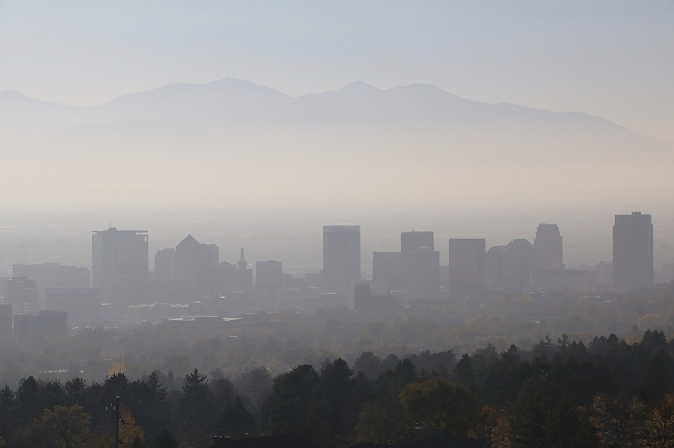
This is not fog, or snow, but engine exhaust and other emissions, caught between the warmed-up valley floor and a layer of cold atmosphere. 


Original picture by Eltiempo10, and posted under the Creative Commons Attribution-Sharealike 4.0 International License. Unfortunately unaltered. This is how my home looks every winter. 

Friday, May 23, 2025

A sustainable transition (Part III): A common interest

The tragedy of the commons is the theory that all common-pool resources (CPR) are finite and are thus in danger of exploitation and eventual destruction, and without governance individual users will exploit these resources to maximize their own benefit, and if their rate of use is faster than the time it takes for the resource to replenish their actions will lead to the eventual overuse and destruction of the CPR


The tragedy of the commons also leads to a conversation about the commons, and if people can recognize the value and vulnerability of the commons, to a coordinated effort of preservation.

This concept can best be understood in the binary of two birds. The passenger pigeon was a bird endemic to North America, and with an estimated population of five billion, was so abundant that their passage across the sky could obscure it as if there was an eclipse. While economic interests, such as protecting crops, were instrumental in their decline, they were also extensively used for trapshooting (before the advent of the clay pigeon) and as a source of food for a burgeoning New York City. 2014 marked the 100 year anniversary that they were entirely eradicated. On the other hand, the northern spotted owl was protected.1,200 pairs of these owls still live in Oregon, 560 pairs in Northern California, and 500 pairs in Washington, today. It is not an animal that is hunted or sought. But it is intolerant to shifts in its habitat, and threats to its livelihood gave rise to the President’s Northwest Plan, which barred logging in areas richly primed to do so, throwing “between 60,000 and 100,000 people out of work.” 

A commons was not threatened in the traditional sense—this was not a treaty about who can whale and how much. But it was a secondary commons—the typical tragedy of the commons has two elements: (1) a resource that can be extracted for the benefit of the extractor, that (2) the full extraction of which is a net and unrecoverable loss to the community—here, what was preserved for the benefit of the whole is the tradition and ecological system of the Pacific Northwest, and the reluctance to extinguish an entire form of life for the pursuit of profit. In sum, the “extraction” of the owl did not motivate the decision of timber companies to engage in logging, but its loss would still have been a net negative for the surrounding area, sparking a rule to protect the loss of a “common resource—the ecological, traditional, and moral benefit of the spotted owl. 

Now obviously an ecological tragedy of the commons is different from one of fossil fuels. There is no replenishment in fossil fuels; while the the stock is so vast that they are not likely to ever be fully
exhausted, there is an inevitability to the fact that they will be. There is only one way that coal can be “exhausted” and that is extracting all of it from the ground. That inures a benefit to the extractor, but it will not replenish, thereby distinguishing it slightly from the typical tragedy of the commons.  If we continue to extract coal, at any rate, it will inevitability be exhausted. While compelling, it is beyond the scope of this blog post to reconcile whether fossil fuel represents a tragedy of the commons (we could still have it if we didn’t exhaust it more than it could replenish) or something like an “inevitability of the commons” (it was never going to replenish anyway, but we could have gotten more out of it if we had just been more careful in which we extracted). But regardless, the commons still represents a common resource. 

The current push to site renewables at all costs means a push for utility-scale renewable energy installation. This has two major downsides. First, these projects are overwhelmingly sited in rural areas. Second, they benefit a sliver of the community’s social strata (wealthy, often absentee landowners, with extensive real estate holdings) while spreading the cost across the entire community. Third, without meaningful planning, the community may bear far more cost than benefit and may be strained to the point of collapse, much like the passenger pigeon. It is a prototypical example of the tragedy of the commons. 


I discussed in Part II the problem with transitional payments (a flat amount of money paid to displaced workers), and how they are unsuccessful. But the flip side of the argument considers the state surplus payments made every year by Alaska to its citizens. Why is it different? Primarily because it is distributed without red tape, but almost more importantly, because it is distributed equally. It is easier to accept the exploitation of a resource if you are receiving a benefit too—ironically, because the commons becomes common. No longer are a few small entities siphoning away something that belongs to all of us: we’re getting to sup on that straw too. In the tragedy of the commons, the costs accrue to everyone. Here, so do the benefits.

While rural America has borne the brunt of extraction, they now possess a somewhat perverse resource in spades: superfund sites. One of the major concerns with utility-scale renewable energy siting is that they will corrupt otherwise usable land (See Part I). But what if the land to be corrupted is already so? 

The term brownfield typically refers to land that is abandoned or underused, in part, because of concerns about contamination. The federal government defines brownfields as “abandoned, idled or underused industrial and commercial properties where expansion or redevelopment is complicated by real or perceived environmental contamination.” 

In the mid 1990s, the EPA began providing seed money to local governments to launch hundreds of two-year pilot projects and developed guidance and tools for cleanup and redevelopment of brownfield sites. The 2002 Small Business Liability Relief and Brownfields Revitalization Act codified many of EPA's practices, policies and guidance. The 2018 Brownfields Utilization, Investment and Local Development (BUILD) Act reauthorized EPA’s Brownfields Program and approved changes that affect grants, ownership and liability provisions, and State and Tribal Response Programs

Under the 2021 Bipartisan Infrastructure Law and the 2022 Inflation Reduction Act, Congress provided major funding to support planning, construction and operation of various public infrastructure improvements. Brownfields are continuously developing in both their characteristics and the government’s approach. It seems more than viable that a government could seize a brownfield through eminent domain and then remediate it enough to house solar farms. I want to stress here that there are two caveats. First, this must be a voluntary process undertaken with the consent of the community. Otherwise, it perpetuates an internal colony as better examined in Part IV--this would be the opposite of taking care of a commons. I It would be extractive. Second, this should not be the fate of all brownfield sites. These sites should still be cleaned up, but in the meantime, with climate change looming like it never has before, this land use could provide a temporary solution to a dire problem. 

Repurposing “bad land” into something better has already proven to be successful in rural communities, to some capacity. In Kentucky, hilltops blown out in search of coal have been repurposed to elevated communities, both reusing the land and relocating a flood-risk community to higher ground

When you think about rural America as a common resource, it is easier to justify what I think is a crucial component of the green transition. Compensating and rehabilitating these communities without benefitting the people who exploited them. I would advocate for governmental seizure of brownfield sites and other superfund sites through eminent domain, and construction of localized renewable energy projects. 

One main benefit of this is decentralizing the grid. If rural areas are able to achieve energy independence, not only can those communities prosper but the energy rate for the rest of the country goes down, and the durability of energy demand goes up. 

By conceptualizing rural America as a commons, we don’t only seek to protect it but justify investment in ensuring its continued existence—if not for them, then for us. Which cuts nicely antithetical to the current rhetoric of considering fossil fuel towns as backwards and standing in the face of progress. But what does extraction really mean to a community?

Monday, May 12, 2025

A sustainable transition (Part 1): Sustainable development and the green transition


Up until mid-twentieth century, miners would carry bright yellow canaries down into coal-blackened tunnels to carve out a meager living from the walls. Canaries are particularly sensitive to carbon monoxide, an odorless gas which can cause drowsiness, weakness, loss of consciousness, and death. Mining is hard, physical work, and miners would often fail to recognize the symptoms of carbon monoxide poisoning. The common canary exhibits distress in the presence of carbon monoxide poisoning and will die well before a human would begin to feel the effects of carbon monoxide poisoning. Thus, miners began to bring canaries down to warn them of the presence of the gas and thus escape its effects.

Although canaries helped save the lives of miners, the miners’ livelihoods are not threatened. Climate change and the pursuant public pivot away from fossil fuels, market volatility, the inconsistent distribution of mineable materials, and an increasingly globalized economy, can all contribute to significant job loss amongst miners. Furthermore, a miner's livelihood is tied to the amount of material present in the mine


A mine exists to extract a metal or mineral, and when the supply is exhausted, the mine is worthless supply, it is worthless. In addition, global politics and shifting market demand can lead to sudden and premature closure of otherwise stable mines, with with the workers the first to feel the impact of these shifts.  While whole swaths of miners lose their jobs, the owners of the mines feel relatively little impact. Ironically, coal workers can function as the “canary in the coal mine” for the coal industry itself. This is true for many extractive industries such as timber, oil, and natural gas

Furthermore, there are entire communities that depend on fossil fuel production to sustain their existence. But the world is facing a climate crisis that will require an energy transition on an unprecedented scale. We are left with a predicament: while we need to transition away from the fossil fuel industry, doing so requires the communities of workers that rely on that industry to sacrifice their way of life and their economies. Corporations have also perpetuated these extractive industries and have a strong interest in delaying this transition. 

So, here’s the trillion dollar question I will take up in this series of five posts: how do we transition a national urban-centric economy away from fossil fuels without destroying the rural communities that produce them? 

There is substantial literature on two aspects of the transition from fossil fuels to renewable energies, widely known as the “green transition.” First, the idea of “environmental justice,” and second, the idea of a "just transition."

Environmental Justice

As we all heard growing up, “the needs of the many outweigh the needs of the few.” But that is a maxim that should be invoked in times of disaster and crisis, not in city planning.


“Environmental justice” asks that the environmental costs associated with renewable energies be borne fairly instead of concentrated within low-income or majority-minority areas. Environmental justice is not a concept limited to the green transition; it has become increasingly relevant in discussions about where to site renewable energy industry and infrastructure.

I first came across the concept while working for the Department of Toxic Substances Control in Sacramento. Consider the car battery recycling process, which can infinitely recycle the lead component of the battery, melt and reform a substantial amount of the plastic casing, and neutralize the sulfuric acid or convert it to sodium sulfate, a product used in laundry detergent. Ninety-nine percent of car batteries are recycled. However, the recycling plant produces air emissions and a risk of lead contamination in air, soil, and groundwater. Battery recycling is an industry that benefits the community as a whole, but the smaller community near the plant suffers. For example, Exide Technologies shut its plant in May 2015, after years of fines and citations by the Department of Toxic Substances Control, leaving a five-square-mile brownfield site with elevated lead levels, near predominantly working-class and Latino neighborhoods. The cleanup in Vernon is ongoing. 

Another example of this conundrum is found in solar panel production. While the energy created by renewable energies is “clean,” the production of solar panels requires silicon, which must be mined, refined, and disposed of if the panel fails or is irreparably damaged. This both threatens health and safety due to emissions and environmental contamination and impacts the quality of life in an area through habitat destruction and a loss of natural beauty. 

Just Transitions 

A “just transition,” as articulated by Ann Eisenberg in a phenomenal law review article with that title, is a labor-driven principle of easing the burden that decarbonization poses to those who depend on high-carbon industries. It emphasizes a fair distribution of the risks and rewards of the green transition. Privately and publicly driven transition attempts have met varying degrees of success. 


In 2017, a nonprofit called Mined Minds came to West Virginia with promises to teach West Virginians how to write computer code, and then get them well-paying jobs. Many West Virginians quit their jobs or dropped out of school to participate, but almost none who signed up for the program are working in programming now. 

Alternatively, there are retraining programs that exist to train wind and solar installation technicians, and workers involved in zero-emission vehicle construction. However, these programs are not widespread and presently are neither widely targeted nor made free to fossil fuel workers. This may hamper their use as a transitional tool. 

In the past, the United States has provided some form of financial benefit to workers displaced by federal policy, such as compensating workers displaced by the Trade Act, the President’s Northwest Forest Plan, the Tobacco Transition Payment Program, and the POWER program. These payment programs have their own problems, which are discussed later in the series. 

Even successful non-fossil fuel climate transition projects, such as the USDA’s Rural Energy for America Program (which uses grants and loans to pay for clean energy projects for farmers and small business owners) and Climate Smart Commodities Program (which helps participating farmers implement production practices that help build soil health, sequester carbon, and enhance productivity) have been shut down or delayed by Trump’s USDA, casting some doubt on the integrity of long-term federal transition programs. 

California is “committed to achieving a just and equitable transition to carbon neutrality by 2045.” Although this will create a significant amount of jobs, only 56% of current fossil fuel workers will have “promising employment opportunities outside fossil fuel industries.” This number is likely to rise as renewable energy industry increases, but not enough to provide for all workers.

So, What’s Missing?

Nestled within the concepts of “environmental justice” and “just transitions” is the sustainable development triangle, a nexus between competing issues and interests like environmental stewardship, economic growth, and human well-being, to meet the needs of the present without compromising the ability of future generations to meet their own needs. Equity, Economy, and Environment lie at the three corners of the triangle. For example, “sustainably developed” housing can be pursued in a way that minimizes environmental impact in the surrounding area, drives improvements in Human Development Index and Multidimensional Poverty Index outcomes, and multiplies community jobs while improving household stability and providing opportunities for home-base. In this example, the issues considered can range from “good health and well-being” and “climate action” to “industry, innovation, and infrastructure” and “responsible consumption and production.”

Eisenberg explains that the existing policies of “environmental justice” and “just transitions” can be seen as lying on the sides of the triangle between ‘Equity and Environment’ and ‘Equity and Economy,’ respectively. 

What, then, lies between ‘Economy and Environment’? 

Extractive economies are unique in the fact that their economy is inextricable from their environment—these communities are ‘stapled’ to the resources they extract. In the late 19th and early 20th centuries, mill towns sprouted as forests were clearcut for the burgeoning timber industry. Mining towns cut into the rock to extract coal. Oil towns drilled down to start drawing up crude oil. However, the fate of many extractive economies is the same—once the resource has been fully extracted, the town fades away.

And What Comes Next? 

While environmental justice asks to distribute the costs of industry equitably, it may also take away the benefits from communities that find the costs acceptable. While just transitions aims to compensate individuals who will lose their employment in the green transition, that same person may be forced to relocate to find employment. 

This series of blog posts aims to discuss complex issues such as place, pride, and progress, and home in on a crucial aspect of the transition—how do we keep these communities intact? 

Here is a quick view of what’s to come: 

Part II of this series will cover the rural concept of “place” and how it factors into the identity of fossil fuel towns, even when there has been a past exploitative relationship with fossil fuel corporations, as well as how past transitions away from rural mono-economies have failed to adequately acknowledge this concept. 

Part III will examine Ann Eisenberg’s concept of rural America as a “commons,” and how this can help drive governmental investment in local communities instead of corporate investment in utility-scale renewable energy projects. 

Part IV will expose how the current renewable energy industry echoes past extractive economies like fossil fuels, and how localized renewable energy production could help decentralize the United States energy grid. 

Part V will examine several ways in which localized renewable energy siting could provide long-term stability for fossil fuel towns.