
Credit: USDA, May 2010
The Supplemental Nutrition Assistance Program (“SNAP”) has played a pivotal role as one of the most effective tools for combating food insecurity at a federal level. Food insecurity and food desserts often go hand in hand, and this blog has previously discussed their impacts. The current administration has proposed major changes to SNAP under the Make America Health Again (“MAHA”) campaign, but what exactly is happening? And how will those changes impact rural Americans differently than urban ones?
In July 2025, Congress passed H.R. 1 (the "One Big Beautiful Bill"), which introduced significant federal cuts to a range of social programs, including SNAP. Beginning in October 2027, the law will change SNAP’s work requirement policy, payment error rate policy, and the share of administrative costs covered by the federal government.
SNAP time-limit work requirements require participants to spend at least 80 hours per month engaged in allowable activities such as employment or job training. Previously, applied these requirements only to “able-bodied adults without dependents.” This group included people between the ages of 18 and 54 without children or a work-limiting disability, and excluded those who were pregnant, veterans, experiencing homelessness, or youth aged out of foster care. The new law expands these requirements. Now, non-disabled adults aged 55 to 64 without dependent children and non-disabled adults ages 18 to 64 whose youngest dependent is between the ages of 14 and 15 must meet the work requirement. In addition, the current law removes previous exemptions for veterans, people experiencing homelessness, and youth who aged out of foster care.
Beyond work requirements, the law also changes how states are held accountable for SNAP benefit distribution. SNAP defines the payment error rate as “the measurement of the accuracy of active case review.” In simple terms, the rate reflects the percentage of SNAP benefits that states issued incorrectly, including both overpayments and underpayments. In the past, states with high payment error rates were required to implement corrective action plans and could face financial penalties only after sustained high error rates over multiple years. Under the new law, states with payment error rates exceeding six percent will be required to absorb a portion of their SNAP benefit costs.
However, past data suggests that this threshold is set too low. In 2024, only seven states reported payment error rates below six percent. Additionally, in an effort to increase cost-sharing, the federal government has reduced the percentage of administrative costs it will cover, lowering the federal share from 50 percent to 25 percent. Administrative costs include staffing, case management, eligibility verification, IT systems, and customer service infrastructure. Cutting federal support in half places a higher burden on state budgets and makes it difficult for states to reduce payment error rates and properly enforce SNAP eligibility requirements.
Consequently, this cost-sharing structure will likely impose the greatest hardships on under-resourced states. For example, based on Ohio’s previous error rates, the state could potentially be on the hook for $318 million in SNAP benefit costs.
In addition to restructuring how SNAP operates, policymakers have also pushed to change what participants can purchase with their benefits. The MAHA movement has pushed to restrict the types of food that can be purchased with SNAP benefits. For decades, federal policy allowed SNAP benefits to be used to purchase any food item except alcohol and ready-to-eat hot foods. States wishing to impose any additional restrictions were required to obtain a waiver from the U.S. Department of Agriculture (USDA). While these federal rules remain in place several states encouraged by the current administration, have applied for waivers that would prevent SNAP benefits from being used to purchase “junk foods.” Beginning January 1, 2026, a number of states, including Utah, West Virginia, Nebraska, Iowa, and Indiana, implemented restrictions preventing SNAP participants from using their benefits to purchase soda.
Supporters of the MAHA movement frame these changes as necessary to combat a national health crisis, critics disagree. Opponents highlight the barriers that many rural communities already face when trying to access food. In some areas, residents may only have access to gas stations or small convenience markets as their primary food sources. Additional restriction on eligible food purchases could leave SNAP participants with few practical options for using their benefits. Furthermore, health policy experts note that limiting choices does not guarantee that individuals will make “healthier” decisions. Instead, these restrictions that limit food purchasing options may undermine participants’ autonomy and dignity.
Taken together, these changes represent a significant shift in the federal approach to SNAP. Expanded work requirements, increased state cost burdens, and new restrictions on eligible food purchases may share how participants access and use benefits. These changes will be felt strongly in many rural communities with limited food access. One in seven rural households rely on SNAP. For these Americans, limited job opportunities, seasonal or unstable employment, and long distances to workplaces make it significantly harder to consistently meet work requirements, especially when reliable transportation and childcare options remain scarce.
Showing posts with label disability. Show all posts
Showing posts with label disability. Show all posts
Thursday, March 12, 2026


Monday, June 23, 2025
Black lung spreads to younger miners due to complications from silica
Kate Morgan reports from the New York Times from a trip across Appalachia to learn about black lung disease's newest manifestation, which implicates silica and is affecting younger miners. Some key excerpts follow:
Modern miners are contracting [black lung disease] at younger ages and at rates not seen since the 1970s. For 20th-century miners, it could take decades to develop severe black lung. For men of Aundra Brock’s generation, just a few years can be enough. Nationwide, one in 10 working miners is now estimated to have black lung. In the heart of the central Appalachian coal fields, it’s one in five. Often, their disease is more severe, the progression faster. Doctors are seeing larger masses and more scarring in the lungs. Transplants, disability claims and deaths are all on the rise.
* * *
In an old industry, the reasons are modern. Centuries of extraction have altered the landscape, making the mountains more dangerous to mine, researchers say, and the men beneath them vulnerable not just to black lung, but to another lung disease called silicosis.
* * *
Silicosis is caused by inhaling a mineral called crystalline silica that is typically found in sand, stone and concrete. It is a building block of the Appalachians. But in the air, it is dangerous, able to create much worse scarring in the lungs than coal dust alone. Breathing the coal and silica dust together can create a kind of hybrid disease that quickly leads to progressive massive fibrosis.
Scientists and miners alike have long understood the dangers of the rock dust. “You can tell there’s silica when you see the flicker in it,” said Charles Thacker, a 69-year-old former miner from Norton, Va., who now has black lung. “It looks like bits of glass flashing in the light. It’s almost pretty. But that’s what gets in your lungs and cuts you up.”
Don't miss the rest of the story, which is chock full of human interest context. Also, I want to mention that the ravages of silica on miners was a topic of discussion at this event at West Virginia University College of Law this spring. (See the panel at 11:00 am).
Friday, January 10, 2025
US DOJ announces Access to Justice Prize to close "Rural Justice Gap"
This is from the Department of Justice press release.
The Justice Department’s Office for Access to Justice today announced the launch of the Access to Justice Prize, a year-long prize competition that aims to foster innovative solutions to address critical gaps in access to justice across the United States. The inaugural competition will focus on access to justice gaps faced by rural communities across the country, aiming to advance general public awareness about rural access to justice gaps; prompt and support the development of new and innovative solutions; and promote the replication and expansion of strategies that work.
“Through our engagement with courts, justice practitioners, legal aid providers, academic institutions and other organizations across the country, we’ve heard loud and clear that solutions to close the rural justice gap must begin with rural communities themselves,” said Director Rachel Rossi of the Justice Department’s Office for Access to Justice. “Through the Access to Justice Prize competition, we further this approach, empowering those who best know the barriers their communities face to drive the effective solutions that will ensure access to justice for all, regardless of geography.”
Nationwide access to justice barriers are often exacerbated for rural Americans, especially when unique circumstances like long travel times, limited internet access or lack of attorneys are too often overlooked. A 2022 study by the Legal Services Corporation revealed that 77% of low-income rural households experienced at least one civil legal problem in the previous year, with 94% receiving inadequate or no legal help. Additionally, rural criminal justice systems are strained by part-time judges, contract defense counsel and lacking prosecutorial resources. Studies demonstrate that recruitment and retention challenges are increasing for criminal justice careers in rural areas, including for public defenders, prosecutors and law enforcement. And rural courts face rising caseloads, delay, uneven workloads among judges and lack of resources.
The 2025 Access to Justice Prize aims to inspire and support innovative ideas that address these challenges by engaging those closest to the issues — rural courts, practitioners and organizations. Eligible participants are encouraged to submit proposals for any solutions that expand access to justice, including, for example, solutions to:
- Expanding access to legal representation, legal assistance, or legal information
- Utilizing alternatives to counsel or other innovative legal assistance models
- Breaking down barriers to accessing legal systems, including barriers disproportionately faced by rural Americans, like lack of proximity to a courthouse, ability to travel or access to broadband
- Simplifying legal processes, systems, forms, or language
- Reducing disparities among those navigating, or impacted by, legal systems
- Reducing the need for interaction with civil and criminal legal systems or developing efficient alternatives to justice processes
- Reducing any harmful effects of legal systems
- Accessing and utilizing technology to expedite and promote efficiency within courts and legal systems
- Advancing cost-saving strategies
- Expanding language access, utilizing written, spoken, and sign languages, as well as auxiliary communication aids and services
- Expanding access for people with disabilities
- Expanding access for specific rural populations, such as Tribal communities, low-income communities, communities of color, or other historically underserved communities
- Identifying and establishing innovative cross-sector, cross-agency, or otherwise unique partnerships to expand access to legal systems
- Reducing financial or economic barriers to accessing legal systems or economic conditions imposed on those impacted by legal systems
- Improving legal or other supports for victims and/or survivors
- Expanding access to legal systems by taking court/legal processes or assistance to communities, outside of the courtroom
- Expanding access to basic and collateral needs for those in rural communities who interact with legal systems, including, for example, housing, food, employment, etc.
- Promoting efficiency of systems or processes through customer or user experience strategies
More information and additional examples can be found here.The competition will run on a one-year cycle, starting in January 2025, and will feature two judging phases:Finalist Selection: Up to five finalists will receive $5,000 each and then refine their proposals over a six-month phase in preparation to compete for the grand prize.
Grand Prize Selection: Finalists will present their solutions at an Access to Justice Showcase, where judges will select the grand prize winner to receive $50,000.
Below is the timeline for the year-long Access to Justice Prize competition cycle:
- Jan. 7: Submissions open
- March 31: Submission deadline
- April 30: Finalists announced
- May 1 – Oct. 31: Refinement Phase
- Early December 2025: Grand Prize Showcase and winner announcement.
Wednesday, July 5, 2023
Census Bureau reports rural residents more likely to experience disability
The U.S. Census Bureau reported last week on rural-urban differences in disability. Here is the introductory material:
And here are the key findings re: rural-urban difference:Where people live may impact their ability to access health care services and for those with disabilities or who require specialized care that entails more frequent attention and medical visits, location can play an even more significant role.
It is important to understand how regional and urban/rural differences in disability contribute to the unique challenge of addressing health disparities in the United States. Identifying where people with disabilities are concentrated can help inform where there may be shortages of specialized providers or limited transportation options.
Examining disability rates across geography reveals notable differences between urban and rural areas, and regions.
In 2021, nearly 42.5 million people (13%) among the civilian noninstitutionalized population in the United States had a disability, according to the American Community Survey (ACS) 1-year estimates.
In 2021, the U.S. population was primarily urban, with 80.2% living in urban areas; 12.6% of them reported a disability in 2021.
Rural residents — less than 20% of the U.S. population — were more likely (14.7%) than their urban counterparts to experience disability.
Rural communities may be more geographically isolated and typically have more limited transportation and access to clinics and hospitals than urban areas. As a result, coordination of care for those with disabilities may be more difficult for rural residents due to these geographic and transportation barriers.

And here is what the report had to say about regional differences:
In 2021, the South had the nation’s highest rates of disability (13.8%), followed by the Midwest (13.1%), the Northeast (12.3%), and the West (12.1%) (Figure 2).
Regional disability rates may differ for a variety of reasons. For example, disability is often associated with age, so regions that contain states with a higher proportion of the population age 65 and over may be more likely to report higher rates of disability.
Many states in the South are part of what is known as the Stroke Belt, defined by the National Heart Lung and Blood Institute as a cluster of states (including Alabama, Arkansas, Georgia, Indiana, Kentucky, Louisiana, Mississippi, North Carolina, South Carolina, Tennessee and Virginia) that have a higher incidence of stroke than the rest of the country.
Tuesday, June 27, 2023
Literary ruralism (Part XXXVII): An interview with Barbara Kingsolver
The Guardian interviewed Barbara Kingsolver, winner of this year's Pulitzer Prize for her 2022 novel Demon Copperhead, on the occasion of the author also being awarded the Women's Prize for literature (previously the Orange Prize). (I've featured excerpts from the Demon Copperhead in prior Legal Ruralism posts here and here).
Writer Lisa Allardice characterizes Kingsolver as "angry" and then provides this quote from the author as Exhibit A:
I understand why rural people are so mad they want to blow up the system. That contempt of urban culture for half the country. I feel like I’m an ambassador between these worlds, trying to explain that if you want to have a conversation you don’t start it with the words, "You idiot."
Then there's this background on Kingsolver and the project:, which is set in Appalachia amidst the opioid epidemic:
With its deep-rooted evocation of place, epic scope and powerful moral purpose, Demon Copperhead is undoubtedly the defining novel of an already distinguished career.
* * *
“Now that it’s finished, I understand that my whole life I’ve been wanting to write the great Appalachian novel,” she says. For years she had been thinking of this big story she wanted to write “but that nobody wanted to hear”, not just about the prescription drugs crisis, but the generations of exploitation and institutional poverty, the plundering of the region for timber, coal and tobacco leading up to it. “Then Purdue Pharma targeting us saying, ‘OK, the last thing that we can make money off is the pain and the disability of the people who were injured in the previous industries’”, she says.
And this, which is about a part of the novel I excerpted in a prior post:
Part of the block in writing her Appalachian novel, she realises, is that she had “internalised the shame” of her rural upbringing. Now she feels she has not “just the right but the duty” to represent her community. “The news, the movies, TV, it’s all manufactured in cities about city people. We’re nothing. We don’t see ourselves at all. And if we do show up, it’s as a joke, the hillbillies. We are the last demographic that progressive people still mock with impunity.”
In one memorable passage, Demon lists off all the insults thrown at them: “Hillbilly, rednecks, moonshiners, ridge runners, hicks. Deplorables.” The last alludes to a comment by Hillary Clinton, referring to Trump supporters as “a basket of deplorables”. Now Kingsolver often spots bumper stickers proudly declaring “I’m a deplorable” in her neighbourhood. But her agent and editor, both based in New York, questioned whether she should include it. “I decided, yes, I’m leaving it in because I want this to make the reader uncomfortable.”
One of my earliest blog posts, from 2008, is about Kingsolver's Animal, Vegetable, Miracle (2007), and this one from earlier that year references the book. This post from 2014 is about her novel Flight Behavior.
Tuesday, June 7, 2022
Democrats strategize how to reach "factory towns" in Midwest, Rust Belt

Blake Hounshell writes for the New York Times about a new report from the political nonprofit American Family Voices (AFV) titled "Winning Back The Factory Towns That Made Trumpism Possible." Like an earlier report on this topic from AFV last fall, the report uses "factory town" as a term of art to refer to places reliant on manufacturing and union jobs. These places have also become associated with widespread population health issues, including the illnesses associated with deaths of despair.
Here's the lede from Hounshell's story:
Should Democrats bother competing in the struggling factory towns of the Midwest?
A report released on Tuesday answers this question with an emphatic “yes.” But the fact that it is being asked at all speaks to the Democratic Party’s still-unresolved challenge of how to win back the more than 2.6 million voters it has lost in places like Ottumwa, Iowa, and Scranton, Pa., since 2012.
More than five years after Donald Trump galvanized the white working class in America’s fading industrial heartland, Democrats are still trying to understand what happened, and debating whether they should scrounge elsewhere for votes. Should they try to run up the electoral score in urban areas and inner-ring suburbs instead?
Basic electoral math suggests that they have little choice: It would be exceedingly difficult for Democrats to win a governing majority without holding onto their “blue wall” in the Midwest, and continued erosion in smaller communities might make that impossible in the near future.
Hounshell then goes on to discuss Democrats' efforts to take open U.S. Senate seats in two Rust Belt states, Ohio and Pennsylvania, and two in the Midwest, Iowa and Wisconsin, "all states that are dotted with places that have been hurt by the effects of global economic and technological change over the last few decades." And these are not a paltry number of voters. The prior AFV report noted, for example, that midsize and small manufacturing counties are 58% of the statewide vote in Wisconsin and half of the voting population in Michigan.
The recommendations in this report are based on polling conducted by Lake Research Partners that "shows a population buffeted by the rising cost of living and suffering from health-related crises. A majority, for instance, said they or a family member had a chronic health condition. Majorities also said they had personally struggled with disabilities, job loss, mental health problems or addiction."
This is perhaps the most striking paragraph, quoting Mike Lux, a Democratic strategist whose roots are in the region and who is the primary author of the report, who spent much of the last year immersed in the study. He commented that “probably the No. 1 surprise to me is how desperate people are for community.”
That quote reminds me of Robert Putnam's Bowling Alone, about the loss of community.
Also regarding Iowa, where there were primary elections today, is this piece about the decline of Democrats in Dubuque, in the northeast quadrant of the state, which was historically the most Democratic part. Elaine Godfrey asks, "Are Iowa's Democratic Days Gone for Good?" Here are a couple of paragraphs of that story that link it to the American Family Voices report, featuring references to the Simpsons, a die-hard Democratic family with deep roots in Dubuque:
After 60 years, voters in Dubuque County seem finished with Democrats. Nationwide, the trends are the same: Working-class voters without a college education are voting more in line with Republicans, while Democrats make inroads among more educated voters. The political winds that used to propel the Simpsons forward in each election are now blowing hard against them.
* * *
Last fall, 10,000 John Deere workers across the country, including many in Dubuque, went on strike for five weeks while they negotiated a new contract. One of Kelly’s cousins was on the picket line, and she told Kelly about men who went on strike wearing their bright-red trump 24 T-shirts. A decade ago, the thought of a UAW member in Dubuque openly supporting a Republican presidential candidate on the picket line was inconceivable. “Donald Trump wasn’t for you!” Kelly wanted to shout at them. “Not one of them should ever be wearing a Trump ’24 shirt. Because then we have failed them.”
Dubuque UAW members who swung to Trump didn’t do so because of his policy promises, though, Dan White, the former president of the union local, told me. Sure, they liked that he talked about keeping jobs in America, but mostly they really just appreciated the way he talked, and how he sounded like he was on their side. Fox News, talk radio, and social media helped reinforce that impression, Tom Townsend, the business manager of the local IBEW, told me. Many of his members have fully bought into the right’s portrayal of Democrats—that they’re all socialists who want to take their guns. They won’t listen when Townsend tries to tell them otherwise.
Changing the reputation that Democrats have in northeast Iowa right now will be a tough project.
Saturday, March 5, 2022
Are findings of disability in rural areas on the decline?
The headline in the Athens (Georgia) News Courier is, "Disability claims challenging in rural areas; data shows low approval rates." The story is from last October, though it just showed up in my Twitter timeline yesterday. Here's an excerpt:
Getting approved for disability payments from the Social Security Administration isn't easy, but depending on where you live, it could be even harder.
In North Alabama, for example, three of the judges who hear disability claims have the lowest approval record of any administrative law judge in the state; two of them also have among the lowest approval rate of any of the 12,000 judges nationwide.
In 2020, 39% of initial disability applications were approved nationwide, according to SSA data. August 2021 data shows that Alabama has the fourth lowest disability claim approval rating — 32.3% — while nationwide data shows a 41.7% approval rate.
Receiving disability payments isn't easy to begin with and that's by design. In the past decade, the Social Security Administration has changed the regulations to make it harder to get disability claims approved.
Social Security has a tight definition of disability: "the inability to engage in substantial gainful activity (work) due to a medically determinable physical or mental impairment that has lasted or is expected to last at least one year or to result in death," said Patti Patterson, regional communications director for the Atlanta region Social Security office, which represents Alabama and seven other Southern states.
The Social Security Disability website lists a range of impairments and disorders that could qualify for disability including mental, respiratory system, immune system and cardiovascular system if it is deemed through medical records to be severe enough to prevent one from working.
Many disability applicants think they'll only need a letter from their doctor saying that they need to be on disability. Not only has it never been that simple, but in 2017, the Social Security Administration made it even easier to dismiss the recommendation of doctors by allowing denial due to the doctor's specialty, and length of treatment and type of treatment, among other factors.
Rachael Henderson of Georgia Legal Services Program, which represents disability clients in 155 counties outside of metro Atlanta, said access to transportation has been a longstanding barrier in rural counties where its clients have tried to get disability.
“In rural areas you will frequently not have any physicians. Over the last few years in some of our rural areas, in one or two counties, they lost the hospitals,” she explained. “You have to get to a city of significant size in order to get to a physician."
You'll find lots of other posts about disability determinations in rural places, and associated issues, here. Certainly, this article flies in the face of the assumption that it is easier to get adjudicated as disabled in rural America than in urban America. Specifically, here is a post focused on disability and transportation, in the context of New York. And this is from a Washington Post series in 2017.
Wednesday, February 23, 2022
Aging and disability services unequally distributed along rural-urban axis
Here's the policy brief from Syracuse University's Lerner Center for Public Health, authored by Claire Pendergrast (Syracuse) and Danielle Rhubart (Penn State):
As the U.S. population ages, demand for aging and disability services will increase, but 15% of U.S. counties have no aging and disability services organizations. This brief shows that rural counties and counties with the highest rates of poverty, highest shares of older adults, and highest shares of non-Hispanic Blacks are most likely to be aging and disability services deserts. To support healthy aging across the country, policymakers should invest in aging services infrastructure and should prioritize resources for places that are aging and disability services deserts.
And here is a related paper, also about aging and rurality, just published in the Journal of Rural Social Sciences, "Support from Adult Children and Parental Health in Rural America," by Shelley Clark, Elizabeth M. Lawrence, and Shannon M. Monnat. The abstract follows:
Adult children are a primary source of care for their aging parents. Parents in rural areas, however, live further from their adult children than parents in urban areas, potentially limiting the support they receive and compromising their health and ability to age in place. We use two waves of the Panel Study of Income Dynamics (2013 and 2017) to investigate the relationships among geographic proximity, adult children’s instrumental and financial support, and parental health. Rural parents live further from their adult children and receive less financial support, but they are more likely to receive instrumental assistance. In addition, rural parents have worse health and more functional limitations than urban parents, and these differences persist after controlling for proximity to and support from adult children. Our findings indicate that factors beyond proximity influence the complex relationships between spatial and social boundaries and their consequences for older adults’ health and well-being.
Saturday, December 11, 2021
Small-town America in Bob Dole's life
Frank Morris reports for NPR this morning on the memorial service for Bob Dole in his hometown, Russell, Kansas, population 4,401. Here's an excerpt that highlights what Dole's hometown meant to him, with a vignette from 1976, when he was Gerald Ford's running mate:
MORRIS: At the Historical Society in Russell, about half the displays are devoted to Bob Dole.
ALDEAN BANKER: Yeah, he was a handsome guy - wasn't he? - very handsome and...
MORRIS: Aldean Banker is showing off a big photo of a dapper teenage Bob Dole. Dole worked long hours in his dad's struggling grain business and at the drugstore on Main Street. He was a star athlete recruited to play basketball at the University of Kansas. The first in his family to go to college, he quit to go to war. Grievously wounded attacking a Nazi machine gun position, he narrowly survived to endure years of surgeries that left him with a withered right arm and only partial use of his left one.
BANKER: Anybody who has gone through what he's gone through would have maybe given up, and he did not do that. His work ethic did not allow him to do that.
MORRIS: Back in Russell, Dole tried to strengthen his shattered body working out with homemade weights on pulleys. Banker says townsfolk stuffed donations in a cigar box at the drugstore to help with expenses.
BANKER: I think he was overwhelmed by the support that he got from the city, and he never forgot that.
MORRIS: Russell voters launched Dole's political career. And in 1976, Gerald Ford tapped Senator Dole to be his presidential running mate. Dole insisted that the first campaign stop after the convention would be Russell, Kan.
(SOUNDBITE OF ARCHIVED RECORDING)
BOB DOLE: But I want to reemphasize, as I did before, if I have done anything, it's because of people I have known up and down Main Street. And I can recall the time when I needed help, the people of Russell helped.
MORRIS: Dole broke down on stage as Gerald Ford and townspeople applauded supportively. He struggled most of a minute to regain composure. After losing the election, Senator Dole worked across the aisle, joining liberal Democrats to improve food assistance, Social Security and the rights of people with disabilities. Dole fought pitched partisan battles, but he never slandered his political opponents as enemies - never called them evil. That kind of talk was way too grandiose for Bob Dole. He maintained a self-deprecating sense of humor and perspective grounded, he said, in his childhood on the high plains of Kansas.
This is fascinating--that Dole wound up supporting food aid, Social Security and people with disabilities. Those are programs we tend to associate with Democrats--but they also do reflect rural needs, as well as urban ones of course. Here's the end of the Morris story, which hints at the limitations of man--and therefore the limitations of self-sufficiency:
DOLE: The first thing you learn on the prairie is the relative size of a man compared to the lay of the land. And under the immense sky where I was born and raised, a man is very small. And if he thinks otherwise, he is wrong.
Sunday, September 12, 2021
Looking out for the rural disabled in the midst of natural disasters
The New York Times published a big story today on the challenges of protecting people with disabilities amidst natural disasters like the recent wildfires in California. Amanda Morris reports from the Dixie Fire, including Plumas County.
As wildfires burn with greater size and intensity across the American West, forcing thousands of people to evacuate their homes each year, communities in the danger zone are struggling to protect their disabled and older residents.
This is a particular problem in Northern California, where some of the biggest blazes are now burning, including the Dixie fire, the second largest in state history. The region is home to a significant population of people with disabilities — the percentage in the area is roughly twice the state average — many of whom live in largely rural areas that lack the critical infrastructure and resources needed to support them during disasters.
The Camp fire wiped out the town of Paradise in 2018, killing at least 85 people — the majority of whom were older or disabled, according to Butte County data. The next year, a state audit found that the county, which includes Paradise, had not adequately prepared to protect people with “access and functional needs,” and that the California Governor’s Office of Emergency Services had not provided enough guidance to local officials about how to develop emergency plans for them.
Since then, a growing number of California communities have partnered with local disability organizations to develop better plans to alert, evacuate and shelter vulnerable populations. But plenty of weak spots remain, and officials acknowledge that many people could still find themselves in danger.
Other posts about the Dixie Fire are here, and other posts about disability issues are here.
Sunday, June 20, 2021
Law and Order in the Ozarks (Part CXXX): Federal regulation of rural polling places
 |
| (c) Lisa R. Pruitt 2010 Murray Community Center, Newton County, Arkansas The sign on the post, facing the other direction, marks handicapped parking |
The June 9, 2021 issue of the Newton County Times features the headline, "Access to polls need addressed." The story is about the interface of federal law and local government, specifically with regard to federal disability law, the Americans with Disabilities Act (ADA). In the course of reporting the matter, the writer tells us something about how elections are financed and run in a small, rural county in Arkansas, i.e., the state provided "new voting machines and other equipment" last year; the number of polling places shrunk in the last election, amidst the pandemic. The story also tells us that the county does have a legal adviser to assist it in responding to a federal communication regarding compliance with federal law.
The Newton County Quorum Court [like a County Board of Supervisors] met almost a week earlier than normal to take care of some important business Tuesday night, June 1. The items on the agenda were a resolution and an ordinance required to answer a US Department of Justice (DOJ) warning that deficiencies under the Americans with Disabilities Act existed at some voting locations in the county.
Brad Brown, the county's legal adviser, said the DOJ sent a list of deficiencies to the county election commission, but the election panel does not have budgeted funds to address the problems. Most of them concern adequate parking, level pads and specified ramps necessary to provide wheelchair-bound voters unimpeded access to the polls. Corrections have to be made by the next regular election in 2022. The county is also required to appoint an ADA coordinator to make sure polling locations are accessible under the law.
Last year, the county received new voting machines and other equipment from the state. The election commission consolidated the more than 20 polling locations into 11 voting centers. Voters could vote at any of the centers even if they're not located in their home precincts. Some of those locations were new and weren't selected until shortly before the election.
Brown said he spoke with DOJ officials and they are willing to work with the county and election commission to ensure changes are made by the next election.
County Clerk Donnie Davis told the justices of the peace [the five elected officials who make up the the Quorum Court) that the election commission doesn't want to close any more polling sites. If locations can not be brought into compliance other locations would have to be found.
County Judge Warren Campbell said a bonded contractor should be hired by the county to ensure that the ramps and other facility updates are built to exact ADA specifications. He did not know what the cost would be for the work, but added that it has to be done. Money would have to be appropriated from the county general fund. It would be transferred into an election commission line item. Davis did not know if the state would assist in the work's funding.
The quorum court then passed the resolution agreeing to meet the DOJ directions and meet the ADA mandates.
It also voted to amend the county's 2021 budget ordinance regarding employees and compensation adding an ADA coordinator position that will pay $12 per hour.
Here is a fall, 2020 story about the county's voting plan, using "voting centers."
In somewhat related news, the New York Times reported today that the Arkansas legislature, like that of various other states, is making moves to assert greater control over local elections. It's not clear what impact this would have in a place like Newton County, which has minimal bureaucracy (election board?) but plenty of concentrated power.
P.S. I've belatedly been made aware of this June 17, 2021 Arkansas Democrat-Gazette story about the Newton County voting matter. It's written by Bill Bowden, who provides some helpful background not in the Newton County Times coverage, as well as an update on events: The U.S. Department of Justice has reached a settlement with the county under Title II of the ADA:
During election day on March 3, 2020, and early voting the previous day, inspectors from the federal government surveyed the county courthouse in Jasper, used during early voting, and all 18 of the county's polling places.
The settlement states:
All of the polling places surveyed contained architectural barriers that rendered the facilities inaccessible to voters with disabilities, such as a lack of accessible parking areas and accessible routes due to gravel and grass ground surfaces; excessively sloped ramps, some without handrails and edge protection; numerous gaps and level changes along exterior routes; and protruding objects.
Bowden's story notes another important infirmity not noted in the local paper's story:
Also, there was a lack of access to working voting machines at all polling places, according to the settlement.
[County Clerk Donnie] Davis said federal inspectors also determined that a wheelchair ramp at the county courthouse was too steep. He said they checked it with a level.
Here's a blog post I wrote 11 years ago about voting in Newton County. Its focus was the rather more exciting topic of vote buying, which has a long history in Newton County. Makes me wonder if that's what brought the DOJ inspectors to the county in March, 2020. If so, I'm relieved that they found only ADA violations and no vote buying, though the malfunctioning voting machines are concerning, especially if they were new and recently provided by the State.
Monday, March 29, 2021
Siskiyou County’s mental health court
The California Report Magazine recently reported on how one woman’s cycle of incarceration and mental illness encouraged a rural county to change it’s system. A resident of Siskiyou County, Marlene Baker’s untreated mental illness led her to have frequent contact with law enforcement for minor offenses associated with homelessness, and be repeatedly booked into and released from their overcrowded jail.
Siskiyou County is in far Northern California and spans 6,000 square miles, but is home to just 44,000 people. Many common rural disadvantages intersect for the residents there, such as a lack of public transportation or community healthcare resources.
According to the California Report,
Siskiyou County now has what they call a behavioral health court. It wipes the criminal charges off the records of participants who complete mental health treatment, and keeps them in the community while they do it.
Siskiyou County’s approach to a mental health court can potentially be a model for other counties in California, rural or urban. Studies have proven that mental health courts are effective. Specifically, “participants are significantly more likely to utilize treatment services, less likely to be rearrested, and spent fewer days in jail as opposed to nonparticipants.”
People with mental health disabilities are overrepresented in jail and prison. In a moment where much of our national conversation is centering on how to move away from our carceral system and integrate a nuanced understanding of mental health, it seems appropriate to include in our community court systems. Perhaps Siskiyou County can be one model for keeping people in their rural communities while also finding a way to get them the mental health supports they need.
Siskiyou County is in far Northern California and spans 6,000 square miles, but is home to just 44,000 people. Many common rural disadvantages intersect for the residents there, such as a lack of public transportation or community healthcare resources.
According to the California Report,
Mental illness plays a role in a high number of criminal cases here. What to do once those people enter the system, said Siskiyou County District Attorney Kirk Andrus, is a vexing question.When Baker was charged with a felony, she became a test case for a new way of addressing the intersection of crime and mental illness in the county. The judge, the public defender, county mental health officials, and prosecutor, came to an agreement that instead of returning her to jail or sending her to a state hospital, they would try to help her on the outside. Her case worker found her housing, which she credits as the key to her success. She was able to continue showing up to her court dates, a challenge without public transportation, and ultimately had her record cleared and legal competence restored.
“You've got a community that wants to be protected,” he said. “But you also have a person who needs intervention and not necessarily the kind of intervention that we have to offer. It's a massive problem.”
In Baker’s case, though, despite those rural challenges — in some ways because of them — a number of key people took some risks and bent some rules to help her heal in the community, with her freedom intact. And her success is helping to bring about some bold changes in the way Siskiyou County confronts its mental health crisis.
Siskiyou County now has what they call a behavioral health court. It wipes the criminal charges off the records of participants who complete mental health treatment, and keeps them in the community while they do it.
Siskiyou County’s approach to a mental health court can potentially be a model for other counties in California, rural or urban. Studies have proven that mental health courts are effective. Specifically, “participants are significantly more likely to utilize treatment services, less likely to be rearrested, and spent fewer days in jail as opposed to nonparticipants.”
People with mental health disabilities are overrepresented in jail and prison. In a moment where much of our national conversation is centering on how to move away from our carceral system and integrate a nuanced understanding of mental health, it seems appropriate to include in our community court systems. Perhaps Siskiyou County can be one model for keeping people in their rural communities while also finding a way to get them the mental health supports they need.
Thursday, August 27, 2020
Rural poverty and disability as peril in the California wildfires
The Los Angeles Times today ran a feature story about the three civilians (by that I means not fire fighters or PG & E employees) killed in the LNU Complex Fire spanning Solano, Napa, Sonoma and Lake counties as fires have raged there for the past 8 days. This is the fire that's been declared the second largest in California history.
The dateline for this story is Lake Berryessa, but that is not even a Census Designated Place. It is just a lake. The lake is, however, surrounded by some settlements, not all even Census Designated Places, including Spanish Flat, one of the communities hardest hit by the recent wildfire. That is where this iconic photo was taken, and here's an excerpt from the New York Times description of what happened to the folks who live there:
As for many rural residents in California, there was no effective system to warn them of the wildfire danger. These are also the themes from the 2017 and 2018 wildfires in, among other places, Mendocino, Butte, and Sonoma counties.
The dateline for this story is Lake Berryessa, but that is not even a Census Designated Place. It is just a lake. The lake is, however, surrounded by some settlements, not all even Census Designated Places, including Spanish Flat, one of the communities hardest hit by the recent wildfire. That is where this iconic photo was taken, and here's an excerpt from the New York Times description of what happened to the folks who live there:
Much of the lakefront community of retirees and young families who commute to landscaping, winery and service jobs in wealthier corners of Napa County had been reduced to a thicket of tangled steel and ash.In any event, the LA Times story by Anita Chabria (formerly of the Sacramento Bee) features, compassionately, these rural fire victims, their precautions and their demise. (They are also named but described in much less detail in the New York Times coverage.) What I also see here, though, is a depiction of rural vulnerability intersecting with other vulnerabilities: disability, low-income, elderly, spatial isolation. Here's an excerpt from Chabria's story:
Normally, there is no cellphone signal in these parched hills that form the basin for Lake Berryessa, a reservoir that runs 15 miles across Napa County’s Vaca Mountains. But that evening, [70-year old Mary Hintemeyer] was able to reach her oldest child, Robert McNeal, who lives 13 miles away in the closest town, Winters. He told her to get out.
As they spoke, she turned back toward the mobile home where she lived with her disabled boyfriend, Leo McDermott, and his son, Thomas. Behind it, on the ridge that loomed above her, she saw smoke — another fire coming out of nearby Wragg Canyon, which she thought had been contained.
“She said, ‘Oh my God, it’s coming over the other side toward me,’” said McNeal, remembering his last conversation with his mother. “‘I have to go.’”Among other things, this story is a reminder that places thought of as rich in the national imaginary--Napa Valley, for example--are also home to low-income folks, sometimes eking out a living in their own little slice of the American dream. Hintemeyer had worked the customer service desk at the Vallejo Times Herald, but also cleaning homes. Belly dancing was a hobby. Her 71-year-old boyfriend, Leo McDermott, was wheelchair bound.
As for many rural residents in California, there was no effective system to warn them of the wildfire danger. These are also the themes from the 2017 and 2018 wildfires in, among other places, Mendocino, Butte, and Sonoma counties.
Tuesday, March 17, 2020
Coronavirus impacts in rural America (Part I: Health)
The media are increasingly paying attention to how coronavirus is playing out differently in rural and urban areas. From the perspective of a ruralist, the news is mixed. First, commentators seemed to suggest that rural America would fare better than the rest of the nation because it is less exposed--less in contact with the people who would have the virus. An illustration of this is that as of March 16, West Virginia didn't yet have a single positive test. Other states popularly thought of as "rural" were slow (compared to other states) to identify their first cases; these include North Dakota, Arkansas, Idaho, Mississippi, Alabama, New Mexico, Wyoming and Maine, none of which had a single diagnosed case as of March 10). Of course, we don't know whether this is because people there did not have access to testing or whether, in fact, the virus was slow to spread there.
This Washington Post story from today indicates that population density drives the spread of the virus, which helps explain why many rural areas are not as hard hit. An exception to that "rule" of low incidence in rural communities is here, from the New York Times, out of Cynthiana, Kentucky, population 6,402, where six cases were diagnosed the first week in March.
The media have also shifted some of their coverage to rural deficits, particularly in the health care sector, which will make it difficult for rural hospitals and medical professionals to deliver the standard of care associated with more populous places.
An example of this is NPR's March 15 story out of Grangeville, Idaho, population 3,141 and the county seat of Idaho County, the largest in land area in the state and spanning the width of Idaho, from Montana to Washington State, just as the state's territory narrows to the panhandle. Here's an except from the story by Kirk Siegler, a veteran reporter on the American West:
As I write this, I'm listening to Governor Gavin Newsom's long press conference for this afternoon, and he's talking about the President's embrace--finally--of telehealth use by Medicare. As many rural folks already know, telehealth can be a lifeline--literally.
Here's a much earlier story (relatively speaking in this time when a month seems to pass every few hours), from March 5, by the Center for American Progress. This excerpt highlights rural demographics and economics--as well as rural deficits--and their salience to the coronavirus outbreak:
P.S. Another resource I just discovered on March 18.
P.P.S. These projections from March 20 suggest that some rural areas--see north central Montana--will not be hard hit even under the worst-case scenarios associated with no social distancing. Generally, more sparsely populous areas will be less hard hit--just look at places like California's Inland Empire, West Texas, western parts of Nebraska and Kansas, and the corner of the remote Arkansas Ozarks where I grew up.
This Washington Post story from today indicates that population density drives the spread of the virus, which helps explain why many rural areas are not as hard hit. An exception to that "rule" of low incidence in rural communities is here, from the New York Times, out of Cynthiana, Kentucky, population 6,402, where six cases were diagnosed the first week in March.
The media have also shifted some of their coverage to rural deficits, particularly in the health care sector, which will make it difficult for rural hospitals and medical professionals to deliver the standard of care associated with more populous places.
An example of this is NPR's March 15 story out of Grangeville, Idaho, population 3,141 and the county seat of Idaho County, the largest in land area in the state and spanning the width of Idaho, from Montana to Washington State, just as the state's territory narrows to the panhandle. Here's an except from the story by Kirk Siegler, a veteran reporter on the American West:
Syringa Hospital has just 15 beds, an emergency room and a clinic. As is common in rural medicine, the chief medical officer, Dr. Matthew Told, is also a family practice OB and, on a recent evening, the on-call ER doc.
"We don't have ventilator services, we don't have respiratory therapy," Told says during a break between seeing patients.
There is no intensive care unit. So when they do get a critically ill patient or trauma victims, it's standard protocol to stabilize and transfer them to a large regional hospital in western Montana or Spokane, Wash. But what if ICUs in those places become overwhelmed with coronavirus patients?
"The biggest challenge is living so close to a state where there are so many cases, such as Washington, and having that really just across the border," Told says.And a few paragraphs later is this related, illuminating comment from Dr. Mark Deutchman, associate dean for rural health at the University of Colorado's medical school.
If the places that you rely on to send your critically ill patients are full, then you're stuck.In other words, this Grangeville hospital and is at the mercy of larger hospitals in Washington State, or perhaps in Montana or in Lewiston, more than an hour to the north, if a patient needs a ventilator. Rural hospitals face other challenges:
Told knows that his hospital could soon be completely overwhelmed and unable to effectively treat anyone, coronavirus patient or not. This is the story in many communities right now. But it could have an even more dire effect in isolated rural towns like this that lack the infrastructure or trained staff, especially if they were to get sick and couldn't come to work.A similar story is reported from nearby Dayton, Washington, population 2,526, by Eli Saslow of the Washington Post. The themes are the same: under-resourced facility with few staff, reliant on larger hospitals in the region, in this case Walla Walla and Spokane, if the need arises. Here's an atmospheric quote from the story, which provides context for both Dayton General and what is happening to rural hospitals across the United States:
[Dayton General] had ... for the past several years [been] somehow keeping the doors open even as America’s rural health-care system collapsed all around them, with 125 other rural hospitals around the country closing for budget reasons and doctor shortages spreading across 85 percent of rural counties. Dayton General could no longer afford to offer obstetrics, endoscopy or surgery of any kind. Its emergency room and nursing home were both losing more than $1 million per year. But the hospital remained the final lifeline for an aging community of about 5,000 people in a rugged corner of southeast Washington state, isolated from all other medical care by 35 miles of barley and wheat.Noting that Dayton General has not ventilators, Saslow continues:
“This is a virus that can take over and expose your weaknesses,” [Shane] McGuire [CEO of Dayton General] said, and he feared that was true for both rural residents and the beleaguered hospitals left to care for them.
The virus had just arrived in rural America, but already, small hospitals across the country had begun bumping up against the limitations of their resources. A facility in the Berkshires had lost much of its nursing staff to a 14-day quarantine. A critical access hospital in North Texas had only one face shield in storage and couldn’t acquire any others. A hospital in Wisconsin was borrowing sterilized medical gowns from local dentists.As is typical of Saslow's reporting, the story features lots of great human interest angles, including an aging physician who retired to his hometown a few miles from Dayton, only to become the emergency department director at Dayton General a few years later.
As I write this, I'm listening to Governor Gavin Newsom's long press conference for this afternoon, and he's talking about the President's embrace--finally--of telehealth use by Medicare. As many rural folks already know, telehealth can be a lifeline--literally.
Here's a much earlier story (relatively speaking in this time when a month seems to pass every few hours), from March 5, by the Center for American Progress. This excerpt highlights rural demographics and economics--as well as rural deficits--and their salience to the coronavirus outbreak:
The CDC also urges people to contact their health care professional if they believe they may have been exposed to the virus.
For many vulnerable individuals, following these instructions are not an option. Though government health agencies may instruct the public on how to combat COVID-19, they don’t give them the capacity or tools to do it. For rural America, which has a higher proportion of people vulnerable to the virus—including those who are older and those with disabilities—these resources are sorely lacking.
As experts have recently noted, many low-income individuals are employed in occupations that do not have health benefits or provide paid sick leave. Rural workers are less likely to have access to paid sick leave than urban workers. Many individuals may be working several jobs so, for them, staying home is not financially feasible. Some companies have encouraged their employees to work from home in order to reduce the chance of transmission, but that isn’t feasible for individuals that don’t have reliable, high-speed internet access at home. Many more Americans work jobs that cannot be performed remotely.
For many who live in rural areas, including many communities of color, LGBTQ people, and people with disabilities, these factors make it impossible to work remotely. Almost one-third of rural households lack internet at home. Though many conflate the agriculture sector with the entire rural economy, the service sector employs the largest number of workers in rural counties, and many of those are in lower-paid occupations in the education, health, and food service sectors. More likely than not, these workers cannot work remotely—nor can they afford to miss work. Because of the economy that rural Americans face, they do not have the capacity to keep themselves safe from COVID-19 and continue to make a living.This story, by Olugbenga Ajilore, a senior economist for the Economic Policy Team at the Center for American Progress, and Zoe Willingham, a research associate for the Economic Policy Team at the Center, is chock full of helpful links providing detailed rural context re economics and demography.
P.S. Another resource I just discovered on March 18.
P.P.S. These projections from March 20 suggest that some rural areas--see north central Montana--will not be hard hit even under the worst-case scenarios associated with no social distancing. Generally, more sparsely populous areas will be less hard hit--just look at places like California's Inland Empire, West Texas, western parts of Nebraska and Kansas, and the corner of the remote Arkansas Ozarks where I grew up.
Saturday, October 26, 2019
On California's wildfires and blackouts, and their impact on rural folks
As we enter the second major round of blackouts in California, I thought I'd collect here some coverage of the last round, earlier this month, and also some breaking news of the impact on rural Californians up and down the state.
During the mid-October blackouts, the Wall Street Journal ran this story with the dateline Eureka, California, population 27,191, and county seat of Humboldt County, population 132,646. The story features the North Coast Co-op, which had to throw out spoiled food after power was cut off.
Anita Chaba and Taryn Luna filed this story for the Los Angeles Times on October 11, headlined "PG&E power outages bring darkness, stress and debt to California’s poor and elderly." The dateline is Clearlake, California, population 15,000, and its focus is the personal toll on residents living with the power outages, including the frail and elderly. Here's an excerpt:
As I prepare to post this, the Sonoma County communities of Healdsburg (population 11,254) and Windsor (population 26,801) are under evacuation orders because of the Kincaide Fire, which required the evacuation of smaller Geyserville (population 862) earlier this week. Hundreds of thousands of customers are expected to be without power in both rural and urban parts of California this weekend.
During the mid-October blackouts, the Wall Street Journal ran this story with the dateline Eureka, California, population 27,191, and county seat of Humboldt County, population 132,646. The story features the North Coast Co-op, which had to throw out spoiled food after power was cut off.
Anita Chaba and Taryn Luna filed this story for the Los Angeles Times on October 11, headlined "PG&E power outages bring darkness, stress and debt to California’s poor and elderly." The dateline is Clearlake, California, population 15,000, and its focus is the personal toll on residents living with the power outages, including the frail and elderly. Here's an excerpt:
Few understood what the challenges would be until they were in the dark: a mom who couldn’t refill her son’s medication for bipolar disorder; a man with schizophrenia who couldn’t quiet the voices in his head without the television on; the people on dialysis who had to travel to another town. In El Dorado County, just northeast of Sacramento, an elderly man died minutes after apparently losing power to his CPAP machine, according to a report from the local fire agency, though an autopsy listed severe coronary artery atherosclerosis as the cause of death.
Even little things became hard. Ice and charcoal were scarce, making it difficult to keep food cold or cook a meal. Freezing showers were too intimidating for elderly nursing home residents as fall arrives with 45-degree nights here.
“You don’t know until it happens how it’s really going to affect you,” said Tara Drolma, 72, who was watching the power fade on her emergency battery, and wondering if she would have to choose between charging her electric wheelchair or her heart monitor.In November last year, following the eruption of the Camp Fire which destroyed Paradise, California, the Los Angeles Times ran this story about possible long-term solutions to the state's fire danger. Its headline is, "Deadly California fires prompt bold thinking about prevention: Shelters, strict zoning, buyouts." It quotes Bruce Cain of Stanford's Bill Lane Center for the American West:
We have to really start to think about new measures and new approaches that have to be more drastic. ... [Among them is] “a strategic retreat from communities that are never going to be safe.And here's perhaps the most ominous headline, from the New York Times this week, "A Forecast for a Warming World: Learning How to Live with Wildfire."
As I prepare to post this, the Sonoma County communities of Healdsburg (population 11,254) and Windsor (population 26,801) are under evacuation orders because of the Kincaide Fire, which required the evacuation of smaller Geyserville (population 862) earlier this week. Hundreds of thousands of customers are expected to be without power in both rural and urban parts of California this weekend.
Monday, August 5, 2019
Rural media (Part I): A new feature reporting from the pages of small-town newspapers
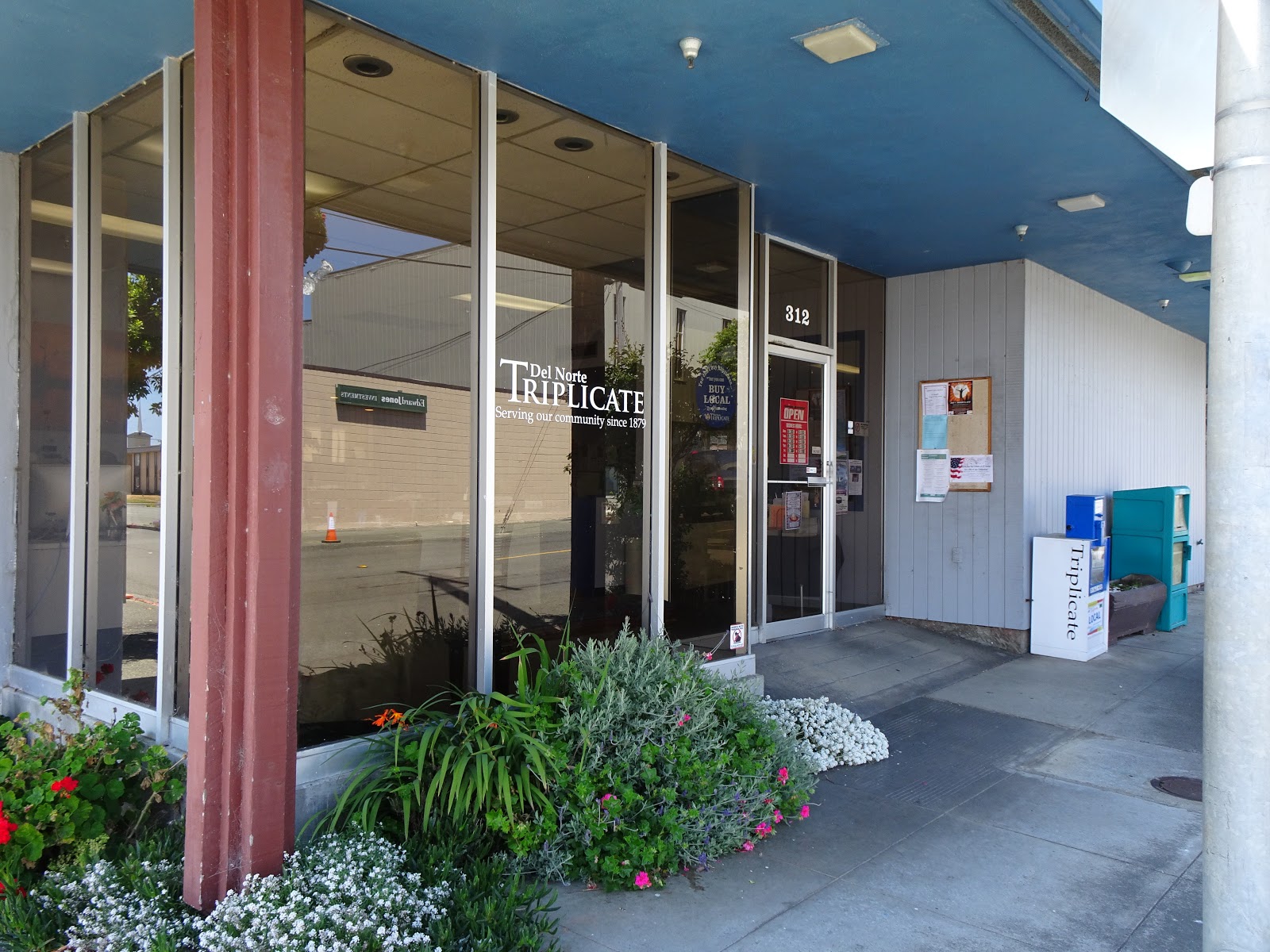 |
| Office of the Del Norte Triplicate, a thrice-weekly paper in Crescent City, California (c) Lisa R. Pruitt 2019 |
The San Luis Obispo Tribune published an editorial headlined, "Reckless drivers, drunks and confederate flags don't belong on the Oceano Dunes," on July 19. Here's an excerpt, about a recent Coastal Commission meeting in the area, which considered the fate of the popular outdoor park where six people have died this year in ATV/off-roading accidents:
Yes, the Coastal Commission agreed to maintain the status quo at the popular off-road park for at least one more year. But it also made it clear that it expects improvement.
And if the commission takes its job to protect and enhance the coastline at all seriously — and wants to retain any credibility with opponents of the state vehicular recreation area — it will treat this as a last chance.
For as much as supporters have tried to portray the Oceano Dunes as a safe, welcoming, family-friendly place, the PR isn’t working.
It’s hard to characterize a place as safe and family-friendly when there have been six fatalities and a shooting so far this year.
And welcoming?
Sorry, but even a single Confederate flag on the back of a pickup is enough to create the impression that the entire off-roading community is a bunch of racist good ol’ boys who come over from the [Central] Valley to drink and raise hell — leaving the locals to eat their dust and clean up their mess.
* * *
For many, the [2019] deaths confirm the park is an inherently lawless, dangerous place — the term “Wild West” gets used a lot — where there’s little supervision and almost anything goes.
As we’ve said before, we don’t believe the increase in fatalities is a reason to close the park — but it definitely is a reason to figure out what the heck is going on and do whatever it takes to make the park safer.I could excerpt more, but I think readers will get the picture.
The (Sonoma County) Press Democrat ran this story by Julie Johnson on July 26 under the headline, "Mendocino marijuana raids reflect California’s stepped-up enforcement on illegal operators." Here are a couple of key excerpts about what went down in what has been called the Emerald Triangle. Specifically, the Mendocino County Sheriff's Office "cut down more than 42,000 marijuana plants on nearly 30 properties in the Eel River watershed." This is reportedly the first "major multiagency operation investigating illegal cultivation and environmental crimes to take place" in the county since the state legalized marijuana. While the state has granted licenses to some 500 entities to grow marijuana in Mendocino County, thousands of unlicensed marijuana farms are believed to exist.
Cannabis industry leaders here said the operation was premature for an industry struggling to adapt to new regulations and that it felt like a resumption of the heavily militarized law enforcement campaigns that for decades targeted marijuana growers in these hills and valleys.
But Sheriff Tom Allman said his teams focused on sites where they spotted evidence of serious environmental crimes such as water theft and polluting the watershed with trash, fuels and pesticides. The investigations targeted properties where people had not even applied for local permits or state licenses to cultivate, he said.
“Is it marijuana enforcement or is it environmental enforcement?” Sheriff Tom Allman said. “There’s a difference, and I think the tide is turning.”
In the aftermath of legalization, marijuana industry leaders had hoped that enforcement of the state’s cannabis cultivation laws would fundamentally change. Where once they had encountered teams of camouflaged and armed peace officers investigating criminal behavior, they envisioned civil operations run by code enforcement officers using warnings, legal notices, fines and penalties to hold people accountable.
The Times-Standard (Eureka/Humboldt County) on July 6 led with this headline, "County buildings aren't up to standards." The story by Sonia Waraich features these paragraphs:
Humboldt County has been failing to make public facilities accessible to people with disabilities for years, according to a report from the county's civil grand jury.
The county has been on hot water with the U.S. Dept. of Justice for over a decade because it has continuously failed to meet deadlines set by the department to bring county buildings up the the standards laid out in the Americans with Disabilities Act, according to the Humboldt County Civil Grand Jury report "Here We Go Again" released Friday morning. The ADA states that government buildings need to be usable for people with disabilities and modifications need to be made to make them accessible.
The following is a quote from the report:
As the County approaches the final deadline in the Consent Decree to remediate the remaining facilities and curb ramps, it seems unlikely that work will be completed on time. Many earlier deadlines have been missed and a number of projects are still out for bid.
Nearly 1700 curb ramps still need to be remediated, according to the report.
Hello, Brookings and Crescent City! We're privileged to be the new owners of the Curry Costal Pilot and the Del Norte Triplicate.
As a native Oregonian, I love this coast and its iconic smaller towns We are excited at the opportunity to learn about and become part of the fabric of Brookings and Crescent City.
My husband, Steve, and I have been working toward this goal of purchasing these two promising community news outlets for four months.
Steve created Country Media nearly 20 years ago because of his passion for community news and service. After half a century working at daily and weekly newspapers of all sizes, his zest for this business continues unabated.
My education and work experience had been centered in the arts and arts management. But early on I agreed to help Steve operate our newspaper company, and I've never regretted that decision.
Over the past two decades, we've built our business to include some 15 nondaily newspapers and 15 years, associated websites serving communities of various sizes in four states. So we have a strong background in finding a good fit between our publications and their communities.
For now, our prime focus with these two newspapers is to make them sustainable, to ensure that Brookings and Crescent City have long-term newspapers they can rely on for non-judgmental, accurate and unbiased news coverage.
The column then goes on to explain that Country Media bought the two papers our bankruptcy. Curry is Oregon's most southwesterly county, and its population is 22,364. Del Norte County, California, home of the sister paper, the Triplicate, has a population of 28,610.
Speaking of media ownership, to close out this initial post on the rural media, let me turn to this New York Times story from August 1 about the last issue of the Warroad (Minnesota) Pioneer, printed this past May. Warroad, population 1,781, is in far northern Minnesota, a few miles south of Canada, and its paper had a distribution of about 1,100. Richard Fausset's story notes that the Warroad paper joined some 2000 United States papers that have ceased to publish over the last decade and a half. A study by UNC research, "The Expanding News Desert," found that “there is simply not enough digital or print revenue to pay for the public service journalism that local newspapers have historically provided.” Fauset writes:
In Warroad, The Pioneer was full of soft-focus features on residents, reprinted news releases, photos of fishermen with their outsize catches, and news of awards won by children and Shriners. There were the occasional stories, too, about city officials, the school board and local sports.And so, Fauset notes, the closure of the paper leaves a big hole:
No hometown paper to print the obituaries from the Helgeson Funeral Home. No place to chronicle the exploits of the beloved high school hockey teams. No historical record for the little town museum, which had carefully kept the newspaper in boxes going back to 1897.
And what about the next government scandal, the next school funding crisis? Who would be there? Who would tell?A prior post about Warroad, as hockey powerhouse, is here.
Wednesday, June 12, 2019
On access to transportation and health (and jobs, poverty and disability) in rural America
NPR reports today from upstate New York on the intersection of disability, rurality, poverty, and employment, with something of a focus on transportation as another feature of that cycle of poverty. Here's the excerpt I wish to highlight:
Having good access to transportation — or not — has a huge impact on the health of people living in rural parts of the country, says Dr. Kirsten Bibbins-Domingo, a professor of epidemiology and biostatistics at the University of California, San Francisco who studies the health of vulnerable populations.The story, by Selena Simmons-Duffin, quotes Bibbins-Domingo:
If you go to less populated areas — rural areas — access to a car that functions well [and] the costs for gas becomes such an essential element. Both to drive to seek medical care, as well as to drive to access the other resources that are necessary to pursue good health.Simmons-Duffin goes on to quote Bill Erickson of Cornell re: employability of people with disabilities.
Since the Great Recession, rural counties really haven't seen as much employment growth as urban counties. Also just the types of jobs that are available to those sorts of communities may be tending toward, you know, requiring people to be able to move things physically or whatever.
And the limitations that the individual with disabilities may have may be preventing them from being able to do those particular types of jobs — or employers can't provide the accommodations that may be necessary.On that latter point, see this excellent NPR story from 2013.
Monday, July 9, 2018
East Kentucky fraudster/lawyer Eric Conn leaves a trail of devastation among clients, as well as a great need for pro bono assistance
Some readers may have followed the story of Eric Conn, a major disability attorney in eastern Kentucky, who was indicted in 2017 on charges of defrauding the Social Security administration. Conn fled house arrest in late 2017 (he cut off the ankle bracelet), only to be captured in Honduras and extradited to the United States. Read more here, here and here.
An excerpt explaining who Conn is and what he did follow, this from Bill Estep's early June, 2018 story in the Kentucky Herald-Leader:
Ned Pillersdorf, an attorney in Prestonburg, population 3,255, has represented a number of Conn’s former clients in the wake of discovery of the fraud. Pillersdorf speculates that not all of the clients had "legitimate claims," though many did. The files of some clients included false evidence that the clients likely did not know about.
Estep quotes Pillersdorf, who makes a stunning revelation about the number of clients who had never even met Conn:
 And I, for one, have come to conclude that we have no more empathy--and perhaps less--for poor whites than for poor Blacks.
An e-mail plea that recently went out via a Kentucky lawyer friend of mine reads:
An excerpt explaining who Conn is and what he did follow, this from Bill Estep's early June, 2018 story in the Kentucky Herald-Leader:
Conn admitted he took part in a scheme to submit fabricated evidence to Social Security on behalf of clients he represented seeking disability benefits.
The scheme would have obligated Social Security to pay more than $600 million over the life of the beneficiaries, according to the charges.
The agency actually paid out $72.5 million on the claims before the fraud came to light. Conn could be ordered to pay that much in restitution.
He already owes millions in restitution in various cases, as well as a $5.7 million judgment to the U.S. Department of Justice that it has not been able to fully collect.
Officials have said Conn’s scheme was the biggest fraud in the history of Social Security, involving thousands of cases.Conn colluded with an SSI judge (who was paid $400/case), as well as medical professionals, to achieve the disability determinations. Others involved in the scheme have already been tried and found guilty, or they have entered guilty pleas.
Ned Pillersdorf, an attorney in Prestonburg, population 3,255, has represented a number of Conn’s former clients in the wake of discovery of the fraud. Pillersdorf speculates that not all of the clients had "legitimate claims," though many did. The files of some clients included false evidence that the clients likely did not know about.
Estep quotes Pillersdorf, who makes a stunning revelation about the number of clients who had never even met Conn:
Unfortunately Conn's outrageous antics has [sic] resulted in the SSA politically posturing by targeting more than 3,500 of his vulnerable former clients with loss of benefits for the crime of guilt by association. The irony is there was no association—in that in my three-year involvement in this continuing crisis, I've yet to meet the first former Conn client who met him.This introduces the crisis that is unfolding for many of Conn's clients. Here's what attorney Pillersdorf wrote in an op-ed in the Kentucky Herald-Leader in mid-June, on the occasion of the Kentucky Bar Association's Annual Meeting. Pillersdorf writes of the current state of affairs re: Conn:
The Social Security Administration intends to put another 1,950 former clients of Conn — who pleaded guilty to fraud this month — through another set of grueling mass hearings.
The first set of hearings have been brutal, in that more than 800 of the 1,500 hearings resulted in our neighbors losing their subsistence benefits and being told they each had to pay back about $100,000 for alleged over-payments. We’ve had suicides, attempted suicides, panic attacks, spikes in homelessness, etc. The new round of hearings is equivalent to a nuclear bomb hitting the mountains.
The challenge throughout this ongoing humanitarian crisis is that the SSA prevents lawyers from earning attorney fees for doing the hearings. Indeed accepting a fee can have negative consequences for your ability to practice before the SSA. We have been blessed in the first round of hearings that we found more than 100 volunteer lawyers to represent more than 1,000 former Conn clients.
Without being asked, should the powers that be in the Kentucky Bar Association have contacted the volunteer lawyer network and asked what they could do to help? It is an interesting question.
Regardless, we did not wait for them to ask. We requested, and thanks to KBA President Bill Garmer, we have been granted a session at this week’s convention to train and recruit lawyers. This is the good.
The not-so-good is the reaction of the bar to the recent stunning revelation that thousands of former client files still sit in Conn’s law office that was seized a year ago. The association has the discretionary authority to request that the Supreme Court appoint a special commissioner to distribute the files to the clients prior to mass hearings. The response to our request for such an appointment was that we need to make other arrangements. So much for looking out for the rights of the least among us in their time of crisis.
I can’t help but think that the unwillingness to assist the former clients was fueled by negative stereotypical views about those who collect Social Security benefits as well as their unfortunate association with the notorious Conn. [On that theme, read more here]Indeed, it is not only disabled folks in Eastern Kentucky who are subject to negative stereotypes. The region is one of the most densely persistent poverty region in the nation, perhaps second only to the Mississippi Delta, as illustrated by this map.

An e-mail plea that recently went out via a Kentucky lawyer friend of mine reads:
I am writing you as the past Director of Appalred in Kentucky, and of counsel to a local Prestonsburg, KY firm (Pillersdorf, De Rossett and Lane).
I am writing for volunteer attorney help.
You may remember that local attorney Eric Conn has pleaded guilty to engaging in a fraudulent scheme with ALJ Daugherty to approve several thousand applications for Social Security Disability benefits. As a result, all the affected individuals were/are being noticed for hearings to review their disability status. In the first round we (Appalred, NOSSCR, and various other helpers) recruited 153 volunteer attorneys around the country to help these claimants with their hearings. The hearings were conducted by video. It was a huge effort. Appalred took over 200 of these cases. And several attorneys took 25 or more. About half of the claimants “won” their hearings and so about half lost. The “win” percentages of those who were represented was substantially higher than those who were not.
The “first round” of these hearings involved about 1900 cases. The SSA has announced that there will be about 2000 more in Round 2 . We are hopeful that the lawyers who helped us in Round 1 will help in Round 2, but there is a fair amount of work involved in preparing these cases, so some of the lawyers may drop out. Additionally, there is currently an appeal pending in the 6th Circuit Court of Appeals which challenges the limitation on the evidence that was permitted to be introduced at the hearings. Based on the reaction of the Judges at the oral argument, we feel somewhat confident that the appellants (our clients) will win and that this will result in a remand of several hundred cases for new hearings, so the lawyers who handled those hearings the first time around will have plenty to do.
There are Training Videos on the Appalred website, www.ardfky.org (Legal Information and social Security tabs)
The result is that we need your help in recruiting more volunteer lawyers for the next round of hearings, currently slated to start in July and August, and to continue on probably throughout the next year or so. I will be glad to talk with any of you to discuss this further, and to obtain your suggestions for how to recruit more lawyers successfully. Or you can contact Appalred’s Pro Bono Coordinator, Mary Going, directly by calling 606-886-3876 Ext. 1315, or by email, maryg@ardfky.org or with me by phone at (606) 886-8851 (preferred); 606-422-4484 (cell); or e-mail, jandjrose@suddenlink.net. Thanks in advance. John RosenbergIf this doesn't illustrate the need for more rural lawyers generally, as well as good rural-urban attorney networks, then I don't know what does. Here is my prior post on that very topic.
Subscribe to:
Posts (Atom)