Showing posts with label rural myth. Show all posts

Thursday, March 5, 2026

Rural morality and the left

Western Norway
Source: Wikimedia Commons (2016)
Internationalism, the idea that people and states should organize across borders, is a popular organizing principle on the political left. It takes two related forms. Liberal internationalism promotes rule of law, open markets, and free trade as a path to peace through multilateral governance. Socialist internationalism emphasizes solidarity among workers across nations, rather than competition between them. Both tend to replace an emphasis on local community with an abstract political identity that isn’t rooted in any particular place. 

International governance creates a layer of authority that communities cannot meaningfully influence. The resulting cosmopolitan governing class (sometimes pejoratively referred to as “globalists”) are socially and geographically distant from communities affected by their policy. Meanwhile, international economic integration guts local economic prospects so that multinational firms can thrive. After China's accession to the World Trade Organization, imports of Chinese furniture surged, leading firms that once anchored the manufacturing economy of High Point to shut local factories and source production abroad

This process spreads similar models of education and culture, eroding distinct regional identities and traditions. In the name of internationalism, many have advocated for cultivating cosmopolitan “citizens of the world.” Within this frame, local or regional culture is something to be overcome, not preserved. Is rural culture something that needs to be overcome in pursuit of a more equal society? 
French philosopher Jean-Claude Michèa offers a critique of liberalism that bears directly on this question. Until recently his work was unavailable in English. Michael Behrent, a History Professor at Appalachian State University, published a collection of his works titled Toward a Conservative Left. Don’t let the title put you off. What the title evokes is the way in which Michèa combines a critique of capitalism with a suspicion of "progress". Michèa says little about American politics in his work, but his analysis maps uncomfortably well onto the contemporary Democratic Party, which has become a party of urban educated professionals. 

Michèa’s personal background is relevant too. Born in Paris in 1950, he was raised in public housing by parents who were both members of the French Communist Party. The Party was central to his childhood. It employed his parents, with his dad working as sports reporter for the Party newspaper. It was a community of working-class people who looked out for one another. Today, Michea lives on a farm in southwest France. 

At the center of Michèa’s work is Orwell’s concept of “common decency,” developed in the 1937 book, The Road to Wigan Pier.  For Orwell, common decency is the moral intuition observable in tight-knit communities built around face-to-face interaction. In his 1939 essay on Dickens, Orwell argues that Dickens owed his popularity to a rare ability to give comic, memorable expression to the native decency of the common man. It is the instinct “that makes a jury award excessive damages when a rich man’s car runs over a poor man.” 

Michèa takes this concept further,  giving it anthropological character. Working people, because of their way of earning a living and social status, tend to exhibit a form of solidarity and spontaneous ethics. Working people rely on one another out of necessity. It is a set of habits that arise through family life, neighborhood association, and shared work. Common decency requires social relations through which people experience themselves as dependent on and responsible for one another. Capitalism, Michèa argues, is breaking down this social fabric. As the market relentlessly expands into every area of life, relationships once governed by reciprocity become self-interested transactions. 

This maps directly with the concept of high density of acquaintanceship associated with rural communities. In a small agricultural community, a neighbor’s failed harvest is visible. Decency is not an abstract value, but a material reality that rural people navigate on a daily basis.  Michèa argues that modern society has removed people from the social relations that foster this common decency. 

Here is where Michèa’s argument becomes uncomfortable. He contends that economic liberalism, meaning the spreading of free markets, free trade, and global integration of markets-- are not in tension with cultural liberalism . He believes these two liberalisms actually operate in concert. He writes, “a right-wing economy cannot function in a lasting way without a left-wing culture.” It is well documented that economic liberalism has devastated rural communities by financializing land, offshoring manufacturing, and consolidating agricultural markets. 

Cultural liberalism, for Michèa, works in parallel. It elevates individual autonomy and the right to choose one’s lifestyle over inherited social norms or traditions. Institutions that once anchored rural life: stable family, religious practice, the local community, have all been delegitimized over time in the name of individual emancipation. Rural communities are left with a social and moral vacuum at a time when economic liberalism has taken away their material foundations. For Michèa this is not a coincidence, capitalism prefers autonomous individuals without a sense of rootedness to a place and an inherited way of life. The tech worker who relocates for opportunity is a more compatible economic subject than the farmer who will not leave because his family has worked the same land for three generations. 

While Michèa’s argument is not without its blind spots, he invites the left to take working class culture seriously. To be clear, I don’t believe the left should abandon a commitment to individual freedom. However, a politics aimed toward a more just society cannot organize against rural morality. To me, this is what is intended by the provocative title. The social fabric that allows for the cultivation of common decency is worth conserving.

Wednesday, April 2, 2025

Bernie Sanders rallies rural Americans to "Fight Oligarchy"

As part of his "Fighting Oligarchy: Where We Go From Here" tour, Independent Vermont Senator Bernie Sanders has spent the last several weeks visiting districts where Republicans enjoyed a narrow electoral advantage during the 2024 general election.

While the tour kicked off in Omaha, Nebraska, Sanders recently stopped in rural Altoona, Wisconsin on March 8, 2025. Bernie Sanders used his platform to address the myth that rural people are regressive and conservative. Following his stop in Altoona, Sanders posted the following message to Facebook:

We're told that rural America doesn't like progressive ideas. Not what I saw today in our great rally in Altoona, WI - population 9,200. The people here, and throughout the country, understand that health care is a human right and that we need an economy that works for all, not the few.

Sanders spoke to the Wisconsin crowd of 2,600 about how the current administration will harm rural and working-class communities. He also sought to empower and motivate the audience through a targeted call to action, saying:

I worry very much that people all over this country in rural areas especially, do not stand up. What we're going to see in the next few months...over a trillion dollars of tax breaks for the top one percent. We can stop it.

Earlier in the tour, Senator Sanders spoke to an overflow crowd of more than 3,400 people in Omaha. Sanders' next stop was in Iowa City, Iowa, where he filled the historic Englert Theatre. Once he was done speaking to the Englert Theatre crowd, Sanders delivered a second rendition of his speech to the overflow crowd at the hotel next door. This was the first time in Sanders' career that he has given the same speech to two audiences in one night due to extremely high turnout.

Although these cities are not rural themselves, both Iowa and Nebraska are states with significant rural populations. Many people traveled from hours away to hear Sanders speak. So far, the tour has drawn record crowds.

Reporting for Barn Raiser, Greg Wickencamp writes about the Iowa crowds' fears and hopes as they attended Senator Sanders' rally in their state on February 22, 2025. Some attendees expressed frustration over rising grocery and feed prices; other audience members worried about their children's job prospects; and others in the crowd said they hoped Sanders' speech would give them hope and motivation. Kelli McCreary, a retired nurse from Toledo, Iowa, noted that her Trump-supporting neighbors are just starting to regret voting for Trump, but that "it's too late."

The theme of Sanders' message seems to be that politicians will not save us, that both political parties have fundamentally failed the American people, and that we have more power than we are led to believe. Sanders told the audience during his Iowa speech:

Trumpism will not be defeated by politicians in the D.C. Beltway. It will only be defeated by millions of Americans in Iowa, in Vermont, in Nebraska, in every state in this country by people who come together in a strong grassroots movement and say no to oligarchy, no to authoritarianism, no to kleptocracy, no to massive cuts in programs that low-income and working Americans desperately need, no to huge tax breaks for the wealthiest people in this country.

For a long time, Bernie Sanders' policies have been degraded by Republicans and Democrats alike for being too radical and extreme. Now, Sanders points out that the Democratic Party has failed to excite people enough to motivate voter turnout. He says that rather than standing for the working class, the Democrats have prioritized corporate interests and need to radically change their approach if they are to succeed in the future.

Whether or not Bernie Sanders will gather enough momentum to inspire significant change remains to be seen. Some Bernie-supporters remain cautiously optimistic. Kelly Schmidt, a University of Northern Iowa graduate from Holstein, Iowa, said that although everyone in her hometown would benefit from Sanders' proposals, she is unsure if her fellow residents will listen. Still, many of those who did listen to Sanders' words left his rally feeling hopeful, inspired, and invigorated.

You can find more information about the rural vote and particular issues that engage rural voters here, herehere, and here

Monday, March 11, 2024

Another authoritative rebuttal of Schaller and Waldman's "White Rural Rage"

Kristin Lunz Trujillo, a political scientist at the University of South Carolina, writes in Newsweek today under the headline, "'White Rural Rage' Cites my Research.  It Gets Everything about Rural America Wrong."  Here's an excerpt:  

Rural Americans' identity is much more about positive emotions they feel toward rural areas and much less about negative emotions toward others. The idea that white rural Americans in general experience unhinged levels of rage is laughable. If you want to see how ridiculous white rural Americans find the idea that they are enraged, they have been posting about their supposed rage on X with pictures of benign, disarming, or exaggerated images, with the ironic caption: "How do you express your #whiteruralrage?"

The thing is, political anger isn't restricted to white rural America. It's something that's actually a shared experience across different walks of life in the U.S.: Most Americans when prompted to think about politics become angry, hateful, and afraid of the struggles of contemporary America, our current political climate, and people we perceive to be politically dissimilar. Partisan polarization based on strong negative emotions has become a harmful force in society that erodes democracy, and it's found in spades on the Right and the Left, and experts and intellectuals are no exception.
As political scientists and commentators in particular, we should be the most self-aware of this, not the ones who fall prey to it or make it worse. Yet because of White Rural Rage's lack of rigorous evidence that white rural Americans writ large are the greatest threat to U.S. democracy, the book starts to feel less like a carefully considered set of conclusions and more like an attack on a group of people who are the partisan other.

On that note, the authors of White Rural Rage cite my own work examining how people who feel that being rural is a strong part of their identity have a heightened distrust of experts and intellectuals. Why is this the case? There's a myriad of reasons, but White Rural Rage is a prime example of how intellectuals sow distrust by villainizing a group of people who are already disproportionately shut out from science, higher education, and similar opportunities.

Although the authors don't misrepresent my work, they do criticize rural Americans for their anti-intellectualism, building on tired tropes of rural people being backward, dumb, violent, and ignorant, while pushing a narrative that worsens such distrust in the first place.

Nick Jacobs, a political scientist whose work is also cited in the Schaller and Waldman book, made similar points last week on the Daily Yonder about how the authors of White Rural Rage misrepresent his empirical research.  

Monday, March 6, 2023

The philosophical underpinnings of rural bashing, part II: Marcuse’s neo-Marxist “liberating tolerance” as a Progressive ethos

“You can’t make an omelet without breaking a few eggs.”
***
“If I ever hear that ‘can’t make an omelet’ phrase again, I’ll start doing a little murder myself! It’s used to justify every atrocity under every despotism, Fascist or Nazi, or Communist or American labor war. Omelet! Eggs! By God, sir, men’s souls and blood are not eggshells for tyrants to break!” Doremus Jessup in Sinclair Lewis’ It Can’t Happen Here

This post builds off an earlier post of mine in which I argued that Progressive elites are invoking Marxist thought (in the form of a neo-Marxist, post-modern ethos) in a way that further alienates rural Americans and fosters a divisive society. I am continuing with a dive into critical theory and post-modern philosophy because we often forget that ideas matter, and intellectuals, those who are in the business of producing ideas, have real consequences. This post considers the work of the neo-Marxist philosopher Herbert Marcuse. For context, when Marcuse was writing in the mid 20th century, he was an intellectual rockstar who had widespread academic and popular influence. He also served as the doctoral advisor for Angela Davis, the renowned Marxist, political activist, and prison abolitionist.

***

In 2017, CNN published an article on the leftist Antifa movement, describing the organization’s methodology as one where “[a]ctivists seek peace through violence” (though the headline was later changed).

The notion of any group seeking peace through violence in a democratic society should worry us, for it is always easy to utilize an “ends-justify-the-means” approach to morally defend even the most abhorrent of actions. At the very least, the intellectual and moral foundations of any claim based on such forms of reasoning should be meticulously scrutinized.

A (slightly) less radical form of this reasoning can be seen within progressive discourse on rural Americans, the white working class, and “Trump voters,” in particular. As I noted in my previous post, Hilary Clinton famously (and arguably to her, and the Democratic party's, peril) denounced such people as “deplorables” unworthy of redemption (though she quickly qualified and backtracked on this, but the damage was done.)

More broadly, some social issues that are important to rural America have been framed by Progressives in a manner in which there is only one morally justifiable (not simply morally correct) side to be on. The difference between morally justifiable and morally correct is important here because the issue is not solely that Progressives are articulating that they believe there is only one correct side to be on (every political faction believes this to be the case for their side), but that there is only one correct moral ethos that can be utilized to arrive at a conclusion on a given issue. The upshot entails Progressives limiting (with intellectual and moral justification) the scope of discourse on issues by policing what perspectives are morally worthy of free speech and free expression.

I’ll give one personal example of this. This past summer, in the wake of the Supreme Court’s ruling on Dobbs, a business acquaintance, who happens to be a non-white non-Christian female, approached me at an event to ask my thoughts about what unfolded at her company. She warily shared that just before Dobbs was published, her company sent an apolitical email regarding the Court’s potential ruling. The email was from the head of the company, who stated its purpose was to ensure belonging and safety for all within the organization, regardless of political, religious, or other beliefs and practices. It was a message of unity.

Nevertheless, the heart of the email stated that the company recognizes that the Dobbs ruling will be divisive (regardless of the outcome) and that some folks in the company will be deeply upset whereas others may welcome the Court’s perspective.

At first, I thought, OK, this sounds reasonable. The company was simply playing the middle ground and affirming everyone’s perspective on a heated political issue that was certain to shake many.

But my instincts were wrong. The email generated outrage amongst Progressive employees at the company, and within the span of 24 hours, the company’s executives recanted their original message and scheduled a company-wide video conference discussion with the executives and the company’s head of diversity, equity, and inclusion. What happened?

The ultimate question posed to me by this acquaintance was: "What about me? I thought diversity and inclusion incorporated me as a woman of color, but apparently it doesn’t." 

I have thought long and hard about this issue, and I have concluded that the explanation for what happened at this acquaintance’s company is that Progressives have adopted a Marcusian notion of “liberating tolerance” in which true tolerance entails enacting “intolerance against movements from the Right and toleration of movements from the Left.” Hence, the problem with my acquaintance’s perspective (per Progressive philosophy) is that her commitments on the issue of abortion are deemed morally reprehensible and therefore outside the realm of morally and intellectually defensible positions. Let me explain.

Herbert Marcuse was a German-American neo-Marxist philosopher and member of the Frankfurt school of critical theory where he figured prominently alongside Max Horkheimer and Theodor Adorno. In 1965, Marcuse published an essay titled “Repressive Tolerance” in which he famously articulated and proposed his theory of “liberating tolerance.”

The basic premise of liberating tolerance is that it is a form of “censorship, even precensorship.” It is justified because, according to Marcuse, traditional tolerance towards all people, including those with whom you disagree with, is actually a mechanism for protecting and furthering oppression within society: “[tolerance] is in many of its most effective manifestations serving the cause of oppression.” Hence, Marcuse proffered, there is a need to subvert the “oppressors” (the political Right) by being intolerant towards their thoughts, ideas, and perspectives and by being especially tolerant of the political Left.

Extraordinarily, Marcuse further argues that in order to effectuate “liberating tolerance,” the Left ought to go beyond the realm of law (“But I believe that there is a ‘natural right’ of resistance for oppressed and overpowered minorities to use extralegal means if the legal ones have proved to be inadequate,” and to even use violence if necessary (“If they use violence, they do not start a new chain of violence but try to break an established one. Since they will be punished, they know the risk, and when they are willing to take it, no third person, and least of all the educator and intellectual, has the right to preach them abstention.”)

Circling back to my acquaintance, we can now better understand why her position on abortion (despite her status as a woman of color) is no longer a morally justifiable position amongst the Left. Again, this is very different than saying that it is not a morally correct position; rather, the Left seems to be arguing (perhaps implicitly) that there are absolutely no grounds upon which such a position could be defensible or even articulated. It is a position exclusive to the oppressor.

All of this is to say that I believe this philosophy is being equally applied to many rural Americans broadly, especially those who voted for Trump. Voting for Trump, regardless of rationale, is a line that once crossed, is due nothing by detest. You become an irredeemable deplorable. This is especially so if you actually believe in conservative perspectives on deeply contested social issues. It is even so if you are a life-long Democrat who simply isn’t comfortable with joining the post-modern realm of pure moral relativity and lack of objective truths.

This is quite the convenient (and pernicious) ideology for those who invoke it. And, ironically, it’s roots are in liberalelitist academia and its victims include some of the poorest and most neglected members of society. Perhaps it’s time to redefine and reconsider the “bourgeoise” and the “proletariat”.

Interestingly, Progressives have now become “the new Puritans,” as Noah Rothman cleverly articulates in the title of his new book: The Rise of the New Puritans: Fighting Back Against Progressives’ War on Fun, in which he argues that “in pursuit of a better world, progressives are ruining the very things which make life worth living.”

We should all pay heed to the contours of Progressive post-modern philosophy and the dangerous outcomes it produces. And we should all be weary of the form in which it manifests. Perhaps the irony of all ironies is the case of “Trumpism” itself being a form of neo-Marxism (articulated here and here.)

To conclude, it is worth pointing out that the neo-Marxist philosophy that stemmed from the Frankfurt school was not wholly false—it contained an element of truth in its critique of consumer society. But the Frankfurt solution, or alternative, to rampant capitalism and commodity culture was essentially Utopia, devoid of any pragmatism and utterly impossible.

The late English philosopher Sir Roger Scruton explains the missing piece by clarifying that the Frankfurt critique of capitalism is essentially a Biblical critique of idolatry sans God. Hence, Dr. Scruton expounds, the partial truth of the Frankfurt critique is in its diagnosis of a real problem (that of Capitalist consumerism) but its proffered solutions are disastrous because of its denial of God, who is then substituted with “Utopia,” promised, but impossible:

[i]ndeed [the partial truth of the Frankfurt critique] is the truth enshrined in the Hebrew Bible, reformulated time and again down the centuries: the truth that, in bowing down to idols, we betray our better nature. 
By turning to God we become what we truly are, creatures of a higher world, whose fulfilment is something more than the satisfaction of our wishes. Through idolatry, by contrast, we fall into a lower way of being–the way of self-enslavement, in which our appetites shape themselves as gods and take command of us.

[The Frankfurt School’s] attack on mass culture should be seen in the Old Testament spirit, as a repudiation of idolatry, a reaffirmation of the age-old distinction between true and false gods—between the worship that ennobles and redeems us, and the superstition that drops us in the ditch. For Adorno the true god is Utopia: the vision of subjects in their freedom, conscious of the world as it is, and claiming that world as their own. The false god is the fetish of consumerism—the god of appetite, who clouds our vision and confiscates our choice. 
(Roger Scruton, Fools, Frauds, and Firebrands: Thinkers of the New Left, 144 (2019).

Wednesday, February 1, 2023

The philosophical underpinnings of “rural bashing”: How progressive appeals to Marxism perpetuate the otherizing of America’s heartland

There are two antipodal tropes that may come to mind when one thinks about rural America: backwards communities of white trash, redneck, racist hillbillies, or close-knit communities that thrive on religious values and rich interpersonal relations. Obviously, neither form of these broad generalizations (the negative “white trash” nor the positive “close-knit”) accurately depicts the diversity within rural communities in America. But what happens if the values underpinning the ostensibly “positive” side of this framework are no longer deemed positive in the perspective of the urban masses? It seems, in that case, that rural people simply become a “basket of deplorables”.

A 2002 study on the perceptions of rural America found that rural Americans are often associated with a strong sense of family, hard work, commitment to community, strong religious beliefs, self-sufficiency, and loyalty to their country. In 2002, many, if not all, of these phrases connoted a positive image for most Americans. This no longer seems to be the case, especially for progressive elites who are increasingly adopting new and constantly changing sets of values at least partially influenced by “wokeness” and ultimately rooted in Marxist thought. This begs the question: does wokeness foster rural bashing even if not explicitly?

***

The concept of family has traditionally been a hallmark of the American dream. However, aspects of the progressive movement have sought to change this. For example, the feminist thinker Sophie Lewis recently published a book titled Abolish the Family: A Manifesto for Care and Liberation. She invokes the philosophies of Karl Marx, Friedrich Engels, Charles Fourier, and Alexandra Kollontai to argue that the family unit is fundamentally classist and oppressive. She thus argues that it ought to be abolished. This perspective is shared by the founders of the popular social justice movement Black Lives Matters who, as self-proclaimed trained Marxists, are committed to “disrupting the Western-prescribed nuclear family structure…”.

Even feminism, which has received widespread support in its various fashions amongst most liberals and even many conservatives, has become enmeshed with a Marxist take on the family unit. This is articulated in a 2020 Vice article titled “We Can’t Have a Feminist Future Without Abolishing the Family.”

Strong religious identity is another association with rural Americans that has become a suspect trait in the eyes of the urban masses who have become increasingly secular, especially those with college degrees and high incomes. As evidence of this, one need not look further than titles like The God Delusion and “Why Are Atheists Generally Smarter Than Religious People?” 

Further, many rural people, most of whom are religious, recognize that their values are “very different” than those who live in cities. These values shape rural people’s political positions on social and economic issues, which in turn accentuates the rural-urban political divide.

More importantly, religious values shape the overall worldview of religious people. Religion is often more than mere faith; it is a way of life. Under this framework of religion as a way of life, we can better comprehend why rural people could be seen as hard working, committed to community, self-sufficient, loyal to their country, and committed to a strong sense of family. These are traits rooted in the Christian tradition.

For example, a Christian worldview recognizes the dignity of honest labor, the dignity of hard work. Acedia, one of the seven deadly sins, can be interpreted as spiritual sloth. But sloth also pertains to general laziness, a characteristic that is so demised by working-class rural folks that it warrants the designation of one as “white trash.”

This has been flipped upside down in the progressive worldview that is inspired by Marxist philosophy. To Marx, a worker qua his work, “does not affirm himself but denies himself, does not feel content but unhappy, does not develop freely his physical and mental energy but mortifies his body and ruins his mind.” (Karl Marx, “Economic and Philosophic Manuscripts of 1844,” in Robert C. Tucker, ed., The Marx-Engels Reader, 2nd Edition (New York: W. W. Norton & Company, 1972), 74.)

We can see the influence of this perspective on the minds of young liberal workers (often corporate) who engage in and justify practices such as “quiet quitting,” where employees mentally disengage from their work, doing just the bare minimum in order to collect a paycheck. In other words, what is there to cherish of commitment to “hard work” in a society that is becoming a “post-work world”.

So, what remains when “family” no longer means family (and is essentially devalued), hard work is despised as a ploy by capitalist elites to exploit the labor of the proletariat masses, religion is nothing but the folly of senseless peasants, and loyalty to one’s country is substituted with calls to completely dismantle most, if not all, institutions regardless of their efficacy or stability (and without a serious plan for rebuilding)? Only one caricature remains: the backwards redneck racist hillbillies of rural America who are allegedly too stupid to even vote in accordance with their own interests. 

As I pointed to elsewhere, arriving at this conclusion is a sign of our own intellectual laziness. 

In order to bridge the gap, progressives ought to make a serious effort to at least understand and respect (though not necessarily celebrate or agree with) the values of rural people. To fail to do this is to ignore their lived reality, which is precisely the opposite of what progressive theories (i.e., Critical Race Theory) are supposed to do. Mary Matsuda, a prominent scholar of Critical Race Theory famously argued that CRT must utilize the various intellectual traditions of people as a "new epistemological source for critical scholars." For Black rural communities in the South where the vast majority of residents are deeply religious Christians, this would seem to entail that the intellectual tradition of the Black Church (i.e., Protestant Christianity) must be utilized as an epistemological source for addressing the concerns of these communities. 

In other words, the religious worldview of rural Americans is essential to their identity; to ignore it is to ignore their lived realities and, instead, to resort to cheap caricatures.

Wednesday, January 25, 2023

Is Half Moon Bay, California "rural"?

Half Moon Bay, California, population 11,975, burst into the news on Monday afternoon when a gunman killed seven on the outskirts of town.  

I've been to Half Moon Bay a few times, and I have friends who live there.  When I visit, I see the posh parts--like the Ritz-Carlton resort and other somewhat less luxurious coastal hotels and amenities.  Many who live in the small city and nearby communities like Montara commute to San Francisco or over the mountains to Silicon Valley.  I think of it as exurban San Francisco, and it lies within densely populated San Mateo County.  

I was thus surprised to hear NPR repeatedly refer to Half Moon Bay as "rural" in the news coverage the morning after the shooting. 

When I started thinking about it, though, I realized that the town does have rural and agricultural aspects.  In particular, when you approach Half Moon Bay from Silicon Valley (rather than from San Francisco, via Devil's Slide), you drive past nurseries and other agricultural enterprises.  Further, the small city is known for its pumpkin festival.  

There's also the fact that the killings happened at two agricultural establishments--one the Mountain Mushroom Farm where the shooter is said to have lived.  The victims were Asian and Hispanic and all were farm workers, some of them migrant.  The shooter was also a farm worker, and the killings are now being characterized as "workplace violence."  Still, I've found it odd that the place is being depicted as essentially rural, when its character of Half Moon Bay is really much more nuanced than that.  Indeed, as I think about it, it's a great example of dramatic inequality crammed into a compact space.  

NPR's subsequent coverage included this description of the community.  Note the "close-knit" cliche associated with rural places.  

Half Moon Bay is a close-knit community known for its ranching, farming and fishing, officials said in a news briefing Tuesday. That sense of security and closeness was shattered with Monday's tragedy.

Here's how the Washington Post characterized the town: 

In Half Moon Bay, a tranquil agricultural town about 40 minutes from San Francisco, local officials were anguished as their home joined a grim fraternity of American communities scarred by gun violence.

Postscript:  Follow up coverage of the shootings indicates that several of those murdered lived in San Francisco.  This means they had a lengthy commute from a very expensive housing market to farmworker labor.   

This is a characterization of Half Moon Bay from the Los Angeles Times

Half Moon Bay is a rural beach town where the bedrock industry is vegetable and flower farms, though many, particularly the flower farms, have closed in recent years, affecting job opportunities. Farm owners have also pointed to the state’s extreme weather, with floods and heavy winds, devastating their fields and the surrounding infrastructure.
About 2,500 to 3,000 farmworkers live in the town at any given time, officials said. Many settle in the wealthy community after finding steady work, often living in mobile homes or trailers on the farms where they’re employed — just a short drive, but out of sight, of the town’s multimillion-dollar coastal homes.
This part of that story touches on the extreme inequality in Half Moon Bay:
Eric DeBode, executive director at Abundant Grace Coastside Worker in Half Moon Bay, said his charitable organization primarily serves the homeless population of the Half Moon Bay area but also farmworkers. The organization runs a farm whose produce is given for free to the very people working low-wage farming jobs that produce much of the area’s food.

A “large portion of folks we serve,” DeBode said, “are making the food we eat and aren’t able to afford it themselves.”

On Thursday, another organization serving farmworkers and other community members was overflowing with goods in the wake of the massacre.

Volunteers were stacking boxes of produce, snacks, eggs, milk and frozen chickens at Ayudando Latinos a Soñar. The group had gathered mounds of clothing, and its food pantry was overflowing from the community response.

A man emerged from a Lexus outside the group’s small, bright yellow building and dropped a bag on a table with a thud. “You said you needed underwear,” he said before returning to his car.

The community’s interest will wane eventually, said volunteer Victoria Sanchez De Alba. But, she said, unacceptable housing conditions for workers will remain: “Why can’t we hold these farm owners accountable?”

She added that, oftentimes when housing violations are reported, “officials red-tag the housing and the families get displaced.”

DeBode called the housing conditions on the farms “shocking” and “deplorable,” adding that farmworkers and the tourists who come to the area “are living in two different worlds.”

Monday’s rampage stunned the entire community. The gunman opened fire at the two rural locations.

The Associated Press also covered the extreme inequality in Half Moon Bay as part of its coverage of the murders:   

The state’s labor department is looking into possible labor, workplace safety and health violations at the farms where the shootings happened, a spokeswoman for the Department of Industrial Relations said Thursday. Newsom’s office said some of the farmworkers told him they made $9 an hour and lived in shipping containers. The state minimum wage is $15.50.

“The conditions farmworkers shared with the Governor ... are simply deplorable. Many workers have no choice but to tolerate the conditions provided to them by their employers,” Newsom spokesperson Daniel Villaseñor said in a statement.

Wednesday, October 28, 2020

Oprah Magazine feature on rural voters of color

The Oct. 21, 2020 story is by Samantha Vincenty, and it is headlined, "Yes, Rural Voters of Color Exist—and Mónica Ramírez Is Helping Them Head to the Polls."  An excerpt follows:  
Mónica Ramírez knows that rural voters have been something of a media obsession since the 2016 presidential election. She's also well aware that news coverage leading up to November 2020 has continually centered on the concerns of white rural voters. That's due—at least in part—to the story exit poll data told four years ago, in which white rural voters overwhelmingly chose Donald Trump over Hillary Rodham Clinton, even in counties that previously leaned Democratic.

The four years since have brought an avalanche of takes on why that was: Residents felt ignored by the "liberal elite," or have a fundamentally different value system than urbanites, or they'd voted from a place of fear over immigration and race. Whatever the reason, it'd be easy for a casual news reader to conclude that "rural voter" is simply shorthand for "white rural voter"—which implies that any other type doesn't exist.

Ramírez is ready to change that story. As founder of Justice for Migrant Women, the attorney and activist is leading efforts to mobilize an overlooked segment of the 60 million people who live in rural America: A diverse population of women who are Latina, Indigenous and native, Black, and Asian. That includes American farm workers who've labored through a coronavirus pandemic and wildfires to keep planting, picking, and packaging the produce we all eat for dinner.

"I am a rural Latina. I was born, raised, and live in a rural community in Ohio, and I know what the perception is of rural America—that it's white, and male," Ramírez tells OprahMag.com. "The reality is that there are many people of color who live in communities like mine, across the country."

Don't buy the narrative that "rural voters" describes a static, homogenous group. "I think it's dangerous to paint a community of people all with the same brush, because our experiences, our world views, and our priorities really differ," she adds. "Try to put us all in one box, and we're going to miss out on understanding what people need and want."
Don't miss the entire story, which does a great job chipping away at some prevalent myths about rural folks and rural communities.   Here's my own publication about the LatinX population in rural America, outside the so-called gateway states.  

Friday, August 7, 2020

Black Lives Matter in rural America (Part V): A role for the BLM movement when police kill white folks?

To draw attention to bad things happening to white people is decidedly out of fashion these days.  To do so risks communicating an "All Lives Matter" message, and that is ill advised in most progressive circles in this period when Black Lives Matter has been revived--appropriately, in my opinion--in the wake of George Floyd's killing at the hands of Minneapolis Police in late May. 

So I was surprised to see Jack Healy's front-page story yesterday for the New York Times dateline Sedalia, Missouri, population 21,287.  The headline in the print edition that landed in my driveway is "In Rural Towns, Similar Chants to Find Justice."  The online headline is a little different, "A Family Cries 'Justice for Hannah.'  Will a Rural Town Listen?"  And here's the subhead, which highlights the rural context:
People in rural areas are killed in police shootings at about the same rate as in cities, but victims’ families and activists say they have struggled to get justice or even make themselves heard.
Neither headline nor the subhead mentions race, however, which I'd argue is a fairly critical piece of the story--even more central to my mind than the rural angle.  This paragraph, about the young Sedalia woman who was shot and killed by a sheriff's deputy appears deep in Healy's story:
Ms. Fizer and the deputy who shot her were both white, a common dynamic in shootings that occur in overwhelmingly white, rural parts of the country. Black and Hispanic people are killed at higher rates than white people in rural areas, but the demographics of rural America mean that about 60 to 70 percent of people killed by law enforcement there are white, according to an analysis by Harvard researchers.
To me, its placement feels a bit like burying the lede.
The lede the editors went with, which doesn't mention race, follows:
Seven weeks had passed, and still there were no answers. So once again, a small cluster of friends and family gathered in the leafy courthouse square and marched for Hannah Fizer, an unarmed woman shot and killed by a rural Missouri sheriff’s deputy during a traffic stop.

“Say her name! Hannah!”

“Prosecute the police!”

Their chants echoed protests over police killings in Minneapolis, Louisville, Atlanta and beyond. But this was no George Floyd moment for rural America.
Though people in rural areas are killed in police shootings at about the same rate as in cities, victims’ families and activists say they have struggled to get justice or even make themselves heard. They say extracting changes can be especially tough in small, conservative towns where residents and officials have abiding support for law enforcement and are leery of new calls to defund the police.
Hannah Fizer's mother, Amy, commented (in a statement that echoes one of my own mother's favorite expressions): 
It’s like pulling teeth.
Amy Fizer also explains that she and Hannah's father have not been been interviewed or kept abreast of the investigation into Hannah's death--and that the Pettis County Sheriff, Kevin Bond, has not revealed to them the name of the deputy who killed their daughter after stopping her on the way to her night shift at an area convenience store.  The deputy claimed that he "met with verbal resistance" from Hannah Fizer and that he suspected she had a gun.  Subsequent investigation revealed no gun.

This is the sort of story I've not been expecting to see in national media for the reason I led with in this post:  this story draws our attention to the phenomenon of law enforcement--including white law enforcement, even in (or is the point especially in?) rural areas--killing white people.

And so the story raises the question:  Where are white victims of police violence in the Black Lives Matter movement?  Should we acknowledge them in the context of that movement?  Or would acknowledging those deaths be tantamount to saying the forbidden "All Lives Matter"?  What are the political, social and cultural implications of not acknowledging them?  An earlier event that took up this conundrum, this one from 2015 in South Carolina, is here.

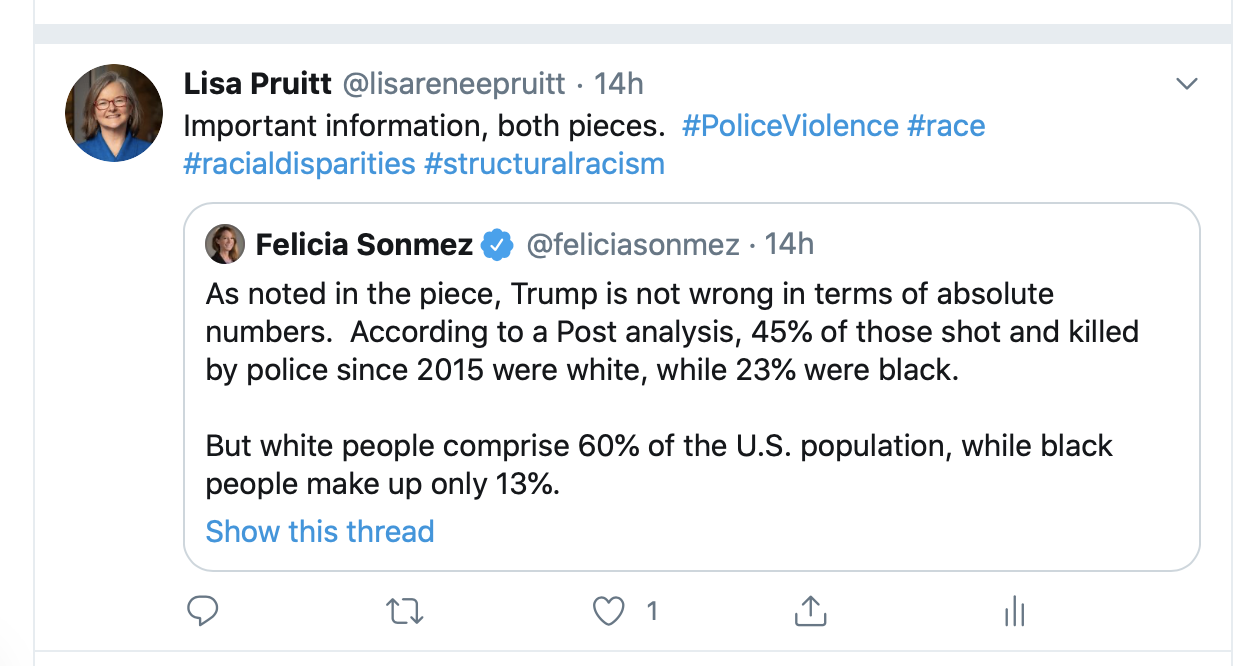
We saw a partial response to these questions, I guess, a few weeks ago when Donald Trump answered a journalist's question about Black Americans being killed by police by saying that "more white people" are killed by cops than black people.  Here are some Tweets by  journalists that I captured just after his  comment:
Screenshots from July 14, 2020

And here are two of my Tweets about the matter then:


The New York Times responded to Trump's comment with this story by Jeremy Peters:
Mr. Trump added to his long record of racially inflammatory comments during an interview with CBS News, in which he brushed off a question about Black people killed by police officers, saying that white people are killed in greater numbers.

Mr. Trump reacted angrily when asked about the issue, which has led to nationwide protests calling for major law enforcement changes.

“Why are African-Americans still dying at the hands of law enforcement in this country?” the interviewer, Catherine Herridge of CBS News, asked the president.

“What a terrible question to ask,” Mr. Trump responded. “So are white people. More white people, by the way.”

Statistics show that while more white Americans are killed by the police over all, people of color are killed at higher rates. A federal study that examined lethal force used by the police from 2009 to 2012 found that a majority of victims were white, but the victims were disproportionately Black. Black people had a fatality rate at the hands of police officers that was 2.8 times as high as that of white people.
Of course, what Trump said is technically true.  So were the clarifications by the media.  I call this the "Lies, Damned Lies and Statistics" problem.  Multiple accurate assertions can be made based on available empirical data.  The media choose to highlight one or the other.  In doing so, they drive wedges between folks who have a lot in common:  both people of color and low-income, low-status whites (who are arguably also people of color) are vulnerable to police misconduct.  Indeed, people of color and low-income whites are vulnerable to lots of bad stuff.

I'd like to see these vulnerable folks banding together across racial lines and not to be put into a contest--or conflict--with each other.  Wouldn't we be better off, at least occasionally, to do what Healy and the New York Times have perhaps done/kinda' sorta/implicitly laid the groundwork for?   Cross-racial coalition building, that is.  It brings me back to a question I've been mulling for a long time, in this context and others:  Wouldn't all parties who have a beef about policing--parties of all colors/races/ethnicities--be better off joining forces rather than strictly competing to say who has it worse?  wouldn't we be better off not engaging in what Chimimanda Ngozi Adichie calls "the oppression Olympics"?

It seems these days that lots of folks, including many non-whites, are skeptical that anything law enforcement do that is "wrong," "inappropriate," even in violation of the constitution, is attributable to anything other than racism or grounded in racial difference.  But don't the data from this Healy story belie that assumption?  As well as the data Trump implicitly invoked in his ham-handed comments a few weeks ago?

On a somewhat different note, this story out of central Missouri reminds me of the movie "Winter's Bone," set in southwest Missouri, and the scene where the county sheriff pulls over Teardrop.  If you don't know what I'm talking about, then see the movie. Some prior posts about that movie are here and here.

I'm also thinking about the movie "Three Billboards Outside Ebbing Missouri," set in a fictitious Missouri town.  That movie features plenty of racism by local police, but also law enforcement failures in relation to the investigation of a local teenager's death, that of a young woman who was raped before she was murdered.

The Healy report wisely addresses two other issues that loom large in rural contexts:  the higher rate of gun ownership and the lower rate of availability of mental health services.  Regarding the former, the story cites David Hemenway, director of the Harvard Injury Control Research Center, who says
the prevalence of guns may explain why cities and rural areas have nearly equal rates of law enforcement killings even though murders and violent crime rates tend to be higher in cities. 
More than half of the people fatally shot by rural officers were reported to have a gun, according to a seven-year tally by Mapping Police Violence. Ms. Fizer was among the roughly 10 percent who were unarmed.
And then there is the issue of body cameras, technology and resources.  I published this in 2014, and it was controversial in the U.S. but has been cited widely in Australia and New Zealand.  One of my points about rural socio-spatiality is that if you are going to police vast rural areas effectively, you're going to need technology and resources.  In this case, the Sheriff claims not to have had enough of both to do something else:  hold law enforcement accountable by downloading, sorting and storing body cam footage.

It is tragically ironic that this story out of Sedalia was published on the same day that another victim of crime in a Missouri small town committed suicide.  Daisy Coleman killed herself yesterday, as Amanda Arnold reports in The Cut:
Daisy Coleman, the survivor at the center of the 2012 Maryville, Missouri, rape case and whose story was later featured in the Netflix documentary Audrie & Daisy, died by suicide on Tuesday evening. She was 23 years old.
* * * 
Coleman became the subject of national attention in 2012, when she, then 14 years old, attended a party where she blacked out from drinking and was allegedly raped by 17-year-old Matthew Barnett, a senior football player who had familial ties to a former Republican state representative. Before dawn the next morning, Melinda [Daisy's mother] found Daisy, who was wearing just a T-shirt and sweatpants in below-freezing weather, passed out on their doorstep. A hospital exam later confirmed Coleman had been raped, which led to Barnett’s arrest. He ultimately faced few repercussions, however: He received two years’ probation but was never convicted. Meanwhile, Coleman endured relentless victim blaming, and her entire family was harassed. People were “calling me a bitch, a whore, and a slut every single day,” she wrote in Seventeen. One Fox News guest suggested Coleman had “expected” to get raped. Melinda claimed she was fired from her job at a local veterinary clinic over the scandal.
The ruthless bullying took a grave toll on Coleman, and in 2014, she was hospitalized following a suicide attempt; it was not her first. After recovering, she went on to advocate for survivors of sexual assault.
Maryville, population 11,972, is in far northwest Missouri, on the Iowa state line. Interestingly, both of these cases (the Sedalia and Maryville matters) attracted the "intervention"--official or not--of professionals from Kansas City, the regional urban center. In the case of Audrie and Daisy, a Jackson County prosecutor was brought in to investigate local law enforcement and prosecutorial handling of the case. In the Sedalia matter, a Kansas City police officer who lives in Sedalia is challenging Pettis County Sheriff Bond in the upcoming election.

And that takes me back to some Facebook comments by Sheriff Bond about the Sedalia protests.
Do you want this to continue and cause irrevocable harm to our community?  Are you willing to allow Pettis County to become the test project for some social justice experiment for rural America?
The use of "social justice" is interesting there, since the right uses it as a pejorative term for the left:  The sheriff also suggested that outside agitators are sowing "social chaos."  Even Hannah Fizer's father invokes similar concerns, as Healy summarizes:
But [Mr. Fizer] counted himself as a conservative Republican and worried that the protests in Sedalia could be co-opted by left-wing outsiders — a pervasive, but largely unfounded fear in small towns after Mr. Floyd’s killing.
Reminds me of similar concerns articulated by my mom about her community in nearby northwest Arkansas.  I wrote this about the "outside agitator" trope, and here's another piece about so-called "antifa busses," which are a hoax.

Post script from August 25, 2020:  Here's a quote from a Trump supporter in a New York Times story, explaining some of the reasons she supports Trump:
We’ve had more cops gun down white people than Black people.  Do we throw a fit if a white guy gets killed by the cops? No.
I’m not racist.  I’m not. I have all kinds of friends. There’s good cops and there’s bad cops, I see that. We just need to weed them out. I think this George Floyd incident got escalated to be ridiculous.
Cross-posted to Working Class Whites and the Law. 

Saturday, June 6, 2020

Black Lives Matter in rural America (Part I): Protests spread to unexpected places, small towns, flyover states

Facebook post about a BLM protest in Vermillion, South Dakota
Anne Helen Petersen, who writes for Buzzfeed and lives in Bozeman, Montana, started this week collecting information on Black Lives Matter protests in "small towns and rural places."  Her initial collection was on her Twitter feed, and I was skeptical off the bat because it included major cities like Portland, Maine (largest city in Maine) and Lexington, Kentucky (second largest city in that state).  But some of the places she was highlighting were more truly rural, and I appreciate the point she is making.

Petersen also wrote a Buzzfeed story headlined "Why the Small Protests in Small Towns Across America Matter." The dateline is Havre, Montana, population 9,310, where the protest was organized by Melody Bernard of the Chippewa Cree from the nearby Rocky Boys Reservation.  Petersen reports that an African American football player for Montana State University-North (but who grew up in Atlanta), Dorian Miles, wrote this encouraging post on his Facebook page after participating in the march:
SPEAK AND YOU WILL BE HEARD! Today we did what had to be done in Havre. A SMALL town of predominantly older white Americans stood with me to protest the wrongdoings at the hands of police EVERYWHERE....Today we stood together for an injustice. Today people who don’t look like me or relate to me showed love and support. I was overwhelmed to see the people I saw today marching in protest to the public lynchings that have been done by the only people whose job is to PROTECT and SERVE their community.
It's a theme you'll see throughout this post:  Defying stereotypes that rural people are consistently  conservative, static, ignorant and racist.

Here are just a few of the places Petersen's Twitter feed has documented as hosting protests.
Twitter screenshot from June 6, 2020
re: BLM protests in East Texas

Benton, Kentucky
Healdsburg, California
Lewisburg, Pennsylvania
Solvang, California
Alpine, Texas
Taylorville, Illinois
Charlottetown, PEI, Canada
Ridgway, Pennsylvania
Lander, Wyoming
Enterprise, Oregon
Paoli, Pennsylvania
Kalispell, Montana
McCall, Idaho
Merrick, New York
Belfast, Maine
Riverton, Wyoming
Vidor, Texas
Conway, New Hampshire
Palmer, Alaska
Williamstown, Massachusetts
Canton, New York
Emporia, Kansas
Brownsville, Pennsylvania
Huntsville, Texas
Forks, Washington
Spencer, Iowa
Boulder, Utah
Lynchburg, Virginia (home of Jerry Falwell's Liberty University!)
Hoover, Alabama (high school students arrested for violating curfew)
Andrews, Texas
Frostburg, Maryland
Mt. Shasta, California
Edna, Texas
Lewiston, Maine
Moab, Utah
Hazard, Kentucky
Murphy, North Carolina
Mad River Valley, Vermont
LaGrange, Illinois
Iqaluit, Nunavut, Canada
Hartwell, Georgia
Avon, Connecticut
Williston, North Dakota
Craig, Colorado
Moses Lake, Washington
Butte, Montana (along with Missoula and Bozeman)
Wolfeboro, New Hampshire
From June 7, Kalispell, Montana
I've seen lots of reporting in the vein of Petersen's, though I believe hers was the first.  Here's a Washington Post opinion piece by Judy Muller about a protest in Norwood, Colorado, where she lives.  The headline is "My tiny, white town just held a protest. We’re not alone." Norwood, population 510, is in San Miguel County, in the southwest part of the state.  

And here's a story by Peter Salter in the Lincoln Journal-Star about protests in Harvard, Nebraska, population 1,013, part of the Hastings Metropolitan Area.   The headline is "'We won’t allow that foolishness in our small town' — In the heart of Nebraska, a peaceful and powerful protest."  Here's an excerpt which, like the Buzzfeed story out of Havre, Montana, features a black football player, one of the only African Americans in the town:
Twitter account out of Nebraska panhandle 
Harvard’s police chief showed up at the protest in short sleeves, because he wasn’t expecting trouble.

“I’m not in favor of any excessive force at all,” Wayne Alley said from the steps of the small city hall. “And I’m for everything that you guys stand for. I wish you the best of luck.”

The town’s only black man was there with a microphone, because he’d started this.

“I woke up that morning and thought we needed to do something,” Jermaine Guinyard said a day later. “Even in small-town Nebraska, we may not deal with police brutality, but we have injustice and inequality to deal with.”

The running back who helped carry Harvard to the six-man football state championship in November was there, too, because Guinyard, his former teacher and coach, needed his help — and his connections.

“My role was putting it out there,” said David Reazola. “Mr. G’s not a social media guy. I have a pretty decent platform. But it was pretty cool how quickly the word spread.”

And that is how an estimated 50 people — many of them students, but some of them families pushing strollers — gathered Tuesday in the center of their small town, in the south-centeral part of the state, to protest the killing of a black man by a Minneapolis police officer, and to call attention to the work that needs to be done in their own community
My friend and colleague Prof. Hannah Haksgaard, who teaches at the University of South Dakota School of Law, shared the image at top of this post from her Facebook feed in Vermillion, South Dakota, population 10,571, home of the University of South Dakota.

Sarah Smarsh (author of Heartland) is also collecting "rural" protests on her Facebook feed and posted some screen shots on Twitter, where she wrote:
I've commented many times on the class lines of political movements. The working poor folks I come from weren't (aren't) civically engaged, not because they didn't care but because, in the hard pursuit of basic survival they had no time to look up from fields and factory lines and retail shelves.   
While many such essential services have not lessened, there is nonetheless a global slowing--of production, of consumption--that, while causing economic loss in one sense, is creating a new wealth of energy in another.  This is true to varying extents for every economic class, albeit amid the energetic payment we will all make to the COVID-19 pandemic.  
Smarsh notes that USA Today has been mapping BLM protests, and Petersen mentions in her Twitter feed this story by Reuters.   

Meanwhile, these shots of a Black Lives Matter demonstration in Harrison, Arkansas came across my Twitter feed on Thursday night.  

This left-leaning commentator from
Fayetteville, Arkansas, the
University town two hours away,
observes the perceived politics and
lack of anonymity associated
with rural places.
I know Harrison, population 13,087, very well.  It is the town where I was born, in the regional hospital previously known as the Boone County Hospital and now the North Arkansas Medical Center.  I grew up 20 miles south of there in an even smaller town, Jasper, county seat of Newton County, population 8,000Boone County, population 37,000, is 96% White, 2.6% Hispanic or Latino, and 0.4% Black.  This post from several years ago is about Harrison and Boone County's history as an outpost of the KuKluxKlan.

I shared these screenshots with my mom, who has lived in Newton County her whole life, and it was important to her to tell me that "the protest in Harrison is organized by a local person and is not affiliated with organizations that are rioting in more metropolitan places." Like lots of folks--apparently including many police--Mom is struggling to differentiate between peaceful protestors protected by the First Amendment and looters who are committing crimes.  (Don't miss this Codeswitch episode on the "outside agitator," including Martin Luther King, Jr., being labeled as such). My mom's comment also reveals her love for the rural and her rural lifestyle; she's always been sensitive when I have written anything negative about my hometown--however fact-based and newsworthy--on this blog.

In any event, three prior posts about Harrison are here, here and here.

In a similar vein, the Southern Illinoisan published this story, by Molly Parker "In wake of Floyd death, rural, white Southern Illinois towns are reckoning with racist past."  Parker writes:
Some of these communities — Benton, Herrin, Carterville, Anna — were “sundown towns” where, by official policy, black people were not allowed after dark into at least the 1960s in some cases, according to research by James W. Loewen, author of the book “Sundown Towns: A Hidden Dimension of American Racism.”
Kalispell Montana, in the screenshot above, is also a place associated with racism; in particular, white supremacist Richard Spencer is a part-time resident of nearby Whitefish, also in Flathead County, gateway to Glacier National Park.

In short, all of these protests run counter to our expectations of rural folks, just like the women's marches spreading to rural places did in 2017.

But then there have been other types of protests this past week, like this one out of Idaho, where people turned out to turn away a rumored "antifa" protest.  The headline for the Washington Post story by Isaac Stanley-Becker and Tony Romm is "Armed white residents lined Idaho streets amid ‘antifa’ protest fears. The leftist incursion was an online myth."  A similar report from Humboldt County in far northern California is in the Lost Coast Outpost.  And here's a story from the same news outlet about a BLM protest in the city of Fortuna.  

And while "redneck" is non synonymous with "small town" or "rural," it is often conflated with these geographies--and with the South--in the national imaginary.  I therefore share this piece from medium.com by Southern Crossroads headlined "Rednecks for Black Lives."  

This seems like a good opportunity to also share a story from NPR this morning.  Michele Block, reporting on the hundreds of voices singing, Lean on Me in Washington, DC, two days ago, noted that Bill Withers, who wrote and recorded the song, considered it a "rural song."  She explained by playing an interview with Withers who shared an incident when he was in the Navy and returning home to West Virginia from where he was stationed in Florida.  He had a flat tire while driving through rural Alabama and a man who Withers said looked like he could have been out of the movie "Deliverance" came upon him.  In due course, the man walked to his home and returned with a tire for Withers, and even helped him change the tire.  Withers said incidents like that gave him hope, and it gives me hope, too--just like these protests in rural places give me hope.

Postscripts:  Here's an op-ed published in the L.A. Times on June 9 by a high school student Lilian Smith of  C'oeur d'Alene, Idaho:  "My Idaho town shows how the Black Lives Matter movement can resonate in deep red communities."

The Takeaway with Tanzina Vega did a great interview with Anne Helen Petersen re: her writing about rural and small town where Black Lives Matter protests have occurred.  I especially appreciated the attention to the rural concept of "lack of anonymity." 

Here is the Daily Yonder story on the matter.  

Monday, June 1, 2020

Exposing injustice in Rural America means recognizing its diversity

When you hear the phrase, “rural America,” what comes to mind? This answer certainly may vary based on the background of the reader and their exposure to rural spaces. For many, they think about a bucolic and pastoral country side that represents a place that they may have visited on a family vacation. Yet others may think of “conservative” America, typified by gun toting, Bible worshipping “Trump supporters.” The same reader may juxtapose these images and use them to represent one in the same, almost as if to represent rural America as a “good place to visit but not live.” But is there even a common image that can accurately depict rural America? After all, the phrase “rural America” be used to describe terrain as diverse as the snow swept Alaskan tundra to the lush Green Mountains of Vermont to the pine forest swamps of eastern North Carolina to the mountainous deserts of Arizona. And people as diverse as the African American people of the Black Belt South, aging “Back to the Landers” in northern New England, coal miners of Appalachia, and Native people all across this country. 

It is a landscape of challenges, an increasingly aging and poverty stricken landscape with vast systemic inequality that the popular imagination is increasingly leaving behind. Being disadvantaged in rural America often means vulnerability. Your ability to seek redress for injustices is significantly impaired by inherent systemic inequalities. After all, approximately twenty percent of Americans live in rural America but yet two percent of lawyer practice there. However, the perceptions of these communities and the struggles that they face are often shrouded in an invisible veil. The lack of attention paid to these communities and the mischaracterizations and overgeneralizations that are made in their popular depictions serve to obscure or distort these issues.  

In the wake of the 2016 Presidential election, many media outlets sought to explain how Donald Trump became the 45th President of the United States. This led to some deep soul searching and ultimately a series of thought pieces on “rural America” and how its citizens were led to vote for Donald Trump. This paper will not seek to litigate the election result and how it ultimately happened, there are other forums for that. However, I will note that Donald Trump was not uniquely popular in rural spaces. In fact, his share of the rural vote was only 3% higher than Mitt Romney in 2012. Trump also performed almost equal to the two previous Republican presidential candidates in urban and suburban communities so Trump also wasn’t uniquely unpopular there either. The bigger shift of rural voters happened between 2008 and 2012 when Mitt Romney gained a 6% greater share of the rural vote than John McCain had. The image of rural America being uniquely Trump obsessed is greatly at odds with the statistical reality of a partisan shift that was better reflected in the 2012 presidential election. 

The statistical reality of the situation did not stop many media outlets from attempting to portray rural America as “Trump Country” and using that as a basis for thought pieces. It is grossly unfair however to look at rural America through the lens of a single election result. It is an outright disservice to the people and institutions in those regions. The systemic inequalities that plague many rural spaces are decades in the making, centuries in some places even. An oversimplification of the struggles faced by rural America is also problematic because it complicates the process of building the political will to address the issues faced by people in those spaces. These systemic inequalities are drive the need to ensure that rural Americans have equitable access to justice. Ensuring that these issues are adequately depicted is essential for creating the political will to get it done. 

This dire reality faced by rural America is reflected in the raw statistics. As a whole, rural America has a higher poverty rate than urban and suburban America. Many rural communities are suffering because their economies were based on a single industry and that industry has left or become obsolete. Others are suffering because of an ongoing decades long economic malady. After all, poverty in rural America tends to be persistent, deep, and remarkably long lasting. In fact, of the 353 “persistent poverty” counties (defined by federal law as a county in which “20 percent or more of its population [has lived] in poverty over the past 30 years"), 301 are “non-metro.” Many places are also suffering because of the economic consequences of racism and the creation of power structures that disadvantage certain groups of people, a commonality shared with urban areas but yet exacerbated by the spatial isolation inherent in a rural existence. A 2018 study by the Bridgespan Group and National 4-H Council found that of the rural counties where a quarter or more of the population was African American, none of them ranked in the upper quartile in terms of social mobility. It is important to remember also that none of these categories are exclusive and a lot of areas are afflicted by multiple issues. For example, a community may have been based around a single industry but the majority of the population who worked in it were impoverished. The economic makeup of a given industry can also doom those who rely on it to poverty. For an example of how this may look in reality, think of a Southern mill town or a town where a significant number of people work as sharecroppers. While the given industry never brought prosperity to the average worker, its collapse only served to further bury the people who depended on it for their survival.

This reality also reflects a community development problem. The migration of job opportunities to urban areas is leading to a corresponding outmigration to urban communities. One has to only drive through old mining towns in West Virginia, old logging towns in Maine, old tobacco farming communities in eastern North Carolina, and countless of other rural landscapes to see the effect. Communities are dying all over this country and the politicization of “rural America” is contributing to the apathy surrounding this trend. Instead of coming together to recognize the struggles of these communities, people are instead being conditioned to frame these people’s struggles in the context of who their region voted for in the last Presidential election. Even if those results don’t reflect the wishes of the most vulnerable people in those regions. As always, the reality is much more complex than whatever simplistic narrative can be spun up. 

Vulnerability is perhaps the biggest factor that is created by the spatial isolation of rural America. When we think of rural America as dominated by white, conservative interests, we are dooming the people who do not fit that archetype to an existence of marginalization. To provide a concrete example, the South is littered with “red” counties that have a significant African American population. However, when we look at a map and see that a Southern state is “red,” we ignore the collective existence of the people in its rural pockets that do not constitute a majority but have to live under the decisions made by the majority.  To be vulnerable in rural America means that you are often subject to the whims of people who support policies that are at best apathetic to your best interests and often times diametrically opposed. In some communities, it also means that you are up against a power structure that was built to oppose your interests and whose existence has been fortified over the years.

The diversity of challenges in rural America also bears mentioning. For communities in rural northern New England, they continue to face the perpetual issue of outmigration, which has plagued them in some way since their son and daughters started leaving for the West and the urbanized Industrial Revolution cities of southern New England in the 19th century. This reality is manifested in the fact that New Hampshire, Vermont, and Maine lead the nation in median age. For communities in the South, they continue to face the plague of persistent poverty and economic despair, which has plagued them for generations. In some ways, these wounds were self-inflicted, the product of policies that served to subjugate entire segments of the population. This reality is reflected in the fact that Southern states are routinely among the leaders in poverty rates around the country. For communities in Appalachia, they have to reckon with the collapse of the coal industry and the declining of mining as an integral part of the local economy. This fact is reflected in the dire poverty statistics and life outcomes for Appalachian communities. And yet even this list is obviously non-exhaustive and other regions of the country are dealing with other issues that I did not name here. Also, no issue is exclusive to any region. There are rural communities in every corner of the country dealing with aging and outmigration and the legacy of racism is also present in every corner of the country, especially in areas along the Mexican border and in Tribal communities. However, these issues are minimized when they are not adequately represented. When rural representation is oversimplified, the vulnerable people in those communities suffer.

Rural America and her citizens deserve better.