Showing posts sorted by relevance for query C & H hog farm. Sort by date Show all posts

Friday, December 27, 2013

NYTimes covers controversy over industrial hog farm in rural Arkansas

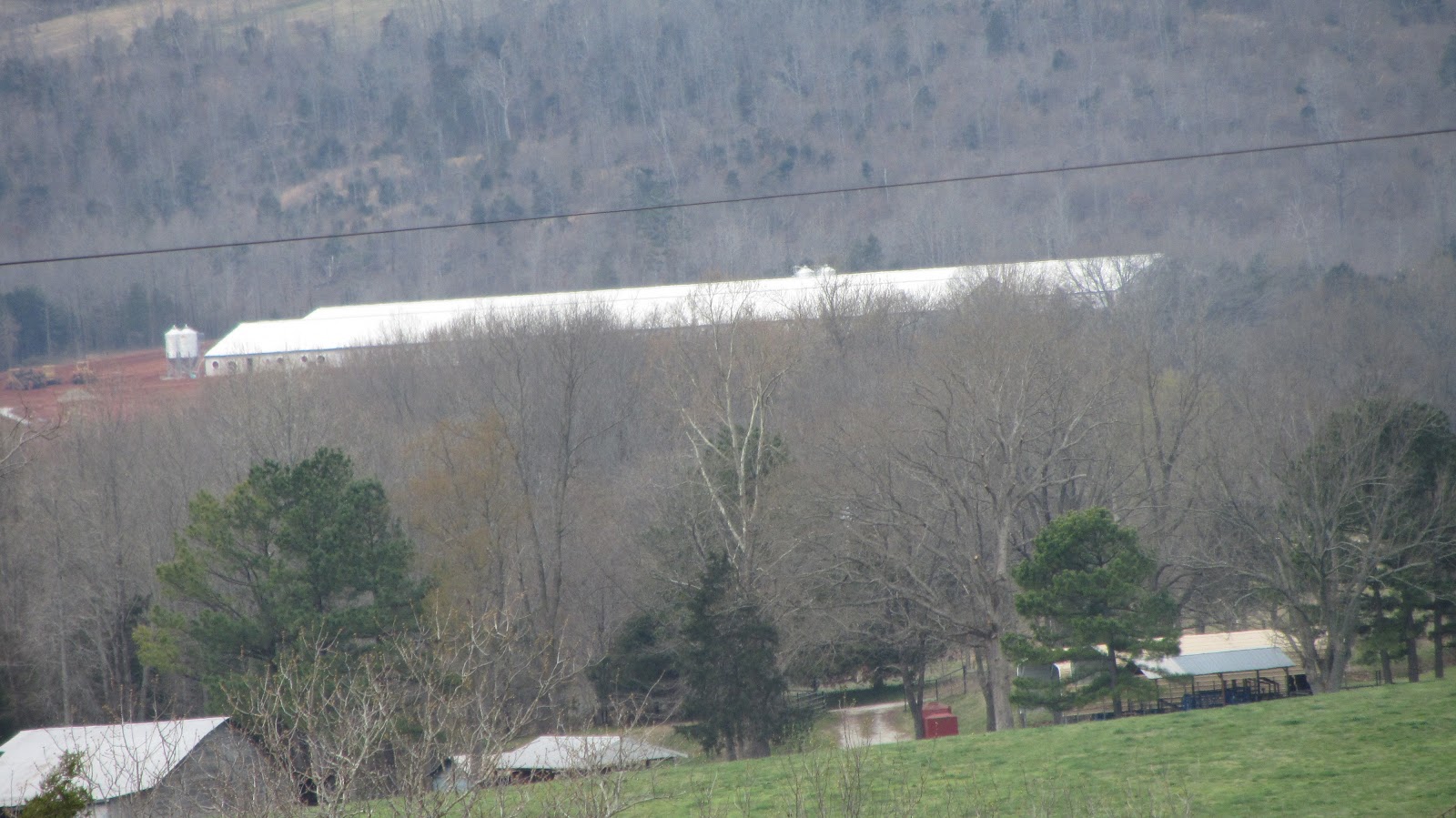
C & H Hog Farm, Mt. Judea, Arkansas, in Buffalo National River watershed.  April, 2013.  Photos by Lisa R. Pruitt
I've been writing since last March about a huge industrial hog farm that Arkansas state agencies approved in August, 2012 under a virtual shroud of secrecy given the lack of notice to area residents.  The farm, called C & H, is in rural Newton County, Arkansas, just a few miles from the Buffalo National River and along one its tributaries, Big Creek.  (Read more here, here, here, here, here and here).  Some state and regional media have followed the story, too, which has drawn protests from environmental groups.

But imagine my surprise--and delight--when the New York Times published on its website this evening "2,500 Pigs Join Debate Over Farms v. Scenery."  I was even more delighted to see that the story focused on the very same industrial hog farm that I and lots of other folks in northwest Arkansas have been complaining about in the 11 months or so since the enterprise became truly public.

John Eligon's story for the Times does not have a lot of new information (above and beyond my blog posts, that is) about what happened and is, indeed, still happening.  It does, however, feature some interesting quotes from locals--some who support the hog farm, others who do not.  Here's a sampling:

  • “I was just sick over it — I just couldn’t believe it,” said Jewell Fowler, 87, who found out about the hog farm after it had been approved, through a notice in a local newspaper. Born in Mount Judea, Ms. Fowler has lived for the past four decades in a wooden cabin on the banks of the Big Creek, one of the main tributaries to the Buffalo River: a quiet oasis where the trees emit a sugary scent and water laps over rocks in a soothing whir.  “I’m just afraid of the stink, maybe contamination, make people sick,” Ms. Fowler said.
  • Glenn Ricketts, 55 and a relative by marriage to some of the hog farm's owners, asked Eligon, "You smell it." He then continued, “Reason why it don’t bother us, we’re just hillbillies.  When you’re raised up around a hog, it don’t bother you.”
  • Charles Campbell, 77, who has an agreement with the hog farm to spray its manure on his land says, “I don’t think that it would pollute the river at all.  I’ve lived in this count[ ]y for, well, all my life, and cattle and hogs has been raised up and down the creek here, and to me it ain’t bothered nothing so far."
As for BigAg, Mike Martin, a spokesman for Cargill, Inc., the entity that will benefit most from the farm, said:
We believe that modern farming and environmental conservation and protecting the environment can coexist.  A lot of the fear and concern is based on a ‘what if’ scenario that may never take place.
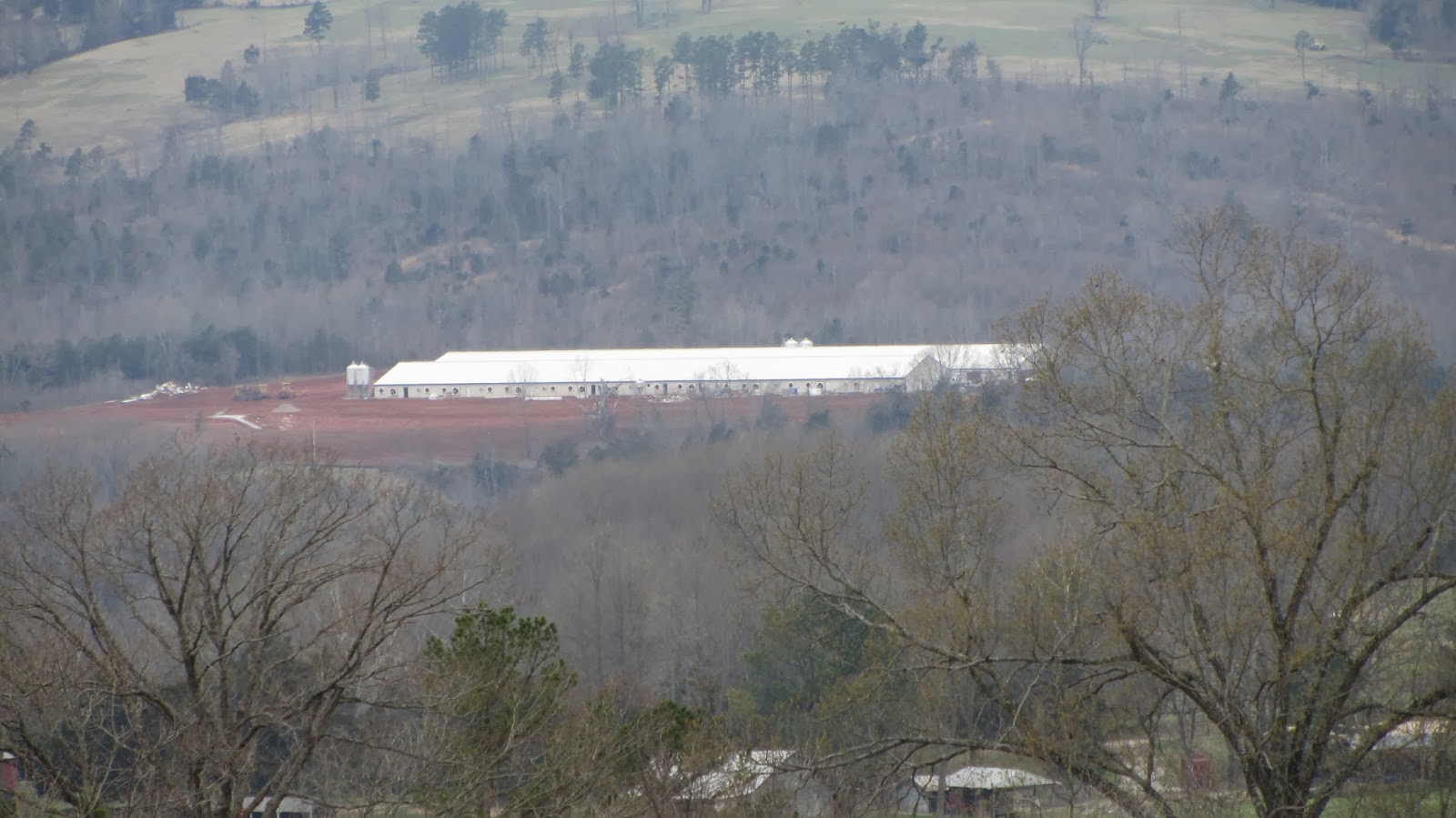
C & H Hog Farm, as seen from Mt. Judea School.
Eligon notes the economic context of this battle as it relates, in particular, to considerable local support for the CAFO:
Many see it as an economic bright spot in Newton County, which has high poverty. 
High poverty, indeed. It is a persistent poverty county with no industry and mostly subsistence farms.  It is classified by USDA ERS as federal-state government dependent.
Neighbors of C & H Hog Farm.  Newton County is a persistent poverty county. 

Sunday, May 12, 2013

Industrial hog farm in the Ozarks a done deal, but no one seems to be responsible for it

Farrowing barn at C & H Farm, photographed from Mount Judea School. 
I wrote (here and here) a few months ago about a proposed industrial hog farm in Newton County, Arkansas.  The massive hog farrowing operation made news--even state and regional news, such as here and here--because of the unusually skimpy notice process followed by the Arkansas Department of Environmental Quality (ADEQ) in granting a General Permit for Concentrated Feeding Operations (CAFO) to C & H Hog Farm.  The permit and the process behind it also attracted attention--and ire from many local stakeholders--because the CAFO is in the watershed of the Buffalo National River.  Indeed, not even the National Park Service nor its officials overseeing the park locally received notice that the permit for the 6500-hog farm was being sought for a site just six miles from the scenic river, which is a popular tourist destination in the region.

Various formal and informal entities, including the National Park Service and some grassroots organizations, were soon up in arms over the decision.  The National Park Service wrote a letter to ADEQ in February articulating 45 irregularities in the permitting process.  ADEQ responded in late March with a 33-page letter, responding point by point to the discrepancies the National Park Service had enumerated.  ADEQ's executive director, Linda Newkirk, signed the letter, which she said responded as best the agency could to some of the "innuendo and conjecture" in the NPS letter.  Newkirk also stated firmly that ADEQ would not conduct an additional environmental impact assessment.  The permit was granted based on a "finding of no significant impact" by the Farm Service Agency.  ADEQ has authority to grant such permits under the National Pollutant Discharge Elimination System.

Meanwhile a group of concerned citizens associated with the Buffalo River Watershed Alliance lobbied the Arkansas Pollution Control and Ecology Commission in Little Rock on March 22, seeking to have the Commission revoke the farm's permit or otherwise intervene.  The Commission chair responded simply that ADEQ and C & H Hog Farm had followed the letter of the law.  Read more here.

Because the permit was granted in August, 2012, and the hog farm was nearly complete by the time it came to widespread public attention in February, prospects for stopping the facility--which by then was nearly complete--seemed slim.  In March, ADEQ announced it would hold a public meeting in Newton County in May, but that meeting was more to inform residents and to respond to questions.  ADEQ did not hold out any real likelihood that the decision would be reversed, stating:
We want to visit the community to provide information in person and hopefully answer some questions that have been raised about the operation and how our permitting process works.  
An overflow crowd gathered at that May 8 meeting, with law enforcement positioned to keep order and direct traffic.

ADEQ Director Teresa Marks stated at the meeting that the agency "didn't know [the permit applicant's notice of intent] would cause this kind of outcry," but that the agency had communicated some with the  county by way of response to many emails and phone calls about the permit.  Marks said that the same provisions "apply to general permits all over the state," with no exceptions for places like the Buffalo River watershed.  Acknowledging that many in attendance disagree, she said "You may feel that way and you have the right to talk to your legislators to make sure they treat [the Buffalo] differently."  

The headline for the story in the Newton County Times is "ADEQ explains limits of authority, and it reminds me of an earlier headline in which the Newton County Quorum Court (the Arkansas name for the county board of supervisors), disclaimed any responsibility for the farm, nor any power to stop it.  (Read more here). It's as if these lower scales of government--especially the state via ADEQ--are saying "the devil made me do it," and the devil in this case is the federal government which sets the environmental standards for such permits. Ironically, the federal government also oversees the Buffalo National River, which stands to lose greatly from the hog farm.

Signs in "downtown" Mount Judea, across
from the school, direct drivers to the hog farm.
Newton County Times coverage of this meeting does a better job than I have seen elsewhere explaining why the permit application process did not require local notice.  The story quotes an Arkansas Water Engineer, John Bailey, who explained that while state permits require notice in a local newspaper, this is a federal permit simply administered by the state and therefore requires neither notice in a local newspaper nor a public meeting.  The CAFO permit will have to be renewed in five years.  When the permit is up for renewal, the phosphorous index for the soil will be measured, and if it indicates over-application of manure, "a decision will have to be made based on either best management practices" or the inclusion of additional land on which the manure can be spread.

Marks remained firm at the meeting regarding the agency's refusal to re-visit any aspect of the process, including the details of the environmental impact assessment.  This is in spite of some contrary scientific opinions about how the 630 acres set aside for manure spreading are likely to "cope" with the manure generated by thousands of hogs.  The facility is already housing 850 sows and three boars, with the first litter of pigs expected in August.

Marks noted that a water monitoring station exists on Big Creek, just above its flow into the Buffalo.  She said inspectors will be available to respond to any complaints and that she expected this "to be one of the most closely watched hog farms in the United States."
Entrance to C & H Farm; just up the driveway is
a "No Trespassing" sign.   

The Times story featured a text box with quotes from the meeting, absent the context in which they were spoken.  A few of the more interesting ones follow:
  • Who's going to compensate the land owners near Mount Judea for the loss of property values?
  • There are industries all over the state that people don't want, but they are actually necessary.  So, what we [ADEQ] try to do is to make sure there's no environmental harm that comes from these industries.  We don't regulate odor.
  • The minimum distance a hog farm should be from a community or school should be at least five miles.  I see the school system closing down because of air quality.   (Read more here on the proximity of the hog farm to the Mount Judea school).

Earlier on the day of the ADEQ meeting, the Buffalo River Watershed Alliance held a public meeting at the Buffalo Theater on the Jasper square.  They presented a film about commercial hog farming to a packed house and had a panel discussion about the health risks, economic impact on property values, inadequacies of the permit process, and the lack of transparency regarding the CAFO permit process.

Photos of C & H Hog Farm and neighboring area by Lisa Pruitt, April, 2013.

Wednesday, July 30, 2014

Time for an update on the hog CAFO in Newton County

I have written frequently in the past 18 months or so about the industrial hog farm on Big Creek, in the Buffalo National River watershed in Arkansas.  Read more here, here, here and here.  That operation, C & H Hog Farm, was approved by the Arkansas Department of Environmental Quality (ADEQ) without notice in any area newspaper or, for that matter, to the National Park Service.  The only notice given was on the ADEQ website.

Ever since folks in Newton County realized the CAFO was under construction, local and regional groups of concerned citizens have been trying to get it shut down.  Among other things, they filed a lawsuit against the U.S. Dept. of Agriculture "Farm Service Agency and the U.S. Small Business Administration for their inadequate review and improper authorization of loan guarantee assistance to C & H Farms."

Efforts are also underway to change Arkansas law so that no more operations of its kind can be sited in the Buffalo River watershed. That watershed includes parts of Madison, Newton, Searcy, Boone, Pope, Marion, Van Buren, Stone and Baxter counties) As of May, 2014, the Arkansas Pollution Control and Ecology Commission (APC & EC) "enacted a 6-month moratorium on issuing new permits for large confined animal operations in the area of the" river.

In June, APC & EC held a hearing in Harrison, in neighboring Boone County, about proposed changes to APC & EC regulations 5 and 6 on "Liquid Animal Waste Systems" and "Regulations for State Administration of the National Pollution Discharge Elimination System," respectively.  These changes proposed would apparently make the moratorium on CAFOs in the Buffalo River watershed permanent.  The usual suspects showed up, including Gordon Watkins, an organic farmer in Newton County who leads the Buffalo River Watershed Alliance (BRWA). He reported that the Alliance had grown to about 1000 members this year, growth largely attributable to interest in this issue.  Needless to say, the Alliance supports the permanent moratorium.

Also speaking at the meeting were two farmers form Benton County, which presumably would not be affected by the moratorium because that county is  not in the Buffalo River watershed.  Nevertheless, the farmers traveled to Harrison to speak against the proposed amendments and permanent moratorium. One of them, a diary farmer, said:
We rely on science and technology to produce a healthy product and protecting our environment for our family, our community and our cows.  This rule making sets a very negative precedent, and is not based on science.  This year it's hog farms.  Next year it could be poultry, dairy or beef.  I am pleading on behalf of family farmers for you to consider delaying all rulings until the research takes its course.
Clearly, this farmer is concerned about a slippery slope that could mean added regulation of her operations in the future.  One Newton County residents also spoke in opposition to the changes.  He  closed with:
We don't need further restrictions that destroy our freedom and our lifestyle.
Another spoke in favor of the proposal, focusing on the need to protect property values, jobs, and clean air.  He also expressed concern about well water contamination and the need to keep the promise "to our children, and to their children, that special places like the Buffalo will be preserved for them to experience."

Neither the temporary moratorium nor the changes under consideration will impact the permit under which C & H Farm operates, which was issued in August, 2012, and which will expire in October, 2016.

A few days before the hearings in Harrison, the National Parks Conservation Association (NPCA), the Ozark Society, the Arkansas Canoe Club and the Buffalo River Watershed Alliance hosted a day-long media event. The event was on the lower Buffalo, between Grinder's Ferry and Gilbert, a segment below where Big Creek flows into the national river and therefore the stretch that would be most affected by pollution from C & H Hog Farm.  Among those participating in the event, which included an aerial tour over the hog farm, was Dr. John Brahana, a retired hydrologist with the University of Arkansas and Bob Allen, Piney Creeks Chapter president of the Arkansas Canoe Club.  The Newton County Times June 11, 2014 issue quotes Allen speaking to the media:
We all want to eat bacon but we can't raise it in the watershed of the Buffalo River.
Brahana reported rumors that Cargill, which has the contract with C & H Farms, "wants out of the situation."  In addition, he reported, Teresa Marks, head of ADEQ, "ways out of her job and the governor wants a resolution of the problem."  Brahana reported that "he has taken some 40 samples from wells, springs and creeks in the area around the hog farm and has found dangerous concentrations of hazardous materials. He added that he introduced non-toxi dye into the ground across the road from the hog farm.  About 30 hours later, he said, it showed up in Big Creek."

Emily Jones, Southeast Program Manager for NPCA said that her organization filed the lawsuit against USDA and the Small Business Administration only after attempts at dialogue with the ADEQ authorities failed.

Sunday, June 2, 2013

Both sides of hog farm dispute vie for public and legislative support

I have been writing for several months about the controversy surrounding an industrial hog farm that just began operation in Mt. Judea, Arkansas, in the Buffalo National River watershed.  (Read my most recent installment here).  That locale, along with the shoddy notice process followed by the Arkansas Department of Environmental Quality, is what created the controversy.  Now, both sides--agribusiness (e.g., Cargill and the Farm Bureau) on the one hand and environmentalists and activists (growing up in Newton County, we called them hippies, but now they are joined by liberal elites)--are trying to sway public opinion, along with the thinking and actions of lawmakers.  

The May 29, 2013 issue of the Newton County Times reports under the headlines, "Lawmakers learn about Buffalo" and "Demonstrators show for law makers' visit." A third front-page headline is "Law makers get facts on hog farm."  Coverage of the same events by the Buffalo River Watershed Alliance is somewhat more detailed and, shall we say, differently illuminating.  One headline, picked up from a column in the Arkansas Democrat-Gazette, is "Grassy Greeting at Jasper Protest."  Here's the gist of the news that both papers cover:

The Arkansas Joint Committee on Agriculture, Forestry and Economic Development convened in the Marshall High School Gymnasium on May 21 for "two-day hearing on the controversial C & H Hog Farm."  State Representatives David Branscum (R-Marshall) and Kelley Linck (R-Yellville) hosted the event.  About 100 attended the hearings, including members of groups opposed to hog farm because they believe it will have an adverse impact on the Buffalo River watershed.  Among those who spoke at the hearing were Kevin Cheri, Buffalo National River Superintendent, and Richard Davies, director of Arkansas Parks and Tourism.  The lawmakers even took a short float trip on the Buffalo, from the U.S. 65 Bridge to Gilbert.  The Newton County Times writes: "The evening meal was provided by Cargill, the company the hog farm is contracted to produce pigs, Branscum reported."  The Times also states that, for the lawmakers, "The main attraction was to float the river as many had never been to this area of the state."

The lawmakers also visited C & H Farm, where protocol required all to "take a shower upon entering and exiting the barns to prevent exposing the pigs inside from contamination or disease." That must have been interesting.

After the tour of the farm, the "law makers were invited to drive to the Ozark Cafe in Jasper for lunch courtesy of Arkansas Farm Bureau."  The paper further reports:
The law makers who accepted the offer were greeted by a throng of demonstrators lined up on the courthouse lawn along state Highway 7 many waving placards and chanting, "Save Our River," and "Hogwash!"  Law enforcement officers stood on guard on the sidewalk in front of the restaurant.
Deborah Ferguson, a Democrat who is state representative from the other side of the state, West Memphis, is quoted:
It is important that tourism and agriculture find ways to co-exist and she believes that can happen here. She said she was impressed with the technology being employed at the hog farm that is designed to protect the environment.
Another representative, Dr. Steven Magie, Democrat of Conway, noted that "some inter-studies" should be made of the farm before the next legislative session.
One remedy that needs to be made is the public notification process so that local public input can be made before permits are issued.
Interestingly, Magie is both a physician and a hog farmer.  Specifically, he is a supplier of gilts (young female domestic pigs that are used on gestation and farrowing farms to replace non-productive sows), including some to C & H Farm.

Coverage of the protest by the Newton County Times, a secondary story on the front page, indicates that the protesters came at the invitation of Don Nelms, an artist whose frequent subject is the Buffalo. Nelms apparently entered the Ozark Cafe while lawmakers dined there, but uniformed sheriff's deputies and Jasper Police officers (what, are there two of them?) prevented the protestors from entering, "at the request of the proprietor."  Nelms's wife estimated that about 50 people came to protest the hog farm.  Some protestors were locals, but others came from Fayetteville and elsewhere in the state.  "This is a concern all over the state," she said.

Mike Masterson wrote of the event for the Arkansas Democrat-Gazette under the headline, "Grassy Greeting:  Weeding out dissent."  His quote from a female protestor, described as a member of a "prominent Newton County family," helps explain that headline:
“I was part of the protest in Jasper in front of the Ozark Cafe while Cargill fed the state’s House and Senate Agriculture Committee members. We surely needed to let Cargill and others see some of the concern for the Buffalo National River. Many came early … and held very creative signs,” she said.  
“At one point I believe there were over 70. It felt good to get to be among others and chant … as [Cargill’s] guests filed into the cafe. We stood directly across the street in front of the Newton County Courthouse. 
“At 12 o’clock sharp, mowing and weed-eating was going on all around us. [My husband] went inside the courthouse to speak to the County Judge [Warren Campbell] about postponing yard work until later and expected to get to do so by phone, but the woman he talked with seemed to just disappear. The yard workers insisted their mowing needed to be done at this time! 
“One informed us he was a county employee and we could be guilty of obstructing their work,” she continued. “There was some risk for the bystanders who cooperated by moving. The mowers were old and didn’t have protective shrouds. No one was injured, though my son did feel something hit the side of his face from the weed-eater. 
“The worker who was weed-eating explained how they had to mow at that time because it was for the holiday [six days later] for the veterans and the flag and also it was shady on that side of the courthouse. Then he wanted to explain how safe CAFOs are and how Mount Judea is fine. He explained how he prefers to eat a CAFO pig instead of an outside pig who wallers about in everything. Those swine are just not clean in his opinion. He thinks the real problem is that some bathrooms are closed at the national park.”
Here is a video of the protestors on YouTube.  Here is the Democrat-Gazette news coverage of the law makers' visit and the protest in response.  All of this reminds me that I could file this post under my "Small-town Government Run Amok" series .... 

Monday, March 31, 2014

Opposition to modification of hog farm permit voiced

The latest chapter in the dustup over an industrial hog farm in Newton County, Arkansas (covered in prior posts here, here and here) is an application the farm has filed seeking modification of the permit the state granted for it to begin operation in 2013.  Specifically, C & H Hog Farm now seeks to use a truck rather than the previously approved sprinkler system to spread manure on three fields.

On March 24, the Arkansas Dept. of Environmental Quality held a public meeting to consider the application for permit modification.  Sixty-five people attended the meeting at the Jasper School, and most, it seems, advocated re-opening the entire permitting process for the farm.  Sixteen attendees took the five minutes allocated to each to make statements.  The Newton County Times reported that "[f]ewer than half of those who made comments said they reside in Newton County." (That seems to be a nod to the issue documented here.) Among those speaking were Jerry Masters, executive vice president of the Arkansas Pork Producers Association and John Bailey, Permits Branch Manger, Water Division, who explained that the farm was eligible for financial and technical assistance to install the spraying system through the Natural Resources Conservation Service's Environmental Program.  Gordon Watkins, a Newton County organic farmer associated with the Buffalo River Watershed Alliance advocated that the three fields at issue should be included in a University of Arkansas monitoring study, asserting that if the fields' owners are unwilling to participate in the study, their fields should "not be part of the permit's nutrient management plan."

The Newton County Times summarizes the concerns voiced, none of which appears new:
the absence of monitoring noxious air quality needed to protect area residents and students attending Mt. Judea School; that phosphorous Index numbers for the fields' soils are not public reported for analysis; manure runoff will pollute Big Creek a tributary to the Buffalo National River; spread of disease from pig manure and impact on local health; need for closer monitoring of area ground water; use of a truck on the fields would compact their soil creating greater amounts and higher concentration of runoff; polluted water will travel quickly and spread through the karst geological formation of the area contaminating other water sources; detrimental impact on tourism and other businesses in the Buffalo River region.  
Two speakers articulated support for the hog farm, noting that they believed the farm was already exceeding permit requirements "to ensure that the farm would not jeopardize Big Creek or the Buffalo River."

ADEQ Director Teresa Marks facilitated the hearing, which lasted only one hour and ten minutes.

C & H is the only facilitate in Arkansas to operate under the CAFO general permit.  It's waste treatment system consists of in-house shallow pits with a 760,000 gallon capacity; a settling basin with a capacity of 831,000 gallons; and a holding pond with a 1.9 million gallon capacity.

Friday, May 17, 2013

Conservation groups to sue USDA over hog farm loan

The May 8, 2013 issue of the Newton County Times reports on a press release indicating that "a coalition of conservation groups" will sue the U.S. Dept. of Agriculture regarding the Farm Service Agency's loan guarantee for C & H Farm, an industrial hog farm on Big Creek, a tributary to the Buffalo National River.  Read earlier blog posts about the hog farm here and here.  The coalition apparently intends to argue that the decision by the FSA "was not properly examined and may violate the Endangered Species Act."

The Buffalo River watershed is "home to over 300 species of fish, insects, freshwater mussels, and aquatic plants, including the endangered snuffbox mussel, the endangered Gray bat, and the endangered Indiana bat." A spokeswoman for the Southeast Region at National Parks Conservation Association stated:
This factory farm will produce massive quantities of waste just six miles from the Buffalo River, and that waste will be spread on land that is right next to one of the Buffalo's major tributaries.  We are talking about one of the most beautiful areas in the country.  To think that our government would allow this hog factory in the watershed without examining its impacts is unconscionable.
The Farm Service Agency of USDA guaranteed 90% of the loan to C & H Farm.  That loan was used to purchase 23.43 acres in Mount Judea, Arkansas, and also for the construction of two barns. Those barns will house more than 6500 swine.

Robert Cross, president of the Ozark Society is quoted in the story:
This is the greatest threat to the Buffalo River since the Corp of Engineers damn proposal that we were able to thwart 50 years ago.  The porous limestone and karst that underlies all of the soil in the Mt. Judea region provides a direct passageway for leakage from the waste holding ponds and for untreated recharge from the waste application fields to reach the groundwater and thus Big Creek and the Buffalo River.  The risk for contamination of the Buffalo River is unacceptably high.  
Hannah Chang, an attorney with Earthjustice, is also quoted:
The letter we are sending today is a notice to the Dept. of Agriculture that its Farm Service Agency failed to undertake the consultation that is required to ensure that endangered species are not harmed as a result of the agency's action. 
Lastly, Jack Stewart of the Buffalo River Watershed Alliance is quoted:
Our aim is to prevent this farm from going forward without a thorough examination of the consequences--consequences that could result in irreversible damage to one of America's most treasured places, the Buffalo National River.
Earthjustice and Earthrise are representing the Buffalo River Watershed Alliance, the National Parks Conservation Alliance, and the Ozark Society in sending the the notice of intent to sue the USDA.

Tuesday, August 20, 2013

Law and Order in the Ozarks (Part CXIX): Environmental coalition sues federal agencies over hog farm

The Newton County Times reported in the August 14, 2013 issue that conservation and citizens groups have filed suit in federal court against the USDA Farm Service Agency and the U.S. Small Business Administration for what the "plaintiffs contend is the agencies' inadequate review and improper authorization of loan guarantee assistance" to an industrial hog farm in the Buffalo National River watershed.  The suit was filed on August 6 in U.S. district court for the Eastern District of Arkansas, Western Division.  I have written here, here, here, here and here of the C & H Hog Farm, which received more than $3.4 million in loan guarantee assistance from the federal government.

Plaintiffs are the Arkansas Canoe Club, Buffalo River Watershed Alliance, National Parks Conservation Association, and the Ozark Society, and they are represented by Earthjustice, Earthrise Law Center, and Hank Bates, a Little Rock attorney.  The plaintiffs' complaints were articulated in a June 6 letter to the defendants.  According to a press release by Earthjustice, a non-profit, public interest law firm, the suit was filed only after the defending agencies made clear they will provide no remedy.  An earlier post about the contemplated lawsuit is here.

The plaintiffs contend that the federal government agencies failed to provide public notice and to undertake the environmental review and consultations that relevant laws require.  The story includes quotes from various plaintiffs.  From Debbie Doss of the Arkansas Canoe Club:
Local residents will suffer the most from this absurdly located factory farm.  Residents of Mt. Judea will be exposed, downwind, to the smell and adverse health effects of methane and hydrogen sulfide.  A swine facility this large will put children at the Mount Judea School at high risk of health impacts including asthma and other respiratory conditions.
Emily Parks of the National Parks Conservation Association is quoted, too:
We're asking the court to set aside the loan guarantees and instruct the agencies to comply.