Showing posts sorted by date for query marin. Sort by relevance Show all posts

Saturday, December 27, 2025

NYT feature on the consequences of California redistricting on rural northstate

Kellen Browning reports for the New York Times under the headline, "They Wanted a Conservative State. They Might Get a Democratic Representative Instead."  The story is a richly textured look at how the residents of far northern California feel about the November passage of Proposition 50, which adopted new congressional districts that will temporarily override the decisions of the state's independent redistricting.  As I've written about previously here, here, here and here, this means residents of the current District 1, an inland district stretching from Butte County, about 80 miles north of Sacramento, all the way to the Oregon state line, are likely to be represented by a Democrat after the 2026 midterm elections.  This is because parts of current District 1 will be combined with a strip of coastal wine country stretching down into Marin County, just north of San Francisco.   The current 1st District is shown in lavender in the map below.  Much of it will be subsumed into a new 2d District, outlined by the dotted orange line. 

Source: We Draw the Lines California, California Legislature
Credits: Jeremia Kimelman, CalMatters

Excerpts from Browning's story follow.  Some highlight rural-urban difference and others highlight the feelings of rural voters in California' north state.  

For decades, residents in the rural north have longed for a political earthquake that would cleave their region out of California and allow them to create their own fabled “State of Jefferson” with conservatives in Southern Oregon. They have increasingly felt underappreciated and misunderstood by the liberal Democrats who run California and dominate the congressional delegation — who, in their telling, siphon away their water and prioritize environmental regulations that undercut farmers’ livelihoods.

Now, they not only lack a conservative State of Jefferson, but their entire region is also likely to lose its Republican congressman and have him replaced by a Democrat after next year’s midterm elections. 

“People in the cities don’t have a clue what it takes to survive out here,” said Terry Williams, a 75-year-old rice and walnut farmer who moved to Richvale in 1974. “I don’t think people that were born and raised in the cities can represent us to the same extent.”
Here's a quote from Gene Lifur, a 52-year-old from Orland, population 8,2998, which claims to be the "Queen Bee Capital" of North America for its role in raising the pollinators:  
There was definitely a feeling of throwing up your hands.  You’re going to lose a lot of the interest for voting in the North State.

Another resident, DaNell Millerburg, 62, who manages the Richvale Cafe, "said the idea of her small town being represented by someone from the Bay Area was 'scary.' ...'They want to save the opossums and the beavers and the snakes.  But it’s not good for the farmers, because those animals dig holes in their ditches.'"

Browning meet many of those he interviewed at the cafe, "a nonprofit kept afloat by locals, who wanted to ensure that the area’s solitary farmers had a place to meet."  Richvale, population 234, is the home of current District 1 Congressperson Doug LaMalfa who asserted, "I understand people here far better than a Bay Area interloper."
Rural residents, Mr. LaMalfa said, grew crops enjoyed by California’s cities but were scorned by those living in cities. He said that Democrats were passing expensive pollution regulations, tearing down crucial dams in the name of protecting salmon populations and introducing wolf packs that attacked their herds. Proposition 50 was the latest affront.

“Their voice is being silenced on how they feel about the issues here, because Newsom and the three-to-one ratio of Democrats wanted to see if they could steal five seats,” Mr. LaMalfa said of the governor and state lawmakers.
* * *
“I’m furious,” [LaMalfa] added, “because I’ve had my people kidnapped from me.”
* * *
The Democrats running against Mr. LaMalfa agreed that rural Californians have been neglected by many in their party. But they also argued that Republicans like Mr. LaMalfa have hurt farmers and agrarian communities with their policies.

Those Democrats include Mike McGuire of Geyserville, in Sonoma County, who until recently was president pro tem of the California Senate, and Audrey Denney, who grew up on a coastal cattle farm but has lived and worked for 20 years in Chico, a college town in the same county (Butte) as Richvale.  Denney has already run twice, unsuccessfully, against LaMalfa.  McGuire's California Senate district stretches from Sonoma County all the way to the Oregon state line, but hugs the coast, a more progressive region.  I have observed over the years that he takes the needs of his region's very rural reaches very seriously.  Read about that here and here.  Denney will presumably vie to represent the new 1st District, and McGuire will seek to represent the new 2d District.  

I'll close with this quote from another resident, Chris Culp, 62, a retired Navy officer, who Browning found at the Last Stand Bar and Grill:  
Somebody from Santa Rosa, Oakland, they’re not going to understand, and honestly I don’t think they’re going to take the time to get educated about what’s going on up here.  We’ve got different needs than the people in the dense cities and the coast.

Other posts highlighting the different needs of rural and urban California and long-standing agitation related to the would-be State of Jefferson are here.   

Monday, October 20, 2025

No Kings protests in rural California

October 11, 2025, Point Arena, California

I was struck this weekend by reports of "No Kings" rallies in northern California, including the region referred to as the "North Bay," including Sonoma, Napa and Mendocino County.  What's striking, of course, is that rural areas are reputedly conservative.  That said, coastal California is certainly more progressive than the interior parts of the state.  (This point is well illustrated by recent debates of redistricting in California and Proposition 50, which will link these parts of the North Bay with uber-rich and uber-progressive Marin County, just north of San Francisco).  The photos in this post I took on October 11 in the town of Point Arena, in coastal Mendocino County.  

Here are the places listed in The Press-Democrat (based in Sonoma County but also covering Napa and Mendocino counties) where "No Kings" rallies were held on Saturday:  

∘ Protest General Dynamics. No Bombs, No Borders

Time: 10 a.m.-noon

Location: Healdsburg Farmers Market at the intersection of West North and Vine streets (first and third Saturday of the month) or the traffic circle at the intersection of Mill Street and Healdsburg Avenue (all other Saturdays)

∘ Gualala Weekly Protest

Organized by: Let Freedom Ring ~ Pro Democracy March

Time: 10 a.m.-noon

Location: Gualala Hotel, 39301 South Highway 1, Gualala

∘ Point Arena Weekly Protest

Organized by: We Are Democracy

Time: 10 a.m.-noon

Location: Downtown Point Arena

∘ Fort Bragg Weekly Protest

Time: 11 a.m.-noon

Location: In front of Guest House Museum, 343 North Main St., Fort Bragg

∘ Healdsburg Weekly Protest

Time: 11 a.m.-noon

Location: Healdsburg Plaza, Healdsburg
Point Arena, California (Oct. 11, 2025)
These signs were plentiful in businesses of coastal Mendocino County merchants.
∘ Petaluma Weekly Protest

Time: 11 a.m.-noon

Location: East Washington Street and Petaluma Boulevard, Petaluma

∘ Trump Regime Takedown Banner Drop

Time: 11 a.m.-1 p.m.
Point Arena, California (Oct. 11, 2025)

Thursday, October 16, 2025

More on gerrymandering and its impact on far nothern California

Several stories have been published about California's Proposition 50, which would permit re-districting immediately, between the decennial censuses.  It's a topic I first blogged about here, in late August.   

The first is Jeanne Kuang's deeply reported story for CalMatters, from mid-September.  

The headline is a telling, "These rural Californians want to secede. Newsom’s maps would pair them with Bay Area liberals."  Here's the lede: 

Over several rivers and through even more woods, flags advocating secession from California flutter above hills dotted with cattle, which outnumber people at least sixfold.

This ranching region with a libertarian streak might have more in common with Texas than the San Francisco Bay Area.

But it’s not Texas. Five hours northeast of Sacramento on an easy day, Modoc County and its roughly 8,500 residents are still — begrudgingly — in California.

And California is dominated by Democrats, who are embroiled in a tit-for-tat redistricting war with the Lone Star State that will likely force conservative Modoc County residents to share a representative in Congress with parts of the Bay Area.
Modoc County and two neighboring red counties would be shifted into a redrawn district that stretches 200 miles west to the Pacific Coast and then south, through redwoods and weed farms, to include some of the state’s wealthiest communities, current Democratic Rep. Jared Huffman’s home in San Rafael and the northern end of the Golden Gate Bridge, all in uber-liberal Marin County.

“It’s like a smack in the face,” said local rancher Amie Martinez. “How could you put Marin County with Modoc County? It’s just a different perspective.”

* * * 

Though Modoc County supervisors have declared their opposition to Prop. 50, there’s little else locals can do. Registered Republicans are outnumbered by Democrats statewide nearly two-to-one. Rural residents represent an even smaller share of the state’s electorate.

“It’ll be very hard to fight back,” said Tim Babcock, owner of a general store in Lassen County, a similar and neighboring community that’s proposed to be drawn into a different liberal-leaning congressional district. “Unless we split the state. And that’s never going to happen.”

Here are some key quotes highlighting the rural implications of the proposed redistricting.    

County Supervisor Geri Byrne said she knew it was a longshot — but thought, “when’s the last time The New York Times called someone in Modoc County?”

Byrne, who is also chair of the Rural County Representatives of California and of the upcoming National Sheepdog Finals, said the secession resolution was about sending a message.
“It wasn’t conservative-liberal,” [Byrne] said. “It was the urban-rural divide, and that’s what this whole Prop. 50 is about.”  
Even a Democratic resident running a produce pickup center in Alturas observed that her neighbors are “not that Trumpy.” Instead, there’s a pervasive general distrust of politics on any side of the aisle.
* * *
Flourishing wolves are a problem

At the moment, all anyone can talk about is the wolves.

The apex predator returned to California more than a decade ago, a celebrated conservation success story after they were hunted to near-extinction in the western U.S. Now they’re flourishing in the North State — and feeding on cattle, throwing ranching communities on edge. Federally, they’re still listed as an endangered species under the landmark conservation law signed by President Richard Nixon.
Under California rules, ranchers can only use nonlethal methods to deter the wolves, like electrifying fencing or hiring ranch hands to guard their herds at night.
* * * 
Few Republicans in the state and nation understand “public lands districts,” said Modoc County Supervisor Shane Starr, a Republican who used to work in LaMalfa’s office. “Doug’s the closest thing we’ve got.”

“This whole thing with DEI and ‘woke culture’ and stuff,” he said, referring to the diversity and inclusion efforts under attack from the right, “it’s like, yeah, we had a kid who goes to the high school who dyed his hair a certain color. Cool, we don’t care. All of these things going on at the national stage are not based in our reality whatsoever.”

At a cattlemen’s dinner in Alturas one recent evening, Martinez said she once ran into LaMalfa at a local barbecue fundraiser for firefighters and approached him about a proposal to designate parts of northwestern Nevada as protected federal wilderness. Her 700-person town of Cedarville in east Modoc County is 10 minutes from the state line.

Martinez worried about rules that prohibit driving motorized vehicles in wilderness, which she said would discourage the hunters who pass through during deer season and book lodging in town. Even though the proposal was in Nevada, LaMalfa sent staff, including Starr, to meetings to raise objections on behalf of the small town, she said.

“I know we won’t get that kind of representation from Marin County,” she said.

Reached by phone, Huffman defended his qualifications to represent the region.

Adding Siskiyou, Shasta and Modoc counties would mean many more hours of travel to meet constituents, but Huffman pointed out his district is already huge, covering 350 miles of the North Coast. And it includes many conservative-leaning, forested areas in Trinity and Del Norte counties. A former attorney for the environmental group Natural Resources Defense Council, he’s the top Democrat on the House Natural Resources Committee, where [first district congresswoman Doug] LaMalfa also sits.

Then there is this more recent story by Bloomberg's Maxwell Adler, which features the following lede: 

California’s Marin and Modoc counties lie more than 200 miles apart — and several worlds away.

Modoc, tucked into the state’s remote northeast corner, lacks a single traffic light. Many of its 8,500 residents once lost internet service after squirrels chewed through a fiber-optic cable. Ranchers fear wolf attacks on cattle.

Tech-industry wealth, meanwhile, has transformed Marin from a bohemian refuge outside San Francisco into one of California’s richest communities. Traffic regularly jams the freeway into the city, and residents fight over efforts to build more homes.

On the same day, the New York Times published this story about Kevin Kiley, a Republican congressman from greater Sacramento who represents a very rural district stretching down the eastern Sierra.  He would almost certainly lose his seat if redistricting occurs.   

Here's coverage from the California Farm Bureau, "In Rural Districts, Backlash Mounts Against Prop. 50." 

In contrast to these rural-focused stories, Politico published this September 7, 2025 piece  covering the California GOP meeting.  It does not even acknowledge the concern regarding lack of representation of rural concerns.  It includes no use of the word "rural." 

Wednesday, August 27, 2025

Will proposed California redistricting undermine rural interests?

The answer most folks from rural California would give to this question is "of course."  But I want to look a bit deeper than that in this post and consider how it is that rural interests will lose ground if gerrymandering runs amok in California, depriving rural interests of the representation they currently enjoy in the U.S. Congress.  I'll begin with some of the coverage of the proposed re-districting, coverage that does justice to the rural concern. 


The most comprehensive coverage I've seen was in the Sacramento Bee, where Nicole Nixon and Lia Russell reported from Redding.  The August 22 headline was "What’s in a district? Rural Californians react to Democratic gerrymandering play."  Here's an excerpt that provides the big picture on what's being proposed: 
To help Democrats win, the proposed congressional map would carve up rural Northern California areas — which are heavily represented by Republicans — and put them in bluer urban and suburban districts.

State Sen. Megan Dahle, R-Bieber, called the proposed map “a straightforward attempt to disenfranchise rural voters.”

Dahle represents the North State, with many of the same constituents as LaMalfa. The proposed map creates more compact congressional districts by breaking up large rural ones to include voters in more urban areas. In particular, it would carve up two sweeping districts in Northern California into four new ones, each with an arm stretching to the coast or into Sacramento-area cities, to include higher concentrations of Democratic voters.

“Nobody who claims to represent rural California can support this,” Dahle said.

Newsom’s office declined to comment on the consequences for rural Californians and directed questions to members of the Legislature.
Nixon and Russell also quote Darek Velez, who recently moved to Redding, the county seat of Shasta County and long the largest city in the "north state."  Velez calls himself a centrist. 
Redding is its own area. It’s been fought for. People have a lot of pride in calling it the North State up here.
* * * 
Redding, which often serves as a stopping point for visitors on their way to Mount Shasta and Lassen National Park, would be included in the new second district — a cockeyed gerrymander that would bring conservative corners of the North State together with northern parts of Marin and Sonoma counties, one of the wealthiest and most liberal areas in the state.
The journalists call Velez a "rural resident" (a stretch given the 95,000 population of Redding), and quote him as saying the new maps would take away "rural voters’ 'freedom of speech.'"  Here's a further quote from Velez:  
To change our minds and call (the North State) the mid-state just doesn’t really reflect what everybody wants.  And I think people come up to Redding too from all over the state that like the solitude and what it represents up here. Going to Marin County, like being part of San Francisco, doesn’t make sense.
Nixon and Russell also quote Congressman Doug LaMalfa, who has represented CA-01 since 2013 and whose seat would become more more competitive:
So now, as a Bay Area representative, are you going to care that much that the wolves are devastating the wildlife and the livestock in Modoc and Sierra and Lassen County?  Are they going to care that much? Or are they going to listen to Marin constituents and say, ‘Well, wolves are great. They’re wonderful.’

James Gallagher, Republican Assemblyman from Yuba City and chair of the Republican caucus, has also focused on the consequences of the re-districting for rural Californians.  Indeed, Gallagher has called for a "two-state solution" that would divide California.  

Sunday, March 30, 2025

Marin County declares shelter crisis crisis after farmworkers displaced by historical Point Reyes settlement

Nearly 100 Marin County farmworkers and tenants are set to lose their homes. This comes as a result of a recent settlement to cease ranching operations throughout California's iconic national park -- the Point Reyes National Seashore. The settlement and its effects raise concerns over whether California’s environmental prerogatives are exacerbating the state’s housing crisis.

John Beck has reported extensively on the Point Reyes Settlement in The Press Democrat (Sonoma County). This post relies heavily on his reports which can be found here, here, and here.

In response to the settlement, the Marin County Board of Supervisors unanimously voted in mid-March to pass a shelter crisis declaration. The declaration will allow the County to bypass certain housing regulations, in order to rapidly develop emergency shelters for displaced farmworkers. The declaration will also provide for a number of different temporary shelter types, including buildings without permanent foundations, according to PublicCEO, an outlet for California local government reporting.

The Board's vote was met with broad support from impacted farmworkers and the community at large. "This is a huge win for the community," Jasmine Bravo, a Marin County farmworker advocate, said. However, some community members are concerned that the temporary housing initiative will only delay the inevitable -- the relocation of Marin County's long-established farmworker community.

As of 2024, Marin County ranked third in most expensive housing amongst all California Counties, according to a California Association of Realtors report. In light of this, Marin County housing advocates have expressed a desire to outline a long-term solution to the current crisis. Bravo commented: 
We are hoping that the [temporary housing initiative] is just an interim solution towards a much bigger project. And, hopefully, [the impacted farmworkers] have the opportunity to be homeowners in the future.
The County's declaration will remain in place for three years, but it could be extended afterwards. Funds to support the development of temporary shelters will "come from county housing trust funds," Marin County Supervisor Dennis Rodoni said.

The cause of the crisis -- the Point Reyes settlement -- was itself the product of a years of litigation among environmental conservation groups, the federal government, and Marin County ranchers.

In 2016, three conservation groups sued the National Park Service ("NPS"). The lawsuit challenged the NPS' decision to issue new 20-year commercial farming leases to several Marin County ranching operations, the Resource Renewal Institute ("RRI") explained. The conservation groups argued that the leases were issued without any analysis of potential environmental impacts and without public input, in violation of the National Environmental Policy Act.

The parties eventually settled the 2016 case. That settlement led the NPS to update its Point Reyes land management plans, "which proposed expanded ranching, livestock diversification, and mobile slaughterhouses in the national park," the RRI reported.

However, the conservation groups once again sued the NPS once again in 2022 to halt implementation of the updated plan. This time, the conservation groups argued that the plan violated the NPS's founding mandate to "conserve the scenery, wildlife, and natural and historic objects in national parks, monuments, and reservation . . . for the enjoyment in a way that leaves them unimpaired for future generations.”

An association representing several Marin County ranching operations joined onto the 2022 lawsuit. That same year, all parties involved in the litigation entered into settlement negotiations. Then, in 2023, the Marin County ranchers agreed to cease their operations , in exchange for around $30 million compensation.

The settlement itself has been met with mixed responses. On this point, The Press Democrat’s John Beck observed:
The settlement has proven divisive in the area, as some environmental advocates hail its benefits for the seashore’s watershed and wildlife, including tule elk, while agriculture supporters and others worry about the fallout on local businesses and schools, as well as the region’s farming legacy.
The Point Reyes settlement, and its resulting displacement of the County's farmworkers, is illustrative of the on-going tension between California's pro-environmental policies and its growing housing crisis.

Over the last two decades, California's pro-environmental reforms have come at the expense of pro-housing efforts. Take the California Environmental Quality Act ("CEQA"), for instance. CEQA was passed to combat climate change and prevent environmental degradation. And, in many respects, it has achieved this goal. However, CEQA has also infamously become the go to litigation tool for affluent community groups that oppose the construction of new, high-density housing projects. Thus, in a state that desperately needs to increase its housing supply, CEQA has operated to exacerbate California's housing crisis.

The Point Reyes settlement was similarly the result of conservation group efforts. The settlement's proponents may have accomplished their goal of mitigating the rancher's ecological impacts on the national park. This could only accomplished, however, at the expense of housing for nearly 100 farmworkers. Now, as a result of soaring housing prices in Marin County, many lower-income families are at risk of being forced out of the community where some of their families have lived for generations.

For a detailed discussion on CEQA’s impact on California’s housing crisis, check out this article by land use attorney Jennifer Hernandez.

The Point Reyes settlement is now another chapter of the growing saga that is California's struggle to reconcile its pro-environmental positions with its unprecedented housing crisis. This struggle shows no sign of relenting, as the state's housing crises continues to worsen, and the effects of climate change continue to surge.

Monday, September 23, 2024

Law that would ban some large farms in Sonoma County, California elicits strong opposition

"Noooooooo on J" sign on Bodega Avenue,
a few miles west of Petaluma
Signs opposing Proposition J are all over Sonoma County, in California's north Bay.  (All photos are (c) Lisa R. Pruitt 2024).  I first noticed them about a month ago in the western part of the county, which is home to many dairy and poultry farms.  Curious, I went to the "No on J" website, which asserts:   
Sonoma County Family Farmers are under attack. Measure J, proposed by an animal extremist group from Berkeley, aims to eliminate Sonoma County’s diverse animal agriculture production. If passed, Measure J would put multi-generational farming families out of business and as a result, the cost of dairy products, eggs, and poultry will increase significantly. Furthermore, Measure J will increase our greenhouse gas emissions since these products will have to be imported from other parts of our state, country or even other countries. Measure J will cost taxpayers millions, and have a half-billion cumulative impact to the Sonoma County economy.
The Organic Valley brand
is commonly seen in 
Sonoma County

"No on J" has a very professional website, with a video showing several generations of farmers from the same family.  

That website sent me, in turn, to this April 2024 story by Susanne Rust in the Los Angeles Times.  An excerpt from it provides additional background: 
[A]nimal rights activists say all is not right in this region known for its wine and farm-to-fork sensibilities. They say there are two dozen large, concentrated animal farming operations — which collectively house almost 3 million animals — befouling watersheds and torturing livestock and poultry in confined lots and cages.

And in an effort to stop it, they’ve collected more than 37,000 signatures from Sonoma County residents to put an end to it.
Coleman Valley Road,
between Bodega Bay 
and Occidental

The LA Times story includes these quotes from key pro-ag stakeholders, who essentially argue that the measure represents a slippery slope that will ultimately shutter many more farms, including those not currently falling within its mandate:

Sponsors of the ordinance aim “to get rid of animal agriculture all together, everywhere,” insisted Dayna Ghirardelli, the president of the Sonoma County Farm Bureau. She said the organizers of the petition are animal “extremists” and are using this legislation as a means to start the process of wiping out farms. “This is just the beginning.”
Then there's this from the president of the California Poultry Federation: 
This ballot initiative would eliminate family livestock farming that is so important in Sonoma County. There will be no eggs, chicken, dairy, cheese, lamb and other livestock from Sonoma County in your supermarkets if this initiative passes.
One of the standard "No on J" signs
seen around Sonoma County

The Press-Democrat, the local Sonoma County newspaper, has covered the matter quite thoroughly with several key stories.  This one from Sept. 19 features a helpful summary: 

Measure J would be the first county ordinance of its kind in the United States if passed in November. Both sides in the initiative see it as a steppingstone for future legislative efforts. (Berkeley, which has no large animal farms, is voting on a similar ban in November that would be largely symbolic.)

For farming representatives looking into the future, Measure J is an alarming political test — in a left-leaning county with a significant farm economy. Other areas with even larger farm sectors could be next, they say.
Standard "No on J" sign in Valley Ford, of the sort common in western Sonoma County

* * * 

Measure J would phase out larger farming operations known as Concentrated Animal Feeding Operations, or CAFOs, over three years, while requiring the county to provide a four-year retraining and employment assistance program for their workers.
Opponents say Measure J would ultimately kill off local dairy and poultry farms and create a wide ripple effect that would harm the economy, eliminate at the very least hundreds of jobs, and push up local food prices. They say the measure misrepresents how local dairy and poultry farmers go about their business and their impact on their animals and the environment.

* * * 

As outlined in the ballot measure, an “animal feeding operation,” or AFO, is a plot of land where animals are “stabled or confined and fed or maintained for a total of 45 days or more in any 12-month period, and crops, vegetation, forage growth or post-harvest residues are not sustained in the normal growing season over any portion” of the property.
Between Dillon Beach and Valley Ford, Sept. 2024
An AFO becomes a CAFO when it exceeds a certain size, depending on the type of animal — farms with more than 700 dairy cows, or 85,000 egg laying hens, or 125,000 chickens raised for meat. The Yes on Measure J campaign says there are 21 farms in Sonoma County that fit that definition.

A “medium-scale” farm also could fit the definition if it discharges manure directly into surface water, a practice not permitted in Sonoma County. ... [S]ince no medium-sized farms in the county have been documented discharging into surface water, Measure J would affect only the 21 largest dairies and poultry farms.

The county’s Economic Development Board, meanwhile, in an analysis for the Board of Supervisors, identified 11 facilities that exceed the large-scale CAFO threshold, and also included 49 medium-scale operations that could be affected. 

A homemade sign, just over
Sonoma County line, 
in Marin County, Hwy 1

Another Press-Democrat story from August 25 focuses on the those who got Proposition J on the ballot--purportedly Berkeley liberals.  Here's a quote from that story, which featured a Yes on J March in Petaluma, one of the cities in the southern part of the county, near the Marin County line.  Petaluma is associated with the poultry industry:  

Just over 100 people were gathered Saturday in Petaluma’s Penry Park, preparing to march 2.5 miles across the city in support of an upcoming November ballot measure that would ban certain large animal farming operations in Sonoma County.

There were signs that said “Honk if you love animals” and “protect our environment.” On a path was scrawled in chalk: “No más granjas industriales,” meaning “No more industrial farms.”

Before they got started, an organizer gave instructions that suggested how emotionally charged the battle over Measure J is becoming.
Valley Ford, along Hwy 1
The story quotes Paul Darwin Picklesimer of the Coalition to End Factory Farming, which sponsored the ballot measure.  
It's really important anytime anybody gives us hell today, they call us whatever names, homophobic slurs, all the kinds of things we've been hearing, just ignore them.... We're just here to deliver our positive message and do so nonviolently.  

Another story focuses on Sonoma County restaurateurs opposing Proposition J. An excerpt follows:  

Samantha Ramey is on a first-name basis with the nearby farmers who provide dairy, meat and vegetables to the three Sonoma County restaurants she owns and operates with her chef husband, Ryan. But like many other farm-to-table restaurateurs in the county, she worries that a ballot initiative aimed at curtailing large local livestock and poultry producers could devastate her businesses.

* * * 

Though Ramey works primarily with small farms and ranches, she said that closing 20 or more local dairies and poultry farms would only increase already skyrocketing prices for eggs, milk and meat that have forced restaurants to raise prices and turned away customers from dining out.

Ramey adds:  

It will have an economic ripple effect in Sonoma County because we all depend on each other. Local feed stores, farm-to-table restaurants, wineries, backyard and hobby farms will all be negatively affected.  
Along Hwy 1, near Valley Ford

Here's a story from CBS News out of San Francisco, on Sept. 18, 

Valley Ford:  The inflatable Halloween-style animals--
one a cow--had collapsed by the time I took this photo
You can read more of the Press-Democrat's excellent reporting on farming in Sonoma County here, in a story about how state environmental regulation forced closure of a large dairy that had been in business more than a century.  Here's a story on who is funding each side of the measure.  

And here's a recent New York Times feature on The Hidden Environmental Costs of Food.

Sunday, May 26, 2024

On rural gentrification, and the ensuing housing shortage, in coastal California

Hailey Branson-Potts reported for the Los Angeles Times a few days ago from Marin County, the famously wealthy county that lies just north of San Francisco, on the north end of the Golden Gate Bridge.  The headline is "Looking to vacation on the California coast?  Marin County just made it harder."  Here are some excerpts particularly relevant to the issue of rural gentrification. 

In Marin County, the explosive growth in short-term rentals has been particularly divisive in smaller towns. There, the number of full-time residents is dwindling while millionaires’ second — and third — homes, many of which are used as seasonal rentals, sit empty much of the year.

That’s a cruel paradox when there are not enough affordable homes for people who work in those communities, proponents of the cap say.

In unincorporated Marin County, the median sales price of a single-family home rose 98% from 2013 to 2021, to $1.91 million, according to a countywide housing plan adopted last year.

The story quotes Sarah Jones, who directs the Marin County Community Development Agency: 

Housing affordability and housing supply were really the driving factor in why we’re addressing short-term rentals right now.  There’s not housing being built. And the housing that’s available, people are just seeing that it’s more profitable and easier to use it as a short-term rental than to rent it out long term.

Branson-Potts' story continues: 

Although Marin County has much open space, it has little room to expand housing. Roughly 85% of its land, including the Point Reyes National Seashore and the Golden Gate National Recreation Area, is public space or agricultural land protected from development.
Marin County Supervisor Dennis Rodoni, who represents the scenic West Marin towns where vacation rentals are most heavily concentrated, said they have transformed “tiny communities where even losing a few homes is a big deal.”  
Rodoni continues: 
Our volunteer fire departments are losing volunteers.  Our schoolteachers, we’re having a hard time locating them in the community; they have to commute long distances.

Read more about this region of California in several posts here.  Posts about Sonoma County, just to the north of Marin, are here, here, and here.  

Thursday, August 31, 2023

New California Senate Pro Tem represents a vast rural district, along with some Bay Area suburbia/exurbia

The world of California politics appeared a bit surprised yesterday when the Democratic leadership of the State Senate announced that Mike McGuire (D-Healdsburg) would succeed Toni Atkins (D-San Diego) as President Pro Tem of the body.  McGuire lives in Sonoma County, toward the far southern (and more populous) end of a massive district that stretches along the Pacific coast from Marin County (on the northern side of the Golden Gate Bridge), up through Del Norte County at the Oregon state line.  His district is, I believe, the second largest of California's Senate districts in land area and includes vast rural areas  The largest is represented by Brain Dahle (R-Bieber) and runs from the Oregon state line south of Lake Tahoe to include Alpine county.      

Here's an excerpt from Politico's coverage of McGuire's ascension to leadership:
McGuire’s term would be brief — no more than 2 ½ years, since he’s termed out in 2026. He and Atkins are negotiating a transition that could begin as soon as January, though the exact timing wasn’t specified.

The decision came after a relatively short period of whipping votes and some brief discussions Monday. McGuire edged out other candidates, including Monique Limón; John Laird; María Elena Durazo; and Steve Padilla.
* * * 
McGuire's ascension comes after months of growing speculation about who would follow Atkins, the first woman and openly gay lawmaker to hold the post. He had pitched himself as an interim leader who can serve as a bridge between an outgoing class of veteran senators and a large group of newer members — some with future leadership aspirations of their own.

The process was devoid of the drama and prolonged leadership clash that just played out in the Assembly, where Speaker Robert Rivas pushed out Anthony Rendon in a fight that fractured the caucus. The Senate leadership contest was worked out within roughly 24 hours of McGuire telling colleagues he had secured the votes. Many senators and staffers also said they had hoped to avoid the Assembly’s fate.
Rivas represents a rural district of a somewhat different sort, one even more focused on agriculture, in the Salinas Valley in central California. 

McGuire has been on Atkins' leadership team since 2022. He has served in the state senate since 2014. He previously served as mayor of Healdsburg and was also a member of the Sonoma County Board of Supervisors.

I've followed McGuire on Twitter for years and have been pleased to see his concern and advocacy for far northern California's rural reaches, as in Mendocino, Humboldt and Del Norte counties.  Among the headlines from his Senate page are these, which are relatively rural focused: 


and 


Prior blog posts about McGuire's district, which mention the state senator, are here.

Here are some blog posts about McGuire's Republican counterpart, Brian Dahle, from that even more rural and sparsely populated district 1,  which is the inland counterpart of McGuire's and runs contiguous to it for hundreds of miles.  Dahle ran against Gavin Newsom in 2022 for the governorship of California and lost badly.  I see on his recent X (formerly known as Twitter) that Dahle is associated with an anti-crime rally on the Capitol grounds. 

Sunday, January 22, 2023

Mass shooting in rural "island" in California's Central Valley linked to drug trade

Here's an excerpt from the Los Angeles Times most recent coverage of the murders of six, including a teenaged mom, her infant, and a 72-year-old grandmother in Goshen, California, population 3,006.

Rural parts of the San Joaquin Valley have become some of the most violent places in California, with a bustling drug trade and among the highest rates of murder and lowest rates of solving murders.

* * *  

According to a report last year from California Atty. Gen. Rob Bonta, Kern County had the highest homicide rate in the state in 2021, with 13.7 killings per 100,000 people. Merced County came in second, at 9.5, followed by Tulare, where the massacre happened Monday, at 8.8. The homicide rate statewide was 6. In Marin County, it was 0.4.
* * *
Little-known rural enclaves such as Goshen — which many Californians glimpse from the window of car speeding between Los Angeles and Yosemite or Sacramento or Lake Tahoe — have become coveted transit points for methamphetamine, fentanyl and other drugs. Layers of criminal organizations including Mexican cartels, prison syndicates and local street gangs all vie for a piece of the real estate.
* * *
Assemblyman Devon Mathis (R-Visalia), who represented the area until the most recent redistricting, said Goshen is one of many “county islands” in the valley — small unincorporated communities, impoverished, lacking their own police forces. Gangs and drug smugglers dig in there, knowing law enforcement presence is sparse.

“We have a vulnerability, and it is being exposed,” Mathis said.He is dismayed how many of his colleagues in the Assembly are flabbergasted to hear about ferocious gangs in the San Joaquin Valley, viewing it as a problem for cities, not for rural areas.
* * *
The rural areas — with few officers on patrol and located along one of the West Coast’s major north-south transportation corridors — have long been attractive for drug traffickers. Tulare County has, despite its population of less than half a million, historically played a prominent role in the transnational movement of drugs, money and guns.

A prior post about the relative lawlessness of rural areas is here. 

Saturday, September 17, 2022

Seen in Sonoma County, California: Dahle for Governor and "One Nation Under God" banner

I saw these signs this afternoon on Coleman Valley Road, between Bodega Bay and Occidental California, in Sonoma County, which is part of the North Bay.  It's only the third Dahle for Governor sign I can recall seeing since he declared his candidacy for California governor a number of months ago.  The other Dahle signs I saw a few weeks ago about 20 miles south of here, on the Petaluma-Tomales Road where Sonoma County meets Marin County.  Those were on the fences of what appeared to be working farms, whereas this was not.  
(c) Lisa R. Pruitt 2022
As interesting as the Dahle sign was the one next to it, which shows an image of Jesus pulling back an American flag with the words "One Nation Under God."  This part of Sonoma County is quite remote, but trends Bohemian and thus progressive.  The Dahle sign surprised me, but not nearly as much as the Jesus banner.  

This juxtaposition of Christianity next to politics also reminded me of this sign, which I photographed more than a decade ago in Searcy County, Arkansas, "Vote Jesus President." 

(c) Lisa R. Pruitt 2012
P. S. On my way home from Sonoma County on Sept. 18, I saw a number of additional Dahle signs, all on properties that appeared to be agricultural.    

Monday, September 5, 2022

My rural travelogue (Part XXXII): West Marin County, California

Tomales General Store and Post Office
(c) Lisa R. Pruitt 2022
I've spent this very hot Labor Day weekend between Marshall and Tomales, California, on Tomales Bay, a narrow 15-mile long inlet from the Pacific, separating the Point Reyes Peninsula from mainland Marin County.  It's given us a welcome respite from the heat and also an opportunity to visit the annual Tomales Festival, which begins at high noon on Labor Day Sunday.  It drew quite a crowd.  

The festival was in the Tomales Community Park, 
between the Catholic Church and the William Tell House
Here are a smattering of photos.  

Marin County Library booth

Cheese and beer, two products associated with 
this part of California (especially cheese, as
Cowgirl Creamery is based down the road in Point Reyes Station). 

Public health booth, where free masks and covid tests were available

Another public service booth, this one for Mosquito Vector Control

The population of Tomales, which lies right on Highway 1, is 187.  It is home to a small elementary school, the William Tell saloon (oldest in California, it says), and the popular Route 1 Bakery and Kitchen.  

This farmer's market, associated with True Grass Farms, was set up at the festival entrance but apparently operates apart from the festival because it was also there on Saturday.  Their meats, eggs, fruit and veggies, and cut flowers were irresistible.


Sunday, October 24, 2021

More on the California water crisis

I've written recently about the coastal northern California water crisis, specifically in Mendocino County, a few times, here and here.  Now the Washington Post is also reporting from this scenic corner of the Golden State.  Scott Wilson reports under the headline, "In this California county, one town has no water. Another has enough to share."  Wilson contrasts what is happening in coastal, working class Fort Bragg, which has purchased a $335,000 water desalination plant, with what is happening down the road in Mendocino village the more picturesque tourist draw where residents are being encouraged to install 1000 gallon tanks.  But the bigger distinction is between these two coastal locales and the county seat, Ukiah, population 16,000, which is inland, across the coastal range.  There, water is plentiful, and trucks full of it are being dispatched to help their coastal counterparts. 

Here's an excerpt: 
The vastly different ways these small towns between San Francisco and the Oregon border are managing their water supplies highlight how uneven California’s brutal drought has been across the state — and even within a single county. Traditionally one of California’s wettest, Mendocino County is now a confused mountain-and-valley geography of damp and dry as the climate changes.

This was the first year in memory that Fort Bragg could not sell its surplus water to Mendocino Village, an old lumber town of historic Victorians and homegrown boutiques.

Postscript:  This story, which appeared in the Los Angeles Times on October 25, suggests that Marin County, two counties to the south from Mendocino and just north of San Francisco, and sharing a Pacific Ocean fronting, will run out of water by next year.  The story, reported by Bloomberg's Todd Woody, highlights Marin County's wealth--it's the state's richest county.  Here's the lede: 

In Marin County, a $2-million house with an ocean view doesn’t necessarily come with a reliable water supply.

Water managers are taking extraordinary measures to keep faucets flowing should the state enter a third year of a punishing drought this winter. That this affluent redwood-studded ecotopia faces such a possibility, though, is a harbinger of a climate-constrained destiny that is fast arriving.

Woody quotes Newsha Ajami, a hydrologist at Stanford University's Water in the West program:   

These droughts are now on a new timeline. There used to be at least 10 years in between droughts in California, which was time enough for water ecosystems to recover.

Sadly, that's no longer the case.  

Monday, September 20, 2021

LA Times analysis of California recall vote, across the rural-urban axis and on the basis of ethnicity

The Los Angeles Times published two stories yesterday on last week's California recall, one out of Lassen County in far northern California, the county with the largest margin for "yes" on the recall, and one out of California's Central Valley, where the "yes" vote won by a relatively narrow margin in most counties.  The first story, by Hailey Branson-Potts, dateline Janesville, population 1,408, is pretty focused on rurality.  The second story, by Maria La Ganga and Anita Chabria, reporting on Fresno and Merced counties, is not so rural-focused, though it might have been given that most of California considers the Great Central Valley rural in spite of its relative population density.  

The story out of Lassen County includes these excerpts: 

There was such fervor here in rural Lassen County — where a whopping 84% of voters supported the recall, the highest percentage in the state — that it was hard not to believe it could happen.

Then Newsom’s landslide victory landed like a kick in the shin with a steel-toed boot.
Ah, Branson-Potts is always great with the turn of (rural) phrase.  Here's more:  
“I went to bed really wanting to put a For Sale sign in front of my house,” said [Denise] Pickens, 50, as she sipped a chai tea latte outside Artisan Coffee in Janesville, population 1,400.

Once again, the votes of vast, rural Northern California, which overwhelmingly supported the recall, were drowned out by urban liberals, Pickens said.

“Part of me is just like, you know what, the Democratic progressive machine is what it is, and there’s just not enough of us,” she said.

Getting the recall on the ballot initially felt like a win here in Northern California, where conservatives have long felt they would be better off seceding to form their own state called Jefferson.

But there was no symbolic, emotional victory in forcing an election. The result was a walloping that displayed, in the harsh bright lights of a lopsided scoreboard, who is firmly in control of this state.

“The Democratic Party is the New York Yankees, and the Republican Party in this state is the Minor Leagues,” said Christopher Cole, the former chairman of the Lassen County Republican Party. “You can’t compete.”

The results — with Newsom prevailing 64% to 36% as of Friday — put California’s urban-rural divide on stark display. Every county in Southern California rejected the recall, as did the entire coast, save for tiny Del Norte County in the state’s northwest corner.

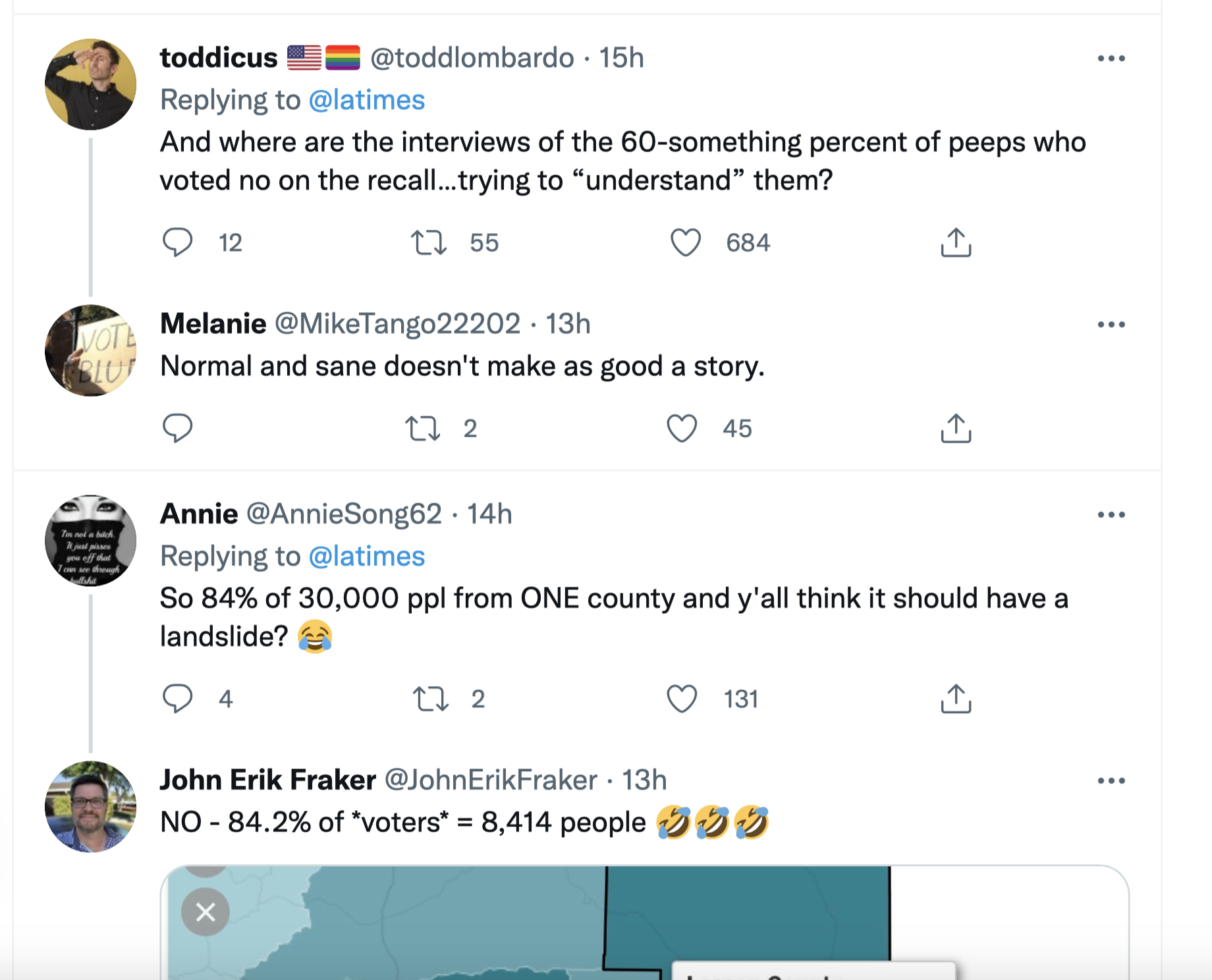
By the way, Hailey Branson-Potts' story attracted a lot of urban haters on Twitter, as you can see here and here.  I'm screen grabbing just two parts of that first thread to illustrate.  Many commenters asserted the Times should have talked to voters in San Francisco or Marin counties, where the vote against the recall mirrored Lassen County's vote in favor of it.  I admit I have no idea who the commenter (Charlee Ferry) is accusing of plagiarism and/or copyright infringement--Branson-Potts or some "yes" on recall supporter who Ferry assumes doesn't have original thoughts:


The LA Times story out of the Central Valley is focused on the LatinX.  The headline is "The Central Valley gives California a recall rarity: a squeaker of a race."  An excerpt follows: 

In 48 of California’s 58 counties, from Oregon to the Mexico border, voters either loved the guy or hated him, with double-digit differences on Saturday afternoon between the yes vote and the no.

Except for one small island in the middle of this vast state, where the recall election was a nail-biter.

Here in the agricultural heart of California, where the drought weighs heavy and the pandemic even heavier, the results were nearly 50-50.

In Merced County, the recall lost by 38 votes. In Fresno County, where the population just crested a million, it won by fewer than 2,000, according to an updated count released by local election officials Friday afternoon.

In both counties, that amounts to one percentage point or less separating yes and no.

Both sides here are claiming victory and both point to Latino voters as an important part of their success. Ballot counting continues throughout the state, and little will be known for sure until the vote is certified in just over a month. The political picture could shift at the county level.

But a few things are clear. The recall failed dramatically statewide. And demographics are destiny.

“The proportion of Latinos [in the Central Valley] is rapidly growing, and to the extent that Latinos have been showing a preference for the Democratic Party, it is an indicator of a strong future for the Democrats,” said Thomas Holyoke, a professor of political science at Fresno State University. “But the Latino vote breaks apart. ... The early returns from the recall show that a lot of Latino men backed the recall.”
Oddly, La Ganga and Chabria paid no attention to urbanization--to the fact that Fresno is the state's fifth largest city, though it did mention Clovis, Fresno's upmarket but smaller sister city.  Perhaps eventually we'll see analysis of Fresno City v. Fresno County voters.  

The journalists also paid no attention to education level.  I would also think that the presence of UC Merced, the youngest of the University of California schools, and the attendant influx of a more highly educated populace would be worthy of note regarding the vote there.  

My earlier post about the California recall vote is here.