Showing posts sorted by date for query Buffalo National river. Sort by relevance Show all posts

Tuesday, June 24, 2025

Buffalo National River watershed finally gets permanent protection from industrial agriculture

I've written a great, great deal about the Buffalo National River over the years, including when a hog CAFO was sited on the banks of one of its tributaries in 2012.  After a great deal of wrangling, that CAFO was ultimately bought out by the State of Arkansas for $6.2 million under former governor Asa Hutchinson.  

Here's an excerpt from a post about these recent events on Arkansas Outside, which explains that .  

The Arkansas Legislative Council on Friday gave final approval to a permanent moratorium on medium- and large-scale hog concentrated animal feeding operations (CAFOs) within the Buffalo National River watershed, cementing over a decade of advocacy from conservation groups and marking a significant milestone in the state’s environmental policy.

The decision, passed without debate, follows years of temporary protections and stems from heightened concerns about the impact of industrial swine farms on water quality in the nation’s first designated national river. The new rule permanently bans CAFOs, as defined by the Environmental Protection Agency, that are medium or large in size, based on animal count and waste production.

Environmental groups, including the Buffalo River Watershed Alliance, the Ozark Society, and the Arkansas chapter of the Sierra Club, hailed the decision as a crucial step to safeguard the river’s karst terrain, which is particularly vulnerable to groundwater pollution.

The move follows years of public outcry sparked by C&H Hog Farms, a large-scale swine operation permitted in 2012 under a general permit process that lacked public input. The farm, located near the town of Mount Judea, drew criticism and concern after manure from thousands of hogs was applied to fields near tributaries that feed the Buffalo.

* * * 

Agricultural interests, including the Arkansas Farm Bureau and the Arkansas Cattlemen’s Association, opposed the permanent moratorium. In comments to the state, they argued the ban was based on public perception rather than scientific evidence, and they warned of regulatory overreach that could limit farmers’ land use rights.
* * *
The rule change came under the broader context of Senate Bill 290, legislation initially intended to overhaul the state’s rulemaking process. The bill was amended during the legislative session to preserve moratoriums on CAFOs in the Buffalo River and Lake Maumelle watersheds. Future bans will now require legislative approval, reducing the ability of state agencies to act independently.

Governor Sarah Huckabee Sanders, who has expressed support for protecting the Buffalo River, reportedly threatened to veto the original version of the bill until amendments preserving the moratorium were included.

Read more about this year's legislative wrangling over the Buffalo and CAFOs here.  

Monday, November 6, 2023

History repeats itself on Arkansas' Buffalo River

I grew up on chatter about the Buffalo National River, the nation's first national river, which was designated in 1972.  I grew up on that chatter because I grew up five miles from the river, in Newton County, Arkansas, home of the river's headwaters.  

My parents talked in my early childhood about their friends--the parents of my friends--whose land was condemned by eminent domain to become part of the park's land, owned and controlled by the federal government.  

While I was still a tween and teen, I saw the establishment of canoe rental enterprises in Jasper and surrounding communities, businesses that had been granted concessions by the National Park Service.  The county attracted growing numbers of tourists as it was remade into a regional ecotourism destination.  (Read more about that here and here; this is just some of my coverage of an industrial hog farm that threatened the river for several years starting in 2013). By the time I was in college and law school at the University of Arkansas (Fayetteville), 80 miles to the west, I had become a tourist on the river myself, consuming (in a sense) the very rurality in which I'd grown up, the very wilderness I'd taken for granted.  (See more photos of Newton County, including the county seat, Jasper, here and here).  

Decades on, I saw the proliferation of vacation rentals--even buildings like a beauty salon in Jasper converted to an AirBnB.  Though I've not seen any news reporting or data on the topic, folks in Jasper have told me that the widespread conversion of buildings to short-term rentals has resulted in a housing shortage.  Of course, that's happening in lots of rural communities, and urban ones, too.

In the past few weeks, the Buffalo has suddenly burst back into the news, once again in relation to its status as a national river.  The reason:  two grandsons of Sam Walton, the legendary founder of Walmart Corporation, have been working behind the scenes--apparently in cahoots with Governor Sarah Huckabee Sanders and U.S. Congressman Bruce Westerman--to get the river re-designated from a National River to a National Park Preserve.  

I first saw this news on the front page of the Arkansas Democrat Gazette on October 7, but it didn't seem to break through the standard media humdrum until KUAF, the NPR station associated with the University of Arkansas, two counties over ran this program on Oct. 16.  After that segment, things started popping on social media, and the next thing I knew, I was seeing reports on X (formerly known as Twitter) of a town hall held in my hometown on Thursday, Oct. 26.  Though only about 550 folks live in Jasper, twice that many reportedly showed up at the Jasper School cafeteria, which photos show at overflow capacity.  Another couple thousand folks were said to have attended the meeting on Zoom.  

Meanwhile, the Madison County Record, a weekly newspaper in neighboring Madison County, which lies to the west, between Washington County (where the land grant University of Arkansas is) and Newton County, has been credited with breaking the story of the proposed  re-designation of the Buffalo River.
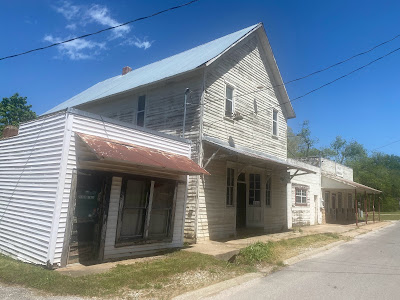
Historic building in Kingston, Arkansas, just off the square.
(c) Lisa R. Pruitt 2023

That is, apparently it was the Madison County Record that first reported that the Walton Family was buying up land in Madison County with an eye to its long-term appreciation if the Buffalo National River becomes a bigger deal. I can't find that coverage online, but here's more from the Arkansas Democrat-Gazette on Walton land purchases in Madison County, including a building on the Kingston town square bought under an alias with a Nebraska address in December, 2021.  The Waltons, via the spokesperson for their Runway Group, have issued this statement about the Kingston property: 
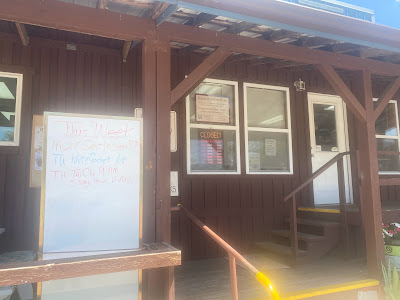
Kingston Community Library
(c) Lisa R. Pruitt 2023

As part of a restoration effort, members of the Walton family acquired three historic buildings on the square in downtown Kingston, intending to update them and open their doors to the community. While we don’t yet have a timeline for the opening, we will share more when we do.

Though Kingston is in Madison County, its school is part of the Jasper School District. You can see a photo of downtown Kingston here.  (And there is a darling, tiny and well-cared-for library on the town square in a squat wooden building that presumably has not been purchased by the Waltons, but lies amidst the three they now own).

Of note is that the Madison County Record has made free its coverage of the Buffalo River re-designation, including this about the community meeting in Jasper on October 26.  What follows is from publisher Ellen Kreth's reporting: 

After a town hall meeting last Thursday, proponents of turning public land around the Buffalo National River into a national park preserve said they would step back from the idea. The following day, a website touting the benefits of re-designating the land was taken down.

But opponents of the idea are not backing down and don’t trust that efforts to re-designate the land are no longer ongoing.

Misty Langdon, owner of Steel Creek Cabins, who organized the town hall meeting, said proponents have poured too much time, resources and money “into this project that seems to be linked to Bryan Sanders [Gov. Sarah Huckabee Sanders’ husband],” to just walk away.

In July 2022, the Runway Group approached U.S. Rep. Bruce Westerman, R-Ark., who represents Arkansas’ 4th Congressional District and chairs the Natural Resources Committee, with the idea of making public land around the river a national park preserve.

Grandsons of Walmart founder Sam Walton and co-founders of the Runway Group, Steuart and Tom Walton are investors in real estate, outdoor initiatives, conservation, recreation, hospitality and businesses in Northwest Arkansas.

* * *

The Runway Group also has been linked with working with the governor’s office and the First Gentleman on the possibility of re-designating public lands.

Last Friday, Runway Group’s Vice President of Corporate and Community Affairs Krista Cupp said the group watched the town hall meeting. She reiterated they are not going forward with any proposal for re-designation. There are “no next steps,” she said.

“We wanted to explore a new idea for our home state together. However, this is not our decision to make. There is no new action being taken,” a statement issued earlier by the Runway Group said.

Cupp said when the group approached Westerman, it didn’t present a proposal to re-designate the land but simply asked if the idea was worth exploring.
Kingston Community Library 

Two Westerman staff members attended the town hall in Jasper, and his office issued a statement including this: 

Although it is in the purview of the House Natural Resources Committee to advance legislation to designate National Parks, I’ve made it clear I would not support any proposition that does not have grass roots support from those that live, work, and raise their families in the Buffalo River watershed.

As the Representative for Arkansas’s Fourth Congressional District, my first priority is advocating on behalf of my constituents. I will continue to listen to the thoughts and concerns of Arkansans that would be impacted by any change in designation. 

Westerman said he had no plan to write or introduce any legislation that would re-designate the land. 

While the Madison County Record story says the meeting was convened by Misty Langdon of Steel Creek Cabins, another report says it was convened by a non-profit that appears focused on preserving the area's history, the Remnant Group.  

Here's part of a column by Jared Phillips, a Washington County farmer who teaches at the University of Arkansas, writing about what's at stake with the proposed re-designation. 
This push by the heirs of Sam Walton to take control of Arkansas’s resources nakedly shows their true aim: control, not philanthropy. The news surrounding the proposal to change the designation of the Buffalo National River, alongside the reported purchase of Horseshoe Canyon, continued land grabs along the Kings River and more amount to only one thing: the wealthiest in the region are pushing the rest of us out. Removal by way of development and recreation is still removal.

The thing is, claims that this development will ease poverty and boost economic vitality in rural areas is suspect at best. Across the nation, developing rural outdoor recreation areas doesn’t produce a meaningful decline in poverty rates at a county level. In fact, in many cases — and Newton County is one — when poverty rates go down in these areas, it has less to do with a wage increase or better opportunity. Economic indicators look better simply because poor folk can’t afford to stay in their place any longer and must leave. That’s why we’ve seen both a drop in poverty in Newton County and a drop in population. The claim that this sort of transition brings about wholly positive things is, on its face, untrue.

The current conversation about the Buffalo isn’t actually about the river. Bike trails, art parks, high-brow museum expansions — it’s not really about that. It’s about the future of the Ozarks. All of us, old stock and new, need to ask ourselves if we are truly represented in the decision making that is shaping — often literally — the next generation’s hills.
And if we’re honest, the only answer is that we’re not. If we truly were, we’d see regional efforts to push the wealthiest and the powerful to put their money where their mouth is. We would see meaningful, long-term action to effectively address economic injustice and food security in the region. To address worker safety. To thoughtfully and wisely engage in land planning that preserves working, welcoming landscapes instead of putting fences around elite, enclosed playgrounds built on the bones of our grandparents.

Instead, what we have is an idle class dictating the region’s future according to their own wishes.

A 2021 column by Phillips and published in the Democrat-Gazette echoed some similar themes and challenged the notion that a rising tide lifts all boats.  Read it here.  

Then, yesterday, Arkansas Democrat-Gazette columnist Rex Nelson wrote in favor of the proposed National Park Preserve, offering a perspective that runs squarely counter to that of Phillips. The headline, "Loving it to death," is a reference to tourists loving the Buffalo River so much that they come in such great numbers that the current infrastrcture, e.g., parking lots, toilets, is overwhelmed.  Interestingly, Nelson vouches for the Walton brothers--declaring their motives "pure."    

In addition to their distrust of government, those who live in these hills distrust outsiders. They’re concerned by the large amounts of land being bought by entities associated with brothers Tom and Steuart Walton of Bentonville. I know the Walton brothers, and I want to make one thing clear: Their motives are pure. They realize that our state’s ability to attract and keep talented people in the decades ahead will rest in part on our protecting and enhancing outdoor recreational attributes.

The Walton brothers could live anywhere in the world and do anything they want. But their focus these days is on enhancing quality of life in Arkansas. Other states should be so lucky. Their involvement in the Coalition for Buffalo River National Park Preserve doesn’t worry me. It gives me hope that this effort will succeed.

Here's a competing column from Mike Masterson arguing that the river should be left as it is.  And here's a column from John Brummet, political columnist writing for the Democrat-Gazette, "Selling the state down the river?"  Brummet, too, is skeptical of the wisdom of a re-designation and of the motives of Governor Sanders and the Walton brothers.  

Here's a post on how to bring oldtimers and newcomers together in places like Newton County.  And here's a post, in the context of an industrial hog farm controversy a decade ago about how the interests of folks in Fayetteville and the wider northwest Arkansas region are often seen as being at odds with those of the rural, Newton County locals.  And that reminds me:  I've not seen anyone talking about how many of the folks who showed up at the Oct. 26 meeting were "locals" from Newton County--as opposed to "environmentalists" or "conservationists" from the wider region.  

Postscript:  Here's a Nov. 8, 2023 update from the Madison County Record reporting that the Newton County Quorum Court (essentially a county board of supervisors) had voted unanimously to oppose any re-designation of the Buffalo National River.  A quote follows: 

Newton County Quorum Court members passed a resolution at their Nov. 6 meeting opposing “the changing of the name designation or expansion of the Buffalo National River, and any further negative impact on the agricultural lands or infringement on private ownership on the Buffalo National River Watershed.”

The vote was unanimous with approximately 25 citizens in attendance.

Justice of the Peace Jamie Mefford said the court wanted to show its opposition to any name change, park expansion, private land rights restrictions and any agricultural restrictions.

The Newton County Times currently has yet to post anything about this on its webpage.  Sad when the neighboring county newspaper is able to cover a county's news faster than its own paper can.  

Wednesday, April 12, 2023

Law and Order in the Ozarks (Part CXXXVII): Recent developments in the reach of Newton County law enforcement

It's been a while since I've blogged about issues out of Newton County, Arkansas (population 7,225) where I grew up, but I want to catch up here primarily on recent news regarding law enforcement staffing in the county.  My focus here is on two stories about beefing up security/law enforcement presence in two places--one a school and the other the courthouse.  

First, a Newton County Times story from October, 2022, reported that the Deer/Mt. Judea School District was hiring a school resource officer.  Here's an excerpt:   

The board has been discussing the possibility of hiring an SRO the last couple of months as the need for on campus security has become a growing concern of school staff and students' parents.

Superintendent Brenda Napier said the cost to the school district would be meeting the officer's salary which has been estimated between $34,000 and $40,000 per year depending on the officer's amount of training and experience.

The actual interviewing and hiring process will be done by the Newton County Sheriff's Office.

The scope of the officer's duties and how the officer would be assigned to cover both campuses will have to be determined by the school board, Napier said.
Nothing in the story indicates why an SRO is needed--that is, whether safety issues have arisen.  
In other news, the board accepted the resignation of the district's school nurse and approved a list of transfers into the school district. All will be enrolled in the district's Digital Education Program. One student is transferring out of the district. The board also accepted the annual legislative audit report.
I have not seen any update on the hiring of an SRO, and meanwhile, in March 2023, the Jasper School District Board of Education applied for a $120K School Safety Grant from the State of Arkansas Division of Elementary and Secondary Education. The application notes that the school district has not conducted a comprehensive school safety audit or assessment, but it has done the following:
• Conducted an annual lockdown (active shooter) drill at each school
• Provided current floor plans and pertinent emergency contact information to appropriate first responders
• Developed a School Safety Plan for each school and provided annual training for all staff
• Identified an individual in the district responsible for overseeing school safety
• Implemented strategies to increase the presence of trained law enforcement officers or commissioned school security officers on school campuses.

Safety measures not yet in place on all campuses include:

• Electronic access controls for high frequency use exterior doorsCovers for vision panels on classroom doors that prevent viewing into the classrooms and allow students a blind area to hide during a lockdown
• Temporary door stoppers or blockers for doors that need additional security may also be purchased, but must comply with current state Fire Prevention Code and ADA standards for accessible design
• Numbers on classroom interior and exterior surfaces easily identifiable to first responders so they can reference the position of students and or intruders.
• District campuses should have fencing that limits access to the school entrances, especially the main entrance.
Other priorities include security cameras, shatter resistant film or other reinforcement for glass windows and physical barriers to prevent access at the main school entrance.

More recently, the Newton County Times reported on March 13 that the Quorum Court has created a courthouse security officer position.  Here's an excerpt: 

The Newton County Quorum Court met Monday night, March 6, and created a position and the budget for a courthouse security officer. Now, all that is needed is for interested, but certified, individuals to apply for the job.

County Judge Warren Campbell said having a courthouse security officer isn't required by state or federal laws. However, he and other courthouse officials feel times being what they are additional security in the courthouse would benefit county employees as well as the public who comes here to do business or attend court. Over the years, the courthouse security has been beefed up with closed circuit monitors, electronic locks on the entry doors and stronger interior doors.

Rarely is there an officer from the sheriff's office in attendance at quorum court meetings.
The security officer would be required to attend all county courthouse functions upon the request of the county judge at the same pay scale that is approved. "No extra pay." 
This is a full-time position with an annual salary of $28,080. The county would also pay the officer's health insurance, $7,476; noncontributory retirement, $4,301.86; Social Security matching, $2,148.12; Workmen's Compensation, $500 and Unemployment Compensation, $300.

Some of the Justices of the Peace (members of the Quorum Court, like a County Board of Supervisors) noted that the county insurance alone would be attractive to prospective employees.  Still, Donnie Davis, County Clerk, said that although the position has been discussed openly around the courthouse, no one has yet to inquire about it.  The lack of inquiries may be due to the requirement that the employee must have graduated from the Arkansas Law Enforcement Academy, and the cost of the training is not included in the county budget.  

That same issue of the paper includes this story about a man who accuses the federal park rangers with the Buffalo National River of abusing their authority.  Thomas Jefferson, a  U.S. Army veteran and resident of Marion County, is accusing National Park Service rangers of abusing their authority.  He is seeking to make the public aware that these rangers' authority applies only within national park boundaries.  An excerpt from the story follows: 

Johnson appeared before the Newton County Quorum Court at its March 6 meeting and asked for time during the part of the meeting when JPs open the floor for public comments.

He called attention to NPS Director's Order #9 - 2005, a copy of which he distributed to the court members.

Johnson contends,  

[T]he park service doesn't want you to know about the[se limits on their power].

The information he submitted defines more in detail park service rangers' law enforcement limitation. They may request local, county or state law enforcement personnel to assist with law enforcement actions within the boundaries of a national park. Rangers cannot be deputized by local or state law enforcement authorities for any law enforcement action that occurs outside a national park boundary.

NPS park ranger assistance can be obtained by outside law enforcement only in cases of emergency. Emergency is defined for use only in response to an unexpected occurrence the requires immediate attention and to the administration of the park such as fire, accidents, local/state law enforcement assistance or actions that place the public in harm's way. NPS law enforcement park rangers cannot assume law enforcement authority outside the national park boundaries.

Johnson cited the National Park's Reference Manual 9-2015, which defines the scope of the rangers' jurisdiction, and he took questions from the Justices of the Peace.  Johnson explained, 

If a violation occurred within the boundaries the ranger can pursue and make a stop outside the park boundaries. But if the ranger is making a stop for a violation outside the park boundaries he has no authority to do so. Johnson said to let the ranger know the limitations of the ranger's authority.

Johnson argues there is a conflict between state and federal laws and courts are allowing this to happen, apparently for the revenue collected through fines.

Johnson concluded: 

I've exposed it and I'm not shutting up.

Also in that issue of the paper is this story about a man sentenced for leading unauthorized hiking tours on the Buffalo National River.  Here's a prior post about the man working as a guide without the permission of the Buffalo National River authorities. 

The February 15 issue of the paper reports that the Jasper Police Department purchased a 2023 Dodge Durango with a USDA Rural Development Grant.  That issue of the paper also reminds readers that Newton County is served by Sanctuary, Inc., a "temporary shelter and extended assistance, support and education to victims of domestic violence."  This information was shared at a meeting of the Newton County Hometown Health Coalition.  Sanctuary, Inc. is located in Harrison, 20 miles from Jasper.  

The February 22 issue of the Newton County Times reports that the Sheriff's office has been awarded $62,673.51 by the Arkansas Department of Public Safety to purchase equipment, including 16 tasers, taser certification and required software and warranties. 

In other news reported March 1, the Newton County Sheriff's office has signed a Mutual Aid Protection Agreement with the sheriffs departments in Boone, Searcy Carroll and Marion counties.  It also includes the Harrison Police Department.  The March 22 issue of the paper reports that the Sheriff's Office got a new roof at a cost of $13,700, replacing the one that was 20 years old.  COVID-19 relief funds were used for the project.  Additional work is scheduled on the interior.  

The March 15 issue reported on cases adjudicated in the Circuit Court.  

In non law enforcement news, lettuce grown in a greenhouse on the campus of Jasper School is being served in the school cafeteria, and the Jasper School Board has declared the day of the 2024 eclipse a "professional development day."

Thursday, December 22, 2022

Law and order in the Ozarks (Part CXXXVI): My hometown prepares for the 2024 eclipse

I've been aware for several years that Newton County, Arkansas (population 8,330), where I grew up, will be in the path of totality of the Great North American Eclipse of April 2024.  I made my reservation for lodging more than six months ago when no premium was being charged for rooms during this period, perhaps because the owners of the cabin were unaware of what was going to happen on that date nearly two years off.  I'd started nagging an area dude ranch to let me make a reservation two and a half years in advance, following up two years in advance, but they turned me away because it was a full year outside their usual window of booking.  They were so unbending that I wondered if they were completely unaware of the eclipse and the onslaught of requests that were sure to pour in at some point.  Thus I moved on to other, more flexible vendors.  

More recently, it's been interesting to see my hometown newspaper begin to cover plans for the event.  This story a few weeks ago was headlined, Cost of eclipse is a concern.   Here's the bulk of the story, which serves as a sort of laundry list of things a locality has to think about when expecting a big influx of visitors, a particular challenge when a locale has so little infrastructure and so little developed human capital: 
The Newton County Local Emergency Planning Committee (LEPC) met Nov. 14 to discuss the preparations that will be involved, but one question remained when the meeting ended. How much will the eclipse cost?

At this early date there are no funds budgeted for the eclipse. Kim Williams, named 2024 Eclipse project manager for Arkansas Tourism, spoked to local business owners in Jasper last October and said it is assumed the governor could release some state funds prior to the eclipse.

The LEPC is a non-funded coalition that works to help the county's planned response to emergencies. Byron Mann, pastor of the Jasper Methodist Church, serves as the chairman. He said while a lot of visitors are anticipated it's important to make sure the residents are taken care of and given information about the eclipse they need to know.

"We need to figure out the best way to gather information and to disburse it," Mann said. That should start in January 2024 with regular mailings. Organizations represented on the LEPC may be asked to help with the expenses of printing and mailing.

Jasper Postmaster Ken Fry said the post office offers Every Door Direct Mail service. It is the least expensive costing about 18 cents per flat piece. He recommended not doing it until the final month. He advised using fliers and handing them out at different locations and using social media before making mail outs.

The key focus is going to be water, fuel, groceries and medicine, Mann said. Residents will need to stock up on these items which will be in short supply after thousands of people suddenly arrive. The worst case scenario, due to the influx of vehicles on local roads and highways, is nobody is going to be able to move, unless you walk or ride a four-wheeler, Mann said. The residents who live in the county will be limited on access to town and won't be able to make their regular shopping trips.

"The pharmacy really needs to be on board on this," Mann emphasized. People need to have their medications in hand or in house a week to 10 days prior to the eclipse because they may not be available.

Not only will people be coming for the eclipse, but this is prime floating season on the Buffalo National River, Mann reminded, along with being in Arkansas's tornado season.

Mann said of an incident that happened in town the prior weekend when some computer lines went down and stores couldn't accept debit or credit cards. What could happen if the local digital transmission systems are overwhelmed. Can the communications utilities handle it?

Mitch Brasel, of Ritter Communications in Jasper, said "we never had it happen before." He said the credit card problem was an issue beyond the local service.

Tim Koren, a board member of the Ozark Mountain Regional Public Water Authority, said he is concerned cell phone towers will be unable to meet demand for service. He said the companies that utilize the few local towers don't appear to understand the trouble customers have accessing service.

Toinette Madison, director of the Newton County Chamber of Commerce, said her organization has been bringing awareness to local businesses. Because Jasper will be in totality it will likely draw not only people just outside the area, but could draw people from as far away as Tulsa, Oklahoma. "We just don't know," she said. Businesses can prepare for the people who make advance reservations for accommodations. It 's those who come unannounced that the area has to be prepared for.

Margie Rutledge, information technology manager for the Jasper School District, asked about the costs to the city or the county. She asked if the city has money for events such as this.

Mayor Jan Larson said overnight rental businesses only pay sales taxes, there are no special fees or taxes collected by the city. There is a bed tax tbut that revenue goes to state tourism.

Rutledge also asked, who's going to foot the bill for clean-up? What if we have 10,000-20,000 people come in and leave behind their trash?

The county handles the city's trash, Larson said. She did not know the capacity of the county's solid waste transfer station.

Larson also noted the need for facilities for dumping liquid waste from the number of travel trailers that might arrive.

The city has only one dump station at Bradley Park.

Mann said he has heard people are already having to go out of state to reserve portable toilets.

Shane Kilgore, Newton county OEM manager, suggested charging additional fees for waste removal. Particularly people who will allow camping or parking on their property. They will be liable for clean-up. He said he believed the county's transfer station is capable of meeting the demand, but it might require hiring additional workers temporarily or working overtime.

Sheriff Glenn Wheeler was asked if his office has began planning to meet the increased demand for law enforcement.

He said he has begun contacting the National Park Service, the US Forest Service and the Arkansas State Police for possible assistance. "We started those wheels turning, but haven't got very far." He said he can also reach out to other counties for help if the need arises.

Will Jasper School have classes that day? Jasper Fire chief Pam Emerson asked.

Rutledge said school will not be in session that Monday. No decision has been made about Tuesday.

"Everybody knows we have a little time, but that window is going to close pretty fast. We don't want to get caught a month out and not know what to do," Mann said.

Here's a more recent story about what the Buffalo National River is doing to prepare for the eclipse.  The headline is "Park service prepares for the eclipse," but the story suggests that the federal agency is doing little to prepare.  Here's an excerpt:

Discussions continued at the Dec. 12 LEPC meeting that was attended by NPS staff members Justin Gibbs and and Casey Johannsen. They explained Buffalo National River hasn't made any specific plans as yet due to the park service does not make reservations for camping facilities no sooner than six months ahead of time. However, the pavilion at the Oark Campground near Jasper can be reserved a year ahead of time.

National Parks in other parts of the county have experienced eclipses in the past, they said, and protocols will be announced and followed at the Buffalo National River. They acknowledged the eclipse will come when floaters are attracted to the river at that prime time of year.

Newton County Justice of the Peace Arlis Jones attended the meeting. He was looking for more specific information about how many visitors the county will have, how traffic will be routed and the costs associated with clean-up afterward. He endorsed a heavy presence of law enforcement and local volunteers to police for littering and taking down license plate numbers.

He also said he would ask the quorum court to petition the state for additional funding to cope with the eclipse aftermath.

Newton County Chief Deputy Sheriff Mike Blocker said state and federal law enforcement will be busy within their own jurisdictions and that Newton County will have to rely mostly on its staffs, reserve officers and in most cases volunteers who can help direct traffic and assist wherever they can.

Jasper Fire Chief Pam Emerson said she plans to station some emergency vehicles to the north and south of Jasper to try to reduce response times to calls while the roads closer to the city are expected to have more traffic on them.

* * *

Besides roads, other infrastructure may also be pushed to capacity. Jacob Collins, director of the Jasper Public Works Department, said he felt the Jasper water system can meet the demands. He said there is a small number of public restrooms, which is a good thing because it is unlikely the wastewater plant would be compromised.

Sunday, July 17, 2022

Smithsonian Magazine features Buffalo National River at 50 (and my hometown)

Buffalo National River
Between Ozark and Pruitt
(c) Lisa R. Pruitt 2015
Boyce Upholt's story, "What Makes the Buffalo River the Jewel of the Ozarks?," is a profile of the nation's first and only national river at the 50th anniversary of its founding.  Along the way, you get a few visual and verbal vignettes of Newton County, where I grew up, along with two photos of Jasper, the county seat where I went to school.  Photos accompanying the story are by Rory Doyle.  Photos shown on this post were taken by me when I floated the river with my mother and my son in 2015.  

Here's the lede for the Smithsonian Magazine story: 
Three Generations 
of Pruitts at 
Pruitt, Arkansas, BNR

If smoothed out flat, the rough mountainous terrain of Newton County, Arkansas, would prove “bigger’n the whole state of Texas,” a local resident once proclaimed to a folklorist. That may be an exaggeration, but the wrinkles of the topography have certainly kept this corner of the Ozarks quiet. Fewer than 8,000 people live scattered across Newton County’s 820 square miles. The place is mostly known for a waterway. Near the county’s western border, a trickling stream grows into the Buffalo River.
For a long time Arkansans couldn’t agree on what the river should be used for, and some even fought over it. In the 1940s, with the local timber felled and the zinc and lead operations floundering, state tourism officials started promoting Newton County as a wilderness destination. The county was home to nearly half of the Buffalo River watershed, and outdoors enthusiasts considered the mountain stream one of the finest in the region, if not the country; it was a rare, free-flowing waterway, perfect for rafting or canoeing. Some local leaders wanted to turn the watershed into a national park. Others wanted to dam the river, which could provide hydroelectric power and form the kind of placid lake that had spurred the development of lodges, restaurants and retirement homes elsewhere in the Ozarks.
(c) Lisa R. Pruitt 2015

Upholt further details the history of the river's designation--including local resistance.  He also talks about the industrial hog farm built in the watershed in 2013, which the state eventually bought out and closed in 2019.  I wrote about that matter in the Journal of Rural Studies in 2016, and you'll find many posts about it here on Legal Ruralism.  
Buffalo National River
Near Ozark Campground
(c) Lisa R. Pruitt 2015

Wednesday, May 25, 2022

Sarah Huckabee Sanders wins Republican nomination for Arkansas governor with rural-focused, culture wars campaign

March 17, 2022 Tweet 
by Sarah Huckabee Sanders

Sarah Huckabee Sanders victory in the GOP primary in Arkansas isn't a rural story per se, but I'm going to blog about it here simply on the basis that Arkansas is popularly thought of a rural state.  In fact, a significant portion of the state's population do live in rural places.  (A 2008 post on Arkansas's rurality, in relation to its politics, is here).
  
As anticipated, Sarah Huckabee Sanders has handily secured the Republican nomination for Governor of Arkansas.  She had a $14 million dollar war chest (raised mostly from outside the state) and no serious opposition in the GOP primary.  

NPR ran a story about Sanders the afternoon before the Tuesday primary, with this commentary on her campaign strategy; Breen is a Little Rock-based reporter:  
(SOUNDBITE OF POLITICAL AD)

SARAH HUCKABEE SANDERS: Everything we love about America is at stake. And with the radical left now in control of Washington, your governor is your last line of defense.

BREEN: Much of Sanders' campaign rhetoric focuses on national issues, positioning herself as a crusader against the liberal agenda, cancel culture and government overreach.

* * *  

BREEN: Unlike Trump, Sanders tends to steer clear of large campaign rallies in favor of smaller events in mainly rural, largely white communities. She also rarely gives interviews. [Political science professor Heather] Yates says that's gotten more popular with the GOP since Donald Trump. 
Speaking of smaller events in mainly rural, largely white communities, this is from May 16, 2022 in my hometown newspaper, The Newton County Times:
Newton County Times, May 18, 2022,
below the fold photo of Sarah Huckabee Sanders,
a local businessman, and the county sheriff 
Arkansas gubernatorial candidate Sarah Huckabee Sanders was spied in Jasper last Thursday along with her family. They were visiting Bubba's Buffalo River Store. Pictured with Sanders are proprietor Walter "Bubba" Lloyd and Newton County Sheriff Glenn Wheeler. Sanders said she, her husband, Bryan, and children, Scarlett, Huck, and George were going on a scheduled float trip on the Buffalo National River arranged by the Buffalo Outdoor Center of Ponca. She said she has been to Newton County and floated the river on several occasions. Sanders served as White House Press Secretary for President Donald J. Trump from 2017 to 2019. Her father is former Arkansas Governor Mike Huckabee.

The short story accompanies a large front-page photo under the headline, "Look Who's Visiting?"

Meanwhile, PBS just ran this feature about the Democratic gubernatorial nominee, Chris Jones, a 7th generation Arkansan, an ordained minister and physicist with degrees from Morehouse College and MIT.  Jones has committed to a "walk a mile in your shoes" campaign, in which he'll walk a mile in each of Arkansas's 75 counties.  He has already visited each county once--well, he has at least driven through each county once.  It's got to be hard for an African American like Jones to go into an all-white county like my home county to campaign, but I'm pleased he's committed to doing so.  Here's a photo of him passing through the county, which he posted on Earth Day.  Not sure when he was actually there.  


Friday, May 13, 2022

Law and Order in the Ozarks (Part CXXXV): "Illegal guide" abandons client who fell to his death

The Arkansas Democrat-Gazette reported this week on the death of a hiker in the Upper Buffalo Wilderness area of Newton County.  The hiker, from Missouri, was in the company of an "illegal guide" when he fell to his death.  Here are some quotes from Bill Bowden's story, which explains why the guide was "illegal."  

An investigation is underway after a Springfield, Mo., man fell to his death Saturday in the Ponca Wilderness area of Buffalo National River, said Newton County Sheriff Glenn Wheeler.

Brad Lee Thomas, 46, was hiking with a group near a rock formation known as the Eye of the Needle when he fell, Wheeler said.

Wheeler said Thomas was led into the area by an "illegal and unlicensed guide out of Bentonville." The same guide led someone into the area the previous Saturday, resulting in an injury, Wheeler said.

Here's a long quote from Sheriff Wheeler:   

This man brings people to the Buffalo River and other parts of Newton County and takes them into some of the most rugged terrain in the Ozarks.  It appears they don't always know what they are getting into. Just last Saturday, a person he was leading was injured and he left her in the woods. We responded with a full rescue team who put themselves in jeopardy to help her, just like they did with Mr. Thomas. They do it because they love it and have servants' hearts. But none of that never would have been necessary if this man had not led them into areas that was possibly beyond their preparation levels. Then to leave an injured 'client' is just absurd!

* * *  

This man has a responsibility to these people.  He takes their money then leads them places without any kind of license, insurance or emergency plan and when something goes wrong, he apparently bails on them.

The guide had neither insurance or a permit.   

A National Park Service official explains the need for a permit: 

Cassie Branstetter, branch chief of interpretation for the national park, said hiking guides must be permitted by the National Park Service if they charge a fee.

"If they're just taking some friends out, there's no permit required for that activity," she said.

Oddly, my most recent post in this series is also about "crime" on the Buffalo National River.  

Friday, September 10, 2021

Law and Order in the Ozarks (Part CXXXIV): Crime in the Buffalo National River

Two stories of crime in the Buffalo National River Park caught my eye in several editions of the Newton County Times, my hometown weekly newspaper.  They are both dateline Fort Smith, where the federal court for the western district of Arkansas sits.  

This is from the August 9, 2021 issue under the headline, "Two Arkansas men plead guilty to damaging historic mines in Buffalo National River."  The subhead notes that the men sold what they got from the mines at a "rock shop" in Alpena, which straddles neighboring Boone and Carroll counties.  Note how long it took for this case to get to court--the men were first observed by a park ranger more than five years earlier:  

Two men pleaded guilty last week to felony violations of the Archaeological Resources Protection Act, in connection with their illegal excavations of archaeological sites in the Historic Rush Mining District of Buffalo National River, and the sale of stolen geological and mineral specimens at a store in Alpena. U.S. District Judge P.K. Holmes III presided over the July 27 change-of-plea hearings, in which Nathan Bradford LeMay, 35, of Hot Springs Village, and Justin Charles Baird, 32, of Hot Springs, each pleaded guilty to the first count of the three-count indictment in which both were named.

According to court documents, on multiple occasions in 2015 and 2016, LeMay and Baird traveled to the Historic Rush Mining District, in Marion County, Arkansas, to dig for mineral and geological specimens to sell at LeMay’s business, Alpena Crystals. The pair’s plans went awry on Feb. 14, 2016, when a U.S. Park Ranger observed them camped in Buffalo National River, which is a United States National Park.

Noticing evidence of their excavations, the Ranger obtained consent to search their campsite and vehicles, recovering digging tools and containers of geological specimens. Two days later, officers were sent to several mines in the area to assess whether or not they had been entered. The Monte Cristo Mine, a gated, locked and controlled mine along Clabber Creek, was observed to have been broken into. Trash, water bottles and other items were located both just inside and outside this mine. On the Rush Creek side of the same mountain, drag marks in high grass, from the Morning Star/Ben Carney Mine, down to Rush Creek and the parking lot, indicated large heavy objects had been dragged down the mountain to the parking area.

A subsequent investigation by the National Park Service, assisted by local law enforcement and the Carroll County Prosecuting Attorney’s Office, established the full extent of the pair’s illegal excavations. LeMay and Baird had excavated and damaged 22 areas within those mines, removing mineral and geological materials, and damaging the historic sites—which add to the knowledge of the mining community in the Ozarks as the industry transitioned from crude mining techniques to modern methods. Dr. Caven Clark, an archaeologist with the National Park Service, now retired, conducted a resource damage assessment, determining that the cost of restoration and repair to the site was approximately $22,241.

Both men were indicted by a federal grand jury in March 2020. In addition to violation of the Archaeological Resources Protection Act, which prohibits excavating, damaging, altering and defacing archaeological sites and resources, both men were also charged with theft of U.S. property and damage to government property. ...  Before the [two defendants] announced their intentions to plead guilty, the case had been scheduled to be tried beginning on July 26.

As a result of their guilty pleas both LeMay and Baird face up to two years in prison and fines of up to $250,000. Additionally, both men have agreed to pay $22,241 in restitution as a shared obligation.

The earlier story is from May 10, 2021.  The headline is "Man sentenced for setting fire within BNR."  Here's an excerpt: 

A Harrison man was sentenced on May 5, to five years in prison followed by three years of supervised release and ordered to pay $12,494.14 in restitution on one count of willfully and without authority and consent of the united states set on fire timber, underbrush, grass and other inflammable material upon a public domain within the Buffalo National River. The Honorable US District Judge P.K. Holmes, III, presided over the sentencing hearing in the United States District Court in Fort Smith. 
According to court documents, In March 2020, Jacob Edward Walls, 29, was indicted by a federal grand jury, of setting a wildland fire within Buffalo National River, in Newton County, near Pruitt, on Feb. 5, 2019. Federal investigators determined Walls set a fire within the park, which threatened nearby private structures and lands, and subsequently fled the area. 

The Newton County Sheriff's office assisted federal authorities in the case.  

Tuesday, August 10, 2021

My hometown is (apparently) about to blow up--in a good way

Newton County Courthouse, Jasper
Spring 2016
(c) Lisa R. Pruitt 2016

Sunday's column by Rex Nelson of the Arkansas Democrat-Gazette makes an encouraging prediction about my hometown.  The headline is "The Coming Boom," and it's about Jasper, Arkansas, the county seat of Newton County, in the Ozarks.   (You can find numerous posts about Newton County here).  It's not the first time Nelson has written about Jasper.  In fact, he seems to have a bit of a Newton County fetish.  Earlier columns are here and here, with this latter from last year repeating a lot of what this weekend's column reports.    

Nelson, a member of the paper's editorial board, predicts an ecotourism boom for Jasper, and he marshals a lot of evidence in support of his thesis.  I've written about the county's ecotourism economy here (2008) and here (2010), and I've generally kept abreast of the phenomenon of rural gentrification, usually in amenity-rich destinations, across the United States.  

Here's an excerpt from Nelson's column, which is thick on details-including details about who has the $$$ that pouring into the area to fuel this boom: 
Abandoned Dogpatch USA theme park property
(c) Lisa R. Pruitt 
The square in downtown Jasper is hopping on this Saturday afternoon. Bubba's Buffalo River Store is filled with visitors.

Opened in March 2020 by North Little Rock businessman Walter "Bubba" Lloyd Jr., who long has had a house in Newton County, Bubba's isn't like those tacky tourist shops that once dotted the Arkansas Ozarks. It's filled with high-quality shirts, caps, coffee mugs and other goods that well-heeled visitors are willing to pay for.

Jasper, which only has about 700 residents, is changing. Johnny Morris, the founder of Bass Pro Shops, purchased the Dogpatch USA property, and there's dirt work going on that's likely costing Morris millions of dollars.

Love thinking about what Dogpatch USA might become, not least because I gave that park six of the best summers of my life (1979-1984).  Also, where did Nelson get the 700 population figure?  As far as I know, Jasper's population has not been so robust for many decades, probably not in my lifetime.  The signs at the edge of town said 394 through most of my childhood, based on the 1970 and 1980 censuses.

Buffalo Theatre on courthouse square.  I worked the concession stand as a teen.
Would love to see investors do something with this old gem 
as many local initiatives to save it have failed. 
(c) Lisa R. Pruitt 

Nelson continues:  

Depending on what Morris does with the land (and all of his projects are first class), Jasper just might be Arkansas' next hot spot for tourists.

Just across East Court Street from Bubba's Buffalo River Store stands the old Gordon Motel. It recently was purchased by investors from northwest Arkansas who have big plans for the property. Harold Gordon moved to Jasper from Bogalusa, La., and purchased the motel from his uncle in 1970. In 1987, Gordon opened Buffalo Canoe. Four years later, he added a canoe factory at Spider Branch. Gordon died in 2017 at age 81.

Yes, I knew Harold Gordon and his wife Roslyn (why doesn't Rex also mention her? I assure you she had an important role in running the business), and I went to high school with their son Gary. Spider Branch is part of the farm homesteaded by my family five generations ago.  I used to catch crawdads there--the trick was getting them to back into the little nets held by my cousin, my sister and me.  We'd come out of a day of crawdad chasing with our backs and necks red with sunburn.  Sunscreen wasn't really a thing then.

Buffalo River Bunkhouse in background
with some visitors from Louisiana
(c) Lisa R. Pruitt
For more than 40 years, Gordon Motel had a partnership with the National Park Service, having obtained one of the original canoe rental permits when the Buffalo was designated by Congress as the country's first national river. Outdoor recreation such as paddling the Buffalo is now more popular than ever. That popularity, combined with Morris' Dogpatch purchase, has investors taking a look at the stone buildings around the Newton County Courthouse.

The column features much more detail still about who is spending money where and how in Newton County.  Reading the column leaves me with but one comment and one question.  The comment is this:  all of this capital is flowing in from outside Newton County--most of it from well outside the region.  Very little of it, if any, is truly local.  Not surprising in a persistent poverty county, I suppose.  There's very little wealth to invest in anything, let alone an ecotourism enterprise.  

One of the stone buildings near the 
Newton County courthouse square
(c) Lisa R. Pruitt 2012
One exception--or is it more of an illustration of my point?--is my mom.  She's definitely an oldtimer--fourth generation Newton Countian.  She's not wealthy by any means, but she owns 10 acres and the modest home she and my father builtin 1964.  It's a mile from Jasper, along the Little Buffalo River.  About 15 years ago, she turned an outbuilding--built as a large garage for truck repair--into a "bunkhouse" what will sleep about a dozen folks.  It's regularly rented by big groups who come to float the Buffalo.  She also turned a little two bedroom trailer, which similarly sits in her front yard, into a "bungalow."  It's also in great demand.  These don't command much money ($80 a night for the bunkhouse, I see, on airbnb.com) compared to other rentals in the area, but the properties contribute substantially to her income as a teacher's aide at the local school. 

Of course, outside money is better than no development at all, but it leaves me with this question:   Will these entrepreneurs from outside the region hire locals?  In particular, will they hire locals to do good jobs, like being river guides? or managers?  

Ozark Cafe, Jasper Town Square (c) Lisa R. Pruitt

I've noticed over the years that the river outfitters often have not employed locals.  Instead, they bring in college students from away.  But it's only appropriate that these outside entrepreneurs will hire local talent--that they will share the opportunities for jobs, for income--if not their wealth--with Newton County teens and young adults.  

One of the less salubrious scenes in Jasper,
not far from town square.  I use this photo when
I teach torts to illustrate "assumption of risk"
doctrine. (c) Lisa R. Pruitt

And that reminds me of this recently published book on rural gentrification, Dividing Paradise: Rural Inequality and the Diminishing American Dream (2021) by Jennifer Sherman.  It is set in central Washington, in a mountain community undergoing gentrification, with lots of Seattle-area folks moving in and pricing locals out of the market.  There, in "Paradise Valley," newcomers found themselves at odds with oldtimers, with the former tending to look down on the latter for, among other things, their lack of success in life.  They rarely saw that prospects for "local" success were undermined by lack of wealth, by which I really just mean capital (think my mother's ownership of 10 acres and some modest outbuildings as an example of someone with limited capital and making the most of it).    

If Jasper does become (more of) a boom town, I hope the community doesn't see the sort of condescension Sherman documented in "Paradise Valley."  

This reminds me of some coverage the Newton County Times has dedicated in recent months to the idea that the City of Jasper should pass a "hamburger tax," the idea being to tax things tourists buy, specifically prepared food  The revenue generated would be used to finance the Japer Advertising and Promotion Commission (JAPC).  Just one of many stories from the local newspaper is here.   Initial members of the commission include Rex Nelson's North Little Rock friend Bubba Lloyd who, for these purposes, apparently has dual citizenship in Pulaski County and Newton County.  

Here's an excerpt from the story: 

Bubba Lloyd, of Bubba's Buffalo River Store, drew the four year term, [Ernie] Yeager [of Junction One-Stop] drew the three year term, Russ Todd, of the Ozark Cafe and Blake Keeton, of Harps Food Store, both drew two year terms and Angela Slape, the commission's at large member, drew the one year term. 

Lloyd will be the commission chair.  

Although the commission was formed without the benefit of a one percent tax on the sale of prepared food in the city to provide it revenue, the city is appropriating a one time $5,000 as seed money for the commission to operate. 


Low Gap Cafe, another Newton County business 
mentioned in the Nelson column.  
(c) Lisa R. Pruitt
Postscript:  The Sept. 1, 2021 issue of the Newton County Times reports that the Jasper Advertising and Promotion Commission (JAPC) is seeking to hire a paid director who would "manage the day to day business operations of the commission.  It is a part-time position paying $12.75 an hour.  The person selected for the job must be a communicator, and be familiar with and excited about the city of Jasper,  said Commission Chairman Walter 'Bubba' Lloyd.  In addition to carrying out directives from the commission, the director must have a creative mind and be able to initiate ideas and suggest events that will benefit the promotion of the city.  These events will raise funds for the commission to use for the promotion and marketing of tourism-related businesses and recreational activities in Jasper."  

Other stories about the JAPC are here and here.  

Friday, June 18, 2021

Law and Order in the Ozarks (Part CXXIX): High-profile violent crimes

Several high-profile crimes have been reported in the Newton County Times during the first half of 2021.   

First, the January 13, 2021 issue featured the front-page headline, "Two men arrested for suspected homicide, arson near Fallsville."  The story reports that the Deer and Ozone [volunteer]  fire departments were called to the scene of a house fire west of Fallsville around 3:35 pm on January 9.  "While battling the blaze, firefighters found the body of a male subject inside the residence.  It is believed to be that of the homeowner.  Evidence at the scene and subsequent information received confirmed investigators' suspicions that a homicide and arson ha occurred." 

A later story, in the March 3, 2021 issue, reports that charges were filed in the case.  The dateline is Oark:

Formal charges were filed Tuesday, Feb. 23, against a 61-year-old man and his 34-year-old son in connection with a suspected murder and arson event in early January, online court records show.

The story continues that the two are charged with first-degree murder and two counts of endangering the welfare of a minor, along with penalty enhancement of committing offenses in the presence of a child, while Steven Stepp (the 34-year-old charged) is also charged with arson, residential burglary, tampering with physical evidence, abuse of a corpse and felony with a firearm.   

The two men were identified after the deputies found a .22 caliber revolver in the front yard of the burned residence, along with a trail leading from the burned residence, where there were more .22 shells and empty beer cans.  

The Stepps were identified as the neighbors and they lived in separate residences on the same property.  

The story is not clear at all--is quite poorly written--but it appears that the Stepps were neighbors of the murdered man, Jerry Don Cantrell.  An interview with Cantrell's son indicated Cantrell was "having problems with the Stepps."  The story continues: 

At about 2:45 the following morning, Clarksville Police got a call from Angela Stepp and her daughter, Jessica Stepp, of Clarksville, who are related to Steven and Vernon [the suspects]. [The story later discloses that Angela is Vernon's sister-in-law] 

They told Clarksville Police that [the Stepp men] had told them they had killed man and burned his house.  They were told that Steven and Vernon [Stepp] would kill them if they told the police and that they were armed for the encounter with law enforcement, the affidavit said.

The involvement of the Clarksville Police is interesting because Clarksville is 16 miles from Oark, the story's dateline, and even farther from Fallsville, where these events occurred.  Clarksville is the county seat of Johnson County, which is also home to Oark, and Fallsville is in Newton County, to the north.  

The story later discloses that Cantrell had supervised visitation with Vernon Stepp's grandchildren.  He told police that Steven went to Cantrell's residence with him and Steven got into an argument.  Steven then left Cantrell's residence, while Vernon stayed.  Vernon said Steven returned a short time later with a .357 pistol and holster.  He said Cantrell produced a pistol-grip shotgun from under the kitchen table and pushed Vernon to the floor.  Vernon said Cantrell fired a shot over the Stepps' heads and Steven fired twice at Cantrell with the .357.  The suggestion is self-defense and/or Steven's defense of his father.  

Steven Stepp told police he burned the house because he was scared.

Will be interesting to see how this case is tried.   

The May 19, 2021 issue features a front-page headline, "Charges filed in matter of stolen school truck."  Here are the details:

Conner Ray Rigsbee, 22, was formally charged in Newton County Circuit Court, last May 5, on charges of theft by receiving, a Class C felony, and possession of drug paraphernalia, a class D felony.  

Court filings allege that last April 23, sheriff's deputy ... was dispatched to the Deer School to investigate a report of a 2006 Chevrolet pick up truck. 

The night before, multiple deputies were attempting to locate Rigsbee in the same area.  He had allegedly stolen a pistol from his mother earlier in the day.  

* * *

Rigsbee later stated he traded the gun and he bought tje truck from someone he had never met before.  Rigsbee was found to have in his possession a glass pipe having a crystal-like residue. 

The May 12 edition featured two more crime headlines:  "Man dies from self-inflicted gunshot wound," with the dateline St. Joe, and "Man sentenced for setting fire within [Buffalo National River]," dateline Fort Smith.  The former story is actually more interesting than it sounds at first blush because the man who shot himself did so after the vehicle in which he was a passenger--a vehicle driven by a woman--was pulled over by the National Park Service for routine traffic violations.   The man, during the "contact," was "determined ... to have possible, non-extraditable warrants from another jurisdiction, along with a lengthy criminal history involving firearms, drugs, assault and domestic violence."  Later, presumably after the suicide, the two were identified "as persons of interest in a shooting incident in Pulaski County [Little Rock]." 

The April 21, 2021 issue reports the headline, "Pregnant woman stabbed," for which the dateline is Harrison.  Here's the lede:  

Authorities say a man formerly from Missouri was in custody Friday on suspicion of stabbing his girlfriend Thursday night in Bellefonte.  

The story reports that the victim was 27 weeks pregnant with the perpetrator's child.  He reportedly attacked her "without provocation as she was lying on the couch."   He will reportedly face two counts of capital murder for the attack.  None of the wounds "damaged vital organs and weren't life threatening," though she suffered "multiple cuts and stab wounds to the arms, back, shoulder and face."  

Another story from that issue is headlined, "Man runs from deputy second time."  The lede states that the Newton Coutny sheriff "said a 33-year-old man on a four-wheeler ran from a deputy Wednesday night for the second time and was airlifted for treatment of injures."  Although on a four-wheeler, the driver took the sheriff's deputy on a chase through parts of two neighboring counties.  The man is wanted on multiple warrants from different jurisdictions, including for speeding and possession of controlled substance.  The "second time" in the heading refers to the man's arrest in August, 2020 after he failed to appear in court on charges from a pursuit in February of that year.  

Friday, June 11, 2021

The bridge over the Buffalo River at Pruitt (yes, "my" Pruitt), came down this week

Old Pruitt Bridge over the Buffalo National River after 
the deck (pavement) was removed, 
before explosives were used to take down the bridge.  

A bridge built in 1931, the last Pennsylvania through-truss bridge in Arkansas, came down on Wednesday--with the help of explosives.  That bridge was part of Scenic Highway 7 and crossed the Buffalo National River at Pruitt.  Yes, that's the same Pruitt as my paternal family.  Pruitt used to have its own post office (up til the 1970s) but more recently hosted a Ranger Station for the National Park Service.   It is in Newton County, just a few miles south of the Boone County line and in a rural area.  Just west of there now is Pruitt Landing, 

The best video I've seen of the implosion of the bridge is compliments of Crouse Construction, which built the replacement bridge that opened on May 14.  A video from a different angle is here, compliments of the Harrison Police Department.  

Some recent stories about the bridge and its history include one from the Arkansas Democrat-Gazette here.  It includes this information about the bridge's design:
Regarding the design of the old Pruitt bridge, Dave Parker, a spokesman for the Arkansas Department of Transportation, said in an email: "The Buffalo River (Pruitt) bridge truss design is a variant of a Pennsylvania through-truss with Warren pony trusses on either side. The through-truss connection to the pony trusses displays a unique design; it has not been identified to date in any other bridges. The Buffalo River (Pruitt) bridge is also the last variation of the Pennsylvania though truss design in service on Arkansas roadways."
This is from a Newton County Times story about the state of the bridge once the deck was removed:
You’ve seen it as a landmark. Your parents and possibly even grandparents have seen it that way, too. After nine decades, the Pruitt bridge will come down, officials say.

Crouse Construction of Harrison was contracted to build a new bridge over the Buffalo National River. It’s now open and the old bridge will be imploded today, Wednesday, if the weather cooperates.

And by looking at the old bridge with all the decking and pavement removed, it’s probably past time for that to happen.

Crystal Crouse with Crouse Construction is overseeing the entire project.

“The deck of the bridge was really keeping the majority of the structure in place,” Crouse said. “Pavement was really what was keeping it together.”

She explained that some of the X-member support braces were so corroded they began to fall when the pavement was removed.

Bridge foreman Eddie Mitchell said two concrete slabs started on either end of the old bridge and met on the center pier. When the two-inch layer of asphalt atop the concrete was taken up, they found that the concrete slabs were barely touching the beam on the pier under it, which Crouse said was the main strength for the bridge.

Some of the beams on which the decking rested showed daylight through corroded holes. Crouse said much of the steel structure is in such bad shape that it can’t even be salvaged for scrap.

Mitchell said some of the massive beams for the new bridge were hauled in from the south and over the bridge. Had they known the condition of the bridge at that time, they wouldn’t have crossed the bridge.

Crouse and Mitchell and their crew are largely from Boone and Newton counties. Crouse said her grandfather lived in Jasper and used the bridge daily. They recognize the gravity of a landmark that many people wanted to save.

“I know it’s an old, historic work of art, but it’s needing to come down,” Mitchell said. “What we were driving on was rotten.”

And here's a story about the bridge's history, also in the Newton County Times, quoting from the Historic American Engineering Record.   As you'll see below, the cost of the bridge was just $55K, and the winning bidder was based in Topeka, Kansas.   

(Pruitt Bridge)
HAER No. AR-23

In February 1931 Arkansas State Highway Department began to consider replacing the bridge over the Buffalo River on the scenic Highway 7 near Jasper, county seat of Newton County. Officials were said to be "not seriously alarmed by the condition of this bridge," indeed, an anonymous representative of the Bridge Department was recorded as saying that the old bridge "was almost as good today as when it was built." However, while the old bridge was not in a condition that required immediate replacement, its older design could withstand only limited loading. In a study of the older bridge by the Highway Department, the bridge engineers suggested that "a three ton load limit sign should be placed on the old Buffalo River bridge."

DESIGN AND CONTRACT

The design of the new bridge for the Buffalo River was not yet underway by April 8, 1931.
The State Highway engineer W.M. Mitchell, reported in a letter of that date that the bridge designers had not "been able to get the plans started due to other work that was ordered ahead of this."

On May 6, Mitchell requested the bridge engineers of the State Highway Department to commence and complete the plans "as early as possible." He specifically requested the urgent attention of the bridge engineers to this project as "considerable pressure is being brought to bear to get this bridge in the next letting. " It cannot be ascertained precisely where that "pressure" was coming from, but the dire need for bridge projects to aid employment in the years of the Depression would suggest that pressure originated at county level.

The plans were commenced on May 11, 1931, and, remarkably, completed the next day.
The contract was advertised on May 13, with an estimated cost of $65,461.43. The contractor, Fred Luttjohann, of Topeka, Kansas, received the contract for the lowest bid of $55,226.09. Work began on the bridge on July 18, 1931, with a contracted building period of 210 days.

Fred Luttjohann was, as with many of the bridge contractors of the 1920s and 1930s, a largely unknown figure. He was involved with a number of Arkansan bridges of the period, but as a contractor he was primarily engaged in subcontracting work, consequently leaving his work as regards the contracts largely supervisory and anonymous. His work, however, was regularly advertised in the State Highway Department magazine of the period. Advertisements there declare that his bridges are "built for the ages."

ENGINEERING DESCRIPTION

The Pruitt Bridge is a steel truss of total length 375 feet, comprised of a center span of 160 feet, two end spans of 80 feet each, and a 55-foot girder approach span on the south end. The Warren end spans and the Pennsylvania main span all have eight panels, where a panel is defined by the space spanned by a main diagonal. The horizontal, vertical, and diagonal sub-struts of the main span radiate from the main diagonal at mid-panel width. The end spans have verticals at every other panel point, meeting the top chord where the diagonals are riveted to it.

The inclined top chord of the end trusses slopes five degrees upward to the polygonal top chord of the main span. The top chord for the entire bridge consists of two 10-inch-deep channels, increasing in weight toward the center of the span, joined by a continuous top plate and lacing bars. The chord is riveted along its length except for a pin connection between the main and secondary span at U7 (see Highway Drawing No. 3223). During construction this joint was riveted to support the center span, which was cantilevered from the end spans. Once the center span was complete, the bridge carried forces as three trusses, and all weight was transferred to the piers and not from one truss to another. So member U7-U8 did not carry any axial load.

The bottom chord, two 12-inch-deep channels with lacing and batten plates, is also pin connected at L8 to a fixed hinge on a concrete pier. The similarly positioned panel point on the other end of the bridge is pinned to an expansion rocker, as are the extreme ends of the end spans.

All verticals, sub-struts, and diagonals are riveted to the chords. Throughout the bridge the web members are 10-inch-deepI sections, oriented with the web transverse to the direction of the bridge.

All lateral, sway, and portal bracing is formed with angles. Top and bottom lateral bracing span one panel diagonally. Those on top are angles with lacing, but the bottom braces are single angles. Sway bracing at each panel point is a three-panel double-intersection Warren truss. Portal braces are trapezoidal with braces reaching from the center of the top strut to the inclined impost. A portal brace on the diagonal at the first vertical of the main span replaces the sway bracing at that point.

The 27-inch-deep I-beam floor girders are supported on the bottom chord and are riveted to the vertical web members. The girders support the 20 foot wide concrete slab deck with curbs without the aid of stringers.
June, 2017 at Pruitt Landing, west of/downstream from bridge(s)

My favorite memory of the Pruitt Bridge:  swimming just downstream from it when I was a kid, when a man named Hillary Jones owned the land north of the bridge and had a campground there.  You could pay for day use to go down to the river, where steps were carved in the bluff to facilitate the descent to the swimming hole.  The photos just above and below are from visits to Pruitt in recent years, where I went floating or kayaking with my son.  On the photo above, you can see the "PRUITT" sign in the background.

Summer 2015, Lower Pruitt Landing