Wednesday, September 20, 2023

Tyler Childers' "In Your Love" video breaks stereotypes and captures the complexities of LGBTQ relationships in Appalachia

Tyler Childers is an American country singer-songwriter. On September 8th, he released his sixth studio album, Rustin' In the Rain. The album's hit song, co-written with Geno Seale, is called "In Your Love." 

When I first saw the "In Your Love" music video, written by Silas House, the only word that came to mind was "powerful." The video portrays the first-ever gay romance and gay kiss in a country music video released by a major label. 

Beyond telling a love story of two Appalachian coal miners, the video depicts the struggles coal miners have faced for centuries and how rural communities are often not accepting of LGBTQ relationships. 

In the video, the gay miner's coworkers beat him up after seeing him engage in a same-sex kiss; at the end, the miner dies from the black lung disease in his partner's arms. 

While most critics have praised the video, some of Childers's fans have complained that the artist has “gone woke.” In response to the video, fans burned him T-shirts and concert tickets, posted comments full of bigotry, and accused Childers of being gay himself (even though he is married and often sings about his wife). 

While these reactions were disheartening, they are unfortunately not surprising. According to the Trevor project, LGBTQ youth from small towns or rural areas are more likely to hear anti-LGBTQ remarks and experience discrimination than those from urban and suburban areas. You can read more about LGBTQ hatred and intolerance in rural communities herehere, and here

Regardless, Childers said the majority of the video's response has been “overwhelmingly more positive than negative.” Some fans thanked him for telling more than one type of love story in the region. Others felt emboldened to come out after watching it. 

Writer, Kentucky-native, and poet laureate Silas House explained why LGBT representation in rural places is so important in a Rolling Stones article
It’s very rare to see LGBT people portrayed in a rural place. The idea is that most LGBT people escape or have to go to the city. And that is true for a lot of people: We have historically sought the safety of cities. There’s strength in numbers. But there are also lots and lots of LGBTQ people who live in rural places.

In a recent NPR article, House elaborated on why the mining aspect of the video was essential: 

Both of us [him and Childers] come from families who have worked in the mining industry. [...] To see yourself in art is a really important thing, especially when you're from an "other" place. You rarely see LGBT people in rural settings in a positive way. You often see them getting murdered there, or escaping from there, but that's it. That's why this [video] matters, especially for country music.

Childers is from Lawrence County, Kentucky, an Appalachian county which shares a border with West Virginia. Lawrence County is a metropolitan county, with a population of 16,293. Demographically,  98.93% of the county is white and 30.70% of residents live below the poverty line. 

Childers, to me, is one of Appalachia's best storytellers. The bulk of his songwriting and lyrics detail the struggles and daily life of Appalachia. In another song, "Coal," Childers sings about the struggles of poverty, gender roles, and the lack of economic opportunity present in Appalachia:
God made coal for the men who sold their lives to West Van Lear
And you keep on digging 'til you get down there
Where it's darker than your darkest fears
And that woman in the kitchen
She keeps on cookin', but she ain't had meat in years
Just live off bread, live off hope, and a pool of a million tears
Childers's lyrics reference Van Lear, a small mining town in Johnson County, Kentucky.  The town's existence was owed to Consolidated Coal Company.  In 1935, there was an explosion in a mine that killed nine people. Since the end of local mining, only a handful of businesses continue to operate in the Van Lear area. Today, the town is home to only 1600 people

In another song, "Nose on the Grindstone" Childers sings about his father's job as a coal miner, the opioid crisis, and how his father told him to get out of Appalachia to seek better employment opportunities: 
Daddy worked like a mule minin' Pike County coal
'Til he f*cked up his back and couldn't work anymore
He said one of these days, you'll get out of these hills
Keep your nose on the grindstone and out of the pills

We need more voices from rural America who support beliefs and social movements that some rural Americans do not support. In 2020, Childers publicly expressed his support for the Black Lives Matter Movement. 

Childers' storytelling through lyricism could be the solution in bridging ideas and negating biases that are distinctly held by rural and urban audiences. While he introduces the idea of LGBTQ acceptance and support for social justice movements to his rural listeners, Childers also teaches his urban listeners about the hardships Appalachians have faced.

House wrote an article for The Bitter Southerner detailing the complexities of Appalachia: 

Appalachia [...] may not have as much diversity as the rest of the country, but we are not all alike, either, and we’re certainly not all white, straight, cis, or Christian, as many people around the world might think. The same could be said for rural America, no matter where it is in the nation.

If there's one take away from the "In Your Love" video, it should be never to underestimate the storytelling power of music. 

Is this the end of an era? Sheep exports expected to conclude in Australia (Part 1)

At its peak in 2017-2018, the Australian live sheep export industry was worth over $160 million USD, exporting a total of 2 million sheep. Following this record-breaking year, journalists found through footage released to Animals Australia by a whistle-blower that over 2,400 sheep died aboard a vessel owned by Emmanuel Exports. The cause of the deaths was overwhelming heat stress. 


Since this catastrophic event, the Australian media, animal welfare organisations and the general public have subjects the live sheep export industry to scrutiny. In an attempt to address the growing concerns, the Australian Liberal government introduced restrictions that reduced export ships capacity for livestock by 28%. Further to this, far greater penalties for those who 'seek profit from breaking export rules around stocking densities and poor animal welfare practices' were also introduced. The penalties, which are still in place, consist of a maximum of $4.2 million for companies and a maximum of $2.1 million for directors. 

Fast forward to 2022: The good intentions of the Liberal government have been completely forgotten. Undercover footage taken in overseas markets exposed the inhumane treatment of Australian livestock once they reached international shores. What was once an issue within Australian control has been transformed into an animal welfare concern that seemingly has one solution: ending live sheep exports out of Australia. 

Shatha Hamade, a solicitor for Animals Australia, released footage to the Australian Broadcasting Commission's 7:30 Report. She captured it by posing as a buyer within Middle Eastern meat markets and livestock yards. The footage displayed highly distressing and shocking content of sheep being mistreated and sold illegally in Oman

A question that bounces around a lot is why don't we just introduce legislation to protect the treatment of sheep for live exports? Well, there's already regulations in place - the Exporter Supply Chain Assurance System ('ECAS'). The problem is that it doesn't appear to be working. With the absence of appropriate civil penalties, corporations have significant leeway to not satisfy the regulations. This idea will be explored through part 2 of this blog series. 

Australia is the only country out of 100 livestock exporting nations that has a regulatory framework in place for the protection of their animals' welfare once they have arrived in the importing country. This, however, begs the question: do the ESCAS regulations even have any effect in international territory? As Hamade eloquently stated;

[E]ffective regulatory framework is only as good as it is policed and enforced, and ESCAS is not policed by the Australian government. 

The intention of the 7:30 Report exposé was to evoke an emotional response from the general public (similar to a discussion on another one of our blog posts which can be found here), who in turn, would place pressure upon the government for legislative reform. 

A petition with more than 43,000 signatures in support of a legislative end date to live sheep export was put before the Labour government on 31 August 2023. This petition has been one of the largest in the last year, and it is ranked within the top 45 most signed petitions in Australian history. The Labour government yet to release their public repsonse to the petition, but it is anticipated this will occur soon. 

Prior to watching the 7:30 Report piece, I had a complete and utter moral aversion to the Labour government's electoral promise to end live sheep exports. From my family's involvement within Australia's rural and agricultural media industry, I have developed an immense appreciation for Australian farmers and livestock. The thought of ending a multimillion-dollar industry that plays such an important role for Australian agriculture seems completely ludicrous. 

The very concept means thousands of Australians would be stranded with a specific skill set and nowhere to go. That doesn't even take into account the local economies that would take an absolute battering. With 97% of all sheep exports departing out of Western Australian ports, it's highly likely that smaller Western Australian towns would become destitute. 

The harsh reality I have come to terms with is that the footage shown on the 7:30 report is not a once-off act. Nor is it something that has arisen in the last 5-10 years. The mistreatment of exported sheep has been an ongoing catastrophe that has been completely swept under the rug for decades, because the only parties who previously knew about it are the ones who are making the profits. 

There comes a time sooner or later where you have to ask yourself, when is enough, enough? How much longer are we going to tolerate the mistreatment of livestock? It their torturous suffering really a good trade-off for our profit?

It appears that all conceivable efforts to find a balance between being able to assure adequate livestock elfare and continuing to practice live exports, has potentially been exhausted. Further amendments could take the form of increased civil penalties for non-compliance - however, this avenue wouldn't necessarily have the desired effect. 

Much like Australian penalties for non-compliance within mining practices, million-dollar penalties for large corporations merely acts as a deterrence for non-compliance, as the potential financial penalty is an insignificant amount in comparison to the revenue they generate. There are many circumstances where it is more beneficial for corporations to breach legislation regulations and pay a penalty than not to commit the breach at all (such as the Rio Tinto destruction of a 46,000 year old Indigenous Australian site). I fear that the penalties introduced in 2018 dud exactly that, and any further increase would have very little impact. 

At the end of the day, the real decision to make is one of a moral dilemma: do we place a higher value on the livelihood of animals or people? This idea will be explored through the second part of this blog series. 

If you wish to gain further insight on Australia's live sheep export industry, you can biew stories from the Australian Broadcasting Commission here, here and here

Tuesday, September 19, 2023

Tribal co-management of U.S. National Parks (Part I): Canyon de Chelly National Monument

The National Park system is often portrayed as the United States’ crown jewel, the one thing that we have that no other country does. Frederick Law Olmstead, the mind behind Central Park (and the Wooded Island near where I grew up), set the stage for the National Park System in 1865 as Chairman of the Board of Commissioners for the development of Yosemite. Though at the time Yosemite was just tract of land gifted by the Federal government to the state of California for the purposes of “public use, resort, and recreation,” Olmstead saw it as a place for ordinary people to contemplate the natural world to maintain perspective on industrialization. Yosemite became a template for the rest of the National Park System.

Today, the United States has 425 National Park sites managed by the National Park Service (NPS). Those 425 parks constitute 3.5% of the land in the United States. Today, only four of those 425 National Park sites are co-managed with Tribal Nations. They are Canyon de Chelly National Monument, Glacier Bay National Park and Preserve, Grand Portage National Monument, and Big Cyprus National Preserve.

Olmstead’s idea of a National Park completely ignored the people already living on the protected land. In managing our National Parks, the NPS has largely done the same. Each blog post in this series will cover the co-management of one of the four parks that works with Tribal entities.

Canyon De Chelly National Monument

N.B. The Diné are the sovereign people of Canyon de Chelly and the surrounding area. The federal designation for the Diné’s government is the Navajo Nation. To avoid confusion, I will use the term Navajo Nation or Navajo Council when referring to the Diné government but will otherwise refer to the people as the Diné. 

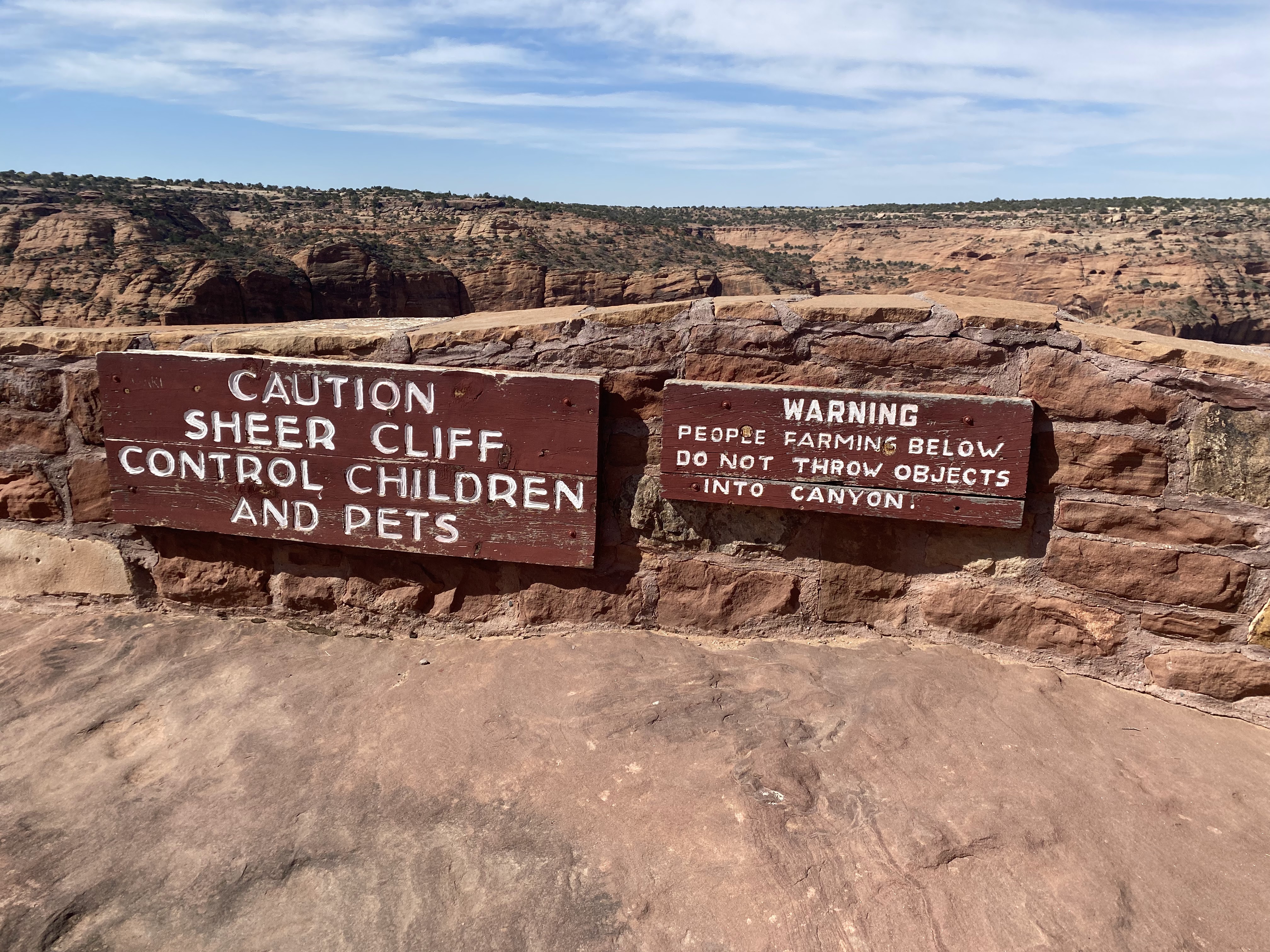
Canyon de Chelly (photo courtesy of Professor Lisa Pruitt)


There are approximately 80 Diné families with the right to live in Canyon de Chelly (pronounced Canyon de-SHAY) National Monument. Traditionally, they grew corn, squash, and had orchards. Rising temperatures and drought conditions have made it harder to farm recently. Today, most families spend only part of the year in the Canyon.

Canyon de Chelly is in Chinle, Arizona, in the Four Corners region of the Southwestern United States. The park encompasses three main canyons as well as approximately one half-mile of land on the edge of each canyon. Canyon de Chelly National Monument is unique because it is situated entirely on land owned by the Navajo Nation. National Parks are typically created on federal land by Presidential proclamation pursuant to authority conferred upon the executive by the Antiquities Act of 1906.

Canyon de Chelly National Monument was established in 1931 by an act of Congress, predicated on a Navajo Council agreement with the Bureau of Indian Affairs. At the turn of the 20th century, non-native peoples were moving west and looting the archaeological and religious sites in Canyon de Chelly, some of the most significant Anasazi and Hopi Pueblo sites in the country. White archeologists were prominent advocates for federal preservation of the Canyon, though the Navajo Nation was reluctant.

In 1925, at a meeting with the Commissioner of Indian Affairs, the Navajo Council agreed to accept the establishment of a national monument in the Canyon, so long as it would not interfere with any Tribal rights, specifically the right to graze, run tourist services, and restrict entry to the Canyon.

In the final agreement, the Navajo Nation would retain all land and mineral rights, including oil and gas, surface use rights, and would be given preferential treatment in furnishing animals for the use of visitors to the monument. The National Park Service would maintain, preserve, and restore cliff dwellings in the canyon, as well as other areas of historical and scientific interest, and would have the right to construct trails, roads and facilities that may be necessary for visitors to the Canyon.

However, none of the new NPS employees appointed to the Canyon de Chelly were Diné, and by 1934 the Navajo Council passed a resolution requesting that the NPS relinquish their rights to the monument. The NPS and the Bureau of Indian Affairs tried to sort it out, but administrative conflicts persisted.

The NPS authorized the Thunderbird Ranch, a property near the Canyon owned by non- Diné people, to house and serve park visitors. The hotel increased traffic to the Canyon, prompting the Diné living there to argue that their right to provide horses for those visiting the park included the right to run businesses, like the hotel, that enabled tourists to access the park. The NPS was not moved. 


A sign at Canyon de Chelly National Monument (photo courtesy of Professor Lisa Pruitt)

In the winter of 1951, a Norwegian tourist got lost in the Canyon and ended up breaking into two hogans (traditional Diné houses) belonging to a Diné family who lived in the Canyon in the summer. He stole shoes and an overcoat, which he ended up burning by falling asleep too close to the fire. After he was rescued, the Diné family whose hogans he had broken into were upset and demanded repayment for the overcoat. The issue was resolved when the Catholic mission the Norwegian was staying at paid for the coat.

Minor though that incident may seem, it reflects the kind of discomfort that the families living in the Canyon must have felt as an increasing number of tourists came onto their homelands on roads and trails built by the NPS.

More significantly, in 1951, the NPS opted to plant Russian olive and Chinese elm trees in the park to control erosion, despite suggestions that plants indigenous to the area, like cottonwood, might work better. The plants grew well and quickly, to the point that they threatened the archeological sites in the canyon. In 2005, the NPS and the Navajo Nation began working together on the Cooperative Watershed Restoration Project to remove invasive tamarisk and Russian olive trees. The NPS stated that:

aggressive infestation by tamarisk (Tamarix ramosissima, T. chinensis, and their hybrids) and Russian olive (Elaeaganus angustifolia), in combination with intensive historic grazing and tour operations within the riparian corridors of the canyon floor, have created the need for an integrated and collaborative approach to managing all resources (natural and cultural) within the Canyons and their associated watersheds.
The issues identified above are ones that the Diné people living in the canyon have been complaining about since at least the 1950’s and are likely largely because of the NPS actions. The use of tamarisk and Russian olive trees to combat soil erosion was effective. However, the density of the tamarisk root structures made streams cut deeper into the ground. The native plants are less effective at erosion prevention, but allow “braided meandering” that better preserves the characteristics of the canyon.

Relations between the Park Service and the Navajo Nation continue to be rocky. However, as Indigenous land management methods gain greater attention for their ability to help us adapt to and combat climate change, the Park Service is encouraging greater Tribal involvement.

Monday, September 18, 2023

Space tames law, dog tames fugitive: Cavalcante captured after two week manhunt

On August 31, convicted killer Danilo Cavalcante escaped from the Chester County Prison, located in West Chester, PA. This past Wednesday, after 2 weeks on the run, Cavalcante was captured in South Coventry Township, nearly 20 miles away from the prison he escaped. While on the run, Cavalcante stole a van, stole a gun, and hid in the deep woods of southeastern Pennsylvania, all while avoiding a massive manhunt involving as many as 500 law enforcement officers. 

As the video of Cavalcante "crab walking" up the walls of the prison went viral, locals were terrified. Cavalcante was a known murderer who stabbed his girlfriend in front of her children. He was clearly dangerous and posed a threat to the community. This threat was amplified when Cavalcante stole a rifle from a local homeowner. 

Hundreds of law enforcement officers from a veritable alphabet soup of agencies combed the area on foot and horseback using dogs, drones, and aircraft with advanced surveillance technologies to look for signs of the fugitive. Meanwhile, Cavalcante hid in woods so thick with foliage that officers reportedly walked past him without realizing it

This wasn't Cavalcante's first rodeo. In 2017, he fled the Brazilian town of Figueirópolis, where he was wanted in connection with a murder. After hiding from the authorities and taking refuge among the cattle ranches of the northern savanna, he escaped to the US with a false identity. 

After numerous sightings, days of intense searching, and a near-miss where a local homeowner shot at Cavalcante, a surveillance aircraft with thermal imagining technology found a heat signature. Two tactical teams were deployed to the area. In a dramatic moment fit for the big screen, a police dog named Yoda subdued Cavalcante, holding the killer down while he attempted to grab his stolen rifle. 

Cavalcante sustained a minor bite wound and was arrested with no shots fired.  

The Cavalcante manhunt echoes a similar manhunt in upstate New York where issues of geography complicated search efforts. The New York search was covered on the blog here

It also illustrates Professor Lisa Pruitt's argument in her chapter "The Rural Lawscape: Space Tames Law Tames Space" that rural spatiality limits the ability of the state to impose the rule of law on the countryside. In essence, the vast expanse, low population density, and natural landscape resist the law. Space "tames" the law, which seeks to "tame" space. Professor Pruitt's theory of rural spatiality's effect on the law is covered in more detail here

Likewise, Ralph A. Weisheit, Ph.D., David N. Falcone, Ph.D., and L. Edward Wells, Ph.D noted in their article "Rural Crime and Rural Policing" that rural isolation negatively impacts rural law enforcement in several ways. Rural police have to patrol significantly larger areas. Sometimes, this means officers patrol alone with no witnesses and the grim knowledge that any backup is miles away. Generally, it means law enforcement will take longer to respond to emergencies and are forced to contend with the natural barriers presented by geography and wilderness. 

Simply put, rural isolation spreads the law thin. 

While Cavalcante was able to use the space inherent to rurality to his advantage, "taming" the law for a time, he was eventually caught thanks to the tireless efforts of law enforcement, the use of advanced technology, and the heroism of man's best friend. 

However, not every rural crime becomes national news. Not every rural crime draws significant resources from the state and federal governments. More often than not, rural police must go about their business without the benefit of drones and expensive surveillance aircraft. The law won this round, but space is far from being down for the count. 


Sunday, September 17, 2023

Solano County: From farm to booming metropolis?

Silicon Valley, often hailed as the global epicenter of technology and innovation, has long been recognized for its pivotal role in shaping the tech industry’s future. In recent years, however, companies and venture capitalists started looking beyond the confines of the San Francisco Bay Area and extending their corporate reach to areas ripe for development. See another recent blog post about these events here

One such region that has garnered significant attention is Solano County, situated just north of the Bay Area. Solano County, boasting fertile land and a rich agricultural heritage, is well-suited for developing sustainable technologies, renewable energy, and agricultural innovation. But should Solano County be gentrified in this manner?

Longtime residents of Solano County are both worried and baffled about these significant changes and the ambitious plan to build a city where there is currently farmland. Ashley Morrill, 40, says:

There’s sheep farms, there’s cattle ranches, and guys that are doing hay and safflower farming. That’s what they do. There’s livestock, and things to feed the livestock.

The company buying up thousands of acres of farmland to create what they imagine to be a futuristic city, Flannery Associates, has committed approximately $800 million and bought 50,000 acres of land (See map of area purchased). The story begins in 2017 when Michael Moritz, a billionaire venture capitalist, sent a note to potential investors describing the chance to invest in creating a new California city. The project’s website pitches the metropolis as a walkable city akin to the West Village in New York that could generate thousands of jobs. Starting from a blank slate, the future city has the unique chance to be built from the ground up. Brian Brokaw, a spokesperson for Flannery Associates, says:

We are proud to partner on a project that aims to deliver access to good-paying jobs, affordable housing, clean energy, sustainable infrastructure, open space, and a healthy environment to residents of Solano County.

Meanwhile, Democratic representative Mike Thompson, who represents Solano County, is less thrilled with the prospective endeavor’s potential impacts on the area. Thompson commented:

They just can’t displace our family farmers; these are people who make a living feeding American households, and that’s totally inappropriate to think that they can come in and just drive them out of business.

Property owners in Collinsville, California, have said the mysterious Flannery corporation has approached them, and a few families have sold their land and left abruptly. Democratic Representative John Garamendi is especially worried about Flannery Associates’ use of “mobster” tactics to purchase the land.

 Tim Miles, 71, said he has concerns that buyers are trying to change the countryside he has enjoyed for decades. His daughter, Lacy Miles, 42, commented:

I moved out here to escape the city.

The story of rural gentrification is nothing new. Rural areas in the United States have been the playgrounds of urban-elite investors for decades. See other blog posts about rural gentrification here and here. Although investors may bring new economic opportunities with them, often rural communities are ripped apart and lower-income residents displaced. 

In Ojai, California, residents complain about tourism’s effects—housing has become too expensive, with older residents essentially priced out and becoming homeless. Meanwhile, in Gunnison County, Colorado, county officials implemented a temporary ban on nonresident property owners to offset the burden on local resources when COVID-19 first hit. See other blog posts about the gentrification of Gunnison and other rural cities here

Rural areas have their own unique character and way of life, often defined by agriculture, close-knit communities, and a slower pace of living. An influx of urbanites with different lifestyles and values can lead to a loss of rural character. As new residents seek amenities and services that cater to urban preferences, traditional rural businesses can struggle or close altogether. 

While rural gentrification can benefit some communities economically, it is crucial to consider its impacts on longtime residents and the preservation of rural identities. With regard to Solano County, although Silicon Valley’s money might provide “an opportunity for a new community, good paying local jobs, solar farms, and open space,” we must consider the cultural erosions that will likely ensue. 

Saturday, September 16, 2023

Fired from fire insurance? Large insurers pull out of the California market

Wildfires have become an increasingly common disaster in California. From 1996 to 2001, the number of wildfires in northern and central California increased fivefold due to climate change. The communities most at risk are those located in rural areas—over 85% of California's rural land is now in "high" or "very high" severity zones for wildfire danger. 

The growing number of wildfires has become a devastating risk not only to rural homeowners, but to home insurance companies as well. Fire insurance is usually covered under general homeowners' insurance and is not a separate coverage, as flood insurance is. The increase of wildfires has resulted in growing premiums and deductibles for home insurance, and more shockingly the withdrawal of two leading home insurers from the California market. In the past year, State Farm, the largest insurer in California, and Allstate both announced they would no longer be accepting applications for homeowners' and renters' insurance in the state. 

This may not be so surprising after the disastrous impact of wildfires in recent years. In 2018, the Camp Fire in Paradise destroyed nearly 19,000 properties costing insurers $16.5 billion. (Read more about the Camp Fire in Paradise here and here.) The year before, the wine country wildfires totaled over $3.3 billion in insured losses

State Farm explained the reasons behind their decision were "historic increases in construction costs outpacing inflation, rapidly growing catastrophe exposure, and a challenging reinsurance market.

Considering the increased risk of wildfires in rural areas, this will undoubtedly have a disproportionate impact on homeowners in rural communities. 

Allstate went further and made the decision to drop some policyholders living in high-risk fire zones. Beth Pratt, who lives near Yosemite National Park in Mariposa County, was dropped by Allstate after they had insured her for 31 years. She told NPR, "I get companies need to make money. I have no problem with that...But to just drop people—you know, it's scary. It leaves us feeling extremely vulnerable."

While state law does not require homeowners' insurance, most mortgages do require it as a condition of the loan.  Smaller insurers are available for lower fire risk zones. For those living in high-risk areas that private insurers refuse to cover, the state offers the Fair Access to Insurance Requirements (FAIR) plan. The FAIR plan consists of insurers in the state willing to cover these areas but it comes at a high cost and for far less coverage than standard policies. 

The hesitancy of insurers to provide policies for homes in high-risk areas is certain to affect new homeowners. According to the Insurance Information Institute, there are 1.2 million homes in California that are at risk of extreme wildfire, and there has been an influx of people moving into these fire-prone areas. While owning property may seem cheaper in rural areas, it is increasingly coming with a hefty added cost. A home insurance policy from an insurer such as State Farm for a million-dollar house in the Santa Cruz mountains would usually be around $150 a month, but with the FAIR plan, the rate is closer to $600 a month. This will be a barrier to many people looking to move to rural areas and buy property. 

Pratt also told NPR, "The notion that, somehow, you know, we all built in this high-risk fire area—well, no, we didn't have major fires here every year." It is unclear what the solution for affordable home insurance is when wildfires and other natural disasters are becoming far too frequent. It seems truly unfair, however, for large insurance companies to be able to pull out when they are needed most. 

You can read more about the disproportionate impact the lack of insurance has on rural communities here and here

Friday, September 15, 2023

Los Angles Times' poignant feature on rural youth in California's far north state

Hailey Branson-Potts, a terrific story teller who works as a metro reporter for the Los Angeles Times, filed her second big story this season out of Modoc County, in the state's far northeast corner.  The digital headline is "There's a hidden crisis among California's rural kids. Would this teen make it?"  

"This teen" is Linda Plumlee, a recent high school graduate from Modoc who has been an emancipated minor for several years.  This fall, she's off to UC Berkeley--against all odds.  

Plumlee, it turns out, is just one of the more extraordinary stories among rural California teens facing uphill battles to stay in school, keep roofs over their heads, and eat.  Here's the part of Branson-Potts feature that provides critical context:  
About eight years ago, educators in Modoc County realized they had a serious problem.

Students kept melting down, becoming so angry or disruptive that they had to be pulled from classrooms. The county’s suspension rate was about three times higher than the state average, and students were twice as likely as those statewide to be chronically absent.

“We realized we were dealing with something bigger than behavior,” said Misti Norby, deputy superintendent of the Modoc County Office of Education. “We were like, what’s going on with our kids?”

Teachers across Modoc County assessed their students, relying on a fact of small-town life that can be both a blessing and a curse: everyone knows everyone’s business. They did an informal, anonymous tally of what are called adverse childhood experiences, or ACEs, which include abuse or neglect; a parent’s death, incarceration or divorce; and mental illness or substance abuse in the home.

About 58% of kids in Modoc County, Norby said, were believed to have four or more ACEs, putting them at significantly higher risk later in life of suicide, substance abuse, chronic health problems and unemployment.

“It was very eye opening,” Norby said. “We now function on: We know they have trauma. Somewhere. Somehow.”

Models consistently show the state’s highest rates of childhood trauma are in rural Northern California, where there is a dire shortage of both primary care and mental-health care providers.

The gun violence and poverty experienced by young people in some urban neighborhoods is well-documented in the media and popular culture. But these issues are as present, if not even more common, in rural areas. While homicide rates are lower, suicide rates are generally much higher in rural than urban counties.

Home to just 8,500 people, Modoc County is one of California’s poorest, with a fifth of the population living in poverty.

* * * 

Now, when social workers or other county officials learn that a child has experienced a major trauma, they email Norby, who then emails the child’s school district.

She provides no details about the incident. Just a name and the words: “Handle with care.”

Also, here's an interesting vignette of life for teens in rural Modoc: 

Alturas was where [Plumlee] and her friends cruised Main Street, cracking jokes and dreaming about the future. It was where teachers and school counselors spent countless hours keeping her spirits up through the emancipation process.

Most stores and restaurants close by 8 p.m. There’s the single-screen Niles movie theater on Main Street — but it only screens once a day on weekends.

Teenagers go hiking, hunting or fishing in the nearby mountains. They party and drink. Or they drive 100 miles to shop in Klamath Falls, Ore. — where the nearest Walmart is.

Their lives revolve around school: sports, band, Future Farmers of America, drama club.

Don't miss this entire feature, which appeared on the front page of the Los Angeles Times print edition on Sept. 16. 

Thursday, September 14, 2023

Democratic lawmakers seek to bolster rural recreation economy

Senators Chuck Schumer (New York) and Michael Bennet (Colorado), along with Congresswoman Melanie Stansbury (New Mexico), recently introduced the Rural Outdoor Investment Act, which Bloomberg describes as authorizing 
$50 million annually through fiscal 2028 for rural areas to upgrade outdoor recreation infrastructure such as boat ramps and trails, as well as help communities plan for the increased tourism and larger workforce the industry is expected to bring.

Outdoor recreation in the US, especially on public lands and waters, boomed during the Covid-19 pandemic, as Americans sought alternatives to indoor activities. The industry supported 4.5 million jobs and contributed about 1.9% to the nation’s gross domestic product in 2021, according to the Bureau of Economic Analysis. Outdoor recreation also contributed about $862 billion in sales and revenue in 2021.

One commentator calls this bill the "recreation industry’s 'big play in the farm bill,'" because while "lawmakers introduced the measure as stand-along legislation...they are eyeing attaching it to broader bipartisan bills [including the farm bill] before year's end."  Read more here from the New Mexico Political Report here.

The link between outdoor recreation and rural economies is explored in prior posts here, here, and here.  

Wednesday, September 13, 2023

Rural responses to corporate utility disasters: Reimagining the future of Butte Creek Canyon after PG&E canal breach

Residents of Butte County, California are no strangers to PG&E-caused disasters. The latest of the vast corporate utility’s mishaps occurred August 10, when a breach of Butte Canal sent millions of pounds of sediment careening into Butte Creek, which runs through Butte Creek Canyon. The sediment turned the water orange and silty, threatening the survival of this year's salmon class and causing deep concern for ecosystem and human health.

The breach happened above Helltown and Centerville, two very small, unincorporated canyon communities about a half hour northeast of Chico and located on the ancestral homelands of the Mechoopda tribe.

I first learned about the breach through the Instagram of a Helltown local, who posted devastating videos of the murky orange waters and documented river otters desperately trying to find the end of the pollution. In the weeks since, I’ve observed that much of the clean up effort responding to this catastrophe is coming from rural canyon residents who have a deep connection with the land and water in their backyards.

For many canyon residents, their biggest concern revolves around the creek’s salmon population. Butte Creek, a 93-mile tributary of the Sacramento River, supports the state’s largest population of wild spring-run Chinook salmon and is one of only three tributaries that still support a self-sustaining salmon population. This makes the creek critical to saving the state’s endangered salmon population. The conservation group California Trout explained in a blog post about the incident:
Sediment in a stream is natural, but if sediment levels get too high, like they are currently at Butte Creek, it can be extremely dangerous for fish and other wildlife. Sediment blocks light that allows algae to grow, harms fish gills, fills or blocks important habitats, and stops fish from seeing well enough to move around or feed.
CalTrout also noted that the impacts on fish and other wildlife can’t be fully assessed until the creek flushes out.

The more I learn about the canal breach, the sadder and angrier I am, feelings I know are shared by many other people from the area.

Allen Harthorn, a canyon resident and founder of advocacy group Friends of Butte Creek, told ChicoSol, “This event is essentially an underwater Camp Fire — there’s no fire, but it’s killing everything in its path.”

Harthorn is referencing a devastating wildfire that burned much of Butte Creek Canyon in 2018. State fire investigators determined it was started by PG&E transmission lines and in litigation over the fire, PG&E settled with the town of Paradise and Butte County for $522 million in 2019. It also settled with individual fire victims from the Camp Fire and other Northern California fires for a total of $13.5 billion. You can read more about the Camp Fire here

Community frustration with PG&E is palpable (and aligns with statewide trends). I’ve heard and seen it voiced by residents in comments on news articles and social media posts about the breach, in my own conversations with friends and family in the area, and by Butte County District Attorney Mike Ramsey, who facetiously referred to PG&E as his “favorite punching bag” in the recent community meeting discussed below. A Friends of Butte Creek post about the incident reads, “We must not let PG&E continue to get away with destroying our watershed. The District Attorney and California Department of Fish and Wildlife are investigating the incident and potential legal actions are possible.”

As I see it, this anger, alongside hope, is fueling powerful community response and creating opportunity for meaningful change.

Following the breach, canyon residents organized a community meeting at the old Centerville Schoolhouse on August 24, and the community showed up in force. A recording of the meeting can be viewed here.

One of the organizers set the tone of the meeting in two meaningful ways. First, she asked everyone who was angry about the incident to raise their hand, her own hand going up first. With those feelings acknowledged, she asked for the meeting to center on solutions, rather than grievances. She also asked explicitly for people to leave partisan politics at the door. I’ve long felt that environmental action and sense of place can transcend partisanship (and the urban-rural divide), and it was refreshing to see that play out.

The meeting then turned toward understanding the problem and thinking about solutions. He-Lo Ramirez, environmental director and member of the Mechoopda Tribe shared the significance of salmon and the Butte Creek Canyon watershed to the Mechoopda people. A video created by canyon residents showed the site and effects of the breach. Harthorn talked about the creek’s salmon runs and the history of the canal project, which is connected to the DeSabla-Centerville hydroelectric project.

Harthorn envisions decommissioning the hydroelectric project and replacing it with a fish restoration project. He noted in the meeting that even PG&E has recognized the power project makes no economic sense. PG&E even tried to withdraw its long-term licensing application for the project in 2017, but the Federal Energy Regulatory Commission denied that request. Since 2009, PG&E has operated with yearly permits.

Harthorn talked about how removing the energy project would allow for the removal of power lines as well. This would benefit the area via less clear-cutting around lines and reduced fire risk, a topic of equally great concern to canyon folks.

Ramsey promised accountability and talked about litigation options, before welcoming some "boots-on-the-ground" PG&E officials to the podium to talk about their response to the breach. The PG&E representatives at the meeting voiced their own deep concerns over the breach and emphasized the utility's prompt response. Residents were respectful of the PG&E employees but insisted on corporate accountability.

As residents move forward with holding PG&E responsible and advocating for solutions that protect the canyon and fish, I’m curious what roadblocks stand in their way and what a reimagined and more sustainable future for the canyon might look like. Can community-based solutions, or even community-operated power, reduce both stream pollution and wildfire risk? In my next post, I’ll explore ways other rural communities are responding to big utilities mistreating or overlooking them and how those responses might transfer to Butte Creek advocacy.

Tuesday, September 12, 2023

Can the Green Mountain State stay green?

It's an old lesson we never seem to learn . . . You can't save the environment by destroying it. -Kit Ausschnitt, current Vermont resident. 

Oftentimes, people think of oil, gas, coal, and other extractive industries being synonymous with rurality. West Virginia has the mines, Kansas has fracking, Alaska drills, and so on and so forth. Despite these stereotypes, there has been a recent boom in clean energy jobs in rural communities (you can read more about clean energy in rural communities here and here). 

Clean energy jobs in rural counties outnumbered fossil fuel jobs by 1.5 to 1 in 2019. In rural parts of the Northeast and Pacific West this rises significantly as clean energy jobs outnumber fossil fuel and power jobs 9 to 1Rural classification for this purpose was developed by the USDA Economic Research Service which distinguishes between metropolitan counties and non-metropolitan counties by rating them on a scale of 1-9. You can read more about the rural/ urban classifications here.

According to the World Resources Institute, jobs in renewable energy, energy efficiency, advanced electric grid development, clean fuels, and other clean energy jobs employed around 360,000 workers in rural counties in 2019. These jobs accounted for as much as 10% of total employment in these places. In fact, clean energy jobs make up 3% of total rural employment in Nevada and Wyoming, 3.2% of total rural employment in Indiana, and 3.6% of rural employment in Hawaii. Vermont leads the pack, however, with 5.7% of total rural employment being comprised of clean energy jobs. 

According to the most recent Census, Vermont is the most rural state in the union with 65% of Vermont's population residing in rural areas. Despite its small size (Vermont is the second least populated state after Wyoming), Vermont's share of in-state electricity from renewable resources is the highest in the nation (reaching just shy of 100% in 2020 and 2021) and has the lowest carbon dioxide emissions of any state. 

Since the end of 2014, when the Vermont Yankee Nuclear Power Station was permanently shut down, Vermont has gotten almost all of its in-state electricity from renewable resources. Most of Vermont's electricity comes from a combination of hydroelectric plants (46% of total electricity), wood and wood waste (23%), solar energy (16%), and wind farms (14%).

That said, Vermont's commitment to renewable resource electricity has not been met with universal approval.

Recently, tensions have risen regarding a renewable energy project in Shaftsbury, Vermont. Shaftsbury is located about 2 hours and 45 minutes from Burlington, Vermont, and is located on the southern end of the state. Shaftsbury boosts “the beauty and quiet of rural living with city convenience within easy reach.” 

The renewable energy project in Shaftsbury has been met with local pushback as "the project would build one of the largest solar panel farms in Vermont. This aversion to large-scale change in rural Vermont is not new. An earlier blog post explores how people want Vermont to "stay Vermont."

Local aversion to large-scale environmental projects is not limited to Shaftsbury. A new bill, H.320, if passed would require Vermont utilities to purchase double the amount of clean, in-state energy by 2030 and triple the requirement by 2035

Opponents of H.320 question the efficiency of solar panels in northern climates and worry that their country roads won't be able to handle the incoming construction traffic. They also worry about increased pressure on their farms, an adverse effect on property values, and an overall threat to rural living

Additionally, residents raise the concern that large solar farms, like the one proposed to be built in Shaftsbury, threaten Vermont's picturesque appearance (parts of the solar array would be visible to neighbors and those traveling on Route 7). One Vermont resident remarked, "The main attraction of Vermont is its appearance. That's all it's got going for it."

Vocal opponents of large-scale renewable energy investments are not against making Vermont more energy-conscious. Instead, they bring attention to the fact that current efforts are "driven by developers trying to make money instead of communities and utilities with incentives to find the most effective way to clean up the grid."

Given the opposition to solar, one might think wind farms would be an easier sell. But, this is likely a nonstarter since the possibility of investing in additional wind power development in Vermont is essentially dead. In fact, there have been no industrial-scale wind turbines built in Vermont in the last decade. And the ones built back then were also met with an outcry at the time. 

So, if Vermont can't build large-scale solar or wind farms, how will they get their energy? One Vermont resident thinks the need will be met by importing more Canadian hydropower from Quebec. In fact, a transmission line that will run under Lake Champlain to provide energy from Canada was approved in April 2022

The push and pull happening between locals and clean energy advocates is not new in Vermont. If Vermont wants to stay green, however, the lawmakers will need to introduce a bill that balances the interests of the locals and the clean energy advocates. 

Saturday, September 9, 2023

Gambling with the rural foster youth

Nonmetropolitan Elko County covers a vast expanse of northeastern Nevada and is home to approximately 54,046 residents, but it only has twelve beds to service every foster child in the county.

Earlier this year, the need for those limited beds spiked in what one Nevada social services manager told NPR was the worst uptick in foster need she had seen in twenty years working for Nevada’s Division of Child and Family Services (DCFS). With the number of displaced children exceeding the number of foster beds, state officials were at a loss on where to house the children.

In response, Nevada social services used hotel casinos to house seven rural foster youth over a period of 89 days, with staff paid overtime to provide one-on-one supervision of the children.

Of course, casinos are not DCFS’s first choice for placement. DCFS’s primary goal is kinship care, where the child is placed with relatives. But when kinship care is not available, DCFS resorts to out-of-home placements, also known as "traditional foster care."

What happens when kinship care is not an option, and “traditional foster care” is overcrowded and shrinking? Where do these displaced children go?

This is a frequent dilemma and a national trend, which is putting other child welfare agencies in the same predicament as Elko County: KCRA 3 reported Sacramento County was fined by the state of California for placing foster youth in former juvenile detention facilities; the Child Welfare Monitor uncovered Colorado, Florida, Kentucky, Maryland, Massachusetts, Michigan, New Mexico, New York, Ohio, Oregon, Pennsylvania, Rhode Island, Tennessee, Texas, Virginia, and Washington all reported similar situations where children removed from their parents were
warehoused in inappropriate settings, such as temporary shelters, hotels, offices, or state-leased houses staffed by social workers; sent far away for residential care, or being left in psychiatric hospitals and detention centers after being cleared for release.
Worth discussion in this regard is the Family First Prevention Services Act (“FFPSA”), which the National Conference of State Legislators describes as offering federal funds to support child welfare programs. As the Act’s name implies, the primary intention is to keep families intact. It thus necessarily shifts child welfare services towards prevention.

Through FFPSA, states with approved funding have the option to apply funds towards “prevention services.”

One explicit goal of FFPSA is to curb the use of congregate or group homes by prioritizing family foster homes for child placement. States are generally not reimbursed under the FFPSA if they place a child in a group home for more than two weeks.

This well-intentioned goal likely will but up against rural realities: it can be particularly difficult to successfully place children with rural foster families, as noted by the American Enterprise Institute (AEI).

In general, the process for vetting a foster family is intensive, for both the government and the prospective family. The Plight of Rural Child Welfare: Meeting Standard Without Services accentuates how spatial barriers, like sheer distance from a social services office, can make it especially difficult for caseworkers to visit foster families and for foster families to engage with social services.

Rural communities often lack the support networks and resources that are necessary for child welfare, which undermines efforts to identify rural foster family placements.

In "When Mamaw Becomes Mom: Social Capital and Kinship Family Formation amid the Rural Opioid Crisis," Professor Kristina Brant posits that social capital with the local legal actors (e.g. bureaucrats, judges, and child welfare caseworkers) plays an important role when establishing foster families in rural communities. Naturally, good social capital cuts in favor of a family becoming a caregiver, while poor social capital likely prevents them from doing so.

The advantages of social capital plummet, however, when the relevant legal actors are no longer local. This is not an uncommon problem given the spatial remoteness typically associated with rural communities and the phenomena of “legal deserts,” a term coined to refer to the rural lawyer shortage. (Read more about “legal deserts” here and here).

In cases where social capital cannot be employed, a key determinant for getting approved as a rural foster family is effectively out of reach.

To compound and exacerbate the difficulties of finding a rural foster family, the social services associated with supporting families and preventing child maltreatment are few and far between in rural communities.

Some of the notable services considered necessary for adequate child welfarethat are scarce in rural communitiesare substance abuse treatment, mental healthcare, and parenting classes. For the social services that are available, material distancethe literal distance that must be traveledcan make accessing and providing services expensive and time consuming.

Simply put, the lack of support and services in rural communities sweeps the legs out from under some of the broad reforms in the child welfare system, like the FFPSA, and leaves rural foster children with no place to go.

This only scratches the surface of several intersectional barriers to adequate child welfare in rural communities, a few of which have been discussed in a thread of blogs starting here, and in this law review article.

Child welfare is by no means an easy issue, and I cannot deny that state agencies and committed individuals and organizations are making efforts to improve it. I only draw attention to differences in rural infrastructure and social services that make rural foster youth especially vulnerable and frustrate the goal of family foster placements.