Showing posts sorted by relevance for query camp fire. Sort by date Show all posts

Friday, November 16, 2018

Paradise fire provides tragic opportunity to blog about several aspects of contemporary rurality

A week ago, the Camp Fire roared through Paradise, California, a community of about 27,000 in Butte County, about 90 miles north of Sacramento (where I happen to live).  Events like these are so shocking--and almost unimaginably tragic--that I've been almost paralyzed, unable to write about the conflagration and its aftermath.  But that's the task I'll undertake today.  

I'll start with the most recent news first:  The number of persons missing from the fire has just shot into the 600s, after days of hovering in the 200s.  The various public agencies apparently began to check the lists and logs of calls and against one another, and the news was not good.  Read more here and here.  The death toll now stands at 63, greater than that from the 1989 Loma Prieta earthquake, making it the deadliest natural disaster in history.  Other stunning data points about the Camp Fire from today's Sacramento Bee:
So far, the blaze has burned 142,000 acres — about 221 square miles — and is 45 percent contained.
More than 52,000 people have been evacuated and 12,256 structures destroyed, 9,700 of them homes.
Speaking of the nearly 10K homes lost in the fire, media are now starting to focus on the impossibility of an adequate response to the widespread human displacement because of California's already enormous housing shortage.   This is a housing shortage afflicting both rural and urban places, and those in between, like Butte County.  The New York Times headline is "California Fires Only Add To Acute Housing Shortage."  The data point it features includes both the Camp Fire and the Southern California fires, where 432 homes have been lost in Los Angeles and Ventura Counties.

Related to this is the tent city that has sprung up next to a Walmart parking lot in Chico California, one of the Butte County seats and just 20 minutes from Paradise.  The Sacramento Bee headline two days ago was "Refugee camps for fire survivors? Butte County on 'edge' of humanitarian crisis after Camp Fire."   The story quotes David Cuen, a survivor of the fire who is living out of his truck in the parking lot,
“People go right next to you, not respecting that we’re sleeping in our vehicles – not respecting that we don’t have nothing no more,” Cuen said of this haphazard community of survivors that has taken shape in recent days.
The lot has become a de facto refugee camp as those who have lost everything seek the most basic of necessities: a place to be. Exactly how long people will stay there is an unsettling and unanswered question in Butte County. In a region already plagued by a severe shortage of homes and apartments, the Camp Fire may usher a massive housing shortage, potentially leaving thousands of fire victims homeless for months or even years. 
The more than 50 tents, and the dozen or more RVs and occupied cars such as Cuen’s in the parking lot represent just a small fraction of the staggering number of families that have been left temporarily or permanently homeless...
Ed Mayer, executive director of the county's housing agency had this to say when asked if the county was facing a humanitarian crisis:
"We’re on the edge."
Local officials warned the destruction from the Camp Fire could set off a wave of refugee migration akin to a smaller version of the Dust Bowl of the 1930s. 
“Big picture, we have 6,000, possibly 7,000 households who have been displaced and who realistically don’t stand a chance of finding housing again in Butte County,” Mayer said. “I don’t even know if these households can be absorbed in California.” 
The county has the capacity to place 800 to 1,000 households in permanent housing, Mayer said, but its short-term options are overwhelmed.
The New York Times story on the housing shortage, by Thomas Fuller, Kirk Johnson and Thomas Dougherty, includes this information:
Housing experts said wildfires have transformed a housing problem that was already vast and deep into something sharp and local. 
“We’ve had a huge increase in population and a huge increase in jobs, and we do not have anywhere close to the supply of housing to put people,” said Carol Galante, faculty director of the Terner Center for Housing Innovation at University of California Berkeley. “There is no margin when there is a disaster; there is no cushion at all.”
It later continues:
For disaster-prone California, the housing shortage creates instant refugees. 
The journalists quote Casey Hatcher, spokeswoman for Butte County: 
There is no way that the current housing stock can accommodate the people displaced by the fire.  We recognize that it’s going to be some time before people rebuild, and there is an extremely large housing need.
One possible solution, [Hatcher] said, would be for FEMA, the Federal Emergency Management Agency, to provide trailers that people could live in while their homes were being rebuilt.
While it is very difficult to find good, credible hard data -- as opposed to anecdote--those who work on rural issues in California have been well aware of the housing shortage facing rural residents for some time.

The Los Angeles Times "equivalent" headline on the same day that the Bee used the term "humanitarian crisis" was "'We have nothing':  Camp fire evacuees turn Chico vacant lot into a tent city."  A story by the local NPR affiliate yesterday commented that homeless people in Chico had made their way to where fire relief goods, including clothing and blankets, were being distributed.  The radio journalist interviewed one of the long-time homeless residents who was thankful for what he could get, and the journalist them commented on how much the fire evacuees and long-time homeless now suddenly have in common.  Homelessness in rural California is another big issue for rural advocates in the Golden State.

Speaking of humanitarian crises, a Norovirus outbreak has recently been confirmed at several Chico area shelters.

Another fascinating story out of the Los Angeles Times (which is continuing to provide excellent coverage of the Camp Fire, though it is very far from Los Angeles) regards the coverage of the fire by Chico's newspaper, the Enterprise-Record.  David Little, the paper's editor, took a photo with his iPhone from atop the paper's office building as the fire burned last Thursday morning.  That photo has now been seen around the world, appearing on the websites of the New York Times, the Washington Post, and Time Magazine.  I can't re-print the photo here without permission, but/and I do hope it is enriching  Mr. Brown and the Enterprise-Record.  You see, they are operating on a shoe-string budget, with a staff of 10 and 4 part-timers, down from 45 when he started running it two decades ago.  That's the story of rural and small-town newspapers these days.  As the Los Angeles Times story points out, Little and his team are doing a heroic job of covering the Camp Fire, well beyond that pervasive, eye-catching photo.

Little oversees not only the  Chico paper, but also one that serves Oroville (co-county seat of Butte County), as well as the Paradise Post.
The twice-weekly Paradise Post also falls under his supervision, and its staff of two has been in overdrive, he said. They work in the Chico office, and the paper is printed there as well — along with a dozen other dailies and six weekly and semiweekly papers from Monterey to Eureka. The challenge, though, has been where to deliver the Paradise Post.

“How do you distribute a newspaper to a town that’s not there?”
Moving on to the next topic, Donald Trump is coming for a visit tomorrow.  Governor-Elect Gavin Newson and Governor Jerry Brown have just announced they will accompany him.  Read more here.  I assume they'll visit both Butte County and the So. Cal fires.  We shall see.  

P.S.  Here is a powerful BBC story, really a series of human stories, about the Camp Fire and the loss of Paradise.

And here is information on how to get help if you have been displaced by the Camp Fire. 

Tuesday, December 11, 2018

On the rural housing shortage and how California's wildfires have drawn attention to it

I've already blogged recently about how the California wildfires have drawn attention not only to California's housing shortage generally, but even more so its rural housing crisis.  I'm coming back to that topic because the national (and state) media continue to attend to it and because the media are also talking about the wildfires in relation to income inequality and poverty. 

The Los Angeles Times' Liam Dillon wrote a few days ago under the headline, "How Northern California's Destructive Wildfires Could Exacerbate the State's Housing Crisis."  Here's an excerpt:
Five large wildfires over the past 14 months, with November’s Camp fire the most devastating, have destroyed nearly 21,000 homes across six counties. That total is equivalent to more than 85% of all the new housing built in those counties over the past decade, according to Construction Industry Research Board building permit statistics.
Dillon quotes Bob Rymer of the California Building Industry Association. 
We had a housing crisis prior to the fires.  This exacerbated the crisis. I can’t even put a measure on it. Just wow.
The story profiles a low-income apartment complex that was destroyed in the Camp Fire, Paradise Community Village.  Its three dozen apartment homes were among 14,000 housing units destroyed by the the fire.  The apartment complex is owned by the Community Housing Improvement Program (CHIP), which owns or manages 17 properties in Butte, Shasta and five surrounding counties.  Even before the fire, CHIP had a wait list of 1800 families. 

Dillon also considers what's been going on around other California communities that have suffered wildfires: 
This summer’s Carr fire in Shasta and Trinity counties destroyed more than 1,000 homes. After the fire, officials in Redding, the largest city in Shasta County, heard from their counterparts in Sonoma County that a shortage of builders was pushing up costs there, Redding City Councilwoman Kristen Schreder said. She fears the effects could be even worse in her community and Butte County as rebuilding efforts get off the ground.
Schreder pointed to $6 billion in new funding for low-income and homeless housing developments approved by California voters in November as a potential source of money to help the neediest residents find permanent homes.
An earlier Los Angeles Times story by Anna M. Phillips provides more helpful context regarding the Butte County housing market: 
Across Butte County — a primarily agricultural area known for its walnut, almond and rice farms — towns are struggling to absorb the roughly 50,000 people displaced by the Camp fire. Through no fault of their own, the evacuees’ arrival has worsened the state’s housing crisis and raised the possibility that they could be evicted from the region again, not by fire but by a scarcity of suitable dwellings.

Hotels and motels from Sacramento to Redding are full. The vacancy rate in the rental market, which hovered around 3% before the fire, has fallen to near zero. Unable to find single-family homes in the area, evacuees have resorted to renting individual bedrooms, buying recreational vehicles and purchasing travel trailers. Others are simply leaving California for other western states with a lower cost of living.
* * *
Butte County Housing Authority Executive Director Ed Mayer said that nearly 14,000 homes burned to the ground on Nov. 8, a loss of about 14% of Butte’s housing stock. Before the fire, the county’s homeless population numbered about 2,000. Now, it is expected to grow.
* * *
On the day before the fire broke out, the city of Chico had 243 homes for sale, said Adam Pearce, president of the North Valley group. About a week later, less than a third of them were still on the market.
Needless to say, demand is driving up housing prices.

Here's some of last year's coverage of the impact of the Tubbs fire on Sonoma County area housing. The dateline is Santa Rosa, the largest population cluster affected by that fire.  Some 5,700 structures, mostly homes, were destroyed in that fire.  Here's a data-dense excerpt from that story:
California already had a housing crisis long before the fires started. With strict environmental rules and local politics that can discourage new housing development, the state’s pace of new construction has fallen far short of the state’s population growth. 
In the five-year period ending in 2014, California added 544,000 households, but only 467,000 housing units, according to the McKinsey Global Institute, and the deficit is only expected to grow over the next decade. Napa and Sonoma Counties, where the fires did some of the most extensive damage, are among the furthest behind, building less than half the number of units in recent years that the state reckons were needed to keep up with the population.
As a somewhat related matter, here's coverage of the disparate impact the Camp Fire had on elderly folks in Butte County, where many lived in manufactured housing. 

At the other end of the housing spectrum--the luxury end--is new high-end accommodation for aging baby boomers--dateline, Santa Rosa.

Sunday, August 8, 2021

Remembering Greenville, California--and awaiting its rise from the ashes


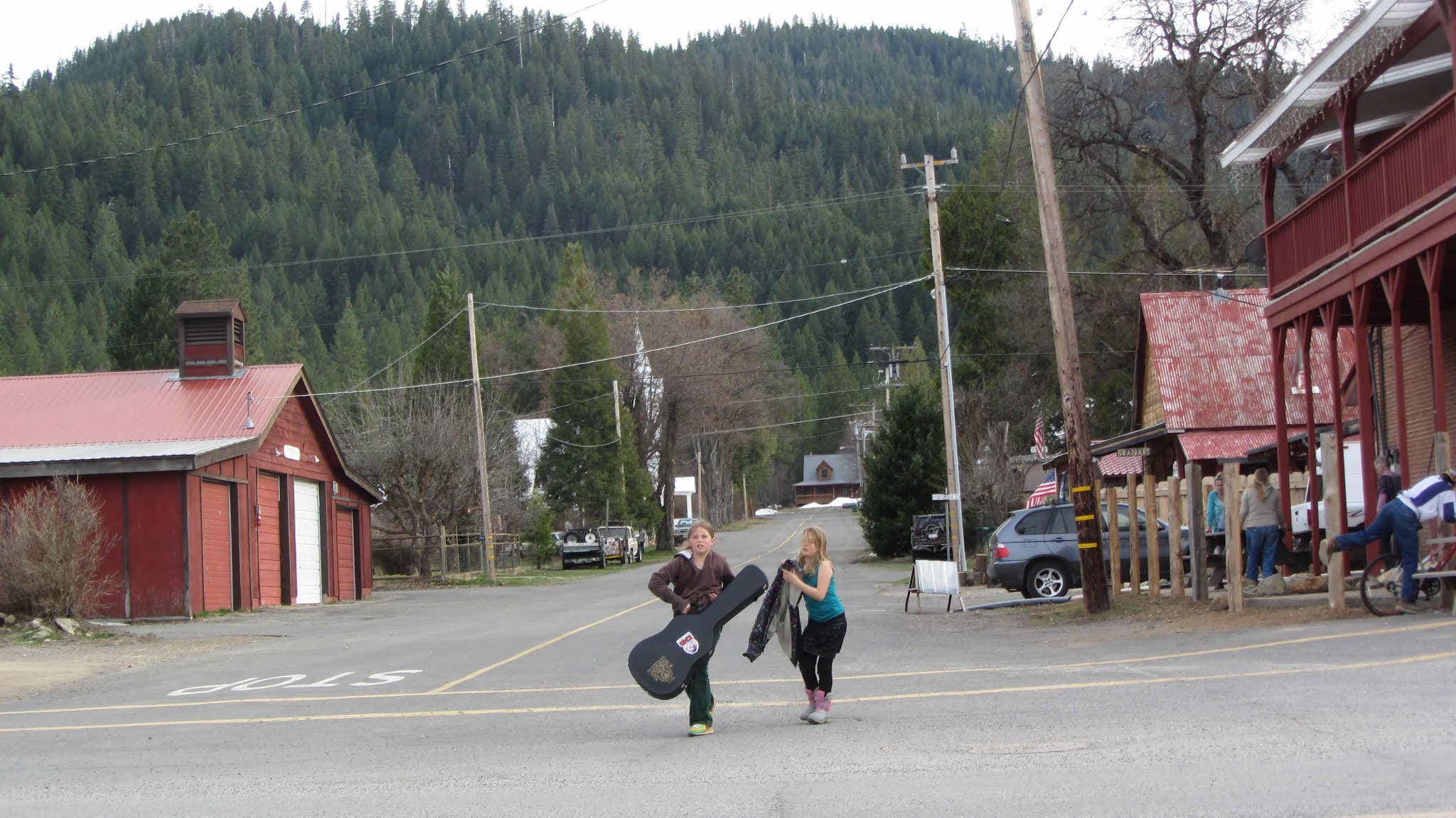
Young musicians
Downtown Greenville, California, March 2013

I spent several days of the 2012-2013 academic year in Plumas County, California.  A good bit of that time was in Greenville, a town of about a thousand folks in an area called Indian Valley, less than an hour north of the county seat, Quincy.  Plumas County is about the size of Delaware, but it's sparsely populated, with just about 20,000 residents.  

Village Pharmacy (left) in a building dating to the 1860s,
was destroyed in the Dixie Fire Wednesday night.  
(c) Lisa R. Pruitt 2013

The year I spent working off and on with my law students in Plumas County is documented in this report that my students and I produced.  We were conducting what is called "participatory action research" in collaboration with Legal Services of Northern California, which had a grant to do do early outreach related to the Affordable Care Act's implementation.  

Historically Mountain Maidu territory, Greenville is one of the poorest parts of the county--and, indeed, one of the poorest places in California.  I took many photos (all (c) Lisa R. Pruitt 2013), and I'm going to share some here as a reminder of what Greenville was--and might be again.  

Anna's Cafe, Greenville

Downtown Greenville, March 2013, with 
Way Fair Tavern and Anna's Cafe in 
background behind the flag

I say "might be again" because on Wednesday evening, Greenville was largely destroyed in the Dixie Fire, now the second largest fire burning the United States, and one of the largest fires ever in California.  As the crow flies, Greenville is not many miles from where the Camp Fire destroyed the town of Paradise in 2018.  Indeed, the Camp Fire and the Dixie Fire started in the same area, both in the Feather River Canyon.  The Camp Fire burned west and north from there, while the Dixie Fire burned mostly south and east.  Also threatened is the Plumas County town of Chester, which borders Lassen County, and the fire is now also burning into Lassen National Park.  

I'm featuring here a sampling of the photos I took in 2013 in and around Greenville.  (I took many, many more, so may do a few additional posts featuring different aspects of Greenville and Indian Valley).

Indian Valley Chamber of Commerce and a bookkeeping service,
Greenville, California, Spring 2013 


Hotel in Downtown Greenville.  The building whose
corner you can see on the right is the Village Pharmacy, pictured above. 


Lutheran church, 2013.  You can see after-fire photos 
of the church at the links below, where just the sign remains.

Music studio
Greenville, 2013


You can read more about what happened in Greenville on Wednesday here, here, here, and here.  You'll see there photos of what's left of some of the buildings I photographed in 2013. 

Hunter Ace Hardware, Greenville, Spring 2013

Greenville Rancheria Tribal Medical Center, Spring 2013

Greenville Library, Spring 2013
Way Station Tavern, which sat right across from Village Pharmacy 
and across Hwy 89 from Anna's Cafe.  You can see after-fire 
photos of the tavern at the links below 

This latest, by Anita Chabria for the Los Angeles Times, features the story of Kevin Goss, a pharmacist in Greenville and also a long-time member of the County Board of Supervisors. (As a county supervisor and business owner, Goss is mentioned in the report my students and I produced).  You can see a photo of his Village Pharmacy above, from 2013.  He was in escrow to sell the business to a pharmacist in Quincy when the Dixie Fire destroyed it.  

A woman was selling goat's milk-based products out of an 
outbuilding behind her home, on a residential street, Feb. 2013

Here's a Eulogy for Greenville, written by resident Meg Upton and published in the Plumas News.  It talks about politics--though it puts a good spin on how community spirit overrides politics in Greenville because they're too small and need each other too much to alienate one another.  And it reminds me of this very memorable photo I took in Greenville in 2013: 

Greenville, California, Spring 2013

Speaking of politics, Governor Gavin Newsom visited Greenville yesterday and posted this video on Twitter.  Mostly, Newsom focused on climate change's role in this disaster, but he also said the Dixie Fire and the disaster in Greenville is "about people's culture, their identity, lifestyles, a sense of place, memories that are attached to this, one of the oldest communities in California.  This is about our families, our kids ... we have a deep responsibility to rebuild." 

More photos to follow in a future post.  

Post script:  You can see after-fire photos of some of these places, including the Greenville public library, the Greenville Rancheria Medical Clinic, and the Way Station Tavern in this August 12 story from the Los Angeles Times.

Wednesday, November 21, 2018

More evidence that rural communities don't have the infrastructure to deal with natural disasters, including providing warnings

When the fires in Sonoma and Mendocino counties in California broke out last fall, media coverage eventually revealed that the warnings systems in the rural reaches of this region had not gotten notice of the fire to many residents.  The Los Angeles Times provided excellent coverage then, as in a story by Joe Mozingo, which was the focus of this blog post.  Now, the New York Times is offering similar revelations about the Camp Fire in Butte County.  Simon Romero, Tim Arango and Thomas Fuller report under the headline, "A Frantic Call, a Neighbor's Knock, but Few Official Alerts as Wildfire Closed In." 
In the frenzied first hours of the Camp Fire, which reduced Paradise to ashes and is the deadliest wildfire in modern California history, only a fraction of people living near the fire received alerts or evacuation orders from local authorities.
* * * 
In the weeks and months ahead, officials across the state will grapple with the question of whether more people could have been alerted sooner, perhaps saving more lives.
Many of those who barely made it to safety already have their answer. 
“They totally dropped the ball on this,” [Matthew] White [who was awakened the morning of the fire by a friend's call to his cell phone] said, of the authorities. “Look, all these people dead, all these people missing. It’s like they decided to forget about us. Like we weren’t worth saving.” 
The decision to issue alerts and evacuation orders rests with local authorities, and as the Camp Fire began on Nov. 8, the Butte County Sheriff’s Department decided to use what experts say is an outdated system — called Code Red — to notify residents of danger with a phone call. 
But only residents who sign up for the service receive alerts — and only a fraction of them had. The decision not to issue an Amber Alert-style message, a federal government system that could reach all cellular phones in the area, was partly out of fear of causing panic and traffic jams on the one main roadway out of Paradise, according to Kory L. Honea, the Butte County sheriff.
Read more about the Camp Fire and its aftermath here and here.

Thursday, January 6, 2022

Legal consequences of state investigators' finding that PG&E equipment involved in start of Dixie Fire

The Los Angeles Times is just one of many outlets reporting Tuesday on PG&E's role in the ignition of the Dixie Fire in July, 2021, one of the largest in California history.  Here's an excerpt from Gregory Yee's story:

State investigators have determined that a Pacific Gas & Electric Co. power line was responsible for sparking last year’s massive Dixie fire, which torched more than 960,000 acres in five Northern California counties as it burned clear across the Sierra Nevada.

According to a statement by the California Department of Forestry and Fire Protection, investigators found that the fire “was caused by a tree contacting electrical distribution lines owned and operated by Pacific Gas & Electric located west of Cresta Dam.”

The department’s investigative report was forwarded to the Butte County district attorney’s office, according to Tuesday’s statement.

Cal Fire officials referred all questions regarding the report to prosecutors. The district attorney’s office could not be reached for comment Tuesday night.
This, from Scott Rodd of Capital Public Radio, provides further context on the utility's fire-related legal woes:
The utility giant said in a statement that it “will continue to be tenacious in our efforts to stop fire ignitions from our equipment and to ensure that everyone and everything is always safe.” Those efforts include a multi-billion dollar undertaking to bury 10,000 miles of powerlines and to keep cutting off power in areas where there’s high wind.

The announcement is not a total surprise. In July, PG&E reported to the California Public Utilities Commission that its equipment may have caused the Dixie Fire. One of the utility’s employees responded to a power outage reported at Cresta Dam and found blown fuses and a tree leaning into PG&E equipment, with fire burning at the tree’s base.

At the time, Cal Fire investigators took several pieces of PG&E equipment.

Last year, Cal Fire investigators concluded the utility started the Zogg Fire, which burned 56,000 acres and killed four people. The Shasta County District Attorney’s Office charged the utility with manslaughter and other crimes in September.
In 2018, PG&E’s equipment started the deadly Camp Fire in Butte County. The fire leveled the town of Paradise and killed 85 people. PG&E later pleaded guilty to 84 counts of manslaughter. In the following months, the company sought bankruptcy protection as it faced tens of billions of dollars in potential liability for wildfires it caused.

Here's a follow up from Rodd today focusing on a newish wildfire liability fund:  

Pacific Gas & Electric could be the first company to access a wildfire liability fund established by the state over two years ago, intended to keep utilities solvent after causing major wildfires.
* * *
Gov. Gavin Newsom established the liability fund by signing AB 1054 in the summer of 2019, as PG&E faced tens of billions of dollars in potential liability for wildfires it caused. The bill established a $21 billion liability fund to help utilities cover the cost of major wildfires started by their equipment.

At the time, PG&E — the state’s largest utility — had already filed for bankruptcy protection and faced uncertainty about its future.

The state’s three largest utilities — PG&E, Southern California Edison and San Diego Gas & Electric — will pay for half of the $21 billion fund, and their customers will cover the other half through rate increases. Currently, the fund has about $11 billion, according to a report released last week by the California Catastrophe Response Council, which oversees the fund.

Utilities must pay $1 billion in claims before being able to access the fund. PG&E’s liability for the Dixie Fire is expected to surpass that threshold.

Michael Wara, a senior research scholar at Stanford University’s Woods Institute for the Environment, is on the council. He said claims tied to the Dixie Fire could be a useful test of the fund’s responsiveness, and see where there’s room for improvement.

Also today, The Guardian has published a feature on Greenville, the Plumas County town destroyed by the Dixie Fire.  The photos by Rachel Bujalski are powerful, as are the stories collected by journalist Dani Anguiano.  

Prior posts about the destruction of Greenville are here and here.  

Wednesday, September 13, 2023

Rural responses to corporate utility disasters: Reimagining the future of Butte Creek Canyon after PG&E canal breach

Residents of Butte County, California are no strangers to PG&E-caused disasters. The latest of the vast corporate utility’s mishaps occurred August 10, when a breach of Butte Canal sent millions of pounds of sediment careening into Butte Creek, which runs through Butte Creek Canyon. The sediment turned the water orange and silty, threatening the survival of this year's salmon class and causing deep concern for ecosystem and human health.

The breach happened above Helltown and Centerville, two very small, unincorporated canyon communities about a half hour northeast of Chico and located on the ancestral homelands of the Mechoopda tribe.

I first learned about the breach through the Instagram of a Helltown local, who posted devastating videos of the murky orange waters and documented river otters desperately trying to find the end of the pollution. In the weeks since, I’ve observed that much of the clean up effort responding to this catastrophe is coming from rural canyon residents who have a deep connection with the land and water in their backyards.

For many canyon residents, their biggest concern revolves around the creek’s salmon population. Butte Creek, a 93-mile tributary of the Sacramento River, supports the state’s largest population of wild spring-run Chinook salmon and is one of only three tributaries that still support a self-sustaining salmon population. This makes the creek critical to saving the state’s endangered salmon population. The conservation group California Trout explained in a blog post about the incident:
Sediment in a stream is natural, but if sediment levels get too high, like they are currently at Butte Creek, it can be extremely dangerous for fish and other wildlife. Sediment blocks light that allows algae to grow, harms fish gills, fills or blocks important habitats, and stops fish from seeing well enough to move around or feed.
CalTrout also noted that the impacts on fish and other wildlife can’t be fully assessed until the creek flushes out.

The more I learn about the canal breach, the sadder and angrier I am, feelings I know are shared by many other people from the area.

Allen Harthorn, a canyon resident and founder of advocacy group Friends of Butte Creek, told ChicoSol, “This event is essentially an underwater Camp Fire — there’s no fire, but it’s killing everything in its path.”

Harthorn is referencing a devastating wildfire that burned much of Butte Creek Canyon in 2018. State fire investigators determined it was started by PG&E transmission lines and in litigation over the fire, PG&E settled with the town of Paradise and Butte County for $522 million in 2019. It also settled with individual fire victims from the Camp Fire and other Northern California fires for a total of $13.5 billion. You can read more about the Camp Fire here. 

Community frustration with PG&E is palpable (and aligns with statewide trends). I’ve heard and seen it voiced by residents in comments on news articles and social media posts about the breach, in my own conversations with friends and family in the area, and by Butte County District Attorney Mike Ramsey, who facetiously referred to PG&E as his “favorite punching bag” in the recent community meeting discussed below. A Friends of Butte Creek post about the incident reads, “We must not let PG&E continue to get away with destroying our watershed. The District Attorney and California Department of Fish and Wildlife are investigating the incident and potential legal actions are possible.”

As I see it, this anger, alongside hope, is fueling powerful community response and creating opportunity for meaningful change.

Following the breach, canyon residents organized a community meeting at the old Centerville Schoolhouse on August 24, and the community showed up in force. A recording of the meeting can be viewed here.

One of the organizers set the tone of the meeting in two meaningful ways. First, she asked everyone who was angry about the incident to raise their hand, her own hand going up first. With those feelings acknowledged, she asked for the meeting to center on solutions, rather than grievances. She also asked explicitly for people to leave partisan politics at the door. I’ve long felt that environmental action and sense of place can transcend partisanship (and the urban-rural divide), and it was refreshing to see that play out.

The meeting then turned toward understanding the problem and thinking about solutions. He-Lo Ramirez, environmental director and member of the Mechoopda Tribe shared the significance of salmon and the Butte Creek Canyon watershed to the Mechoopda people. A video created by canyon residents showed the site and effects of the breach. Harthorn talked about the creek’s salmon runs and the history of the canal project, which is connected to the DeSabla-Centerville hydroelectric project.

Harthorn envisions decommissioning the hydroelectric project and replacing it with a fish restoration project. He noted in the meeting that even PG&E has recognized the power project makes no economic sense. PG&E even tried to withdraw its long-term licensing application for the project in 2017, but the Federal Energy Regulatory Commission denied that request. Since 2009, PG&E has operated with yearly permits.

Harthorn talked about how removing the energy project would allow for the removal of power lines as well. This would benefit the area via less clear-cutting around lines and reduced fire risk, a topic of equally great concern to canyon folks.

Ramsey promised accountability and talked about litigation options, before welcoming some "boots-on-the-ground" PG&E officials to the podium to talk about their response to the breach. The PG&E representatives at the meeting voiced their own deep concerns over the breach and emphasized the utility's prompt response. Residents were respectful of the PG&E employees but insisted on corporate accountability.

As residents move forward with holding PG&E responsible and advocating for solutions that protect the canyon and fish, I’m curious what roadblocks stand in their way and what a reimagined and more sustainable future for the canyon might look like. Can community-based solutions, or even community-operated power, reduce both stream pollution and wildfire risk? In my next post, I’ll explore ways other rural communities are responding to big utilities mistreating or overlooking them and how those responses might transfer to Butte Creek advocacy.

Saturday, September 16, 2023

Fired from fire insurance? Large insurers pull out of the California market

Wildfires have become an increasingly common disaster in California. From 1996 to 2001, the number of wildfires in northern and central California increased fivefold due to climate change. The communities most at risk are those located in rural areas—over 85% of California's rural land is now in "high" or "very high" severity zones for wildfire danger. 

The growing number of wildfires has become a devastating risk not only to rural homeowners, but to home insurance companies as well. Fire insurance is usually covered under general homeowners' insurance and is not a separate coverage, as flood insurance is. The increase of wildfires has resulted in growing premiums and deductibles for home insurance, and more shockingly the withdrawal of two leading home insurers from the California market. In the past year, State Farm, the largest insurer in California, and Allstate both announced they would no longer be accepting applications for homeowners' and renters' insurance in the state. 

This may not be so surprising after the disastrous impact of wildfires in recent years. In 2018, the Camp Fire in Paradise destroyed nearly 19,000 properties costing insurers $16.5 billion. (Read more about the Camp Fire in Paradise here and here.) The year before, the wine country wildfires totaled over $3.3 billion in insured losses. 

State Farm explained the reasons behind their decision were "historic increases in construction costs outpacing inflation, rapidly growing catastrophe exposure, and a challenging reinsurance market." 

Considering the increased risk of wildfires in rural areas, this will undoubtedly have a disproportionate impact on homeowners in rural communities. 

Allstate went further and made the decision to drop some policyholders living in high-risk fire zones. Beth Pratt, who lives near Yosemite National Park in Mariposa County, was dropped by Allstate after they had insured her for 31 years. She told NPR, "I get companies need to make money. I have no problem with that...But to just drop people—you know, it's scary. It leaves us feeling extremely vulnerable."

While state law does not require homeowners' insurance, most mortgages do require it as a condition of the loan.  Smaller insurers are available for lower fire risk zones. For those living in high-risk areas that private insurers refuse to cover, the state offers the Fair Access to Insurance Requirements (FAIR) plan. The FAIR plan consists of insurers in the state willing to cover these areas but it comes at a high cost and for far less coverage than standard policies. 

The hesitancy of insurers to provide policies for homes in high-risk areas is certain to affect new homeowners. According to the Insurance Information Institute, there are 1.2 million homes in California that are at risk of extreme wildfire, and there has been an influx of people moving into these fire-prone areas. While owning property may seem cheaper in rural areas, it is increasingly coming with a hefty added cost. A home insurance policy from an insurer such as State Farm for a million-dollar house in the Santa Cruz mountains would usually be around $150 a month, but with the FAIR plan, the rate is closer to $600 a month. This will be a barrier to many people looking to move to rural areas and buy property. 

Pratt also told NPR, "The notion that, somehow, you know, we all built in this high-risk fire area—well, no, we didn't have major fires here every year." It is unclear what the solution for affordable home insurance is when wildfires and other natural disasters are becoming far too frequent. It seems truly unfair, however, for large insurance companies to be able to pull out when they are needed most. 

You can read more about the disproportionate impact the lack of insurance has on rural communities here and here. 

Saturday, August 3, 2019

California Commission on Access to Justice Rural Task Force publishes two policy briefs

The California Commission on Access to Justice has published two policy briefs which, I will admit right here, I played a major role in drafting over this past year.  The first, titled "Disasters in Rural California:  The Impact on Access to Justice," highlights the need for legal assistance in the aftermath of disasters.  Because disasters like wildfires disproportionately impact rural areas--areas already underserved by both legal aid and other attorneys (see more below re: California Attorney Deserts), the post-disaster need in rural areas tends to be greater.  Here's the opening excerpt:
California faced ten federally-declared disasters in 2018, and then-Governor Brown declared an additional two. These disasters disproportionately struck rural parts of the state, including the November 2018 Camp Fire that decimated the town of Paradise in Butte County. That fire was the deadliest and most destructive wildfire in California history, claiming 86 lives, destroying or damaging some 18,000 structures, and causing $16.5 billion in damage. Map 1 illustrates the rural impact of the Camp Fire and other recent wildfires, including the Klamathon Fire in Siskiyou County, the Ferguson Fire in Mariposa County, and the Ranch and River fires in Mendocino County. (See Map 1 and Table 1). The 2015 Valley Fire in Lake, Sonoma, and Napa counties caused $1.5 billion in damage, while that from the Butte fire in Calaveras and Amador counties tallied $450 million.
Low-income neighborhoods and communities of color are typically the slowest to recover from disasters, in part due to income-based differences in FEMA assistance. Ten million people with incomes below 125% of the federal poverty level live in rural places in the United States. Indeed, rural areas often have higher poverty rates than urban ones.
This means that areas most affected by wildfires are often burdened by poverty even before disaster strikes, as illustrated by the poverty rates in Lake County (25%); Mendocino County (20%); and Shasta County (17.5%).8 Disasters aggravate poverty, as those who already have few resources face loss of homes, personal possessions, and livelihoods. Those who can afford to leave a wildfire-impacted area often do, while low-income residents are more likely to remain. Major disasters typically increase a county’s poverty rate by an average of 1%.
* * * 
The intensity and frequency of such disasters demand unparalleled levels of resources and support for affected communities, and those resources must include legal assistance. Legal aid attorneys work in coordination with attorneys offering pro bono services to assist low-income and modest means rural populations with the many civil legal issues that arise in the wake of a disaster. These include housing, employment, and consumer fraud, as well as securing FEMA assistance and other public benefits. 
* * *  
Legal aid and pro bono assistance are vital aspects of any disaster recovery process. Legal assistance to low-income Californians is critical when they are facing illegal actions by landlords, scammers, and employers. In the aftermath of disaster, this legal assistance is critical if disaster survivors are to regain a sense of normalcy and stabilize their lives. Legal aid must have the funding and resources to provide wide-ranging services that protect low-income and vulnerable Californians after a disaster. These populations disproportionately reside in rural areas, where both legal aid lawyers and attorneys generally are in short supply. Rural deficits in access to legal services are nothing new.
The second brief, California Attorney Deserts:  Access to Justice Implications of the Rural Lawyer Shortage, essentially summarizes the California data presented in the six-author law review article, "Legal Deserts:  A Multi-State Perspective on Rural Access to Justice," published earlier this year by the Harvard Law and Policy Review.  This policy brief also discusses possible solutions to the rural lawyer shortage, and most of these are applicable in the Golden State and elsewhere.  We highlight roles law schools and other stakeholders can play.  And, we include some colorful maps depicting where the state's lawyers are.  Here's a short excerpt:
One measure of access to the legal system is access to an attorney. Massive parts of rural California are attorney deserts, where residents must drive many miles to reach an attorney who can represent them. This brief presents the geography of 2016 California attorney data to illustrate where attorney deficits exist throughout the state.

Many parts of California lack sufficient numbers of attorneys to serve their population, a situation that is particularly acute in many rural areas.
* * * 
Some of the disparities in lawyer availability are best revealed not by comparing counties or regions, but by looking at where lawyers are within a particular county. Fresno County makes an interesting case study because it represents a blend of urban, rural, and frontier: Fresno (City), California’s fifth largest city, is surrounded by rural areas, with the Sierra Nevada mountains rising to the east and central valley farms stretching south and west from the county seat. The county covers some 6,000 square miles, of which 98% is classified as rural or frontier under the MSSA scheme. While 37% of the population lives in those rural and frontier areas, just 5% of Fresno County attorneys have addresses there. Thus, each lawyer in an urban part of Fresno County serves around 417 people and about 1/20 of a square mile, while each rural lawyer serves around 2,887 people and 48 square miles.
The brief features a number of maps visually depicting where California's lawyers are, as well as which are the state's highest poverty counties.

Tuesday, September 21, 2021

Lawyers scramble to represent California wildfire victims as plaintiffs

Ad from my Twitter feed, Sept. 26, 2021

Lily Jamali reported for KQED, in a story picked up by National Public Radio yesterday.  It's about lawyers, local and from far away, soliciting clients at an event in Plumas County, amidst the Dixie Fire rubble.  The lawyers want to represent those damaged by the Dixie Fire in a lawsuit against PG & E, or anyone else who may be found responsible for the fire's recent destruction.  It's an important story that names names, meaning names of attorneys who've represented plaintiffs in relation to other lawsuits, like those arising from the Camp Fire that destroyed Paradise.  And those lawyers have not always made good on their representations to clients.  At the end of the audio story is an admonition from the Plumas County District attorney to residents to choose their attorney wisely.  

An August, 2021 Wall Street Journal story on the shortcomings of the litigation against PG&E that arose  from the Camp Fire is here.   

Friday, August 9, 2019

Who fights wildfires out west?

Wildfires in the west get a lot of media coverage, especially now that fire season is upon us.  One angle of some of this news coverage is who's doing the firefighting, and I'm going to summarize some of that coverage in this post.

I first started collecting stories on this topic a few months ago when the Trump administration laid off more than 1000 workers in the Rural Job Corps program.  Lisa Rein reported in the Washington Post that this Forest Service program, which "trains disadvantaged young people for wildland fire fighting and other jobs in rural communities."
The Job Corps Civilian Conservation Centers enroll more than 3,000 students a year in rural America. The soon-to-close centers — in Montana, Wisconsin, Arkansas, Virginia, Washington state, Kentucky, North Carolina and Oregon — include hundreds of jobs in some of President Trump’s political strongholds. In Congress, members of both parties objected to the plan. 
The drawdown of the program, starting in September, will result in the largest layoffs of civil servants since the military’s base realignment and closures of 2010 and 2011, federal personnel experts said. Nine of the centers will close and another 16 will be taken over by private companies and possibly states.
The thousands of young people aged 16 to 24 who participate in the program are from low-income communities.
Politico reported this same story under the headline, "USDA ends long-standing Forest Service job training program for at-risk youth."  Catherine Broudreau, writing for Politico, quotes Forest Service Chief Vicki Christiansen who told staff,
[Secretary of Agriculture Sonny] Perdue has a goal of efficient and effective government.... This was a high-level policy discussion and decision. It in no way reflects on your excellent work and dedication.  
Noting that the Department of Labor will take on oversight of the remaining program, such as it is, the Washington Post story paraphrased the efficiency point this way:
Officials said many of the Forest Service operations are low-performing, with inefficiencies and high costs, and that a reboot was necessary.
This echoes a common theme of my writing about rurality:  doing most anything in rural areas is inefficient because it is hard to achieve economies of scale in sparsely populated places.  I wish the stories had more to say on the privatization angle, which is barely mentioned.   

In California news, the Sacramento Bee reported on July 31 that Gov. Gavin Newsom has hired hundreds of additional fire fighters with fire season looming.  Wes Venteicher and Sophia Bollag write:
California will hire 393 more firefighters in anticipation of an upcoming wildfire season that has the potential to be even worse than last year’s, Gov. Gavin Newsom announced Wednesday. 
The long rainy season promoted heavy growth of grass and other underbrush in which fires can start and spread once the vegetation dries out. Cal Fire and the state firefighter union have said the state needs more firefighters to face the escalating threat.
Newsom signed an executive order Wednesday authorizing more seasonal firefighters to boost staffing on a third of Cal Fire’s 340 engines.
* * *  
The newly announced hires will add to the state’s force of about 6,000 firefighters, a number the Cal Fire Local 2881 union has pointed out is lower than the department’s peak staffing in 1975, when fire seasons were shorter and the state was responsible for less territory. 
Newsom is quoted:
I think that’s going to help morale, it’s going to help with rotation, it’s certainly going to help with women and man power as it relates to suppression efforts and mitigation efforts.
High Country News just published this piece on the use of prison labor to fight wildfires in Arizona.
[Prison] wildfire crews are a rare spark of hope in a dark system. Arizona’s prisons are notoriously callous: According to Corene Kendrick, a staff attorney with the nonprofit Prison Law Office, as other states move toward restorative justice, Arizona is locking up ever more people — even first-time offenders — under mandatory sentencing laws for nonviolent offenses, such as drug use, shoplifting or drunk driving, with little possibility of time off for good behavior. Kendrick said that’s despite plenty of research showing that “extremely tough and long sentences, especially for low-level offenses, don’t reduce crime.” 
Arizona’s draconian policies mean that its state prisoners and county jail inmates have faced unusual mental and physical hardships — fewer than three meals a day, for example, or lack of access to menstrual products. 
* * * 
But even amid these chaotic and oppressive conditions, participants in Arizona’s Inmate Wildfire Program come to believe that they, and their future lives, can be different. It’s the rare program supported by prisoners and correctional officers alike, notwithstanding the exploitative system of which it’s a part.
Be sure to read the entire story for a full account of what is cast as an empowering prison program--apparently a win-win. 

Meanwhile, two magazines just ran big features on California's fire season and the Camp Fire of November, 2018, which destroyed the small city of Paradise.  Read Los Angeles Magazine's story here and the New York Times Magazine story here.  The former is by Mark Arax, who has just published a book on the history of California's quest to control nature, The Dreamt Land.  On the post-wildfire gentrification of Paradise, don't miss this.

And on the subject of wildfires and their aftermath, let me mention again this policy brief recently released by the California Commission on Access to Justice which discusses legal needs and challenges in the wake of disasters.

P.S.  Here's another High Country News piece on fighting wildfires, this on the three months of training wildland firefighting recruits gets.  This is dated August 5, 2019 and precedes the date of this post, but I'd missed it when I wrote this post last month.

Friday, August 30, 2019

On small-town football (and toughness) in the wake of disasters

The Los Angeles Times has recently run two stories about small-town football teams in the Golden State, each one in the process of recovering from a disaster.  Trona High, on the edge of Death Valley,  straddling Inyo and San Bernardino County, was near the epicenter of earthquakes in early July.  Read more here.  Paradise High is recovering from the Camp Fire of November, 2018, which destroyed nearly the entire town.  Read more here.  

Dan Wharton reports for the LA Times from Trona, population 1,900, under the headline, "Trona High’s once-mighty Sandmen fight to keep football alive in wake of earthquakes." Here's a poignant depiction of the city:
At least in the old days the school fielded big squads, all those miners’ sons eager to prove themselves on Friday night. They forged a reputation for toughness, scratching out wins, even contending for an occasional championship. 

That was before the local processing plant laid off hundreds of workers, leaving this remote community littered with abandoned homes, forcing the grocery and furniture store out of business. The Ridgecrest earthquakes last month scared off even more people. 
Now the once-powerful Trona program, which downsized to eight-man football a while back, is scrambling to attract enough bodies for its fall schedule.
The story about the Paradise football team win on August 23 is by the Associated Press, and an excerpt follows:
It’s hard to recognize Paradise. 
It is heaps of melted metal. It is scorched pine trees. It is a place where things used to be, before a fire destroyed nearly 19,000 structures and killed 86 people in November 2018. 
But on Friday night, Paradise looked like home again. Thousands of people filled the stands at Om Wraith Field at Paradise High School — which was spared from the flames — to watch the football team missing more than a third of its players play its first game since losing everything. 
Girls wore ribbons in their hair and glitter on their faces. Boys wore jerseys with the sleeves rolled up. People stood in line to order hot dogs at the concession stand, only to be given a paper plate with a bun and told to walk around the corner and pick one off the grill.
Paradise's current population is just over 2,000, though it was more than 26,000 before the Camp Fire. 

It's interesting how sports--perhaps especially football--become symbolic of so much else about community and place, especially when it comes to small towns.

Saturday, December 15, 2018

This story about Paradise (California) High School's Class of 2019 resonates eerily with my last post

Dan Levin reports today in the New York Times under the headline, "After Wildfire, Class of 2019 Faces Uncertain Future."  As a law student and I suggested in posts a few weeks ago on Working Class Whites and the Law (here and here), Paradise, California, the small city destroyed in the so-called Camp Fire in November, was very much a working class town, and its population was predominantly white.  Here's a data point from Levin's story that reinforces the point:  
  • 67 percent of Paradise High School students qualify for free or reduced lunch
The story features many profiles of Paradise High students.  One profile in particular reminds me of my Legal Ruralism post from a few days ago regarding the struggles of rural students in the higher education context:   
[Elie] Wyllie, 17, grew up in Paradise “way below the poverty line,” she said. Problems at home motivated her to get stellar grades. Her zeal for perfection made her Paradise High’s top tennis player and earned her the nickname The Comeback. She dreamed of becoming a cardiothoracic surgeon, believing that college was the sole path to changing her family’s fortunes.

She was in the midst of applying to a dozen colleges, including Yale, when the inferno reduced her home to ashes. While California state schools extended their application deadlines, she still does not have all the paperwork they require.
Levin quotes Wyllie:
Everything is crashing down.  Now I’ll be the only person in my family to have a future. They’re going to expect me to take care of them when I can barely take care of myself. 
Wyllie has moved in with her now-retired AP history teacher, the only way she could complete homework and her college applications. 

Here's another sobering quote from Ms. Wyllie: 
The Camp Fire tore up more than just my town; it took away my peace of mind.  Everything for the rest of my life is going to be affected by this.
Cross-posted to Working Class Whites and the Law.  

Friday, November 8, 2019

Revisiting Paradise Lost, a year on

The Camp Fire destroyed the Butte County city of Paradise, along with a few smaller communities, a year ago today.  Thus, many radio programs and newspapers are running commemorative features.  I'm linking to just a few of them below.  Legal Ruralism's earlier coverage of the Camp Fire disaster is here, here, and here.   And here you'll find the CalATJ's policy brief on rural disasters, which was published this summer. 

From Northstate Public Radio

From National Public Radio--predictably about sports (another exemplar of that is here)

From the New York Times.

From the Sacramento Bee. 

From the Los Angeles Times

From the San Francisco Chronicle. 

Saturday, October 26, 2019

On California's wildfires and blackouts, and their impact on rural folks

As we enter the second major round of blackouts in California, I thought I'd collect here some coverage of the last round, earlier this month, and also some breaking news of the impact on rural Californians up and down the state.

During the mid-October blackouts, the Wall Street Journal ran this story with the dateline Eureka, California, population 27,191, and county seat of Humboldt County, population 132,646.   The story features the North Coast Co-op, which had to throw out spoiled food after power was cut off.

Anita Chaba and Taryn Luna filed this story for the Los Angeles Times on October 11, headlined "PG&E power outages bring darkness, stress and debt to California’s poor and elderly."  The dateline is Clearlake, California, population 15,000, and its focus is the personal toll on residents living with the power outages, including the frail and elderly.  Here's an excerpt:
Few understood what the challenges would be until they were in the dark: a mom who couldn’t refill her son’s medication for bipolar disorder; a man with schizophrenia who couldn’t quiet the voices in his head without the television on; the people on dialysis who had to travel to another town. In El Dorado County, just northeast of Sacramento, an elderly man died minutes after apparently losing power to his CPAP machine, according to a report from the local fire agency, though an autopsy listed severe coronary artery atherosclerosis as the cause of death. 
Even little things became hard. Ice and charcoal were scarce, making it difficult to keep food cold or cook a meal. Freezing showers were too intimidating for elderly nursing home residents as fall arrives with 45-degree nights here. 
“You don’t know until it happens how it’s really going to affect you,” said Tara Drolma, 72, who was watching the power fade on her emergency battery, and wondering if she would have to choose between charging her electric wheelchair or her heart monitor.
In November last year, following the eruption of the Camp Fire which destroyed Paradise, California, the Los Angeles Times ran this story about possible long-term solutions to the state's fire danger.  Its headline is, "Deadly California fires prompt bold thinking about prevention: Shelters, strict zoning, buyouts."  It quotes Bruce Cain of Stanford's Bill Lane Center for the American West:
We have to really start to think about new measures and new approaches that have to be more drastic.  ...  [Among them is] “a strategic retreat from communities that are never going to be safe.
And here's perhaps the most ominous headline, from the New York Times this week, "A Forecast for a Warming World:  Learning How to Live with Wildfire."

As I prepare to post this, the Sonoma County communities of Healdsburg (population 11,254) and Windsor (population 26,801) are under evacuation orders because of the Kincaide Fire, which required the evacuation of smaller Geyserville (population 862) earlier this week.  Hundreds of thousands of customers are expected to be without power in both rural and urban parts of California this weekend. 

Sunday, September 12, 2021

Looking out for the rural disabled in the midst of natural disasters

The New York Times published a big story today on the challenges of protecting people with disabilities amidst natural disasters like the recent wildfires in California.  Amanda Morris reports from the Dixie Fire, including Plumas County.  

As wildfires burn with greater size and intensity across the American West, forcing thousands of people to evacuate their homes each year, communities in the danger zone are struggling to protect their disabled and older residents.

This is a particular problem in Northern California, where some of the biggest blazes are now burning, including the Dixie fire, the second largest in state history. The region is home to a significant population of people with disabilities — the percentage in the area is roughly twice the state average — many of whom live in largely rural areas that lack the critical infrastructure and resources needed to support them during disasters.
The Camp fire wiped out the town of Paradise in 2018, killing at least 85 people — the majority of whom were older or disabled, according to Butte County data. The next year, a state audit found that the county, which includes Paradise, had not adequately prepared to protect people with “access and functional needs,” and that the California Governor’s Office of Emergency Services had not provided enough guidance to local officials about how to develop emergency plans for them.

Since then, a growing number of California communities have partnered with local disability organizations to develop better plans to alert, evacuate and shelter vulnerable populations. But plenty of weak spots remain, and officials acknowledge that many people could still find themselves in danger. 

Other posts about the Dixie Fire are here, and other posts about disability issues are here.   

Wednesday, September 9, 2020

Small towns in the West obliterated by wildfire (Part I)


That's the sobering theme of several reports from the past few days, stories out of Washington, Oregon and California.  

Here's one from Whitman County, Washington, where the town of Malden, population 203, was destroyed on Monday.  

Here's another from Mill City, Oregon, population 1,855, which straddles Linn and Marion counties, both metropolitan.  This story includes video from Mill City and Gates.  Meanwhile, several towns and cities in southwest Oregon, including Ashland and Medford in metropolitan Jackson County, were evacuated last night.  Other stories about the Oregon fires are here and here.  Governor Kate Brown has told Oregonians to brace for the worst; she expects the highest death toll ever from wildfires in the state.

Finally, Berry Creek, (population unspecified on Wikipedia) in Butte County, California, was destroyed today.  Paradise and Concow, other Butte Co. communities decimated by the 2018 Camp Fire, are also threatened, as the county seat, Oroville.  Read more here.  All photos here are from the Berry Creek community (c) Lisa R. Pruitt 2012. 


The Creek Fire in Fresno and Madera counties has decimated the community of Big Creek.  Read more here and here.  Other Central Valley and Sierra Nevada communities are also threatened, as well as those along the Central Coast.  

Saturday, December 19, 2020

Applications down at Cal State University's "rural" campuses in northern California

A story in today's Los Angeles Times  reports that applications to University of California campuses are up this fall, while applications to California State University (CSU) campuses are generally down, but especially at locations like Dominguez Hills, which serves many low income students, and at CSU's northern California campuses, several of which are rural by some measure.  

The change in volume of applications varied by campus, dropping by as much as 26% among first-time freshmen at Sonoma State and increasing by as much as 9% at Cal Poly Pomona. In part, the numbers reflected some ongoing trends: the recent struggle of several Northern California campuses to attract students from outside their areas because of competition from Southern California, wildfires, limited housing availability and the high cost of housing.

In addition to Sonoma State, there are CSU campuses in Chico, which was badly impacted by the Camp Fire in 2018 and another major fire in Butte County this year, and in Arcata (Humboldt State).  Sonoma State is in Rohnert Park, near Santa Rosa, the county seat of Sonoma County.  

The story is reported by Teresa Watanabe and Nina Agrawal.