Saturday, January 23, 2021

Biden's Executive Order on Racial Equity recognizes rural disadvantage

President Biden signed an "Executive Order On Advancing Racial Equity and Support for Underserved Communities Through the Federal Government" on January 20, 2021, his first day in office, and I was intrigued to see that it concerned a lot more than race.  Indeed, it includes "persons who live in rural areas" as well as "persons otherwise adversely affected by persistent poverty or inequality."  "Persistent poverty" is a federal government term of art for counties that have experienced high poverty (20% or more) for the last four decennial censuses, and the vast majority of those counties are nonmetro.  Thus, that last category seems also to be a nod toward rural disadvantage.  

Here's the full text of the definition section, with the salient portion highlighted.  
Sec. 2. Definitions. For purposes of this order: (a) The term “equity” means the consistent and systematic fair, just, and impartial treatment of all individuals, including individuals who belong to underserved communities that have been denied such treatment, such as Black, Latino, and Indigenous and Native American persons, Asian Americans and Pacific Islanders and other persons of color; members of religious minorities; lesbian, gay, bisexual, transgender, and queer (LGBTQ+) persons; persons with disabilities; persons who live in rural areas; and persons otherwise adversely affected by persistent poverty or inequality.

It'll be interesting to see how this is actualized.  Right now, as an executive order, this appears mostly symbolic.  

Nevertheless, it reminds me that of Guinier and Torres' suggestion in The Miner's Canary that rural whites are "political Blacks" for purposes of the Texas 10% plan.  Personally, I think it's good to try to build coalitions among disadvantaged populations.  

Friday, January 22, 2021

Coronavirus in rural America (Part CXVIII): The difficulties of vaccine rollout

It’s a common sentiment amongst many news articles I’ve read this week that getting rural Americans vaccinated is much harder than getting those individuals in suburban or urban areas vaccinated. Bennett Doughty and Pamela Stewart Fahs explored this difficult issue in their piece, Why Getting Covid-19 Vaccines to Rural Americans Is Harder Than It Looks, and How to Lift the Barriers. Among the key obstacles in vaccinating rural Americans are storage, distribution, and misinformation.


The first issue has to do with storage. The first two authorized vaccines – one made by Pfizer and BioNTech and the other by Moderna – are mRNA vaccines that require storage in very cold temperatures. The Pfizer vaccine must be stored at minus 94 degrees Fahrenheit and Moderna’s at minus 4 Fahrenheit. Once thawed and prepared, the Pfizer vaccine must be used within five days and Moderna’s within 30 days


Unfortunately, small hospitals, which are more prevalent in rural areas, are less likely to have expensive freezers that can accommodate storing these vaccines. An article by Thomas C Ricketts, III and Paige E Heaphy puts forth a number of figures demonstrating the numbers and distributions of hospitals in rural America. I found the most telling statistic to be the following: 

Nonmetropolitan hospitals are smaller: 72% have fewer than 100 beds, and 42% have fewer than 50 beds. Twenty percent of all hospital beds are in rural hospitals. The median number of staffed beds for nonmetropolitan hospitals is 59 compared with 156 for urban hospitals, while the average number of beds per hospital is 82 and 245, respectively. Rural hospital inpatient days account for 20% of all hospital inpatient days in the United States. Medicare and Medicaid are important sources of payment for hospital patients.

Having always lived in a city or suburbia, I found it to be astounding that hospitals with fewer than 50 beds even existed. Moreover, with the influx of coronavirus patients, I can easily see how rural hospitals with these small numbers of beds would be overwhelmed with the number of patients they need to treat. 

On another note, this got me thinking: the time limit to use the vaccines, within 5 and 30 days respectively, proves to be a larger issue because rural populations are much smaller compared to their urban or suburban counterparts. I decided to do some research and came across the following Census data, where Census Bureau Director John H. Thompson noted, “Rural areas cover 97 percent of the nation’s land area but contain 19.3 percent of the population (about 60 million people).” As a result, rural areas may not have enough individuals to vaccinate within the time limit set by the FDA, thus leading to wastage of unused vaccine doses. 

This is a great 3-minute listen provided by NPR that discusses the significant challenges faced by rural hospitals to rollout mass vaccinations. 

The second issue has to do with big batches. The vaccine doses are currently being shipped in special containers with dry ice, and for now, vaccines are being delivered only in large batches. While urban areas will be able to quickly distribute these large batch doses, finding enough patients to vaccinate quickly in rural areas may be more difficult. As a result, the vaccine distribution efforts will favor hubs that cater to more populated areas to avoid wasting any vaccine or leaving patients unable to get their second dose. 

The article notes: 

The current vaccines’ cold storage requirements and shipping rules mean many rural hospitals can't serve as vaccination distribution hubs. That can leave rural residents – about 20% of the U.S. population in all – traveling long distances, if they’re able to travel at all.

The third issue has to do with difficult barriers to healthcare access. This is not a new problem in rural America. As Haider Warraich, Robert Califf and Sarah Cross discuss in their article, Beyond covid-19, rural areas face growing threat from chronic heart and lung diseases:

Rural hospital closures grab all the headlines and perhaps rightfully so. From 2010 until today, some 134 rural hospitals have closed, and a report released last spring, before the pandemic had hit many rural areas, showed a quarter of surviving rural hospitals in dire financial straits. Cancellation of routine medical care necessitated by the novel coronavirus, which causes covid-19, has pushed more hospitals off the cliff.

 The Rural Health Information Hub has also noted that:

Recent years, however, have presented challenges for rural hospitals. Factors such as low reimbursement rates, increased regulation, reduced patient volumes, and uncompensated care have caused many rural hospitals to struggle financially.” 

Rural areas have fewer health care providers that serve a more geographically diverse population than in urban or suburban communities. Moreover, in many of these areas, the closure of rural hospitals has forced individuals to travel farther for care. This got me thinking about more vulnerable populations such as the elderly and poor, which, I would imagine, have an even more difficult time traveling for care. Not only do these vulnerable populations lack access to public transportation to help them reach hospitals, at least in comparison to their urban or suburban counterparts, but at the same time, the “distance and geography, such as mountain roads, can mean driving to those sites takes time."

At a more local level, Hailey Branson-Potts notes in her article for the LA Times:

In the battle against COVID-19, health officials in Northern California face the daunting task of vaccinating more than 683,300 people spread across a mountainous, heavily forested region where calamity — either from illness or physical trauma — can mean hours-long drives to the nearest medical facility.

This further demonstrates the difficulty that rural areas across our nation face in regards to vaccinating a population that is much more spread out amongst various geographic areas. 

The fourth and last issue involves widespread suspicion and defiance. Aside from growing skepticism that the virus is a serious threat only in major towns, there is also a common fear amongst the rural community that the new vaccine is unsafe. Moreover, there has been a constant and continuous open rebellion against health orders.

As Hailey Branson-Potts discusses, “the pushback in rural parts of California is emblematic of the challenge in many parts of the United States, particularly outside more liberal urban centers.” 

"We’re getting very frustrated here in Northern California,” said Dr. Richard Wickenheiser, the Tehama County health officer. “We have a lot of anti-vaxxers and a lot of independent people who just feel that COVID was a hoax, that it was going to go away when the election was over. And that didn’t happen. ... The excuses just go on and on.” 
In Shasta County, some speakers at supervisors’ meetings have compared mask mandates to Nazis forcing Jewish people to wear a yellow Star of David and spouted conspiracy theories about vaccines containing tracking devices. The county health officer has been threatened repeatedly.
In Tehama County, where indoor dining is banned by the state, restaurants were still seating maskless customers in recent days. In downtown Red Bluff, signs in store windows read: “Please respect everyone’s personal space. ... Masks are welcome, but not required” and “Due to pre-existing health conditions, some of the staff are not wearing a face mask” and “MASKS OK."

The widespread suspicion and defiance exhibited by rural communities across Northern California are a telltale sign of the difficulties of vaccine rollout, not simply due to logistical issues, but rather of a more deeper belief system. 

This is a great podcast on the vaccine rollout in rural areas. 

Other posts on this topic are here, here, and here.


Thursday, January 21, 2021

5 ways Biden can help rural America thrive and bridge the rural-urban divide

Republished from The Conversation, by Ann Eisenberg, Jessica Shoemaker and Lisa Pruitt: 

It’s no secret that rural and urban people have grown apart culturally and economically in recent years. A quick glance at the media – especially social media – confirms an ideological gap has also widened.

City folks have long been detached from rural conditions. Even in the 1700s, urbanites labeled rural people as backward or different. And lately, urban views of rural people have deteriorated.

All three of us are law professors who study and advocate intervention to assist distressed rural communities. The response we often hear is, “You expect me to care about those far-off places, especially given the way the people there vote?”

Our answer is “yes.”

Rural communities provide much of the food and energy that fuel our lives. They are made up of people who, after decades of exploitative resource extraction and neglect, need strong connective infrastructure and opportunities to pursue regional prosperity. A lack of investment in broadband, schools, jobs, sustainable farms, hospitals, roads and even the U.S. Postal Service has increasingly driven rural voters to seek change from national politics. And this sharp hunger for change gave Trump’s promises to disrupt the status quo particular appeal in rural areas.

Metropolitan stakeholders often complain that the Electoral College and U.S. Senate give less populous states disproportionate power nationally. Yet that power has not steered enough resources, infrastructure investment and jobs to rural America for communities to survive and thrive.

So, how can the federal government help?

Based on our years of research into rural issues, here are five federal initiatives that would go a long way toward empowering distressed rural communities to improve their destinies, while also helping bridge the urban/rural divide.

1. Get high-speed internet to the rest of rural America

The COVID-19 era has made more acute something rural communities were already familiar with: High-speed internet is the gateway to everything. Education, work, health care, information access and even a social life depend directly on broadband.

Yet 22.3% of rural residents and 27.7% of tribal lands residents lacked access to high-speed internet as of 2018, compared with 1.5% of urban residents.

The Trump administration undermined progress on the digital divide in 2018 by reversing an Obama-era rule that categorized broadband as a public utility, like electricity. When broadband was regulated as a utility, the government could ensure fairer access even in regions that were less profitable for service providers. The reversal left rural communities more vulnerable to the whims of competitive markets.

Although President Joe Biden has signaled support for rural broadband expansion, it’s not yet clear what the Federal Communications Commission might do under his leadership. Recategorizing broadband as a public utility could help close the digital divide.

2. Help local governments avoid going broke

It’s easy to take for granted the everyday things local governments do, like trash pickup, building code enforcement and overseeing public health. So, what happens when a local government goes broke?

A lot of rural local governments are dealing with an invisible crisis of fiscal collapse. Regions that have lost traditional livelihoods in manufacturing, mining, timber and agriculture are stuck in a downward cycle: Jobs loss and population decline mean less tax revenue to keep local government running.

Federal institutions could help by expanding capacity-building programs, like Community Development Block Grants and Rural Economic Development Loans and Grants that let communities invest in long-term assets like main street improvements and housing.

Rural activists are also calling for a federal office of rural prosperity or economic transitions that could provide leadership on the widespread need to reverse declining rural communities’ fates.

3. Rein in big agriculture

Only 6% of rural people still live in counties with economies that are farming dependent.

Decades of policies favoring consolidation of agriculture have emptied out large swaths of rural landscapes. The top 8% of farms in America now own more than 70% of American farmland, and the rural people who remain increasingly bear the brunt of decisions made in urban agribusiness boardrooms.

Rural communities get less and less of the wealth. Those in counties with industrialized agricultural are more likely to have unsafe drinking water, lower incomes and greater economic inequality.

What many rural people want from agricultural policy is increased antitrust enforcement to break up agricultural monopolies, improved conditions for agricultural workers, conservation policies that actually protect rural health, and a food policy that addresses rural hunger, which outpaces food insecurity in urban areas.

Access to affordable land is another huge issue. Beginning farmers cite that as their biggest obstacle. Federal support for these new farmers, like that imagined in the proposed Justice for Black Farmers Act or in other property-law reforms, could help rebuild an agriculture system that is diversified, sustainable and rooted in close connections to rural communities.

Biden’s plan to bring former Secretary of Agriculture Tom Vilsack back in the same role he held in the Obama administration has cast doubt on whether Biden is really committed to change. Vilsack built a suspect record on racial equity and has spent the past four years as a marketing executive for big dairy, leading many to worry his leadership will result in “agribusiness as usual.”

4. Pursue broad racial justice in rural America

One in five rural residents are people of color, and they are two to three times more likely to be poor than rural whites. Diverse rural residents are also significantly more likely to live in impoverished areas that have been described as “rural ghettos.”

More than 98% of U.S. agricultural land is owned by white people, while over 83% of farmworkers are Hispanic.

Criminal justice and law enforcement reforms occurring in cities are less likely to reach small or remote communities, leaving rural minorities vulnerable to discrimination and vigilantism, with limited avenues for redress.

At a minimum, the federal government can enhance workplace protections for farm laborers, strengthen protections of ancestral lands and tribal sovereignty and provide leadership for improving rural access to justice.

5. Focus on the basics

People who live in distressed rural communities have important place-based connections. In many cases, the idea of “just move someplace elseis a myth.

The greatest historic progress on rural poverty followed large-scale federal intervention via Franklin Roosevelt’s New Deal and Lyndon Johnson’s War on Poverty. Although these reforms were implemented in ways that were racially unjust, they offer models for ameliorating rural poverty.

They created public jobs programs that addressed important social needs like conservation and school building repair; established relationships between universities and communities for agricultural and economic progress; provided federal funding for K-12 schools and made higher education more affordable; and expanded the social safety net to address hunger and other health needs.

A new federal antipoverty program – which urban communities also need – could go a long way to improving rural quality of life. The 2009 American Recovery and Reinvestment Act targeted many of these issues. But urban communities’ quicker and stronger recovery from the Great Recession than rural ones shows that this program neglected key rural challenges.

Some of these steps will also require Congress’s involvement. So the question is, will federal leadership take the bold steps necessary to address rural marginalization and start mending these divisions? Or will it pay lip service to those steps while continuing the patterns of neglect and exploitation that have gotten the U.S. to where it is today: facing an untenable stalemate shaped by inequality and mutual distrust.

Wednesday, January 20, 2021

Biden on unity acknowledges rural-urban divide, says we can transcend it

I'm just going to highlight one little part of Biden's inaugural speech, for obvious reasons:  

We must end this uncivil war, that pits red against blue, rural versus urban, conservative versus liberal.  We can do this if we open our souls instead of hardening our hearts.  

Those who watched or listened to the speech will have noticed that he stumbled over the word "rural" and had to repeat "rural versus urban."  Oh well, as someone pointed out on my Twitter feed, lots of folks do struggle to pronounce "rural."  I think it's something about those two r's in close proximity.  

Saturday, January 16, 2021

Coronavirus in rural America (Part CXVII): The conundrum and paradoxes of health regulations in multi-jurisdictional Lake Tahoe

Susanne Rust reports in the Los Angeles Times under the headline, "At Lake Tahoe, unfurling the statewide welcome mat is ‘awkward’ as pandemic rages."  Some geographic background is helpful to understand the story:  The California side of Lake Tahoe falls within two counties, El Dorado and Placer, that stretch westward all the way to greater Sacramento.  The state announced a few days ago that the Sacramento region, including Lake Tahoe, is no longer part of the state’s stay-at-home order.  Further complicating the array of salient regulations is that Lake Tahoe straddles the California-Nevada state line, and Nevada restrictions have generally been less stringent than those here in the Golden State.  

The story quotes several local officials regarding the conundrum they face and the paradoxes of trying to stop a virus with regulations that vary across arbitrary state and local boundaries.  

Here's an excerpt from Rust's story referring to Tamara Wallace, mayor of South Lake Tahoe, a municipality in El Dorado County:

As much as she wants to uphold the orders banning indoor dining, she’s had few tools at her disposal: El Dorado County’s sheriff and district attorney have both said they will not enforce the governor’s mandates.

Rust also quotes Cindy Gustafson, a Placer County supervisor, who lives in Tahoe City, on the "north shore."

“It’s just an influx of people going back and forth [between this part of California and Reno],” she said, also noting the arbitrariness of the governor’s regional orders, which pulls unincorporated cities, such as Placer County’s Tahoe City, into the Greater Sacramento region.

“Auburn may be where the county seat is,” she said, “but we’re nothing like Auburn. We’re a rural, mountain town.”

This is an interesting distinction Gustafson is drawing because many would characterize Auburn as also a "rural, mountain town."  An earlier story about Placer County's reaction to COVID-19 also depicts Auburn as "rural," of a sort.  

Friday, January 15, 2021

Were rural folks responsible for the Capitol riots last week?

Over the past four years, rural voters have drawn enormous attention in relation to--and enormous responsibility for--the presidency of Donald Trump.  Ditto working-class whites, people like coal miners and factory workers, for example.  Now, however, in the wake of the January 6 attack on the Capitol, the media are waking up to the fact that many of the insurrectionists were neither rural nor low-income.  Indeed, the media are waking up to a fact I've been trying to draw attention to for some time:  lots of rich folks voted for Trump, and they were prominent among the folks who led the raid on the Capitol last week.  We're learning more and more about them because (1) they are starting to be arrested and (2) the dead among them are being identified. 

This story from the Los Angeles Times provides a good overview of who the rioters were.  The headline is "A broad cross section of Trump supporters stormed the Capitol, arrests show. Now what?," and Kevin Rector, Chris Megerian and Anna M. Phillips report.   Here's an excerpt:  

The reality of the Jan. 6 attack, captured in affidavits and court filings in dozens of criminal cases, is that the crowd included not just fringe radicals but also a broad cross section of President Trump’s supporters — people with office jobs, kids and mortgages, and otherwise respectable public reputations.

Among those identified and charged with crimes by law enforcement as participating in the insurrection were municipal employees, former members of the military, social media influencers, police officers and a school therapist. Also charged were a data analytics company’s chief executive and a two-time Olympic gold medalist swimmer from USC.

They came from across the country. A West Virginia state delegate livestreamed himself alongside the rioters. Houston Police Chief Art Acevedo said one of his officers — who resigned Thursday — had “penetrated” the Capitol building and was expected to face federal charges soon. Two Virginia police officers have been charged with violent entry and disorderly conduct on Capitol grounds.
Law enforcement officials are alarmed by the varied backgrounds of the pro-Trump intruders and say it can be difficult to prevent attacks and uncover dangerous motives when extremists hide behind the veneer of normality.

Among the folks that apparently surprised us as having been involved in the Capitol raid is this Dallas-area real estate agent who flew a private plane to DC for the riot.  Note that the framing by law professor Jennifer Taub, who re-tweeted the story, implies that Trump voters are homogeneous by highlighting the topic of socioeconomic class based on one very rich rioter.  That is, she appears to question the economic anxiety or economic distress of all Trump voters by noting that this Trump-inspired rioter is under no economic distress.  Law professors should be above that sort of shoddy reasoning.  

What follows are some Tweets that further illustrate the point that the rioters were not just--and perhaps not even primarily--working class whites.     


Here are two other stories about relatively affluent folks who participated in the Capitol riots, this one about a CEO from suburban Chicago and this one about a man who owns a carwash in suburban Atlanta.  Finally, here's a deep dive by Connor Sheets for Pro Publica about a rioter from Decatur, Alabama (part of the Huntsville, Alabama metro area) who appears to have been living a middle-class existence; he died of a heart attack during the events in Washington, DC.  He's one of those particularly intriguing Trump devotees who was, until relatively recently, a Democrat and voted for Obama in 2008.

In spite of what we're learning about the rioters, some are nevertheless blaming working-class white and rural voters for the riot.  Others see the riot as vindication of sorts of the working-class and rural folks who've been widely blamed for Trump's presidency.  In the Tweets immediately below, I respond to a journalist, Olivia Paschal, who is ignoring some important facts about poverty on the day after the riot. Interestingly, she grew up and now again lives in the same county as the Gravette, Arkansas man, Richard Barnett, who was widely photographed with his feet up in Nancy Pelosi's office, the one now in federal custody.  That's Benton County, Arkansas, a metropolitan county that's home of Walmart's "home office" (aka corporate headquarters).  It's one of the wealthiest counties in the state.  Gravette is an exurban part of the county, but the journalist grew up in one of the two large cities, Bentonville and Rogers, that have now effectively merged.  She went away for an Ivy League education and is now back working as a reporter for Facing South.  Generally, I am a fan of her work, but her argument that there is no "economic anxiety" in Benton County or elsewhere is an unhelpful one that will alienate many voters who are, in fact, suffering economic distress.   That said, I have read that Barnett, the Gravette ma,n is a contractor, from which one could surmise he is not economically distressed.  

Screenshot taken January 7, 2021

Here's more of that unhelpful framing, which I've not (yet) responded to, from Amy Siskind, a notable progressive who leads The New Agenda.

Screenshot taken January 15, 2021

Siskind went down this path after the Charlottesville riots, too, suggesting that event proved racism on the part of Trump supporters, to the exclusion of economic anxiety.  I wrote about the problem with that thinking here.  What's lost in that framing, obviously, is that not all folks who voted for Trump--not nearly all of them--marched in Charlottesville or on the Capitol last week.  Siskind's comment also has the very unfortunate effect of dismissing the economic pain experienced by many Americans who voted for Trump, just as journalist Paschal did in her tweets above.  

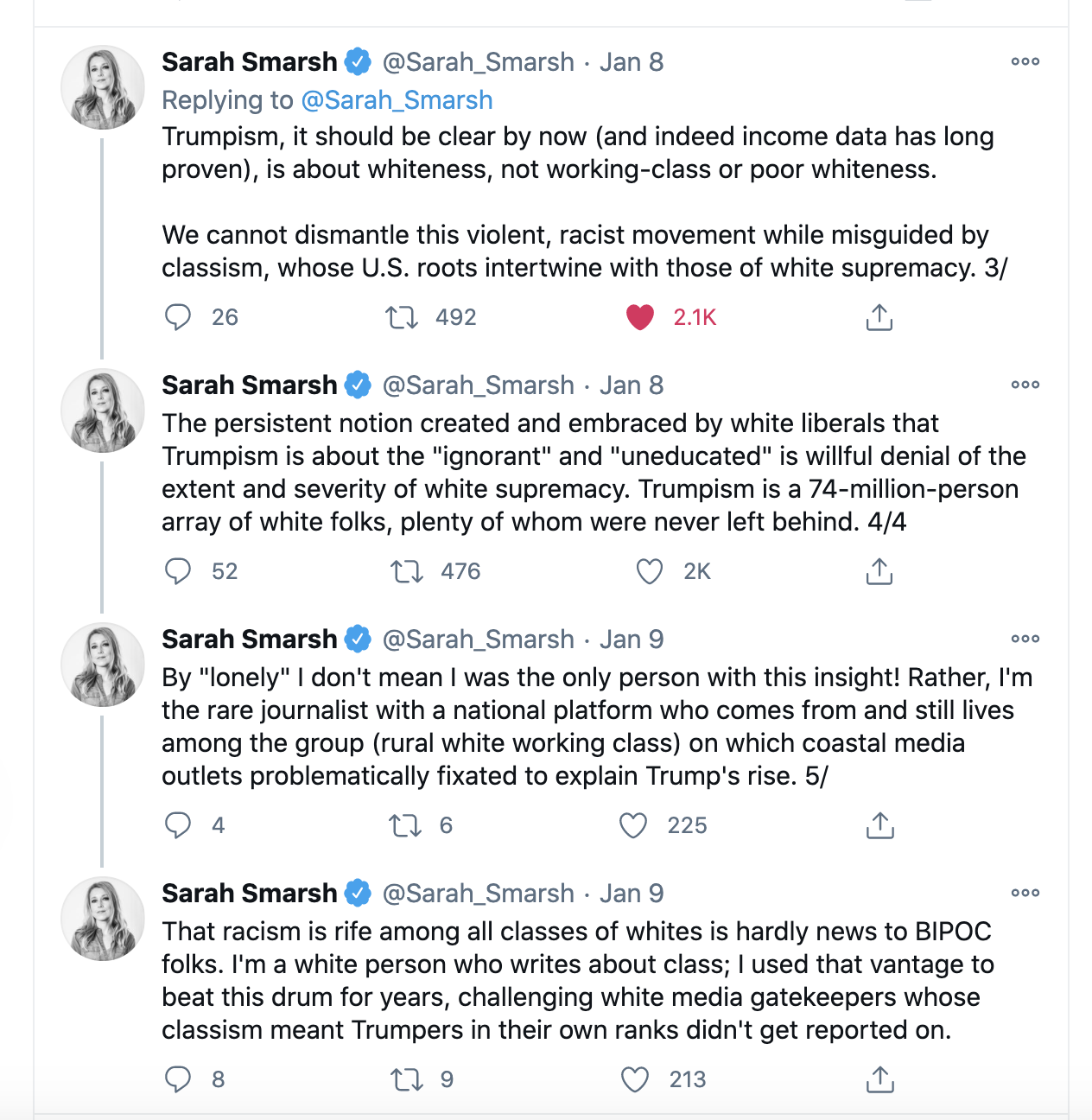
Here are some more Tweets about who the Capitol rioters were (along my responses to some of them): 


Screenshots taken January 8, 2021

Smarsh is the author of Heartland:  A Memoir of Working Hard and Being Broke in the Richest Country on Earth.  

Screenshot taken January 14, 2021


Screenshots taken January 12, 2021

Finally, here's a screenshot I've shared frequently in recent years; it's from the 2016 election exit polls broken down by income.  It shows that it is, in fact, those who might be called the "petit bourgeoisie," those who've gotten a leg up on the poor folks around them, who are most likely to oppose social safety net programs and support Trump.  The point is fleshed out in my scholarly writings and also illustrated here.  

Cross-posted to Working-Class Whites and the Law

Post script:  Here's a Washington Post story about how Washington insiders helped to organize the January 6 rallies that preceded the insurrection.   

Tuesday, January 12, 2021

Coronavirus in rural America (Part CXVI): Teachers in rural California district among first to get vaccine

EdSource reports from Mariposa County, where vaccinations of teachers and school staff began yesterday.  Diana Lambert writes: 

Teachers and school employees in Mariposa County are expected to be among the first of California’s 1.4 million teachers and other school staff to be vaccinated for Covid-19 when they roll up their sleeves for the shot on Monday. 

Half of the rural county’s school staff, 146 people so far, have signed up for the vaccination, said Mariposa County Health Officer Eric Sergienko. A team of nurses will travel from school to school to vaccinate those who have registered to receive the immunization.

All 15 schools in the county of 17,000 residents in the Sierra Nevada foothills have been back to in-person instruction since October. Although the county is in the red tier, which signifies a substantial Covid-19 infection rate, it is one of only four California counties that is not in the purple tier, the most restrictive status due to widespread infection rates.

* * * 

Mariposa County is able to move on to vaccinating teachers and others in Phase 1B because it has nearly completed vaccinating medical staff, who are in Phase 1A. Larger counties like Los Angeles are likely to take longer to begin vaccinating school staff because they still have many health care providers to vaccinate. Los Angeles County predicts it will be able to begin Phase 1B in early February.

I guess there's something to be said for rural agility.  A May story out of Mariposa County, which also put the sparsely populated county on the cutting edge, is here.  

Sunday, January 10, 2021

Local insurrection in far northern California parallels federal insurrection at Capitol

Hailey Branson-Potts reports from Redding, the most populous city in far northern California (north of Sacramento), under the headline, "A day before Capitol attack, pro-Trump crowd stormed meeting, threatened officials in rural California."  Here's an excerpt:

The rebellion that took place inside a government building in rural Northern California happened the day before the violent siege of the U.S. Capitol by supporters of President Trump.

The Shasta County Board of Supervisors had planned to meet virtually Jan. 5 because of an uptick in coronavirus cases. The supervisors’ chambers in Redding were closed. Seats had been removed. The public speakers’ microphone was disabled.

But, in protest, a newly elected supervisor unlocked the doors. In poured dozens of people, unmasked, to vent their fury. Three supervisors attending virtually watched from afar as threats flew amid the speeches.
Branson-Potts quotes Timothy Fairfield, 44 of Shingletown, population 2,222, east of Redding.  He asked the supervisors:  
When Joe Biden’s long winter sets and the dark night comes in this country, do you think you’re going to get to see the dawn?  No, you will not. Flee now while you can. Because the days of your tyranny are drawing to a close, and the legitimacy of this government is waning.

When the ballot box is gone, there is only the cartridge box. You have made bullets expensive. But luckily for you, ropes are reusable.
Wow!  Lots of prior Legal Ruralism posts discuss attitudes like these in the would-be State of Jefferson, including Shasta County.  

Friday, January 8, 2021

Coronavirus in rural America (Part CXV): More vaccine news

Efforts to get the coronavirus vaccine "into arms" has been a big story this week.  I'm going to briefly cover just a few of the news items I consumed on this topic.  

The Los Angeles Times reported Tuesday out of Mendocino County, California, population 87,841, where a freezer storing vaccines failed on January 4, 2021.  Anita Chabria reports under the headline, "Its freezer kaput, this NorCal hospital had two hours to give out 600 vaccine shots."  The hospital is in the county seat, Ukiah, population 16,075.

Here's an excerpt about the third of those doses that went to the county because they "belong to the county" and were merely being stored by the hospital.  Specifically they went to the county jail.   
Lt. John Bednar, who helps run the county jail, said his facility received 97 of those doses at about 1 p.m. The jail has been experiencing an outbreak, with about three dozen inmates out of 250 currently positive, he said. About a dozen staff have also fallen ill with the virus.

Faced with only an hour to use the shots, sheriff’s officials decided to administer them to staff and front-line personnel because they didn’t think there was enough time to gain consent and organize a safe protocol for inmates. Four county medical staff began giving the shots, said Bednar.

The story quotes Bednar regarding when the vaccines arrived: 

I was like, ‘Oh, boy, let’s get going.'  I think it went as well as it could.

NPR reported today on how well the immunization scheme is going in one rural Colorado town.  Kirk Seigler reports from Oak Creek, population 844.  He quotes Gene Bracegirdle, a firefighter and EMT in training, who is pleased to have just gotten the shot:  

The fact that it is here is kind of mind-blowing, like, they care enough to reach out to the rural communities. ... It's exciting to see the initiative being taken.  

The story acknowledges the spatial challenges in such places: 

The vaccine arrived in Oak Creek via a blue igloo cooler in a new mobile clinic set up by the local Routt County health department. Officials used CARES Act money to get things going. The task at hand is huge. Health officials must distribute the shots to a population of about 25,000 people spread across 2,300 square miles of northwest Colorado.

Another story yesterday commented on what West Virginia, popularly thought of as a rural state, is doing well in terms of vaccine distribution and immunization.  Yuki Noguchi reports from Morgantown, West Virginia.  She explains that CVS and Walgreens pharmacies, which the federal government has engaged to help with vaccine distribution to long-term care facilities, are not common in West Virginia.  Thus the state has had to look elsewhere for partners in its vaccine roll-out.  Noguchi quotes a pharmacist and clinical professor at West Virginia University, Gretchen Garofoli:  

We have a lot of independent pharmacies or smaller pharmacies that are in the more rural communities, so in order to get the vaccine out to some of those areas, we needed to follow something a little bit different.

The story continues: 

Many long-term care sites in the state already use local pharmacies for other vaccines and medicines as well as twice-weekly coronavirus testing of residents and staff. The state decided to piggyback off those existing relationships. Because those pharmacies already had data on many patients, it was easier to begin scheduling appointments in early December, securing consent forms and matching doses to eligible patients — logistics that are confounding efforts in many other states.

This story in particular features a rural lack-of-anonymity, reliance-on-community angle. 

Saturday, January 2, 2021

Coronavirus in rural America (Part CXIV): Are rural states doing a better job at getting folks vaccinated?

This map, a screen shot from the New York Times, suggests "rural states" (a term I've often ridiculed) are doing better with vaccination logistics.  The darker states are those where a larger share of the population have gotten vaccinated.  That outcome is counterintuitive to me.   

Here's an excerpt that mentions some states popularly thought of as rural, but which does not explicitly mention rurality.

Some states, like Alaska, North Dakota and Utah, are supposed to receive supplements for tribal governments that have elected to receive their vaccines through the state, rather than through the federal Indian Health Service.

According to the federal data, West Virginia, North Dakota and South Dakota had administered the most doses per capita among states, and Kansas had administered the fewest.

P.S.  An NPR Morning Edition segment on January 5 specifically noted that some rural states are doing a better job at rolling out the vaccine and getting it into arms.   

Friday, January 1, 2021

Rural China garners NYT front-page story about the nation's costly investment in persistent, deep poverty

Keith Bradsher reports under the headline, "Jobs, Houses and Cows: China’s Costly Drive to Erase Extreme Poverty."  The subhead: "China has spent heavily to help its poorest citizens, an approach that few developing countries can afford and even Beijing may struggle to sustain."

Here's the lede:  

JIEYUAN VILLAGE, China — When the Chinese government offered free cows to farmers in Jieyuan, villagers in the remote mountain community were skeptical. They worried officials would ask them to return the cattle later, along with any calves they managed to raise.

But the farmers kept the cows, and the money they brought. Others received small flocks of sheep. Government workers also paved a road into the town, built new houses for the village’s poorest residents and repurposed an old school as a community center.

And here are the implications for a country where "a migrant worker in a coastal factory city can earn as much in a month as a Gansu farmer earns in a year":  

The village of Jieyuan is one of many successes of President Xi Jinping’s ambitious pledge to eradicate abject rural poverty by the end of 2020. In just five years, China says it has lifted from extreme poverty over 50 million farmers left behind by breakneck economic growth in cities.

But the village, one of six in Gansu visited by The New York Times without government oversight, is also a testament to the considerable cost of the ruling Communist Party’s approach to poverty alleviation. That approach has relied on massive, possibly unsustainable subsidies to create jobs and build better housing.

The high price and lack of sustainability are clues to why the United States government is unlikely to make a major investment of this sort, if not in cows, even in housing and jobs.  

The story quotes Martin Raiser, the World Bank's country director for China, 

We’re pretty sure China’s eradication of absolute poverty in rural areas has been successful — given the resources mobilized, we are less sure it is sustainable or cost effective.

The total cost of the program, thus far, is $700 billion in both loans and grants, over five years.  And that doesn't count "large donations by state-owned enterprises like State Grid, a power transmission giant, which put $120 billion into rural electricity upgrades and assigned more than 7,000 employees to work on poverty alleviation projects."

Here's more on what's happening in some rural reaches of China's Gansu province, with quotes from various residents: 

According to the government’s complicated criteria for determining eligibility for aid, anyone who owned a car, had more than $4,600 in assets or had a new or recently rebuilt house was excluded. People hovering just above the government’s poverty line continue to struggle to make ends meet, but are often denied help with housing or other benefits.

* * *
The party’s campaign-style approach also fails to tackle deep-seated problems that disproportionately hurt the poor, including the cost of health care and other gaping holes in China’s emerging social safety net. Villages provide limited health insurance — only 17 percent of the cost of Mr. Jia’s arthritis medicine is covered, for example. Hefty medical bills can ruin families.
* * *
Despite the challenges, the poverty relief program may have a long-term political benefit that helps to ensure some of it survives. Gratitude for the program seems to be reinforcing the political power of the party in rural areas.

In Youfang, Mr. Zhang was quick to praise not just the poverty program but also Mr. Xi, comparing him to Mao.

“It is good for the country to have Xi Jinping,” he said, “and the national policy is good.”

That's an interesting twist since neither major party in the United States seems to care much about the rural vote, though one party certainly pays more lip service than the other to rural voters.  

By the way, the print headline for this story, which appeared below the fold, was different, "Free Cows?  China Wages War on Rural Poverty."    That language is reminiscent of LBJ's "War on Poverty" from the 1960s.