Saturday, March 12, 2022

GOP candidate for Governor of California launches series of campaign videos, the first with a focus on agricultural roots

I wrote a few weeks ago (here and here) about State Senator Brian Dahle's campaign for the GOP nod for Governor of California.  On Monday this week, Dahle launched a series of campaign videos with this, which focuses on Dahle's--and his family's--decision to make the run, a real David and Goliath contest based on relative campaign funds on hand.  The video is titled "Brian Dahle:  Road to Change:  Episode One," and as of this morning, it has been viewed 717 times.  Forty-two likes and no dislikes have been registered.  The Brian Dahle for Governor channel has 54 followers, and nine folks have commented on the video.  
Screenshot taken 8:15 am on March 12, 2022

Themes I saw in the video: 
  • Focus on his family, including the candidate's two sons and a daughter.  Dahle's wife Megan is the Assembly Member for a district that significantly overlaps with her husband's Senate District.  One son introduced Dahle at the announcement of his candidacy for Governor.  Another son, Chase, is said to be looking after the farm as Dahle and the rest of the family are away campaigning.  The daughter, referred to as Ros or Roz, looks about the age of tween or young teen.  
  • The campaign announcement took place in Redding, California with a seemingly small crowd present.  Redding, the county seat of Shasta County, is the largest city in the region Dahle comes from (far northern California) and probably the largest city in the district he represents.  That said, Dahle's district is huge, the largest in land area among state senate districts, and includes the area where I live, a suburb of Sacramento called Fair Oaks.  
California State Senator Brian Dahle's Office
in Gold River, California, a Sacramento suburb  
  • A contrast between rural and urban. We see Dahle leaving an urban house--presumably where he and his wife live while in Sacramento--and traveling to his home in Lassen County, where he farms and has a seed company in the tiny town of Bieber.  We see several shots of him driving in his pick up truck, including on an interstate--presumably I-5, which would link his homes in Bieber and Sacramento. I couldn't help think how much money he is spending on gas these days--and also how he seemingly could afford to move to an electric vehicle were he so inclined.  Dahle also talks about how much more he is motivated to be farming than to be in Sacramento working as a legislator.  I wonder if that is a message that works--one he wants to convey when he is running for Governor and will need to be in Sacramento and elsewhere in the state dealing with things other than farming.  
  • And, of course, Dahle talks about things that aren't going well in California, such as the migration of folks away from the state.  Dahle expresses concern about lack of opportunity in the Golden State.  
Meanwhile, I thought this was an interesting Tweet from the Capital Public Radio (Sacramento) program director, previously a political reporter for the organization.   

Adler, the journalist, seems to be contrasting Dahle with Larry Elder, the top GOP vote getter in the failed gubernatorial recall election last fall. 

Postscript:  The Los Angeles Times published this story today referring to Dahle and another (an independent) who is challenging him as "little known."  Here's the paragraph about the two men challenging Newsom: 
The field of candidates currently challenging Newsom includes Republican state Sen. Brian Dahle, a conservative, seasoned politician from Northern California, and independent candidate Michael Shellenberger, a longtime activist on energy and homelessness issues. Dahle has never run for statewide office and Shellenberger, who supported Newsom’s recall, ran for governor in 2018 as a Democrat and was backed by less than 1% of California voters.

Friday, March 11, 2022

The latest on the Klamath (California) water wars, from local journalists

From the Bill Lane Center for the American West, "As the Klamath Basin’s water crisis worsens, local journalism explores a way forward."  The subtitle is:  "With grant support, a Klamath Falls, Oregon, newspaper sought “kernels of solutions” for a divided community’s problems with drought and resource depletion. The lead reporter reflects on his experiences."  

Here's an excerpt:  
Water Year 2021 was, by many accounts, the worst the Klamath Basin had experienced in modern history. Water Year 2022 might give it a run for its money. Climate change is a big contributor — a recent study showed that, with the help of 2020 and 2021, the West’s current megadrought is the worst in 1,200 years. Warming temperatures were responsible for about a fifth of that intensity.

* * *  

Last summer, the Klamath became the ugly face of climate change in the dry West. Farmers in the federally managed Klamath Irrigation Project went without water for the first time ever. Thousands of baby salmon died of disease while C’waam and Koptu, two ancient species of suckers in Upper Klamath Lake, inched closer to extinction. Birds skipped their ancestral rest stops on the Pacific Flyway as 95 percent of the basin’s remaining wetlands dried up. When cooperation between stakeholders was never more crucial, anti-government activist Ammon Bundy threatened to show up and wreak havoc.

News crews flocked to the remote basin to cover what appeared to be Ground Zero for the new round of water wars. I saw countless pieces by reporters trying to wrap their heads around the situation’s dizzying complexity. Lacking space and time to tell the full story, some picked sides. Solutions are seldom as newsworthy as conflict.

Having joined the Herald and News in Klamath Falls as part of the Report for America service journalism corps, I had received a grant that spring from MIT’s Environmental Solutions Initiative to produce reporting on climate change impacts and solutions in my area. My challenge was to frame this climate-driven crisis, which magnifies the basin’s existing water woes, as an opportunity.

So I described the kind of clothes the Klamath would need to survive. A thick cloak with fabric made of wetlands would wick winter moisture and temper summer thirst. Sturdy boots of scientific inquiry and traditional knowledge would provide stability over shifting sands and soils. Everything would be held together by the stitches of collaboration among diverse communities.

Don't miss the rest of the story.  

Thursday, March 10, 2022

The move from urban to rural California as a cost-saving, survival measure

This story appeared in the Los Angeles Times this week under the headline, "L.A. sank them into debt. Will this family find a better life in rural California?"  It is the story of immigrants from Mexico who left  Los Angeles for Huron, population 6,754, in the Central Valley.  They made the move, in part, because they were not able to get ahead and, in fact, were sinking further into debt.  Here's an excerpt from Alejandra Reyes-Velarde's poignant story:  

While some urban dwellers fled to less crowded regions during the pandemic, working-class immigrants have largely stayed put, tied to jobs that required them to show up in person, as well as the extensive social networks of the big city.

Puebla, 44, is among the relatively few who have left, turning away from Los Angeles, long a beacon for immigrants from Latin America and Asia.

People questioned the decision. What would the kids do for fun? They might not have the same shot at success.

But Puebla and her husband decided that Huron held more opportunity.

* * * 

For a decade, Puebla’s family got by mostly on her husband’s salary. She managed their apartment building in exchange for cheaper rent — $1,000 instead of $1,700 for a similar two-bedroom unit.

The rent inched higher, along with gas.

The pandemic pushed them closer to the edge. With repairs inside apartments put off to avoid transmitting the virus, Cabrera’s hours were cut. Their debt skyrocketed to more than $25,000.

The kids — three boys and a girl, ages 9 to 17— grew restless and bored with Zoom school and few chances to leave the house. Puebla did what she could to entertain them.

Recently, more homeless people were walking through the neighborhood. There was an uptick in shootings, and two cars were set ablaze.

Eliazer Cabrera, Puebla's husband, got an offer to manage an apartment complex in Huron; they had previously visited the area for quail hunting.    

The family didn’t hesitate. Puebla believed the job offer was a sign from God. The apartment complex was just a few years old, and they would get a three-bedroom unit at no cost.

The rest of the story is about how things went after the move.  Turns out, the grass was not necessarily greener in Huron.  Read this excellent story for the details, including some common complaints about rural living.  Particularly striking to me are the complaints about the Huron and other Fresno County schools--and details about how the cost of travel for necessities drives up the overall cost of living in a rural places.  

Other posts about (or at least mentioning) Huron, California are here.        

Wednesday, March 9, 2022

Why rural college graduates go home

Stephanie Sowl wrote in The Conversation yesterday.  Sowl reports that the rural brain drain trend is reversing and provides these details 

To find out what might be prompting some college graduates to return to their rural hometowns later in life, we conducted a study using national data on the well-being of adolescents into adulthood to look at why people who grew up in rural places decided to return. Specifically, we took a look at whether their middle and high school experiences had any connection to their decision to return home in their late 30s or early 40s. We considered only those individuals who had gone at least 50 miles away to complete a bachelor’s degree. We found three factors that contributed to college graduates coming back home.

1. Tight-knit school communities
We found that the more students enjoyed school and felt as if they belonged, the more likely these college-educated adults from rural areas returned home. Even after considering demographic, neighborhood and college characteristics, positive middle and high school experiences remained significant. This demonstrates the lasting value of supportive teacher-student and peer relationships.

This is consistent with other research that has found college graduates who return had roots that made them feel grounded in their rural hometowns.
2. Fewer people and more land
College-educated people from smaller towns or open, undeveloped land were twice as likely to return home as people who grew up in slightly larger rural towns.
3. Contributing to their communities
College graduates who grew up in rural communities where relatively few people went to college were more likely to return home than those from communities with more college-educated adults.
Read the entire essay here.   

Monday, March 7, 2022

Recalling local government officials: A rural-urban comparison (Part III: Shasta County)

The recall of a member of the Shasta County (California) Board of Supervisors was very much in the news last month, and one weighty word was used in nearly all of the headlines I saw about the matter.  See if you can identify it:  


The KQED (San Francisco, public radio) headline was "A Militia-Led Recall Is Targeting a Shasta County Supervisor – Who's a Republican." 
 . 

Then just today, the Washington Post weighed in with "How far-right militia groups found a foothold in deep-blue California."

The momentous word, of course, is "militia."  We see "militia-aligned," "militia-backed," "militia-led" and "far-right militia groups."  But these stories generally do little to dig down on the nature of the militia.  What exactly is this militia?  How big it?  What has it done?  How big a physical threat is it?  I thought the best job in that regard is from this Los Angeles Times story from last summer, when the recall effort was initiated. That story's headline was "Threats, videos and a recall: A California militia fuels civic revolt in a red county"--so again the word militia was used.  

I blogged about that story at the time, but now I want to highlight what the story told us about the militia in an effort to get a sense of how seriously it should be taken.  LA Times journalists Hailey Branson-Potts and Anita Chabria describe Carlos Zapata, of the so-called Cottonwood militia (Cottonwood being the town where he lives, south of Redding, the seat of Shasta County) as a "high-profile militia member and a leader in a movement to recall a trio of Republican Shasta County supervisors who supported Gov. Gavin Newsom’s pandemic health orders."  

The story describes how Zapata threw a drink at a man named Pinkey, a Black Lives Matter supporter, who had been "making political parody videos of Zapata."  
Soon after the two saw each other, Zapata threw a drink at Pinkney, according to police. It escalated from there. That night, the BLM activist ended up with a black eye after two associates of Zapata allegedly assaulted him at the rear entrance of the restaurant while Zapata was present, according to police and interviews with people involved.

While the events of May 4 are disputed, the altercation involving Pinkney and Zapata has intensified tensions in this Northern California town. ... Shasta County residents [are] divided over the health risks posed by the pandemic, government’s power and the degree that armed citizenry should take matters into their own hands.
* * *
Speakers at supervisors’ meetings have repeatedly threatened violence, militia members have attended racial justice rallies carrying concealed weapons and opponents of the far right say they are increasingly afraid to speak out, fearing retribution.

Zapata has been at the center of this fray, becoming a literal “poster boy” for a media campaign that hopes to redirect the energies of Trump supporters into local politics, and spread civic revolt nationwide.

Zapata, a 42-year-old Marine Corps combat veteran, made his viral debut in August. At a Shasta County supervisors meeting, he warned of potential violence if elected officials did not drop pandemic health restrictions. “It’s not going to be peaceful much longer. ... Good citizens are going to turn into real concerned and revolutionary citizens real soon,” he warned.

Pinkney and his supporters say they’ve long cautioned that militia members could turn their threats into action, and are watching to see how authorities will now respond.

And here's more on the nature of the "militia." 

South of Redding, residents formed the Cottonwood militia more than a decade ago when five local businesses in the town were robbed on five subsequent nights, according to one of the group’s founders and leaders, Woody Clendenen. It has since grown from 11 members to a sizeable political force, including Zapata, with an increasingly savvy media reach across Northern California and beyond.

Its members are well-known in the community, offering a scholarship each year, hosting a boys’ camp, and sometimes being called in lieu of the police, said Clendenen.

“It grew into almost kind of a political action committee,” said Clendenen, a Cottonwood barber and bit actor in Hollywood B-movies. Candidates for office would call and court militia members for support, he said. Before the pandemic, he said, “our fundraiser dinners, the sheriff and the supervisors come.”

* * *  

During the pandemic, Shasta County Sheriff Eric Magrini made clear he would not enforce restrictions on businesses. Even so, the mandates became a rallying cry in Shasta and other counties statewide as “patriot” groups claimed their liberties were being trampled. Driven by that outrage, the Cottonwood militia has also backed efforts by an unaffiliated group to recall three conservative supervisors and replace them with like-minded “constitutionalists,” using videos to target elected leaders and “snitches” suspected of reporting businesses defying coronavirus restrictions.
In a video last year, Clendenen and Zapata issued a warning to those who informed on businesses defying health orders.

“Don’t think we are going to forget who you are because we are not going to. We know who you are,” Clendenen says in it, while he is seen sitting next to Zapata.

Zapata continues, saying his group is also collecting “intelligence.”

“We also have people on the streets. We know where you live. We know who your family is. We know your dog’s name,” Zapata says. “So if you think for one second that we are going to let you spy on us without us doing our due diligence and spying on you, you are absolutely wrong.”

* * *

“We’ve been accused of being insurrectionists and domestic terrorists, and calling for violence. No. All we’ve ever done is talk about the reality of, violence can happen if we fail,” Zapata said.

Critics say they are trying to have it both ways, claiming they are nonviolent even as they blast out incendiary messages around the recall and the pandemic.
Today's Washington Post story by Scott Wilson tells us this about the militia:  
The far right is rising in the ranchland of Northern California, using special elections and veiled intimidation to spread political influence across a historically conservative region of this deeply liberal state.

The movement is rooted here in Shasta County and includes the support of a roughly decade-old militia.
* * * 
What the movement will do with its increasing power remains unclear. But, just as it has across the country, its leaders have pushed against public health mandates and brought a sharp edge to once-civil local politics. Members, backed by the militia, have paid particular attention to Black activism, gun rights and rules preventing businesses from operating as they have wished. Homeless programs are also on the block.

The architect is Carlos Zapata, a retired Marine, militia member and restaurateur who raises bucking bulls on his ranch just outside this city, a hub of what locals refer to as “the north state.” Zapata filmed and podcast much of the recall campaign. He called his project “Red White and Blueprint,” a pointed invitation to neighboring conservative counties and others across the west to follow suit.

“This is a weird pie we’ve baked and I’m still trying to figure out exactly what the flavor is,” Zapata said during a recent interview in his light-filled living room on his ranch about 10 miles east of this city. “But we’re going to keep documenting this and look to help others because all government for us right now is local.”
* * *
A frontier ethic prevails among many here, and that explains in part why the region is out of sync with the state’s prevailing strictness on gun control.
Then there is this interesting factoid:
More than 12,000 residents of Shasta County, population 182,000, have conceal-carry permits. Local officials say that is among the highest proportions of any county in the state.

As for whether Zapata is peace-loving or not, journalist Wilson notes mixed signals:  

“Right now we’re being peaceful,” Zapata told the board in August 2020, his first appearance in the chambers. “But it’s not going to be peaceful much longer.”

The comments made him the face of the movement, even though “Recall Shasta” emphasizes that the grass-roots work was done primarily by “moms and grandmoms.”
* * *
Last August, as an increasing number of Shasta residents were reporting businesses breaking state pandemic rules, Zapata appeared next to Woody Clendenen, who heads the local militia and who referred to those notifying authorities as “ratting” out their neighbors.

“Go move off down to San Francisco,” Clendenen said. “Or somewhere where your kind live because I don’t want you here.”

The story then repeats the language quoted in the Los Angeles Times story from the Zapata/Clendenen video--the one that warns they know where informants live, they know the names of informants' dogs.  Wilson concludes:   

The remarks, coming amid the recall effort, were chilling.

So, you be the judge:  is the focus on "militia" in these stories' headlines sensationalizing?  Or is this so-called militia in Shasta County--with perhaps 10 members--actually a threat?  Are they all hat and no cattle, to use an old expression?  or at least more hat than cattle?

And how should we think about what happened in Shasta County--metropolitan, though the surrounding area is often thought of as "rural"--in relation to the recall of three school board members in San Francisco a few weeks later?  Is one more shocking than the other?  Both arose in relation to pandemic restrictions and conditions, but are the underlying motivations of one recall more rational than the other?  Is the underlying behavior of some of the recalled officials more problematic than others?  

Two enlightening 2018 Los Angeles Times stories about Shasta County's politics are here and here. 

Sunday, March 6, 2022

Why not to move to rural America

Last week, this blog featured a New York Times story about the travails and trauma of city dwellers who moved to "the country" to ride out the pandemic.  It was a well-done story with lots of quotes that I found funny--quotes about things like hurting one's back while weed whacking.  It also talked about structural deficits in rural areas--things like the lack of childcare.   In sharp contrast, Inc. Magazine has published online "7 Reasons to Avoid Going Rural to Work from Home."  It's chock full of stereotypes and frankly quite offensive.  Here's the list:  
  1. Guns
  2. Trucks
  3. Food
  4. Nightlife
  5. Culture
  6. Education 
  7. Bugs
Here's an excerpt from what author Geoffrey James says about trucks:
Pickup truckers were a**holes before the pandemic; since 2020, they've become intolerant and intolerable.
And here's what James says about culture:
There's an art show at the town hall if you ever feel compelled to reassure yourself that the Bob Ross school of painting is still as influential as it was in the 1970s.

This is so crude as to read like a parody, but it appears not to be that.  I wasn't familiar with Inc. until this list came across my Twitter feed.  Here's what Inc's wikipedia entry says:  

Inc. is an American business media property founded in 1979 and based in New York City. It publishes six print issues annually, as well as daily online articles and videos. Inc. also produces several live and virtual events yearly.

Published by Mansueto Ventures, Inc. is best known for its annual rankings of the fastest-growing privately held companies in the United States, called the "Inc. 500" and "Inc. 5000."

Saturday, March 5, 2022

Are findings of disability in rural areas on the decline?

The headline in the Athens (Georgia) News Courier is, "Disability claims challenging in rural areas; data shows low approval rates."  The story is from last October, though it just showed up in my Twitter timeline yesterday.  Here's an excerpt:  
Getting approved for disability payments from the Social Security Administration isn't easy, but depending on where you live, it could be even harder.

In North Alabama, for example, three of the judges who hear disability claims have the lowest approval record of any administrative law judge in the state; two of them also have among the lowest approval rate of any of the 12,000 judges nationwide.

In 2020, 39% of initial disability applications were approved nationwide, according to SSA data. August 2021 data shows that Alabama has the fourth lowest disability claim approval rating — 32.3% — while nationwide data shows a 41.7% approval rate.

Receiving disability payments isn't easy to begin with and that's by design. In the past decade, the Social Security Administration has changed the regulations to make it harder to get disability claims approved.

Social Security has a tight definition of disability: "the inability to engage in substantial gainful activity (work) due to a medically determinable physical or mental impairment that has lasted or is expected to last at least one year or to result in death," said Patti Patterson, regional communications director for the Atlanta region Social Security office, which represents Alabama and seven other Southern states.

The Social Security Disability website lists a range of impairments and disorders that could qualify for disability including mental, respiratory system, immune system and cardiovascular system if it is deemed through medical records to be severe enough to prevent one from working. 
Many disability applicants think they'll only need a letter from their doctor saying that they need to be on disability. Not only has it never been that simple, but in 2017, the Social Security Administration made it even easier to dismiss the recommendation of doctors by allowing denial due to the doctor's specialty, and length of treatment and type of treatment, among other factors.

Rachael Henderson of Georgia Legal Services Program, which represents disability clients in 155 counties outside of metro Atlanta, said access to transportation has been a longstanding barrier in rural counties where its clients have tried to get disability.

“In rural areas you will frequently not have any physicians. Over the last few years in some of our rural areas, in one or two counties, they lost the hospitals,” she explained. “You have to get to a city of significant size in order to get to a physician."

You'll find lots of other posts about disability determinations in rural places, and associated issues, here.  Certainly, this article flies in the face of the assumption that it is easier to get adjudicated as disabled in rural America than in urban America.  Specifically, here is a post focused on disability and transportation, in the context of New York.  And this is from a Washington Post series in 2017.  

Friday, March 4, 2022

Coronavirus in rural America (Part CLXXVIII): On farm shows and county fairs, than and now

Mendocino County Fairground, Boonville, California
February 2022
St. Louis Public Radio ran this story a few days ago, about how farm shows have changed as a consequence of the pandemic, with reporting by Jonathan Ahl.  Here's an excerpt: 
JONATHAN AHL, BYLINE: Dozens of farmers and their families are walking among the giant combines, tractors and other farm equipment that can cost up to a half a million dollars each. This is the scene at the Ag Expo in Sedalia, Mo. Local corn and soybean farmer Bill Taylor loves it. He says it's a low-pressure way to check out a lot of different things.
Mendocino County Fairgrounds, Boonville, California
February 2022
BILL TAYLOR: If you want to talk to a guy, you can. If you want to walk by, you can. And that's what we like about - there's a little bit of everything here. I mean, we got anything from siding to gutters to tractor tires, fertilizer buggies, livestock equipment.

AHL: Like most farm shows, this one was canceled last year over COVID concerns. This year, it's back in full force. But some farm shows across the country canceled again, and others just went online. Danny Young is a rural banker who loans to farmers and is on the planning commission of Sedalia's farm show.

DANNY YOUNG: A lot of farmers - they're hands-on kind of people. They don't really want to sit in front of a computer or something and do it virtually. They want to get out of the house. They want to go to town. They want to touch the machinery. They want to talk to the people. And it's not a real virtual clientele.

AHL: But many in the ag business think virtual connections might be the future and the in-person farm show doesn't have much life left.

JIM MANDES: We were well on this path, and just COVID kind of proved the point to a lot of people.

AHL: Jim Mandes is a sales manager with Krone, maker of machines for hay production like mowers and balers. He says with consolidations every year, there are fewer farmers to sell to, and most are tech savvy enough to research big purchases on their own.

MANDES: They know more about what they're buying than they did 20 years ago, 10 years ago, three years ago. The relevance of a trade show - physically seeing machines and talking to reps - is not what it once was.

AHL: While businesses may be looking for more bang for their buck at farm shows, the towns that host them say the money is only part of the narrative. They say the shows are just as much about community, identity and a full embrace of the farming lifestyle.
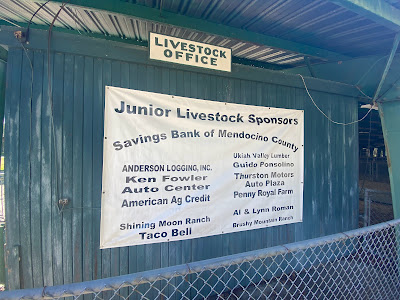
Yes, I know a farm equipment show and a county fair are not the same thing, but it reminded me of this story from the Christian Science Monitor, way back in 2017, about county fairs.  The dateline is Craig, Colorado, in Moffat County, and the headline is "A County Fair Offers Pie--and a Window on the Rural-Urban Divide."  An excerpt follows: 

Mendocino County Fairground, Boonville, California
February 2022
Editorials and politicians struggle to explain the polarization of this country. On the East and West fringes of America, and the scattered blazes of urban areas in between, each news flash from the White House is parsed and plumbed for meaning.

Better, perhaps, to stop to watch at this small country fair tucked in the northwest corner of Colorado. This is Trump country. And coal country. It’s a place where ranchers and miners and wheat farmers with hard hands keep to harder politics.

None of that’s on the agenda of the two-week fair, a homey event with no carnival rides, but a rodeo on Friday night and three metal barns for exhibits. Folks in the sagebrush hills of this rural county of 12,000 say they feel little connection with the great urban beehives. Their evidence for that is at the fair, in scenes that have nothing to do with politics.
You really need to read this entire story to get a feel for how deeply engrained these cultural practices are.  You get that sense from reading about the kids taking care of and raising their animals for show.   And that reminded me of these scenes, which I recently photographed in Boonville, California, home to the Mendocino County Fair.  It's interesting to see the focus on wool and lambs there given that I didn't see a lot of sheep, though I did see sheep grazing among the vineyards the last morning I was there, before the sun was high in the sky.  I regret not getting a photo of those sheep in that vineyard (by Lichen Estate, I might add, between Boonville and Philo) because when I passed back through as the fog was lifting, the sheep were gone.   
Mendocino County Fairgrounds, Boonville, California
February 2022
Mendocino County Fairgrounds, Boonville, California
February 2022


Thursday, March 3, 2022

Policy brief on how prosecutors should handle intimate partner violence in smaller jurisdictions

Maybell Romero, Jon Tunheim and Chantelle Williams have published a policy brief with the Institute for Innovation in Prosecution at John Jay College, which has a new series called the "Beyond Big Cities Initiative."  The title is "Intimate Partner Violence:  A Best Practice Guide for Prosecutors in Smaller Jurisdictions."  Here's the Introduction to the brief, which is available in full here.  
Intimate partner violence (IPV) impacts people irrespective of income, education, and geography. In the United States, one in five homicide victims are killed by an intimate partner, and over half of female homicide victims are killed by a current or former male partner. Over 10 million women and men continue to experience IPV each year. 
IPV is an age-old social concern that continues to torment millions of people across the nation. With this sobering reality in mind, the IIP’s Beyond Big Cities members came together to discuss their experiences with IPV cases. These conversations highlighted successful approaches to combating IPV in smaller communities, revealed unique challenges that rural communities face relating to IPV, and explored innovative responses to IPV. This document provides a survey of IPV prosecution in smaller jurisdictions, particularly rural ones, based on research and information that Beyond Big Cities members provided to the authors.
The brief closes with a checklist for developing a family justice center in a smaller jurisdiction.  

My own work on domestic violence in rural contexts is here and here.  The former is cited in this new policy brief, though my own work is now quite outdated (from 2008 and 2007).  

Wednesday, March 2, 2022

LA Times story explains why FEMA denies assistance to California wildfire victims

Alex Wigglesworth reported yesterday for the Los Angeles Times under the headline, "These wildfire survivors say FEMA did little to help those who lost homes."  An excerpt, about denials of assistance to victims of the Caldor Fire, primarily in El Dorado County, follows:  
FEMA said it considered multiple factors before denying aid, including the destruction of homes and infrastructure, residents’ insurance coverage and income levels and the fiscal resources of the state. It determined the Caldor fire “was not of such severity and magnitude to warrant the designation of the Individual Assistance program,” spokesman Victor Inge wrote in an email.

But residents of Grizzly Flats, a rural community in the western Sierra Nevada where the fire destroyed an estimated two-thirds of the housing stock, along with the town’s water system, say that makes no sense. They fear the government’s calculations were skewed by wealthy neighboring areas such as El Dorado Hills and Lake Tahoe, obscuring the true reality of the fire’s impact.

“Just because we reside within the borders of El Dorado County doesn’t mean we are rich,” Tyler said.

The California Office of Emergency Services agreed in a letter appealing the denial, pointing out that predisaster unemployment in Grizzly Flats was more than four times the national rate.

* * * 

FEMA’s Individuals and Households Program provides for grants totaling up to $75,800 to assist uninsured or underinsured disaster survivors with things such as home and vehicle repairs and replacement, medical expenses and the replacement of personal property. The agency also offers rental assistance on which there is no cap.

In order for residents to be eligible, the governor must request the assistance and the president must approve it. The White House bases its decision on a recommendation from FEMA, representatives said.

FEMA, in turn, forms its recommendation based on the Stafford Act of 1988, which dictates how the U.S. government responds to disasters, and the Code of Federal Regulations, which spells out the criteria for evaluating a governor’s request for a major disaster declaration.

The principal factors are the amount of uninsured home and personal property losses and the fiscal capacity of the state in which the disaster took place, which are calculated as a ratio. The higher the estimated cost of providing assistance and the lower a state’s total taxable receipts, the more likely a state is to be approved for assistance.

That puts California at a relative disadvantage from the start, as its economy is larger than any other U.S. state and most countries.

Other posts about the Caldor Fire, which raged for more than a month starting about an hour east of where I live in Sacramento and burning another hour's drive to the South Lake Tahoe basin, are here and here.  Other stories about California's wildfires are here.  A policy brief about legal issues facing California disaster survivors, with a focus on rural folks as wildfire victims and their FEMA claims, is here.  

Tuesday, March 1, 2022

On rural resentment and pain, and its link to the trucker strike

I am a huge fan of Thomas Edsall, who writes regularly for the New York Times, but I missed this column earlier this month until today.  The headline is provocative, "There's a Reason Trump Loves the Truckers."  As is typical of Edsall, he marshals recent academic research on a topic.  You have to get pretty deep into this column to get to the rural part of this one, which otherwise focuses on class and regional inequality, but I'm just going to highlight below those rural bits.  The rural bits, by the way, could also be framed as regional inequality.  
I asked Rodríguez-Pose whether the truck protests in Canada are a harbinger of future right-wing populist protests, and he pointed to developments in France in his emailed reply:
In France, the phenomenon of the “gilets jaunes” (or yellow vests) is clearly an example of the “revenge of the places that don’t matter.” This is a movement that emerged as a result of a severe hike in diesel taxes in order to pay for the green transition. But this was a decision that many people in small town and rural France felt imposed significant costs on them. These are people who had been encouraged just over a decade before to buy diesel cars and, in the meantime, had seen their public transport — mainly buses and rail lines — decline and/or disappear. Most of them felt this was a decision taken by what they consider an aloof Parisian elite that is, on average, far wealthier than they were and enjoys a world-class public transport system.
The pitting of a populist rural America against a cosmopolitan urban America has deep economic and cultural roots, and this divide has become a staple of contemporary polarization.

“Urban residents are much more likely to have progressive values. This result applies across three categories of values: family values, gender equality and immigration attitudes,” Davide Luca of Cambridge University; Javier Terrero-Davila and Neil Lee, both of the London School of Economics; and Jonas Stein of the Arctic University of Norway write in their January 2022 article “Progressive Cities: Urban-Rural Polarization of Social Values and Economic Development Around the World.”

* * * 
Luca and his colleagues emphasize the divisive role of what Ronald Inglehart, a political scientist at the University of Michigan who died last year, called the “silent revolution” and what Ron Lesthaeghe of the Free University of Brussels describes as the “second demographic transition.”

Citing Inglehart, Luca and his co-authors write:
when people are secure, they focus on postmaterialist goals such as “belonging, esteem and free choice.” The possibility of taking survival for granted “brings cultural changes that make individual autonomy, gender equality and democracy increasingly likely, giving rise to a new type of society that promotes human emancipation on many fronts.”
The urban-rural conflict between postmaterialistic values (shorthand for autonomy, environmental protection, sexual freedom, gender equality) and more traditional values (family obligation, sexual restraint, church, community) is most acute in “high income countries,” they write. This suggests, they continue, “that only more advanced economies can provide cities with the material comfort, and probably the right institutional environment, to make progressive values relevant.”

I'm thinking "postmaterialistic values" sound like what Rob Henderson calls "luxury beliefs"--those that folks with other pressing problems (think Maslow's hierarchy of needs) in their lives solved then have the time to worry and think about. 

In an email, Luca elaborated:
There is a strong correlation between my analyses (and similar lines of research) and trends highlighted in second demographic transition theories. Some of the factors driving the second demographic transition are definitely linked to the development of “self-expression” values, especially among women.
Cities, Luca argued, “are the catalysts for these changes to occur. In other words, cities are the loci where self-expression values can develop, in turn affecting reproductive behaviors and, hence, demographic patterns.”

Social capital is by no means the only glue that holds right-wing movements together.

The Rodríguez-Pose and Luca papers suggest that cultural conflict and regional economic discrepancies also generate powerful political momentum for those seeking to build a “coalition of resentment.” Since the 2016 election of Trump, the Republican Party has focused on that just that kind of Election Day alliance.

Shannon M. Monnat and David L. Brown, sociologists at Syracuse and Cornell, have analyzed the economic and demographic characteristics of counties that sharply increased their vote for Trump in 2016 compared with their support for Mitt Romney in 2012.

In their October 2017 paper “More Than a Rural Revolt: Landscapes of Despair and the 2016 Presidential Election,” Monnat and Brown found that “Trump performed better in counties with more economic distress, worse health, higher drug, alcohol and suicide mortality rates, lower educational attainment and higher marital separation/divorce rates.”

There's so much more to Edsall's column, which I'll try to get to in another post focusing more on class than geography.  

Meanwhile, here's another New York Times column on the Ottawa trucker's strike, this one by Ross Douthat and focused on class.   

Cross-posted to Working Class Whites and the Law.