Monday, May 11, 2020

Review of international anthology about women traveling for abortion

Prof. Hannah Haksgaard of the University of South Dakota Law School has just published a book review in the South Dakota Law Review.  Her review is of Abortion Across Borders:  Transnational Travel and Access to Abortion Services (Christabell Sethna and Gayle Davis, eds. 2019).  Here's the abstract Haksgaard posted on ssrn.com:
This is a book review of "Abortion Across Borders: Transnational Travel and Access to Abortion Services" by Christabell Sethna and Gayle Davis (2019). The book review focuses on rural women and the particular barriers they face in accessing abortions.
Here is Prof. Haksgaard's key observation (from my standpoint, at least):
Although Abortion across Borders includes many important points, there is one noticeable shortcoming: Abortion across Borders lacks an explicit discussion of rural women throughout most of the book. The rest of this book review draws common rural-based themes out of the essays and posits that, in addition to the five arguments identified by Sethna, there is a sixth argument in Abortion across Borders: that rurality matters when discussing abortion travel. In summarizing the arguments made in the book, Sethna makes the intersectional argument that “un-even access to abortion services in local healthcare jurisdictions reinforces or exacerbates discrimination by gender, race, class, sexuality, age, and region.” An unfortunate omission from this list is rurality.  (emphasis added)
Haksgaard closes with this, referencing Lori A. Brown's contribution to the anthology:  
Brown’s proposal provides a possible solution to the issue that Abortion across Borders highlights: the burden of travel guarantees many women do not have equal access to abortion services and there are women around the world that “we must not forget: those women from rural areas and smaller cities” who face even more difficult paths to accessing abortion services.  (emphasis added)
Here's a description of Sethna and Davis's book, which was published by Johns Hopkins University Press: 
Safe, legal, and affordable abortion is widely recognized as an essential medical service for women across the world. When access to that service is denied or restricted, women are compelled to carry unwanted pregnancies to term, seek backstreet abortionists, attempt self-induced abortions, or even travel to less restrictive states, provinces, and countries to receive care. 
Abortion across Borders focuses on travel across domestic and international boundaries to terminate a pregnancy. Christabelle Sethna and Gayle Davis have gathered a cadre of authors to examine how restrictive policies force women to move both within and across national borders in order to reach abortion providers, often at great expense, over long distances and with significant safety risks. Taking historical and contemporary perspectives, contributors examine the situation in regions that include Texas, Prince Edward Island, Ireland, Australia, the United Kingdom, and Eastern Europe. 
Throughout, they take a feminist intersectional approach to transnational travel and access to abortion services that is sensitive to inequalities of gender, race, and class in reproductive health care. 
This multidisciplinary volume raises challenging logistical, legal, and ethical questions while exploring the gendered aspects of medical tourism. A noticeable rollback of reproductive rights and renewed attention to border security in many parts of the world will make Abortion across Borders of timely interest to scholars of gender and women's studies, health, medicine, law, mobility studies, and reproductive justice.

Saturday, May 9, 2020

Coronavirus in rural America (Part XXXXII): Meatpacking

This is not actually a "rural" topic, nor is it one limited to the white working class, so I have avoided treating it as such and writing about it on these blogs.  But after weeks of following outbreaks of coronavirus in meatpacking plants, I've decided to collect many of those stories here, along with datelines, in no particular order.  Well, no particular order except that I have to start with this Washington Post coverage of comments by the Chief Justice of the Wisconsin Supreme Court earlier this week.  Justice Patience Roggensack, in the middle of an oral argument about the constitutionality of the governor's stay-at-home order, responded to data about the high rate of infection in Brown County (whose county seat is Green Bay):
These were due to the meatpacking, though. That’s where Brown County got the flare. It wasn’t just the regular folks in Brown County.
Many people on Twitter are calling this racist, though I've not seen any data on the racial make up of those who work at the JBS meatpacking plant in Brown County.   Others called Justice Roggensack's comments "elitist" and "classist," which they no doubt are.  My favorite comment on Twitter came from Prof. Steve Vladeck of the University of Texas Law School who commented that the Chief Justice said "the quiet part out loud."  Ahem. 

Here's a great overview of what is happening in this coronavirus era, with the meatpacking industry overall, from Adam Clark Estes for Vox/Recode, from May 8:
This is the new reality: an America where beef, chicken, and pork are not quite as abundant or affordable as they were even a month ago. The coronavirus pandemic has hit the meatpacking industry hard, as some of the worst virus outbreaks in the United States have occurred in the tight, chilly confines of meat processing plants. Standing elbow-to-elbow, workers there — many of them immigrants, in already dangerous roles and making minimum wage — are facing some of the highest infection rates in the nation.

Sick workers mean meatpacking plants are shutting down, and these closures are contributing to a deeply disruptive breakdown in the meat supply chain. The vast majority of meat processing takes place in a small number of plants controlled by a handful of large corporations, namely Tyson Foods, Smithfield Foods, JBS USA Holdings Inc., and Cargill Inc. More than a dozen of these companies’ beef, chicken, and pork plants closed in April, and despite an order by President Trump to reopen the plants, managers fear that doing so will put lives at risk so facilities continue to close. There have been nearly 5,000 reported cases of workers with Covid-19 at some 115 meat processing facilities nationwide. At least 20 meatpacking workers have died.
Here's a Politico story about how Alex Azar, Secretary for Health and Human Services, blamed the high incidence of coronavirus in meatpacking plants on workers' "home and social" conditions.  An earlier Buzzfeed story reported similar blame-shifting by Smithfield re: the Sioux Falls outbreak.

A Smithfield pork processing facility, Sioux Falls, South Dakota, population 154,000, was one of the earliest meatpacking outbreaks reported.  Reports on the outbreak there are here, here and here.  Don't miss NYT's "The Daily" Podcast interviewing a woman, born in South Sudan, who worked at the plant and was diagnosed with coronavirus after she was quarantined following a co-worker's diagnosis.  But one poignant aspect:  when she was put on quarantine, she was told she would be paid for 40/hours a week during that period.  But she could not get by on just 40/hours week wages because she'd been working and earning an average of $500/week in overtime.

A Cargill pork and beef processing plant in Hazelton, Pennsylvania, population 25,340, is the subject of this Bloomberg story and this NYTimes story from a few days ago. 

A Tyson plant in southwest Georgia was featured in this post from early April. 

A Smithfield plant in Milan, Missouri, population 1,960, is featured in this New York Times story from late April.  Here's an excerpt, focusing in part on a novel legal theory being used in a suit against Smithfield:
But as the coronavirus pandemic has emerged, workers say they have encountered another health complication: reluctance to cover their mouths while coughing or to clean their faces after sneezing, because this can cause them to miss a piece of meat as it goes by, creating a risk of disciplinary action.

The claims appear in a complaint filed Thursday in federal court by an anonymous Smithfield worker and the Rural Community Workers Alliance, a local advocacy group whose leadership council includes several other Smithfield workers.

The complaint also seeks to test a novel legal question: whether health hazards at the plant present a public nuisance.
Meat and poultry processing plants in Nebraska (Grand Island), Colorado, and on the DelMarVa peninsula have also been closed temporarily.  Here's a terrific Pro Publica story on Nebraska Governor Ricketts' decision to keep a JBS meatpacking plant open, against the advice of public health officials.

Today, The Oregonian covered an outbreak of coronavirus at a seafood packing plant in Astoria, Oregon, population 9477.

There are no doubt many more outbreaks I've not picked up on or am not highlighting here, such as in Dodge City, Kansas, the Texas Panhandle, and "deep East" Texas.  As with nursing homes and jails/prisons, these packinghouse outbreaks show up as dense spikes on charts and tables tracking where the coronavirus hotspots are.  They look particularly "oversized," if you will, when they occur in areas with small populations.

Post-script:  Big New York Times feature May 10 out of Black Hawk County, Iowa, population 131,090, which includes Waterloo.  Here's the lede, which has the county sheriff playing a role I would not have expected, while Tyson Foods plays the villain part just as expected:
On April 10, Tony Thompson, the sheriff for Black Hawk County in Iowa, visited the giant Tyson Foods pork plant in Waterloo. What he saw, he said, “shook me to the core.”

Workers, many of them immigrants, were crowded elbow to elbow as they broke down hog carcasses zipping by on a conveyor belt. The few who had face coverings wore a motley assortment of bandannas, painters’ masks or even sleep masks stretched around their mouths. Some had masks hanging around their necks.

Sheriff Thompson and other local officials, including from the county health department, lobbied Tyson to close the plant, worried about a coronavirus outbreak. But Tyson was “less than cooperative,” said the sheriff, who supervises the county’s coronavirus response, and Iowa’s governor declined to shut the facility.
A week later, Tyson sent a text message to employees:
Waterloo Tyson is running.  Thank you team members! WE ARE PROUD OF YOU!
Please read for yourself the rest, reported by Ana Swanson, David Yaffe-Bellany and Michael Corkery.

Cross-posted to Working Class Whites and the Law.

Postscript from ProPublica on June 12, by Michael Grabell, Claire Perlman and Bernice Yeung.  The headline is "Emails Reveal Chaos as Meatpacking Companies Fought Health Agencies Over COVID-19 Outbreaks in Their Plants."

This postscript is from McDonald County, Missouri, in the state's far southwestern corner, in early July 2020, where a surge in cases is attributable to two meatpacking plants. 

Thursday, May 7, 2020

Coronavirus in rural America (Part XXXXII): Back to New Mexico

The Washington Post reported yesterday from Gallup, population 21,678,  and Grants, population 9,182, both in New Mexico.  These cities represent different responses to the   Robert Klemko and Griff Witte write under the headline "America’s coronavirus divide is reflected in two New Mexico mayors. One asked for a lockdown. The other defied orders."

Here's the lede, dateline Gallup:
Louie Bonaguidi had been mayor of this tiny city set among high desert buttes and Native American reservations for just a matter of hours last week when the governor called.

“I want to congratulate you on your election,” New Mexico Gov. Michelle Lujan Grisham told him. “And give my condolences, because we’re locking your city down.”

Bonaguidi was not disappointed to hear that state troopers would be deployed to blockade all roads into Gallup. He was relieved: This was the only way, he believed, to stop local hospitals from spinning out of control during a novel coronavirus outbreak that already had overwhelmed them.

Less than an hour’s drive east on historic Route 66, in the even smaller city of Grants, the mayor was fighting a very different enemy last week: the governor.

Mayor Martin “Modey” Hicks was screaming at state troopers he had derided as “Gestapo” and leading a rebellion against Lujan Grisham’s statewide stay-at-home orders. He was encouraging local businesses on the city’s hard-luck main drag to defiantly reopen. There was no sense shutting down the economy, Hicks said, just because of a virus that, like the flu, needed to be left to “take its course.”
It goes without saying that these mayors represent different outlooks, different politics.  Plus, Gallup was surely more in touch with devastation on the Navajo Nation, a big chunk of which overlaps with McKinley County, of which Gallup is county seat.  That highlights the issue that the two small cities are in different counties: Gallup in McKinley County and Grants in less densely populated Cibola County.  That said, both of are sparsely populated.

Another story about New Mexico and the coronavirus--this one quite positive--is here, and the prior blog post I wrote is here.

Coronavirus in rural America (Part XXXXI): Are "rural" states doing better with testing?

I was struck when listening to this NPR segment this morning that many of the states meeting the minimum testing guidelines are rural, by one measure or another.  They are Alaska, Hawaii, Montana, North Dakota, Oregon, Tennessee, Utah, West Virginia and Wyoming.

The story, by NPR's Rob Stein, quotes Ashish Jha, director of the Global Health Institute at Harvard University:
But each state's specific need for testing varies depending on the size of its outbreak, explains Jha. The bigger the outbreak, the more testing is needed. 
On Thursday, Jha's group at Harvard published a simulation that estimates the amount of testing needed in each state by May 15. In the graphic below, we compare these estimates with the average numbers of daily tests states are currently doing.
* * *
To make their state-by-state estimates, the Harvard Global Health Institute group started from a model of future case counts. It calculated how much testing would be needed for a state to test all infected people and any close contacts they may have exposed to the virus. (The simulation estimates testing 10 contacts on average.) 
"Testing is outbreak control 101, because what testing lets you do is figure out who's infected and who's not," Jha says. "And that lets you separate out the infected people from the noninfected people and bring the disease under control."
* * *
Several states with large outbreaks — New York, Massachusetts and Connecticut, among others — are very far from the minimum testing target. Some states that are already relaxing their social distancing restrictions, such as Georgia, Texas and Colorado, are far from the target too.
Here's an April 24 story out of Texas about the 50 counties in the Lone Star State with no cases, perhaps attributable to the lack of testing. 

Finally, here's a link to an op-ed by the Republican governors of several states--again states often popularly thought of as "rural"--about their decisions not to clamp down on economic activity to the extent many other more populous--and blue--states did.  Participating governors are from Iowa, Missouri, Wyoming, Arkansas and Nebraska.  Wyoming is the only one of these states on the list above, of those states meeting the minimum guidelines for testing to suggest re-opening is possibly appropriate.  The op-ed appeared in the Washington Post on May 5.  

Coronavirus in rural America (Part XXXX): Some Montana public schools first in nation to re-open

I learned from listening to NPR's "Up First" this morning that a few rural Montana schools were re-opening today.  The school mentioned in that podcast was Libby, in far northwest Montana, population 2,628.  The podcast suggested that only the Libby High School would re-open, with limits of 4 students per teacher.  Younger students would not be invited back yet because they have cannot be trusted to abide by social distance rules.  Here is Aaron Bolton's story for Montana Public Radio, from this evening.

Here's a report from NBC-Montana a few days ago listing some other schools that are re-opening, most of them tiny schools, even one-room schools around the state. 

An important aspect of the story:  Governor Steve Bullock has ceded control on these issues to local school boards and leaders, with state guidelines. 

Wednesday, May 6, 2020

Coronavirus in rural America (Part XXXIX): Time Magazine and the AP weigh in

Seems like this is the day for big rural stories, with one from Time Magazine and one from the Associated Press both just out.  What both stories convey, I think, is the still great unknown about what is going to happen in rural America as shelter-in-place orders are lifted.  What we can see at this point is a lot of variation, with some notable rural hotspots, other rural places still relatively unfazed.

Vera Burgengruen writes for Time from the Nebraska panhandle, and the headline is "Rural America Risks Letting Down Its Guard Just as Coronavirus Is About to Hit."  Here's the lede, which conveys a lot of fear:
It’s cattle-branding season in the panhandle of Nebraska, but this spring things look starkly different. What is usually one of the biggest social events of the year in a state where livestock makes up two-thirds of farm revenue has been cut down to the bare essentials: no children, no older crew members, and bag lunches instead of large festive gatherings. “This is not the year to have your daughter’s friend from the city out to experience a branding,” a local news article warned. “Although calves must be branded, not taking precautions can mean the difference between life and death for some loved ones.” 
It may not be visible here, but the danger of the COVID-19 pandemic is very real, says Kim Engel, the director of the Panhandle Public Health District. As of May 5, her region had seen 55 positive cases after testing 1,063 people, most of whom have recovered, and no deaths. But with only 31 ventilators for 87,000 people across her 15,000 square mile district, even a small spike in the number of cases could quickly overwhelm the local health system. “We’re still waiting for our peak,” Engel says, emphasizing that it won’t look like the urban outbreaks that have dominated national headlines. “We are not out of the woods, and we’re afraid we are really just starting on that upward curve.”
* * * 
But as the country’s leaders talk of reopening the shuttered economy, it is precisely these regions of the U.S. that are among the most at risk. A TIME analysis of county-level COVID-19 cases shows that the virus is only just now arriving in much of rural America.
The Panhandle Public Health District covers 12 counties in western Nebraska. Other posts on health care deficits in rural Nebraska are here and here.

The Associated Press reports from Dawson, Georgia, in the region that garnered a lot of early media attention as a "rural" hotspot, even though Albany, the center of that hotspot, was not exactly rural (though surrounding Dougherty County was nonmetropolitan).  I mentioned the Albany outbreak here and here, and the New York Times major story on it is here. The headline for Claire Galofaro's AP story is "It's gone haywire:  When COVID 19 arrived in rural America."  Here's an excerpt: 
As the world’s attention was fixated on the horrors in Italy and New York City, the per capita death rates in counties in the impoverished southwest corner of Georgia climbed to among the worst in the country. The devastation here is a cautionary tale of what happens when the virus seeps into communities that have for generations remained on the losing end of the nation’s most intractable inequalities: these counties are rural, mostly African American and poor.
But Dawson is more rural--though no more poor--than Albany. Galofaro makes this point, though not as a contrast to Albany, which is the county seat of Dougherty County.   Indeed, both are part of the "Black belt," meaning they are counties with a majority African American population.  More than 60% of Terrell County, of which Dawson is the county seat, is African American, and more than 70% of more populous Dougherty County is. 

Tuesday, May 5, 2020

Coronavirus in rural America (Part XXXVIII): Mariposa, California

The Los Angeles Times reported a few days ago out of Mariposa County, California, population 18,251, about an impressive nonmetro county government  health response to the coronavirus.  Journalist Kevin Baxter describes Dr. Eric Sergienko, the county health officer, and his response to the county's first case, a 23-year-old woman.  Baxter writes:
Though the case marked the arrival of a potentially deadly pathogen, it also allowed Sergienko to launch a contact-tracing system he had been working on for weeks, one of the final planks of a well-constructed response platform the county has been building for months.
A really interesting aspect of the story is how responding to the coronavirus parallels responding to a major wildfire, which Mariposa County has more experience with.
If the pandemic’s rapid and deadly spread across the U.S. has exposed government incompetence and lack of preparation in other communities, in Mariposa County the tiny Health and Human Services Agency has offered a textbook example of how to handle a crisis. 
* * *  
And when Gov. Gavin Newsom announced in mid-March that all Californians were being required to stay at home as much as possible, the Mariposa County Sheriff’s Office, utilizing lessons it had learned during the Detwiler fire that swept through the area nearly three years earlier, immediately alerted the county’s 18,000 residents, spread over more than 1,400 square miles, to heed the order.
Baxter notes that the minimum rural lot size in the county is 5 acres, so the idea of social distancing wasn't as hard a sell as one might expect.  Baxter quotes Chevon Kothari, the director of Mariposa Health and Human Services Agency:
We were ready for this.  We worked together as a team during previous disasters, so we already had some of this planning process in place. But in addition, we’ve had the luxury of time to not have cases early on. So we had the ability to plan.
Sergienko first heard of the coronavirus in China on New Year's Eve, and two weeks later, he and Kothari were warning the Mariposa County Board of Supervisors and making plans for what to do if and when the virus reached their corner of the Sierra-Nevada.  And they were pretty sure it would reach Mariposa because 4.5 million people pass through each year en route to the southern entrance to Yosemite National Park, which is in Mariposa County.  Among other actions, the county trained sheriff's detectives in contact tracing.  When the first case was reported in late April, the plan was implemented. 

I love the small-town manageability and preparedness angles if this story, which were also reflected in this story out of Oklahoma from late March.

On a national note, here is a quote about rural from today's coronavirus coverage in the New York Times:
Rural towns that one month ago were unscathed are suddenly hot spots for the virus. It is rampaging through nursing homes, meatpacking plants and prisons, killing the medically vulnerable and the poor, and new outbreaks keep emerging in grocery stores, Walmarts or factories, an ominous harbinger of what a full reopening of the economy will bring.

While dozens of rural counties have no known coronavirus cases, a panoramic view of the country reveals a grim and distressing picture.

Monday, May 4, 2020

Winner of Pulitzer Prize for Public Service reveals Alaska's "two-tier" justice system, which barely serves rural areas

I'm devastated by what this multi-part series discloses about crime and justice system deficits in rural Alaska, but I'm so delighted that the Anchorage Daily News and Pro Publica have been awarded the 2020 Pulitzer Prize for Public Service for their "Lawless:  Sexual Violence in Alaska" coverage.  The Anchorage Daily News describes the series in its coverage of the award:
“Lawless” was the first comprehensive investigation to document Alaska’s failing, two-tiered criminal justice system, in which many rural communities are denied access to first responders. The project evolved from reporting on similar issues by the Daily News in 2018, and the partnership continues in 2020.

The collaboration’s first story, based on more than 750 public records requests and interviews, found that one in three rural Alaska communities has no local law enforcement of any kind. These communities are also among the nation’s most vulnerable, with very high rates of sexual assault, suicide and domestic violence. The series’ second major installment found that many Alaska villages, desperate for police of any kind, hired officers convicted of felonies, domestic violence, assault and other offenses that would make them ineligible to work in law enforcement or even as security guards anywhere else in the country.

Another major story revealed how the state’s 40-year-old Village Public Safety Officer program, designed to recruit villagers to work as lifesaving first responders, has failed. The series documented how Alaska State Troopers resources have been deployed largely to patrol areas on the road system, and concluded with a set of practical solutions based on interviews with experts, village leaders, Alaska’s congressional delegation and sexual assault survivors.
In the wake of the investigation, U.S. Attorney General William Barr visited Alaska last spring. He declared an emergency for public safety in rural Alaska and pledged more than $52 million as part of a sweeping plan to better support law enforcement in Alaska Native communities. The plan included three new federal prosecutors to focus on rural Alaska, the hiring of 20 more officers, upgrading public safety infrastructure for Alaska villages and expanding tribal victim services. The U.S. attorney’s office in Alaska announced it would hire rural prosecutors, and some communities will receive Alaska State Troopers posts for the first time. 
I'm surprised that this story (and the series on which it reports) doesn't say more about Alaska Native women in particular; they are mentioned only in this prior paragraph. 

Reporters and editors primarily responsible for this reporting include Kyle Hopkins, David Hulen, and Tess Williams of the Anchorage Daily News.  For Pro Publica, Charles Ornstein helped edit the series, and Adriana Gallardo and Nadia Sussman contributed reporting and photography.

The series confirms and illustrates a lot of my own theorizing about rural difference  and disadvantage over the years, especially in relation to the presence of law, legal actors, the state.  Perhaps most on point is "The Rural Lawscape:  Space Tames Law Tames Space," which appeared in a legal geography collection published by Stanford University Press, The Expanding Spaces of Law:  A Timely Legal Geography (2014).  At the workshop where the scholars who participated in that collection came together to discuss our contributions, I was nearly laughed out of the room for insisting that rural places were more lawless than urban ones, that the state struggled to police these areas.  All of the other legal geographers there were coming from an urban perspective.  I was the sole ruralist, though one observer, a legal scholar who had grown up in a small town in North Dakota, was perhaps my most vocal critic that day.  He refused to grasp the difference between small town America and remote rural, open country, which is exceedingly hard to police because of sheer space/material distance. As I said then, it can be policed, but doing so is costly, in personnel and/or technology.

Other work I've done over the last 15 years that is also consistent with and relevant to this reporting:  "Place Matters:  Domestic Violence and Rural Difference," "Gender, Geography and Rural Justice," "Toward a Feminist Theory of the Rural," "Law Stretched Thin," and "Legal Deserts:  A Multi-State Perspective on Rural Access-to-Justice," among others.

I'm reminded of this passage from my 2006 article, "Rural Rhetoric." The case is One v. State, and it was decided by the Alaska Supreme Court in 1979 (592 P.2d 1193, 1195).  In it, the Court observed that residents of a rural fishing camp were more threatened by an escaped criminal than those in more developed areas, because those in the fishing village could not call nearby police and receive a quick response.  I believe the determination of relatively vulnerability or threat was relevant to sentencing.

Post script:  The series, "Alaska Daily" (2022-23) is, according to wikipedia, based on the reporting that won the Pulitzer, but the television series features a much greater focus--indeed, a nearly exclusive focus--on missing and murdered Alaska Native women.  Rural spatiality and corruption among local law enforcement are present, too.  

Sunday, May 3, 2020

Coronavirus in rural America (Part XXXVII): more on the media and California

Plumas County Courthouse, Quincy, 2013
(c) Lisa R. Pruitt
I've already written a lot of posts in this coronavirus era about both California (read more here, here, here, and here) and, separately, about the impact the coronavirus shelter-in-place rules are having on media outlets, mostly due to lost advertising revenue (see more here).  This post is going to bring those two together, in a story by Hailey Branson-Potts of the Los Angeles Times, out of Plumas County, California, population 20,007.  (Oh, and by the way, those 20,000 people live in a county the size of the State of Delaware, and they are divided by the mountains and the flow of the Feather River into four communities or valleys).  The headline is "In rural Northern California, pandemic crushes newspapers that delivered news and warmth during winter cold," and the lede follows:
Eight days after the first case of the novel coronavirus was confirmed in rural Plumas County, something happened that sent shock waves through the small health department trying to keep people updated during the pandemic. 
The publisher of all four of the Northern California county’s newspapers stopped the presses. 
The Plumas County Public Health Agency had relied on them to provide residents with information about COVID-19. 
Branson-Potts quotes Lori Beatly, spokesperson for the county health agency: 
It’s been difficult trying to provide information about the pandemic ... Unfortunately, not having a newspaper makes a difference. 
In this case, after the four Plumas County newspapers stopped publishing, the health agency sent postcards to every county resident "detailing COVID019 symptoms and stay-at-home orders."  Beatly comments: 
It was very expensive and time-consuming.
This illustrates just one more important way that local media outlets matters, including in rural areas.  Among the challenges facing the public health department:  the fact that online notices are not very effective because so many Plumas County residents don't have access to computers or broadband at home.   Plus, the population is especially vulnerable: 28% are elderly, twice the state average.

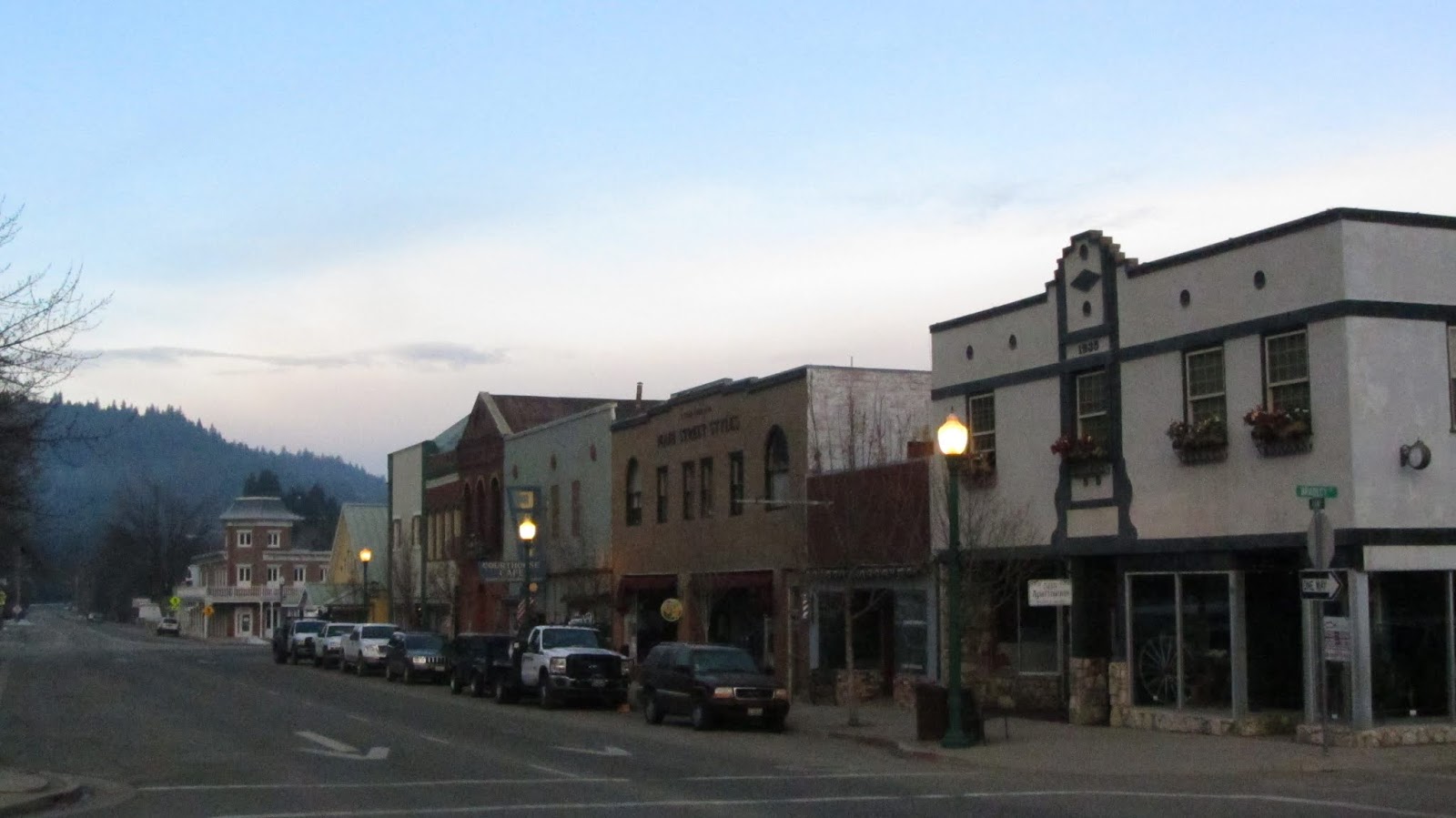
Main Street, Quincy, February 2013
(c) Lisa R. Pruitt 2013
Branson-Potts quotes Mike Taborski who, with his wife Keri, runs Feather Publishing, which also published neighboring Lassen County's newspaper.  They now are simply publishing/updating both counties' news websites. 
We’re primarily the only game in town; that just made the decision that much more difficult. It was extremely painful, both for the impact it was going to have on the community, to shutter their only means of getting local, reliable news, and the impact it was going to have on our family of employees.
Branson-Potts also quotes Debra Moore, managing editor of the Plumas County papers:
You get people upset about the content, and you get the people who worry about how they’re going to start their fires.  It’s a big, big deal. We’ve had people come in to stock up in case we don’t start printing again.
The "how they're going to start their fires" apparently refers to this bit of additional context from the LA Times story:
In this region where winter can be brutal, the papers published by family-owned Feather Publishing did more than deliver the news — they literally kept people warm. Sold in bundles, they crackled aflame in wood-burning stoves.
I'm not sure how to feel about that, but I guess if it sells papers and funds journalism, I can live with burning a few newspapers.  Certainly, during the winter months, I use my old Sacramento Bee and New York Times print editions to start fires in my fireplace.

But consider the rural economics of what has just happened in Plumas County--the local economic implications:
With some 75 employees, Feather Publishing is one of Plumas County’s largest employers. The publisher laid off all but two.
That is a stunning data point and one that surprises me. I'd never have anticipated that newspapers serving such a spatially dispersed population across two relatively poor counties would employ 75 people.

In the past decade and a half, 25% of newspapers, 2100 total, have closed.  Many of these have served rural counties and with disproportionately high poverty rates.  Here's some information about national trends re: newspaper closures, including those serving rural areas and those serving poor places.  A quote from Prof. Penny Muse Abernathy of the University of North Carolina follows:
The tragic part about that is these are the very communities that need the kind of information that a local newspaper provides. If you lose your local newspaper, and you’re in a small or mid-sized community, nobody’s showing up at the local school board meeting. Nobody is covering local team sports. Nobody is covering everyday life.
I have written previously of rural newspaper closures.  This post collects media coverage of the phenomenon; this story is about the "near miss" (closure) of the newspaper in Sierra County, California, to the south of Plumas County, and here's the first post of a series I started last summer about what nonmetro newspapers are writing about. 

This blog's prior coverage of Plumas County is here.   This post from last year mentions both Plumas and Lassen County, and it relates to this one, about California's state legislature and assembly representation from that region, which remains persistently Republican.  Indeed, the Republican being discussed in those posts, Brian Dahle, is a seed farmer in northern Lassen County who previously served several terms on that county's Board of Supervisors.  Interestingly, Dahle is now my State Senator, representing what I believe is the state's senate largest district in land area, stretching from Modoc and Siskiyou counties bordering Oregon, through Lassen and Plumas counties, to north Lake Tahoe, to the eastern suburbs of Sacramento where I live.

This post from 2018 also mentions Lassen County, along with a number of other counties now in the news for protesting Governor Gavin Newsom's stay-at-home order.

In 2012 and 2013, I spent several weeks off and on in Plumas County with students in a course I created called "Practicum in Rural Community Advocacy."  We were working with Legal Services of Northern California to help educate community members--working with as many stakeholders as we could engage--about early opportunities for enrollment in the Affordable Care Act.  I say "as many stakeholders as we could engage" because after an initial meeting, the Plumas County Health Office stopped returning our phone calls.  They were not interested in collaborating with outsiders.

At that time, I visited all four population centers in the county, including the county seat, Quincy; the only incorporated entity/municipality, Portola; and tertiary communities of Greenville and Chester.  The latter is on Lake Almanor, a site of some rural gentrification--at least it has many homes that are second homes to Californians whose primary residence is elsewhere.  Neighboring Lassen County is the home of several state and federal prisons, and it was the subject of the 2007 documentary "Prison Town USA."

Here's a link to a "Small Business Marketing Grant" program being run by the owners of my hometown newspaper, The Newton County Times, which is one of 10 papers owned by the Phillips Media Group in southern Missouri and northern Arkansas.  It's described thusly:
All 10 Phillips Media Group publications are participating in this program, jointly allocating up to $250,000 in matching advertising credits to assist local businesses. Local businesses are an important part of a community’s identity. Whether it is the jobs they create, the uniqueness they add, or the services they provide, they truly are the heartbeat of our towns. As the local leader in news and advertising, we want to be there for you during these uncertain times. Our Local Marketing Grant Program is another way we are looking to strengthen our communities, one business at a time.
I hope it helps small businesses in the region continue to advertise so that the newspapers are able to stay in business.  Will be interesting to see. 

Saturday, May 2, 2020

Coronavirus in rural America (Part XXXVI): impacts on the U.S. Post Office

I have written so much over the years about the U.S. Post Office--specifically on threatened closures and how they will impact rural communities--that I am reluctant to add much more now beyond acknowledging the latest threat.  That threat arises, at least indirectly, from the coronavirus because the pandemic's threat to businesses has those businesses pulling back from direct mail advertising (this dynamic is also having a big impact on local media, the subject of posts here and here).   So this post, I'm just going to link to a couple of recent pieces advocating that the government keep the U.S. Postal Service afloat and acknowledging the particular importance of the postal service in rural America. 

This piece is by Catherine Kim for Vox, published in mid-April.  The headline is, "If the U.S. Postal Service Fails, Rural America will Suffer the Most."  The subhead is "USPS is a 'lifeline' for many remote and Native communities."  Here's an excerpt focusing on the rural impact of any disruption of service or the proposed privatization of the postal service: 
The absence of the USPS would particularly affect indigenous people living in tribal lands, as there are already few resources dedicated to keeping them connected with the world, said Twyla Baker, of the Mandan-Hidatsa tribe in North Dakota. 
“It would just be kind of a continuation of these structures in the US that already dispossessed people of color, black and indigenous people of color, and people below the poverty line,” Baker said. 
The USPS is legally required to deliver all mail, to all postal addresses in all regions, at a flat rate, no matter how far it may have to travel. The service’s accessibility and affordability are especially important to rural communities that live in poverty and to people with disabilities, who can’t afford the cost of a private business to deliver their daily necessities. (In 2017, the rural poverty rate was 16.4 percent, compared with 12.9 percent for urban areas.)
And here's a New York Times op-ed published last Sunday by U.S. Senator Kirsten Gillibrand of New York, in which she argues that every post office should be a bank and a voting booth.  The headline is "Trump Called the Postal Service a ‘Joke.’ I’m Trying to Save It."  I'm happy to report that the subhead invokes the "rural":  "The Postal Service should be allowed to deliver low-cost financial services to poor and rural communities. And vote-by-mail should be universal."  The only paragraph that mentions rural, however, is this one, which advocates that the post office return to its banking roots: 
During the Great Depression, postal banking flourished, serving many of the poorest families. My proposal, the Postal Banking Act, would serve a similar population by leveraging the Postal Service’s 30,000-plus locations to create access to a nonprofit bank in every community in the country, from low-income urban neighborhoods to rural areas.
One interesting thing about this op-ed is that when it does mention "rural," in both sub-head and in this paragraph, it links rurality to poverty or socioeconomic disadvantage.  That's pretty accurate for the most part in that rural poverty rates have long been higher than urban ones, as mentioned in the Vox article quoted above.  Yet it's important to bear in mind that not all rural areas are high-poverty.

Some of my earlier posts about post offices are here (collecting many others), here, here, here, here, here, and here.  These are all from 2011, when closure and consolidation last threatened.  Here is a post from 2012 ... and here's another and another from that year.  And here's one from 2019 that isn't dedicated to post offices, but which features some photos of California's rural post offices.  And here's a 2019 post about voting by mail, related to an important but (in my opinion) wrongly decided case by the Eighth Circuit Court of Appeals re voting practices in North Dakota. 

Friday, May 1, 2020

Coronavirus in rural America (Part XXXV): Back to California

Both the Los Angeles Times and the Sacramento Bee are running stories today about the rural-urban divide over coronavirus in the Golden State.  It appears that cases of coronavirus in rural areas are much lower (also as measured per capita) in most rural areas, especially in far northern California.  Governor Newsom has even been responding to criticism in terms of rural-urban difference in the past few days.  Don't miss the maps produced by the Sacramento Bee, one for cases, one for deaths.  You'll see that the "hottest" counties in far northern California are Shasta (county seat Redding, the most populous county north of Sacramento) and Tehama (county seat Red Bluff, just south of Shasta County).  

Here's a quote from Leila Miller's story for the Los Angeles Times, which features a photo of Yuba City, but starts out talking about Tehama County:
For Bob Williams, the chairman of Tehama County’s Board of Supervisors, the numbers don’t justify the reality. The rural Northern California community of 65,000 has had only one case of the coronavirus, but it continues to face the same restrictions from the state as denser cities such as Los Angeles, which has had more than 23,000 cases. 
That’s why Williams has joined elected officials from the Central Coast, Central Valley, Northern California and elsewhere who have asked Gov. Gavin Newsom to let them gradually lift their stay-at-home order. They have argued that their infection rates are incomparable to hot spots in the state and that the coronavirus appears under control. 
Tehama County will already suffer from the cancellation of the 99th annual Red Bluff Round-Up, a rodeo that generates $4 million to $7 million for a local economy that only has a sales tax revenue of about $2 million a year. By reopening, Williams hopes to lessen the harm. 
The story quotes Williams:
Is it fair to treat Tehama the same as L.A. County?  I think the locals that are dealing with the problem here are better suited to understand what’s needed in rural California than folks in Sacramento or L.A.
The Bee story, by Philip Reese,  Tony Bizjak and Jayson Chesler, states that the Bee's
review of infection and death rates in each of the state’s 58 counties shows vast differences in the depth of the crisis, notably between lightly-hit rural and harder-hit urban spots. The rural north state in particular stands out with lower rates.
The numbers help explain why some rural counties are pushing the governor to rescind or loosen his statewide “stay at home” order for their areas.
Among California's nonmetro counties, only Mono County has a high per capita rate of infection. I've written about the situation in Mono County, which includes the Mammoth Lake ski resort, here and here.