Sunday, May 12, 2013

Industrial hog farm in the Ozarks a done deal, but no one seems to be responsible for it

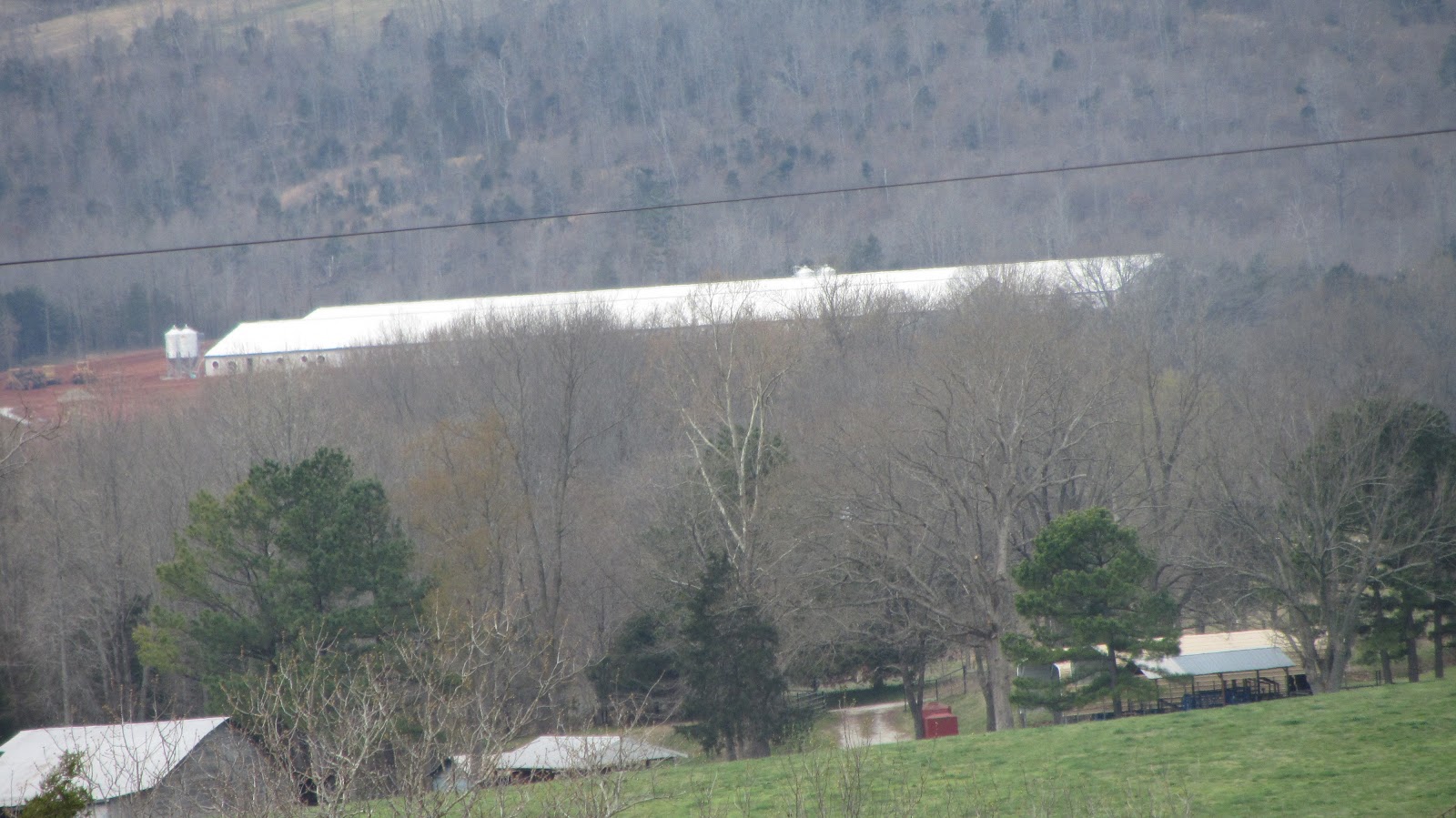
Farrowing barn at C & H Farm, photographed from Mount Judea School. 
I wrote (here and here) a few months ago about a proposed industrial hog farm in Newton County, Arkansas.  The massive hog farrowing operation made news--even state and regional news, such as here and here--because of the unusually skimpy notice process followed by the Arkansas Department of Environmental Quality (ADEQ) in granting a General Permit for Concentrated Feeding Operations (CAFO) to C & H Hog Farm.  The permit and the process behind it also attracted attention--and ire from many local stakeholders--because the CAFO is in the watershed of the Buffalo National River.  Indeed, not even the National Park Service nor its officials overseeing the park locally received notice that the permit for the 6500-hog farm was being sought for a site just six miles from the scenic river, which is a popular tourist destination in the region.

Various formal and informal entities, including the National Park Service and some grassroots organizations, were soon up in arms over the decision.  The National Park Service wrote a letter to ADEQ in February articulating 45 irregularities in the permitting process.  ADEQ responded in late March with a 33-page letter, responding point by point to the discrepancies the National Park Service had enumerated.  ADEQ's executive director, Linda Newkirk, signed the letter, which she said responded as best the agency could to some of the "innuendo and conjecture" in the NPS letter.  Newkirk also stated firmly that ADEQ would not conduct an additional environmental impact assessment.  The permit was granted based on a "finding of no significant impact" by the Farm Service Agency.  ADEQ has authority to grant such permits under the National Pollutant Discharge Elimination System.

Meanwhile a group of concerned citizens associated with the Buffalo River Watershed Alliance lobbied the Arkansas Pollution Control and Ecology Commission in Little Rock on March 22, seeking to have the Commission revoke the farm's permit or otherwise intervene.  The Commission chair responded simply that ADEQ and C & H Hog Farm had followed the letter of the law.  Read more here.

Because the permit was granted in August, 2012, and the hog farm was nearly complete by the time it came to widespread public attention in February, prospects for stopping the facility--which by then was nearly complete--seemed slim.  In March, ADEQ announced it would hold a public meeting in Newton County in May, but that meeting was more to inform residents and to respond to questions.  ADEQ did not hold out any real likelihood that the decision would be reversed, stating:
We want to visit the community to provide information in person and hopefully answer some questions that have been raised about the operation and how our permitting process works.  
An overflow crowd gathered at that May 8 meeting, with law enforcement positioned to keep order and direct traffic.

ADEQ Director Teresa Marks stated at the meeting that the agency "didn't know [the permit applicant's notice of intent] would cause this kind of outcry," but that the agency had communicated some with the  county by way of response to many emails and phone calls about the permit.  Marks said that the same provisions "apply to general permits all over the state," with no exceptions for places like the Buffalo River watershed.  Acknowledging that many in attendance disagree, she said "You may feel that way and you have the right to talk to your legislators to make sure they treat [the Buffalo] differently."  

The headline for the story in the Newton County Times is "ADEQ explains limits of authority, and it reminds me of an earlier headline in which the Newton County Quorum Court (the Arkansas name for the county board of supervisors), disclaimed any responsibility for the farm, nor any power to stop it.  (Read more here). It's as if these lower scales of government--especially the state via ADEQ--are saying "the devil made me do it," and the devil in this case is the federal government which sets the environmental standards for such permits. Ironically, the federal government also oversees the Buffalo National River, which stands to lose greatly from the hog farm.

Signs in "downtown" Mount Judea, across
from the school, direct drivers to the hog farm.
Newton County Times coverage of this meeting does a better job than I have seen elsewhere explaining why the permit application process did not require local notice.  The story quotes an Arkansas Water Engineer, John Bailey, who explained that while state permits require notice in a local newspaper, this is a federal permit simply administered by the state and therefore requires neither notice in a local newspaper nor a public meeting.  The CAFO permit will have to be renewed in five years.  When the permit is up for renewal, the phosphorous index for the soil will be measured, and if it indicates over-application of manure, "a decision will have to be made based on either best management practices" or the inclusion of additional land on which the manure can be spread.

Marks remained firm at the meeting regarding the agency's refusal to re-visit any aspect of the process, including the details of the environmental impact assessment.  This is in spite of some contrary scientific opinions about how the 630 acres set aside for manure spreading are likely to "cope" with the manure generated by thousands of hogs.  The facility is already housing 850 sows and three boars, with the first litter of pigs expected in August.

Marks noted that a water monitoring station exists on Big Creek, just above its flow into the Buffalo.  She said inspectors will be available to respond to any complaints and that she expected this "to be one of the most closely watched hog farms in the United States."
Entrance to C & H Farm; just up the driveway is
a "No Trespassing" sign.   

The Times story featured a text box with quotes from the meeting, absent the context in which they were spoken.  A few of the more interesting ones follow:
  • Who's going to compensate the land owners near Mount Judea for the loss of property values?
  • There are industries all over the state that people don't want, but they are actually necessary.  So, what we [ADEQ] try to do is to make sure there's no environmental harm that comes from these industries.  We don't regulate odor.
  • The minimum distance a hog farm should be from a community or school should be at least five miles.  I see the school system closing down because of air quality.   (Read more here on the proximity of the hog farm to the Mount Judea school).

Earlier on the day of the ADEQ meeting, the Buffalo River Watershed Alliance held a public meeting at the Buffalo Theater on the Jasper square.  They presented a film about commercial hog farming to a packed house and had a panel discussion about the health risks, economic impact on property values, inadequacies of the permit process, and the lack of transparency regarding the CAFO permit process.

Photos of C & H Hog Farm and neighboring area by Lisa Pruitt, April, 2013.

Saturday, May 11, 2013

Yet Another Defense of Honey Boo Boo

Yesterday, Legal Ruralism discussed Eric Deggans' condemnation of "hicksploitation. Deggans astutely points to the lack of outrage to the "truckload of reality shows that make fun of working-class, white Southern culture." We do not fight mockery of working white class individuals the same way we do the negative depiction of African-American and Latinos on television. This is not to say that we should not be outraged about the portrayal of minorities. Aisha Harris recently wrote a poignant article on Slate.com about the troubling viral trend of the “hilarious” black neighbor, where the "laughter directed at people like Sweet Brown plays into the most basic stereotyping of blacks as simple-minded ramblers living in the “ghetto,” socially out of step with the rest of educated America." However, Deggans' point is to shed light on how redneck, hick, and other epithets directed at (and at the expense of) working class white people persists to be a socially acceptable.

However, I wonder if the TLC show Here Comes Honey Boo Boo is actually bad per say. Deggans includes this show as one of "a big pile of the worse stereotypes about white, working-class people." He would classify it is as another opportunity for the television industry to make money off of America laughing at backward "white trash" folks. But not everyone feels that way - including the very individuals who are on the show. In an interview with Anderson Cooper (a professed Honey Boo Boo fan), June Thomson (Honey Boo Boo's mother) thoughtfully  responded to haters of the show. She said, "in life there is going to be criticism ... There is people who love us and people who hate us. We appreciate the people who support us and all through this and the people who hate us, it's a part of life everyday. We are real, we are not scripted. We are who we are, we are loving and I love being around my family so that's all that matters."

The reaction to the show has been interesting to say the least. There seems to be two camps of individuals. On the one side, you have individuals such as Deggans who believe shows like these perpetuate working white class stereotypes at the expense of the reality tv show subjects. Then there are others who think the show is a new low of reality tv, with individuals such as Maroon 5's front man Adam Levine to cite the new show as "the worst thing that has ever happened" and evidence of "the decay of Western Civilization." All this passionate outcry over an average (yes, I said average) working class small town family. This makes me think the real problem is us.

Last year, Joanna Spataro wrote a pretty brilliant piece in the Huffington Post, entitled "In Defense of Honey Boo Boo." Spataro grew tired of hipster, "intellectual," urban elites derisive reaction to her love of the show. (And she's not the only one! The show had higher ratings than the 2010 Republican National Convention, attracting 2.9 million viewers and tied in the ratings with Bill Clinton's barnburner speech at the Democratic National Convention.) She notes, the "dismissive way [a party goer] said that show perturbed me. He was quick to trumpet his more pretentious than progressive views on equal rights, but even quicker to put down a family he had never watched in action."

The Honey Boo Bo family is both supportive and positive. They spend loads of family time together. While Mike "Sugar Bear" Thompson is the biological father of Alana "Honey Boo Boo" Thompson only, he embraces all of June's children as his own. At June and Sugar Bear's commitment ceremony last weekend, the couple felt it was important to stay "true to [their] roots and made the focus on the family" and their commitment to each other. Unlike other pageant moms, Spataro says "we never see June forcing Honey Boo Boo to practice nine hours a day for her pageant or yelling she's too fat to fit into her frilly dress. When Honey Boo Boo says she looks like a chunky lemon in her yellow life vest at a water park, her mom says she's beautiful." June instills a strong sense of worth in her girls. She tells them to "never settle for a man who doesn't treat you right. If a guy doesn't love everything about you, move on! There are plenty of other fish in the sea." June says, "I give this advice to my daughters because I always want them to be themselves and surround themselves with people who love them for them." To me, it seems that Honey Boo Boo and her siblings have a lot to be thankful for tomorrow on Mother's Day.

Further, the family "seem[s] to embrace the rainbow, as they do each other." Honey Boo Boo's revelation of LGBT tolerance was both profound and adorable. She stated: "Ain't nothin' wrong with bein' a little gay" and "Everybody's a little bit gay." Some cringe at the meals the family makes. For example, they love sketti, the mom's homemade sauce made of ketchup, butter, and a hint of mustard. If I'm honest, I love a dish called tuna fish pasta, which consists of cooked pasta, canned tuna, and copious amounts of mayonnaise. Not exactly an "urban" worthy classy dish to serve at a dinner party. Perhaps we are all not just "a little bit gay," but if we look inside, we are all a little bit country as well. 

Of course, not all shows are the same. So I admit Deggans criticism may very likely ring true for some or many of the shows he mentioned. However, I think Deggans' own criticism can be seen as its own form of intellectual elite perception - one that can be just as damaging and hurtful. I think the Honey Boo Boo family is honest and real. They are most assuredly different from my urban indoctrination of what it means to be "a good white person," but that does not mean that they are bad or that their presence on television is a bad thing. Instead I think we should look within and reexamine our reactions. After finally watching an episode of the show, Ben Bailey summed it up pretty perfectly in his blog:
Now that I have [watched the show], I think we all need to be a little ashamed at how we were all far too ashamed, and what that initial shame says about what complete dicks we are. I say embrace Honey Boo Boo, and learn to be a little less judgmental, especially about s**t that does not directly effect us, or the culture, or anything in any way. Honey Boo Boo's family isn't a new low, and just in terms of reality television, I'd say its a step up to actually have people on TV with actual human souls for once. And they're not the decay of civilization either. They're just a family that, if they were my neighbors, I'd think were pretty fun.

Friday, May 10, 2013

"City Folks Just Don't Get It"

Television is inundated with commercials about dating websites and services. All promise to be better than the others or to satisfy a particular need. Aside from the usual eharmony.com and chemistry.com, there are sites designed specifically for gay individuals, Christians (www.christianmingle.com), and even certain races (such as http://www.blackpeoplemeet.com/). Therefore, I was not surprised when I discovered a dating site for rural folks. What did surprise me is that it has been around since 2005! The creation and success of the concept illuminate some of the various trends rural scholars have observed about rural communities. It touches on lack of anonymity, defining "rural" as a culture, and technological limitations.

Farmersonly.com was founded in 2005 by Jerry Miller. Miller started the site after a farm owner complained about lack of like-minded people in her dating pool. in 2006, Laura Bruno wrote in USA Today about the site achieving the 200,000 subscribers milestone. In his interview, Miller recounted the rural reality of small town lack of anonymity. He said he "kept hearing the same thing: 'I know everybody in my church, everybody at the store, but I go on these big dating sites, and they just don't understand the lifestyle.'" In a rural town, you know everyone, and that is not a lot of people. This leaves individuals such as the divorcee who inspired Miller to be afraid they would not meet anybody new. "Lots of these people are really, really lonely," Miller said. "When you walk outside in New York, there are 10,000 people within three blocks. In some of these rural towns, there are three people within 10 miles. It's a whole different ballgame." Not to mention with everyone knowing everyone and everything, individuals are robbed of the opportunity to learn about each other. Further, you can't escape past mistakes (including those pesky exes).

The site uses the more loose definition of rural. Most define rural through population size or density.  However, others argue that "rural" is a set of values. This latter approach would exclude certain communities that are filled with city folks in a rural space. For example, exurbs are "region or settlement that lies outside a city and usually beyond its suburbs and that often is inhabited chiefly by well-to-do families."  It "is not the same as an outright rural area. It is where the edges of a metropolitan area blend with a rural area, resulting in a semi-rural character." While it's distance and population density may qualify certain exurbs as rural, the culture of the area is closer to urban than rural. Farmersonly.com has but one criteria for membership - individuals who embrace small town values. Because after all, "city folks just don't get it." A person does not need to be farmer. One "could work at a restaurant, or the feed store, but are looking for someone who has those values." In fact, Miller said that he has a few urban users instead. Most often, they are rural transplants in urban concrete jungles. They  "grew up in the country and dream of moving back to country ... Dreamers that want to get out."

Unsurprisingly, technology is the most challenging part. When they launched in 2005, "everybody had phone modems," Miller said. "Connections were slow, so we had to keep it simple." While things have gotten a little better, rural areas continue to struggle with internet infrastructure (see past Legal Ruralism posts on the subject here, here, here and here). Even rural areas that have broadband, individuals are simply not as familiar with how to navigate the internet highway. Miller admits that the most challenging part of the venture is showing people the roles. He noted, "the learning curve is a lot different for us." In fact, he "spent thousands of hours coaching people on how to use the site, send messages—even just teaching them how to upload their photos."

The cost of the service is rather low. Users only pay $15.95 per month, or $49.95 for six months, to find a like-minded match on the service. However, rural areas are more likely to struggle with poverty. In fact, the Carsey Institute finds that "one-half of all rural poor are segregated in high-poverty areas." Therefore, the cost may be prohibitive. But for those that can afford it, Miller reports there have been plenty of success stories of couples who married after they met on the site. The service provides an innovative way for individuals to make a small town a little larger, without loosing the small town values they hold so dear.


"In rural Texas, no one votes for regulation."

That is a quote from the engineer for McLennan County, Stephen T. Hendrick.  It appears in a New York Times story headlined, "After Plant Explosion, Texas Remains Wary of Regulation," by Ian Urbina, Manny Fernandez, and John Schwartz.   The feature, which discusses the aftermath of the fertilizer facility explosion in mid April in the town of West, asserts that "the state’s pro-business, limited-government mantra has been a vital part of its identity." The journalists support that proposition by referring to state and local responses to the West disaster, one of the worst industrial disasters on record.  The mayor of West, like Governor Rick Perry, has asserted that more regulation would not have prevented the explosion.

Also illustrating the state's "free market posture," the authors of the story write:
It is the only state that does not require companies to contribute to workers’ compensation coverage. It boasts the largest city in the country, Houston, with no zoning laws. It does not have a state fire code, and it prohibits smaller counties from having such codes. Some Texas counties even cite the lack of local fire codes as a reason for companies to move there.
As Prof. Thomas McGarity of the University of Texas Law School asserts, it's a "wild west approach to protecting public health and safety."  

Codeswitch takes up "Hicksploitation"

NPR launched the Codeswitch blog, billed as "frontiers of race, culture and ethnicity," about a month ago.  Today, Eric Deggans, writing for the forum, takes up what he calls "hicksploitation."  Here's the lede:
On cable TV, there's a whole truckload of reality shows that make fun of working-class, white Southern culture. They are some of the most popular and talked about new shows, too, such as Here Comes Honey Boo Boo and Duck Dynasty. 
MTV tried cashing in on the redneck TV trend with its own hyped-up platform for young Southern kids behaving badly, Buckwild. It played like a Southern-fried version of Jersey Shore. Its stars were a dimwitted crew of young people in West Virginia drinking hard and riding pickup trucks through ditches filled with mud.
And, Deggans notes, "plenty more ... blatant stereotypes of white subcultures" are on display on TV, "a big pile of the worse stereotypes about white, working-class people."  He lists "Mob wives," which he describes as "cliche in-your-face Italian Mafia matriarchs" and "Breaking Amish," which he describes as "backward, barely educated rural kids wandering around New York City."  There is also "My Big Fat American Gypsy Wedding," which features "barely legal prospective brides brag[ging] about marrying their cousins."  

Not only is Deggans perceptive enough to see how pejorative (and offensive to some) these shows are, he is perceptive enough to note that we no longer see African-Americans or Latinos, "especially if they are working class," depicted so negatively these days--at least not in new shows.  No, he observes, shows about those racial and ethnic groups "show off more lavish lifestyles and have been around longer."  

Deggans also notes that when a show called "All My Babies' Mamas" (featuring a rapper bragging about his 11 children by 10 different women) was proposed by the Oxygen Channel last year, the backlash was "immediate and powerful." Some 30,000 protesters signed a petition opposing it on change.org.  Oxygen responded by dropping development of the series.  

Why no similar outcry against these shows that ridicule working class whites?  Deggans answer:  "too many folks see stereotypes as a problem mostly for people of color."

Deggans summarizes:
We've got lots of practice criticizing degrading images of black and brown people. Activists know how to gather the news stories, book the media appearances and assemble the petitions to press their case. Advertisers get nervous and programmers think twice. 
What many forget is that it can be just as easy to stereotype white, working-class folks, and just as hard to scrub those stereotypes off your TV screen.

Thursday, May 9, 2013

Keystone XL grand deal may be in the pipeline ... but what about those who will have the pipeline in their backyard?

Pun intended.

The New York Times reported today on the front page of the business section under the headline, "Foes Suggest a Trade-Off If Pipeline is Approved."  Here's the lede:
President Obama’s first major environmental decision of his second term could be to approve the Keystone XLpipeline, profoundly disappointing environmental advocates who have made the project a symbolic test of the president’s seriousness on climate change. 
But could some kind of deal be in the offing — a major climate policy announcement on, for example, power plant regulation or renewable energy incentives — to ease the sting of the pipeline approval? 
White House and State Department officials ... say the pipeline is not a fundamental piece of the nation’s climate policy nor is it a political bargaining chip to trade for other measures. 
* * * 
But to many environmentalists, including some of the president’s most active campaign supporters, the issue has huge symbolic and political importance.
So, some are suggesting that if President Obama approves the Keystone pipeline, he use the occasion to announce major new pro-environment policies, like new regulations for coal-fired power plants or a national clean energy standard.

Those sound like great policies for the nation--and the world.  But that sort of "deal making" at the national and global scale leaves me wondering: what about Nebraska? specifically, what about the rural Nebraskans and others living on the plains, along the pipeline's path, who bear different risks from the Keystone XL pipeline--on-the-ground risks, not just the global climate change risk we all share.  Read more here and here.  Is there something more for these folks in a possible grand compromise?

Tuesday, May 7, 2013

Farm workers accuse employers of bias, favoring immigrant workers

Ethan Bronner reports in today's New York Times from Vidalia, Georgia, with this lede:
For years, labor unions and immigrant rights activists have accused large-scale farmers, like those harvesting sweet Vidalia onions here this month, of exploiting Mexican guest workers. Working for hours on end under a punishing sun, the pickers are said to be crowded into squalid camps, driven without a break and even cheated of wages. 
But as Congress weighs immigration legislation expected to expand the guest worker program, another group is increasingly crying foul — Americans, mostly black, who live near the farms and say they want the field work but cannot get it because it is going to Mexicans.
Those American workers have filed several suits against Georgia growers like Stanley Farms.  Sherry Tomason is among the plaintiffs in that case. She argues that the employer for whom she worked for seven years , against an employer for whom she worked for seven years.  Tomason is quoted:
They like the Mexicans because they are scared and will do anything they tell them to.
An owner of Stanley Farms, Brian Stanley, tells another story: 
We have tried to fill our labor locally.  But we couldn’t get enough workers, and that was hindering our growth. So we turned to the guest worker program.
Stanley and other farmers assert that "Americans who say they want the work end up quitting because it is hard, leaving the crops to rot in the fields."  The comments of Jon Schwalls, director of operations at Southern Valley, had racist overtones:
When Jose gets on the bus to come here from Mexico he is committed to the work.  It’s like going into the military. He leaves his family at home. The work is hard, but he’s ready. A domestic wants to know: What’s the pay? What are the conditions? In these communities, I am sorry to say, there are no fathers at home, no role models for hard work. They want rewards without input.
And some local workers do acknowledge that, unlike the immigrant workers who are bused in for short periods of time, they are not willing to work around the clock for several consecutive days to increase their pay.  

Jim Knoepp of the Southern Poverty Law Center, which has lobbied against the guest worker program, amplifies the domestic worker's point:
There used to be lots of American pickers who moved around the country.  But wages have stagnated and conditions have deteriorated, and agriculture is unwilling to make these jobs attractive. Think of trash collection. That’s not very appealing, either. But if you offer a decent wage and conditions, people do it.
In fact, according to Cindy Hahamovitch, a professor at the College of William and Mary who studies guest worker programs, domestic workers comprised two-thirds of farm laborers in the 1970s, immigrant workers the remaining third.  Within a decade, those proportions flipped, and now the vast majority of agricultural workers are immigrants, though most are not in the guest worker program.   

Bronner's is a very thoughtful story, giving due to both sides of a difficult issue.  I believe that an exceptionally strong work ethic was historically a feature of the U.S. work force (of all colors), but employers take advantage of such a strong work ethic--just as they currently take advantage of immigrant labor in part because of that exceptional work ethic.  I appreciate that immigrant laborers are now willing to work harder than many Americans, but a considerable downside to that right now is that employers are not forced to treat any workers well because they have the option of desperate immigrant labor.  The quote above from Jon Schwalls speaks volumes about the attitudes of some employers.  Since when it is not OK to ask about the pay rate?  about working conditions?  Since when is it not OK to expect fair pay and breaks for one's labor?

Other recent reports on the role of immigrant labor in agriculture are here and here.  These focus on the dairy industry, which like a handful of other agricultural sectors, requires year-round labor.  

Monday, May 6, 2013

Kentucky town hunkers down in the face of outside criticism over child's gun death

I wrote a few days ago about the shooting death this past week of a 2-year-old in Burkesville, Kentucky.  The girl was shot by her 5-year-old brother with his .22 gun when the children's mother stepped outside the home to take care of a household cleaning task.  In that story, I observed that the media seemed to be ridiculing the family by printing a photo of their trailer home and by describing the particular task the mother was doing:  pouring out grease for the dogs.

Now, today's New York Times picks up on that latter theme--or at least a related one.  The somewhat opaque and inartful headline is "Girl's Death by Gunshot is Rejected as Symbol."  In it, journalist Trip Gabriel explains that Burkesville wants "no part of being a symbol" in the national debate over gun control.  He writes:
The death has convulsed this rural community of 1,800 in south-central Kentucky, where everyone seems to know the extended Sparks family, which is now riven by grief. But as mourners gathered for Caroline’s funeral on Saturday, there were equally strong emotions directed at the outside world, which has been quick to pass judgment on the parents and a way of life in which many see nothing unusual about introducing children to firearms while they are still in kindergarten.
Gabriel quotes several local residents, including one who said, "I think it's nobody's business but our own town's."  Another also referenced the town's solidarity: "This town, there's nothing like it.  They pull together." One teenager "said strangers from around the country had written scathing comments online blaming the parents, deepening the town’s pain and anger."  Indeed, Gabriel reports that a couple of Burkesville locals punched the cameraman from a German television crew who were in town to cover the girl's funeral.  Those men told a newspaper reporter, "If you had any sense, you'd get out of here.  You're next, buddy."

Nevertheless, Gabriel found a few locals who "expressed skepticism of the parents for having a loaded, unlocked gun in the house."  I don't know if expressing skepticism is quite the same as blaming the parents--like many outsiders have done--but it sounds like there's some room for debate, even down in Burkesville.  (I note that one Burkesville parent Gabriel interviewed had taken the step of better securing the family's guns, "[s]ince that little girl died").

Some states have laws that make criminal the negligent storage of a gun, but Kentucky is not among them.

As for the media's behavior in all this, I go back to my original criticism that running a photo of the trailer home and using the detail about pouring out grease for the dogs serves only to fuel stereotypes of ignorant, unworthy "others," those I sometimes label retrograde rednecks to connote how the outside world--especially the world of liberal elite NYT readers and NPR listeners--see them.  I note that the New York Times also ran the photo of the family home--the same one from the earlier AP story, the same one NPR picked up--and they described the work of the children's father: shoeing horses and working at a sawmill.  I guess that completes the picture for us.  

Sunday, May 5, 2013

California's Great Central Valley: "the largest human alteration of the Earth's surface"

Verlyn Klinkenborg, author of The Rural Life, writes in today's New York Times of his trip this past week down California's San Joaquin Valley, along I-5.  The headline is "Lost in the Geometry of California's Farms," and in this essay he compares this recent journey to one he took with his family in 1966, as they contemplated a move from Iowa to California.

Klinkenborg borrows Joan Didion's phrase to describe the Great Central Valley: "the trail of an intention gone haywire." He calls California's history "a story of feverish intention, a tale of almost manic possibility and reinvention."  And he describes some consequences of that intention and reinvention.  Klinkenborg's tale is essentially that of a land abused, and paying the consequences. For example, he says orchards planted high above the irrigation line have "become firewood," and--perhaps more shocking: "The entire valley has sunk in on itself over the years as the aquifer beneath it has been siphoned off."  He notes that the U.S. Geological Survey has labeled the Valley "the largest human alteration of the Earth's surface."

He calls the Valley a "biological desert," where only a few species are allowed to thrive, a place "utterly alien" to all except a few machine operators "wearing hazmat-like suits."  Like Wendell Berry, Klinkenborg laments the separation of people from food systems.

The picture Klinkenborg paints is of agriculture on a massive, almost unimaginable scale, a scale the author implies is inappropriate and certainly unnatural.  
There is something stunning in the way the soil has been engineered into precision. Every human imperfection linked with the word “farming” has been erased. The rows are machined. The earth is molded. The angles are more rigid, and more accurate, than the platted but unbuilt streets out where easy credit dried up during the housing crisis. This is no longer soil. It is infrastructure, like the vast concrete sluice of the California Aqueduct, like the convoluted arrays of piping that spring up everywhere at the corners of fields.
Klinkenborg acknowledges his nostalgia (with specific reference to his high school days in Sacramento), and he contrasts that nostalgia with the apparent lack thereof by most Californians, who simply "marvel at the rate of change."  Klinkenborg suggests that "the logic and illusion in so much of California, urban and rural" is to see agriculture on this scale as inevitable and necessary, whether or not that is objectively so.  

As always, Klinkenborg's prose is beautiful, and the entire essay is thought-provoking, if a somewhat depressing, read.  

Saturday, May 4, 2013

Hatfields & McCoys become tourist draw

Chase Purdy reports for the New York Times today from Sarah Ann, West Virginia, home of the Hatfield Family Cemetery.  His story is about the tourism boom linked to the long-standing Hatfield-McCoy feud in this part of Appalachia, a resurgence in interest that most attribute to the History Channel's 2012 mini series, Hatfields & McCoys.  Here's an excerpt from Purdy's story:  
Local tourism departments, along with members of the Hatfield and McCoy families, are working to transform feud folklore into a dependable source of jobs and revenue for Eastern Kentucky and West Virginia, a region grappling with the decline of coal. In the past year, communities along the Tug Fork, the stream that is the state boundary in the area, have witnessed a surge in out-of-town foot traffic, tourists by the thousands drawn to the region in search of history.
The Hatfield Family Cemetery is one focus of the tourists' interest, but the cemetery has fallen into disrepair, even though it is on the National Register of Historic Places.  A descendent of the Hatfield clan, Reo Hatfield, approached West Virginia officials with a plan to clean up the cemetery, but a determination has yet to be made regarding whose land the cemetery is on.  

The Dils Cemetery, where patriarch Randolph McCoy is buried, is across the state line, in Pikeville, Kentucky.  That cemetery is much better kept and touted as a must-see spot.  Indeed, beginning about a year go, Pike County, Kentucky's tourism office has spent $40,000 of state funds on billboards and a national advertising campaign to draw people to the land of the Hatfields & McCoys.  Some of that money was spent on signs to direct tourists to landmarks like the Dils Cemetery.  The executive director of the Pike County tourism office noted the need for jobs in the region, where coal--once the economic king--is now on the decline:
The mines are shutting down every day.  We have to put our people back to work.  
Of particular interest to me is the intrigue that this legendary feud still conjures up, the attraction it represents.  I would like to know from whence most of the visitors come.  Purdy's story suggests that some of them are relatively local, as from Ashland, Kentucky, but surely some come from farther away, too.  I note that Pike County's tourism office spent some of its ad dollars in Oprah's Magazine, O, which suggests a certain demographic.  

Just as our nation has a love-hate relationship with rural America, we also have one with the Scots-Irish associated with Appalachia and phenomena like the Hatfield-McCoy dynamic.  I'm glad to see this economically depressed region capitalizing on some of that.  

Thursday, May 2, 2013

Gun culture extends to children, with fatal consequences

Like many, I was shocked by the news this week that a 5-year-old boy had shot and killed his 2-year-old sister with a rifle--indeed, with the child's own rifle, which the boy had received for his 5th birthday.  Read more here and here.  This happened in Burkesville, Kentucky, population 1,756, which wikipedia describes as "[n]estled among the rolling foothills of Appalachia and bordered by the Cumberland River to the south and east."

The .22 rifle the boy used was called a Crickett and was marketed to children as "my first rifle."  The product comes with different design options on the shoulder stock, including pink to appeal to girls.  The gun was apparently stored in a corner of the family's mobile home, next to the child's BB gun, and the parents did not know it had a shell in it.  The incident has sparked debate over whether the children's parents should be prosecuted, and there is some talk of letting a grand jury decide.

One thing I find interesting in the media's coverage of this story are featured quotes from Kentucky locals that normalize gun ownership and use by children.  Here are some of those quotes, as reported in the Louisville Courier-Journal on May 2:
[C]ommunity and business leaders in Burkes­ville said they strongly support the couple and saw nothing unusual about giving a rifle to such a young child. 
“Learning how to use a gun at a young age has been common for generations in rural Kentucky,” said County Judge-Executive John A. Phelps Jr. 
He said it was a “mistake” to let the boy have access to the rifle, “but it was an accident.”
“These are good people, a normal, average Kentucky family who loved their children very much,” Phelps said.
Kathy Mosby, who runs Shapes Fitness Center in Burkesville, said the “whole community is behind the family,” while Terry Riley, general manager of Don Franklin Auto, a car dealer, said, what happened “can happen to any of us.”
County Coroner Gary White is quoted in the AP report that NPR picked up:
Down in Kentucky where we're from, you know, guns are passed down from generation to generation. ... You start at a young age with guns for hunting and everything. ... What is more unusual than a child having a gun is that a kid would get shot with it.  
I am not saying that it is inappropriate to include the quotes; the quotes do, after all, give one perspective on the events, and the media also note the contrary position, as in a quote from a pediatrician who co-wrote the American Academy of Pediatricians policy on children and guns.    

I was also struck by the detail included in this AP report (quoted by NPR) of what the mother was doing outside when the boy shot his sibling:
As Stephanie Sparks cleaned the kitchen, her 5-year-old son, Kristian, began playing with a rifle he was given last year. She stepped out onto the front porch, poured grease out of a frying pan for the dogs and 'heard the gun go off.'
This detail--"pour[ing] grease out of a frying pan for the dogs"--is so vivid.  It conjures up images from "Winter's Bone" and from my own upbringing in the rural Arkansas Ozarks.  But it's also arguably a rather inflammatory detail--suggesting "white trash." (The same could be said of the AP photo of the family's home, a run-down trailer, which accompanied the NPR report).  For folks like me, no household errand would justify a mother leaving her young children in the house with a loaded gun, but that is now how folks in rural Kentucky see it--especially for a parent who though the gun was no loaded.    

As it happens, the Courier-Journal reports a slightly different version of what the mother (here referred to by her last name rather than that of the children's father) was doing:   
Robinson was home, cleaning, at the time of the shooting, and said she had stepped out to empty a mop bucket when she heard a pop.
Maybe the children's mother was, in fact, taking care of both tasks, which I suppose increased the amount of time she was out of the home. The total time she was outside, which would be influenced by the number of tasks she was doing, would be legally relevant to establishing her possible negligence. 

Here is an NPR feature on when children are old enough to have guns.  The Kentucky shooting came on the heels of two other recent gun deaths at the hands of children.  One was in neighboring Tennessee, and the other was in New Jersey.  

Here is an op-ed in the New York Times by columnist Joe Nocera, which mentions the Kentucky death.   Here is a Courier-Journal editorial about marketing guns to kids; it compares the gun industry's efforts to previous efforts by the tobacco industry to entice children to use their products.