Showing posts sorted by date for query Newton County. Sort by relevance Show all posts

Thursday, June 5, 2025

Another rural institution certain to be hurt by Trump administration cuts: public libraries

Children's Section of Rio Vista Library, Solano County California
(c)Lisa R. Pruitt 2024
The likely disproportionate harm Trump administration policies and budget cuts will have on rural America has been a theme of several recent posts on the blog.  In this one, I'm going go to leverage a story by Emily Hays of Illinois Public Radio, who reported on the topic a few days ago from Greenup, population 1,365 in central Illinois.  The excerpt that follows provides insights into why rural libraries are so vulnerable and it echoes a theme from other stories about rural vulnerability: because of weak local tax bases, small towns and nonmetro counties are less able to absorb the loss of federal funds that have helped to provide all sorts of services.  

Take and Make Kits at the Newton County (AR) Library
(c) Lisa R. Pruitt 2025 
I'm also using this post to share some photos of rural libraries that I've taken in the past few years, some from my home county, Newton County, Arkansas, and some from California towns.  What I've seen in my hometown library, where I've spent more time recently, is that these institutions provide a wide range of services, from a seed bank to lending telescopes to craft bags for kids.  They host legal aid attorneys coming to chat about elder law and other issues residents may need to know about.  Sadly, to my mind, they may also mindlessly distribute The Epoch Times and other right-wing propaganda.  

(c) Lisa R. Pruitt 2025
The following excerpt from journalist Hayes story features her in conversation with Vickie Pierce, the retired English teacher working part time as the circulation clerk in what is described as one large room: 
Telescopes on loan at
Newton County Library, AR
(c) Lisa R. Pruitt 2025
PIERCE: We're a small-town library, so really small budget. And honestly, I'm not sure how we manage to stay open.
Reading room, Coleville Library,
Mono County, CA
(c)Lisa R. Pruitt 2024

HAYES: Part of how they stay open is through grants from the independent federal agency the Institute of Museum and Library Services. Before the pandemic, the federal government covered around 5% of Greenup library's operating costs. Kate McDowell is a professor at the University of Illinois School of Information Sciences. She says the IMLS is a very small agency...

KATE MCDOWELL: That has impacts on almost every community in the whole of the United States and territories.

HAYES: Public libraries get most of their funding from county and city taxes. IMLS distributes the majority of federal library funds. McDowell says the grants vary year to year and are often small, but they help libraries try new things.

MCDOWELL: What the IMLS funds is not just the subsistence of libraries, although that's there too - it's their future.
Mammoth Lakes Library,

 HAYES: IMLS gave out $267 million last year to libraries and museums. That's 3,000th of a percent of federal spending. But the future of that funding is in doubt. In March, almost all of the IMLS staff were put on administrative leave. In an executive order, President Trump claimed the move would reduce unnecessary bureaucracy. Greenup isn't expecting any federal money this year, and Pierce says the library is financially cautious.

PIERCE: We squeeze every penny three or four or five times to get the most out of it.

HAYES: And Pierce says the idea of taking more money away from libraries sickens her. The American Library Association says that's been happening nationwide to libraries and museums receiving IMLS grants.
Seed saving chart and seed library
Newton County (AR) Library 
(c) Lisa R. Pruitt 2025

* * *
[A] judge has temporarily blocked the Trump administration from dismantling the Institute of Museum and Library Services. Congress has funded the department through September. For now, Greenup Library says it's still providing the same services, but that could change for it and other rural libraries.


Libraries are important sources of WiFi,
as illustrated by this sign 
at the Newton County (AR) Library
(c) Lisa R. Pruitt 2025

Friday, May 9, 2025

As traditional media collapse, "The Epoch Times" gains a following in rural America

The newspaper racks at the Newton County (Arkansas) Library
are full of issues of The Epoch Times, along with News China 
(c) Lisa R. Pruitt 2025.

The New York Times journalist Eli Tan reported last week from Oakdale, California (population 23,181), on the evolution of that community's media ecosystem.  The headline for Tan's story focuses on events from 2020, "It was Just a Rumor on Facebook.  Then a Militia Showed Up" but the story is about the longer-term disintegration of local media, both before and after that 2020 event.  It's a story of how the local media dried up, leaving residents reliant on local Facebook groups, eventually supplemented by The Epoch Times, a publication of Falun Gong, a group associated with right-wing views and its opposition to the Chinese government. I want to focus on that part of the story because it relates to something I observed first-hand in my home county this year.  First, I'll share a bit more background on Oakdale, which is in Stanislaus County, in California's Central Valley:   
First the nearby newspapers shrank, and hundreds of local reporters in the region became handfuls. Then came the presidential elections of 2016 and 2020, and the pandemic; suddenly cable networks long deemed trustworthy were peddlers of fake news, on the right and the left.
By the 2024 election, when its county, Stanislaus, was among the 10 in California that President Trump flipped red, it wasn’t just trust in traditional media that had vanished from Oakdale — it was the media itself.

Now, in place of longtime TV pundits and radio hosts, residents turn to a new sphere of podcasters and online influencers to get their political news. Facebook groups for local events run by residents have replaced the role of local newspapers, elevating the county’s “keyboard warriors” to roles akin to editors in chief.
Many issues of News China magazine
were also on display in the 
Newton County Library

Of the 80 Oakdale residents The New York Times spoke to for this article, not a single one subscribed to a regional news site, The New York Times, The Wall Street Journal or The Washington Post.

Oakdale is not alone: Between news deserts expanding in rural areas and a growing distrust of national outlets, the town’s shift toward new sources of information is becoming commonplace in small communities across the country. 

Here is more coverage of the rural news desert phenomenon. 

As local news outlets shrank throughout the Central Valley in the 2010s, Facebook groups dedicated to local events started popping up in their place. 

* * *  

The town is still able to support a weekly newspaper called The Oakdale Leader, which shares a handful of reporters with nine other local newspapers in the Central Valley, all owned by Hank Vander Veen, its publisher and a former circulation director at the Modesto Bee.
* * *
It isn’t just local news habits that are changing in Oakdale. Since the pandemic, a wider skepticism for everything including vaccines and the price of eggs has changed the way people approach information in general: The thinking is, do your own research, and trust neither side.
Newton County Library, Feb. 2025
(c) Lisa R. Pruitt 2025

Here is another post about misinformation influencing politics in rural communities.  Tan's story in the NYT continues:

Alternative news in Oakdale has even extended into print. In barber shops, clock repair stores and diners across town, copies of a peculiar newspaper appear on tables and bookshelves: The Epoch Times.
The media outlet is affiliated with the Chinese spiritual movement Falun Gong, and it is known to include right-wing misinformation with an anti-China slant. (The outlet did not respond to a request for comment.) A weekly print subscription costs less than $15 a year, but most store owners in Oakdale said they didn’t initially pay for a subscription — the editions just started showing up in the mail during the pandemic.

This brought to mind what I saw in the Newton County (Arkansas) Library (in my hometown) when I visited in February, 2025:  the newspaper rack was dominated by just two publications, The Epoch Times and the local(ish) Harrison Daily Times, from neighboring Boone County.  Oddly, there was no copy of the local weekly, The Newton County Times, on display.  (It is owned by the same company that owns the Harrison Daily Times and currently operates out of the same office in Boone County--that is, The Newton County Times has no physical presence in Newton County except when the reporter comes over from Harrison, Boone County's seat, to cover events like local government meetings).  

I was back in Newton County in early April and again popped into the library.  Nothing had changed in terms of what was on display--well, the issues of The Epoch Times and The Harrison Daily Times were more recent because it was April and no longer February.  On this latter visit, the librarian was present, and so I asked her about the prominence of The Epoch Times--and why she carried it at all.  She said that a patron had requested it.  My facial response was skeptical, perhaps even as strong as an eye roll.  Though what I was really judging was her decision to display this propaganda so prominently, especially when there was so little counter-balance of real news.  Not a copy of the Arkansas Democrat-Gazette, let alone any national newspaper, in sight.    

Now, however, that I've read this New York Times story, I'm skeptical in a different way about what the librarian told me.  I suggest The Epoch Times is being sent to lots of local libraries, and those without much else--and those who don't see how biased it is--simply display it.  After all, they have plenty of room, and it's no tax at all on their budgets.   

It seems this is an important bit of information toward understanding the media ecosystem that has led to a right-ward shift in the rural vote. 

It also reminds me of some billboards for The Epoch Times I saw on California's I-80 in the last year.  Those billboards proclaimed The Epoch Times the most trusted news source in America, a claim that made me very skeptical.   Here's a story about those billboards and how they showed up in Tampa, Florida. from Axios. 

Saturday, February 15, 2025

Bridging the attitude gap

During my first year of college, I was shocked to hear one of my friends had never seen a cow in the flesh until she came to UC Davis. It was undeniable that she was a city girl, born and raised. Although Davis is not a large urban area, she nevertheless enrolled to attend UC Davis because she was attracted to the small college-town vibe.

As for me, the first time I saw a cow was when I was in kindergarten. The school had brought in cows so the students could learn more about livestock. Cows, cowboy boots, and tractors were normal, everyday sightings for me. I grew up in an agricultural town, which is best described as a rural-adjacent, suburban town. Although my hometown was not a remote rural town, I grew up with a positive attitude toward rural places. Specifically, I appreciated the labor that went into growing the produce I found on my table.

However, not everyone shares this positive attitude toward rural areas. A study from 2018 stated that 53% of urban residents do not believe rural people share the same values as them. Meanwhile 58% of rural residents do not believe urbanites share their values. Many scholars have commented on this urbanormativity phenomenon. For example, in Fulkerson and Thomas’s book, Urbanormativity: Reality, Representation, and Everyday Life, the authors discuss the perspective of urbanites toward rural residents:
[T]he residents of the swampy marsh of colonial North Carolina were widely believed to consume mud in order to survive, since farming was nearly impossible. The people of this “wasted” land were seen as sickly, stupid, lazy, and unproductive. Why else would people be content to stay in such a foreboding place?
Although cities may be an economic hub for wealth and job opportunities, urban and rural places have an undeniable link. With rural hospitals closing, many rural residents depend on urban centers to provide access to specialized medical treatment. On the other hand, urban places also rely on rural resources. A prime example is Los Angeles’ need for water from rural places:
A July 2024 report from the department found that climate change could threaten to shrink water supplies in the State Water Project — a water storage and delivery system that stretches from the western foothills of the Sierra to Riverside County — by nearly one-fourth in the next 20 years, prompting officials to call for bolstering the project’s system of reservoirs, pumps and aqueducts for the state’s future climate.
So, an important question presents itself: how can we bridge the attitude gap between urban and rural residents? Although I love to see every urban school bring livestock on campus, it is an unlikely prospect. However, urban schools can provide more educational opportunities to talk to students and increase awareness about rural places. For example, other than providing food, schools can discuss how rural areas generate energy that powers many urban cities. Hopefully, for these students, the first time they see livestock is not well into adulthood.

Thursday, January 23, 2025

Arkansas newspaper columnist's 2025 wish list implicates ecotourism, local autonomy, and the future of my home town

Arkansas Democrat-Gazette columnist Rex Nelson published a wish list last week of things he'd like to see happen in Arkansas this year.  Among them, he this wrote this about Newton County, where I grew up (and about which I've often written on the blog):

I would like to see brothers Tom and Steuart Walton, along with Bass Pro Shops founder Johnny Morris, continue their environmentally sensitive efforts to transform Newton County into a nationally known outdoor recreational hub. Rather than sawing down trees, mining gravel from streams, raising hogs and raising chickens, hardworking people in this part of the Ozarks will be able to make a good living in ways that don't harm the environment. The massive investments being made by the Waltons and Morris will lead to new shops and restaurants. Entrepreneurs already are starting to discover formerly sleepy places like Jasper.

This sort of thinking is not new to Nelson (formerly a senior advisor to Governor Mike Huckabee in the late 1990s), as you can see from reading prior blog posts here, here, and here.

What is especially striking about this most recent Nelson column is how condescending Nelson is to long-time Newton County residents--perhaps I should call them legacy residents--whose vision differs from his.  Theirs is often the vision passed down from their parents, one that has them making money off the land in whatever way they can, including from industrial agriculture and timber harvesting.   As I have written previously, it would be interesting to know the extent to which the county's legacy families benefit from development like that which Nelson promotes--and the extent to which they have a say in how--and how fast--it happens.  

Saturday, June 8, 2024

Rallying to keep post office closure brought community group together

The headline in my hometown newspaper, The Newton County Times, a few months ago was "Mt. Judea Alliance mission:  Advocate for community and rural way of life."  It's a feel-good story about a group in my home county, but no where does the story use the word rural or otherwise suggest precisely what is distinctly rural about what the community group is doing or protecting.  

Here's the story, for which there is no link on the newspaper's website: 

The Mt. Judea Area Allieance never does anything political nor takes a position on issues.  "Except that's how we started," laughed Beth Ardapple, of the Cave Creek community. 

Ardapple is a member of the Alliance and she spoke about the organization during the April 25 meeting of Community Matters, a coalition of non-profit organizations serving the residents of Newton County.  The meeting was held at the Jasper First Baptist Church.  Each month a member organization is asked to present itself to the group. 

The Mt. Judea Area Alliance originally formed in 2011 when community residents joined together to successfully fight the U.S. Postal SErvice's plan to close rural post offices including the one at Mr. Judea.  Ardapple said she delved into the history of the organization and found documentation noting that residents had written and sent 192 letters to a postal manager asking that ht epost office be spared.  It worked.  

It was a positive experience and community members continued to meet and address issue of local relevance and importance.  It came up with a mission to be an advocate of the community and the rual way of life.  Early leaders included the late Donna Dodson and teh late Sharon Pierce. Anita Hudson, Ima Jean Freeman, Bertie Wells and Ardapple continue to be the core group.  It has about ten active members today. 

Projects have involved community beautification, a mini senior center, street music and dancing, back to school breakfasts for teachers and staff, summer learning camps, participation in the Arkansas Quilt Trail and helps offer community service hours to area students. 

The most successful project was the initiation in the county of the Dolly Parton Imagination Library.  Wells, a former school librarian, took it on as personal project. 

It grew and was adopted into the programs offered through the Newton County Library.  Library Director Kenya Windel reported later in the meeting that Newton County was recently recognized by the state organization for the county's volume of memberships.  About 90% of Newton County children are enrolled. 

"That was a one-woman show," said Ardapple.  She was determined that all children aged birth through 5 could get a free book every month from the Dolly Parton Imagination Library.  

"That's kind of the way we work.  If somebody has something they are interested in doing, everybody says that's fine and if they want to join us, they join in."

Current projects are the annual Heritage Days held at the Mt. Judea School and the annual community yard sale also on the school grounds.  This year's yard sale is scheduled for Saturday, May 4.

The only time these events were suspended was during the pandemic.

The group maintains a blessing box at the Mercantile.  There is also a little free library in the old post office building. 

The Alliance also provide some amenities for the visitors who came to Mt. Judea to watch the April 8 solar eclipse.  

Members have also recently taken on the restoration of the Sam Davis Cemetery.  Davis is the historical figure behind Sam's Throne the local geological and historic landmark just outside Mt. Judea.  

Thursday, June 6, 2024

What school choice looks like in rural Arkansas: Tiny district turns to YouTube and Facebook ads to attract students

School choice is a topic I've been interested in for some time, certainly since school consolidation was mandated in Arkansas in the early aughts.  I wrote about it here in 2012.  During a recent visit to Arkansas for the April eclipse, I saw the electronic billboards at schools in Cotter and Bee Branch touting their schools in that context--that is, they were recruiting students. As I observed back in 2012, I find this curious given that rural students typically already must travel inconvenient distances to get to the nearest school, so it's always struck me as unlikely that students (and their parents) would choose to travel greater distances to a neighboring school district.  

More recently, "school choice" is back in the news because of the proliferation of voucher programs that permit parents to use public tax money to send their children to private schools, including religious ones.  The Washington Post ran a big feature on the topic a few days ago.

Now, I see in my hometown Newton County Times (May 8, 2024 issue; no link is available on the newspaper's website) that the tiny Deer/Mt. Judea School District there is engaged in an advertisement streaming campaign to reach prospective students who might choose the school.  Deer/Mt Judea is perennially on the verge of closure due to falling below the enrollment threshold.  (That was the topic of this 2011 post) The school board engaged A4 Advertising, a "national advertising and data company that provides audience-based multiscreen advertising solutions."  The company is targeting only households with children aged 4 to 18.  The ad executive, Tonda Mixon, proposed sending ads about the school's "latest curriculum of drone technology, cave exploration and study as well as its more established distance learning program to designated households within a 50-mile radius of the school district."  

At the April 25 board meeting, the board got data about the 15-second and 30-second commericals that have been running on YouTube.  The ads have been streamed 48,000 times, and the VCR (Video Completion Rate is 96% and 97%). The ads are not skippable, which lends to a higher VCR rate, though viewers could still click away from the website when they see the ad come up.  Most of the advertisements are being viewed on television sets rahte rhtan on computers and tablets, Mixon reported.  

The superintendent said the school is now looking at doing "some Facebook advertising and boosting to generate about 27,000 additional views."  The board will decide over the next few months how hard it wants to push the different ads.  The school board president said he expects to see the fruits of the advertising effort in six to eight months.  The story reports that "Patrons of the school district voiced their concerns that the school board wasn't doing enough to promote the schools and raise the district's enrollment numbers." 

The story explains that the "drone technology and caving programs were recently added to the district's curriculum based on student interest.  The school district pioneered digital learning prior to the COVID-19 pandemic when schools suddenly had to initiate distance learning programs for their stay-at-home students.  That reduced the number of students enrolled in Deer-Mt. Judea's program.  However, schools have begun to abandon distance learning in favor of returning to tradition in-person teaching.  The school district's digital program has rebounded and recently the program's director said all of the existing student slots were full."  

In other business, the school board authorized the purchase of 300 Chromebooks for $96,528, which will come from federal funds.  Currently, the school has "stacks of expired units," an apparent reference to the fact they "can be updated only so often."  It was reported that two or three of the Chromebooks are turned in each day for repair.  After gathering three bids for the purchase, the school negotiated to get the devices for less than $300/each. 

In other front page news from the May 8, 2024 issue were these headlines: 

  • Senate approves new regulations for crypto mining (republishing a press release from the Arkansas Senate)
  • Administrative office of the Courts delivers naloxone kits (several employees of the administrative office of the court, a circuit judge, and drug court personnel are pictured with the story)
  • Despite bad weather Career and Info Fair reigns in Bradley Park.   An accompanying photos features two employees of the Newton County Sheriff's Office, the jail administrator and a deputy.  a jailer position is currently open.  Health insurance benefits are included.  
  • Waterfall tour May 11.  This Spring Waterfall Chasing Back Road Tour is sponsored by Jasper Advertising and Promotion Commission, and the cost is $50/vehicle. 

Wednesday, April 17, 2024

My Rural Travelogue (Part XXXVIII): The Great American Eclipse from the Arkansas River Valley

The Great American Eclipse, viewed from Ozark, Arkansas
(c) David Herbert 2024
I traveled to Arkansas a few weeks ago so I could experience the Great American Eclipse in my home state--near, in fact, to my hometown.  I viewed the event from a bluff high above the Arkansas River, just outside Ozark (population 3684), one of two county seats of Franklin County.  

Arkansas River, southwest of Ozark, AR
(c) Lisa R. Pruitt 2024
Ozark is one of the small cities in the zone of totality that promoted itself as an eclipse destination.  (Larger Russellville, population 30,000, less than an hour away, also promoted itself and was designated by NASA as a top-10 eclipse viewing destination). The numerous porta potties around the courthouse square were evidence of the preparation, as were signs like those in the photos I'm posting here.  (Fun fact about Ozark:  It's a colloquialism of "aux arc", which is what the French, colonial powers, called the place because of the deep bend in the Arkansas River). 

Meanwhile, my home county, Newton County, did not promote itself as an eclipse destination.  In contrast to Ozark, Newton County brought only four porta potties into the county, four in the county seat, Jasper, and two in the hamlet of Mt. Judea.   

Rearranging the porta potties (JR Handycans)
in Ozark, Arkansas on April 7, 2024
(c) Lisa R. Pruitt 2024
Here's what the Arkansas Democrat-Gazette reported on the turnout there:  
A couple of thousand people milled around downtown Jasper and Bradley Park on Monday as the moon began crossing the path of the sun.

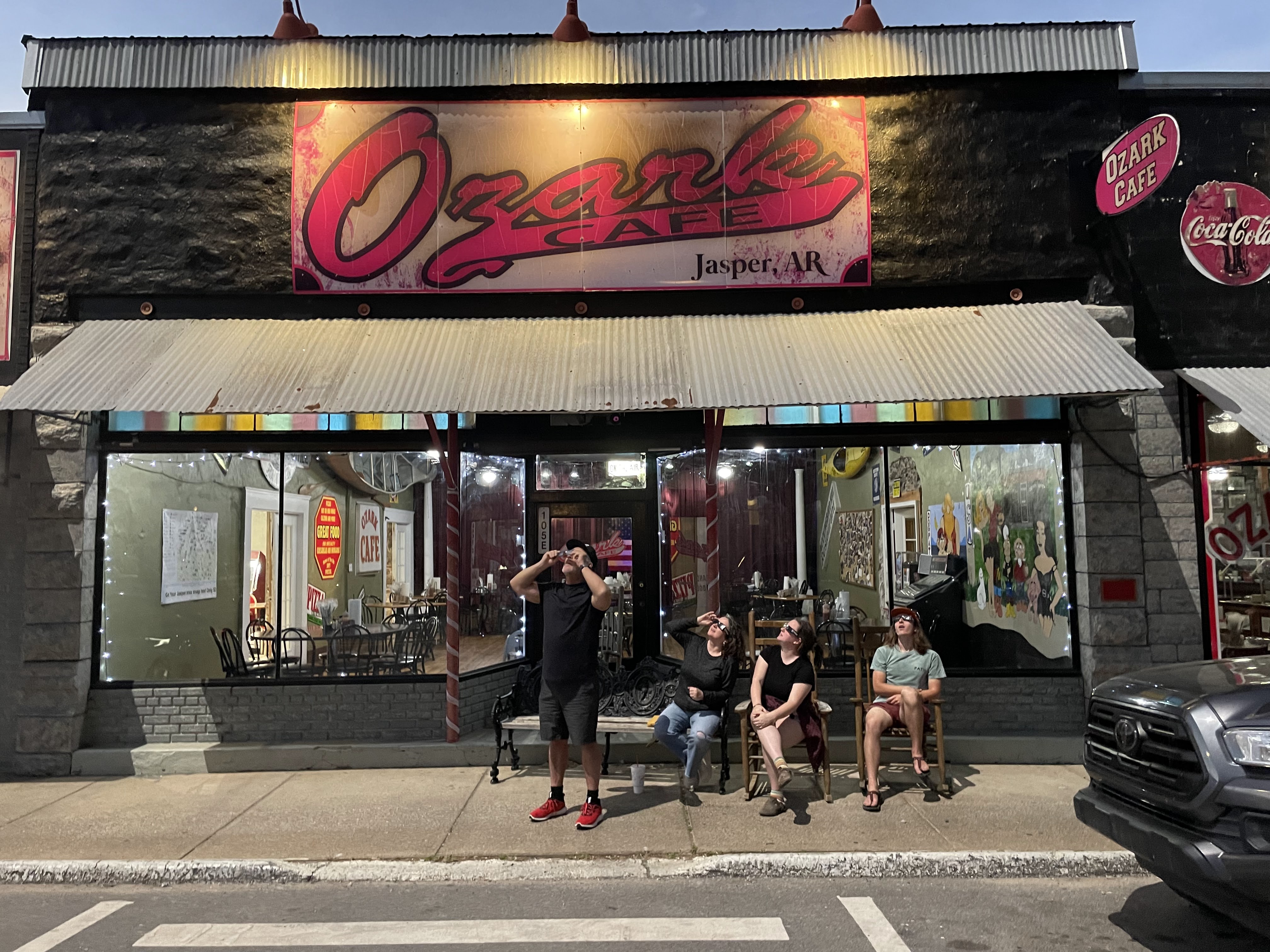
Russ Todd, owner of the Ozark Cafe, said he had plenty of customers on Monday. He said Saturday was normal but business really began picking up on Sunday.

"I've got all the business I need," he said, referring not only to the day of the Great American Eclipse, but every day, in general. 

Ozark Cafe, Jasper, Arkansas, April 8, 2024

As far back as the summer of 2022, predictions were that Jasper, population 547, and Newton County, population 7,228, should prepare for an influx of at least 25,000 people for the eclipse, but crowds were nowhere near those levels on Monday.

"As far as I know we didn't run out of gas, stuff like that that they said was going to happen," said Todd. "Stores were going to be wiped clean. We even got a flyer in the mail that said stock up on everything, I think it was overkill a little bit."

The story further reports on a local conflict over whether the town wanted visitors or not.  Clearly, not everyone was on the same page.  

Representatives from the Mt. Judea Area Alliance reported it has began publicizing the event on its Facebook page to make residents aware of the effects it may have on the community in the way of the number of visitors that may come to see the event.

"We are expecting thousands. That’s a lot of people coming whether we want it to or not. We need to be ready and to make the absolute best of it. All these people coming in to the area will want a little piece of clear sky to view the eclipse. Most will come a day or two before the eclipse to ensure a good spot and to enjoy the local area. Our roads will mostly likely be highly congested and traveling anywhere whether it’s for groceries or doctors’ appointments or anything else is projected to be near impossible to do in any timely manner. So, here’s just a touch of what you may want to do to prepare:

"Reschedule or don’t schedule any appointments from April 5th to April 10th, just to be on the safe side.
Newton County Courthouse Square
Jasper, Arkansas
April 8, 2024

Make sure you have enough groceries, water, gas, MEDICATION, or anything else you might need to hold you over during the same time frame.

"Plan to not leave home or the area during this time, if possible, as it will probably be cumbersome if not near impossible to travel our roads.

"BONUS: You may want to check on utilizing your property, rental home, etc. to allow those people coming in to stay in or camp on. This could be a big opportunity to cash in on a little extra Christmas money! There will probably not be anywhere near the motel space, camping spaces, Air B&B’s, rental cabins, etc needed to accommodate everyone coming to the area. {You may want to check on extra insurance if you decide to do this. Most insurance companies have an “event” insurance that is a one time fee to cover a specific event days. It’s as easy as making a phone call.) Or, if you don’t want them staying, you may choose to set up a table and canopy on your property (depending where you live) and sell water, t-shirts, baked goods (be sure to check cottage food laws), cups, or other memorabilia items that they might be interested in.

"There is already an eclipse committee for Newton County and they have been busy since last year planning for safety, medical services, police services, etc. There is a public Facebook page that offers access to some extra information on the eclipse, if you use Facebook. It is “Eclipse 2024 Newton County, AR”. If you have any questions, you can reach out to us and we will do our best to answer or help. We are just about 9 months away from the eclipse. What a blessing to be us and have the best seats to view it without having to travel to enjoy it."

It was noted the Alliance is joining with the American Legion in preparation of the eclipse. The groups have been able to secure four portable toilets, two at the Legion Hut and two in Mt. Judea for a week. The cost is $150 each, but does not include the cost for emptying them. Outside sources are being sought to perform this task.

The Newton County Times first reported on local eclipse preparation in May, 2022, and by Sept. 19, 2022, the headline was "Time running out to prepare for the eclipse."

Ozark, Arkansas on April 7
(c) Lisa R. Pruitt 2024
As for other parts of the state, initial reports of eclipse tourism in the southwest area suggest disappointment in the turnout there, too, as the Democrat-Gazette reported here.  An excerpt follows: 
Three small-town southwest Arkansas mayors said in phone interviews that the numbers the Arkansas Department of Parks, Heritage and Tourism told them to prepare for for Monday's eclipse didn't bear out.

"It's pretty much a bust. Our numbers are not nearly what we were told they were going to be," said Murfreesboro Mayor Jim O'Neal. "We've got entertainment, we've got the diamond mine; we anticipated 40,000-plus visitors, and we did not even begin to come close to that."

Crater of Diamonds State Park was seeing decent patronage over the weekend and directing visitors beyond their capacity into town. Some businesses did OK, but O'Neal said the event was "a major disappointment" and expects the city government to take a financial loss. Chamber of commerce and other planned local fundraisers went for naught.

"We rented port-a-potties and empty trash dumpsters, and they're of very little use," O'Neal said. "It obviously cost us a lot of money. It cost us money we didn't recoup because of this exaggerated number."
Porta potties lined up in front of the district court
Ozark, AR on April 7
(c) Lisa R. Pruitt 2024

A Democrat-Gazette story the next day had a more optimistic cast, suggesting that 200,000 folks had visited the state's parks for the eclipse: 

Gov. Sarah Huckabee Sanders said in early March that anywhere between 300,000 to a million visitors could travel to the state for the eclipse.

Despite grumblings from some merchants and restaurateurs over crowds that left them with surplus food and merchandise, state officials seemed pleased with how the state fared with the eclipse.

According to a statement from Shea Lewis, secretary of the Arkansas Department of Parks, Heritage and Tourism, Arkansas Welcome Centers greeted more than 41,000 visitors from dozens of states and 14 countries.

"This years' solar eclipse introduced Arkansas to new visitors from around the country and around the world," Lewis said. "We're thrilled so many came to enjoy all our beautiful state has to offer and look forward to welcoming visitors back again and again."
Sign painted on window of a business in Ozark, Arkansas
(c) Lisa R. Pruitt 2024

Meanwhile, other media outlets reported on visitors to other rural regions in the zone of totality.  Here is some reporting by North State Public Radio in New York on the economic impact of the eclipse there: 

Monday, April 8 was the best sales day ever for the [Hotel Saranac's] restaurant. They also sold street food that day during Saranac Lake’s Solar Fest event.

“We had three food vendors and all we did was tacos- total tacos- and I think we sold almost 200 tacos that day and people came in and got to enjoy Saranac Lake," said [the hotel's director of marketing and sales]

Other hotels, motels, and short-term rentals around the Adirondacks were also booked full, some a year in advance. Using that and other economic data, the Regional Office of Sustainable Tourism estimates that Essex County alone saw a $2.2 million boost in business compared to the same time last year.

One local restaurant in Saranac Lake that was busy all weekend was the Blue Moon Cafe. Owner Kenny Fontana said it was overwhelming at times. “We had three days where everybody really worked 12-13 hours."

* * * 

But the haymakers may have largely been hotels and restaurants. A few people who own a convenience shop in the area didn’t want to talk on the record, but said most people who came into their shop just wanted to use the restroom during the eclipse. They believed the region and state overhyped the event.

And here's a late March Washington Post story on anticipated spending from eclipse tourism.

Here's a mile-by-mile map of the solar eclipse, from the Washington Post. 

Here's a report on employment and wages in the path of the eclipse.   

Here's a story on AirBnB bookings in the path of totality.

Postscript:  The April 24, 2024 issue of the Newton County Times reported on an April 15, 2024 meeting of Local Emergency Planning Committee.  The headline is telling:  "Preparations wouldn't have changed for the eclipse."  In other words, local officials say they wouldn't do anything differently--either to attract more tourists or try to deter them from coming--if they had it to do over.  Oddly, the newspaper's website includes no link to the story.  

Monday, November 6, 2023

History repeats itself on Arkansas' Buffalo River

I grew up on chatter about the Buffalo National River, the nation's first national river, which was designated in 1972.  I grew up on that chatter because I grew up five miles from the river, in Newton County, Arkansas, home of the river's headwaters.  

My parents talked in my early childhood about their friends--the parents of my friends--whose land was condemned by eminent domain to become part of the park's land, owned and controlled by the federal government.  

While I was still a tween and teen, I saw the establishment of canoe rental enterprises in Jasper and surrounding communities, businesses that had been granted concessions by the National Park Service.  The county attracted growing numbers of tourists as it was remade into a regional ecotourism destination.  (Read more about that here and here; this is just some of my coverage of an industrial hog farm that threatened the river for several years starting in 2013). By the time I was in college and law school at the University of Arkansas (Fayetteville), 80 miles to the west, I had become a tourist on the river myself, consuming (in a sense) the very rurality in which I'd grown up, the very wilderness I'd taken for granted.  (See more photos of Newton County, including the county seat, Jasper, here and here).  

Decades on, I saw the proliferation of vacation rentals--even buildings like a beauty salon in Jasper converted to an AirBnB.  Though I've not seen any news reporting or data on the topic, folks in Jasper have told me that the widespread conversion of buildings to short-term rentals has resulted in a housing shortage.  Of course, that's happening in lots of rural communities, and urban ones, too.

In the past few weeks, the Buffalo has suddenly burst back into the news, once again in relation to its status as a national river.  The reason:  two grandsons of Sam Walton, the legendary founder of Walmart Corporation, have been working behind the scenes--apparently in cahoots with Governor Sarah Huckabee Sanders and U.S. Congressman Bruce Westerman--to get the river re-designated from a National River to a National Park Preserve.  

I first saw this news on the front page of the Arkansas Democrat Gazette on October 7, but it didn't seem to break through the standard media humdrum until KUAF, the NPR station associated with the University of Arkansas, two counties over ran this program on Oct. 16.  After that segment, things started popping on social media, and the next thing I knew, I was seeing reports on X (formerly known as Twitter) of a town hall held in my hometown on Thursday, Oct. 26.  Though only about 550 folks live in Jasper, twice that many reportedly showed up at the Jasper School cafeteria, which photos show at overflow capacity.  Another couple thousand folks were said to have attended the meeting on Zoom.  

Meanwhile, the Madison County Record, a weekly newspaper in neighboring Madison County, which lies to the west, between Washington County (where the land grant University of Arkansas is) and Newton County, has been credited with breaking the story of the proposed  re-designation of the Buffalo River.
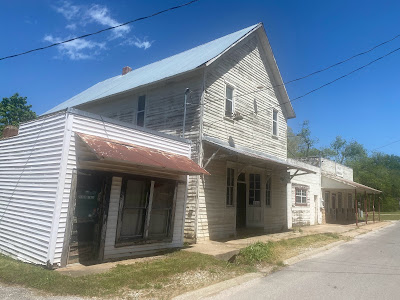
Historic building in Kingston, Arkansas, just off the square.
(c) Lisa R. Pruitt 2023

That is, apparently it was the Madison County Record that first reported that the Walton Family was buying up land in Madison County with an eye to its long-term appreciation if the Buffalo National River becomes a bigger deal. I can't find that coverage online, but here's more from the Arkansas Democrat-Gazette on Walton land purchases in Madison County, including a building on the Kingston town square bought under an alias with a Nebraska address in December, 2021.  The Waltons, via the spokesperson for their Runway Group, have issued this statement about the Kingston property: 
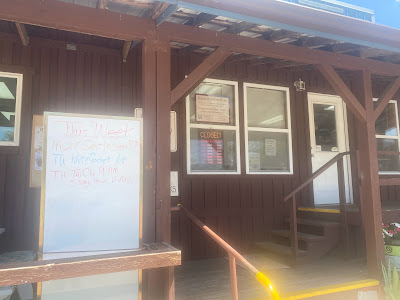
Kingston Community Library
(c) Lisa R. Pruitt 2023

As part of a restoration effort, members of the Walton family acquired three historic buildings on the square in downtown Kingston, intending to update them and open their doors to the community. While we don’t yet have a timeline for the opening, we will share more when we do.

Though Kingston is in Madison County, its school is part of the Jasper School District. You can see a photo of downtown Kingston here.  (And there is a darling, tiny and well-cared-for library on the town square in a squat wooden building that presumably has not been purchased by the Waltons, but lies amidst the three they now own).

Of note is that the Madison County Record has made free its coverage of the Buffalo River re-designation, including this about the community meeting in Jasper on October 26.  What follows is from publisher Ellen Kreth's reporting: 

After a town hall meeting last Thursday, proponents of turning public land around the Buffalo National River into a national park preserve said they would step back from the idea. The following day, a website touting the benefits of re-designating the land was taken down.

But opponents of the idea are not backing down and don’t trust that efforts to re-designate the land are no longer ongoing.

Misty Langdon, owner of Steel Creek Cabins, who organized the town hall meeting, said proponents have poured too much time, resources and money “into this project that seems to be linked to Bryan Sanders [Gov. Sarah Huckabee Sanders’ husband],” to just walk away.

In July 2022, the Runway Group approached U.S. Rep. Bruce Westerman, R-Ark., who represents Arkansas’ 4th Congressional District and chairs the Natural Resources Committee, with the idea of making public land around the river a national park preserve.

Grandsons of Walmart founder Sam Walton and co-founders of the Runway Group, Steuart and Tom Walton are investors in real estate, outdoor initiatives, conservation, recreation, hospitality and businesses in Northwest Arkansas.

* * *

The Runway Group also has been linked with working with the governor’s office and the First Gentleman on the possibility of re-designating public lands.

Last Friday, Runway Group’s Vice President of Corporate and Community Affairs Krista Cupp said the group watched the town hall meeting. She reiterated they are not going forward with any proposal for re-designation. There are “no next steps,” she said.

“We wanted to explore a new idea for our home state together. However, this is not our decision to make. There is no new action being taken,” a statement issued earlier by the Runway Group said.

Cupp said when the group approached Westerman, it didn’t present a proposal to re-designate the land but simply asked if the idea was worth exploring.
Kingston Community Library 

Two Westerman staff members attended the town hall in Jasper, and his office issued a statement including this: 

Although it is in the purview of the House Natural Resources Committee to advance legislation to designate National Parks, I’ve made it clear I would not support any proposition that does not have grass roots support from those that live, work, and raise their families in the Buffalo River watershed.

As the Representative for Arkansas’s Fourth Congressional District, my first priority is advocating on behalf of my constituents. I will continue to listen to the thoughts and concerns of Arkansans that would be impacted by any change in designation. 

Westerman said he had no plan to write or introduce any legislation that would re-designate the land. 

While the Madison County Record story says the meeting was convened by Misty Langdon of Steel Creek Cabins, another report says it was convened by a non-profit that appears focused on preserving the area's history, the Remnant Group.  

Here's part of a column by Jared Phillips, a Washington County farmer who teaches at the University of Arkansas, writing about what's at stake with the proposed re-designation. 
This push by the heirs of Sam Walton to take control of Arkansas’s resources nakedly shows their true aim: control, not philanthropy. The news surrounding the proposal to change the designation of the Buffalo National River, alongside the reported purchase of Horseshoe Canyon, continued land grabs along the Kings River and more amount to only one thing: the wealthiest in the region are pushing the rest of us out. Removal by way of development and recreation is still removal.

The thing is, claims that this development will ease poverty and boost economic vitality in rural areas is suspect at best. Across the nation, developing rural outdoor recreation areas doesn’t produce a meaningful decline in poverty rates at a county level. In fact, in many cases — and Newton County is one — when poverty rates go down in these areas, it has less to do with a wage increase or better opportunity. Economic indicators look better simply because poor folk can’t afford to stay in their place any longer and must leave. That’s why we’ve seen both a drop in poverty in Newton County and a drop in population. The claim that this sort of transition brings about wholly positive things is, on its face, untrue.

The current conversation about the Buffalo isn’t actually about the river. Bike trails, art parks, high-brow museum expansions — it’s not really about that. It’s about the future of the Ozarks. All of us, old stock and new, need to ask ourselves if we are truly represented in the decision making that is shaping — often literally — the next generation’s hills.
And if we’re honest, the only answer is that we’re not. If we truly were, we’d see regional efforts to push the wealthiest and the powerful to put their money where their mouth is. We would see meaningful, long-term action to effectively address economic injustice and food security in the region. To address worker safety. To thoughtfully and wisely engage in land planning that preserves working, welcoming landscapes instead of putting fences around elite, enclosed playgrounds built on the bones of our grandparents.

Instead, what we have is an idle class dictating the region’s future according to their own wishes.

A 2021 column by Phillips and published in the Democrat-Gazette echoed some similar themes and challenged the notion that a rising tide lifts all boats.  Read it here.  

Then, yesterday, Arkansas Democrat-Gazette columnist Rex Nelson wrote in favor of the proposed National Park Preserve, offering a perspective that runs squarely counter to that of Phillips. The headline, "Loving it to death," is a reference to tourists loving the Buffalo River so much that they come in such great numbers that the current infrastrcture, e.g., parking lots, toilets, is overwhelmed.  Interestingly, Nelson vouches for the Walton brothers--declaring their motives "pure."    

In addition to their distrust of government, those who live in these hills distrust outsiders. They’re concerned by the large amounts of land being bought by entities associated with brothers Tom and Steuart Walton of Bentonville. I know the Walton brothers, and I want to make one thing clear: Their motives are pure. They realize that our state’s ability to attract and keep talented people in the decades ahead will rest in part on our protecting and enhancing outdoor recreational attributes.

The Walton brothers could live anywhere in the world and do anything they want. But their focus these days is on enhancing quality of life in Arkansas. Other states should be so lucky. Their involvement in the Coalition for Buffalo River National Park Preserve doesn’t worry me. It gives me hope that this effort will succeed.

Here's a competing column from Mike Masterson arguing that the river should be left as it is.  And here's a column from John Brummet, political columnist writing for the Democrat-Gazette, "Selling the state down the river?"  Brummet, too, is skeptical of the wisdom of a re-designation and of the motives of Governor Sanders and the Walton brothers.  

Here's a post on how to bring oldtimers and newcomers together in places like Newton County.  And here's a post, in the context of an industrial hog farm controversy a decade ago about how the interests of folks in Fayetteville and the wider northwest Arkansas region are often seen as being at odds with those of the rural, Newton County locals.  And that reminds me:  I've not seen anyone talking about how many of the folks who showed up at the Oct. 26 meeting were "locals" from Newton County--as opposed to "environmentalists" or "conservationists" from the wider region.  

Postscript:  Here's a Nov. 8, 2023 update from the Madison County Record reporting that the Newton County Quorum Court (essentially a county board of supervisors) had voted unanimously to oppose any re-designation of the Buffalo National River.  A quote follows: 

Newton County Quorum Court members passed a resolution at their Nov. 6 meeting opposing “the changing of the name designation or expansion of the Buffalo National River, and any further negative impact on the agricultural lands or infringement on private ownership on the Buffalo National River Watershed.”

The vote was unanimous with approximately 25 citizens in attendance.

Justice of the Peace Jamie Mefford said the court wanted to show its opposition to any name change, park expansion, private land rights restrictions and any agricultural restrictions.

The Newton County Times currently has yet to post anything about this on its webpage.  Sad when the neighboring county newspaper is able to cover a county's news faster than its own paper can.  

Monday, October 16, 2023

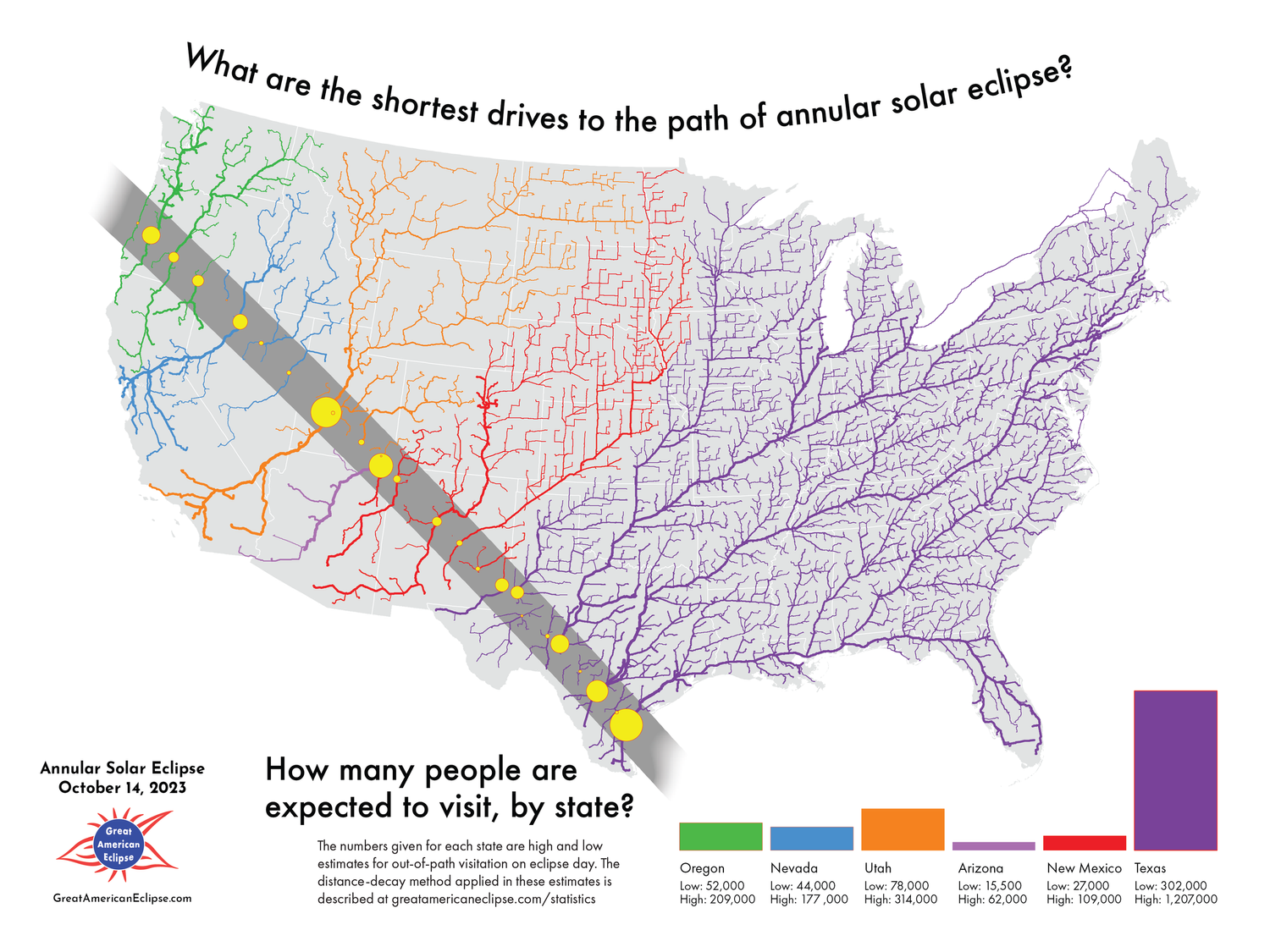
Ring of fire brings floods of tourists: hundreds of thousands travel across the American West to see an annular eclipse

This weekend, a rare annular eclipse crossed over the Americas. Beginning in Oregon around 9 am local time on October 14, the eclipse cut through the American Southwest and Yucatan Peninsula in Mexico before traveling over Central America, Columbia, and Brazil. States within the path of annularity prepared for an onslaught of ecotourists coming to experience the once-in-a-generation event. In the United States alone, an estimated half a million to two million people were expected to travel for the eclipse.

Travel Oregon, the state’s tourism agency, advertised the many opportunities for businesses along the path. Klamath County organized a week-long Eclipse Fest to celebrate. County officials issued a travel advisory on Saturday and collaborated with more than a dozen federal, state, and tribal agencies to handle a wave of ecotourists that were expected to temporarily double the county’s population.

Remote Modoc County, California, expected tourists to outnumber residents as Californians flocked to the only county in the state in the path of the eclipse. Hotels in the small town of Alturas, population 2,715, booked out for the weekend.

In neighboring Nevada, Great Basin National Park welcomed visitors with guided viewings, astronomy programs, and guest speakers from NASA, while the nearby town of Ely, population 3,924, hosted a 4-day Ring of Fire Eclipse Festival. Meanwhile, the state’s tourism agency directed visitors to the best viewpoints and state energy officials prepared for a temporary shift as the eclipse dampens solar energy production, which accounts for over a third of the power supply for the state.

The Utah Department of Transportation warned visitors and residents alike of heavy traffic, as an expected 300,000 travelers drove across central Utah roads and highways. Thousands of visitors flocked to Bryce Canyon National Park for clear skies to view the eclipse.

While other parks were filled with crowds, the Monument Valley Navajo Tribal Park was closed in keeping with sacred tradition. For the Navajo people, or Diné, as they call themselves, solar eclipses are a time for reflection and tranquility. The Navajo practice solemnity, not spectacle, out of reverence for the rebirth of the sun, which they regard as a father figure. Tribal educators instructed their people to pray in their homes and to avoid eating, drinking, sleeping, or looking at the eclipse, following centuries of tribal practice.

Just north of the Navajo Nation, the Bear Ears National Monument, which is co-managed by the Bureau of Land Management and indigenous tribes such as the Hopi and Ute, prepared for as many as 20,000 visitors. The Bear Ears Partnership informed tourists of the different beliefs held by those tribes, who view the area as sacred and encouraged them to visit with respect.

While the West relishes in the increased tax and travel revenues and returns to normal life, the Northeast, Midwest, and South prepare for future crowds of their own. A total eclipse will cut a path from Texas to Maine on April 8, 2024. While Indiana gets ready for what is expected to be the single largest tourist event in the state’s history, Ohio anxiously awaits the estimated $23 to 94 million in economic benefits that it hopes to gain from eclipse tourism.

You can read more about preparation efforts in Newton County, Arkansas, here. You can read about eclipse tourism during the last solar eclipse in 2017 here.

Wednesday, April 12, 2023

Law and Order in the Ozarks (Part CXXXVII): Recent developments in the reach of Newton County law enforcement

It's been a while since I've blogged about issues out of Newton County, Arkansas (population 7,225) where I grew up, but I want to catch up here primarily on recent news regarding law enforcement staffing in the county.  My focus here is on two stories about beefing up security/law enforcement presence in two places--one a school and the other the courthouse.  

First, a Newton County Times story from October, 2022, reported that the Deer/Mt. Judea School District was hiring a school resource officer.  Here's an excerpt:   

The board has been discussing the possibility of hiring an SRO the last couple of months as the need for on campus security has become a growing concern of school staff and students' parents.

Superintendent Brenda Napier said the cost to the school district would be meeting the officer's salary which has been estimated between $34,000 and $40,000 per year depending on the officer's amount of training and experience.

The actual interviewing and hiring process will be done by the Newton County Sheriff's Office.

The scope of the officer's duties and how the officer would be assigned to cover both campuses will have to be determined by the school board, Napier said.
Nothing in the story indicates why an SRO is needed--that is, whether safety issues have arisen.  
In other news, the board accepted the resignation of the district's school nurse and approved a list of transfers into the school district. All will be enrolled in the district's Digital Education Program. One student is transferring out of the district. The board also accepted the annual legislative audit report.
I have not seen any update on the hiring of an SRO, and meanwhile, in March 2023, the Jasper School District Board of Education applied for a $120K School Safety Grant from the State of Arkansas Division of Elementary and Secondary Education. The application notes that the school district has not conducted a comprehensive school safety audit or assessment, but it has done the following:
• Conducted an annual lockdown (active shooter) drill at each school
• Provided current floor plans and pertinent emergency contact information to appropriate first responders
• Developed a School Safety Plan for each school and provided annual training for all staff
• Identified an individual in the district responsible for overseeing school safety
• Implemented strategies to increase the presence of trained law enforcement officers or commissioned school security officers on school campuses.

Safety measures not yet in place on all campuses include:

• Electronic access controls for high frequency use exterior doorsCovers for vision panels on classroom doors that prevent viewing into the classrooms and allow students a blind area to hide during a lockdown
• Temporary door stoppers or blockers for doors that need additional security may also be purchased, but must comply with current state Fire Prevention Code and ADA standards for accessible design
• Numbers on classroom interior and exterior surfaces easily identifiable to first responders so they can reference the position of students and or intruders.
• District campuses should have fencing that limits access to the school entrances, especially the main entrance.
Other priorities include security cameras, shatter resistant film or other reinforcement for glass windows and physical barriers to prevent access at the main school entrance.

More recently, the Newton County Times reported on March 13 that the Quorum Court has created a courthouse security officer position.  Here's an excerpt: 

The Newton County Quorum Court met Monday night, March 6, and created a position and the budget for a courthouse security officer. Now, all that is needed is for interested, but certified, individuals to apply for the job.

County Judge Warren Campbell said having a courthouse security officer isn't required by state or federal laws. However, he and other courthouse officials feel times being what they are additional security in the courthouse would benefit county employees as well as the public who comes here to do business or attend court. Over the years, the courthouse security has been beefed up with closed circuit monitors, electronic locks on the entry doors and stronger interior doors.

Rarely is there an officer from the sheriff's office in attendance at quorum court meetings.
The security officer would be required to attend all county courthouse functions upon the request of the county judge at the same pay scale that is approved. "No extra pay." 
This is a full-time position with an annual salary of $28,080. The county would also pay the officer's health insurance, $7,476; noncontributory retirement, $4,301.86; Social Security matching, $2,148.12; Workmen's Compensation, $500 and Unemployment Compensation, $300.

Some of the Justices of the Peace (members of the Quorum Court, like a County Board of Supervisors) noted that the county insurance alone would be attractive to prospective employees.  Still, Donnie Davis, County Clerk, said that although the position has been discussed openly around the courthouse, no one has yet to inquire about it.  The lack of inquiries may be due to the requirement that the employee must have graduated from the Arkansas Law Enforcement Academy, and the cost of the training is not included in the county budget.  

That same issue of the paper includes this story about a man who accuses the federal park rangers with the Buffalo National River of abusing their authority.  Thomas Jefferson, a  U.S. Army veteran and resident of Marion County, is accusing National Park Service rangers of abusing their authority.  He is seeking to make the public aware that these rangers' authority applies only within national park boundaries.  An excerpt from the story follows: 

Johnson appeared before the Newton County Quorum Court at its March 6 meeting and asked for time during the part of the meeting when JPs open the floor for public comments.

He called attention to NPS Director's Order #9 - 2005, a copy of which he distributed to the court members.

Johnson contends,  

[T]he park service doesn't want you to know about the[se limits on their power].

The information he submitted defines more in detail park service rangers' law enforcement limitation. They may request local, county or state law enforcement personnel to assist with law enforcement actions within the boundaries of a national park. Rangers cannot be deputized by local or state law enforcement authorities for any law enforcement action that occurs outside a national park boundary.

NPS park ranger assistance can be obtained by outside law enforcement only in cases of emergency. Emergency is defined for use only in response to an unexpected occurrence the requires immediate attention and to the administration of the park such as fire, accidents, local/state law enforcement assistance or actions that place the public in harm's way. NPS law enforcement park rangers cannot assume law enforcement authority outside the national park boundaries.

Johnson cited the National Park's Reference Manual 9-2015, which defines the scope of the rangers' jurisdiction, and he took questions from the Justices of the Peace.  Johnson explained, 

If a violation occurred within the boundaries the ranger can pursue and make a stop outside the park boundaries. But if the ranger is making a stop for a violation outside the park boundaries he has no authority to do so. Johnson said to let the ranger know the limitations of the ranger's authority.

Johnson argues there is a conflict between state and federal laws and courts are allowing this to happen, apparently for the revenue collected through fines.

Johnson concluded: 

I've exposed it and I'm not shutting up.

Also in that issue of the paper is this story about a man sentenced for leading unauthorized hiking tours on the Buffalo National River.  Here's a prior post about the man working as a guide without the permission of the Buffalo National River authorities. 

The February 15 issue of the paper reports that the Jasper Police Department purchased a 2023 Dodge Durango with a USDA Rural Development Grant.  That issue of the paper also reminds readers that Newton County is served by Sanctuary, Inc., a "temporary shelter and extended assistance, support and education to victims of domestic violence."  This information was shared at a meeting of the Newton County Hometown Health Coalition.  Sanctuary, Inc. is located in Harrison, 20 miles from Jasper.  

The February 22 issue of the Newton County Times reports that the Sheriff's office has been awarded $62,673.51 by the Arkansas Department of Public Safety to purchase equipment, including 16 tasers, taser certification and required software and warranties. 

In other news reported March 1, the Newton County Sheriff's office has signed a Mutual Aid Protection Agreement with the sheriffs departments in Boone, Searcy Carroll and Marion counties.  It also includes the Harrison Police Department.  The March 22 issue of the paper reports that the Sheriff's Office got a new roof at a cost of $13,700, replacing the one that was 20 years old.  COVID-19 relief funds were used for the project.  Additional work is scheduled on the interior.  

The March 15 issue reported on cases adjudicated in the Circuit Court.  

In non law enforcement news, lettuce grown in a greenhouse on the campus of Jasper School is being served in the school cafeteria, and the Jasper School Board has declared the day of the 2024 eclipse a "professional development day."