Showing posts sorted by relevance for query oklahoma hospital. Sort by date Show all posts

Wednesday, May 15, 2019

Rural poverty and its consequences: Here, there and everywhere

A few major stories about rural poverty and related aspects of rural disadvantage have caught my eye in the past few days, first from the United States and then yesterday out of the north of England.  Population loss, the elderly, and the high cost of service delivery to rural populations are implicated in them.  Two of the stories feature extraordinary photography.

The first is this major piece in the Washington Post on the looming closure of a hospital in Fairfax, Oklahoma, population 1,380.   Eli Saslow, journalist extraordinaire, brings us not just another story of a down-on-its-luck, near death rural hospital, but of the juxtaposition of this pending closure against the circumstances of community:
Childhood poverty climbing up above 30 percent. Accidental deaths doubling in the past decade. Increasing rates of diabetes, heart disease, drug addiction and obesity.
Saslow then puts what's happening in Fairfax, a town in Osage County, population 47,987, and co-terminous with the Osage Nation, in national context:
More than 100 of the country’s remote hospitals have gone broke and then closed in the past decade, turning some of the most impoverished parts of the United States into what experts now call “health-hazard zones,” and Fairfax was on the verge of becoming the latest. The emergency room was down to its final four tanks of oxygen. The nursing staff was out of basic supplies such as snakebite antivenin and strep tests. Hospital employees had not received paychecks for the past 11 weeks and counting. 
The only reason the hospital had been able to stay open at all was that about 30 employees continued showing up to work without pay, increasing their hours to fill empty shifts and essentially donating time to the hospital, understanding what was at stake.
In 2016, the 15-bed Fairfax Community Hospital had been purchased by EmpowerHMS, a Florida-based company that held itself out as “a savior for struggling rural hospitals.” Soon after the takeover, however, Empower began to default on some of the hospital's bills.  Fairfax was one of nine of Empower's hospitals that had since declared bankruptcy; another four had already closed.

The story includes an interesting profile of Dr. James Graham, 67, who has served the hospital and community for 41 years.  Yet with his malpractice insurance premium unpaid by Fairfax Community Hospital, Graham was on the verge of losing his license.  Be sure to give the story a read in its entirety.  Another recent story about a rural hospital closure is here, those one from NPR, featuring Fort Scott, Kansas, population 8,087, and county seat of Bourbon County.

The second big story is out of the United Kingdom's Lake District, in northern England.  Specifically, it features the town of Alston, population 1128, in northeastern Cumbria.  Wikipedia notes that Alston is a market town with several "listed buildings" and also an Area of Outstanding Natural Beauty, surrounded by moors.  Yet the story reported by Ceylan Yeginsu is as depressing as they come, as are Laetitia Vancon's extraordinary photos, particularly those of elderly residents and their living conditions.  A major cause of the human suffering:  government austerity.  The opening excerpt features 77-year-old Trevor Robinson:
Mr. Robinson’s isolation, shared by thousands of older people in Britain, is the result of a chain of cause-and-effect that stretches from rural Cumbria to the halls of power in London. He used to ride a subsidized bus to town until the local council discontinued the route. The council was responding to steep budget cutbacks stemming from the Conservative-led government’s decade-long austerity program.
* * *
But a free bus pass [for the elderly] is of little use if buses no longer reach you, and many retired people have discovered that apparently minor cuts — the elimination of a bus route, the closing of a tiny health care center, community center or post office — can profoundly upend their lives.
Cumbria is impoverished and rapidly aging, yet Alston is an hour from the nearest hospital bed. Yeginsu quotes Peter Thornton of the Cumbria County Council:
It’s always been expensive to deliver services to rural communities because the population is so spread out. But since the central government cuts that started in 2010 this becomes more of a challenge each year.
Cumbria is in the part of England commonly referred to as the Lake District, where tourists have long flocked to walk the moors and enjoy lakeside mansions.  But one of the photo captions observes: 
The idyllic landscape masks pockets of deprivation, inequality and poor health comparable to some inner-city areas.
This reminds me of a thread of the work of British geographer, Paul Cloke, who wrote about the juxtaposition of rural poverty with natural beauty.  I quoted him in my article about rural environmental injustice a few years ago:
Hard times” can be “naturalized in to [such] landscapes” (Cloke, 1997:264), causing rurality to “signify itself as a poverty-free zone” (Cloke, 2006:381). The idyll-ised rural thereby “both exacerbate[s] and hide[s] poverty in rural geographic space” (Cloke, 2006:381).
The third story I'll excerpt here is a bit older, having been published in the wake of California's Carr wildfire last year.  That fire struck Shasta and Trinity counties.  Sam Harnett reports for KQED, the San Francisco area NPR affiliate, "Low-income Communities Struggle to Recover after a Wildfire."  His vignettes of fire victims are nuanced and haunting, but he also provides extraordinary data such as this:
A paper published last year by the National Bureau of Economic Research analyzed 90 years of natural disaster data. It found that major catastrophes increase a county's poverty rate — the percentage of people living below the poverty line — by an average of 1 percent. That's because disasters encourage those who are well off to leave, and it makes those with low income poorer.  (emphasis added)
Indeed, I see Harnett has reported frequently on various aspects of California wildfires.  Another story about disparities in disaster recovery is here, from High Country News.  Sara Viner reports, "Fires are indiscrimiant.  Recovery isn't."

Friday, August 23, 2019

A spate of reporting on rural health care issues

Four feature stories on rural health care, three with compelling profiles of individuals, have come across my news feed in the past few days, so I decided to collect them here.  All of these stories are well worth reading in their entirety, and I'll acknowledge up front that this post won't do them justice in terms of complexity and nuance of the situations addressed.  This post also won't do justice to the incredible journeys of some of the health care providers and other care givers featured.  It also won't do justice to the atmospherics of each of these stories and the rural places on which they are centered.

It's hard to say which story is most tragic but I'll start with one that is a clear contender for that designation, Eli Saslow's report out of Poplar Bluff, Missouri on the high incidence of medical debt in that high poverty community.  Poplar Bluff, population 17,023, is the county seat of Butler County (population 43,000) in the southeast region of the state (near the bootheel).  Here's the lede, plus some in a story that depicts better than I've ever seen in the mainstream media the link between health care costs and poverty/bankruptcy.  
The people being sued arrived at the courthouse carrying their hospital bills, and they followed signs upstairs to a small courtroom labeled “Debt and Collections.” A 68-year-old wheeled her portable oxygen tank toward the first row. A nurse’s aide came in wearing scrubs after working a night shift. A teenager with an injured leg stood near the back wall and leaned against crutches.
By 9 a.m., more than two-dozen people were crowded into the room for what has become the busiest legal docket in rural Butler County. 
“Lots of medical cases again today,” the judge said, and then he called court into session for another weekly fight between a hospital and its patients, which neither side appears to be winning. 
So far this year, Poplar Bluff Regional Medical Center has filed more than 1,100 lawsuits for unpaid bills in a rural corner of Southeast Missouri, where emergency medical care has become a standoff between hospitals and patients who are both going broke.
Twenty-seven year-old Matthew McCormick is an attorney representing the hospital, which means he appears in a different county courthouse each day of the week for lawsuits against that county's residents who have received health care from Poplar Bluff Regional Medical Center.  On the day featured in Saslow's story, McCormick was representing the hospital in 19 cases worth $55,000 total against Butler County residents.  The facility treats 50,000 patients a year, and the cost of the uncompensated care it renders has risen from $84 million to $60 million in recent years.  The hospital is one of about 100 rural and suburban facilities owned by Community Health Systems, who stock price is now below $3/share, having dropped from $50/share in 2015.  Other interesting characters in this story include a self described "old hillbilly lawyer," Daniel Moore, who began a few years ago to take cases pro bono on behalf of those being sued by the medical center.  He has sometimes succeeded in cases that have gone to trial, in part by demonstrating the self-evident unfairness of the prices charged, e.g., $838 for a pregnancy test.

In buckling under bad debt, Poplar Bluff's hospital is not alone among rural facilities.  More than 100 have closed in the last 10 years and many others are on the brink of insolvency.  (A recent related story by Saslow, this one out of Oklahoma, is featured in this blog post).  Saslow notes what many of us already know:  "Unpaid medical bills are the leading cause of personal debt and bankruptcy in the United States according to credit reports."

Indeed, the story reminds me of what Elizabeth Warren found when she began to investigate the causes of bankruptcy several decades ago, as reported in the NYTimes Magazine a few months ago.  Another really interesting feature of this story is its depiction of the debt collector--the under-30 lawyer employed by the hospital to show up at these rural courtrooms and bargain literally every day with people who have not a dime to spare.  (Other relatively recent posts out of his corner of rural America are here and here, some of them based on reporting by the Washington Post.  Here is a post on the region as a high poverty one).

Next is this Bloomberg News piece out of Montana, "The State with the Highest Suicide Rate Desperately Needs Shrinks."  Monte Reel's story is set mostly in Glendive, Montana, population 4935, and the county seat of Dawson County, and it also refers to Glasgow, Montana, population 3319, and the county seat of Valley County.  Both are in the state's eastern section.  The face of this story is Dr. Joan Dickson, the founding director (2002) of the mental health unit of Glendive's Medical Center, an inspiring character who, as this story was being written, had taken a leave of absence to help care for an ill sibling in another state, leaving the unit abandoned.  Dickson,who is both a family practitioner and a psychiatrist, has a dual-specialty private practice in Glendive.  She also works part time for the Veterans Administration as a regional psychiatrist and she serves (for the nominal fee of $1/year) as medical director for Eastern Montana Community Mental Health Center, a network of clinics.

Here's an excerpt about the struggle for the unit in Glendive to hire and keep a psychiatrist, the only one between Bismark, North Dakota and Billings, Montana:  
Last fall, after years of fruitless recruiting drives and ad placements, the center finally snagged a recently graduated psychiatrist to oversee the unit. This spring, not long after the local newspaper celebrated her arrival, she quit. “I think maybe it was just a little too much for someone without experience to take on, and I don’t blame her,” says Shanks, who as marketing director is part of the recruitment team. “There’s such a huge need out here, and I can see the burnout in mental health providers that comes out of that.”
This echoes what young lawyers sometimes say about why they don't want to work in rural areas--they just don't feel competent enough not to have mentors around.

I also want to highlight this language from the an ad the local hospital ran seeking to attract a new psychiatrist:
Welcome to Glendive, Montana! Outdoor enthusiasts will thrill to almost limitless possibilities around Glendive. Imagine watching the Milky Way nightly and counting shooting stars as you fall asleep; quiet so deep you can hear your soul relax; hunting or just having a staring contest with wildlife. The Yellowstone River, the nation’s longest untamed river, starts in Yellowstone Park and flows through the heart of Glendive. It’s a great source of recreation, agate hunting, and paddlefishing … .”
This reflects the strategy I've often advocated for attracting young lawyers to rural areas rich in natural amenities:  lead with those outdoor amenities on the assumption that the persons you are likely to be successful in recruiting will one seeking such a lifestyle.

As for the need for mental health services in places like this, here are some data points:
  • The national suicide rate has jumped 33% since 1999, and the spike has been sharpest in rural counties, 52%, compared to about 15% in urban areas.  
  • Rural residents are twice as likely to commit suicide as urban residents. 
  • The stressors include farm debt and diminishing farm incomes.  
  • About two-thirds of all rural counties lack a psychiatrist, and about half lack a psychotherapist.  
The third recent story on rural health care is this Cal Matters report, "Paging More Doctors:  California's Worsening Physician Shortage" about the situation primarily in rural far northern California, between Sacramento and the Oregon state line.  It's set mostly in Bieber, California, population 312, which I've written about previously here and here, and features Bieber's local son--now aged 71--Daniel Dahle.  Here's the story's lede:
In a northern California valley stretching under miles of bright blue sky between two snowy volcanic peaks, Mt. Lassen and Mt. Shasta, Daniel Dahle is known as a godsend, a friend, a lifesaver, a companion until the end.

For more than three decades, “Doc” Dahle has been the physician in Bieber, serving a region about the size of five smaller U.S. states. When he started, he was one of five doctors in the region. Today he is joined by only one other full-time physician.

At 71, Dahle has delayed retirement for years — waiting for someone to take his place.

“I was going to retire November 8th of last year; it was going to be a third of a century,” he said. “It’s tough to recruit young new vibrant family practitioners or internists or pediatricians to come up here.”

Unfortunately, Dahle’s situation is not unique.

California is facing a growing shortage of primary care physicians, one that is already afflicting rural areas and low-income inner city areas, and is forecasted to impact millions of people within ten years. Not enough newly minted doctors are going into primary care, and a third of the doctors in the state are over 55 and looking to retire soon, according to a study by the Healthforce Center at UC-San Francisco.
The Washington Post ran this story, dateline Dover-Foxcroft, Maine (population 4213), last week.  It's not exactly about health care, but really about elder care.  An excerpt from Jeff Stein's story follows:
Across Maine, families ... are being hammered by two slow-moving demographic forces — the growth of the retirement population and a simultaneous decline in young workers — that have been exacerbated by a national worker shortage pushing up the cost of labor. The unemployment rate in Maine is 3.2 percent, below the national average of 3.7 percent. 
The disconnect between Maine’s aging population and its need for young workers to care for that population is expected to be mirrored in states throughout the country over the coming decade, demographic experts say. And that’s especially true in states with populations with fewer immigrants, who are disproportionately represented in many occupations serving the elderly, statistics show.
* * *
By 2026, Maine will be joined by more than 15 other states, according to Fitch Ratings, including Vermont and New Hampshire, Maine’s neighbors in the Northeast; Montana; Delaware; West Virginia; Wisconsin; and Pennsylvania. More than a dozen more will meet that criterion by 2030. 
Across the country, the number of seniors will grow by more than 40 million, approximately doubling between 2015 and 2050, while the population older than 85 will come close to tripling.
* * *
About one-third of Maine’s physicians are older than 60. In several rural counties in the state, close to half of the registered nurses are 55 or older and expected to retire or cut back their hours within a decade.
And here's a story, not explicitly oriented to rural but with clear spatial implications, about the use of telemedicine for the elderly.  Here's a rural healthcare story from the New York Times in July, 2018, which previously evaded me on the blog.  It includes brief anecdotes from rural health care providers from around the United States and Canada. 

Don't miss the new documentary out from Bullfrog Films, "The Providers," (as in healthcare providers) out of rural northern New Mexico.  

Friday, August 21, 2020

Coronavirus in rural America (Part LXXXVI): Three NPR rural stories this Friday afternoon

The first is out of Orangeburg, South Carolina, population  13,964, reported by Victoria Hansen.  An excerpt follows: 
The county is one of the poorest in the state, and more than half of its population of 86,000 is Black. African Americans have been hit especially hard by the coronavirus. 
What's more, there is just one hospital for people in four counties. Pastor Greene says the virus has done more than just make people sick. It's highlighted decades of inequality. 
GREENE: We are living in a season of exposure. And when your infrastructure is not in place, everything's exposed. So all of our leaks, all of our cracks, everything that has been going on in our community is now - has come to the surface. 
* * *
HANSEN: Charles Williams is the CEO of the Regional Medical Center. 
CHARLES WILLIAMS: We really were about to pop. We had over 60 patients in house. And we said, OK, we have to have a valve. 
HANSEN: That's 60 coronavirus patients in a hospital that can handle no more than 162 beds. At times, they're almost all full. So the hospital has set up a giant white tent outside.
The second story is out of Aroostook County, population 71,870, in far northern Maine.  Robbie Feinberg reports from a school that's just opened, even as those in southern Maine have not.  Here's an excerpt:
Elaine Boulier is superintendent of the MSAD #42 school district. She says the decision to reopen has been easier here in Aroostook County along the Canadian border. The farming community is relatively isolated, and the county has had less than 40 confirmed cases of COVID-19 since March. Also, the school district serves only about 400 students. But even in an area with no community spread, back to school looks a little different, beginning before students even arrive in the classroom.
The third story is the most poignant, about an elderly Cherokee woman in northeast Oklahoma who died from coronavirus in early July.   Her name is Edna Raper, and she was one of 2000 fluent Cherokee speakers in the country. 
SHAPIRO: Raper lived in Kenwood, Okla. Her lifelong dream was that her four children and 13 grandchildren learn Cherokee. So she came up with all sorts of ways to introduce them to the language. 
CORNISH: For instance, singing lullabies to them in Cherokee. 
SARAH PICKUP: (Singing in Cherokee). 
SHAPIRO: Here's Raper's daughter Sarah Pickup. 
PICKUP: She babysat both of my little girls, so any time it was naptime or bedtime, she was just - she'd started singing in Cherokee. And that's how she'd put them to sleep.
The population of Kenwood, Oklahoma, an unincorporated community is 1,224.  It is in the heart of the Cherokee nation.  Don't miss the entire story about this incredibly generous and community-minded woman, part of the NPR series on those who have died from the coronavirus.  You will be moved and humbled. 

Saturday, March 28, 2020

Coronavirus in rural America (Part VI): Small-town grit and preparedness in Oklahoma

Annie Gowan and Juliet Eilperin report for the Washington Post out of Bristow, Oklahoma under the headline, "Small town battled coronavirus on its own, as outbreak spread in a red state."
Epidemiologist Mark Brandenburg saw the threat months ago: The data coming out of China signaled that this could be "the pandemic we had feared for a long time."

The chief medical officer of a small hospital in this town of 4,200 people, Brandenburg didn't wait for orders from the federal government or direction from the statehouse. By mid-February, he had launched a citizens' response team to prepare the community for the novel coronavirus's arrival. Local leaders organized a phone chain. Teams of teenagers and college students were formed to deliver groceries to seniors.

Long before schools around the country started closing their doors, the Bristow school system readied a program to feed kids if it shut down — a must in a city with a 25 percent poverty rate.

Meanwhile, Oklahoma Gov. Kevin Stitt (R) was resisting health officials' recommendations to close schools and restaurants and was allowing medical centers to continue elective procedures, even as other hospitals reported shortages of masks and protective equipment.
The story quotes Brandenburg, a veteran of Hurricane Katrina and the Oklahoma City bombing:
There was no guidance on how small towns should prepare well in advance. And my experience allowed me to know this and get in early and get our town up and running.
Bristow is in Creek County and part of the Tulsa Metro area. 

Other stories about small towns and small cities being hit hard by the coronavirus crisis are here (noting Greenville, MS and Pine Bluff, AR, among others), here (Springfield, Oregon), and here (Albany, Georgia).

Sunday, December 26, 2021

Coronavirus in rural America (Part CLXX): failure to declare COVID deaths and how it relates to the dearth of rural healthcare resources

The Missouri Independent reports out of Cape Girardeau County, in the state's bootheel, on a coroner who has declared no deaths from COVID.  Dillon Bergin and Rudi Keller write:  
Wavis Jordan, a Republican who was elected last year to serve as coroner of the 80,000-person county, says his office “doesn’t do COVID deaths.” He does not investigate deaths himself, and requires families to provide proof of a positive COVID-19 test before including it on a death certificate.

Meanwhile, deaths at home attributed to conditions with symptoms that look a lot like COVID-19 — heart attacks, Alzheimer’s and chronic obstructive pulmonary disease — increased.

“When it comes to COVID, we don’t do a test,” Jordan said, “so we don’t know if someone has COVID or not.”

About a million more Americans died in 2020 and 2021, compared to pre-pandemic years.  Some 800,000 of those have been attributed to COVID-19, leaving about 195,000, which public health experts suggest may be due to COVID-19 but unidentified as such.   Why the possible mis-classification?  Our  decentralized system of investigating and reporting cause of death, as reflected in what's happening in Cape Girardeau County.  The story continues:   

Short-staffed, undertrained and overworked coroners and medical examiners took families at their word when they called to report the death of a relative at home. Coroners and medical examiners didn’t review medical histories or order tests to look for COVID-19.

They, and even some physicians, attributed deaths to inaccurate and nonspecific causes that are meaningless to pathologists. In some cases, stringent rules for attributing a death to COVID-19 created obstacles for relatives of the deceased and contradicted CDC guidance.

These trends are clear in small cities and rural areas with less access to healthcare and fewer physicians. They’re especially pronounced in rural areas of the South and Western United States, areas that heavily voted for former President Donald Trump in the 2020 presidential election.

Cape Girardeau County in Missouri; Hinds and Rankin counties in Mississippi; and Lafayette Parish in Louisiana are four of the 10 counties with the greatest spike in deaths not attributed to COVID-19. In those communities, official COVID-19 deaths account for just half of the increase in deaths in 2020.

If official figures are to be believed, in Lafayette Parish deaths at home from heart disease increased by 20% from 2019 to 2020. Deaths from hypertensive heart disease, or heart ailments due to high blood pressure, doubled and are on track to remain that high in 2021.

What the story doesn't note is that in many rural places, the county coroner is an elected official for whom no medical education is required.   

Speaking of rural healthcare, Texas Public Radio recently reported on the closure of rural hospitals in that state since 2005. Jaymie Lozano and Kaysie Ellingson write as part of a series titled "Rural Healthcare:  The Other Texas Drought," dateline Bowie, near the Oklahoma state line, population 5,218, where the hospital closed a few years ago.   
Rural hospitals like the one that was in Bowie are up against many obstacles. They often face low reimbursements from insurance companies, and that's if their patients are insured. Many of the hospitals rely on patients and Medicare payments, but their populations are older or declining.

Perhaps the biggest part of that problem can be traced far back.

In 1965, the Medicare and Medicaid programs were established by the federal government in the Social Security Act. The programs, Medicaid especially, were a large source of income for hospitals - Medicaid is supposed to cover people with low-incomes who can’t afford services on their own. Those reimbursements have gotten lower due to federal budget cuts.

"Those cuts included a 2% reduction in all Medicare payments to all doctors, hospitals and providers," explained Don McBeath, government relations director for the Texas Organization of Rural and Community Hospitals (TORCH).

Aside from the budget cuts, McBeath said there are multiple reasons the closures are happening. Not only are Medicare and Medicaid reimbursements to medical facilities not high enough to keep up with the increasing costs of providing healthcare, but the amount of uninsured Texans increases every year and many rural communities are seeing a decline in population.

"It creates a recipe for disaster because a hospital is like any other business," McBeath said. "It's expensive to operate, and you have to bring in enough money to pay for the costs to operate. If you look at a rural hospital, there are some days where some of them don't have a single patient. Or other days, maybe five or six patients."

The latter part of the story focuses on West Texas, also the setting for this Washington Post story from a few years ago about a doctor who serves more than 10,000 square miles. 

Monday, April 24, 2017

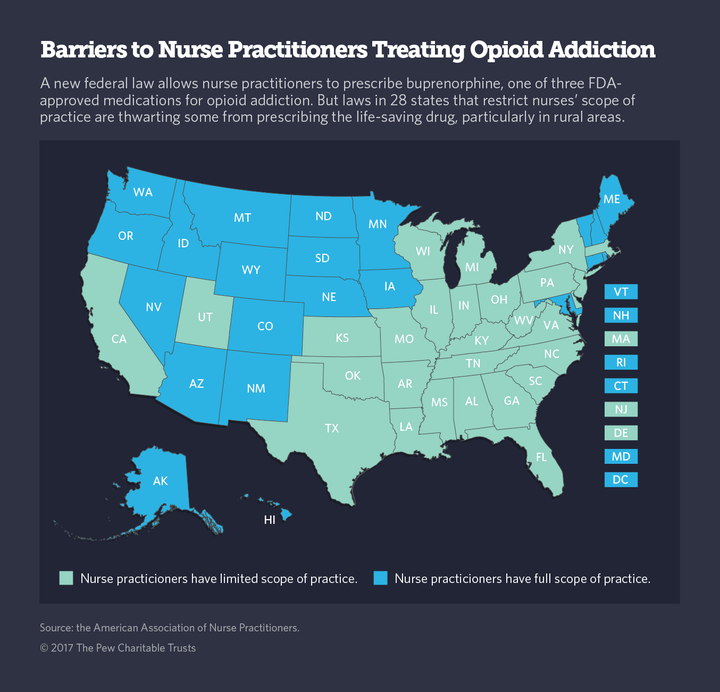
Nurse practitioners join fight against opioid addictions by gaining ability to prescribe anti-addiction medication

Rural America is struggling with an opioid epidemic. Since 1999, opioid overdoses cause four times more deaths in America. In 2015, nearly 13,000 people died from heroin overdoses which were 20,6% more than in 2014. Although all states have experienced increases in opioid overdoses, states with large rural populations, like Kentucky, West Virginia, Alaska, and Oklahoma, have experienced disproportionately high increases. Various blog posts have recently discussed this issue (here, here, here, and here).

Unfortunately, there is a shortage of doctors in rural areas to treat this problem. In rural areas, the patient-to-primary care physician ratio is 39.8 physicians per 100,000 people. In urban areas, the ratio is 53.3 per 100,000 people. This shortage will only worsen after the United States Citizenship and Immigration Services made procedural changes to the temporary visas for skilled workers (H-1B visas) because rural areas depend heavily on foreign doctors. 

However, nurse practitioners may help to solve the shortage of doctors in rural areas. In 2012, 127,000 nurse practitioners provided patient care in the United States. Nurse practitioners are registered nurses who have also completed Master's degrees or other higher level nursing degrees. It takes much less time to become a nurse practitioner rather than a physician with an M.D. On average it takes six years of education and training to become a nurse practitioner and eleven to twelve years for a physician to complete their education and residency. Like physicians, nurse practitioners can hold hospital privileges, write prescriptions, specialize in certain practice ares. 

There are already significantly more nurse practitioners practicing in rural areas than physicians. There are 85.3 registered nurses per 10,000 rural residents compared to 13.1 physicians and surgeons per 10,000 rural residents. However, in many states, nurse practitioners cannot prescribe life-saving medication to opioid addicts.

This month two federal agencies gave over 700 nurse practitioners the ability to write prescriptions for buprenorphine to create broader access to the anti-addiction medication. In the United States, a federal licenses is required to prescribe buprenorphine. Buprenorphine is one of three anti-addiction medications approved by the FDA. It is a highly effective addiction treatment because it prevents withdrawal system and lessens cravings. The Comprehensive Addiction Treatment and Recovery Act passed in 2016 allows nurse practitioners and physician assistants to obtain federal licenses to prescribe buprenorphine. To obtain the license nurse practitioners must complete a 24-hour training and may only prescribe it to 30 patients a year. (Qualifying physicians may currently prescribe it to 275 patients a year).

Currently 28 states restrict nurse practioners' scope of practice by only letting them prescibe buprenorphine if they are working in collaboration with a doctor who has a federal license to prescribe it. However, 21.2 million people live in rural counties with no physician with a waiver for office-based physicians to prescribe buprenorphine. Of the total counties in the United States with no physician able to prescribe buprenorphine, 82.1% were in rural areas. In addition, Oklahoma, Tennessee, and Wyoming explicitly prohibit Nurse Practitioners from prescribing buprenorphine even if they are working with a licensed physician. 

Credit: Huffington Post

Some states recognize the potential positive impacts allowing nurse practitioenrs to prescribe buprenorphine. Oregon is currently updating its laws to allow nurse practitioners to prescribe buprenorphine for addiction. Currently nurse practitioners can prescribe Schedule III drugs like buprenorphine for pain management, but not for addiction treatment. In 2016, West Virgina changed its laws to allow nurse practitioners to prescribe all prescription drugs except Schedule II drugs (i.e., Percocet,  Vicadin, and OxyContin) without doctor supervision. West Virginia has a large rural population, a shortage of medical professionals, and the most overdose deaths in the country.

Hopefully, more states will follow Oregon and West Virginia's example and change their laws to allow nurse practitioners to prescribe buprenorphine. With the physician shortage and rise of opioid overdoses, rural areas can benefit from more medical professions having the ability to prescribe buprenorphine to treat addiction.

Monday, April 28, 2014

Neighborly rural rescue amidst Arkansas tornadoes

I was struck by the following description in the New York Times coverage of the tornadoes last night in central Arkansas and northeast Oklahoma.  Referring to those brought in to the Conway Medical Center, in the midst of the stricken area, Alan Blinder and Motoko Rich report:
A number of the injured brought in overnight came with the help of neighbors. 
“We had a gentleman who was strapped to a door,” [Lori Paladino] Ross [of the Conway Medical Center] said, and taken to the hospital in the back of a pickup. Another man went to the hospital twice carrying injured people in his pickup.
Of course, pickup trucks are not limited to rural areas, but two areas of Faulkner County, Arkansas, hardest hit by the storms, are rural by some measures Vilonia, population 3,815, and Mayflower, population 1,631. Certainly that quote elicited a rural image for me.

Friday, July 9, 2021

Coronavirus in rural America (Part CXLI): Five phase-three hotspots are mostly rural, with low vaccination rates

In this CNN story yesterday Elizbeth Cohen and John Bonfield report under the headline, "Five undervaccinated clusters put the entire United States at risk."  One of those under-vaccinated regions is the Missouri-Arkansas Ozarks. That's where I grew up, so it caught my attention.  Here's a salient quote:

The five clusters are largely in parts of eight states, starting in the east in Georgia and stretching west to Texas and north to southern Missouri. The clusters also include parts of Alabama, Arkansas, Louisiana, Oklahoma and Tennessee, and are made up of mostly smaller counties but also cities such as Montgomery, Alabama; Shreveport, Louisiana; and Amarillo, Texas.

And here's a map depicting the five clusters:


Information about the data collections challenges of that study is here:

The county data is not without its flaws. When someone gets a shot, their home county is supposed to be noted in state records, but the system doesn't always work perfectly. In the Georgetown analysis, at least 90% of all vaccinations were recorded with the person's home county, Bansal said.
In some cases, the Georgetown data differs from CDC data because Bansal and her team were able to obtain additional data directly from state health departments.

Then, this morning, NPR reported on the region's new COVID challenges.  NPR singled out two counties, Ottawa County, Oklahoma, population 31,848, and Newton County, Missouri, population 58,118, where cases are spiking.  Those two counties are nearly contiguous and are in the greater Ozarks region mentioned above.  In both counties, the vaccination rate is low, just 16% in Ottawa County, OK and 22% in Newton County, MO.  This story features a data table showing hot spot counties.  Interestingly, they include the county where I was born, Boone County, Arkansas, and the county where I live now, Sacramento County, California.  The rate per 100,000 is 44 in Boone County, Arkansas, while it is less than a fifth that--just 8 per 100K, in Sacramento County, California. 

As a related matter, this Tweet about Stone County, Arkansas came across my timeline yesterday, suggesting that a single COVID case on June 1 had turned into 70 this past week.  The vaccination rate is 29%.

The source of the Tweet, Skip Rutherford, recently stepped down as head of the Clinton School of Public Policy at the University of Arkansas at Little Rock.  

Stone County is in north central Arkansas, part of the region noted above. 

Meanwhile, in Baxter County, Arkansas, also along the Missouri state line in north central Arkansas, the Ranger Bass Boats manufacturing facility shut down after a COVID outbreak among workers.  

Postscript:  The New York Times reported out of Springfield, Missouri on July 10, where Cox Medical Center has been overwhelmed by COVID-19 patients.  Cox is the closest major hospital to where I grew up.  My father had several heart surgeries there.  

Monday, December 29, 2025

Rural health "slush fund" distributions announced

Fall River Mills, California
(c) Lisa R. Pruitt 2018
The Centers for Medicare and Medicaid Services announced this week the establishment of the Rural Health Transformation Program in relation to Trump's "One Big Beautiful Bill" passed in July--and the so called "rural slush fund" that was a last-minute addition to that law.  An earlier post about that late addition to the law is here, also noting that it was added in part to secure the vote of U.S. Senator Lisa Muskowski's (Alaska) support for the law.  

The Rural Health Transformation Program website touts it as 
empower[ing] states to strengthen rural communities across America by improving healthcare access, quality, and outcomes by transforming the healthcare delivery ecosystem. Through innovative system-wide change, the RHT Program invests in the rural healthcare delivery ecosystem for future generations.

Its stated goals are: 

  • make rural America healthy again
  • sustainable access
  • workforce development
  • innovative care
  • tech innovation
At the end of this post, I cut and pasted from this website more information about the structure and requirements.  For now, however, I want to focus on details of the distribution.  First, all states got a share of the distribution,  and the states that fared best were Texas, Alaska, California, Oklahoma and Montana.  That said, the award amounts to the states did not vary dramatically.  The average amount awarded to each state was $200 million, with the range from $147 million (New Jersey) to $281 million (Texas).  Here's an excerpt from the CMS announcement of the awards, which went to all 50 states.  
This unprecedented federal investment will help states expand access to care in rural communities, strengthen the rural health workforce, modernize rural facilities and technology, and support innovative models that bring high-quality, dependable care closer to home.

It includes this long quote from Health and Human Services Secretary Robert F. Kennedy, Jr.:  

More than 60 million Americans living in rural areas have the right to equal access to quality care.  This historic investment puts local hospitals, clinics, and health workers in control of their communities’ healthcare. Thanks to President Trump’s leadership, rural Americans will now have affordable healthcare close to home, free from bureaucratic obstacles.

It also features this direct quote from Dr. Mehmet Oz, the CMS administrator:  

Today marks an extraordinary milestone for rural health in America. Thanks to Congress establishing this investment and President Trump for his leadership, states are stepping forward with bold, creative plans to expand rural access, strengthen their workforces, modernize care, and support the communities that keep our nation running. CMS is proud to partner with every state to turn their ideas into lasting improvements for rural families.

Roll call covered the matter, with a focus on Texas.  Some key excerpts follow: 

Twenty percent of [a state's] score [on the application for the competitive part] was determined by a state’s policy actions, including vows to pursue waivers to ban SNAP users from buying certain items like soda and candy, reinstating the presidential fitness test for schoolchildren and requiring that medical schools teach students about nutrition, among other things. States could lose money in future years through a “rescoring” process if they don’t follow through on those initiatives, Oz said.

The remaining 30 percent is based on the strength of the ideas that states proposed in their applications.

Projects highlighted by CMS on Monday include ones that aim to expand access to preventative, primary, maternal and behavioral health care. States also are pursuing “food as medicine” initiatives, models to address chronic disease prevention and programs to shore up their health care workforce.

Critics had argued the amount of funding available is nowhere near large enough to offset reductions in federal Medicaid spending made by the reconciliation law, which amounts to $911 billion over 10 years. Sen. Susan Collins, R-Maine, who voted against the bill, had pushed for at least $100 billion in rural health funding.

The $50 billion would offset only about 37 percent of the estimated loss of federal Medicaid funding in rural areas, according to KFF, a health policy research organization.

But Dr. Mehmet Ozi is quoted as saying the funding is not intended to offset the reductions:  

The purpose of this $50 billion investment in rural health care is not to pay off bills.  The purpose of this $50 billion investment is to allow us to right-size the system and to deal with the fundamental hindrances of improvement in rural health care.

This excerpt from PBS Newshour coverage hits more squarely at the politics of the matter and what the Trump administration's CMS is trying to accomplish with these awards in relation to its wider "Make America Healthy Again" agenda: 

Several Republican-led states — including Arkansas, Iowa, Louisiana, Nebraska, Oklahoma and Texas — have already adopted rules banning the purchase of foods like candy and soda with SNAP benefits.

The money that the states get will be recalculated annually, Oz said, allowing the administration to "claw back" funds if, for example, state leaders don't pass promised policies. Oz said the clawbacks are not punishments, but leverage governors can use to push policies by pointing to the potential loss of millions.

"I've already heard governors express that sentiment that this is not a threat, that this is actually an empowering element of the One Big Beautiful Bill," he said.

Carrie Cochran-McClain, chief policy officer with the National Rural Health Association, said she's heard from a number of Democratic-led states that refused to include such restrictions on SNAP benefits even though it could hurt their chance to get more money from the fund.

"It's not where their state leadership is," she said.
Next, I quote from the analysis of a rural health care consultant working out of Texas, which came across my LinkedIn feed: 
Just reviewed the state allocations from CMS’s landmark $50B Rural Health Transformation Program, and the per‑rural‑person math is fascinating. I'm a CPA and I love excel...so you know I had to create my end of year fun facts related to the CMS awards for RHTP.

If you missed the announcement, here is a link to the full article. 

For context, the average award across all states is $1,957 per rural person.
Texas received $329 per rural person — a solid, meaningful investment in our rural communities. 

N.B.   It is not clear how this consultant is defining "rural" for purposes of these calculations.  

To put that in perspective:
Rhode Island: $31,525 per rural person
Just above Texas: Ohio ($345), NC ($360), PA ($390), MI ($413)
Next tier below RI: NJ ($5,343), AK ($4,949), MA ($3,332), DE ($3,231)

Texas’s total award is $1.4 billion over five years — the largest in the country. While we weren’t guaranteed the top spot, the hard work by the Texas team at HHSC on the application positioned us to lead in rural innovation.

I was personally hoping for closer to $2.1B, but we’ll take this $1.4B and put it to work transforming the rural health landscape across Texas. Huge congratulations to the HHSC team and all our partners who made this possible.

Here’s to an innovative, data‑driven 2026 and beyond for rural Texas! 🌟
Finally, I'm pasting here the details on the program (as promised above), which is essentially the call for applications: 

Program Structure

RHT Program funding is $50 billion to be allocated to approved States over five fiscal years, with $10 billion of funding available each fiscal year, beginning in fiscal year 2026 and ending in fiscal year 2030.
  • 50% to be distributed equally amongst all approved States
  • 50% will be allocated by CMS based on a variety of factors including rural population, the proportion of rural health facilities in the State, the situation of certain hospitals in the State, and other factors to be specified by CMS in the NOFO
Uses of Funds

States must use RHT Program funds for three or more of the approved uses of funds:Promoting evidence-based, measurable interventions to improve prevention and chronic disease management.
  • Providing payments to health care providers for the provision of health care items or services, as specified by the Administrator.
  • Promoting consumer-facing, technology-driven solutions for the prevention and management of chronic diseases.
  • Providing training and technical assistance for the development and adoption of technology-enabled solutions that improve care delivery in rural hospitals, including remote monitoring, robotics, artificial intelligence, and other advanced technologies.
  • Recruiting and retaining clinical workforce talent to rural areas, with commitments to serve rural communities for a minimum of 5 years.
  • Providing technical assistance, software, and hardware for significant information technology advances designed to improve efficiency, enhance cybersecurity capability development, and improve patient health outcomes.
  • Assisting rural communities to right size their health care delivery systems by identifying needed preventative, ambulatory, pre-hospital, emergency, acute inpatient care, outpatient care, and post-acute care service lines.
  • Supporting access to opioid use disorder treatment services (as defined in section 1861(jjj)(1)), other substance use disorder treatment services, and mental health services.
  • Developing projects that support innovative models of care that include value-based care arrangements and alternative payment models, as appropriate.
  • Additional uses designed to promote sustainable access to high quality rural health care services, as determined by the Administrator.
This KFF Health News site tracked the states' applications for these funds.  

Wednesday, November 24, 2021

Coronavirus in rural America (Part CLXI): California disparities

Ana B. Ibarra and Hannah Getahun report for CalMatters, with story picked up by Capital Public Radio  Here's the excerpt salient to California's rural-urban divide:
At least 18 counties have more hospitalized COVID-19 patients today than they did this time last year. Another five have just as many.

The vast majority of the ones faring worse are in the Central Valley and rural Northern California, which are still recovering from bad summer surges. Humboldt, Madera and Lassen counties have the biggest year-over-year increases. In Madera, the 7-day average stood at 32 hospitalized patients on Sunday, compared to 13 a year ago. Humboldt had 11 hospitalizations on Sunday compared to three on the same date last year.

It’s a different — and far better — situation in California’s urban counties. Of the state’s 10 most populous counties, all except Fresno have fewer COVID patients in the hospital today than a year ago.
* * *
Last year’s winter surge was harsh for most of the state. But for some counties — including Butte, Humboldt, Mendocino, Shasta and Placer — this summer and fall were even worse. Some saw more patients hospitalized in summer and fall than they did last winter.

In the Central Valley some local hospitals are still strained. And experts say that’s a dangerous situation going into the holidays when another wave of cases is expected.
Here's a Los Angeles Times story from a few days ago about how Central Valley hospitals are trying to move patients to hospitals in other regions.  An excerpt follows, mostly quoting Dr. Rais Vohra, Fresno County's interim health officer.  
We don’t have enough hospitals to serve the population and the needs.  [Hospitals across the entire San Joaquin Valley are] often running over capacity, so that they’re holding dozens and dozens of patients in the emergency department.

It’s really hard to transfer across counties in the state of California.  When you look at Los Angeles ... they have hundreds and hundreds of open beds in Los Angeles County.

If we need to transfer patients out to keep our hospitals operational, we should really be able to do that with one or two phone calls. That’s not the situation right now. And so that’s a point of frustration that we’re hearing from multiple different facilities.  We’re trying to really decompress as much as possible in anticipation of those winter numbers.

So, part of the problem is about disparities in healthcare infrastructure--not only the incidence in cases.  A dramatic story out of Oklahoma about the struggle to transfer patients from rural to urban hospitals is here.  

Saturday, August 29, 2020

Coronavirus in rural America (Part LXXXVIII): update on my hometown

Screenshot from New York Times 7:12 am (PST) August 28, 2020
A month ago, I wrote about a coronavirus outbreak in the nursing home in Newton County, Arkansas, where I grew up. That story indicated a severe outbreak--very high incidence per capita--but/and centered at the county nursing home, which is owned by the county, an unusual arrangement.  Since then, the Arkansas Democrat-Gazette reported on August 1 a follow up to its initial story: 
The nursing home accounts for 85% of all virus cases in the county, based on numbers released Friday by the Arkansas Department of Health. 
The Newton County Nursing Home is the only such facility in the county, which has a population of 8,330. 
A worker at the nursing home tested positive March 31, according to the Health Department, but that employee was sent home and the virus was kept at bay until last week, when the first patient tested positive. 
By July 24, the Health Department said, there were 50-60 positive cases at the nursing home, but exact numbers didn’t show up in the department’s “nursing homes and congregate settings” list until Thursday — 50 positive patients and 27 positive health care workers. However, two of those workers have recovered. 
[Rachel] Bunch [executive director of the Arkansas Health Care Association] said the number 50 for patients includes three people who had been living at the nursing home but died at hospitals.
Bunch's statement is a little confusing since the story doesn't specify the number of COVID-19 deaths at the nursing home, just other data points, e.g., 50-60 positive cases.  Also, Bunch says she doesn't now how many folks in the nursing home are symptomatic, nor how the "virus got in." 

Here's what the state's long-term care facility map and chart looks like currently

Screenshot from Arkansasonline.com 7:20 am (PST) August 28, 2020
Newton County is the county, three east of Oklahoma,
second south from Missouri, with the large dot indicating number of cases
in long-term care facilities.  
This chart shows 59 positive residents, 30 positive staff members, but no "resident deaths" at the Newton County nursing home.  This is in spite of that August 1 story from the Arkansas Democrat-Gazette which alluded to three deaths, albeit occurring at a hospital after the patient was moved from the nursing home.  That story also includes this paragraph deeper in the report:
Late Friday [July 31], the Health Department updated its online coronavirus count to show 91 total positive cases in Newton County. Nineteen people had recovered and three died. That means 85% of the county’s total positive virus cases can be traced to the nursing home.
Were the three deaths nursing home deaths, I wondered?  It isn't clear from the story.

The chart above is also inconsistent with what I see reported in the Newton County Times.  The August 19, 2020 issue of that local paper shows two nursing home deaths in the obituaries section, Iva Jean Berry, 88, and Christine Robie, age 85.  The obituary for the former says she died at the Newton County Nursing Home on August 12, 2020, and the one for the latter says she died the day before, August 11, 2020, also at the Newton County Nursing Home in Jasper.  Meanwhile, the August 12, 2020, issue of the Newton County Times reports that 84-year-old Alice Tenison and 63-year-old Dale Rocole, died at the Newton County Nursing Home.  Both died on August 5, 2020.  The August 26, 2020 issue arrived today, and it reports no nursing home deaths. 

With all of these deaths, one can't help wonder if deaths were due to COVID, as has been reported in national media given the higher volume of deaths (than usual) in 2020.  Plus, nothing in the obituaries indicates cause of death, which is typical of obituaries in this newspaper, even if the cause of death is traumatic, like a car accident.  So, these four early August nursing home deaths may well be--are likely to be--COVID caused.  One thing I do find odd--especially if these are COVID deaths and therefore of patients known to have tested positive for COVID--is that the nursing home residents had not been transferred to area hospitals for treatment.  Why did they die at the nursing home, assuming that fact was reported accurately in the obituaries?

The August 19, 2020 issue of the Newton County Times also mentions on the cover page the death of a physician, 84-year-old Roy Lee, who lived in Newton County but worked in Boone County and southern Missouri.  This story is explicit about the cause of death:  COVID-19.  I'm not sure why the distinction unless his family wanted it that way.  Also, I guess because he is a physician--an important figure in the community?--his death runs as a front-page story, with a separate obituary for him also on the front page.  Or maybe it is the fact he died of COVID that caused the editor to run this as a front page story.  The story quotes

At the other end of the age spectrum, Arkansas has sent its public school students back to school.  Here's what the Arkansas Democrat-Gazette reported yesterday, on that front:
Yesterday, the Health Department released a report showing that 1,126 public school students and 356 employees at the schools had tested positive for the coronavirus since June 15.

Among students and employees, 411 of the infections remained active as of Thursday, meaning the person had not yet recovered.

At his briefing, Hutchinson presented a lower set of statewide school numbers that included only cases from districts with five or more active cases.

He said that “seems like a very modest number” relative to the state’s 480,000 public school students.

“Why it’s important for us to have this starting point, and that’s really what I’m most interested in, is that this is a number really before school activity has started,” Hutchinson said.

“If there was an infection, the students would have got that outside of the school activities to be a statistic right now, and so we’ll be able to measure from that two weeks from now, three weeks, four weeks from now, and I expect that number to go up, but we’ll see.”
Several weeks ago, the governor announced that the state would use a $10 million CARES Act grant to provide hot spots and other means of digital access for Arkansas's public school students. 

Tuesday, April 28, 2020

Coronavirus in rural America (Part XXXIV): New Mexico

Simon Romero reported this story for the New York Times last week, dateline Albuquerque, under the headline, "How New Mexico, One of the Poorest States, Averted a Steep Death Toll."  The odds were against the state that calls itself the Land of Enchantment, which has fewer hospital beds per capita than most states.  It is also a high-poverty state, and many of its residents are elderly. 
Still, infectious disease specialists say New Mexico seems to have staved off disaster — for the moment, at least — with a coronavirus death rate that is lower than neighboring states like Colorado and Oklahoma.
New Mexico’s measures included shutting down schools before most states, aggressively expanding social distancing, ramping up testing beyond levels achieved in richer states and using a pioneering telemedicine initiative to quickly train rural health workers for coronavirus care.
Romero quotes Helen Wearing, a University of New Mexico mathematician who is an expert on disease ecology: 
Hundreds of lives were saved because of what the state did early on, and that’s using conservative estimates.  

Sunday, May 24, 2020

Coronavirus in rural America (Part LI): Big WaPo feature

Reis Thebault and Abigail Hauslohner report today for the Washington Post under the headline, "A deadly 'checkerboard': COVID-19's new surge across rural America."  I won't belabor the part that  regular readers of this blog already know:  rural America is older, sicker, less formally educated, poorer, more religious etc., except to say it's covered in the story.  Regular readers (and those who follow rural America more generally) also know what's been happening with coronavirus in rural places--that meatpacking plants, prisons, and church services have become hot spots.  The journalists also note the part about isolation and places being "hard to reach."  And, of course, there has been the politicization of mask-wearing, with this plea from the North Dakota governor a few days ago. 

Here's a quote the Post journalists include from a public health official for Hillsdale County, Michigan, Rebecca Burns:  
We’ve got a little bit of everything: folks who feel their rights have been taken away because they’ve been asked to stay home and they lost jobs and they’re really hurting, and we have folks who are very concerned and frightened and won’t leave their house.
Hillsdale County, population 46,688, in the state's south central region, last month topped the state for the highest death toll among rural counties. The spike there, like many in rural America, was due to a nursing home outbreak. Other rural outbreaks, like those in Arkansas and Ohio, were centered in prisons.

The story also features two other contrasting rural locations that have been hot spots at one time or another this spring:  Sun Valley, Idaho, an example of rural gentrification (which I wrote about here) and Dougherty County, Georgia, in the black belt, which I wrote about here.

Then there is this vignette from Texas County, Oklahoma, population 20,640, where
patients pouring into the hospital with covid-19 symptoms are predominantly Hispanic and work in the local Seaboard Foods pork processing plant, which like many others has stayed open even after becoming the locus of an outbreak. 
Some of the workers tell Jeffrey Lim, one of the county’s few internal medicine physicians, that they have seen colleagues who appear ill continue to show up at the plant. State health officials tested everybody at the plant two weeks ago and found that of some 1,600 asymptomatic employees, 350 were positive, nearly four times as were known, Seaboard said in a statement. “As of May 20, 440 employees have active cases of covid-19,” the company said.
Dr. Lim is also quoted talking about the lack of mask usage:
If you go to the local Walmart, I would say 10 percent of people are wearing masks, and the restaurants … that are open are packed.
Then the story closes with this vignette out of Decatur County, Indiana, population 25,740, where a high school basketball game that drew 27,000 became a super-spreader event in early March.  Given the basketball link, it's a very Indiana kind of story.  Another rural theme:  lack of anonymity.  A county public health official, Sean Durbin, is quoted:
“Being a small community, what is that line in ‘For Whom the Bell Tolls’? ‘Every man’s death diminishes me,’” Durbin said, quoting the John Donne poem. “If I didn’t know every death, if I didn’t know them personally — and I knew many of them personally — you always know someone who knows them in a community this size.”

Wednesday, April 29, 2009

Chickasaw use gaming and other revenues to provide services in rural context


An NPR story a few days ago about the Chickasaw nation had a rural angle, though it went unexpressed. According to the report of Arun Rath, the Chickasaw nation, which is spread over a 13-county non-metropolitan swath of south central Oklahoma, is thriving. The nation is flourishing in part from gambling revenues; in particular, it benefits from having the closest casino to the Dallas-Fort Worth metropolitan area. Under the leadership of governor Bill Anoatubby, the Chickasaw have taken their gaming profits and diversified into other enterprises, including a radio station, banks, and the production of high-end chocolates.

Here's an excerpt from the report about how the Chickasaw are using gambling and other revenue to provide for their citizens:

With such deep pockets, the governor has been able to pursue an ambitious domestic agenda. Every member of the tribe has access to extended education benefits and scholarships. For working parents, there is free child care, and even a care center for mildly ill children.

And Anoatubby has been able to achieve something President Obama can currently only dream of — universal health care.

* * *

The Chickasaw Nation is actually adding new health care services. To address high rates of diabetes among the native population, for example, a state of the art comprehensive care facility was recently established.

One remarkable thing about the efforts of the Chickasaw in pursuing this domestic agenda is the sort of rural challenges they face in serving citizens who are spread across such a vast area. These challenges include spatial ones, and presumably also difficulties achieving economies of scale. The report doesn't acknowledge these, however. It describes a marvelous new health care facility and a $147 million hospital under construction, but it doesn't address how people get there given the dearth of public transportation in rural places. Perhaps the Chickasaw are addressing that challenge, too, but Rath's report did not.