Showing posts with label natural resources. Show all posts

Thursday, January 22, 2026

Rural tourism: a double-edged sword

Summer Hike 2025 - KÄ«holo Bay, Big Island, HI 
Where tourists vacation, money often flows: lodging bookings increase, more jobs are created, and the beauties of rural communities are discovered. The reality, however, is that the people and places making money aren't always the ones paying the price for over-tourism. Within this context, people like environmentalist Hanan Kouli are part of a movement supporting rural tourism

Kouli explained the significance of tourism to rural economies in places like Hawaii, and the need for a more sustainable approach, stating:

...[M]any residents rely on [tourism]...The problem isn't tourism, it's too much tourism without enough care. 

As someone from a rural island community, it's encouraging that tourists and locals alike recognize the harms of mass tourism, even though it can also be a double-edged sword. Without increased community control, rural tourism can reproduce the same harms as mass tourism - displacement and cultural commodification - albeit with better branding than mass tourism. 

What is rural tourism? 

Rural tourism occurs in non-urban areas and is considered a sustainable alternative to mass tourism. A 2015 blog post put it even more simply, defining rural tourism as: 

...[T]he country experience [with] opportunities for visitors to directly experience agricultural and/or natural environments. 

I felt the appeal of that "country experience" while staying on a farm in New Zealand. Even then, it was clear that rural areas were still recovering from COVID-19's impact on the tourism industry. Indeed, especially after COVID-19, one benefit of rural tourism is attracting more tourists like me, who seek rural destinations to avoid large crowds and experience a different way of life.

Farm Stay 2024 - New Zealand
What are the benefits of rural tourism?
At its best, rural tourism can broaden the local economy by keeping income streams rooted in rural communities instead of flowing from (or towards) urban centers. The promise is simple: jobs and demand for local businesses in rural areas. According to a 2023 article from the journal for Humanities & Social Sciences Communications, rural tourism:
...[Promotes] rural community development and...could counteract the negative impacts of urbanization.

Hawaii offers an illustration of how that can play out. Tourism is the state's largest economic driver, but the benefits are most visible when tourism dollars circulate through rural communities, rather than resorts. This is particularly true in rural areas that offer  "authentic" island experiences, like the Polynesian Cultural Center (PCC), Hawaii's top-paid tourist attraction

Mariott Resort 2024 - Ko'olina, Oahu

However one views it culturally, PCC channels visitor spending into the rural community where it operates - supporting jobs, and for many workers, substantial college scholarships

Sadie's Inn 2025 - Utulei, American Samoa

Similar dynamics show up in my home country of American Samoa. Tourism helps offset the country's financial reliance on its tuna processing plant - Starkist - which makes up about one-third of its workforce. Rural attractions like the National Park and Ofu Beach draw tourists whose spending supports lodging, food service, and cultural education.

My criticisms of rural tourism

My gripe with rural tourism is rooted in concern about what happens to "authenticity" once it becomes the selling point. What was once authentic is often changed to meet consumer expectations rather than community needs. That was the dynamic Professor Lisa Pruitt described as "faux rural" in her 2013 blog post. 

Sapphire Princess 2023 - Pago Pago, American Samoa

The trade-off of living in a highly marketable rural "paradise" is that it can make you feel like you're always on display. When tourists arrive expecting a specific version of island life, the pressure to look the part increases. A 2023 study on the Socio-Cultural Effects of Rural Tourism observed that 

...[T]he development of tourism in rural communities has the potential to produce unwanted socio-cultural consequences.

I felt that dynamic early. As a child, I remember giving staged performances for tourists. Those dances weren't fake, but over time, the performance mindset skewed my perception of "authenticity."  

So, what now?

I can't deny the economic benefit that rural tourism has brought to rural communities, mine included. I still see it as a bridge between the "urban-rural" divide discussed in Professor Pruitt's 2024 blog post. The goal isn't to eliminate tourism; it's to shape it on community terms. 

What does this look like? Perhaps restrictions on short-term rentals, visitor caps, or local hiring requirements. In any case, increased community control is essential to stop rural tourism from reproducing the same harms as mass tourism.

Monday, May 26, 2025

A sustainable transition (Part IV): Extraction and investment

I grew up in Salt Lake City, Utah, which is surrounded by mountains. In my time there I occasionally drove south, out of the valley, into the midlands of the state. It gets so flat out there that every nub and knot on the horizon feels like a wrinkle on your eyeball. And if you’re driving in the afternoon, the sun skims in so bright down in front of you that even with sunglasses, you find yourself blinking away blindness every few minutes. At other points, it feels like traversing an alien landscape. It’s a wonder that anything lives out there. Luckily for us, a lot of things have died there too. 

My dad started running rivers for Holiday Expeditions when he was a teenager. One of their main hubs is the town of Vernal, also known as “Dinosaurland.” Dinosaur National Monument is located 20 minutes away and contains over 800 paleontological sites. My twin brother and I learned to drive in Vernal on the runway of an airport under what I still consider impossibly bright stars. We would refuel at the Sinclair gas station, whose mascot is a green dinosaur. 

South of Vernal is the Uinta basin, which the Green River bisects. The Uintah basin is where most of the oil reservoirs in Utah are located. Every trip we took down there, we saw great ranges of oil derricks grazing on the simmering hardpan of the land. On the way back, we would pass by Dinosaur, Utah, occasionally stopping to check out the fossils. 

Before coming to law school, I worked a number of service jobs. I like talking to people, and getting paid to do it felt like I was committing a heist. My favorite place where I worked was the Grand America Hotel, an alabaster mass of angles and glass among the uneven skyline of downtown Salt Lake City . The building is worth one billion dollars. It has marble sourced from a specific quarry in Italy. Chandeliers cut from the same set of natural glass. It is the eighth tallest building in Salt Lake, with 775 rooms and 75,000 square feet of conference space. I met James Harden, Frank Abegnale, and Rick Steves when I was there, let alone the other unspoken millionaires who politely complied with the awkward mating dance of a clerk performing highly specialized check-ins as the hotel sought its fifth star. 

The Grand America is owned and operated by the Sinclair Oil Company. The same one that operates the gas station in Vernal that we used to refuel at. Last time I was there, I think it had a plywood sheet as a bathroom door. It's been a long time since I've been there. 

Uintah County has a population of 35,620 people and  a median income of $69,821. Its poverty rate is just 11.1%, which is pretty incredible—there are plenty of rural places which have lower income and higher populations. But Uintah County is large, clocking in at 4,500 square miles. This is nearly the size of the Diablo mountain range at 5,400 square miles. As a Utahn, I’ve been staggered by the fact that California’s top 100 cities (by population), as listed by population, tapers out with Livermore with 85,000. Delving deeper, Oildale California has a population of approximately 35,324 and a poverty rate of 26.9%.  It is 8 square miles, and its median income is $50,000. So, Uintah County has a lot going for it, even considering the transportation costs of just getting around. 

Uintah County has an economy partially driven by mining, quarrying, and oil and gas extraction. Within that sector, the median wage is around $121,000. Taken in a vacuum, this sounds amazing. But fossil fuel salaries don’t often represent the full picture. 

To get a sense of what it’s like to chase oil as a worker, rather than an investor, I could not more highly recommend Michael Flanagan Patrick Smith’s article detailing his experience joining the oil rush in Bakken, North Dakota. He is now a folksinger, and while he’s likely bled his fingers into the strings of a guitar, he’s also bled his experiences into a book called The Good Hand. While it is not a simple issue, I took away the sense that the two most serious problems with these hyper-competitive extractive economies are as follows.  First, a significant increase in income in an area like this leads to a significant increase in cost of living expenses, wiping out what we presume to be a windfall for the risk and demands of these kind of jobs. Second, these economies are not aberrations, but serve oil company interests far more than they do their workers, and oil companies are incentivized to keep the damaging components of these economies (such as scarcity, competition, high hours, and local strain on infrastructure) in place. 

Because here’s the kicker—even with that high income and low poverty rate, if you multiply Uintah County's population by its median income, you can estimate an annual income is $2.4 billion. Sinclair Oil’s 2024 revenue is reportedly $28.58 billion. That does not include other income from the hotels and resorts which the Holding family was able to invest in due to their oil profits. 

Vernal, Utah, is both a fossil town and a fossil fuel town, but it could end up a fossil of its own. 

The billions of dollars pumped out of town translate more to corporate profits than they do to community benefit. These resources don’t replenish, meaning that while the town’s economy is maintained, even healthy, due to this extraction, when the last drop of oil is squeezed out of the stone, there might be no Vernal left. 

Extraction is not limited to the extraction of material. It can also be thought of as extracting value from a community in a disproportionate degree to that which it contributes. Utility-scale renewables projects echo many of the predatory practices and extractive effects of the fossil fuel economy. 

Ann Eisenberg’s forthcoming paper, due to be published in Volume 59 of the UC Davis Law Review, applies internal colony theory to the current practice of siting utility-scale renewable energy projects (which require thousands of acres of land) in rural areas. Some 99.8% of utility-scale renewable energies are sited in rural areas. While this does create some jobs, the benefits of those jobs disproportionately go to the cities that receive that power. While not physically extracting the resource, it is still forcing the majority of costs on a community while benefitting another area. That is the same mode in which fossil fuel extraction has operated. 

Nearly six percent of the land area of the United States has to be dedicated to renewable infrastructure for our nation to be truly climate neutral. The United States has about 2.27 billion acres, and six percent of that is 136 million acres. There are more than 450,000 brownfields in the United States. In fact, the EPA already funds Land Revitalization Projects to encourage communities and land owners to reuse and redevelop land that was previously contaminated and turn it into public parks, restored wetlands, and new businesses. Why not invest in a community’s ability to use that land for solar farms or other renewable projects, instead of prioritizing corporate profits and interests while damaging great swathes of otherwise usable land? 

This is yet another component of the green transitions that should be managed wisely; while just transitions should shift to incorporate community transitions, environmental justice should be refined to incentivize voluntary development. If a fossil fuel community is going to lose its jobs, it should be the first one offered to host renewable infrastructure. Therein lies the beauty of the brownfield. By seizing a brownfield, the government ensures that a landowner is compensated but cannot further profit from their poisoning of the land.

At the same time, installing renewable infrastructure in these communities helps to decarbonize the community. I think that we often overlook the fact that decarbonizing America doesn’t mean that we just have to decarbonize cities; we have to decarbonize rural areas, too.  If it is so important to decarbonize, this should represent sufficient justification to seize, transfer, and repurpose land. If that is not an acceptable solution, then maybe the problem isn’t as serious as we think. But you, and I, and everyone else, know that it is.

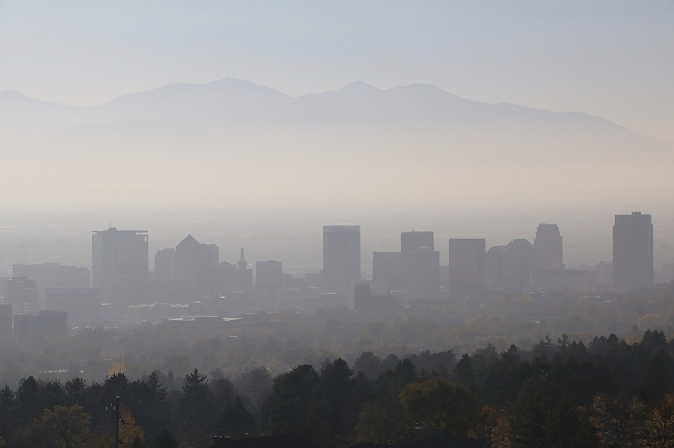
This is not fog, or snow, but engine exhaust and other emissions, caught between the warmed-up valley floor and a layer of cold atmosphere. 


Original picture by Eltiempo10, and posted under the Creative Commons Attribution-Sharealike 4.0 International License. Unfortunately unaltered. This is how my home looks every winter. 

Friday, May 23, 2025

A sustainable transition (Part III): A common interest

The tragedy of the commons is the theory that all common-pool resources (CPR) are finite and are thus in danger of exploitation and eventual destruction, and without governance individual users will exploit these resources to maximize their own benefit, and if their rate of use is faster than the time it takes for the resource to replenish their actions will lead to the eventual overuse and destruction of the CPR


The tragedy of the commons also leads to a conversation about the commons, and if people can recognize the value and vulnerability of the commons, to a coordinated effort of preservation.

This concept can best be understood in the binary of two birds. The passenger pigeon was a bird endemic to North America, and with an estimated population of five billion, was so abundant that their passage across the sky could obscure it as if there was an eclipse. While economic interests, such as protecting crops, were instrumental in their decline, they were also extensively used for trapshooting (before the advent of the clay pigeon) and as a source of food for a burgeoning New York City. 2014 marked the 100 year anniversary that they were entirely eradicated. On the other hand, the northern spotted owl was protected.1,200 pairs of these owls still live in Oregon, 560 pairs in Northern California, and 500 pairs in Washington, today. It is not an animal that is hunted or sought. But it is intolerant to shifts in its habitat, and threats to its livelihood gave rise to the President’s Northwest Plan, which barred logging in areas richly primed to do so, throwing “between 60,000 and 100,000 people out of work.” 

A commons was not threatened in the traditional sense—this was not a treaty about who can whale and how much. But it was a secondary commons—the typical tragedy of the commons has two elements: (1) a resource that can be extracted for the benefit of the extractor, that (2) the full extraction of which is a net and unrecoverable loss to the community—here, what was preserved for the benefit of the whole is the tradition and ecological system of the Pacific Northwest, and the reluctance to extinguish an entire form of life for the pursuit of profit. In sum, the “extraction” of the owl did not motivate the decision of timber companies to engage in logging, but its loss would still have been a net negative for the surrounding area, sparking a rule to protect the loss of a “common resource—the ecological, traditional, and moral benefit of the spotted owl. 

Now obviously an ecological tragedy of the commons is different from one of fossil fuels. There is no replenishment in fossil fuels; while the the stock is so vast that they are not likely to ever be fully
exhausted, there is an inevitability to the fact that they will be. There is only one way that coal can be “exhausted” and that is extracting all of it from the ground. That inures a benefit to the extractor, but it will not replenish, thereby distinguishing it slightly from the typical tragedy of the commons.  If we continue to extract coal, at any rate, it will inevitability be exhausted. While compelling, it is beyond the scope of this blog post to reconcile whether fossil fuel represents a tragedy of the commons (we could still have it if we didn’t exhaust it more than it could replenish) or something like an “inevitability of the commons” (it was never going to replenish anyway, but we could have gotten more out of it if we had just been more careful in which we extracted). But regardless, the commons still represents a common resource. 

The current push to site renewables at all costs means a push for utility-scale renewable energy installation. This has two major downsides. First, these projects are overwhelmingly sited in rural areas. Second, they benefit a sliver of the community’s social strata (wealthy, often absentee landowners, with extensive real estate holdings) while spreading the cost across the entire community. Third, without meaningful planning, the community may bear far more cost than benefit and may be strained to the point of collapse, much like the passenger pigeon. It is a prototypical example of the tragedy of the commons. 


I discussed in Part II the problem with transitional payments (a flat amount of money paid to displaced workers), and how they are unsuccessful. But the flip side of the argument considers the state surplus payments made every year by Alaska to its citizens. Why is it different? Primarily because it is distributed without red tape, but almost more importantly, because it is distributed equally. It is easier to accept the exploitation of a resource if you are receiving a benefit too—ironically, because the commons becomes common. No longer are a few small entities siphoning away something that belongs to all of us: we’re getting to sup on that straw too. In the tragedy of the commons, the costs accrue to everyone. Here, so do the benefits.

While rural America has borne the brunt of extraction, they now possess a somewhat perverse resource in spades: superfund sites. One of the major concerns with utility-scale renewable energy siting is that they will corrupt otherwise usable land (See Part I). But what if the land to be corrupted is already so? 

The term brownfield typically refers to land that is abandoned or underused, in part, because of concerns about contamination. The federal government defines brownfields as “abandoned, idled or underused industrial and commercial properties where expansion or redevelopment is complicated by real or perceived environmental contamination.” 

In the mid 1990s, the EPA began providing seed money to local governments to launch hundreds of two-year pilot projects and developed guidance and tools for cleanup and redevelopment of brownfield sites. The 2002 Small Business Liability Relief and Brownfields Revitalization Act codified many of EPA's practices, policies and guidance. The 2018 Brownfields Utilization, Investment and Local Development (BUILD) Act reauthorized EPA’s Brownfields Program and approved changes that affect grants, ownership and liability provisions, and State and Tribal Response Programs

Under the 2021 Bipartisan Infrastructure Law and the 2022 Inflation Reduction Act, Congress provided major funding to support planning, construction and operation of various public infrastructure improvements. Brownfields are continuously developing in both their characteristics and the government’s approach. It seems more than viable that a government could seize a brownfield through eminent domain and then remediate it enough to house solar farms. I want to stress here that there are two caveats. First, this must be a voluntary process undertaken with the consent of the community. Otherwise, it perpetuates an internal colony as better examined in Part IV--this would be the opposite of taking care of a commons. I It would be extractive. Second, this should not be the fate of all brownfield sites. These sites should still be cleaned up, but in the meantime, with climate change looming like it never has before, this land use could provide a temporary solution to a dire problem. 

Repurposing “bad land” into something better has already proven to be successful in rural communities, to some capacity. In Kentucky, hilltops blown out in search of coal have been repurposed to elevated communities, both reusing the land and relocating a flood-risk community to higher ground

When you think about rural America as a common resource, it is easier to justify what I think is a crucial component of the green transition. Compensating and rehabilitating these communities without benefitting the people who exploited them. I would advocate for governmental seizure of brownfield sites and other superfund sites through eminent domain, and construction of localized renewable energy projects. 

One main benefit of this is decentralizing the grid. If rural areas are able to achieve energy independence, not only can those communities prosper but the energy rate for the rest of the country goes down, and the durability of energy demand goes up. 

By conceptualizing rural America as a commons, we don’t only seek to protect it but justify investment in ensuring its continued existence—if not for them, then for us. Which cuts nicely antithetical to the current rhetoric of considering fossil fuel towns as backwards and standing in the face of progress. But what does extraction really mean to a community?

Sunday, March 16, 2025

The ripple effects of a pivot away from clean energy reach Humboldt County

Efforts to develop offshore wind infrastructure off the coast of California have run into a confluence of Trump administration priorities: reducing federal spending, eliminating clean energy projects, and undoing anything related to the Biden administration. In a widely expected move, the Trump administration announced that they were pausing all offshore wind leasing and reviewing existing leases for potential termination. 

Since that announcement, companies planning to build wind turbines off the coast of Humboldt County announced significant layoffs, a sign that those projects may no longer be moving forward. While the Trump administration's announcement did not immediately revoke the permits for the planned offshore wind sites off of Morro Bay and Humboldt County, development of these sites and the onshore infrastructure needed to build the wind turbines and carry the electricity to its destination markets requires a huge investment that offshore wind supporters believe would almost certainly require federal funding. Given the current administration's posture towards wind and other clean energy sources (not to mention towards the entire state of California), that funding will not be coming anytime soon. Thus, it is not surprising that the companies who already paid the U.S. government $757.1 million to lease tracts of the ocean for wind energy appear to be rolling back those plans and cutting jobs that would have been focused on those projects.

In addition to the direct impacts on those losing their jobs with these wind energy developers, the Trump administration's decision to pull support for offshore wind will affect those in Humboldt County who were hoping for the economic benefits that were promised to accompany these projects. As part of the lease bidding process, bidding companies were required to "commit to mak[ing] a qualifying monetary contribution to programs or initiatives that benefit the greater Humboldt County community." The agreement with the federal government provided for about 7.5% of the bid amounts to go to local stakeholders, a not-insignificant amount considering that the total bids amounted to over $750 million for parcels off Morro Bay and Humboldt County. It is unclear how much of that money the County and other local stakeholders have received.

Beyond the direct payments, however, local communities stood to gain from accompanying investments in electric infrastructure and in making significant upgrades to the Humboldt Bay Harbor District, as well as accompanying increases in economic activity in the local area. Now, whether any of those benefits will materialize is an open question.

Even before the Trump administration moved to scuttle clean energy development, many locals in Humboldt County were skeptical about the promised benefits from wind projects. Calmatters' Julie Cart, in her excellent reporting on offshore wind development in California, noted that local communities would bear social costs and face strains on infrastructure, including higher housing costs and utility upgrades. 

As previously discussed on this blog, Humboldt County has experienced a series of boom-and-bust cycles from different industries, including timber, fishing, and cannabis, that have brought prosperity to the region only to collapse and give way to economic despair. Humboldt County's Director of Economic Development, Scott Adair, shared that locals "are cautious about the flimflam, if you will, the over-promisers."

Adair also noted that, even if locals are skeptical, the fate of the project is out of their hands.

“This is a federal project that is happening to us,” Adair said. “We have a limited ability to be involved and to help steer or shape the outcomes of the project.”

County supervisors expressed some cautious optimism that underscores how the region stood to gain and how it has suffered from prior economic hardships: 

The supervisors said they are excited about the possibilities, but they also worry about the pitfalls and are bracing for disappointment. “I go into this with my eyes wide open,” said Supervisor Rex Bohn. “I pray this happens. I hope like hell this happens.

From outside of Humboldt County, offshore wind is considered critical to achieving California's zero-carbon targets for electricity. 

“There is an undeniable urgency,” said David Hochschild, chair of the California Energy Commission. “California has had unprecedented climate challenges. There is a fierce urgency to respond. We have to stop being academic on this. We have to build.”

But this urgency is not enough to justify the project's presence in Humboldt for many locals who have felt burned by prior experiences with extractive industry. Phillip Williams, a member of the Yurok Tribal Council, was extremely skeptical about relying on this project for economic benefits to the local communities:

“Everybody's lining up. It's almost like there's a predator. ‘Okay, these guys are weak. We can come in here and take advantage of this community that’s this desperate for dollars, because they've already depleted all their natural resources. What else can we extract from these communities, and these communities are so desperate, that they're willing to jump off the bridge blind, in hopes that there's gold at the bottom,’” he said.

Like other communities along the North Coast, Williams said the Yuroks need sustainable jobs, but not at any cost. More than a third of tribal members live below the poverty line, 60% of them children.

 Now that it appears likely that the project will be delayed, if not abandoned, skeptics in the local community may be breathing a sigh of relief. Their reactions to the proposed project certainly show the importance of local input and the potential pain that can be caused by major infrastructure development in rural and economically depressed areas. But the climate crisis continues unabated, and the Trump administration has not announced any proposals for economic development in Humboldt County to lessen the impact of the potential loss of offshore wind. 

Tuesday, February 11, 2025

As domestic water wells run dry in California, many rural individuals cannot afford to drill another one

Access to water is becoming more of a challenge in California, especially for rural communities in the Central Valley. Many rural families across California get water from domestic wells that tap into groundwater, but some of these wells are drying up due in part to climate change and the overconsumption of groundwater resources. This sets the stage for many political and legal battles across California.

Many households across California are not connected or do not have access to municipal water or sewer services. My family was one of them. 

When my family and I lived in Mount Shasta, California, we had a domestic water well that sat about ten yards from the house. When my parents began to have problems with the well, a pump company we paid to investigate the problem told us the well was dry. The only solution was to hire a drilling company to drill a new domestic water well.

My parents soon discovered that there were only nine drillers licensed to drill domestic water wells in all of Siskiyou County. All were booked out for months due to the high demand for water wells in Siskiyou County. In the meantime, my parents bought a 1,000-gallon water tank and would have potable water trucked in every two weeks.

After two months, the well-drilling company called with an opening for the next week. My parents promptly said yes, but the cost was beyond what anyone anticipated. While this was four years ago, the price of drilling a domestic well has only increased. Today, drilling a well costs an average of $5,500 in the United States, but the price “can range between $1,800 and $24,500, or around $25 to $65 per foot.”

Well Drilling. Credit: Paul Hamann
Well Drilling and Pipe Welding. Credit: Paul Hamann
My family was fortunate enough to be able to afford the hefty price tag for the new 360-foot well, but many California families cannot.

The past two years have been relatively wet, reducing the number of domestic wells going dry. As as result, press coverage of the issue has also fallen. Before that, California was experiencing a major drought, and thousands of wells went dry. Climate change and overconsumption of groundwater mean that policy makers and politicians cannot ignore this problem. 

In 2023 the Rural Community Assistance Corp. published a study analyzing water supply issues in California’s Central Valley. The study found that “32% of the 29,567 domestic wells analyzed are at risk” and that this creates a “burden that’s likely to fall disproportionately on rural disadvantaged communities.

In numerous instances, the California State Government has stepped in. The Sustainable Groundwater Management Act (SGMA) was implemented in 2014 to help tackle groundwater management issues in California. The Rural Community Assistance Corp. study also identified the overpumping of groundwater as a major concern for those in rural communities. Large farming operations often have more resources and can afford to drill deeper wells than the surrounding residential homes and communities, but agricultural overpumping of groundwater lowers the water table, which raises the risk of domestic wells going dry. 

With so many domestic water wells going dry, non-profit organizations, like Self Help Enterprises have stepped in to help people in the Central Valley. Self Help Enterprises owns 1500 water storage tanks that they loan out to people whose wells have gone dry. While these tanks are not a permanent solution, they help those who cannot afford immediately to drill a new domestic well. Self Help Enterprises also offers domestic well drilling services to those who qualify for the program.

While the past two years have provided more rainfall to California than prior years, many people's wells are still drying up. Many of these wells are dated and were drilled before the effects of climate change and overconsumption of groundwater were fully recognized. Rural communities and families will be hit the hardest as many will not be able to afford the massive price tag for a new domestic well.

This is a very complicated issue, and many stakeholders are implicated. All Californians will continue to fight for access to dependable sources of water. Future policy decisions regarding groundwater usage need to consider potential impacts on rural communities as domestic water wells in rural areas will continue to be at risk.

Saturday, February 8, 2025

In California’s Inland Empire, a complex battle for groundwater rages: if the wells go dry, there are no winners.

The Indian Wells Valley sprawls across Inyo, Kern, and San Bernardino county lines in the northwestern Mojave Desert. Beneath it lies the Indian Wells Aquifer, a major groundwater deposit upon which the local communities rely. In the dry Mojave, groundwater is the primary source of water for domestic and agricultural purposes; few aquifers in California have been as significantly depleted as Indian Wells. 

When former Governor Jerry Brown signed the Sustainable Groundwater Management Act (SGMA) into law, the Department of Water Resources identified Indian Wells Valley as one of many "critically overdrafted" groundwater basins. In response, a Groundwater Sustainability Agency (GSA) was created to manage the basin. That agency is now embroiled in a seven-year fight against some of the basin's largest groundwater pumpers to keep their regulatory authority—and the authority of SGMA—intact. 

The GSA operates out of Ridgecrest, the Indian Wells Valley's largest community. With a population of nearly 30,000, the city is built around Naval Air Weapons Station China Lake, the U.S. Navy's largest landholding. Employing more than 5,000 military and civilian personnel and generating $36 million in state and local taxes, it is of vital importance to the Ridgecrest economy.

China Lake's website boasts of its "incredible access to natural resources and recreational activities," and of Ridgecrest's affordable housing, shopping amenities, and small town life. This description sits in stark contrast with nearby towns like Trona, an unincorporated community in San Bernardino county with a population well under 2,000 and a poverty rate roughly twice that of Ridgecrest. Devastated by a 7.1 magnitude earthquake in 2019, Trona is a community in recovery—eyewitnesses describe houses "cracked in half" and residents driven out. Trona native Marilyn McKee refers to it as a "dying town". (You can see photos of Trona on the blog here).

Trona Gun Club. Credit: Lisa R. Pruitt

Mural in Trona. Credit: Lisa R. Pruitt

Whether dying or recovering, Trona is heavily reliant on the neighboring Searles Mineral Company for jobs and domestic water; “With no Searles, there’s no Trona,” says another Trona resident, Regina Troglin. Perhaps unknowingly, she echoes Ridgecrest city attorney and counsel for the Indian Wells Valley GSA, Kieth Lemieux, who explained to the Los Angeles Times in 2024 that "without [China Lake], there's no Ridgecrest." Without water, of course, there is no China Lake.

Trona Picnic Area. Credit: Lisa R. Pruitt

Despite the parallel between these two communities, Searles argues China Lake has received more favorable treatment from the GSA in implementing SGMA. Searles has been required to pay a fee of $2,100+ per acre-foot of groundwater extracted, while China Lake has not; as a federal landholding, China Lake is essentially exempt from such fees. Nonetheless, vice president of operations for Searles, Burchell Blanchard, believes the fee could bankrupt the company, causing hundreds of employees (many of whom are Trona residents) to lose their jobs (see: San Bernardino County Sentinel, "Searles Valley Minerals Contesting Groundwater Authority's H2O use fees" for a full public statement from Searles).

These claims are part of an ongoing legal battle between Searles and the GSA. Joined by the Indian Wells Valley Water District and Mojave Pistachio, one of the largest pistachio-growers in California, Searles has triggered an 'adjudication,' a complex legal proceeding in which a court manually determines the individual groundwater rights of every stakeholder in the basin. The adjudication challenges the GSA's authority to impose fees and seeks to replace their technical plan to achieve groundwater sustainability in Indian Wells Valley—two of the GSA's essential functions.

Alongside several other state agencies, the GSA appealed to the California Supreme Court for an early ruling on the GSA's authority under SGMA. On January 29th, 2025, the court declined to take the appeal, meaning the adjudication will proceed and will be determinative of water rights in the basin.

This is certainly a victory for Searles and Mojave Pistachio. Perhaps it is also a victory for the people of Trona. But many smaller water users have been unable to participate in the adjudication, due to high legal costs. These users generally have much shallower wells than entities like Searles and Mojave, meaning theirs will be the first to fail if the valley cannot figure out a sustainable solution to its water needs. So as the adjudication drags on, and groundwater levels in Indian Wells Valley continue to decline, the question remains: what happens when those wells run dry?

Monday, October 16, 2023

Unleashing the river: The Klamath dam removal project

The Klamath River, flowing through California and Oregon, is not just a waterway but a lifeline for people and wildlife. For decades, the river has faced numerous challenges, including water diversions, pollution, and four hydroelectric dams that have significantly altered its natural flow. Now, however, a remarkable endeavor is underway to restore the Klamath River to its former glory: The Klamath dam removal project is the largest dam removal in the world. You can read prior posts about the Klamath dams here and here.  

The Klamath River holds deep cultural significance for indigenous tribes, particularly the Yurok, Karuk, and Hoopa Valley tribes. These tribes have relied on the Klamath for thousands of years to provide salmon, steelhead, and suckers. However, the river’s ecosystem began to deteriorate in the 20th century with the construction of four hydroelectric dams: Iron Gate, Copco 1, Copco 2, and J.C. Boyle. The four dams were built for power generation and disrupted fish migration, sediment transport, and nutrient cycling. Annelia Hillman, a traditional food coordinator for the Yurok tribe, commented,

This river is our lifeline. It’s the foundation to our people, for our culture.

In 2001, two cases brought national attention to issues between farmers who relied on the dam’s water for irrigation and the Coho salmon listed under the Endangered Species Act: Kandra v. United States and Pacific Coast Federation of Fishermen’s Associations v. U.S. Bureau of Reclamation. In these cases, locals and agencies fought over who deserved water during a historically dry year. The Bush administration ultimately sided with the irrigators, diverting water to farmers during the drought year. These water diversions drained critical river habitats, culminating in salmon populations plummeting during the 2002 Fish Kill. Outrage over the 34,000 dead salmon supercharged the campaign to remove the dams (See also Yurok Tribe v. U.S. Bureau of Reclamation and Baley v. United States).  

Iron Gate Dam (Photo: Katie Eng, September 29, 2023)

Last month, I had the privilege of hearing from the CEO of the Klamath River Renewal Corporation, Mark Bransom. Bransom spoke about FERC’s decision to decommission and acknowledge the social and cultural impacts of the dams  for the first time. FERC also banned the Klamath’s hydroelectric license. For more about FERC’s approval of the four dams, see this blog post

Today, the Klamath River Renewal Corporation is working to blast holes through the base of the dams, dredging out the accumulated sediment and flushing the sediment and accumulated algae (muck) into the ocean. When I visited the dam last month, Bransom commented, 

The river needs to go through a little more pain before it heals again.

Meanwhile, the Klamath River Renewal Corporation is working closely with indigenous tribes to cultivate seeds from over 90 species of native vegetation. They hope to plant over 19 billion seeds over 8,000 acres. With such aggressive efforts, the Renewal Corporation anticipates a 24-month timeline for the project to be complete, with returning adult salmon inhabiting the river by next October. 

It would be surprising, of course, if a project of this size had zero opposition. In fact, Bransom says the Renewal Corporation has struggled with balancing the interests of environmentalists and local property owners —he calls them the “way of life” people versus the “quality of life” people. 

Driving along the roads of rural Hornbrook, California, where Iron Gate Dam lives, it is typical to see signs protesting the dam’s removal. Bransom says locals are worried about the noise, the future lack of a lake for recreational activities, and the impacts on property values. He spoke about the difficulties in telling senior locals, whose retirement money is wrapped up in their waterfront property, that the removal will affect their estates for the next decade. Bransom believes that ten to fifteen years from now, the Klamath River’s restored wildlife and salmon populations will positively impact property values and the lives of those that’s live beside it.

J.C. Boyle Dam (Photo: Katie Eng, September 30, 2023)

The possibility of salmon returning to the Upper Klamath raises questions about whether the dam removal project could inspire other changes in Oregon and California. One such place a dam removal project may be warranted is the Snake River, where tribes and farmers suffer from water shortages and related environmental issues. Under the direction of his legal team, Bransom was unable to comment on whether he thinks similar efforts would be successful in California. However, Bransom has hope that the lessons learned from the Klamath dam removal project will be used for years and decades to come—including in other locales facing similar quandaries.

Friday, October 6, 2023

California struggles to provide its rural residents with safe drinking water

Last week, a Los Angeles Times story detailed how rural California residents often consume contaminated drinking water, with 400 (or about 25%) of the state's water systems failing to provide safe drinking water to residents.

The article explained how California cannot provide clean water to residents in California's Central Valley. In particular, the article found Kern County's water systems do not function effectively. Almost 80% of the county's water supply (65 systems) have been categorized as failing for three years

Kern County is home to around 900,00 residents, of whom 18.5% live in poverty.  The county's economy is primarily based on agriculture and petroleum extraction industries and its median household income is $58,000 is significantly less than California's median household income of $86,000

The Central Valley, a vast agricultural region of California and ranks among the United State's most polluted areas, due to heavy vehicle trafficdiesel-burning locomotivestractors and irrigation pumps, and wood-burning stoves and fireplaces. 

Despite its booming agricultural industry, Central Valley residents are among California's poorest. About 24% of the Valley's population lives below the poverty line. While suburbs like Elk Grove and cities like Fresno sprawl out of the region, the Central Valley's agricultural communities are classified as rural according to CivicWell, a Sacramento-based nonprofit. 

Overall, the region covers more than 20,000 square miles and is home to around 2 million people. For comparison, Los Angeles County covers 4,084 square miles and is home to almost 10 million residents.

According to the American Bar Association, water supplies in farming areas (like the Central Valley) often contain high nitrate levels because the nitrates seep into the groundwater from fertilizer and manure. 

Ingesting too much nitrate can affect how the blood moves oxygen through the bloodstream and can cause methemoglobinemia (also known as blue baby syndrome), which can result in serious injury or death. In adults, high nitrate exposure can potentially lead to an increased risk of cancers like gastric cancer, although there is yet to be a scientific consensus on causation. 

Despite these data, 85% of the communities with nitrate-contaminated drinking water have no treatment systems in place to remove the chemical.

Madison Condon of Boston University School of Law wrote a piece for the American Bar Association and further explained that rural residents are those most likely to face poor water quality and unsafe drinking water: 

All across rural America, small community water systems are failing to protect public health due to a perfect storm of forces. Poor regulation of agricultural waste and other pollutants, shrinking populations, and aging infrastructure all contribute to the increasing incidents of water quality violations dotting the rural landscape.

It is troubling that the Central Valley experiences a lack of clean and safe drinking water, especially because the water used produces 25% of the U.S.'s food and 40% of American fruits and nuts. The region is a major agricultural output not just for California, but for the entire county.  

Water contamination in farming and industrial communities is unfortunately typical. 

In 2017,  environmental lawyer Rob Billot reached a $631 million settlement with chemical corporation DuPont for releasing 7,100 sludge tons of perfluorooctanoic acid (also known as PFOAs or C-8) into a landfill in Parkersburg, West Virginia. The chemicals ended up in the town's waterways, leading to deleterious health effects in the Parkersburg community.  Many residents suffered cancers, thyroid disease, high cholesterol, pre-eclampsia and ulcerative colitis–– all verified scientific effects from exposure to PFOA. A few years after the settlement, Focus Features made a film about the Billot's story called Dark Waters, starring actor and environmental activist Mark Ruffalo

Having access to reliable and safe drinking water is not merely a rural phenomenon, and happens in urban settings as well.   

In 2014, Flint, Michigan switched its water supply from Detroit’s system to the Flint River to save costs without the proper testing. Flint residents complained of a foul-smelling odor and suffered numerous health effects, but they were ignored for years. The Michigan Civil Rights Commission deemed the poor governmental response to the Flint crisis a “result of systemic racism.”

Having access to safe drinking water is essential for our health and wellbeing, according to The Centers for Disease Control and Prevention. While EPA regulations require federal and state agencies to regulate public water systems, those regulations do not apply to privately owned wells. This can be a problem in rural communities like those in the Central Valley, where most private wells are the source of many landowners' water.

In a 2019 paper posted in Environmental Health, Schaider et al. studied the link between low-income communities and drinking water contamination. They found that

Low-income and minority communities often face disproportionately high pollutant exposures. [...] Small water supplies, particularly those that serve low-income and minority communities, may have poorer source water quality due to closer proximity to pollution sources.

Rural residents suffer higher rates of poverty than their urban counterparts. According to Circle of Blue, a nonprofit aimed to educate and inform about the problems plagued by climate change, found that many rural towns have neglected their drinking water systems for decades:

As some rural towns lose population and government funds shrink, some drinking water systems are one failure away from crisis.

With the lack of affordable housing and the rise in housing prices in the Bay Area and Southern California, the Central Valley's population is expected to increase by five million people by the year 2060. Lawmakers, politicians, and policymakers should ensure safe access to drinking water in rural communities, despite the region's low population density.

Regardless of the size of a population cluster in an area, where one's water comes from, and what a town's primary industry is should not impact safe and reliable access to drinking water. 

You read more about water contamination on the blog here and here. You can read more about California's Central Valley here and here.


Wednesday, September 13, 2023

Rural responses to corporate utility disasters: Reimagining the future of Butte Creek Canyon after PG&E canal breach

Residents of Butte County, California are no strangers to PG&E-caused disasters. The latest of the vast corporate utility’s mishaps occurred August 10, when a breach of Butte Canal sent millions of pounds of sediment careening into Butte Creek, which runs through Butte Creek Canyon. The sediment turned the water orange and silty, threatening the survival of this year's salmon class and causing deep concern for ecosystem and human health.

The breach happened above Helltown and Centerville, two very small, unincorporated canyon communities about a half hour northeast of Chico and located on the ancestral homelands of the Mechoopda tribe.

I first learned about the breach through the Instagram of a Helltown local, who posted devastating videos of the murky orange waters and documented river otters desperately trying to find the end of the pollution. In the weeks since, I’ve observed that much of the clean up effort responding to this catastrophe is coming from rural canyon residents who have a deep connection with the land and water in their backyards.

For many canyon residents, their biggest concern revolves around the creek’s salmon population. Butte Creek, a 93-mile tributary of the Sacramento River, supports the state’s largest population of wild spring-run Chinook salmon and is one of only three tributaries that still support a self-sustaining salmon population. This makes the creek critical to saving the state’s endangered salmon population. The conservation group California Trout explained in a blog post about the incident:
Sediment in a stream is natural, but if sediment levels get too high, like they are currently at Butte Creek, it can be extremely dangerous for fish and other wildlife. Sediment blocks light that allows algae to grow, harms fish gills, fills or blocks important habitats, and stops fish from seeing well enough to move around or feed.
CalTrout also noted that the impacts on fish and other wildlife can’t be fully assessed until the creek flushes out.

The more I learn about the canal breach, the sadder and angrier I am, feelings I know are shared by many other people from the area.

Allen Harthorn, a canyon resident and founder of advocacy group Friends of Butte Creek, told ChicoSol, “This event is essentially an underwater Camp Fire — there’s no fire, but it’s killing everything in its path.”

Harthorn is referencing a devastating wildfire that burned much of Butte Creek Canyon in 2018. State fire investigators determined it was started by PG&E transmission lines and in litigation over the fire, PG&E settled with the town of Paradise and Butte County for $522 million in 2019. It also settled with individual fire victims from the Camp Fire and other Northern California fires for a total of $13.5 billion. You can read more about the Camp Fire here

Community frustration with PG&E is palpable (and aligns with statewide trends). I’ve heard and seen it voiced by residents in comments on news articles and social media posts about the breach, in my own conversations with friends and family in the area, and by Butte County District Attorney Mike Ramsey, who facetiously referred to PG&E as his “favorite punching bag” in the recent community meeting discussed below. A Friends of Butte Creek post about the incident reads, “We must not let PG&E continue to get away with destroying our watershed. The District Attorney and California Department of Fish and Wildlife are investigating the incident and potential legal actions are possible.”

As I see it, this anger, alongside hope, is fueling powerful community response and creating opportunity for meaningful change.

Following the breach, canyon residents organized a community meeting at the old Centerville Schoolhouse on August 24, and the community showed up in force. A recording of the meeting can be viewed here.

One of the organizers set the tone of the meeting in two meaningful ways. First, she asked everyone who was angry about the incident to raise their hand, her own hand going up first. With those feelings acknowledged, she asked for the meeting to center on solutions, rather than grievances. She also asked explicitly for people to leave partisan politics at the door. I’ve long felt that environmental action and sense of place can transcend partisanship (and the urban-rural divide), and it was refreshing to see that play out.

The meeting then turned toward understanding the problem and thinking about solutions. He-Lo Ramirez, environmental director and member of the Mechoopda Tribe shared the significance of salmon and the Butte Creek Canyon watershed to the Mechoopda people. A video created by canyon residents showed the site and effects of the breach. Harthorn talked about the creek’s salmon runs and the history of the canal project, which is connected to the DeSabla-Centerville hydroelectric project.

Harthorn envisions decommissioning the hydroelectric project and replacing it with a fish restoration project. He noted in the meeting that even PG&E has recognized the power project makes no economic sense. PG&E even tried to withdraw its long-term licensing application for the project in 2017, but the Federal Energy Regulatory Commission denied that request. Since 2009, PG&E has operated with yearly permits.

Harthorn talked about how removing the energy project would allow for the removal of power lines as well. This would benefit the area via less clear-cutting around lines and reduced fire risk, a topic of equally great concern to canyon folks.

Ramsey promised accountability and talked about litigation options, before welcoming some "boots-on-the-ground" PG&E officials to the podium to talk about their response to the breach. The PG&E representatives at the meeting voiced their own deep concerns over the breach and emphasized the utility's prompt response. Residents were respectful of the PG&E employees but insisted on corporate accountability.

As residents move forward with holding PG&E responsible and advocating for solutions that protect the canyon and fish, I’m curious what roadblocks stand in their way and what a reimagined and more sustainable future for the canyon might look like. Can community-based solutions, or even community-operated power, reduce both stream pollution and wildfire risk? In my next post, I’ll explore ways other rural communities are responding to big utilities mistreating or overlooking them and how those responses might transfer to Butte Creek advocacy.

Tuesday, September 12, 2023

Can the Green Mountain State stay green?

It's an old lesson we never seem to learn . . . You can't save the environment by destroying it. -Kit Ausschnitt, current Vermont resident. 

Oftentimes, people think of oil, gas, coal, and other extractive industries being synonymous with rurality. West Virginia has the mines, Kansas has fracking, Alaska drills, and so on and so forth. Despite these stereotypes, there has been a recent boom in clean energy jobs in rural communities (you can read more about clean energy in rural communities here and here). 

Clean energy jobs in rural counties outnumbered fossil fuel jobs by 1.5 to 1 in 2019. In rural parts of the Northeast and Pacific West this rises significantly as clean energy jobs outnumber fossil fuel and power jobs 9 to 1Rural classification for this purpose was developed by the USDA Economic Research Service which distinguishes between metropolitan counties and non-metropolitan counties by rating them on a scale of 1-9. You can read more about the rural/ urban classifications here.

According to the World Resources Institute, jobs in renewable energy, energy efficiency, advanced electric grid development, clean fuels, and other clean energy jobs employed around 360,000 workers in rural counties in 2019. These jobs accounted for as much as 10% of total employment in these places. In fact, clean energy jobs make up 3% of total rural employment in Nevada and Wyoming, 3.2% of total rural employment in Indiana, and 3.6% of rural employment in Hawaii. Vermont leads the pack, however, with 5.7% of total rural employment being comprised of clean energy jobs. 

According to the most recent Census, Vermont is the most rural state in the union with 65% of Vermont's population residing in rural areas. Despite its small size (Vermont is the second least populated state after Wyoming), Vermont's share of in-state electricity from renewable resources is the highest in the nation (reaching just shy of 100% in 2020 and 2021) and has the lowest carbon dioxide emissions of any state. 

Since the end of 2014, when the Vermont Yankee Nuclear Power Station was permanently shut down, Vermont has gotten almost all of its in-state electricity from renewable resources. Most of Vermont's electricity comes from a combination of hydroelectric plants (46% of total electricity), wood and wood waste (23%), solar energy (16%), and wind farms (14%).

That said, Vermont's commitment to renewable resource electricity has not been met with universal approval.

Recently, tensions have risen regarding a renewable energy project in Shaftsbury, Vermont. Shaftsbury is located about 2 hours and 45 minutes from Burlington, Vermont, and is located on the southern end of the state. Shaftsbury boosts “the beauty and quiet of rural living with city convenience within easy reach.” 

The renewable energy project in Shaftsbury has been met with local pushback as "the project would build one of the largest solar panel farms in Vermont. This aversion to large-scale change in rural Vermont is not new. An earlier blog post explores how people want Vermont to "stay Vermont."

Local aversion to large-scale environmental projects is not limited to Shaftsbury. A new bill, H.320, if passed would require Vermont utilities to purchase double the amount of clean, in-state energy by 2030 and triple the requirement by 2035

Opponents of H.320 question the efficiency of solar panels in northern climates and worry that their country roads won't be able to handle the incoming construction traffic. They also worry about increased pressure on their farms, an adverse effect on property values, and an overall threat to rural living

Additionally, residents raise the concern that large solar farms, like the one proposed to be built in Shaftsbury, threaten Vermont's picturesque appearance (parts of the solar array would be visible to neighbors and those traveling on Route 7). One Vermont resident remarked, "The main attraction of Vermont is its appearance. That's all it's got going for it."

Vocal opponents of large-scale renewable energy investments are not against making Vermont more energy-conscious. Instead, they bring attention to the fact that current efforts are "driven by developers trying to make money instead of communities and utilities with incentives to find the most effective way to clean up the grid."

Given the opposition to solar, one might think wind farms would be an easier sell. But, this is likely a nonstarter since the possibility of investing in additional wind power development in Vermont is essentially dead. In fact, there have been no industrial-scale wind turbines built in Vermont in the last decade. And the ones built back then were also met with an outcry at the time. 

So, if Vermont can't build large-scale solar or wind farms, how will they get their energy? One Vermont resident thinks the need will be met by importing more Canadian hydropower from Quebec. In fact, a transmission line that will run under Lake Champlain to provide energy from Canada was approved in April 2022

The push and pull happening between locals and clean energy advocates is not new in Vermont. If Vermont wants to stay green, however, the lawmakers will need to introduce a bill that balances the interests of the locals and the clean energy advocates.