Showing posts with label military. Show all posts

Tuesday, October 21, 2025

An unduly provocative headline from the Ezra Klein Show about rural-urban tension

Image from today's New York Times Ezra Klein Show podcast.

The headline for the Ezra Klein podcast today--the one that popped up on my NYTimes audio feed--is "The Rural Power Behind Trump's Assault on Cities."  I found that very provocative--unhelpfully so.  It seems to place blame on rural America and rural Americans for Trump's assault on urban America.  In fact, it's not only provocative, it's a bit misleading regarding the content of the podcast, which is an interview with Suzanne Mettler about her book, with Trevor Brown, Rural versus Urban:  The Growing Divide that Threatens Democracy (Princeton University Press, 2025).  I'll come back to that, but first I want to excerpt the part of the interview where Klein gets closest to backing up the provocative headline: 

Klein:  
I’ve heard a lot of people who study civil wars say it is a bad sign when the federal government is ordering armed troops from some states into other states over the objections of those states’ governors and — these are all cities they’re ordering them into — those cities’ mayors.

And you can look at this, and I think I have been looking at this, and say: This sure looks like a rural coalition militarily occupying the cities it has come to see as the power centers of their enemies. (emphasis mine)
What I don't understand is how Klein can assert that a "rural coalition" is militarily occupying U.S. cities.  Who makes up this purported "rural coalition," exactly, when there are too few rural voters to have put Trump in the White House?  Klein's assertion completely overlooks the much more robust numbers of urban voters who chose Trump.  (Nicholas Jacobs, co-author of The Rural Voter, has commented on this in various publications, most recently here).  Perhaps Klein is thinking about the disproportionate power of red states in the U.S. Senate and the Electoral College?  If so, he should consider that the rural voters in California and New York are as underrepresented as those states' urban voters--and that "red states" like Idaho and Arkansas have "blue cities" like Boise and Little Rock, whose urban residents are overrepresented.  (I wrote more about this here and here).  

Or is Klein somehow claiming that rural is occupying urban because a disproportionate number of rural young people join the armed services?  whatever Klein means, I see this framing--this attribution of what Trump is doing to a "rural coalition"--as inflammatory and therefore unhelpful.  Of course, it is also inaccurate unless one uses a really capacious definition of "rural."     

Here's Mettler's response to Klein's comment.  Unfortunately, Mettler doesn't actually respond to Klein's assertion that some rural coalition is militarily occupying U.S. cities.  She says:  
Well, it’s unthinkable. It’s so un-American to be telling the military you can use cities as training grounds and to be sending in federal troops and federalized National Guard into cities. And this comes on top of Trump, for the past few years, using a lot of rhetoric against cities — but now using actual violent force against cities.

So how is this possible? It’s possible because of the rural-urban divide. It’s possible because this us-versus-them politics has become so deep.
By the way, the headline for this podcast on the NYT home page right now is a less sensational "How the Democratic Brand Turned Radioactive in Rural America."  Both the provocative and less provocative headlines show up when you click through

Here are some of the more interesting exchanges about the book that are featured  in the podcast:

Klein: 
Before we get into what created the divide, beginning in the ’90s, what kept urban and rural America politically united for so long?

Mettler:  

If you go back to, say, the late 19th, early 20th century, as industrialization is happening, rural areas really feel left behind. There’s a big agricultural depression in the 1920s. Then the Great Depression comes. And rural people at that point are really upset, and policymakers are worried there’s about to be a revolution in the countryside, as they call it.

But what happens is that Franklin D. Roosevelt steps in and creates this big rural-urban coalition. And to an extent that I was unaware of until we wrote this book, he really put rural Americans front and center in his vision of what needed to happen for the country and created all of these policies that were really designed to lift up rural America.
Archived clip of Franklin D. Roosevelt: 
I cannot escape the conclusion that one of the essential parts of a national program of restoration must be to restore purchasing power to the farming half of the country. Without this, the wheels of railroads and of factories will not turn.

* * *  

Rural Americans really appreciated that. They felt the Democratic Party was there for them, and many of them remembered it for their lifetimes. And then their kids did, as well, all the way up until the 1990s.

In the 1980s and early ’90s, rural places were more likely to send Democrats to Congress than Republicans. Only a few decades ago, there was still a coalition where there were rural politicians who were really at the forefront in Congress in brokering compromises on all sorts of important policies.
Klein:
In 1964, Lyndon Johnson signed the Civil Rights Act into law. And that kicks off this process of ideological polarization, where the parties sort into liberal and conservative. The Dixiecrats die out.

And I think the most commonly believed story about what happened in the urban-rural divide is that they hated the Civil Rights Act. I think if you look at a lot of Democratic accounts of this, you’ll see something like that.

But you don’t buy that account. Why?
Mettler:
Yes, that’s wrong. So for one thing, just look at when the rural-urban divide emerged: It’s not until the late 1990s.

The story that you’re telling, usually the follow-up is that the South left the Democratic Party. Well, in fact, there were a lot of urban Southerners who left the Democratic Party. But rural Southerners stuck with it up until the 1990s, and then they left.
Klein:  
The way your book is structured, you sort of say: There’s this economic divergence, and then layered on top of that very quickly is what you call elite overreach. That’s what we’re talking about here.

The way you describe it is: “It was not any one issue that tipped the scales but rather the persistent commonality that ran across them. From 2008 onward, rural Americans perceived an urban elite that sought to impose itself on far-flung places, controlling residents’ lives through new rules and procedures, in which they felt they had little voice.”

And you argue that the issue here is not the policy but the sense of respect or disrespect, of listening or not listening, of representation or absence of representation — that there was something sort of beneath policy that drove this.
Klein: 
Political scientists use this slightly strange tool called the feeling thermometer, where they ask people to rate other groups on a 1-to-100 scale.

You have this data for white rural America, and on a scale of 1 to 100, they put Black Americans at a 70 — pretty good; Hispanic Americans at 67; gay men at 57; illegal immigrants at 39 — pretty low; and Democrats at 14 points.

So Democrats are rated at less than half illegal immigrants’ rating.
By the way, this is not just rural America — white urban Democrats put Republicans at 17 points. But the hatred is much more concentrated at the political outgroup, at least in these measures, than at any other group.
Klein:
White rural America’s sense that the Democratic Party sees all these other groups as in need of help and respect and is prioritizing them ahead of them — Arlie Hochschild’s idea about other groups getting to cut in line. And then there’s a real rise of discourse around white privilege. And this creates — we’ve seen this in our politics — a lot of anger.

Like: You’re telling me — in a poor community that has very few jobs now, where life expectancy is going down — that I have white privilege, and your urban coalition is what needs the help? Or that illegal immigrants need the help?

I’d like you to talk a bit about that distinction between the divide being discriminatory, and the divide being a feeling: That coalition doesn’t prioritize me, so I’m going to go with a coalition that does.

Mettler:  

It’s a really important issue in that I think a lot of urban Democrats assume that what’s at play in this rural-urban divide is that rural white people are racist. What we find is that it’s not reducible to that.  (emphasis mine)

The way we understand it is that it’s in this same period that there’s the sense of elite overreach on the part of Democrats, where rural Americans are looking at the Democratic Party and thinking: They don’t understand us. They don’t care about our communities.

And on this, they’re viewing the Democratic Party as really prioritizing the needs of people of color in urban communities and immigrants — but not really understanding or caring about rural people who are struggling, as well.

This last bit from Mettler is, to my mind, so important.  What Mettler doesn't say is how academics contribute to this problem of saying that so-called rural resentment is all due to racial animus.  See some nuanced and thoughtful pushback to that notion--or at least the notion it is all so simple--in this academic article.   

I'll no doubt have more to say about Mettler and Brown's book in future posts, after I've read it.   For now, I'll just say that three of my recent publications aim to take a more optimistic tack regarding rural voters.  They encourage progressives to play to rural residents' rural identity--to show them that they and their needs are seen.   Read more here, here, and here.  I'm somewhat less optimistic here, while still taking seriously the need for politicians--including those on the left--to respond to rural needs.  

Wednesday, April 30, 2025

Helicopters over Humboldt: a retrospective interview

Growing up in suburban Southern California, Humboldt County seemed like a completely different world. In some ways, I think it probably is. But stories about Humboldt—stories about environmental activists, cannabis cultivation, and, of course, Bigfoot—have always fascinated me. From bitter campus protests to its history as a major logging hub, Humboldt has been a major talking point on this blog for years. I wanted to contribute something to the already robust list of stories, but there was a problem: I have never been to Humboldt, and I don't have any stories about it!

My solution was to interview a friend, "M." He grew up at the end of a dirt road, on 44 acres of land ~15 minutes from the town of Redway. Initially, our conversation was general—we discussed his upbringing in the '80s and '90s and rural life in Southern Humboldt. But the piece of the story we kept coming back to (perhaps unsurprisingly) was marijuana. What M ultimately chose to share was, essentially, a brief oral history of cannabis cultivation in Southern Humboldt.

It started, of course, with the hippies. According to M, they were "mostly college-educated idealists, looking to live off the land." Most were looking for tranquility, self-sufficiency, an escape from city living. In rural Southern Humboldt, "they found it for cheap." These initial community members were "rich in natural resources, but not in money." There was an issue, though—In Southern Humboldt, you can't grow much. "It's an interesting landscape for agriculture. Most of it is... these vast conifer forests. It's not really agricultural land."

 Enter the Marijuana plant. 

"Cannabis, during those early years, was something that [people] perhaps stumbled upon as a means of generating income for their community." By the time M was born, it had blossomed into a "spectrum of growers." On the one hand, there were "those that were fully in it, willing to grow more, risk jailtime, and supply cities that were farther away." For them, cannabis was a livelihood. 

On the other hand, "you had the mom-and-pop operations that were just a small greenhouse, or a few plants hidden in the woods." For them, cannabis was just "used to supplement income from whatever job they had in the local community." By the '80s and '90s, both groups were facing serious challenges from local, state, and federal law enforcement.

At the heart of our conversation was a story about Vietnam-era helicopters flying low across the treetops around his home. 

You could hear them coming from miles away—and we'd all run out into the yard... to have that experience; ok, we're on a homestead, living in nature, on a homestead off the grid; to have that seclusion, that self sufficiency, and then to hear an army helicopter disrupt the tranquility was pretty strange...

This profound juxtaposition was the result of CAMP: the Campaign Against Marijuana Planting. Managed by the California Department of Justice, CAMP united local, state, and federal agencies in a concerted effort to eradicate illegal marijuana grow operations all over the State of California. Launched in 1983, CAMP activity escalated throughout the 90s. 

In Northern California, CAMP culminated in Summer 1990 with operation Green Sweep. During that operation, the federal government deployed active-duty troops to Southern Humboldt in a drastic escalation of previous drug-policing methods. The operation was met with large-scale protests, some of which became violent. According to M, the "community felt it was being targeted and really terrorized by this government-funded operation." 

Despite its attempts at deterrence, M felt CAMP only increased profits for determined growers: 

when you have these aggressive tactics, the beneficiaries are the ones that are able to continue [growing]. If you increase the focus and the efforts to disrupt the exchange of product... you increase the price. That's what happened: you had cannabis that wasn't initially of significant value, [skyrocketing] to four or five thousand dollars a pound. There were many in the community that felt the reward was worth the risk: friends and neighbors that either faced jailtime or were impacted by friends and family getting locked up for cultivation...

M recalled one community member, busted with what was later described as "a handful of sprouts. They slapped a 5-year sentence on him. He had a young daughter. But he knew the risks..." 

Sometimes, the dangers went beyond jail time. 

As far as the actual exchange of the product for cash, I've heard there were buyers that would come up from the city; they would go up to someone's house, and you would hope to establish some kind of rapport and trust. 

But finding a buyer, at least at first, entailed "meeting at the bottom of a dirt road, and hoping for the best." For one of M's high school classmates, this dynamic proved deadly. "[He] became affiliated with some buyers from the Bay Area... perhaps he didn't put a lot of trust in them. They came up and robbed him, he resisted, and they shot him. He was 17 or 18." 

"It's interesting," M remarked towards the end of our conversation, "to return to that time period and compare it to the traditional American high school experience." 

I am inclined to agree. 

M now works in Portland, Oregon as a registered nurse. When asked if he ever saw himself settling down back in Humboldt, he responded with a simple "no," adding briefly that "too much has changed."

Sunday, December 22, 2024

Rural-ish outreach by California Governor?

Mark Barabak in the Los Angeles Times today writes under the headline, "Newsom is acting more like a governor should. Will that boost his White House prospects?"  Here are the introductory blurbs, which both highlight "rural"of a sort:  

  • Ever since the election, Gov. Gavin Newsom has made a concentrated effort to show up and deliver policies for red California.
  • The move, as Democrats seek to rebuild their depleted rural support, can’t hurt if the governor decides to run for president in 2028.
And here's more, which reflects what I've been thinking about Newsom's latest moves:
Things changed after Nov. 5, following Donald Trump’s triumph and California’s notable shift toward the center-right on election day. Suddenly, Newsom started appearing in places such as Bakersfield, Redding and Colusa, among the ruddiest parts of red California.

It’s something the governor should have done a long time ago, rather than strutting and preening on the national stage. There are millions of Californians — politically outnumbered, geographically far-flung — who have long felt derided or ignored by Sacramento.
* * * 
And if he’s interested in really, truly running for president in 2028 — when the Democratic contest looks to be a wide-open affair — it’s not a bad place to start.

Barabak continues: 

In promotional materials, the governor’s office describes the program as a “bottom-up strategy for creating good-paying jobs and regional economic development.” The plan follows lengthy consultation with locals in 13 parts of the state and aims to streamline programs and spur economic growth through a series of tailor-made initiatives.

The unveiling in the red reaches of California was no accident.

With Trump’s victory, Democrats have begun to reckon ever more seriously with their diminished standing among union members and working-class voters and the party’s catastrophic collapse — decades in the making — across rural America. There’s a new urgency “to solve problems and meet people where they are,” as David McCuan, a Sonoma State political science professor and longtime student of state politics, put it.

In other words, if building bridges is in order, why not start with a bridge across the rural-urban divide.  Indeed, when this Barabak column came across my news feed this morning, it dovetailed with this blog post I'd already begun to write with a similar theme:  Newsom going rural--or at last, ruralish. Below is part of that draft:  

California Governor Gavin Newsom recently traveled to Redding, California to announce a new "career passport" initiative.  Here's coverage from the Los Angeles Times.

Initiatives to expand college and career education have drawn bipartisan support. State Assemblywoman Heather Hadwick (R-Grass Valley) appeared with Newsom on Monday, expressing excitement for more opportunities for youth in her rural community — some areas so remote that the nearest Costco is a three-hour drive away, she said.

Here's a compelling--but not surprising--data point from the new plan: 

California has one of the largest economic divides in the nation...with the top 10% of California earners making an average of $300,000 annually compared with the bottom 10% at $29,000 annually.
And here's a further quote from the plan: 
The economic divide underscores the imperative for a more coherent career education infrastructure. Degree attainment cannot be the only pathway to stable, well-paid work. Even though individuals with bachelor’s degrees earn significantly more over their lifetimes than those without, degrees are not a panacea, particularly in the absence of practical experience and social capital.

Prior to his visit to Redding, Newsom visited Fresno.  Admittedly, it's one of the state's largest cities, but it's also associated with conservative politics and rural California, to the extent that rural is equated with agricultural in the Golden State.  

Tuesday, August 27, 2024

Marilynne Robinson ponders the role of U.S. war losses in relation to resentful voters and the rise of Trump

Pulitzer-prize winning novelist Marilynne Robinson published this piece in the New York Review of Books earlier this summer (publication date shows July 18, 2024, but it appeared online weeks before that--certainly well before Biden decided not to seek a second term).  I'm revisiting the piece now because I think it's really important--really insightful-- in relation to this election season.  The headline is an opaque "Agreeing to Our Harm."  The subhead is a telling "We ignore at our peril the rage that animates Trump voters and threatens Biden’s chances this fall."  In it, Robinson links working-class discontent to the fact that what we might think of as left-behind communities (and she does use that term) are the ones that have supplied most of the soldiers who've been killed in the Iraq and Afghan engagements in the past few decades. And, of course, those left-behind communities providing many soldiers are often rural.  Here are some salient excerpts from the essay: 

[T]here is a baffled cynicism abroad in the country, a sense that we will and must fail at everything except adding wealth to wealth and influencing other countries to their harm. We have the war in Gaza to remind us how suddenly horror can descend on a region, how a provocation can unleash utter disaster, and how the contending pathologies of a few men can destroy lives by the scores of thousands.

A profound alienation has set in, regularly expressed on both sides in contempt—contempt for Trumpists and those who vote with them on one side, and on the other side Trump and his allies’ contemptuous rejection of the entire project we have called America. In contemporary parlance this rejection is called conservatism.
* * * 
More than 4,400 American military personnel died in the Iraq War. Say their average age was twenty-five and their life expectancy was seventy-five years. Then our civilization was deprived of some 220,000 years of productive life—soldiers are healthy and competent people in the vast majority of cases. I am not speaking here of economic loss—our tendency to bring this measure to bear on virtually everything is a disheartening and destructive habit. I am speaking of everything they might have done to enjoy and enhance life, charming us, dazzling us, simply sustaining us in the course of finding occupations and rearing families. The death toll among Iraqis was vastly higher, and a calculation of the cost to civilization of the kind I have made here would be proportionately more unfathomable.
But my subject is the rage and rejection that have emerged in America, threatening to displace politics, therefore democracy, and to supplant them with a figure whose rage and resentment excite an extreme loyalty, and disloyalty, a sort of black mass of patriotism, a business of inverted words and symbols where the idea of the sacred is turned against itself. I will suggest that one great reason for this rage is a gross maldistribution of the burdens and consequences of our wars. If I am right that this inequity has some part in the anger that has inflamed our public life, in order to vindicate democracy we must acknowledge it and try to put it right.
It is taken to be true that the Trump phenomenon reflects the feeling in a large part of the population that they are “left behind.” This view is obviously too smug to deserve the acceptance it enjoys. Why does this movement have no vision of a future, beyond the incarceration of whomever Trump chooses to vilify? Why have its members proposed no reforms to narrow the economic divide? Why is there no response to the ambitious investments President Biden has made, designed to stimulate the economies of struggling areas? A “populism” whose lieutenants have an impressive number of Yale Law degrees and whose idol is a Manhattan moneyman is not to be understood as a flaring up of aggrieved self-interest. 
* * * 
I will suggest that, in the very fact of making no sense, the movement has enormous meaning. Something has enraged a great manyAmericans, and a democracy worthy of the name should make a serious effort to understand what it is. The pocketbook metric we apply to everything is not sufficiently respectful to be of use.

When I calculated the loss of lives America suffered in the Iraq War, I might have implied that this immense loss was suffered by us all, and in a sense it was. But in a deeper sense it fell disproportionately on a part of the population described in other contexts as men without college degrees, men without higher education or training. And their families, and their communities. They accepted the inducements the military offers and were caught up in a war of frivolous choice. Many of them killed and died. Like the rest of us, on religious and other grounds they can be assumed to be deeply reluctant to take human lives. Their own deaths, without need or purpose, would be profoundly bitter for everyone who loved them.  These fine young people entrusted their lives to authority they assumed would not make casual use of them, and when all was said and done, no one was prosecuted.
It is true that these men without college degrees often vote for Republicans. The Presidents Bush are seen in retrospect as exemplars of political civility, and perhaps they would be a little embarrassed by the crude thing their party has become. It is hard to imagine a purer example of privilege than father-son presidencies. Still, the Tea Party found a home for its “populism” there and opened the way for the kind of postpolitical disruptiveness now so strongly associated with the Republicans. Among their masses there is a disillusionment verging on nihilism that experiences itself as patriotic. 
* * * 
And now we all talk about an elite, elitism. It is a meaningful issue, despite and because of the general pointlessness of the rhetoric that surrounds it. Billionaires and their offspring can be excused from this disfavored category if they are conspicuously crass or ignorant. Insofar as the potent term is securely linked to any group, it is associated with the highly educated and their institutions and with people whose politics are liberal. There is nothing more American, historically, than education. 

* * * 

If elitism is a thing that is deplored in academe itself, this looks like a fig leaf on the foolish and discreditable rise in the cost of higher education. This hostility to the universities traces back to the social polarization that associated them with privilege and immunity rather than with the humane value of learning for its own sake. Because of the system of student deferments, universities became associated with draft dodging. To the degree that they had ever conferred social advantage, this was compounded by the immunity they offered from the stark claim the government was making on the lives of the population as a whole. They were largely and appropriately centers of resistance to the war, an opposition that could not entirely mitigate the appearance, or the reality, that some lives were being treated as having more value than others. The struggles for minority rights and women’s rights should have taught us that an inequity is also an insult, and that a sting can persist long after a law has been repealed.

* * *  

A population more likely to provide troops for the military would have a livelier awareness of the fact that they are deployed all over the world, in places that are or at any time might become very dangerous. This might yield a different definition of globalism. On the other side, that regrettable gift for forgetting is a factor, forgetfulness of the weight of this burden.  

Cross-posted to Working-Class Whites and the Law

Monday, July 22, 2024

On rural and white working class identity as favored in higher education admissions? The case of J.D. Vance

Lydia Polgreen of the New York Times must have had this in the pipeline because it was published moments after Joe Biden announced he would not seek or accept the Democratic nomination for President--leaving Kamala Harris his heir apparent.  Indeed, not long after he said he would not run, Biden endorsed Harris.  The headline for Polgren's column is "If Kamala Harris Is a D.E.I. Candidate, So Is JD Vance."  Here's the lede: 

Ever since speculation began that Vice President Kamala Harris might replace President Biden at the top of the Democratic ticket, there has been a steady, ugly chorus on the right. The New York Post published a column that declared that Harris would be a “D.E.I. president,” and quickly the phrase ricocheted across the conservative media ecosystem.

Polgreen goes on to make the argument that J.D. Vance, Trump's selection to be Vice President, is also a D.E.I. candidate.  Here's how the argument goes: 

Vance’s entire business and political career has flowed from his life story, which is embedded in identities he did not choose: Born a “hillbilly,” of Scottish-Irish descent, he grew up in poverty, son of a single mother who was addicted to drugs. Overcoming this adversity, these disadvantages, lies at the core of his personal narrative. His ascent would hardly be so remarkable if he started from a life of middle-class comfort. But no one is portraying Vance’s elevation to the Republican ticket as the outcome of some kind of illegitimate identity politics, nor is Vance perceived as having benefited from a political form of affirmative action.

And yet he almost certainly did. Race is not the only kind of diversity that gets noticed and embraced. Elite institutions love up-by-your-bootstraps Americans, and that archetype is all over Vance’s life story. A promising white candidate from a county that sends few students to an elite college like Yale would get a strong look, even if that person’s grades and test scores were less impressive than other applicants’.

* * * 

Vance benefited from one of the most powerful forms of affirmative action that elite universities practice to attract low-income students: need-blind admissions.

* * * 

The sort of affirmative action that helped Vance gets easily overlooked; it’s less visible than race, making it easier to ascribe the achievements of white men to merit alone.

Polgreen goes on to note Vance's slim résumé.  She points out, "This champion of forgotten America made his fortune by writing a best-selling book that portrayed the rural white community he came from as lazy and undisciplined, responsible for its poverty and misery."

Then Polgreen turns back to Harris and the comparison she makes to Vance: 

Kamala Harris and JD Vance, despite their political differences, have a few things in common... They both come from backgrounds that are underrepresented in the halls of power. And now they are both engaged in the core work of politics — translating their stories into power.

This is a provocative thesis, and Polgreen may be right about Vance:  He may well have benefitted from a variety of affirmative action although, as she points out, we know nothing of his numerical metrics, e.g, LSAT score or undergraduate GPA.  But Vance entered Yale well over a decade ago, and I"m not at all sure that any of the benefits he may have enjoyed by virtue of his background are alive and well today.  In my world, I don't see any benefit to being a working-class white in higher education admissions.  Indeed, I see a lack of understanding of the working-class white struggle in that context--and an assumption that these students are retrograde in their political values and therefore not welcome, let alone favored.  

Cross-posted to Working-Class Whites and the Law.

Postscript:  Here, a week later, is Catherine Rampell in the Washington Post making a point similar to Polgreen's on identity politics and, one might say, what's good for the goose is good for the gander: 

Harris’s main qualification, at [the point when she was picked to be Biden's Vice Presidential running mate], was that she was easily the safest choice. Absent her identity, it’s hard to imagine she would have been anywhere near Biden’s top choice.

But you know what? You could say the same for almost every vice-presidential pick in recent memory. Would JD Vance be on Donald Trump’s ticket if he weren’t a rural White guy from Ohio? Was Sarah Palin chosen for her vast policy experience? Would Barack Obama have chosen Biden if he hadn’t felt he needed a validator for White working-class voters?

Further postscript:  On August 2, the New York Times Matter of Opinions titled its episode, "‘Mountain Dew and Racism’: Identity Enters the Election."  The first few comments, which I found disjointed, follow:

Carlos Lozada:  Wait, we’re going to talk about identity politics in this campaign and not talk about —

Lydia Polgreen:  Childless cat ladies? 

Carlos Lozada:  — JD Vance and women and parents?

* * * 
Lydia Polgreen:  Well, surprise, surprise. It didn’t take long for Kamala Harris’s identity to be politicized now that she’s running for president. Just this week, Trump questioned her racial identity at a Black journalist conference, insisting that she wasn’t really Black.
Archived Recording from Black journalist conference: 
Trump:  I didn’t know she was Black until a number of years ago when she happened to turn Black. And now she wants to be known as Black. So, I don’t know. Is she Indian, or is she Black? 
Interviewer:  She has always identified as a Black woman.  She went to a historically Black college.
Trump:  I respect either one. But she obviously doesn’t, because she was Indian all the way. And then all of a sudden, she made a turn, and she went she became a Black person.
Interviewer:  Just to be clear, sir. Do you believe that she is — 
Trump: And I think somebody should look into that, too...
Lydia Polgreen:  And at the same time, race and gender seem to be animating Harris supporters. Have either of you guys seen merch for White Dudes for Harris? Have you stocked up? Or Carlos, maybe the Latinos for Harris is more your speed?

Here's more on the reference to Mountain Dew--specifically on J.D. Vance's assertion that Mountain Dew is considered racist by the woke left. 

Saturday, March 4, 2023

How Tyler, the Creator got me into college

When I was fifteen years old, I had an indescribable, all-consuming obsession with an up-and-coming rapper named Tyler, the Creator. I listened to every song, had notifications turned on for every one of his tweets, and watched every interview and vlog of his I could find. 

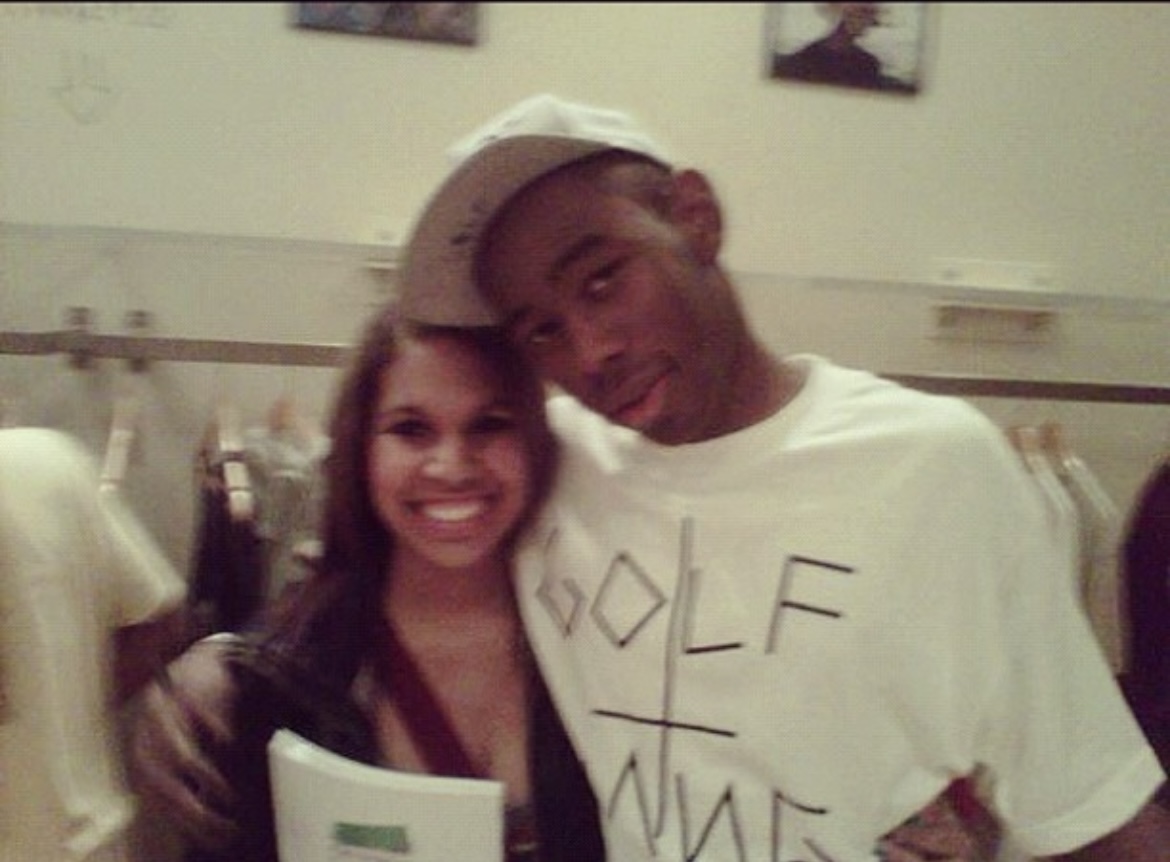
In October of that year, I waited in a six-hour line at the grand opening of his Odd Future store on Fairfax Avenue in Los Angeles, CA. When I finally reached the front of the line, I met Tyler. We took a picture, he told me I had pretty teeth, and I bought a photography book and tank top. For years, I never washed the shirt I was wearing while I met him. It was literally the best day of my life up until that point. 

This is the picture of Tyler & I (There was a no photo policy in the store but he made an exception for me, because I was practically hyperventilating, saying, "Someone take a picture of us before she passes out.") 

I saw a bunch of street banners advertising UCLA while waiting in line. I assumed the campus was close by, not knowing anything about LA's geography or traffic. That day changed the trajectory of my life and was the birth of my "dream school." My goal was clear: I would gain acceptance to UCLA, putting me in clear proximity to Tyler's store which would allow me to be around him often enough for us to fall in love and get married. 

The second part of the goal never came to fruition; I very rarely went back to his store. The first part of the goal, however, did come true on March 21, 2014. This became the new best day of my life. Little had I known, my unhealthy obsession with a rapper would lead to my acceptance to UCLA. 

Once I got to UCLA, I realized my journey there was unlike the rest of my peers. In the words of Claire Vaye Watkins, "All educations, [I] realized then, are not created equal." In The Ivy League was Another Planet, Vaye Watkins tells her college admission story. Growing up in rural Pahrump, Nevada, population 44,738, she explains, "By the time they're ready to apply to colleges, most kids from families like mine--poor, rural, no college grads in sight--know of and apply to only those few universities to which they've incidentally been exposed."

This blog by Professor Pruitt explores Vaye Watkins article in more detail.

Growing up in Merced, California, was similar in a lot of ways to Vaye Watkins in Pahrump but also very different. Merced is a mid-sized, agricultural city in the middle of the central valley, but it also the home of the University of California's newest campus, UC Merced and Merced Community College. Moreover, twenty minutes north is California State University (CSU), Stanislaus and fifty minutes south is CSU Fresno. It is a great privilege to grow up surrounded by so many options for higher education, one that many rural students don't enjoy.

For the most part, however, I learned of these schools because of proximity or incidental exposure, not because they put any effort into recruiting my classmates or me. Like Watkins' high school, the only recruiters that came to Merced High were military recruiters. And their efforts were rewarded. We loved the college-aged men coming to our school, getting us out of history class to go into the quad and engage in pushup and pull up challenges. They bragged to us about seeing the world, buying brand new Mustangs and Camaros, and making double the money for simply being married. Sarina Mugino discusses military recruitment, and military marriages, in more detail in this blog. At my high school graduation, a small group of us were going off to a university, but plenty of others stood to be honored for enlisting in the military. 

Ivy League schools were truly another planet. I couldn't even name any outside of Harvard and Yale. I often got Stanford confused with CSU Stanislaus. I knew absolutely nothing about the vast range of prestigious universities throughout the country.

I applied to eight schools because I qualified for a fee waiver that granted me four free CSU applications and four free UC applications. At seventeen, my choices were based on location. I knew practically nothing about any of the schools, but I knew UC Santa Barbara, UC San Diego, and San Diego State University were by the beach. I knew CSU Chico was known for parties. I knew UC Irvine, CSU Humboldt, and CSU Northridge were far enough away from my hometown that I could distance myself and begin healing from the difficult environment I grew up in. 

Outside of Tyler, the Creator, UCLA also had one thing no other school had. It had prestige. The day I proudly announced to my geometry class that I planned to go to UCLA I had no clue of its prestige or small acceptance rate. After my announcement, two of my classmates burst out laughing, telling me that "like 5% of people accepted there are Black" and I wouldn't qualify to join that small number. I will always remember my geometry teacher, Mr. Aguayo, for adamantly and immediately sticking up for me by saying his brother, "who was a lot less smart than me," graduated from there and Riki could, too. 

Unfortunately, Mr. Aguayo was an exception to the norm. It became a pattern for people to doubt my dream. Repeatedly, I was told I would not be admitted. These messages came from classmates, teachers, an assistant principal, and probably many more people behind my back. Eventually, I allowed the doubts to erode my enthusiasm until I stopped telling people my dream. In fact, by UCLA's decision day, I told all my classmates I wasn't going to check because I would never go to UCLA anyways. I will always regret waiting to read my acceptance until I was at home and all alone. I wish I had trusted myself more. 

In hindsight, the people who doubted me knew something I, very thankfully, had no clue of--the resources of the students I was up against. 

I took my SATs twice, with no studying beforehand. I had straight As, but from a low-funded, low-performing high school. Most shocking of it all, to me, is that little seventeen-year-old me submitted every part of my college applications through my iPhone because my family had no computer. I wrote my personal statement and scholarship essays in my notes app, copy and pasting straight from there to admissions portals. 

I've worked in college admissions since I was nineteen and I've seen over and over how unequal educations are. With my current company, students start their college preparation as early as middle school. They are assigned a tutor for every subject they can't get an A in. They begin our rigorous, years-long SAT/ACT prep. They are assigned a college counselor who studies their transcripts, extracurricular activities, interests, etc. and curates a perfect college list for them that ranges across the country. And, before the applications even open, essay coaches, like me, fine comb through every word on each and every one of their applications, using our CEO's essay writing formula, until each is polished to perfection.

I look back at my own college application efforts and I truly marvel that I ever stood a chance. 

In some ways, I think there is a privilege in growing up a world away from the Ivy Leagues. I still remember the unexplainable joy I got reading I was accepted into my first college, San Diego State. I ran to my mom's room and we both cried, repeating over and over, "we're going to college." She immediately asked me to send her a screenshot so she could brag on Facebook. For us, honestly, any college was a dream.

But I was lucky enough to grow up in California. Even my "safety" schools were great schools. There are many students for whom UCs and CSUs are on another planet, and many for whom even community college is in another universe. Watkins ends her article with a very powerful question, "...is it any wonder that students in Pahrump and throughout rural America are more likely to end up in Afghanistan than N.Y.U.?" From my experience, there is no wonder in this at all. 

This post, by Geovanna, goes into detail about other risks that hold rural students back from receiving college educations.

Thursday, February 16, 2023

A theory on low numbers of rural women in graduate schools

https://unsplash.com/photos/aqXcd12XrYY?utm_source=unsplash&utm_medium=referral&utm_content=creditShareLink

Growing up, my answer to what I wanted to be when I was older was always, "a soccer mom." This answer wasn't met with laughter, as one might have expected, as being a stay-at-home mother was a common career path for women in my hometown. Many of these stay-at-home moms were a product of necessity, as their husbands were military men who could be deployed or re-stationed at any moment. Due to their husband's career choices, they were left with very few of their own. I theorize that the commonality of rural women marrying military men affects their graduate school enrollment rates. 

Women are enrolling in graduate school at a higher rate than men. In the fall of 2020, students who are biologically female accounted for 59.7% of incoming students, whereas students who are biologically male accounted for only 40.3%. This seems like a positive trend for women, who historically enrolled in post-secondary education at a rate much lower than their male counterparts. The bad news is that only 9% of rural women participate in this trend. 

A lack of access and resources in the primary education sector is not uncommon in rural areas. To assume these deficits don't account for low undergraduate and graduate enrollment for those from rural communities would be naive. A quick quote from a prior blog post about rural education illustrates:

According to a study by the National Center for Education Statistics, a larger percentage of public schools in rural areas reported being under-enrolled, reported a lack of instructional computers with internet access, and a lack of counselors, social workers, and special education teachers. Most rural schools face higher costs with lower revenues, and spend an average of 10 percent less per student than metropolitan communities. Teachers in rural communities often have less training, receive lower pay, and are overall less educated than teachers in non-rural communities.

Primary education in rural communities has much room for improvement. However, the issues in rural primary schools are not the only reason that rural women enroll in graduate school at a much lower rate than the American average. 

My theory that women choose to marry military men over enrolling in graduate schools is further evidenced by a common career path for rural teenagers. Instead of enrolling in post-secondary education, many rural teens enlist in the military. In 2011, rural residents made up 44% of the enlisted forces, even though they accounted for only 17% of the population. According to a 2005 Washington Post article, high rural enlistment rates are often due to the lack of economic opportunities afforded to young rural residents. The only options many rural youth see are to sign up for a lifetime of repaying student loans with the hope of making money in the future or to sign up for a guaranteed paycheck, job security, education benefits, 30 days of annual paid vacation, housing, food security, free health care, education plans, and many other enticing benefits. This could be a viable career option for teens of all gender identities but biological women make up only 16% of the total enlisted forces

Other benefits associated with military enrollment are the benefits that accrue by virtue of a soldier's marital status. From the spousal perspective, those include free health care (including births), free housing, and world travel. Service members also receive additional pay for their spouses and avoid living in the dorms on base. These benefits largely fuel the stereotype that military members marry quickly, and the stereotype is backed up by data. For example, 64.8% of those in the active duty Army are or have been married, in contrast to 45% of all Americans who are married. 

This correlates with the higher marriage rate in rural communities. This map shows that marriage rates in rural communities are above average: 

https://dailyyonder.com/rural-upbringing-increases-odds-young-people-will-mary/2017/08/16/


Many career paths that require higher education, especially those that require graduate school, require state-specific licensing and certification. These professions include lawyers, doctors, teachers, accountants, nurses and other medical technicians, veterinarians, and more. Furthermore, job markets vary from region to region. 

Military spouses are often limited in what careers they can pursue due to the constant moves. It is common for service members to change assignments, requiring them to move to a different base across the country (or even to another country). Frequent moves make it very difficult to get and retain jobs, especially with a career that requires post-secondary education. By the time a lawyer spouse would be able to study and pass the bar for the new state they moved to, they are likely packing up their house to move again. The same goes for most careers that require state certifications. Thus, it is easier and more cost-efficient to pursue a career that does not require any level of state certification, and therefore does not require a post-secondary degree. 

Although this is a working hypothesis, there seems to be a correlation between the anomalously high statistics for rural marriage and military enlistment and the low statistics for rural women pursuing graduate education. This theory, alongside the rural primary education systems and other socioeconomic factors, correlates and should be examined to reconcile the disparity between rurality and the graduate school enrollment rates for rural women in the United States.

Thursday, February 2, 2023

Chinese spy balloon over Montana gives new meaning to "flyover states"

This afternoon as I was driving home from work, I heard NPR report the breaking story of a high-altitude balloon over Montana--at least that is where it was yesterday.  The U.S. Government says it is a Chinese surveillance balloon and is not disclosing where the balloon is now.  Given Montana's reputation as a "rural state" that is sparsely populated, I found interesting this coverage by Dan Lamothe and Alex Horton in the Washington Post:
The incident, first reported by NBC News, prompted a series of unusual events as the balloon was observed Wednesday over sparsely populated Montana, officials said. The state is home to numerous U.S. nuclear missile silos.
* * * 
Senior military officers, including Gen. Mark A. Milley, chairman of the Joint Chiefs of Staff, advised against [shooting down the balloon], citing concerns that falling debris could put people and property at risk, the senior official said.

The balloon’s flight path takes it over “a number of sensitive sites,” this official said.

Also of interest is this about prior Chinese surveillance of U.S. territories outside the North American continent, surveillance that spanned "several years."  

[S]imilar balloons, carrying guidance systems on board, have been detected previously over Hawaii and Guam, a U.S. territory that houses substantial American military assets.

The presence of missile silos in Montana is reminding me that many are also present in my home state, Arkansas.  This, it seems, suddenly makes sparsely populated places of interest and value--if only because strategic defense systems have been sited in them.  I assume that the sparse populations and cheap land are primary reasons for the decisions to site this sensitive--and potentially dangerous military infrastructure--in these rural places.  

The Washington Post story notes similar national security concerns in Montana's neighbor to the east, sparsely populated North Dakota: 

China’s brazen surveillance effort coincides with recent warnings from the U.S. Air Force over proposed Chinese land purchases in North Dakota about 12 miles from a military facility where drone test flights are conducted. The pending deal for a corn milling site has fueled concerns that the purchase is a cover for Chinese surveillance activities. A U.S. interagency committee decided last year it did not have jurisdiction to oppose the sale.

Air Force Assistant Secretary Andrew P. Hunter took an unambiguous view in a letter released earlier this week by North Dakota’s senators.

“The proposed project presents a significant threat to national security,” it says, “both near- and long-term risks of significant impacts to our operations in the area.” The senators called for the project to be discontinued.

Here's a somewhat humorous quote from the New York Times coverage of the surveillance balloon: 

On the ground in Montana, Jeffrey Sherlock, a retired state district court judge in Helena, agreed that the balloon was a “provocative” move. But he also expressed wonder that the Chinese would have been interested in his part of the country.

“I can’t believe they are spying on Billings, Mont.,” he said. “There’s not much there.” 

This recent post similarly speaks to the conflict between rural development and the risk of Chinese surveillance or influence.