Showing posts with label extraction industries. Show all posts

Tuesday, March 17, 2026

The burden of the "American Dream" on rural communities

Photo Credit - Chelsea Peng 2025 "The end of the American Dream and why it’s OK"

On March 14, the House Committee on Small Business held a hearing called “Empowering Rural America Through Investment in Innovation.” Subcommittee Chairman Jake Ellzey, a Republican representing Texas's 6th Congressional District (a mix of Dallas-Fort Worth suburbs and rural counties like Navarro and Cherokee), told the room that “as the demand for AI accelerates, America’s digital infrastructure is rapidly expanding into rural communities.” He promised that for every data center job created, seven more would follow in the surrounding community.

I have spent this semester writing about technology arriving in rural America. The promise is always the same: innovation, jobs, progress. The pattern is also the same: the benefits flow out, and the costs remain.

Three posts, one pattern

In my first post, I wrote about a $25 billion AI data center planned for Tonopah, Arizona, population a few hundred. Backed by a billionaire venture capitalist and a Trump mega-donor, the project would consume as much electricity as a million homes and drain aquifers that residents depend on for drinking water. The tech consumers served by the facility live in cities. The residents of Tonopah got noise, light pollution, and a fight they lacked the political power to win.

In my second post, I stepped back from tech to look at the framing. I had caught myself thinking that rural investment came at urban expense. That zero-sum instinct turned out to be the wrong lens. The federal government spends $850 billion a year on defense and asked $1.8 billion for the Legal Services Corporation. The scarcity pitting rural against urban is a policy choice, not a fact of nature. Rural and urban working people have lost ground to the same forces and share the same interest in functional public services.

In my third post, I wrote about robotic strawberry harvesters arriving in Salinas Valley. Immigration enforcement had squeezed the farm labor supply. The federal government’s response was to lower guest worker wages, and then automation filled the gap. The robots cost $300,000 each, priced for corporate farms. Small growers and the farmworker communities who built Salinas for generations got nothing.

Each story has different characters and geography. But the structure is identical: federal policy creates or worsens a rural problem, and capital arrives promising solutions. The benefits accrue to investors/urban consumers and the people who already live there absorb the costs.

Photo Credit - Will Robinson 2020 "Is the American dream dead?"
The packaging

This pattern persists because it is wrapped in a story that Americans have been told their whole lives: that progress rewards hard work, that innovation lifts all boats, that the people who struggle simply need to adapt. This is the "American Dream," and I have come to believe it is one of the deepest sources of political paralysis in this country.

I said something like this in class a few weeks ago. I told Professor Pruitt and my fellow students that the American Dream is this country’s “original sin.” She pushed back, fairly, and pointed out that there are things about this country that are more original and more sinful. She’s right. Slavery, land theft, and genocide are the material foundations. But the American Dream is the legitimating story that makes those foundations look earned. It converts structural advantage into personal merit and structural disadvantage into personal failure.

I know this because I lived it. I grew up male, Mormon, white, healthy, and financially comfortable. My family believed fiercely in individual agency. I followed the rules and concluded that people whose lives were less "successful" than mine were in that position because of their own bad choices. It took college and a lot of unlearning to see that my “good choices” were only available because the structure was built for me.

The same logic operates at the community level. When a rural hospital closes after Medicaid cuts, residents blame the hospital, not the lawmakers who voted for the bill. When a farmer in Colorado threatens to mechanize rather than pay overtime, the framing is that labor protections killed the farm, not that the farm’s business model depended on paying workers less than the legal standard in every other industry. The American Dream teaches people to punch down and look away from the hand above them.

What would it look like to say no?

There are signs of resistance. At least 25 data center projects were cancelled across the United States in 2025 after community opposition, four times the number in 2024. Rural school voucher programs have been blocked by rural Republicans who understand that their public schools are the backbone of their communities. Bernie Sanders and Alexandria Ocasio-Cortez drew 10,000 people to Greeley, Colorado, a conservative town in Weld County, on a message of class solidarity across the rural-urban divide.

None of these are sufficient. But they share a feature that the American Dream framework lacks: they start from the premise that rural communities have the right to decide what happens to their land, their labor, and their resources. That premise is incompatible with a system that treats rural space as a site of extraction and rural people as obstacles to progress.

Congressman Ellzey’s hearing (referenced at the beginning of this post) promised rural America seven jobs for every data center. Nobody on the panel asked how many jobs, aquifers, and night skies those same communities would lose. Until that question gets equal time, the American Dream will keep doing what it has always done: blaming the most vulnerable among us for their poverty and lack of resources, while lionizing the most powerful people in this country as they get increasingly wealthy. 

Monday, January 19, 2026

Big tech sets its sights on rural Arizona

The blog’s most recent post discussed the Rural Health Transformation Program. Passed as part of Trump’s “One Big Beautiful Bill,” this “rural slush fund” was added as a last-minute sweetener to secure the support of Alaska Senator Lisa Murkowski.

One of the $50 billion fund’s stated goals is “tech innovation.” States utilizing the funds must spend them on three or more approved uses, including:

Providing training and technical assistance for the development and adoption of technology-enabled solutions that improve care delivery in rural hospitals, including remote monitoring, robotics, artificial intelligence, and other advanced technologies.

This sounds promising. Rural hospitals face unique challenges, and technology that improves care and increases capacity could be transformative. An earlier post on this blog discussed how RFK Jr. has promoted AI nurses as a potential solution to the rural health care crisis. That optimistic vision contrasts sharply with how artificial intelligence is currently arriving in many rural areas.

In December 2025, Sharon Goldman reported for Fortune on a massive AI data center project planned for rural Arizona. The development would be built on a 2,000-acre property called Hassayampa Ranch, located about 50 miles west of Phoenix near the unincorporated community of Tonopah in western Maricopa County. The area is home to a few hundred residents, drawn there for its tranquility and clear skies for stargazing.

Photo caption: Buckeye Ranch, Tonopah. © Nextdoor

This quiet corner of the desert has become the center of intense activity since developer Anita Verma-Lallian purchased the land for $51 million, backed by billionaire venture capitalist and Trump mega-donor Chamath Palihapitiya. The plan is to spend as much as $25 billion to build a data center that would produce 1.5 gigawatts of compute and consume as much electricity as a million homes.

Photo caption: Visualization of the land parcel. © Jason Ma, 2025

Investment in rural communities sounds exciting, but who benefits? As Andrew Aitken noted in The Builder Bureau, AI is largely being developed for and used by urban populations, while rural people continue to struggle with poor network coverage and slow internet speeds. So while it remains unclear whether Tonopah will reap any benefits from hosting AI infrastructure, residents are already bearing the costs.

This pattern echoes concerns raised in prior entries on this blog. A May 2024 post discussed how rural folks in Montana are resisting efforts to make their land a “carbon sponge” for urban America. As one county commissioner put it:

The question I keep hearing is, ‘Why are they making us the dumping ground for the rest of the country?’

A similar dynamic is at play in Tonopah, with rural Arizona poised to bear the environmental burden of infrastructure that primarily serves urban tech consumers.

In her Fortune article, Goldman explains that Tonopah residents are already worried about incoming noise and light pollution, traffic and infrastructure strain, and negative impacts on property values. Concerned community members have organized and signed petitions against the development. But with such a small population, their political power is limited against billionaire-backed interests. As Kathy Fletcher, a 76-year-old resident who lives on a one-acre plot next to the Hassayampa Ranch site, said:

All we can do is plead with the people here... We’re kind of treated like the redheaded stepchild, and they just think they can throw anything they want out here... We’re having a difficult time fighting the battle to tell people, ‘You can make a difference.’

Another major concern is water. AI data centers generate vast amounts of heat and require millions of gallons of water per day for cooling. According to the Environmental and Energy Study Institute, a medium-sized data center can consume up to 110 million gallons of water per year—equivalent to the annual water usage of approximately 1,000 households. Larger data centers can use up to 5 million gallons per day. For the people of Tonopah, who rely almost exclusively on ground wells for their water needs, the prospect of a massive development tapping into their water supply is daunting.

As Dillon Beckett wrote on this blog, utility-scale projects are “overwhelmingly sited in rural areas” and tend to “benefit a sliver of the community’s social strata (wealthy, often absentee landowners, with extensive real estate holdings) while spreading the cost across the entire community.” The Hassayampa Ranch data center fits this pattern: Silicon Valley investors stand to profit, while local residents face rising utility costs, depleted aquifers, and a transformed landscape.

Tonya Pearsall, a Tonopah resident who has lived in the area since 1999, feels a profound sense of loss as this project rapidly changes the character of her once-calm community:

We used to be able to see the Milky Way—that’s why we moved out here... It’s painful... I could break down and cry.

Photo caption: The night sky over Maricopa County. © David Iversen, 2025.

There is some movement in Congress to address these concerns. Representative Jim Costa (D-CA) has introduced the Unleashing Low-Cost Rural AI Act, which would require the Departments of Agriculture, Interior, and Energy to study the impact of AI data center expansion on rural areas, including effects on energy supply, consumer costs, and infrastructure needs. Whether such a study will lead to meaningful protections for communities like Tonopah remains to be seen.

The Hassayampa Ranch project is not unique. Similar fights are playing out in Louisiana, Wisconsin, and Georgia, where rural residents are pushing back against data center proposals that promise economic development but threaten local resources and quality of life.

As AI continues its rapid expansion, rural communities across the country will increasingly find themselves on the front lines of a familiar struggle: who decides what happens to rural land, and who bears the cost of progress?

Wednesday, December 10, 2025

Congress (finally) renews Secure Rural Schools Act, through 2027

Congress voted overwhelmingly yesterday to renew the Secure Rural Schools Act.  Here's an excerpt from the Los Angeles Times coverage, by Hailey Branson-Potts, which leads with a bit historical perspective on rural schools lobbying efforts for the funding over the past few years:  
In February 2023, Jaime Green, the superintendent of a tiny school district in the mountains of Northern California, flew to Washington, D.C., with an urgent appeal.

The Secure Rural Schools Act, a long-standing financial aid program for schools like his in forested counties, was about to lapse, putting thousands of districts at risk of losing significant chunks of their budgets. The law had originated 25 years ago as a temporary fix for rural counties that were losing tax revenue from reduced timber harvesting on public lands.

Green, whose Trinity Alps Unified School District serves about 650 students in the struggling logging town of Weaverville, bounded through Capitol Hill with a small group of Northern California educators, pleading with anyone who would listen: Please renew the program.

They were assured, over and over, that it had bipartisan support, wasn’t much money in the grand scheme of things and almost certainly would be renewed.

But because Congress could not agree on how to fund the program, it took nearly three years — and a lapse in funding — for the Secure Rural Schools Act to be revived, at least temporarily.

On Tuesday, the U.S. House overwhelmingly voted to extend the program through 2027 and to provide retroactive payments to districts that lost funding while it was lapsed.

The vote was 399 to 5, with all nay votes cast by Republicans. The bill, approved unanimously by the Senate in June, now awaits President Trump’s signature.

“We’ve got Republicans and Democrats holding hands, passing this freaking bill, finally,” Green said. “We stayed positive. The option to quit was, what, layoffs and kids not getting educated? We kept telling them the same story, and they kept listening.”

Green, who until that 2023 trip had never traveled east of Texas, wound up flying to Washington 14 times. He was in the House audience Tuesday as the bill was passed.

In an interview Tuesday, Republican Rep. Doug LaMalfa, who represents a vast swath of Northern California and helped lead the push for reauthorization, said Congress never should have let the program lapse in the first place.

I don't agree with LaMalfa on many issues, but on this one he is absolutely correct.  

The five congresspersons who voted against the Act were: 

  • Rep. Andy Biggs (R-AZ)
  • Rep. Paul Gosar (R-AZ)
  • Rep. Anna Paulina Luna (R-FL)
  • Rep. Thomas Massie (R-KY)
  • Rep. Ralph Norman (R-SC)
Here is an Ed Source story about the passage of the law, and here's an Oregon Public Broadcasting story focused on the significance of this funding to many counties in the Pacific Northwest.  CalMatters covered it here.  An announcement by New Mexico Congressman Gabe Vasquez, who says it means $9 million for his state's rural schools, is here. 

Finally, here is a February 2023 post based on Branson-Potts' previous story about California rural school administrators lobbying in Washington, D.C., for the Secure Rural Schools Act.   The term used there for the pittance represented by this spending--at least from the perspective of all federal spending: "budget dust."  

Sunday, July 20, 2025

Cutbacks to public media likely to hurt rural communities the most

The disporportionate impact that federal funding cuts to public media will have on rural communities has been a theme of several publications in recent weeks, all in the run up Congress' vote to do just that--take back $1.1 billion previously allocated in support of public media.  

The first item I want to highlight is this July 11, 2025 episode of The Daily (New York Times audio), "Is Congress about to Kill this Local Radio Station?"  It discusses the likely impact of the proposed cuts on a public radio station, KFSK, in Petersburg, Alaska, population 3,000, in the southeast part of the state.  Jessica Cheung of The Daily sets up the interview with KFSK Station Manager Tom Abbott:    

Small rural stations, like KFSK, rely on federal funding to exist. And in a town like Petersburg, that is conservative, a town that voted for Trump by almost two to one in the last election, people are grappling with the Republican Party that is now trying to defund an important resource within the community — a radio station that a lot of people love. So I wanted to talk to Tom about what that’s been like, what’s at stake, and just what a station like KFSK offers people.

They start with a discussion of the place, including its beauty, economy, wildlife, and remoteness. 

Tom Abbott:  We also don’t have any chain stores here. Everything is mom and pop. Even though if you go to the post office, you’ll see a lot of Amazon boxes coming across the counter, because on occasion, there are things that can’t be found here, just because it’s a small market and it’s a small community. And that’s what brings us back around. radio. That’s why there’s only public radio here.

Jessica Cheung:  And if you turn the dial in Petersburg, can you hear any other radio station out there?

Tom Abbott:  Yeah, you can catch 88.5, which is the Lutheran Church.

Jessica Cheung:  And that’s it?

Tom Abbott:  Yeah, they broadcast for the shut ins that can’t make it to their service on Sunday. And that’s the only other service that’s on the FM dial. And there’s nothing on the AM dial.

What follows in the interview is a description of a service that reminds me of the "party line" feature on the local radio station I listened to while growing up in the Arkansas Ozarks.  On KFSK, it is called Tradio.  Here's an excerpt: 

Tom Abbott:  Where the caller calls in to the radio station. We put them on the air. And they either make an announcement about an event coming up. Maybe they’re having a garage sale on Saturday.

Archived Recording:  And we have tons of stuff — chairs, dozens of hand tools, fishing poles, sporting goods. There’s books and movies. And you name it, we got it.

Tom Abbott:  Well, this week, we’ve got a lot of fishing poles. Or this week, we’ve got a lot of baby clothes, something, whatever it may be.

Archived Recording:  Yes, good morning. This is Earl. I got a 2012 Nissan red vehicle with low mileage.

As Cheung expresses it, 

This is basically Facebook Marketplace on the radio.

At some point, Abbott starts talking about how the station ceased live broadcasts of some meetings during the pandemic because what some residents were saying at the meetings constituted misinformation, as locals stated their opinions about public health measures.

Cheung then turns to the likely effect of the proposed federal budget cuts on KFSK. 

Tom Abbott:  Our service would be drastically altered. The CPB funding that we receive is 30 percent of our budget. As public radio does, we rely on membership donations. And that is our largest single source. Our second largest single source funding is CPB funds.

Jessica Cheung:  And without that 30 percent you get from the federal government, what are you contemplating?

Tom Abbott:  As far as the expenses go, personnel expenses are 65 percent of our budget.

Jessica Cheung:  And how many personnel do you have on staff right now?

Tom Abbott:  Five, and there’s two high school kids that help us out when we’re doing live broadcasts in the evenings. And going forward, I foresee KFSK eliminating all staff except for two. And both of those I would like to see it remain two reporters. If you were to go down to one reporter, you’re on an endless cycle of burnout.

Jessica Cheung:  And is it my understanding that with 30 percent cut, you could still survive? Or is taking KFSK off the air an option you’re contemplating?

Tom Abbott:  I don’t think you’d ever have to go off the air, because the infrastructure is here, the antenna is here. But it wouldn’t be locally run anymore. It just couldn’t be. 

Right now, we have 27 individual public radio stations in the state of Alaska. I think that’s going to go down to two, maybe three if this rescission goes through. It’s not going to happen immediately, but it’s going to go that route. And that’s what’s under threat here.
Then Abbott discusses how some NPR reporting has been received by locals. There's a lot here, and I'm just going to include a very brief excerpt:

Tom Abbott:  [W]hat we have control over is local. I have no control over the editorial content of NPR. I have no control over that whatsoever.

In fact, I have, myself, as a station manager, contacted them many times over the years with complaints. I think there are certain subject matters that are covered heavily that are not necessarily representative. They’re certainly not representative of the audience that I serve.

Jessica Cheung:  Is there a specific story that you’re thinking about, maybe one that you wrote to NPR about?

Tom Abbott:  I don’t know. What comes to mind is the propensity for the LGBTQ+ stories. I don’t believe that the percentage of the stories that that subject matter has is equivalent to certainly the service area that I have. And I’m not saying that people are not caring about others. I’m not saying that at all.

I get the editorial decision on it. It’s under threat. But I’m just saying, what is pertinent in your personal life? And I think this holds for Kansas, Nebraska, Oklahoma, wherever you are. Small town, rural areas, to me, it sounds like the editorial decisions are being made for the audiences that are in New York, Chicago, Philadelphia, the big metro areas.

And on occasion, there is a great story that NPR does that covers small-town America or relates to small-town America plenty of times. I’m not saying that they totally have a blind eye towards it. I just think the target audience that NPR has is metro areas.

Jessica Cheung:  And what would you rather hear get coverage by NPR?

Tom Abbott:  Well, what’s the effect of the tariffs on the farmers of America, the seafood industry of America? That would really resonate here locally.

Following on this excellent and very comprehensive podcast focused on KFSK in Alaska, the New York Times editorial board published on July 16, "This is Why America Needs Public Media." Here, I'm just going to excerpt the part that mentions rural places, as well as an acknowledgement that NPR's programming (as distinct from local programming) may not reflect "the citizenry that is subsidizing them": 

When the private sector doesn’t provide an important service, the government often steps in. That is why the framers established the U.S. Postal Service; they believed no one else would deliver the mail to the entire country. Many places in America, especially in rural communities, would not have a library without public funding. Police departments, the military, Medicare, Social Security and public education offer other examples.
* * *
Republicans complain, not always wrongly, that public media reflects left-leaning assumptions and biases. And they can fairly tell NPR and PBS to do a better job of reflecting the citizenry that is subsidizing them.

* * *  

We are reminded of the excesses of the “defund the police” and “abolish ICE” movements on the other side of the ideological spectrum. They adopted a fatalistic view of vital government services, suggesting that their imperfections justified their elimination. They were wrong, and so are the conservatives who want to defund public media.
* * *
Public media, like every other major institution, is imperfect. But it improves the lives of millions of Americans, and it strengthens American interests. 

I earlier commented on NPR's political bias here.  To be clear, I completely trust NPR's reporting on factual matters, such as whether the 2020 Presidential election was stolen.  It was not.  I simply think that the entity's editorial slant is often far enough to the left of middle America to fuel distrust by many--as suggested by some of the patrons of KFSK.

Finally, today, NPR's Frank Langfitt reported from Dunmore, West Virginia, under the headline, "Cuts to public media will smash budgets of some local radio stations."  I'll just include some key excerpts here:  

[S]ome of those hardest hit by Congress' decision last week to clawback $1.1 billion in federal funds are small radio operations that provide local news and information to rural communities.

One is Allegheny Mountain Radio, a cooperative of three stations which cover Pocahontas County, West Virginia as well as Bath and Highland counties in Virginia. Allegheny Mountain is not an NPR member station, but it does run NPR's daily newscast, a quick run down of top stories.
* * * 
Allegheny Mountain's mix of programming includes local news and information as well as gospel, country and blues shows. A recent episode of the Noon Hour Magazine reported on a $5,000 signing bonus to attract new teachers and how the energy demands from data centers could eventually affect this remote region where people sometimes have to drive 60 miles to reach the nearest shopping center.

Allegheny Mountain relies on funding from the Corporation for Public Broadcasting (CPB) for up to 65 percent of its annual budget of about half a million dollars. Smith says his stations do have financial reserves, but the hole in their budget could become existential.
Langfitt quotes station's general manager:
There is only so long that you can continue to exist when you are operating in the red. ... At some point that well runs dry.

One bottom line, this quoting the NYT editorial:

[T]he “national” part of NPR (or National Public Radio, as it used to call itself) that chafes conservatives may well be just fine without federal funds.   

It is local stations, trying to provide local programming, that will suffer most from these cuts, along with their listeners.  

One other detail worth noting on the Congressional vote to claw back the public media funding:  Senator Mike Rounds (R) of South Dakota had previously indicated that he would oppose the cuts but decided to support the package after "top Trump administration officials" said they would steer unspent funds 'to continue grants to tribal radio stations without interruption' for next year."  Yet, Loris Taylor of Native Public Media commented: 

There is currently no clear path for redirecting these funds to tribal broadcasters without significant legislative and administrative changes.

Monday, June 23, 2025

Black lung spreads to younger miners due to complications from silica

Kate Morgan reports from the New York Times from a trip across Appalachia to learn about black lung disease's newest manifestation, which implicates silica and is affecting younger miners.  Some key excerpts follow:

Modern miners are contracting [black lung disease] at younger ages and at rates not seen since the 1970s. For 20th-century miners, it could take decades to develop severe black lung. For men of Aundra Brock’s generation, just a few years can be enough. Nationwide, one in 10 working miners is now estimated to have black lung. In the heart of the central Appalachian coal fields, it’s one in five. Often, their disease is more severe, the progression faster. Doctors are seeing larger masses and more scarring in the lungs. Transplants, disability claims and deaths are all on the rise.

* * *  

In an old industry, the reasons are modern. Centuries of extraction have altered the landscape, making the mountains more dangerous to mine, researchers say, and the men beneath them vulnerable not just to black lung, but to another lung disease called silicosis.

* * * 

Silicosis is caused by inhaling a mineral called crystalline silica that is typically found in sand, stone and concrete. It is a building block of the Appalachians. But in the air, it is dangerous, able to create much worse scarring in the lungs than coal dust alone. Breathing the coal and silica dust together can create a kind of hybrid disease that quickly leads to progressive massive fibrosis.
Scientists and miners alike have long understood the dangers of the rock dust. “You can tell there’s silica when you see the flicker in it,” said Charles Thacker, a 69-year-old former miner from Norton, Va., who now has black lung. “It looks like bits of glass flashing in the light. It’s almost pretty. But that’s what gets in your lungs and cuts you up.”

Don't miss the rest of the story, which is chock full of human interest context.   Also, I want to mention that the ravages of silica on miners was a topic of discussion at this event at West Virginia University College of Law this spring.  (See the panel at 11:00 am).

Monday, May 26, 2025

A sustainable transition (Part IV): Extraction and investment

I grew up in Salt Lake City, Utah, which is surrounded by mountains. In my time there I occasionally drove south, out of the valley, into the midlands of the state. It gets so flat out there that every nub and knot on the horizon feels like a wrinkle on your eyeball. And if you’re driving in the afternoon, the sun skims in so bright down in front of you that even with sunglasses, you find yourself blinking away blindness every few minutes. At other points, it feels like traversing an alien landscape. It’s a wonder that anything lives out there. Luckily for us, a lot of things have died there too. 

My dad started running rivers for Holiday Expeditions when he was a teenager. One of their main hubs is the town of Vernal, also known as “Dinosaurland.” Dinosaur National Monument is located 20 minutes away and contains over 800 paleontological sites. My twin brother and I learned to drive in Vernal on the runway of an airport under what I still consider impossibly bright stars. We would refuel at the Sinclair gas station, whose mascot is a green dinosaur. 

South of Vernal is the Uinta basin, which the Green River bisects. The Uintah basin is where most of the oil reservoirs in Utah are located. Every trip we took down there, we saw great ranges of oil derricks grazing on the simmering hardpan of the land. On the way back, we would pass by Dinosaur, Utah, occasionally stopping to check out the fossils. 

Before coming to law school, I worked a number of service jobs. I like talking to people, and getting paid to do it felt like I was committing a heist. My favorite place where I worked was the Grand America Hotel, an alabaster mass of angles and glass among the uneven skyline of downtown Salt Lake City . The building is worth one billion dollars. It has marble sourced from a specific quarry in Italy. Chandeliers cut from the same set of natural glass. It is the eighth tallest building in Salt Lake, with 775 rooms and 75,000 square feet of conference space. I met James Harden, Frank Abegnale, and Rick Steves when I was there, let alone the other unspoken millionaires who politely complied with the awkward mating dance of a clerk performing highly specialized check-ins as the hotel sought its fifth star. 

The Grand America is owned and operated by the Sinclair Oil Company. The same one that operates the gas station in Vernal that we used to refuel at. Last time I was there, I think it had a plywood sheet as a bathroom door. It's been a long time since I've been there. 

Uintah County has a population of 35,620 people and  a median income of $69,821. Its poverty rate is just 11.1%, which is pretty incredible—there are plenty of rural places which have lower income and higher populations. But Uintah County is large, clocking in at 4,500 square miles. This is nearly the size of the Diablo mountain range at 5,400 square miles. As a Utahn, I’ve been staggered by the fact that California’s top 100 cities (by population), as listed by population, tapers out with Livermore with 85,000. Delving deeper, Oildale California has a population of approximately 35,324 and a poverty rate of 26.9%.  It is 8 square miles, and its median income is $50,000. So, Uintah County has a lot going for it, even considering the transportation costs of just getting around. 

Uintah County has an economy partially driven by mining, quarrying, and oil and gas extraction. Within that sector, the median wage is around $121,000. Taken in a vacuum, this sounds amazing. But fossil fuel salaries don’t often represent the full picture. 

To get a sense of what it’s like to chase oil as a worker, rather than an investor, I could not more highly recommend Michael Flanagan Patrick Smith’s article detailing his experience joining the oil rush in Bakken, North Dakota. He is now a folksinger, and while he’s likely bled his fingers into the strings of a guitar, he’s also bled his experiences into a book called The Good Hand. While it is not a simple issue, I took away the sense that the two most serious problems with these hyper-competitive extractive economies are as follows.  First, a significant increase in income in an area like this leads to a significant increase in cost of living expenses, wiping out what we presume to be a windfall for the risk and demands of these kind of jobs. Second, these economies are not aberrations, but serve oil company interests far more than they do their workers, and oil companies are incentivized to keep the damaging components of these economies (such as scarcity, competition, high hours, and local strain on infrastructure) in place. 

Because here’s the kicker—even with that high income and low poverty rate, if you multiply Uintah County's population by its median income, you can estimate an annual income is $2.4 billion. Sinclair Oil’s 2024 revenue is reportedly $28.58 billion. That does not include other income from the hotels and resorts which the Holding family was able to invest in due to their oil profits. 

Vernal, Utah, is both a fossil town and a fossil fuel town, but it could end up a fossil of its own. 

The billions of dollars pumped out of town translate more to corporate profits than they do to community benefit. These resources don’t replenish, meaning that while the town’s economy is maintained, even healthy, due to this extraction, when the last drop of oil is squeezed out of the stone, there might be no Vernal left. 

Extraction is not limited to the extraction of material. It can also be thought of as extracting value from a community in a disproportionate degree to that which it contributes. Utility-scale renewables projects echo many of the predatory practices and extractive effects of the fossil fuel economy. 

Ann Eisenberg’s forthcoming paper, due to be published in Volume 59 of the UC Davis Law Review, applies internal colony theory to the current practice of siting utility-scale renewable energy projects (which require thousands of acres of land) in rural areas. Some 99.8% of utility-scale renewable energies are sited in rural areas. While this does create some jobs, the benefits of those jobs disproportionately go to the cities that receive that power. While not physically extracting the resource, it is still forcing the majority of costs on a community while benefitting another area. That is the same mode in which fossil fuel extraction has operated. 

Nearly six percent of the land area of the United States has to be dedicated to renewable infrastructure for our nation to be truly climate neutral. The United States has about 2.27 billion acres, and six percent of that is 136 million acres. There are more than 450,000 brownfields in the United States. In fact, the EPA already funds Land Revitalization Projects to encourage communities and land owners to reuse and redevelop land that was previously contaminated and turn it into public parks, restored wetlands, and new businesses. Why not invest in a community’s ability to use that land for solar farms or other renewable projects, instead of prioritizing corporate profits and interests while damaging great swathes of otherwise usable land? 

This is yet another component of the green transitions that should be managed wisely; while just transitions should shift to incorporate community transitions, environmental justice should be refined to incentivize voluntary development. If a fossil fuel community is going to lose its jobs, it should be the first one offered to host renewable infrastructure. Therein lies the beauty of the brownfield. By seizing a brownfield, the government ensures that a landowner is compensated but cannot further profit from their poisoning of the land.

At the same time, installing renewable infrastructure in these communities helps to decarbonize the community. I think that we often overlook the fact that decarbonizing America doesn’t mean that we just have to decarbonize cities; we have to decarbonize rural areas, too.  If it is so important to decarbonize, this should represent sufficient justification to seize, transfer, and repurpose land. If that is not an acceptable solution, then maybe the problem isn’t as serious as we think. But you, and I, and everyone else, know that it is.

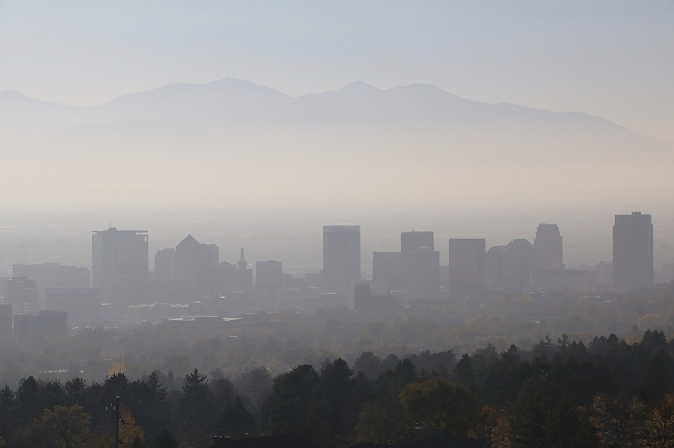
This is not fog, or snow, but engine exhaust and other emissions, caught between the warmed-up valley floor and a layer of cold atmosphere. 


Original picture by Eltiempo10, and posted under the Creative Commons Attribution-Sharealike 4.0 International License. Unfortunately unaltered. This is how my home looks every winter. 

Friday, May 23, 2025

A sustainable transition (Part III): A common interest

The tragedy of the commons is the theory that all common-pool resources (CPR) are finite and are thus in danger of exploitation and eventual destruction, and without governance individual users will exploit these resources to maximize their own benefit, and if their rate of use is faster than the time it takes for the resource to replenish their actions will lead to the eventual overuse and destruction of the CPR. 


The tragedy of the commons also leads to a conversation about the commons, and if people can recognize the value and vulnerability of the commons, to a coordinated effort of preservation.

This concept can best be understood in the binary of two birds. The passenger pigeon was a bird endemic to North America, and with an estimated population of five billion, was so abundant that their passage across the sky could obscure it as if there was an eclipse. While economic interests, such as protecting crops, were instrumental in their decline, they were also extensively used for trapshooting (before the advent of the clay pigeon) and as a source of food for a burgeoning New York City. 2014 marked the 100 year anniversary that they were entirely eradicated. On the other hand, the northern spotted owl was protected.1,200 pairs of these owls still live in Oregon, 560 pairs in Northern California, and 500 pairs in Washington, today. It is not an animal that is hunted or sought. But it is intolerant to shifts in its habitat, and threats to its livelihood gave rise to the President’s Northwest Plan, which barred logging in areas richly primed to do so, throwing “between 60,000 and 100,000 people out of work.” 

A commons was not threatened in the traditional sense—this was not a treaty about who can whale and how much. But it was a secondary commons—the typical tragedy of the commons has two elements: (1) a resource that can be extracted for the benefit of the extractor, that (2) the full extraction of which is a net and unrecoverable loss to the community—here, what was preserved for the benefit of the whole is the tradition and ecological system of the Pacific Northwest, and the reluctance to extinguish an entire form of life for the pursuit of profit. In sum, the “extraction” of the owl did not motivate the decision of timber companies to engage in logging, but its loss would still have been a net negative for the surrounding area, sparking a rule to protect the loss of a “common resource—the ecological, traditional, and moral benefit of the spotted owl. 

Now obviously an ecological tragedy of the commons is different from one of fossil fuels. There is no replenishment in fossil fuels; while the the stock is so vast that they are not likely to ever be fully
exhausted, there is an inevitability to the fact that they will be. There is only one way that coal can be “exhausted” and that is extracting all of it from the ground. That inures a benefit to the extractor, but it will not replenish, thereby distinguishing it slightly from the typical tragedy of the commons.  If we continue to extract coal, at any rate, it will inevitability be exhausted. While compelling, it is beyond the scope of this blog post to reconcile whether fossil fuel represents a tragedy of the commons (we could still have it if we didn’t exhaust it more than it could replenish) or something like an “inevitability of the commons” (it was never going to replenish anyway, but we could have gotten more out of it if we had just been more careful in which we extracted). But regardless, the commons still represents a common resource. 

The current push to site renewables at all costs means a push for utility-scale renewable energy installation. This has two major downsides. First, these projects are overwhelmingly sited in rural areas. Second, they benefit a sliver of the community’s social strata (wealthy, often absentee landowners, with extensive real estate holdings) while spreading the cost across the entire community. Third, without meaningful planning, the community may bear far more cost than benefit and may be strained to the point of collapse, much like the passenger pigeon. It is a prototypical example of the tragedy of the commons. 


I discussed in Part II the problem with transitional payments (a flat amount of money paid to displaced workers), and how they are unsuccessful. But the flip side of the argument considers the state surplus payments made every year by Alaska to its citizens. Why is it different? Primarily because it is distributed without red tape, but almost more importantly, because it is distributed equally. It is easier to accept the exploitation of a resource if you are receiving a benefit too—ironically, because the commons becomes common. No longer are a few small entities siphoning away something that belongs to all of us: we’re getting to sup on that straw too. In the tragedy of the commons, the costs accrue to everyone. Here, so do the benefits.

While rural America has borne the brunt of extraction, they now possess a somewhat perverse resource in spades: superfund sites. One of the major concerns with utility-scale renewable energy siting is that they will corrupt otherwise usable land (See Part I). But what if the land to be corrupted is already so? 

The term brownfield typically refers to land that is abandoned or underused, in part, because of concerns about contamination. The federal government defines brownfields as “abandoned, idled or underused industrial and commercial properties where expansion or redevelopment is complicated by real or perceived environmental contamination.” 

In the mid 1990s, the EPA began providing seed money to local governments to launch hundreds of two-year pilot projects and developed guidance and tools for cleanup and redevelopment of brownfield sites. The 2002 Small Business Liability Relief and Brownfields Revitalization Act codified many of EPA's practices, policies and guidance. The 2018 Brownfields Utilization, Investment and Local Development (BUILD) Act reauthorized EPA’s Brownfields Program and approved changes that affect grants, ownership and liability provisions, and State and Tribal Response Programs. 

Under the 2021 Bipartisan Infrastructure Law and the 2022 Inflation Reduction Act, Congress provided major funding to support planning, construction and operation of various public infrastructure improvements. Brownfields are continuously developing in both their characteristics and the government’s approach. It seems more than viable that a government could seize a brownfield through eminent domain and then remediate it enough to house solar farms. I want to stress here that there are two caveats. First, this must be a voluntary process undertaken with the consent of the community. Otherwise, it perpetuates an internal colony as better examined in Part IV--this would be the opposite of taking care of a commons. I It would be extractive. Second, this should not be the fate of all brownfield sites. These sites should still be cleaned up, but in the meantime, with climate change looming like it never has before, this land use could provide a temporary solution to a dire problem. 

Repurposing “bad land” into something better has already proven to be successful in rural communities, to some capacity. In Kentucky, hilltops blown out in search of coal have been repurposed to elevated communities, both reusing the land and relocating a flood-risk community to higher ground. 

When you think about rural America as a common resource, it is easier to justify what I think is a crucial component of the green transition. Compensating and rehabilitating these communities without benefitting the people who exploited them. I would advocate for governmental seizure of brownfield sites and other superfund sites through eminent domain, and construction of localized renewable energy projects. 

One main benefit of this is decentralizing the grid. If rural areas are able to achieve energy independence, not only can those communities prosper but the energy rate for the rest of the country goes down, and the durability of energy demand goes up. 

By conceptualizing rural America as a commons, we don’t only seek to protect it but justify investment in ensuring its continued existence—if not for them, then for us. Which cuts nicely antithetical to the current rhetoric of considering fossil fuel towns as backwards and standing in the face of progress. But what does extraction really mean to a community?

Monday, May 12, 2025

A sustainable transition (Part 1): Sustainable development and the green transition


Up until mid-twentieth century, miners would carry bright yellow canaries down into coal-blackened tunnels to carve out a meager living from the walls. Canaries are particularly sensitive to carbon monoxide, an odorless gas which can cause drowsiness, weakness, loss of consciousness, and death. Mining is hard, physical work, and miners would often fail to recognize the symptoms of carbon monoxide poisoning. The common canary exhibits distress in the presence of carbon monoxide poisoning and will die well before a human would begin to feel the effects of carbon monoxide poisoning. Thus, miners began to bring canaries down to warn them of the presence of the gas and thus escape its effects.

Although canaries helped save the lives of miners, the miners’ livelihoods are not threatened. Climate change and the pursuant public pivot away from fossil fuels, market volatility, the inconsistent distribution of mineable materials, and an increasingly globalized economy, can all contribute to significant job loss amongst miners. Furthermore, a miner's livelihood is tied to the amount of material present in the mine


A mine exists to extract a metal or mineral, and when the supply is exhausted, the mine is worthless supply, it is worthless. In addition, global politics and shifting market demand can lead to sudden and premature closure of otherwise stable mines, with with the workers the first to feel the impact of these shifts.  While whole swaths of miners lose their jobs, the owners of the mines feel relatively little impact. Ironically, coal workers can function as the “canary in the coal mine” for the coal industry itself. This is true for many extractive industries such as timber, oil, and natural gas. 

Furthermore, there are entire communities that depend on fossil fuel production to sustain their existence. But the world is facing a climate crisis that will require an energy transition on an unprecedented scale. We are left with a predicament: while we need to transition away from the fossil fuel industry, doing so requires the communities of workers that rely on that industry to sacrifice their way of life and their economies. Corporations have also perpetuated these extractive industries and have a strong interest in delaying this transition. 

So, here’s the trillion dollar question I will take up in this series of five posts: how do we transition a national urban-centric economy away from fossil fuels without destroying the rural communities that produce them? 

There is substantial literature on two aspects of the transition from fossil fuels to renewable energies, widely known as the “green transition.” First, the idea of “environmental justice,” and second, the idea of a "just transition."

Environmental Justice

As we all heard growing up, “the needs of the many outweigh the needs of the few.” But that is a maxim that should be invoked in times of disaster and crisis, not in city planning.


“Environmental justice” asks that the environmental costs associated with renewable energies be borne fairly instead of concentrated within low-income or majority-minority areas. Environmental justice is not a concept limited to the green transition; it has become increasingly relevant in discussions about where to site renewable energy industry and infrastructure.

I first came across the concept while working for the Department of Toxic Substances Control in Sacramento. Consider the car battery recycling process, which can infinitely recycle the lead component of the battery, melt and reform a substantial amount of the plastic casing, and neutralize the sulfuric acid or convert it to sodium sulfate, a product used in laundry detergent. Ninety-nine percent of car batteries are recycled. However, the recycling plant produces air emissions and a risk of lead contamination in air, soil, and groundwater. Battery recycling is an industry that benefits the community as a whole, but the smaller community near the plant suffers. For example, Exide Technologies shut its plant in May 2015, after years of fines and citations by the Department of Toxic Substances Control, leaving a five-square-mile brownfield site with elevated lead levels, near predominantly working-class and Latino neighborhoods. The cleanup in Vernon is ongoing. 

Another example of this conundrum is found in solar panel production. While the energy created by renewable energies is “clean,” the production of solar panels requires silicon, which must be mined, refined, and disposed of if the panel fails or is irreparably damaged. This both threatens health and safety due to emissions and environmental contamination and impacts the quality of life in an area through habitat destruction and a loss of natural beauty. 

Just Transitions 

A “just transition,” as articulated by Ann Eisenberg in a phenomenal law review article with that title, is a labor-driven principle of easing the burden that decarbonization poses to those who depend on high-carbon industries. It emphasizes a fair distribution of the risks and rewards of the green transition. Privately and publicly driven transition attempts have met varying degrees of success. 


In 2017, a nonprofit called Mined Minds came to West Virginia with promises to teach West Virginians how to write computer code, and then get them well-paying jobs. Many West Virginians quit their jobs or dropped out of school to participate, but almost none who signed up for the program are working in programming now. 

Alternatively, there are retraining programs that exist to train wind and solar installation technicians, and workers involved in zero-emission vehicle construction. However, these programs are not widespread and presently are neither widely targeted nor made free to fossil fuel workers. This may hamper their use as a transitional tool. 

In the past, the United States has provided some form of financial benefit to workers displaced by federal policy, such as compensating workers displaced by the Trade Act, the President’s Northwest Forest Plan, the Tobacco Transition Payment Program, and the POWER program. These payment programs have their own problems, which are discussed later in the series. 

Even successful non-fossil fuel climate transition projects, such as the USDA’s Rural Energy for America Program (which uses grants and loans to pay for clean energy projects for farmers and small business owners) and Climate Smart Commodities Program (which helps participating farmers implement production practices that help build soil health, sequester carbon, and enhance productivity) have been shut down or delayed by Trump’s USDA, casting some doubt on the integrity of long-term federal transition programs. 

California is “committed to achieving a just and equitable transition to carbon neutrality by 2045.” Although this will create a significant amount of jobs, only 56% of current fossil fuel workers will have “promising employment opportunities outside fossil fuel industries.” This number is likely to rise as renewable energy industry increases, but not enough to provide for all workers.

So, What’s Missing?

Nestled within the concepts of “environmental justice” and “just transitions” is the sustainable development triangle, a nexus between competing issues and interests like environmental stewardship, economic growth, and human well-being, to meet the needs of the present without compromising the ability of future generations to meet their own needs. Equity, Economy, and Environment lie at the three corners of the triangle. For example, “sustainably developed” housing can be pursued in a way that minimizes environmental impact in the surrounding area, drives improvements in Human Development Index and Multidimensional Poverty Index outcomes, and multiplies community jobs while improving household stability and providing opportunities for home-base. In this example, the issues considered can range from “good health and well-being” and “climate action” to “industry, innovation, and infrastructure” and “responsible consumption and production.”

Eisenberg explains that the existing policies of “environmental justice” and “just transitions” can be seen as lying on the sides of the triangle between ‘Equity and Environment’ and ‘Equity and Economy,’ respectively. 

What, then, lies between ‘Economy and Environment’? 

Extractive economies are unique in the fact that their economy is inextricable from their environment—these communities are ‘stapled’ to the resources they extract. In the late 19th and early 20th centuries, mill towns sprouted as forests were clearcut for the burgeoning timber industry. Mining towns cut into the rock to extract coal. Oil towns drilled down to start drawing up crude oil. However, the fate of many extractive economies is the same—once the resource has been fully extracted, the town fades away.

And What Comes Next? 

While environmental justice asks to distribute the costs of industry equitably, it may also take away the benefits from communities that find the costs acceptable. While just transitions aims to compensate individuals who will lose their employment in the green transition, that same person may be forced to relocate to find employment. 

This series of blog posts aims to discuss complex issues such as place, pride, and progress, and home in on a crucial aspect of the transition—how do we keep these communities intact? 

Here is a quick view of what’s to come: 

Part II of this series will cover the rural concept of “place” and how it factors into the identity of fossil fuel towns, even when there has been a past exploitative relationship with fossil fuel corporations, as well as how past transitions away from rural mono-economies have failed to adequately acknowledge this concept. 

Part III will examine Ann Eisenberg’s concept of rural America as a “commons,” and how this can help drive governmental investment in local communities instead of corporate investment in utility-scale renewable energy projects. 

Part IV will expose how the current renewable energy industry echoes past extractive economies like fossil fuels, and how localized renewable energy production could help decentralize the United States energy grid. 

Part V will examine several ways in which localized renewable energy siting could provide long-term stability for fossil fuel towns.

Thursday, May 1, 2025

Will Trump’s push to increase timber production help rural communities?

Many rural communities in the Pacific Northwest grew up around a once-thriving timber industry. Almost all timber harvesting operations are located in rural areas. Logging has, and continues to be, a source of pride in these communities. The timber industry allowed rural communities to thrive economically. However, the timber industry has slowly shrunk over the years. President Trump wants to revive the timber industry by opening more national forests to logging.

On March 1, 2025, President Trump issued an Executive Order directing the United States Department of Agriculture (USDA) to expand American timber production. The Executive Order calls for the reversal of restrictive policies and the implementation of federal policies that promote timber harvesting throughout the United States.

This executive order is meant to assist rural communities that depend on the timber industry and help gain support for the Trump Administration. Will the change in policy work, and will it help the economies of rural communities? The answer is likely no.

The timber industry has been slowly shrinking across the United States, particularly in Western states. Many sawmills near national forests have closed in recent years. With the closure of mills, jobs in the rural communities that surround local mills have disappeared. For many rural communities, the local mill was the largest employer in the area.

One example of this is the closure of the Malheur Lumber Company in John Day, Oregon. John Day has a population of 1,543 people, and the Malheur Lumber Company employed 76 people. Following the closing of the Malheur Lumber Company, two other mills in Oregon closed in 2024. This means that in Oregon alone, seven individual mills have closed in 2024.

The closure of so many mills demonstrates that the timber industry in rural areas has vanished. This means that increasing timber harvesting in national forests will be of little help to rural communities. There is nowhere to go with the logs that are harvested. This is because “logs would have to be transported longer distances, at increased costs.” Struggling mills cannot afford to pay extra transportation costs.

It is also unlikely that any of these closed mills will reopen their doors. Susan Jane Brown, an environmental lawyer and principal at Silvix Resources in Oregon, said that “‘no businessman is going to invest millions of dollars in a new mill or in retrofitting an old mill.’”

Further complicating the implementation of President Trump’s Executive Order is the recent Forest Service budget cuts and employee layoffs. I have previously discussed how the layoffs of Forest Service employees disproportionately affect rural communities, but these layoffs also hamper the Trump Administration’s goal of increasing timber production.

The Federal Government has laid off approximately 3,400 Forest Service workers. Forest Service staff are responsible for organizing and implementing timber sales. Without adequate staffing, the Forest Service will struggle to market timber sales to private companies.

The Trump Administration's ongoing tariff war will negatively affect the wood products industry as well. If the United States’ economy falls into a recession, the timber industry and rural communities will be hit extraordinarily hard. If a recession were to occur, the housing market would suffer. Since the wood products industry is intertwined with the housing market, the effects on rural communities that depend on local mills would be devastating.

President Trump’s Executive Order is unlikely to assist rural communities that depend on the timber industry. Local mills and rural mill communities have already disappeared. The industry that needed to produce wood products no longer exists. Harvesting more trees will be of little use, as there is nowhere to go with the logs.

The Executive Order appears to be an attempt by the Trump Administration to appease rural communities who overwhelmingly voted for President Trump in 2024. However, this push to open more national forests will do very little to help rural communities that depend on the remnants of the timber industry. 

For further reading on the hardships that logging-dependent communities face, please see Jennifer Sherman’s book, Those Who Work, Those Who Don't: Poverty, Morality, and Family in Rural America, and Michelle Wilde Anderson’s book, The Fight to Save the Town: Reimagining Discarded America. 

Saturday, February 8, 2025

In California’s Inland Empire, a complex battle for groundwater rages: if the wells go dry, there are no winners.

The Indian Wells Valley sprawls across Inyo, Kern, and San Bernardino county lines in the northwestern Mojave Desert. Beneath it lies the Indian Wells Aquifer, a major groundwater deposit upon which the local communities rely. In the dry Mojave, groundwater is the primary source of water for domestic and agricultural purposes; few aquifers in California have been as significantly depleted as Indian Wells. 

When former Governor Jerry Brown signed the Sustainable Groundwater Management Act (SGMA) into law, the Department of Water Resources identified Indian Wells Valley as one of many "critically overdrafted" groundwater basins. In response, a Groundwater Sustainability Agency (GSA) was created to manage the basin. That agency is now embroiled in a seven-year fight against some of the basin's largest groundwater pumpers to keep their regulatory authority—and the authority of SGMA—intact. 

The GSA operates out of Ridgecrest, the Indian Wells Valley's largest community. With a population of nearly 30,000, the city is built around Naval Air Weapons Station China Lake, the U.S. Navy's largest landholding. Employing more than 5,000 military and civilian personnel and generating $36 million in state and local taxes, it is of vital importance to the Ridgecrest economy.

China Lake's website boasts of its "incredible access to natural resources and recreational activities," and of Ridgecrest's affordable housing, shopping amenities, and small town life. This description sits in stark contrast with nearby towns like Trona, an unincorporated community in San Bernardino county with a population well under 2,000 and a poverty rate roughly twice that of Ridgecrest. Devastated by a 7.1 magnitude earthquake in 2019, Trona is a community in recovery—eyewitnesses describe houses "cracked in half" and residents driven out. Trona native Marilyn McKee refers to it as a "dying town". (You can see photos of Trona on the blog here).

Trona Gun Club. Credit: Lisa R. Pruitt

Mural in Trona. Credit: Lisa R. Pruitt

Whether dying or recovering, Trona is heavily reliant on the neighboring Searles Mineral Company for jobs and domestic water; “With no Searles, there’s no Trona,” says another Trona resident, Regina Troglin. Perhaps unknowingly, she echoes Ridgecrest city attorney and counsel for the Indian Wells Valley GSA, Kieth Lemieux, who explained to the Los Angeles Times in 2024 that "without [China Lake], there's no Ridgecrest." Without water, of course, there is no China Lake.

Trona Picnic Area. Credit: Lisa R. Pruitt

Despite the parallel between these two communities, Searles argues China Lake has received more favorable treatment from the GSA in implementing SGMA. Searles has been required to pay a fee of $2,100+ per acre-foot of groundwater extracted, while China Lake has not; as a federal landholding, China Lake is essentially exempt from such fees. Nonetheless, vice president of operations for Searles, Burchell Blanchard, believes the fee could bankrupt the company, causing hundreds of employees (many of whom are Trona residents) to lose their jobs (see: San Bernardino County Sentinel, "Searles Valley Minerals Contesting Groundwater Authority's H2O use fees" for a full public statement from Searles).

These claims are part of an ongoing legal battle between Searles and the GSA. Joined by the Indian Wells Valley Water District and Mojave Pistachio, one of the largest pistachio-growers in California, Searles has triggered an 'adjudication,' a complex legal proceeding in which a court manually determines the individual groundwater rights of every stakeholder in the basin. The adjudication challenges the GSA's authority to impose fees and seeks to replace their technical plan to achieve groundwater sustainability in Indian Wells Valley—two of the GSA's essential functions.

Alongside several other state agencies, the GSA appealed to the California Supreme Court for an early ruling on the GSA's authority under SGMA. On January 29th, 2025, the court declined to take the appeal, meaning the adjudication will proceed and will be determinative of water rights in the basin.

This is certainly a victory for Searles and Mojave Pistachio. Perhaps it is also a victory for the people of Trona. But many smaller water users have been unable to participate in the adjudication, due to high legal costs. These users generally have much shallower wells than entities like Searles and Mojave, meaning theirs will be the first to fail if the valley cannot figure out a sustainable solution to its water needs. So as the adjudication drags on, and groundwater levels in Indian Wells Valley continue to decline, the question remains: what happens when those wells run dry?