 |
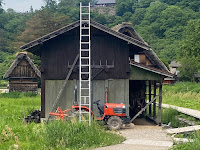
Truck delivering rice plants in Nagahama, Shiga Prefecture, Japan, May 2025
|
I traveled to Japan for the first time in late May, which happened to be amidst a spike in rice prices. As such, this was a topic much in the news during my time there, and I got interested in the matter and talked to many of our guides about why prices have risen so steeply of late. I'll return to that subject below.
 |
| Nagahama, Shiga Prefecture |
Rice farms everywhere. While on Honshu, the primary island in the Japanese archipelago, I had the opportunity to take many photos of rice fields and rice farming--and even a few rice farmers. You don't have to get far out of the major cities--and this includes looking out the windows of bullet trains (the Japanese is "shinkansen") as you are whisked through the countryside--to see multitudes of what appear to be small family rice farms. (All photos are (c) Lisa R. Pruitt 2025).
 |
Agricultural activity
Rural Shiga Prefecture, May 2025 |
We learned that in exurban and rural places, many families have their own little family rice paddy. This seems especially common among elderly folks. For example, in one village in Shiga prefecture (where I took the photo above of the rice plant delivery truck), we met a Japanese gentleman who came to greet us and take our photo at the local shrine. He is retired from local government, and when we asked if he is a rice farmer, he said not any more, though he still raises a vegetable garden. (The man, photo below, wore an Anaheim Angels baseball cap to signify he is a Shohei Ohtani fan, he told us, because that was Ohtani's first team; when he is out of his village, he wears a Dodgers cap to signify his fandom to the wider world).
One elderly rice farmer we met in his field said he planted his crop on May 9, and we were there less than two weeks after that. He was weed whacking the grass at the margins of his small paddy, which was adjacent to other small fields being tended by other elderly male farmers. We also saw both elderly men and women tending vegetable patches.
 |
Elderly Ohtani fan in rural Shiga
Prefecture |
(By the way, my family and I got to these Nagahama villages with Biwako Backroads Tours, an amazing little biking and walking tour company based in nearby Maibara. The entrepreneur behind this company, Takako Matsui-Leidy, has terrific English language skills. Her company offers many tours of this area around the northern part of Lake Biwa, an easy train ride from Kyoto. See photo below, near a green tea plantation in the area. Highly recommend these outings.)
 |
Biwako Backroads Tour, Nagahama,
Shiga May 2025 |
 |
Shirakawa-go Village, May 2025
|
We also saw a lot of rice farming activity in the village of Shirakawa-go, in Gifu Prefecture, on the Sho River. It is a UNESCO World Heritage Site because of the historic structures, gassho-zukuri houses, with thatched roofs. Farmers still live in the village, and we saw a great deal of rice farming activity while there, much of it involving mechanical equipment farmers seemed to be using to turn the fields or to put the plants in the ground. We saw the same thing as we took the train from Takayama toward Nagoya a few days later.
 |
Vegetable gardens along irrigation canal
Rural Shiga Prefecture |
This New York Times coverage dug a little deeper:
The shortage has been blamed on decades-old policies, meant to protect small-time farmers, that have blocked newcomers from buying or using agricultural land, leaving thousands of acres uncultivated. Efforts to change the system have been blocked by the national farming cooperative and other rural interests, which are stolid supporters of the governing Liberal Democratic Party.
That has put Prime Minister Shigeru Ishiba between a rock and a hard place. Urban voters have chafed at the soaring prices and shortages, which at times have forced rationing by supermarkets.
Here is some late March 2025 New York Times coverage of a farmer protest--partly on tractors(!)--in Tokyo.
Over the past year, Japan has grappled with a more than 200,000-ton shortage of its staple grain. Rice prices have skyrocketed, and supermarkets have been forced to restrict amounts that shoppers can buy. The situation became so dire that the government had to tap its emergency rice reserves.
 |
Farmer in rice field, Shirakawa-go Village,
a UNESCO World Heritage Site
|
The twist is that even as Japan deals with shortages, the government is paying farmers to limit how much they grow. The policy, in place for more than half a century, consumes billions of dollars a year in public spending.
Farmers exasperated with the government regulations protested on Sunday. Under cherry blossoms in a park in central Tokyo, more than 4,000 farmers, wearing straw hats and sun caps, gathered with signs declaring “Rice is life” and “We make rice but can’t make a living.” Thirty of them drove tractors through the skyscraper-lined streets of the capital city.
Politicians' heads rolling: The "rice minister" resigns. In the midst of all this, on May 20 (our first day in Japan), agriculture minister Taku Eto resigned after a significant gaffe: admitting he'd never purchased rice. Here's the full quote:
I have never bought rice myself. Frankly, my supporters give me quite a lot of rice. I have so much rice at home that I could sell it.
 |
Transportation to the garden plot for an elderly resident of
rural Nagahama, Shiga Prefecture |
I'm reminded of Barack Obama's 2007 campaign gaffe:
Anybody gone into Whole Foods lately and see what they charge for arugula? I mean, they’re charging a lot of money for this stuff.
 |
Local rice for sale
Kinomoto Train Station, Shiga |
I guess he didn't realize most people in Iowa don't eat arugula--or shop at Whole Foods. But at least there was a hint of him doing this own grocery shopping.
The Times further explains Prime Minister Ishiba's response in pushing Eto out, with a July election looming:
Underscoring the political importance of containing the furor, Mr. Ishiba said on Wednesday that he had asked one of the Liberal Democrats’ rising stars, Shinjiro Koizumi, the photogenic son of a former prime minister, to replace Mr. Eto.
Here is May 24 and May 26 coverage of the crisis by Nikkei Asia, in which Koizumi announces sales of government rice stockpiles. His stated aim was to bring the price down to Y2000 per 5 kilograms by early June. Don't know if that has happened yet, but this Reuters story says prices in Japanese grocery stores have fallen for the third straight week.
 |
| Rice plants (c) Lisa R. Pruitt 2025 |


