Showing posts with label Europe. Show all posts

Friday, March 13, 2026

Spain's rural de-population . . . and maybe repopulation

In 2019, I went studied abroad in Salamanca, Spain. I am part Spanish, but my great-grandmother's birth records have since been lost to us. My mother often told us stories of the days when the Spanish and Native American part of the family had a small farm in Texas. They were always juxtaposed with how things went horribly wrong in my grandmother's marriage, which led to the relocation of my mother's family to Mexico. My great-grandmother, born Josephine de la Garza in 1898, had thirteen children and lived the rural life you would imagine in the run up to the Great Depression. She, her husband, and her children, including my grandmother, milked cows, kept chickens, and made ends meet by picking cotton for other people. Because of this, I always associated rurality with Hispanidad or Spanish-ness. 

I learned many things when I went to Spain. My brother who went before me, Ian, was right that we get many of our cultural cues from Spain. The type of dry, morbid, blunt, and sometimes insensitive humor I got from my family was ubiquitous in the part of Spain where I studied. Unlike in America, no Spaniards stopped being friends with me because a joke landed the wrong way. 

In some ways, Spain's politics felt less divided than in America, even in the midst of the Catalan separatist referendum on the other side of Spain. Spaniards on the left seemed more socially conservative than their American counterparts, with one self-described feminist Spanish language professor calling the term "Latinx" grammatically incorrect. Spaniards on the right were far more economically progressive than their American counterparts. I recall that my conservative friends from the local fencing club were immensely proud of Spain's socialized healthcare system. If you've seen my previous posts, this should ring a bell. Rural Americans tend to poll as more socially conservative and fiscally progressive than their metropolitan counterparts. 

Among other things I learned, I quickly became aware that Salamanca was a culturally rural place, with many of the people I interacted with either growing up rural or whose families moved to the city in the past few generations. 

Spain's population dilemma

With a population of around 47 million people, Spain also has some of the most densely populated cities of Western Europe and least densely populated countryside. The rapid industrialization of the 1950s and 1960s brought the vast majority of Spain's rural population away from the villages and into its cities. Exacerbating the issue is Spain's low birth rate, the average number of children per woman fell to 1.10 in 2024

The birthrares among each Autonomous Community ("Comunidades Autonomas" are Spain's rough equivalent to states) vary. Some communities like Madrid are very urbanized while others like Asturias are rural and mountainous. The Instituto Nacional de Estadistica records birth rates, infant mortality rates, life expectancy at birth, and the proportion of people over certain ages by province. The site also differentiates between total births, births from exclusively Spanish mothers, and births from foreign-born mothers. The last delineation is helpful in assessing one proposed solution for Spain's depopulation, which is the encouragement of immigration to Spain from the Spanish-speaking countries in Latin America

In 2024, the provinces scoring the highest birth rates to mothers of Spanish origin are Ceuta and Melilla, two of Spain's remaining urban port enclaves in North Africa. The two cities are also undocumented immigration hotspots for SpainCeuta had a rate of 7.17 births per 1,000 inhabitants, and Melilla had 7.54 births per 1,000 inhabitants. Counting Spanish and foreign mothers, the rate rose moderately to 8.22 and 9.19 births per 1,000 inhabitants. Just across the Strait of Gibraltar, Andalucia and Murcia boasted higher numbers of children born to Spanish mothers than in Spain's northern regions, with 6.45 live births per 1,000 people and 6.81 live births per 1,000 people respectively. Calculations including foreign mothers yielded a very mild increase to 6.95 in Andalucia and a moderate increase to 7.93 in Murcia. 

According to the Spanish Ministerio de Agricultura, Pesca, y Alimentacion (Agriculture, Fish, and Food), Andalucia, Murcia, Melilla, and Ceuta appeared to host significantly more urban communities when compared to autonomous communities in the interior of Spain. The most rural autonomous communities were Extremadura, Castilla La Mancha, Castilla y Leon, and Aragon. According to the Instituto Nacional de Estadistica's 2024 data, Aragon, Castilla La Mancha, Castilla y Leon, and Extremadura had birth rates of 5.27, 5.76, 4.57, and 5.82 per 1,000 inhabitants respectively. Counting foreign mothers, the rates increased to 6.33, 6.71, 5.23, and 6.20 per 1,000 inhabitants. Today's immigration may prove to be a long-term solution to Spain's rural depopulation crisis.

Credit: Ministerio de Agricultura, Pesca, y Alimentacion.

While the comparatively lessened birth rates in rural Spain might seem like a cause for alarm, it is important to consider that the median age in rural Spain is much higher. In many cases, however, young people whose families left Spain's rural villages have been the ones trying to revive Spain's countryside. 

Immigration in Spain

Anecdotally speaking, I made friends with many immigrants in Spain: a Venezuelan family that owned a bar in the middle of my 35 minute walk to religious studies class at the Universidad Pontificia de Salamanca; an Ecuadorian churchgoer; an Argentinian fencer; a Chinese fencer; and a Black American Navy veteran who found work as an English professor. I never heard anything negative about Spain from any of them. Most Spaniards I met welcomed me, although they often mistook me for an Italian or Central American from my accent. Most never guessed me to be an American due to my obvious lack of North European features or (thankfully) fashion sense. 

Spain is an immigration hotspot in two ways: it is the bridge between Africa and Europe, and it has a long-standing policy of giving immigrants from its former colonies an expedited path to citizenship in the hopes that such immigrants remain in Spain. Most preferred immigrants come from Latin America, but the Philippines and Equatorial Guinea are also on the list. Even dual Latin American-United States citizens are eligible for the two-year fast track. Conversely, Spain generally does not have birthright citizenship for being born on Spanish soil. The contrast in treatment creates a strong preference for immigrants from the former Spanish viceroyalties in Latin America. 

The Instituto Nacional de Estadistica traces both immigration and emigration data for Spain, among other demographic data. South American immigrants, not even including Central and North Americans, outnumbered all African immigrants by a ratio of 335,185 to 128,527. Despite its preferred status, the Philippines only contributed 3,305 immigrants. With over 600,000 residents emigrating annually, most of whom are foreign-born, Spain has issues retaining immigrants. Nonetheless, with a total immigration of 1,288,562 in 2024, Spain still has a positive balance of net immigration. Furthermore, for both male and female immigrants, the single largest age cohort of immigrants is between 23 years of age and 33 years of age. In other words, Spain receives statistically prime working age immigrants.

Spain's most anti-immigration party, VOX, is split on the issue of immigration from Latin America, with younger party members opposing all immigration. Establishment party members believe that Latin Americans share a cultural and linguistic heritage with Spaniards that prime them for citizenship. Partido Popular (PP), the center-right party, outlined its 2026 immigration platform calling for tougher enforcement of immigration laws and stressing the meteoric rise of the population born overseas by 1.5 million people over four years. Reading between the lines of its five principles, "Order & Legality," "Contribution Should Be A Condition For Remaining," "Integration With Demands," and "Zero Tolerance For Crime," it is clear that Partido Popular does not share concerns about immigrants competing with Spaniards for employment opportunities. Explicitly under their 2nd proposal prong "employment as a port of entry," Partido Popular says that Hispanidad, understood as a shared space of language, history, and values, will be a positive factor in the evaluation of visas. 

 Unlike with VOX's split, PP does not appear to be advocating for a change in Spain's immigration structure, but rather stricter enforcement of existing law. With a mere half of Spain's extreme right turning against immigration from Latin America, it looks like Spain's incentives for Latin American immigration will remain in place.

For reasons likely dating back to long-standing historical grievances, VOX and Partido Popular, the center-right party, oppose North African immigration. In Moorish Blood: Islamophobia, Racism, and the Struggle for Identity in Modern Spain, Fernando Bravo Lopez acknowledges that the long Moorish occupation of Spain resulted in various reactions to that part of Spanish history. Modern Spanish reactions range from an attempt from Spaniards to erase marks of the occupation to an embrace of the past occupation as a part of Spanish history. 

The currently governing PSOE (Partido Socialista Obrero Espanol) on the left appears conciliatory toward irregular migrants, most recently granting amnesty to 500,000 undocumented immigrants and allowing immigrants without legal residency access to Spain's public health services. It goes without saying that PSOE is also perfectly fine with immigration from Latin America. In any case, the proportion of Latin American migrants has eclipsed migration from North Africa, and given the political landscape, will likely continue to do so.

Foreign-Born Population of Spain by Region of Birth, 1998 and 2022

Source: Claudia Finotelli and Sebastian Rinken, Migration Policy Institute

In particular, rural communities came to rely upon Latin American immigrants who work in the agricultural and hospitality sectors of the economy. South American immigration has revived some rural villages in Teruel, Leon, and Palencia, proving that the system can work at scale. A 2023 article Is Spanish depopulation irreversible? Recent demographic and spatial changes in small municipalities by Fernando Gil-Alonso, Jordi Bayona-i-Carrasco, and Isabel Pujadas-Rubies noted factors aiding or hindering the recovery of rural Spanish communities from depopulation. The researchers concluded that while immigration has historically benefitted Spain's rural communities, migration patterns depend upon the health of the economy. Migration growth was also mostly able to compensate for negative natural growth in most cases.

Credit: Fernando Gil-Alonso, Jordi Bayona-i-Carrasco, Isabel Pujadas-Rubies. Charts derived from the Instituto Nacional de Estadistica (INE)

Infrastructure and grassroots efforts

While helpful to the recovery of Spain's villages, immigration can only go so far. Infrastructure is needed to keep rural communities livable, connected, and economically viable in the 21st century.

As illustrated by this video from early 2026, the resettlement of Spain's villages carry different challenges. One isolated Aragonese village named La Estrella in the mountains, until very recently inhabited only by an elderly couple, is less likely to be repopulated than the long-abandoned village of Sarnago in the Castilian plains. Aside from access, one key ingredient to the revival of Sarnago is the fondness that the descendants of former residents still hold for the village. 

Once a week, the relatively young descendants of Sarnago's villagers converge upon the village to repair its buildings in the hopes that the site one day can again be livable. The group even created a museum out of an old schoolhouse, potentially attracting some small measure of tourism. Illustrating further the difference between Sarnago and La Estrella is the 2023 piece by Fernando Gil-Alonso, Jordi Bayona-i-Carrasco, and Isabel Pujadas-Rubies addressing whether Spanish depopulation is irreversible. The researchers ultimately concluded that while rural communities may survive through bonds with larger municipalities, rural communities that are distant from metro areas will likely never recover.  

Villages in Western Castilla y Leon experienced the greatest population loss in the twenty years preceding the 2020 pandemic, followed by small municipalities in Aragon, Castilla La Mancha, and Extremadura. Some "villages situated far from the coast in Galicia, Catalonia, and Andalusia" also suffered heavy population losses. In total, the researchers concluded that 40% of Spain's municipalities face "a bleak demographic future." Nonetheless, efforts against rural depopulation continue on the activist level, the national level, and even at the level of the EU. The President of the EU, Ursula von der Leyen, "created a Vice-Presidency for Democracy and Demography." The office will be responsible for assessing the link between rural demographic changes and access to services. EU efforts on rural depopulation will need to be covered in a different blog post. 

Local passion met institutional support as early as March of 2021 when the Spanish government introduced a $11.9 million plan to improve internet infrastructure in the countryside. The plan came as part of a greater effort to bring digital nomads to Spain during the pandemic years. Sarnago was among the villages attempting to attract digital nomads. By late 2024, Spain continued efforts to extend 5G internet service to rural areas with the collaboration of private companies like Vodafone and Telefonica. As of 2025, Spain's fiber optic internet connectivity coverage reaches 46% of the rural population. According to the Spanish Ministerio del Economia, Comercio, y Empresa (Economy, Commerce, and Business), rural internet coverage exceeds the coverage available to rural French, German, and British communities. 

In spite of the federal and grass-roots support for the restoration of Spain's villages, some efforts find themselves halted by local governments. In 2023, the Autonomous Community of Castilla La Mancha threatened to fine or imprison a group of young Spaniards seeking to revitalize the village of Fraguas because the village site now lies within a natural park.

Tourism: a problem in the cities; a solution in the country

Spain is a major tourist destination for both international and internal Spanish tourists. The site of a confluence of Celtiberian, Carthaginian, Roman, Visigothic, and Moorish civilizations, in addition to the native Spanish Catholic peoples in Spain, the nation hosts fifty UNESCO World Heritage Sites. Four of the World Heritage Sites are national parks. 

Recently, however, urban Spaniards have protested against the tourism industry because of the rising cost of living in Spain's cities. In a seeming contradiction from Spain's earlier efforts to attract digital nomads to its countryside, Spain's government recently proposed a 100% tax on property purchases by non-EU citizens. While tourism may strangle the budget of locals in already saturated cities, it may at the same time provide a lifeline to rural communities. 

I specifically recall during trips from Salamanca to Valladolid, Madrid, Toledo, Avila, and Zamora that the train or bus would pass by old medieval watchtowers and beautiful scenery. There is little doubt that Spain's countryside holds untapped potential for tourism. 

The Camino de Santiago, a set of pilgrimage routes, stretches across Spain and ends at Santiago de Compostela in Galicia. Each of the routes necessarily pass through stretches of rural lands and communities which could use the business more than cities like Barcelona, Seville, and Madrid. 


Credit: https://www.pilgrim.es/en/routes/

The pilgrimage is traditionally completed on foot. Most of the routes run through the rural regions of Extremadura and Castilla y Leon before ending in the comparatively urbanized Galicia. The two most urbanized routes appear to be the Portuguese route and the Ruta Norte (Northern Route), which runs through the Cantabrian Mountains on Spain's northern coast. 

Portuguese Route on the Camino de Santiago 
Credit: Lisa R. Pruitt (2019)

Pilgrims stop along the route in hostels specifically for pilgrims or "albergues." Most albergues are located in urban centers, but it is conceivable that some pilgrims need to stop between cities due to lengthy distances. Furthermore, the albergues are relatively inexpensive, and in many cases, managed by the public specifically to host pilgrims rather than general tourists. For example, between Caceres and Salamanca are numerous smaller cities and villages whose economies could be bolstered by the presence of publicly funded albergues. While urban Spaniards rail against the tourism industry for raising the cost of living, rural Spaniards could preserve their communities with the aid of rest stops for weary and hungry pilgrims. 

Credit: Google Maps

Conclusion

Spain's rural depopulation crisis may seem insurmountable. Gil-Alonso, Bayona-i-Carrasco, and Pujadas-Rubies were not optimistic in their article Is Spanish depopulation irreversible? Recent demographic and spatial changes in small municipalities. However, a number of unique solutions are available to Spain. Furthermore, strong institutional support from the Spanish government and the EU may extend the services and internet connectivity needed for geographically distant villages to survive and perhaps flourish. Finally, if Spain could come back from an even worse episode of depopulation during the Reconquista, it can surely come back from this. 

Thursday, March 20, 2025

Agro-Mafia and the Caporalato: How far-right immigration policy is failing rural Italy

 Le Langhe, a region in Northern Italy, has been heralded as the "New Tuscany" for its scenic landscape, tartufi bianchi, and quality wines. It's one of many parts of Italy that relies on rural agricultural practices for economic output. The agri-food industry in Italy accounts for almost 15 percent of its total GDP. It also represents an economic expansion: from 2006 to 2016, international demand for Italian wine grew by 74 percent

The people making the wine? Migrant workers from Romania, India, and Northern Africa. Foreign workers account for 10.3 percent of Italy's total workforce, but in the agricultural sector, around half of workers are migrants — around 400,000 or 500,000 people in total. Some are asylum seekers, fleeing violence from their home country. Some are hoping to pass through Italy to resettle further north, but are stuck due to European Union restrictions that require the first EU state an asylum seeker enters to be the one to adjudicate their claim. 

Trapped without status, many turn to temporary agricultural jobs in rural areas that pay little and require long hours. Their recruiters? Corporali, or intermediaries who offer migrants exploitative, temporary jobs and take a fee for providing them with work. 

Many refer to the Caporalato and their control of the industry as the "Agro-Mafia." In 2020, over 42 percent of Tuscany's 55,000-person workforce were migrants. Some reported working for as little as 3 to 4 euros an hour. The Migration Policy Institute estimates that when migrant workers are employed through corporali, their wages are sometimes 50 percent lower than those working under regulated contracts. Workers face rampant discrimination, racism, and poor working conditions. One worker in a study conducted by Amnesty International shared that after working from 6 AM to 6 PM and taking only a thirty-minute break, he was paid only 20 euros for his time. Rurality, of course, exacerbates all of these problems, leaving workers far from community resources and the employers with little oversight and incentive to stop their labor practices. 

In 2016, Italy passed Law No. 199/2016, which included criminal penalties for corporali and codified a new definition of "labor exploitation." However, the law has been heavily criticized for penalizing the intermediary worker, but not the employer itself. And given the high turnover in short-term agricultural work, many leave to a new job or exit the country entirely before prosecution is possible. 

The possibility of reform has become further complicated given dramatic changes in Italy's political landscape. In 2018, then-Interior Minister Matteo Salvini abolished all humanitarian aid in Italy. Tens of thousands of refugees lost their status, forcing many to turn to agricultural jobs and expanding the reach of the corporali. The 2022 national elections fared no better: Giorgia Meloni was sworn in as Italy's first female prime minister. Her party, Fratelli d'Italia ("Brothers of Italy"), now leads what is largely considered to be the most conservative Italian administration since World War II. Meloni recently announced that pursuant to a new agreement between their two countries, Albania will detain up to 36,000 migrants rescued by Italian authorities in the Mediterranean. The deal also included a dedicated €650 million for new detention centers.

Beyond the evident humanitarian crisis, extremist immigration practices will have an undeniable impact on rural economies. Border restrictions and punitive immigration policy will lead to labor shortages in the agricultural industry, which relies entirely on migrant labor. Not to mention that declining population levels in rural areas have often been filled by immigrants working in those communities. Camini, a commune that had a population of 751 in 2007, now hosts over 118 immigrants from Syria, Bangladesh, and Turkey. Camini exemplifies how immigrants are often the difference between a community collapsing entirely or thriving. 

Read more about agricultural crime in Italy here. This article further discusses rural population decline in Italy. 

Thursday, February 20, 2025

Has the far-right taken over rural France?

The leading far-right party in France is called the National Rally (Rassemblement National, RN). Some of its early members were affiliated with the Waffen-SS, a military unit under Nazi command during the second world war. The party is currently led by Jordan Bardella, one of France’s youngest politicians.

With Bardella, the party found a new face that helped its rebranding. His popularity is proof that what was once taboo is now normalized and has become mainstream. Today, voting for the far-right is no longer something to be ashamed of in France. RN’s president has unprecedented popularity due to his carefully curated social media presence. His Tik Tok account makes him look familiar and relatable. He also appeals to the unemployed, the working class and young people in rural areas. 


Vincent Lebrou, professor at Université de Franche-Comté told BBC News that the RN is attractive to people who live in rural areas because they are affected by unemployment and deindustrialization. The population is often less educated and experiences professional difficulties. Many Montbéliard citizens feel they have lost their safety and economic security, leading them to believe that the RN is the true solution. 


Last year, France held parliamentary elections. In Colombier-Saugnieu, 54% of voters cast their ballot for the far-right party. Citizens of that village explain they support the National Rally because they desire change. They say they want more dialogue, less violence and are heavily influenced by what they see on the news coverage of big cities, which results in blaming immigration. One could argue that people in the countryside are afraid of situations they aren’t directly experiencing and only judge what they see on television. The far-right clearly has an agenda, but people from big cities often highlight diversity and do not share the same fears, unlike what the media is trying to portray. 


In reality, the far-right’s rise is not exclusive to rural areas, cities like Nice are also affected. French media was quick to highlight a political divide between urban and rural areas but much of the voting pattern can be attributed to the demographics living in both areas. According to Mathieu Gallard, account director for Ipsos, rural France has more people from the working class, more retired citizens, and more individuals without higher education. This would explain the appeal of the far-right.


Nevertheless, generalizations should be made cautiously, as rural France is not monolithic. Regardless of where people live, voters are united by the cost of living. The far-right has convinced French citizens that economic growth will be achieved by combating immigration. Such a claim is questionable because in 2022, immigrants made up just over 10% of France’s population and a third had already obtained French nationality.


During a rally, Jordan Bardella told his crowd that French civilization would die as it is being submerged by migrants who will change France’s culture, customs, and way of life. While campaigning for the parliamentary elections, he made threats of mass expulsions, claiming the country needed to rid itself of delinquents, criminals, and foreign Islamists. Similarly, Trump has referred to immigrants as “aliens” and “animals”. He uses hateful and dehumanizing language to argue against a group of people. This rhetoric isn’t unique to the U.S. During World War II, fascists leaders in Europe targeted Jews, gay people, and other groups, labeling them as “social pollution”.


It is evident that the far-right is rising all around the world. It looks like society is slowly drifting back towards fascism. What could we do to make a significant change?

Monday, August 5, 2024

On National Farmers Market Week (Part I): Celebrating Croatian markets


Farmers Market on last Wednesday in May, just outside Korcula city walls
I was in Slovenia and Croatia in May and had the opportunity to visit many farmers markets.  Now, on National Farmers Market week in the United States, I'm going to focus on the Croatian markets, from Trogir and Split to Dubrovnik, including one island, Korcula, off the Dalmatian coast.   Of course, the larger markets were in the larger cities, including Split and Dubrovnik.    All photos are (c) Lisa R. Pruitt 2024
Green Market, Split 

Tomato Plants and Green Walnuts, Green Market, Split 
May 2024

Wednesday market, Korcula, Croatia

Homemade cheese and cured meats, Green Market, Split

Dubrovnik Farmers' Market, June 1, 2024
near "Walk of Shame" from Game of Thrones

Dubrovnik Farmers' Market, June 1, 2024

Traditional bread with chard, cured meats, Split

Snails, Green market, Split

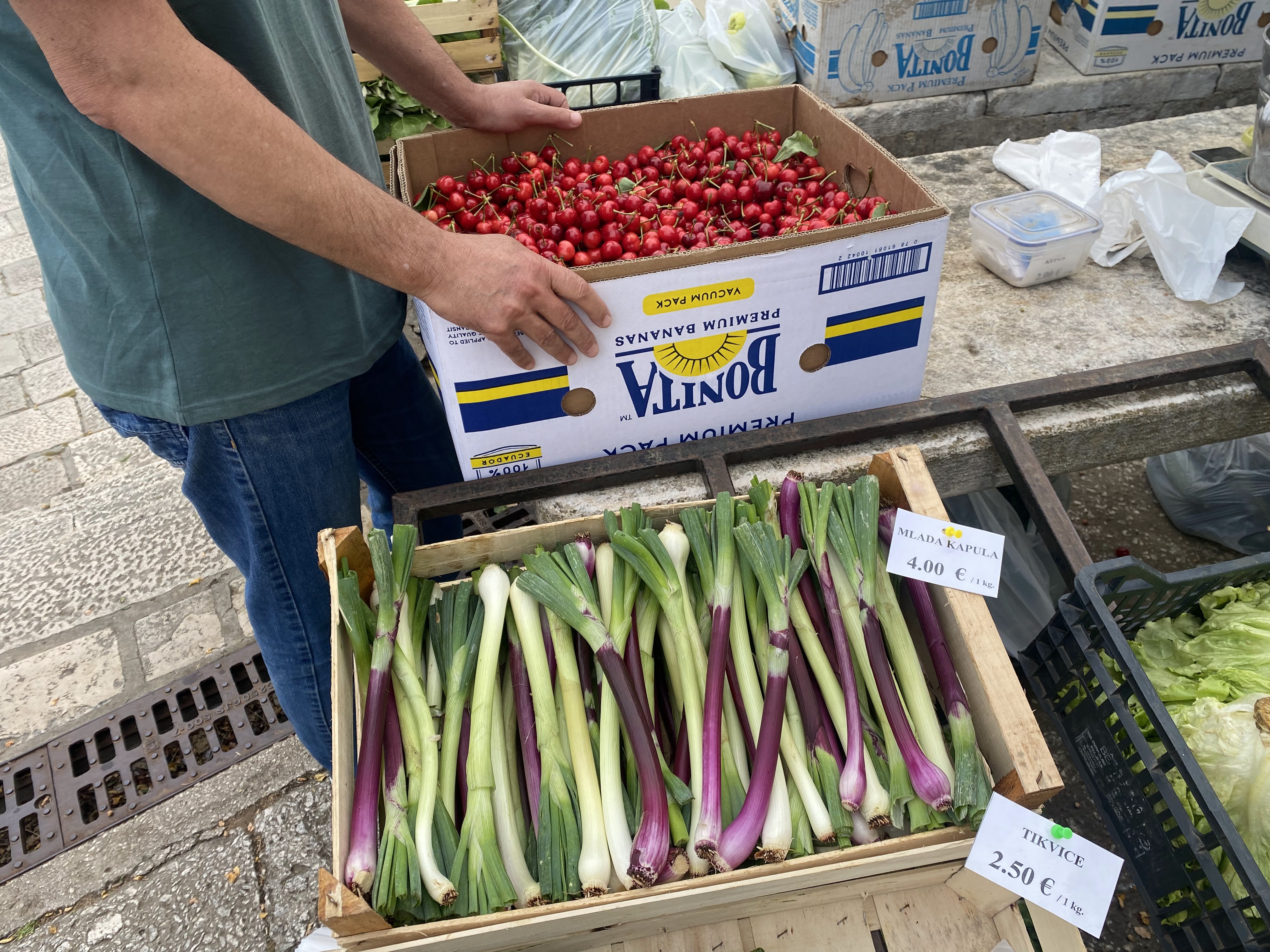
Cherries and onions, Korcula 
When I asked the woman selling cherries in Korcula whether they were locally grown--because it didn't seen like cherry growing climate--she replied, "yes, the other side of the islnd."Here's a recent post about a farmers market in Madison, Wisconsin.

Saturday, July 6, 2024

On loss of services--aka "desertification"--as a reason for rural disgruntlement

"In the French Countryside, a Deep Discontent Takes Root" is the headline for the pre-election story by NYTimes Paris bureau chief Roger Cohen.  The subhead is "In northern Burgundy, services have collapsed and the far-right National Rally has risen."  What's striking to me about this story is the similarity between this French form of rural neglect/resentment and what we have seen in the United States of a similar ilk.   Here are some relevant quotes: 

Residents in this sparsely populated region of France — the Yonne district in northwestern Burgundy has only about 335,000 inhabitants — describe what is happening to their community as “desertification,” by which they mean an emptying out of services, and of their lives.

Schools close. Train stations close. Post offices close. Doctors and dentists leave. Cafés and small convenience stores close, squeezed by megastores. People need to go further for services, jobs and food. Many travel in their old cars but are encouraged by the authorities to switch to electric cars, which are priced way beyond their means.

At the same time, since the war in Ukraine, gas and electricity bills have shot up, leading some to switch off their heating last winter. They feel invisible and only just get by; and on their televisions they see President Emmanuel Macron explaining the critical importance of such abstract policies as European “strategic autonomy.” It is not their concern.

Along comes the National Rally, saying its focus is on people, not ideas, the purchasing power of people above all.

The story quotes National Rally party candidate Sophie-Laurence Roy, whose reference to territory I read to be linked to "place," even land. 

My party is anchored in this territory, it is not, like our president, trying to give moral lessons to the whole world.

As for the receptivity to these appeals, here is a quote from André Villiers, "a centrist allied to the party of Mr. Macron — and Ms. Roy’s opponent in Sunday’s runoff":  

Our French heartland has the feeling of being forgotten.  What you see here in the National Rally surge is anger and alienation.

Note how similar some of these thoughts are to what has been labeled rural resentment--and often dismissed as unreasonable--in the United States. Another relevant post is here.   Recall that Kathy Cramer's 2016 book about the shift in Wisconsin politics was titled The Politics of Resentment

The yellow vest protests of a few years ago also seem relevant.  Some posts about those protests are here.

Friday, May 31, 2024

My Rural Travelogue (Part XXXIX): Hvar Island, Croatia

Island of Hvar, Croatia
all photos (c) Lisa R. Pruitt 2024

I've been traveling in Slovenia and Croatia the last week or so and, not surprisingly, paying particular attention to rural places.  A few days ago, I visited the Island of Hvar (population 10,678 on an island 42 kilometers long).  Our guide--because it was raining and she was delaying the start of our bicycle tour--drove us over the mountain between Hvar town and Stari Grad (population 2,772), and through the village of Velo Grablje, which featured this sign about the "entity" being protected cultural heritage.  (Going over the mountain as we did was a longer-distance alternative to going through a tunnel).  We saw what appeared to be the only restaurant in the village overflowing with families following first communion at the nearby church.  (We also stopped in the "ghost town" of Malo Grablje, a few kilometers below, along the same "back road").  Among the things we have learned here is that not only music and art, but also recipes and--as we see here--entire villages can be deemed protected cultural heritage.  

As we have found to be the case elsewhere in Croatia--including on Hvar and other islands in Dalmatia, small-scale agriculture is widespread.  Many folks have small garden plots in their front or back yards, and on Hvar many also have plots in the Stari Grad Plain, prime agricultural land that made Stari Grad such a desirable location for settlement.  Many also have small vineyards and/or olive groves, which are also on terraces that stretch up the mountainsides.   

Vineyard near Stari Grad, Hvar Island
Stone wall along ancient Roman road on Stari Grad Plain

Potato plants are as common as vineyards and olive groves on the island.

Little free library in Stari Grad

Our guide, who is viola player as well as a cyclist and librarian, told us about a recent benefit concert she played to raise funds to buy food for donkeys kept by a local woman.  The yield from the event raised a few thousand Euros for the care of the donkeys.  That outdoor concert was held near the restaurant featured in this advertisement, adjacent to the village of Dol, which rises above the Stari Grad Plain.
Public library, Stari Grad.  It is above a coffee shop,
right on the waterfront, next to the city hall.

K-4 school in the village of Dol; older children go to school in Stari Grad 

Artichoke plant next to a stone wall on road between Dol and Vrbnj

Hvar is known for its lavender, which was in early season.

Wednesday, February 7, 2024

Extraordinary story of French farmer behind recent blockade in Southern France

Catherine Porter reported for the New York Times last week under the headline, "The Farmers' Protests Have Become a Wildfire.  He was the Spark."  The "he" is Jerome Bayle, and this story is largely about the 42-year-old former professional rugby player who has been running his family's farm since his father died by suicide in 2015, at age 61.  

The story's lede is catchy, for sure, and presents a real contrast between rural and urban: 
Jérôme Bayle had spent seven nights on a major French highway, leading a group of aggrieved farmers in protest, when the prime minister arrived, dressed in his Parisian blue suit and tie, to thank them for “making France proud” and announced he would meet their demands.

Before camera flashes and outstretched microphones, Mr. Bayle told Prime Minister Gabriel Attal that he had seen the standoff as a match between two teams — the revolting farmers, led by Mr. Bayle, and the government, led by Mr. Attal.

“I don’t like losing,” said Mr. Bayle, dressed decidedly more casually, with a baseball hat on his head, turned backward. The thick crowd around him chuckled. It was clear his team had won.

Then there is this bit, which provides a wider-angle perspective: 

More broadly, not just in France but all around Europe, farmers are complaining about rising costs from inflation and the war in Ukraine. Those burdens have been exacerbated as the governments look to save money by shaving farm subsidies, even as the European Union heaps more regulations on farmers to meet climate and other environmental goals.

You can hear Porter's further commentary on Bayle and his victory on the NYTimes audio of this story. 

Regarding the wider European angle, here's news yesterday of a Spanish farmer blockade. 

Saturday, August 19, 2023

On the rehabilitation of wolves, from California to Germany

Wolves have been the subject of about half a dozen blog posts over the years, most recently here and here.  Many of those posts have focused on environmentalists' efforts to save them ranchers' war on them (both the wolves and the environmentalists, that is)  The links between rural folks and these natural predators is thus well-worn territory, so it would seem an oversight not to acknowledge here some recent reporting about the resurgence of wolf populations--in both Europe and the United States.  

The first is this Washington Post story about wolves in Germany.  The dateline is Luneburg Heath, and the headline for the story by Loveday Morris and Kate Brady is, "Wolves, once confined to fairy tales, are back in Germany, stirring debate."   An excerpt follows: 

Virtually extinct in Germany for more than a century, wolves are flourishing here once again — a rare success story in a world of diminishing biodiversity. One factor: German reunification, which extended protections in the former West Germany to the former East. Their numbers have increased more than sixfold in the past decade, with Germany now home to as many as 161 packs, or about 1,300 wolves.

But accompanying their rebound are attacks on livestock — and an emotional debate.
* * * 
The spread of wolves — through Germany and into Belgium, the Netherlands and beyond — has become an issue at the highest levels of the European Union.

* * *  

At a local level, the conflict pits farmers against conservationists. People on both sides have been accused of taking matters into their own hands: Hunting shelters have been burned down and wolves have been illegally shot and dismembered.

The second story, from NPR, does not mention conflict with ranchers but does report on the spread of wolves in California, in the Sequoia National Forest, 200 miles south of where the nearest pack were previously known to be.  

The California Department of Fish and Wildlife said Friday the pack was found in Tulare County — the farthest south a pack of wolves has been detected in the state in more than a century.

* * *
CDFW visited the area and found tracks, scat and hair, and their DNA analysis found that all 12 collected samples came from gray wolves. The analysis found the new pack has at least five female wolves not previously detected in California.

Wolves are protected under the Endangered Species Act.  

Postscript:  Here's a story dated Sept. 12, 2023, from WyoFile about how Colorado wolves are getting killed when they wander into Wyoming. 

And here's one from this summer in the Daily Yonder, also out of California. It's about how the State of California is compensating ranchers for living near wolves.  

Wednesday, August 9, 2023

The rural housing crisis: analytical dimensions and emblematic issues

This article by German scholars Stefan Kordel and Matthias Naumann appeared this week in the journal, Housing Studies.  The abstract follows:  

While the urban housing crisis is pivotal to current debates in housing studies, the question of affordable as well as sustainable housing in rural settings has arisen only recently. However, recent developments, including increasing demand for housing as well as for a specific supply, indicate that there is a rural housing crisis. Connecting the scattered strands of literature on rural housing, we propose an understanding of the rural housing crisis that involves spatialities, temporalities and intersectionalities. These dimensions are illustrated by three emblematic issues: the financialization/assetization of the rural housing supply, the increasing mobility of rural residents and the selective gentrification of rural communities. Building on a review of the literature on rural housing and its challenges, we argue that greater consideration of the rural in housing studies and a more nuanced focus on housing issues in rural studies would be fruitful, not only for future research but also for political action.

Monday, July 31, 2023

Britain's rural reaches as places of "profound inequality"

Rebecca Smith, author of Rural:  The Lives of the Working Class Countryside (Harper Collins 2023), published an essay/excerpt in the New York Times this weekend titled "The English Countryside is a Place of Profound Inequality."  Graythwaite is an English manor in Cumbria, in the Lake District, where Smith grew up in a cottage that Here's the gist of it: 
[F]or the landless who work and belong to the British countryside but do not own a piece of it, it’s a place of profound inequality. Damp, cold and underresourced but beautiful.

When I was growing up on Graythwaite, it was still possible to live, work and raise a family in some of the most beautiful parts of England on a working-class wage. That’s less true now. Rural Britain, long a scenic playground for the rich, is in danger of becoming only that, for tourists, second-homers and wealthy retirees.

Hawkshead, about five miles from Graythwaite, is one of the prettiest villages in the Lake District. It used to have two banks, a police station, four pubs, cafes and businesses.
* * *
These days, there are still lots of cafes, but now the police station is apartments, one bank is a gallery, and the other one is a ticket office for a Beatrix Potter attraction. Many of the village homes are vacation rentals or second homes, empty for most of the year, pushing the prices higher for the few homes that do go up for sale. There were always bus trippers, but the streams of tourists at this time of year, its busiest, make it feel a bit like a rural Disneyland.
* * *

In some of the villages around where I grew up, as many as 80 percent of the houses are second homes, according to housing advocates.

Over and over again, people who grew up or made a life there have been forced to make way for others. (In Dinorwig, a former slate-mining town in Wales that is popular with visitors, a schoolteacher told The Guardian that her family was evicted by a landlady who admitted that she could make four times as much by renting their home to tourists.) These visitors spend money in the local shops, but they don’t put children in the school. They don’t become part of the church congregation. A way of life slowly suffocates.

In part, Smith's British story is one of rural gentrification like we're seeing throughout the United States of late.  

Richard Benson's review of Rural in The Guardian last month includes this passage about her book: 

Its strength is Smith’s sharp eye for new examples of urban money breaking up the relationships between local people and their landscapes. Corporations who offset their pollution by planting thousands of trees in inappropriate locations where the saplings will die off anyway; absentee landlords who shorten tenancy agreements so farmers can’t plan long-term improvements of the land; the gentry sacking estate workers and hawking their heritage to the leisure industry. For the roughly 20% of Britons who live in rural areas, such trends debilitate in the same way that gentrification does in cities. 

Monday, July 10, 2023

Rural scholarship: Pumping iron in the countryside: The challenges of IPED use in rural areas

What follows is part of the abstract for a paper by Dr. Kyle Mulrooney (University of New England, Australia) and Dr. Luke Turnock (University of Lincoln, UK):

The use of image and performance enhancing drugs (IPEDs) is a growing issue, with users seeking to enhance their physical appearance and athletic performance. While much research has been done on IPED use, little attention has been paid to how rurality shapes IPED use and access to harm reduction services. This is a critical gap, as rural populations face unique challenges in accessing health services, and their experiences may differ from those living in urban areas.

Dr. Luke Turnock and Dr. Kyle Mulrooney recently published an article in the journal Contemporary Drug Problems titled Exploring the Impacts of Rurality on Service Access and Harm Among Image and Performance Enhancing Drug (IPED) Users in a Remote English Region. The article is open access if you would like to read it in its entirety.

The study, conducted in a rural region of the United Kingdom, aimed to explore the barriers to accessing harm reduction services among steroid users. The research highlights the challenges faced by steroid users living in remote and often deprived areas. Specifically, the study found that while transport limitations and physical access to specialist services were highlighted as issues by participants, this was generally identified as an exacerbating factor on top of more significant barriers, surrounding perceptions of stigma and distrust of healthcare providers.

Steroid users in rural areas faced greater concerns over the personal impacts of being identified as a user on employment prospects. Additionally, the impact of small-town surveillance and stigma exacerbated the issue. As such, one key finding was the importance of anonymity to steroid users. Rural gym users, in particular, expressed the need to access injecting equipment and advice without being identified by neighbours and friends, which is made difficult by small-town contexts. There was also a need to seek health advice and monitoring without risking this being permanently recorded on medical records, in a way that could harm future employment prospects.

Connected to this, the study found that economic deprivation and class played a significant role in access to harm reduction services, with those perceiving they had few career prospects outside of the military being especially vulnerable. Particularly in regions where physical labour such as quarrying, agriculture, or the military are the primary avenues for good employment prospects among working-class men, understanding how IPED use may intersect with the strains of demanding physical labour is significant in directing harm reduction. 

Sunday, June 18, 2023

My Rural Travelogue (Part XXXV): A farmer's market in Prague

Ok, it isn't exactly "rural," but the farmer's market I visited last week in Prague brought the rural to the urban, which is what many (if not most) farmer's markets do.  (About a decade ago, I blogged about farmer's markets before, this one in my home town and this one in posh Telluride, Colorado).

Last Saturday, I visited the much touted Naplavka Farmer's Market, in Praha 2.  At least I thought that is what I was visiting.  It appears on reflection that I didn't travel far enough south on the Vlatava River embankment, because when I reached the intersection of the embankment with Na Morani at about 7:45 am, I saw vendors setting up in the little park and stopped to peruse the goods.  It featured perhaps a dozen stalls, which included a few flower stalls, a cherry stand, a strawberry booth, a coffee stand, a few bakeries, one egg stand, one chicken stand, a stand dedicated solely to kolach (the sweet Czech pastry), one with wine, and several with a variety of vegetables.  

Lots of potatoes and onions, along with
more colorful vegetables and herbers.


The egg vendor had 
a photo her chickens 
roaming free.

The poultry vendor from Holysov had photos of 
the types of poultry he was selling. He chopped 
the chickens in half right in front of customers, for those
who didn't want an entire bird.  
(c) Lisa R. Pruitt 2023

A dairy stall, with yogurts, cheese and milk

The coffee stand was popular.  There were no disposable cups so a 50 kr. deposit was required for those who didn't bring their own cup.  Only whole milk available for lattes and such.

The wine stall was guarded by a friendly dog. 

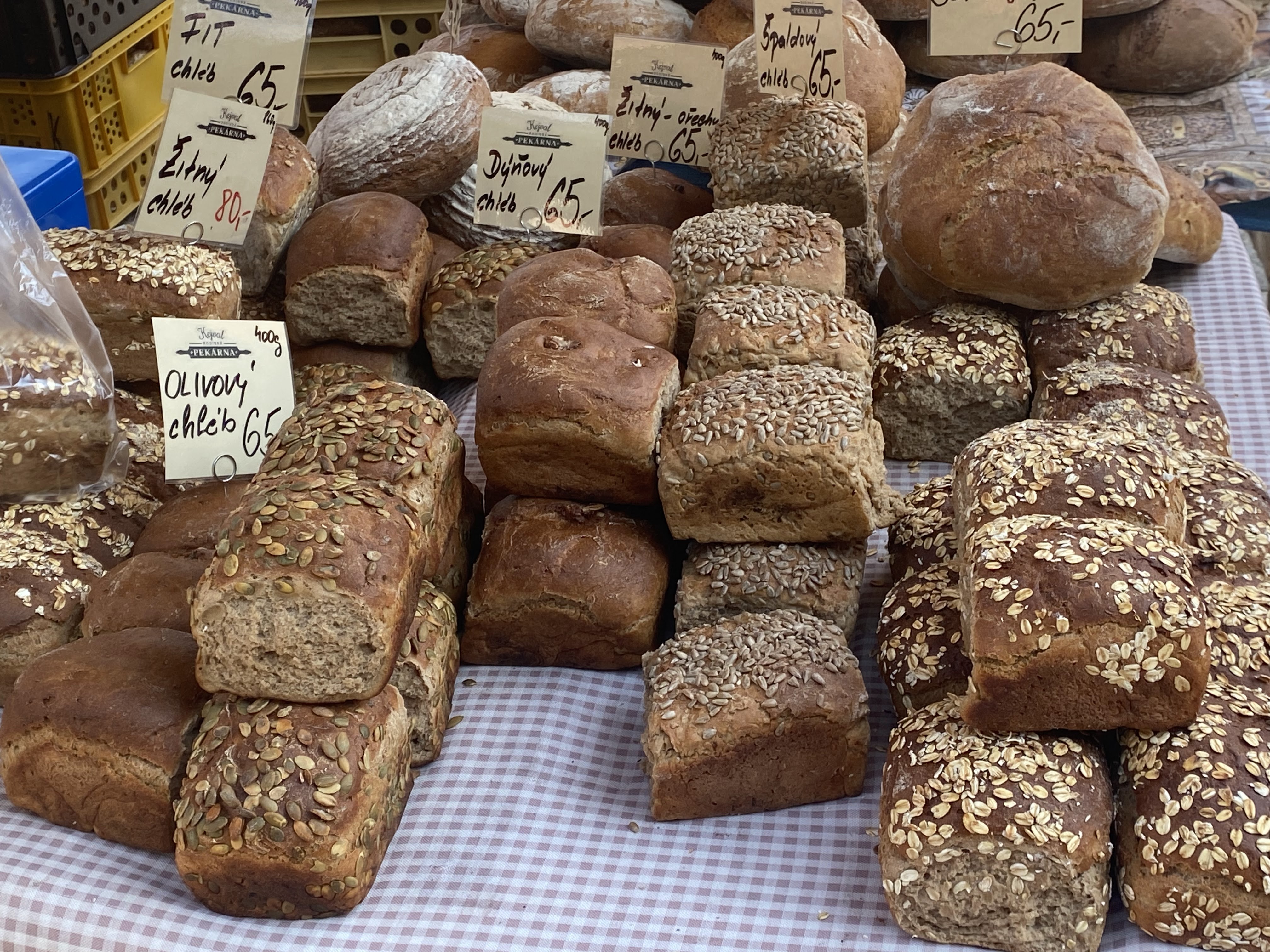
One of several bakeries. 
(c) Lisa R. Pruitt 2023

The name and address of each
vendor was displayed.  This was 
for the baker.  


This sign was at the juice stand.

Milovice is northeast of Prague, perhaps an hour away

This vendor had beautiful white and green asparagus, 
the former in its short season right now.
"Chrest" is the Czech word for asparagus.

This stand was all Kolach.

The cherry vendor had a few varieties. 

Strawberries in season from this farm, which has an address on
the southeastern edge of Prague 

Oh, and there was a woman and what appeared to be here two teenaged children selling various pestos, as well as what her sign called "fried green bread."  This was toasted bread smeared in the pesto(s) and herb butter of the patron's choosing.  She made me the striped one below, so I didn't have to choose.  The pale green at the top was with horseradish.  The bottom stripe is the melting herb butter.