Showing posts with label tradition. Show all posts

Wednesday, February 11, 2026

The extinction of mermaids

Photo Credit: UNxArtPartner Create COP25 Haenyeo 2019

Emerald sequins bathed in refracting light. Lavender velvet crushed beneath loose limbs. Shimmering turquoise dappled with the tacky remnants of a cherry ice pop. These were the qualities that sketched the lines of one of my most treasured childhood possessions: a swimsuit, inspired by the 1989 film, "The Little Mermaid." 

In a plastic pool in late 90s, Castro Valley, California, I would spend hours baking under the gaze of an overzealous sun, grieving the mythos of creatures that existed only in daydreams. However, nearly six thousand miles away, on the Island of Jeju, mermaids were very much a reality. 

Photo Credit: UNxArtPartner Create COP25 Haenyeo 2019

The sea women

Evidence of female free divers, or haenyeos (Korean:해녀), first appears in literature dating to the 17th Century. What began as a solely male-dominated field soon shifted into one of the quintessential representations of semi-matriarchal family structure in Asia. To become a haenyeo, women must join a fishing village cooperative, requiring the agreement of other members. Diving rights are often passed on from elderly haenyeo to their daughters and daughters-in-law. 

Diving barehanded, clad in simple cotton mulsojungi, without oxygen tanks or other technological adornments, these women routinely plunge their bodies into the gelid waters off the southernmost coast of the Korean peninsula. For seven hours a day, 90 days a year, haenyeo dive up to 20 meters below the surface to harvest marine resources, including abalone, other mollusks, octopi, sea urchin, seaweed, turban shells, and other shellfish for their families and the community. According to Kim Hoo-ran of The Korean Herald, the spirit of the haenyeo is communal, "The women seek equitable distribution of their harvest, giving away part of their catch to a diver who has a poor catch. Such favors are always returned by the recipient."

As Dr. Miyoung Kim of Ewha Women's University notes, the lifestyle is not without its dangers:

These divers are [also] exposed to decompression sickness because they perform breath-hold dives, and these dives can cause neurological problems, such as muscle weakness and dysthesia, as well as other symptoms, such as vertigo, dizziness, and nausea. In addition, increases in intraocular pressure while diving damage the optic nerves and lead to headaches. Among this group, 83.5% take analgesics and antihistamines during work to prevent the headaches and earaches that occur due to diving, and they often take more than the recommended doses; thus, drug overdose is a serious problem. 

Photo Credit: Blog Duam 

Translating the currents

The adversities, however, are paired with marvels. According to a new study in Cell Reports, generations of diving has literally altered the genetics of divers and their children, passing down a series of psychological adaptations allowing them to dive more safely. Dr. Melissa Lardo and her team observed that:

Haenyeo's heart rates drop[ped] about 50 percent more during simulated dives compared with other groups, which helps them hold their breath longer by limiting oxygen that the body needs and reducing the work the heart needs and reducing the work the heart needs to do...This blood pressure genetic variant can protect the haenyeo as they dive while pregnant-typically, pregnant haenyeo will dive up until the day they give birth, says Ilardo. Researchers suggest this lower blood pressure genetic variant could protect against complications like preeclampsia, a health risk for pregnant women that can be exacerbated by diving. 

Centuries of diving has not only changed the anatomy of these women's bodies; it has embedded in them, what Dr. Samantha Chisolm Hatfield calls Traditional Ecological Knowledge (TEK). 

TEK "specifically relates to the environment in a given traditional homeland of Indigenous groups and/or Usual and Accustomed areas. This may include but is not limited to: botany knowledge, medicinal application (collection and/or administration), hunting, fishing, gathering, processing of materials(s), caretaking such as burning, coppicing, thinning, astronomy, phenology, time, ecological markers, species markers, weather, and climate knowledge."

In a paper published in the Journal of Marine Island Cultures, Hatfield and Dr. Sung-Hee Kong interviewed haenyeo and concluded that they have highly developed environmental acuity, a unique ability to read environments and document information on environmental changes. This is particularly vital as the collection of resources has steadily declined, and sustainability efforts are necessary to mitigate the ravages of climate change. 

Photo Credit: Bernard Gagnon

The ebbing tide 

After thousands of years, the mermaids of Jeju face extinction. According to Katie Hunt of CNN Science "The practice is dying out. Young women are no longer continuing this matrilineal tradition; the current group of haenyeo divers, with an average age of around 70 years years may represent the last generation." The recalibrated values of a modern Korea are looking increasingly incompatible with this practice, threatening to erase the women of Jeju and their stewardship of the peninsula's marine ecology. 

Without haenyeo governance, author Taeyoung Kim expresses concerns that the combination of non-traditional extraction methods and capitalism-driven development will irreparably damage rural Jeju:

“Rapid economic progress [has] led to the exploitation of working class, women, and rural areas to reinforce the progress of national economic development. This action was justified as a means for "nation building", which led to severe repercussions to the natural habitat in Jeju marine ecosystem…External capital inflow extracted profits by expropriating Jeju people's land, resources and communal assets, which is a common mechanism used by traditional colonial extractive industries.”

Photo Credit: Peter Chanovec

A coruscation of hope

However, as in all fairy tales, the hope of happy ending remains. In 2016, the haenyeo were included on the UNESCO List of Intangible Cultural Heritage and just this month, haenyeo was added to the Oxford English Dictionary, which many hope will raise awareness for this vanishing way of life. Furthermore, although the population continues to dwindle, younger generations are beginning to answer the haenyeo's siren song. Together, these factors may protect the last of the mermaids. 

Thursday, April 25, 2024

On rurality as a double-edged sword: David McCormick, Republican Senate candidate, presents himself as "rural"

The New York Times published this story last week (before the Pennsylvania primary) under the headline, "This G.O.P. Senate Candidate Says He Grew Up on a Family Farm. Not Exactly."  Here's the lede: 
David McCormick’s origin story goes something like this: He grew up in rural Pennsylvania, southwest of Scranton. He baled hay, trimmed Christmas trees and otherwise worked on his family’s farm. And from those humble beginnings, he rose to achieve the American dream.

“I spent most of my life in Pennsylvania, growing up in Bloomsburg on my family’s farm,” Mr. McCormick, now a Republican candidate for Senate, told Pittsburgh Quarterly in 2022.

“I’ve truly lived the American dream,” he wrote in a fund-raising appeal in October. “My life’s journey — from growing up on a farm in Bloomsburg, to graduating from West Point and serving in the 82nd Airborne Division, growing a business in Pittsburgh, and serving at the highest levels of government — reflects that.”

In January, speaking at the Pennsylvania farm show, McCormick said: 

I grew up on a family farm from the time I was a kid.

The journalists reporting this story, however, who have conducted interviews, reviewed public records and news coverage, "suggest he has given a misleading impression about key aspects of his background."   

McCormick has also described his parents at school teachers. In fact, his father was president of Bloomsburg University, and he grew up mostly in the house provided by the University.  

All of the reminds me the recent assertion by Paul Waldman and Tom Schaller of what they claim is an unwritten rule that the media are hands off rural folks--that they are a group you can't criticize.  I don't agree with that (and have written lots in support of the contrary proposition).  That said, it's interesting that politicians like McCormick are (still) trying to present themselves as "regular Joe's" by saying they grew up rural and/or on a farm.  (Recall that George W. Bush was widely identified as incorporating a similar strategy).  

Wednesday, April 19, 2023

The culture of alcoholism in Wisconsin and its effect on rural Wisconsinites


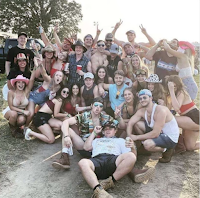
This is a typical summer day for my friend group. This picture was taken at Country Thunder, an annual music and camping festival in Twin Lakes, Wisconsin. This behavior is, at minimum, a weekly occurrence.

I was never embarrassed by my upbringing until I began to share it with others who were not raised in my Illinois hometown. My home county borders Walworth County, Wisconsin (population density of 191.7 per square mile), and I spent a lot of time in Wisconsin growing up. My house, much like my friends’ homes, was filled with clutter, empty bottles, and cigarette butts. All too often, dinner was meager leftovers disguised as a salad or stew; other times it was eaten with my mom in a bar. Either way, my mom and I washed the meal down with a bottle of room-temperature Coors Light and a breath of fresh smoke from the cigarette burning in my mother’s hand.

For a long time, my relationship with my mother consisted of nothing more than sharing a beer in my room while I did homework and listened to her complain about work. “Smoking kills,” I’d say as the air became hazy. “Work will kill me first,” she’d reply, “or hunger will get us both if I quit my job.”

Before I continue, I’d like to state that I adore my mother and greatly appreciate the sacrifices she has made for me. As a working, single parent who has lived a traumatic life, she was doing the best she could. I wouldn’t be where I am today, or probably even alive, without my mother and her selfless parenting.

Now that I am in a California law school, studying rural livelihoods, I realize my classmates’ judgment of my past is fitting. Although alcoholism is in no way exclusive to rural areas, I have learned that rural residents are much more likely to struggle with it, particularly those in the Midwest.

Recently, I stumbled upon this map, compiled by Ph.D student Nicholas Pierson at the University of Chicago from data gathered by County Health Rankings by the University of Wisconsin:


At first glance, I laughed and was proud that Wisconsin dominated the map. (For those not familiar with Wisconsin, the tiny white area in the middle-right is a lake, not a county).

Then, I began to ponder how Wisconsin got so drunk.

Numerous studies have shown that children mirror habits from their parents, as observational learning is one of the fundamental ways developing minds develop their behavior. This led me to wonder, does the time-old adage about “monkey see, monkey do” perpetuate alcoholism in Wisconsin?

From a young age, Wisconsinites are surrounded by drinking. Children often take trips to see the Clydesdale horses at the headquarters of the Miller Brewing Company in Milwaukee or cheer on their MLB team, the Milwaukee Brewers

This pride surrounding beer (and drinking it) is evident in the legislation, too. In Wisconsin, underage persons are legally allowed to be served alcoholic beverages in public, so long as they are accompanied by a parent, legal guardian, or spouse of legal drinking age. Further, many bars interpret this loosely. At age 12, I sat with my mom and legally drink in bars. As I got older, my friends and I would go with people of age and claim they were our guardians or spouses, which allowed us to be served just as easily. When doing so, we knew to stay out of urban centers like Milwaukee, where the laws tended to be more strictly enforced. We opted instead for small, corner bars in less populous areas that rarely check IDs at all.

However, allowing those under 21 to legally drink in public is not the only legislative loophole that allows minors to partake in addictive habits. Wisconsin law allows adults to escape liability for facilitating underage drinking. Their code specifies the elements of “knowingly permitting or failing to take action,” yet this only applies to adults physically occupying the property when underage drinking occurs. For lodging establishments, liability can be avoided if the establishment does not have hired security and if minors pay for the rented space themselves. (Although not strictly related to alcohol, Wisconsin also allows the sale of tobacco products to those 18 and over, even though federal law mandates an age of 21 to purchase.) 

As children grow to become adults, access to alcohol increases substantially. Wisconsin law allows adults to begin buying alcohol as early as 6 am. Tax on alcohol is also low in Wisconsin. Instead of using a percentage of cost sold, Wisconsin taxes alcohol by volume, at the following rates: all beer and cider is taxed at around 6.5 cents per gallon; wine is taxed at 25 cents per gallon; and liquor is taxed at $3.25 per gallon. These are among the lowest rates of taxation for alcohol in the nation. For comparison, consider that Washington state taxes beer at 26 cents per gallon, wine at 87 cents per gallon, and liquor at $35.22 per gallon. 

Wisconsin even provides a legislative loophole for the enforcement of drunk driving. Legislation classifies driving with a BAC over 0.08 as Operating While Intoxicated (OWI) instead of Driving Under the Influence (DUI). The difference between the two is in the enforcement because officers are not required to cite or arrest an adult for an OWI, even though the driver may be legally drunk. The consequences of an OWI are also far less harsh than that of a DUI because jail time is not imposed on first-time offenders unless the drunk driving results in injury, death, or endangerment of a minor (which occurs if a minor is in the vehicle when stopped by an officer). Furthermore, second-time offenders do not have much threat of jail time if their first offense happened ten or more years ago. Since OWI laws are much more lax than other states, many Wisconsin drinkers have the mindset that there is no penalty for drunk driving as long as they’ve never been caught before. 

Alcohol use is also greatly accepted in Wisconsin. Although there is no definitive reason as to why drinking is a cultural norm, everybody there agrees that it is. In fact, many Wisconsinites are proud to be known as drinkers, brag about their high-tolerances, wear state-specific drinking merchandise, and are even globally recognized for their spirit for the spirits.


This all seems like a lot of good (yet, irresponsible) fun until you consider this through the rural lens. After looking at the “% Excessive Drinking per County Map” above, I began to wonder why the upper Midwest, namely Wisconsin, Minnesota, Iowa, Illinois, the Dakotas, and Michigan, drink so excessively. A pattern emerged when comparing the map above to the “Classification of Counties” map by the Daily Yonder, which depicts which counties are rural, exurban, and urban:


Many of the Wisconsin counties with the highest percentage of excessive drinking are rural counties. I gave my best attempt at Photoshop to overlay the two, with the darkest green being rural areas with the highest percentages of excessive drinking:


The phenomenon of higher alcoholism rates in rural areas has been studied in length, and rural Wisconsin is no outlier to researchers’ findings. Statistics show that rural Wisconsinites have higher rates of excessive drinking than their urban neighbors. This study cites two main reasons for drinking alcohol: in social scenarios or to cope with mental health issues.
 
These two factors are certainly reflective of what I’ve seen in rural Wisconsinites. I’ll discuss social scenarios later, as I feel the tie between mental health issues and drinking is stronger in rural Wisconsin. One reason for this is the harsh winter climates. Although all of Wisconsin is subject to cold and gloomy weather, rural areas tend to suffer more from the elements. This is due to a lack of concentrations of buildings, pavement, and other surfaces that absorb and retain heat, and a lack of resources to assist those needing refuge from the cold. Additionally, many rural counties in Wisconsin do not receive the warming effect of Lake Michigan in the winter. 
 
Over 3 million people in the U.S. were diagnosed with seasonal depressive disorder (SAD), but many more experience some version of the “winter blues,” although not as severely. SAD and the “winter blues” typically occur during the colder months of the year when the skies are also drearier. Wisconsin experiences these colder months from October to April, making Wisconsinites susceptible to seasonal sadness six months out of the year. This is in addition to the higher depression rates rural citizens already face compared to their urban counterparts. (This 2014 post expands on the mental health crisis facing rural America). More than 2 million Wisconsin residents (almost half of the population) reported living in a community without access to mental health care. This data point does not include those who did not receive the poll and those who did not report, and it does not distinguish between rural and urban respondents.
           
Additionally, treatment for alcohol dependence and addiction is harder to find in rural Wisconsin. Although many areas have access to Alcoholics Anonymous programs, a large number of towns have no meetings within a 30-minute drive. Community substance abuse programs exist in every county, but they are often overcrowded, underfunded, and not available in all rural communities
 
Moving on to the social aspect, it is common for rural Wisconsinites to entertain themselves and rely on get-togethers as the only “fun” thing to do. (These get-togethers largely resemble the many basement scenes in That 70’s Show, which is based on the life of teenagers in rural Wisconsin). As established above, you can find alcohol anywhere in America’s Dairyland. However, urban areas have more alcohol-free activities to keep people entertained. Some rural Wisconsin counties rely on tourism, but the without the population to keep alcohol-free activities open year-round, the off-season only increases alcohol access. For example, Door County (Population 30,369), known as “the Cape Cod of the Midwest,” is a top summer destination for camping, fishing, lake life, and family fun. Yet when summer tourism has reached its end, many of the tourist attractions close. The only things that survive being open during the winter months are the alcohol establishments. For perspective, Door County has one liquor outlet for every nine residents
 
The combination of cultural, legislative, and societal factors, alongside high rates of mental health issues and low access to resources paves the way for generational alcoholism. Children—myself included—start drinking at a young age. This behavior is normalized, accepted, and in some cases legalized in Wisconsin. A quick Google search will pull up article after article on Wisconsin’s drinking culture and almost anyone from there will second it with first-hand accounts. As these children grow up, their drinking habits often become more alarming. Alcohol becomes easier to access and afford, punishments for drinking decline, and reasons to drink increase. Urban centers get to experience different lifestyles and have a better chance of changing their drinking habits. However, those in rural areas may see this drinking culture as normal behavior, because they haven’t experienced any other way of living.
 
As bizarre as it sounds, I am so grateful for the COVID-19 lockdowns because prior to that, I was an alcoholic. I started drinking when I was nine, my mom giving me a shot to calm me down or cure a sick throat. By the time I was 13, I had replaced Mountain Dew with beer. When I went to college, I could outdrink anybody, and I was proud of it. When the lockdown happened, I couldn’t go to bars, the stores were sold out of liquor, and I didn’t have anyone to drink with. I was an essential worker at the time, so I picked up extra shifts and filled my time with four jobs instead of filling my void with alcohol.
 
I will always be grateful for this time because it allowed me to break the cycle, culture, and tradition of alcoholism that was passed on to me. I can’t say the same for my friends and family, but their bootstrap mentality is a post for another time.

Sunday, March 26, 2023

Addressing nihilism in rural America: What we can learn from the Jordan Peterson phenomenon and why it should not be written off as “dangerous right-wing radicalism”

A couple weeks ago, I stumbled across an interesting find in the used book section of a thrift store in a rural town in southwest Kern County, California. It was a copy of Dr. Jordan Peterson’s 12 Rules for Life: An Antidote to Chaos. I purchased the book, and on my drive home up highway 99, I contemplated the impact of Jordan Peterson, a prominent public intellectual who, at times is casted as a conservative, is more accurately described as a classical liberal and traditionalist, on rural communities.

While I recognize that Jordan Peterson is a polarizing figure, I believe that understanding the “Jordan Peterson phenomenon” is important for anyone seeking to understand and uplift rural peoples in America. 


The aspect of Jordan Peterson’s message that I am interested in exploring in this post is his emphasis on personal responsibility, to which Peterson attributes much of his popularity, especially amongst young men (though women are an increasingly growing part of his audience as well). For Peterson, responsibility is the neglected half of any discussion pertaining to rights. And this is especially important because, Peterson argues, responsibility gives meaning to life–it’s what makes the suffering one experiences in the world worth enduring.

Peterson’s book is subtitled “An Antidote to Chaos,” signaling the clear purpose of his rules for life. Peterson notes that though not all chaos is bad, it must be balanced adequately with order, lest extreme forms of chaos—like anarchy or tyranny—result. 

Many parts of rural America seem to suffer from what I would call an inner chaos, if I may, in the form of ennui. It is a chaos of the soul due to feelings of loss of dignity, status, purpose, and importance, which ultimately results in nihilism—the notion that there is no meaning or purpose to life. Nihilism entails the rejection of objective truths, morals, philosophical codes, meanings, or values. This inner chaos is exacerbated by the pitiful economic conditions of many rural communities.

The plight of despair within rural communities has been chronicled by Princeton economists Anne Case and Angus Deaton in their book Deaths of Despair and the Future of Capitalism (2020). Since the turn of the century, premature death rates have sharply increased among rural Americans due to increases in suicide, drug overdoses, and liver disease related to alcohol abuse. To be fair, there are countering narratives as to the cause of these tragedies. Case and Deaton argue that the main reason is the lack of economic opportunities whereas others point to the proliferation and accessibility of illegal drugs. Either way, the net effects are undeniable, and they result in what we logically expect from broken communities: pervasive poverty, homelessness, drug addiction, and the likes.

To add insult to injury, rural communities also face “rural bashing” often at the hands of progressive elites, who, in recent election cycles, have resorted to blaming rural folks for their own problems because they ostensibly vote against their own interests.

The zeitgeist of our time would entail rural folks adopting a mentality of victimhood and internalizing it as an identity. Perhaps many rural Americans have done just this in embracing Donald Trump. President Trump capitalized on America’s victimhood culture by encouraging his supporters to embrace victimhood as an identity throughout his presidential campaigns and presidency. 

This should not be too surprising because furthering victimhood culture is (tragically) an excellent political strategy. Indeed, both Democrats and Republicans are guilty of perpetuating it. This is because it allows an “in-group” to rally its members to act in an intensely revengeful manner against an otherized “out-group”. Think Democrats vs. Republicans, rural vs. urban, white vs. non-white, educated vs. uneducated, etc. What results is dangerous and destructive.

When a group places extraordinarily great emphasis on their own suffering, they can develop “egoism of victimhood.” Psychologists use this phrase (egoism of victimhood) to refer to situations “whereby members [of an in-group] are unable to see things from the perspective of the rival group’s perspective, are unable or unwilling to empathize with the suffering of the rival group, and are unwilling to accept any responsibility for harm inflicted by their own group.” (See here and here for research supporting this.) Further, researchers have found that people who embrace victimhood culture are less willing to forgive others, have an increased desire for revenge (as opposed to mere avoidance,) and are more likely to engage in revengeful behavior. 

Another pitfall of victimhood culture is that it relieves one of responsibility by shifting it to someone else, maybe even “the world,” broadly, or to some structural aspect of society. Dr. Peterson argues that once a person is relieved of responsibility, they are also stripped of power and agency. Thus, without responsibility, one has no power to change one’s circumstances (though it seems that without personal agency to change one’s immediate situation, some folks shift their energy towards deconstructing and destroying societal structures at large, given their ostensible structural inequities). 

Given this backdrop of the rise of victimhood culture, the plight of rural America, and the increasing struggles of young men (see Richard Reeves, Of Boys and Men: Why the Modern Male is Struggling, Why It Matters, and What to Do about It), Jordan Peterson offers an attractive alternative. I argue that rural Americans may be attracted to this message—and benefiting from it—because it is radically different.

Jordan Peterson fans and followers seem to share a common perspective and experience. Many are disenchanted by the shaping of contemporary society (the prominence of ideologies based on the centralization of race, gender, and sexuality,) and many are even more troubled by the apparent lack of purpose in their own lives. Many share stories of despair, addiction, and depression in their lives. Still, his followers are often written off as right-wing extremists. I believe, however, that there’s more to Jordan Peterson fans than the popular media presents.

If we look past the rhetoric and analyze Dr. Peterson’s message, we can see that his message is one that seeks to uplift individuals by speaking to the basic nature of humans as conceived within a Judeo-Christian-Islamic ethos. In short, Peterson proffers a solution to chaos that has been neglected and maligned by the Left in recent years and only superficially discussed by the Right.

The power of his message is that it seeks to restore dignity and agency to each human being, reminding them that they have control over their circumstances so long as they take responsibility. This is so even if much of their predicament is technically at the hands of forces outside of their own individual power. Put another way, this is a return to personal responsibility, and it seems to resonate with rural people, who tend to value individual striving, hard work, and responsibility

Dr. Peterson proffers 24 “Rules for Life”  in his books. Fifteen out of the 24 are related to personal responsibility:
  • Treat yourself like you are someone you are responsible for helping.
  • Compare yourself to who you were yesterday, not to who someone else is today.
  • Set your house in perfect order before you criticize the world.
  • Tell the truth – or, at least, don't lie.
  • Be precise in your speech.
  • Do not carelessly denigrate social institutions or creative achievement.
  • Imagine who you could be and then aim single-mindedly at that.
  • Do not hide unwanted things in the fog.
  • Notice that opportunity lurks where responsibility has been abdicated.
  • Abandon ideology.
  • Work as hard as you possibly can on at least one thing and see what happens.
  • Try to make one room in your home as beautiful as possible.
  • Plan and work diligently to maintain the romance in your relationship.
  • Do not allow yourself to become resentful, deceitful, or arrogant.
  • Be grateful in spite of your suffering.
I believe that a message that puts power back into people's hands resonates with folks in despair because it means they have agency to change their lives. This does not necessarily mean that it puts blame on the individual for their circumstances or that it rejects the notion of structural issues that may play a role in causing underlying crises. I’ve always wondered why a message that emphasizes personal responsibility ought to be viewed as one that denies the existence of structural inequalities? The two aren’t mutually exclusive. 

People in despair genuinely seem to be benefiting from Jordan Peterson’s message. He has amassed a massive following on YouTube (over six million subscribers and over half a billion total views on his videos). Glossing through the comments on his videos and posts on the Jordan Peterson Reddit page (which has over 300,000 members) there seems to be a significant number of people profusely thanking Dr. Peterson for his role in transforming their lives for the better. Sure this is anecdotal, but it is certainly worth something.

Earlier I stated that Jordan Peterson’s approach is a “return to” personal responsibility. I say this because the importance of personal responsibility in uplifting the downtrodden has ancient roots. It can be traced least as far back as the Judeo-Christian-Islamic tradition. Arguably one of the most successful programs for pulling people out of addiction and despair, the 12-step program created by Alcoholics Anonymous, puts the power in the hands of the sufferer, but interestingly, via a recognition of a higher power that can give aid, i.e., God. Ultimately, though, it is the individual who has the conscious ability and free will to make decisions and perform actions that will better their life.

This reminds me of multiple verses in the Quran in which God says that no soul is taxed with a burden except that it is one which they are able to bear. (Quran 2:233, 2:286, 6:152, 7:42, and 23:62). Furthermore, God states that “no bearer of burdens shall bear that of another.” (Quran 6:164, 17:15, 53:38. Translation by Nuh Ha Mim Keller, The Quran Beheld, (2022)). The implication is that some level of personal responsibility is required to recognize and strive toward a path out of one’s difficult circumstances. For the 12-step program, as well as the Muslim and broader Abrahamic traditions, the path begins with recognition of the Higher Power.

Tying this back to the discussion about victimhood culture, psychologist Dr. Scott Kaufman explains in an article published in a Scientific American article that the opposite of a victimhood mindset is a “personal growth mindset.” He argues that a personal growth mindset can help flip the narrative of trauma and despair if individuals choose to view their trauma not as a something essential to their identity, but as something that may actually be a source of personal growth and development, rather than a demarcation of oppression. He ponders of the personal growth mindset:
What if we all learned at a young age that our traumas don’t have to define us? That it’s possible to have experienced a trauma and for victimhood to not form the core of our identity? That it’s even possible to grow from trauma, to become a better person, to use the experiences we’ve had in our lives toward working to instill hope and possibility to others who were in a similar situation? What if we all learned that it’s possible to have healthy pride for an in-group without having out-group hate? That if you expect kindness from others, it pays to be kind yourself? That no one is entitled to anything, but we all are worthy of being treated as human?

This would be quite the paradigm shift, but it would be in line with the latest social science that makes clear that a perpetual victimhood mindset leads us to see the world with rose-tinted glasses. With a clear lens, we’d be able to see that not everyone in our out-group is evil, and not everyone in our in-group is a saint. We’re all human with the same underlying needs to belong, to be seen, to be heard and to matter.

Seeing reality as clearly as possible is an essential step to making long-lasting change, and I believe one important step along that path is to shed the perpetual victimhood mindset for something more productive, constructive, hopeful and amenable to building positive relationships with others.
Dr. Kaufman’s proposal seems to be an explanation of how people in despair are benefiting from the message of Jordan Peterson. I would further argue that a good part of why Dr. Peterson has been so successful with his employment of this messaging is because it is rooted (however imperfectly) in ancient, transcendent truths steeped in the Judeo-Christian-Islamic tradition.

I share this post in large part to compel us to reckon with the possibility that there is great good in a message that emphasizes personal responsibility in lieu of one that places greater emphasis on structural inequities and victimhood culture. For one, the former seems to bring about real benefit more readily for real individuals in a relatively short period of time, whereas the latter leaves one stuck in a rut, hoping for the government to deliver a utopia.

Sunday, March 19, 2023

Hollywood stereotypes of rural America


When I was a kid, I loved day trips to Chicago. I remember my grandmother having to sign a clearance contract because I "accidentally" stumbled onto the “Transformers 3” set and got picked up by a camera. Movies about Chicago, or even just ones filmed there, have always been my favorite because I get to see a little slice of my childhood on the screen. But when it comes to movies from my real childhood, tucked away in the rural Midwest, I often find myself cringing at the media stereotypes.

I was recently encouraged to watch the movie, “Hillbilly Elegy”, for a class about whiteness in Rural America. However, I fail to see how this movie was anything more than a jaundiced example of media tactics. Stories of underdogs overcoming poverty, abuse, and addiction can be found on any street in America, not just the rural backroads. Yet, Hollywood only uses this type of plot-line as a heartstring blockbuster for people of color, such as “The Blind Side”, or to further depreciate the image of rural whiteness.

Rural America is shown by the media to be either "hicks and hayseeds" or "criminal kingpins and murderers." Dramatic television shows such as Ozark and Sons of Anarchy depict a rural lifestyle of crime, whereas "reality" shows such as Here Comes Honey Boo Boo and Duck Dynasty uphold the hillbilly tropes. This is seen across Hollywood and has been around since the early 1900s. A 1904 film, "The Moonshiner", depicts rural Americans breaking the law in order to drink. The behavior shown in media such as this culminates and fosters these rural cliches to the point where Rosann Kent, Appalachian studies professor at the University of North Georgia, asks, "Why are we the last acceptable stereotype?

This cliche becomes particularly harmful when the political climate of America is considered. The US is increasingly politically polarized and this difference in opinion has been leading to violence. From the January 6 insurrection to protests that turned violent against speakers on college campuses, politics have become a method of assuming one’s moral character and can even determine one's safety and social acceptance. Rural Americans get portrayed as being alt-right and are even being credited as the reason Trump won in 2016

Rurality is painted by the media as being predominantly white, with a culture of poverty and addiction. Although there is some truth to both poverty and addiction rates in rural communities, many rural areas thrive culturally. A previous article can be found here describing how music is an integral part of Appalachian culture. By whitewashing rurality, Hollywood loses any appreciation for minority groups who inspire and elevate rural livelihoods.

Furthermore, there are many parallels exist in how rural Americans and people of color are depicted. Unwhite: Appalachia, Race, and Film examines this further and argues:
Appalachian people in cinema have been portrayed as phenotypically white, but using the same tropes that have long been used to portray non-whites in film . . . The similarity in the way these groups are portrayed draws a connection between the treatment of non-whites and the treatment of Appalachians, both of which maintain and protect a particular image of whiteness.
I have personally experienced the negative impact of this "white trash" stereotype. When I moved to California, I experienced a culture shock so large I felt like I was in a different country. Being thrust into high-level academia with a background that matched these stereotypes, I was set up to be looked down upon. After the intro week of law school, I began to state that I was instead from Chicago, hoping that people would think I belonged there. I recategorized my uncle's hand-me-down tees into "vintage thrift finds" and made an aesthetic out of never owning clothes nice enough to ruin. However, I can't blame the people around me for making those assumptions. Most of my classmates are from urban areas and likely gathered their understanding of rurality through their media consumption. Even though many of the Hollywood portrayals are hyperbolic, the cumulation of negative stereotypes is othering rural people, and the misunderstood cliches need to be retired.

Monday, March 6, 2023

The philosophical underpinnings of rural bashing, part II: Marcuse’s neo-Marxist “liberating tolerance” as a Progressive ethos

“You can’t make an omelet without breaking a few eggs.”
***
“If I ever hear that ‘can’t make an omelet’ phrase again, I’ll start doing a little murder myself! It’s used to justify every atrocity under every despotism, Fascist or Nazi, or Communist or American labor war. Omelet! Eggs! By God, sir, men’s souls and blood are not eggshells for tyrants to break!” Doremus Jessup in Sinclair Lewis’ It Can’t Happen Here

This post builds off an earlier post of mine in which I argued that Progressive elites are invoking Marxist thought (in the form of a neo-Marxist, post-modern ethos) in a way that further alienates rural Americans and fosters a divisive society. I am continuing with a dive into critical theory and post-modern philosophy because we often forget that ideas matter, and intellectuals, those who are in the business of producing ideas, have real consequences. This post considers the work of the neo-Marxist philosopher Herbert Marcuse. For context, when Marcuse was writing in the mid 20th century, he was an intellectual rockstar who had widespread academic and popular influence. He also served as the doctoral advisor for Angela Davis, the renowned Marxist, political activist, and prison abolitionist.

***

In 2017, CNN published an article on the leftist Antifa movement, describing the organization’s methodology as one where “[a]ctivists seek peace through violence” (though the headline was later changed).

The notion of any group seeking peace through violence in a democratic society should worry us, for it is always easy to utilize an “ends-justify-the-means” approach to morally defend even the most abhorrent of actions. At the very least, the intellectual and moral foundations of any claim based on such forms of reasoning should be meticulously scrutinized.

A (slightly) less radical form of this reasoning can be seen within progressive discourse on rural Americans, the white working class, and “Trump voters,” in particular. As I noted in my previous post, Hilary Clinton famously (and arguably to her, and the Democratic party's, peril) denounced such people as “deplorables” unworthy of redemption (though she quickly qualified and backtracked on this, but the damage was done.)

More broadly, some social issues that are important to rural America have been framed by Progressives in a manner in which there is only one morally justifiable (not simply morally correct) side to be on. The difference between morally justifiable and morally correct is important here because the issue is not solely that Progressives are articulating that they believe there is only one correct side to be on (every political faction believes this to be the case for their side), but that there is only one correct moral ethos that can be utilized to arrive at a conclusion on a given issue. The upshot entails Progressives limiting (with intellectual and moral justification) the scope of discourse on issues by policing what perspectives are morally worthy of free speech and free expression.

I’ll give one personal example of this. This past summer, in the wake of the Supreme Court’s ruling on Dobbs, a business acquaintance, who happens to be a non-white non-Christian female, approached me at an event to ask my thoughts about what unfolded at her company. She warily shared that just before Dobbs was published, her company sent an apolitical email regarding the Court’s potential ruling. The email was from the head of the company, who stated its purpose was to ensure belonging and safety for all within the organization, regardless of political, religious, or other beliefs and practices. It was a message of unity.

Nevertheless, the heart of the email stated that the company recognizes that the Dobbs ruling will be divisive (regardless of the outcome) and that some folks in the company will be deeply upset whereas others may welcome the Court’s perspective.

At first, I thought, OK, this sounds reasonable. The company was simply playing the middle ground and affirming everyone’s perspective on a heated political issue that was certain to shake many.

But my instincts were wrong. The email generated outrage amongst Progressive employees at the company, and within the span of 24 hours, the company’s executives recanted their original message and scheduled a company-wide video conference discussion with the executives and the company’s head of diversity, equity, and inclusion. What happened?

The ultimate question posed to me by this acquaintance was: "What about me? I thought diversity and inclusion incorporated me as a woman of color, but apparently it doesn’t." 

I have thought long and hard about this issue, and I have concluded that the explanation for what happened at this acquaintance’s company is that Progressives have adopted a Marcusian notion of “liberating tolerance” in which true tolerance entails enacting “intolerance against movements from the Right and toleration of movements from the Left.” Hence, the problem with my acquaintance’s perspective (per Progressive philosophy) is that her commitments on the issue of abortion are deemed morally reprehensible and therefore outside the realm of morally and intellectually defensible positions. Let me explain.

Herbert Marcuse was a German-American neo-Marxist philosopher and member of the Frankfurt school of critical theory where he figured prominently alongside Max Horkheimer and Theodor Adorno. In 1965, Marcuse published an essay titled “Repressive Tolerance” in which he famously articulated and proposed his theory of “liberating tolerance.”

The basic premise of liberating tolerance is that it is a form of “censorship, even precensorship.” It is justified because, according to Marcuse, traditional tolerance towards all people, including those with whom you disagree with, is actually a mechanism for protecting and furthering oppression within society: “[tolerance] is in many of its most effective manifestations serving the cause of oppression.” Hence, Marcuse proffered, there is a need to subvert the “oppressors” (the political Right) by being intolerant towards their thoughts, ideas, and perspectives and by being especially tolerant of the political Left.

Extraordinarily, Marcuse further argues that in order to effectuate “liberating tolerance,” the Left ought to go beyond the realm of law (“But I believe that there is a ‘natural right’ of resistance for oppressed and overpowered minorities to use extralegal means if the legal ones have proved to be inadequate,” and to even use violence if necessary (“If they use violence, they do not start a new chain of violence but try to break an established one. Since they will be punished, they know the risk, and when they are willing to take it, no third person, and least of all the educator and intellectual, has the right to preach them abstention.”)

Circling back to my acquaintance, we can now better understand why her position on abortion (despite her status as a woman of color) is no longer a morally justifiable position amongst the Left. Again, this is very different than saying that it is not a morally correct position; rather, the Left seems to be arguing (perhaps implicitly) that there are absolutely no grounds upon which such a position could be defensible or even articulated. It is a position exclusive to the oppressor.

All of this is to say that I believe this philosophy is being equally applied to many rural Americans broadly, especially those who voted for Trump. Voting for Trump, regardless of rationale, is a line that once crossed, is due nothing by detest. You become an irredeemable deplorable. This is especially so if you actually believe in conservative perspectives on deeply contested social issues. It is even so if you are a life-long Democrat who simply isn’t comfortable with joining the post-modern realm of pure moral relativity and lack of objective truths.

This is quite the convenient (and pernicious) ideology for those who invoke it. And, ironically, it’s roots are in liberalelitist academia and its victims include some of the poorest and most neglected members of society. Perhaps it’s time to redefine and reconsider the “bourgeoise” and the “proletariat”.

Interestingly, Progressives have now become “the new Puritans,” as Noah Rothman cleverly articulates in the title of his new book: The Rise of the New Puritans: Fighting Back Against Progressives’ War on Fun, in which he argues that “in pursuit of a better world, progressives are ruining the very things which make life worth living.”

We should all pay heed to the contours of Progressive post-modern philosophy and the dangerous outcomes it produces. And we should all be weary of the form in which it manifests. Perhaps the irony of all ironies is the case of “Trumpism” itself being a form of neo-Marxism (articulated here and here.)

To conclude, it is worth pointing out that the neo-Marxist philosophy that stemmed from the Frankfurt school was not wholly false—it contained an element of truth in its critique of consumer society. But the Frankfurt solution, or alternative, to rampant capitalism and commodity culture was essentially Utopia, devoid of any pragmatism and utterly impossible.

The late English philosopher Sir Roger Scruton explains the missing piece by clarifying that the Frankfurt critique of capitalism is essentially a Biblical critique of idolatry sans God. Hence, Dr. Scruton expounds, the partial truth of the Frankfurt critique is in its diagnosis of a real problem (that of Capitalist consumerism) but its proffered solutions are disastrous because of its denial of God, who is then substituted with “Utopia,” promised, but impossible:

[i]ndeed [the partial truth of the Frankfurt critique] is the truth enshrined in the Hebrew Bible, reformulated time and again down the centuries: the truth that, in bowing down to idols, we betray our better nature. 
By turning to God we become what we truly are, creatures of a higher world, whose fulfilment is something more than the satisfaction of our wishes. Through idolatry, by contrast, we fall into a lower way of being–the way of self-enslavement, in which our appetites shape themselves as gods and take command of us.

[The Frankfurt School’s] attack on mass culture should be seen in the Old Testament spirit, as a repudiation of idolatry, a reaffirmation of the age-old distinction between true and false gods—between the worship that ennobles and redeems us, and the superstition that drops us in the ditch. For Adorno the true god is Utopia: the vision of subjects in their freedom, conscious of the world as it is, and claiming that world as their own. The false god is the fetish of consumerism—the god of appetite, who clouds our vision and confiscates our choice. 
(Roger Scruton, Fools, Frauds, and Firebrands: Thinkers of the New Left, 144 (2019).

Wednesday, February 8, 2023

Fostering the arts to foster rural communities


Take a moment to remember your teenage glory days. Many think of Friday night lights associated with your football team's valiant efforts. The smell of stale popcorn so familiar may have you longing for the innocence and irresponsibility of those years. When you close your eyes and picture that time, it becomes a near-impossible feat to imagine that scene without also hearing the iconic drumlines. As halftime rears, the band is gearing up to perform alongside the cheerleading and dance teams. A warm summer breeze crosses your face, and your only care in the world is your team scoring the winning touchdown.

For many Americans, however, this memory is one only seen in movies. According to the National Center for Education Statistics, there were 25,188 rural schools, responsible for educating 18.7% of American students. The lower population density in these schools results in fewer musical ensemble opportunities, due to how many states allocate funding. Although musical and artistic education isn't unheard of in rural areas, these types of classes are often taught by existing staff members (without a background in this type of education) and the first curricula to be dropped when budget cuts must be made. 

Community music programs offer some relief to students longing for music opportunities but can prove to be inaccessible due to socioeconomic factors. Additionally, many of these programs are only offered on a county level or in urban/suburban areas, creating a distance barrier as well. Not only do these students miss out on music education and opportunities, they also don't get to experience the social aspect as well.

This gap in education and socialization doesn't just pertain to music, however. This gap can be seen in the arts as a whole. An Americans for the Arts article elaborates on how rural communities investing in art can create lasting, positive change:

The arts are kindling for the economy—small investments that deliver big returns. They get people out of their homes and spending money in the community. . . . This provides vital income to local merchants, energizes the downtown, and puts people to work.

In 2020, arts and cultural economic activity accounted for $876.7 billion of the GDP. Of that, rural states (those in which 30 percent or more of the population live in rural areas) reaped $72.8 billion to their economies. The successes of these rural arts organizations can be quantified by comparison to their urban counterparts. Research done by the National Endowment for the Arts shows that both rural and urban arts organizations qualify as substantive innovators, a term reserved for businesses that actively create intellectual property worth protecting. This parallel is hardly seen in other service industries. Additionally, a USDA Economic Research Service study showed that rural arts organizations bring in more nonlocal attendance than their urban counterparts.

Future changes to rural systems should take this research into account when determining the allocation of their time and resources and should invest in the arts when taking actions to strengthen and grow their communities. The positive impact of fostering art in rural communities is so convincing that the National Governor's Association released a framework for rebuilding to incorporate these arts organizations into their communities.

A portion of the NGA report suggests engaging the community, particularly the youth, in becoming artistic entrepreneurs to expand creativity-based economic growth. By creating entrepreneurial opportunities for the youth in rural communities, rural politicians can also help combat the out-migration problem—sometimes called rural “brain drain”—that these communities are facing.

A successful example of this concept is the Hinterland Music Festival, which takes place in St. Charles, Iowa, population 647. This music festival brings in world class acts and helps the community by featuring art, craft vendors, and food vendors, which roughly 14,000 attendees support. Aside from the financial benefit, the community also bands together to prepare and execute this festival and are shifting their community culture to accommodate this event.

An earlier blog post boasts another example of the importance of arts in fostering culture in rural communities. Found here, this post elaborates on Virginia's Crooked Road and how that rural community became a destination on the basis of their bluegrass musical roots. Even though their local economy is dwindling, the spirit of bluegrass is much alive and bonds the residents through daily pick-up jams.

This phenomenon is far from novel, as rural communities have been culturally impacted and strengthened by the commonality of community events throughout history. Lori Pourier of the Oglala Lakota tribe describes artists as “culture bearers,” in explaining the long-standing traditions of her tribe. Additionally, Dennis Coelho wrote an article in the late 1900s describing the positive cultural identity that was formed with the tradition of a large-scale rural community event, stating:
Throughout rural America, community events such as Homecomings act as centripetal forces pulling members back into the center of values, of behaviors, of world view all tied together in activities that reinforce the past and tailor the future. . .. Community events in America reinforce and restate the expected style of behavior in attempting to reintegrate distant members to the community's values. No event, no matter how tedious, is all work—nor is any festivity all frolic. Perhaps there is something in humanity that best transmits and receives cultural statements as a mixture of frivolity and determination.
Focusing on fostering the development and prevalence of art organizations in rural communities will positively impact the youth, stability, growth, culture, and identity of the community, and should be more seriously considered by struggling towns in their future planning and restructuring.


Monday, February 6, 2023

Reader responses to Paul Krugman's "rural rage" column

From New York Times readers in response to the January 27, 2023 column by Paul Krugman, which I wrote about here:
Mr. Krugman’s piece on rural resentment illustrates, in its inadvertent condescension, the very reasons rural people resent big-city elites.

Mr. Krugman details the reasons rural complaints about big government are wrong, noting, for example, that much more federal assistance and more investment funds go to many rural areas than come in through taxes. This misses the deeper issue: Human beings need to be needed, to feel that the work they do matters to the larger community.

For decades now the jobs that help men to feel they are contributing something essential, such as coal mining, manufacturing and farming, have been disappearing. We’ve created an economy that cuts off access to meaningful work, and then told people we’ll “help them” with welfare. Who wouldn’t resent that?

Carol Frances Johnston
Indianapolis

To the Editor:

In my town of approximately 5,000 people, there are at least five farms. Those federal farm subsidies go mostly to corporate farms, leaving family farms the crumbs. Who helps young people who want to farm to buy farmland? Who helps farmers construct decent housing for their migrant workers? Who helps food producers convert to organic farming or to crops that pay them more? 
What if the government reopened the rural hospitals that were closed and subsidized them, staffing them with nurses, nurse practitioners and midwives who know when to send their patients to doctors and when to treat them on-site?

What if it helped locals revitalize Main Street, set up food co-ops when the only supermarket leaves town, and replace the only bank when it closes?

These projects will turn rural residents’ negative opinions of “the government” around.

Andi Weiss Bartczak
Gardiner, N.Y.

To the Editor:

When my kids graduated from a rural high school in upstate New York in the mid 1980s, every classmate with decent academic skills and ambition went away to college, most never to return. They were applauded and encouraged by their teachers and the community.

Those left behind must have had some feelings of resentment. While they are proud of their children’s achievement, their children and grandchildren now live far away. The kids may have picked up more liberal social values and no longer attend church.

Thus, the resentment toward “elites” in a rural area may be less that they feel disrespected, but that the elites have taken their family away. Economic issues are secondary.

William Hussey
New York

To the Editor:

As a product of rural Ohio and a current San Franciscan, I disagree with Paul Krugman’s argument about the disrespect rural Americans feel. It is not a simple manner of which side makes fun of the other.

White rural Americans have felt they have been progressively losing the culture war on the battlefield of our cultural institutions (entertainment, media, education, politics) since at least the 1960s.

These institutions have been used to change or advance views on various issues — race, gender and sexuality, political correctness, to name a few — and this has been seen as an affront to a deeply held identity rooted in faith and family traditions. This affront is where the rage comes from.

Seth Andrzejewski
San Francisco

The Daily Yonder published this response to Krugman, by Claire Carlson. 

Wednesday, February 1, 2023

The philosophical underpinnings of “rural bashing”: How progressive appeals to Marxism perpetuate the otherizing of America’s heartland

There are two antipodal tropes that may come to mind when one thinks about rural America: backwards communities of white trash, redneck, racist hillbillies, or close-knit communities that thrive on religious values and rich interpersonal relations. Obviously, neither form of these broad generalizations (the negative “white trash” nor the positive “close-knit”) accurately depicts the diversity within rural communities in America. But what happens if the values underpinning the ostensibly “positive” side of this framework are no longer deemed positive in the perspective of the urban masses? It seems, in that case, that rural people simply become a “basket of deplorables”.

A 2002 study on the perceptions of rural America found that rural Americans are often associated with a strong sense of family, hard work, commitment to community, strong religious beliefs, self-sufficiency, and loyalty to their country. In 2002, many, if not all, of these phrases connoted a positive image for most Americans. This no longer seems to be the case, especially for progressive elites who are increasingly adopting new and constantly changing sets of values at least partially influenced by “wokeness” and ultimately rooted in Marxist thought. This begs the question: does wokeness foster rural bashing even if not explicitly?

***

The concept of family has traditionally been a hallmark of the American dream. However, aspects of the progressive movement have sought to change this. For example, the feminist thinker Sophie Lewis recently published a book titled Abolish the Family: A Manifesto for Care and Liberation. She invokes the philosophies of Karl Marx, Friedrich Engels, Charles Fourier, and Alexandra Kollontai to argue that the family unit is fundamentally classist and oppressive. She thus argues that it ought to be abolished. This perspective is shared by the founders of the popular social justice movement Black Lives Matters who, as self-proclaimed trained Marxists, are committed to “disrupting the Western-prescribed nuclear family structure…”.

Even feminism, which has received widespread support in its various fashions amongst most liberals and even many conservatives, has become enmeshed with a Marxist take on the family unit. This is articulated in a 2020 Vice article titled “We Can’t Have a Feminist Future Without Abolishing the Family.”

Strong religious identity is another association with rural Americans that has become a suspect trait in the eyes of the urban masses who have become increasingly secular, especially those with college degrees and high incomes. As evidence of this, one need not look further than titles like The God Delusion and “Why Are Atheists Generally Smarter Than Religious People?” 

Further, many rural people, most of whom are religious, recognize that their values are “very different” than those who live in cities. These values shape rural people’s political positions on social and economic issues, which in turn accentuates the rural-urban political divide.

More importantly, religious values shape the overall worldview of religious people. Religion is often more than mere faith; it is a way of life. Under this framework of religion as a way of life, we can better comprehend why rural people could be seen as hard working, committed to community, self-sufficient, loyal to their country, and committed to a strong sense of family. These are traits rooted in the Christian tradition.

For example, a Christian worldview recognizes the dignity of honest labor, the dignity of hard work. Acedia, one of the seven deadly sins, can be interpreted as spiritual sloth. But sloth also pertains to general laziness, a characteristic that is so demised by working-class rural folks that it warrants the designation of one as “white trash.”

This has been flipped upside down in the progressive worldview that is inspired by Marxist philosophy. To Marx, a worker qua his work, “does not affirm himself but denies himself, does not feel content but unhappy, does not develop freely his physical and mental energy but mortifies his body and ruins his mind.” (Karl Marx, “Economic and Philosophic Manuscripts of 1844,” in Robert C. Tucker, ed., The Marx-Engels Reader, 2nd Edition (New York: W. W. Norton & Company, 1972), 74.)

We can see the influence of this perspective on the minds of young liberal workers (often corporate) who engage in and justify practices such as “quiet quitting,” where employees mentally disengage from their work, doing just the bare minimum in order to collect a paycheck. In other words, what is there to cherish of commitment to “hard work” in a society that is becoming a “post-work world”.

So, what remains when “family” no longer means family (and is essentially devalued), hard work is despised as a ploy by capitalist elites to exploit the labor of the proletariat masses, religion is nothing but the folly of senseless peasants, and loyalty to one’s country is substituted with calls to completely dismantle most, if not all, institutions regardless of their efficacy or stability (and without a serious plan for rebuilding)? Only one caricature remains: the backwards redneck racist hillbillies of rural America who are allegedly too stupid to even vote in accordance with their own interests. 

As I pointed to elsewhere, arriving at this conclusion is a sign of our own intellectual laziness. 

In order to bridge the gap, progressives ought to make a serious effort to at least understand and respect (though not necessarily celebrate or agree with) the values of rural people. To fail to do this is to ignore their lived reality, which is precisely the opposite of what progressive theories (i.e., Critical Race Theory) are supposed to do. Mary Matsuda, a prominent scholar of Critical Race Theory famously argued that CRT must utilize the various intellectual traditions of people as a "new epistemological source for critical scholars." For Black rural communities in the South where the vast majority of residents are deeply religious Christians, this would seem to entail that the intellectual tradition of the Black Church (i.e., Protestant Christianity) must be utilized as an epistemological source for addressing the concerns of these communities. 

In other words, the religious worldview of rural Americans is essential to their identity; to ignore it is to ignore their lived realities and, instead, to resort to cheap caricatures.