Showing posts with label persistent poverty. Show all posts

Friday, March 14, 2025

Ndala and Cyclone Freddy: the harsh reality of climate change

On March 13, 2023, Ndala, a village in northeastern Mozambique, was almost entirely submerged in water. Heavy rains caused the river running through the village to overflow. The torrent of water and rocks cleared everything in its path: houses and people inside them, roads, bridges, livestock, and vehicles. The cause of these tragic events was Cyclone Freddy, the longest tropical cyclone on record. Two years later, Ndala still faces the effects of the storm. The population endures isolation, illness, and deepening poverty. The cyclone injured many, tore families apart, and destroyed livelihoods. 


The people most affected by extreme weather, particularly in places like Mozambique and across Africa, are often the least responsible for the climate crisis. Those affected live in communities with the least resources to adapt to climate disasters such as Cyclone Freddy. As a result, these countries and population pay the heaviest price for climate change with their lives. 


This vulnerability is not unique to Mozambique. In his blog post “Rural vulnerabilities in a changing climate”, Ryan Chen highlighted how rural areas with weak infrastructure are the most vulnerable to the effects of climate change. He cites Texas’ Rio Grande Valley, where drought is worsening due to it. Similarly, Ndala also lacks infrastructure and has trouble dealing with flooding. 


The increased frequency of floods and droughts directly impacts agriculture, threatening crop yields and livestock, primary sources of income sustenance for many rural communities in Mozambique. The cost of adapting to these drastic changes strains already limited financial resources of rural communities.


Malawi, a neighboring country of Mozambique, was also impacted by Cyclone Freddy. Recognizing the previous challenges, the International Fund for Agricultural Development (IFAD) and the government of Malawi launched a US$53 million agricultural development program in 2023. The initiative aims to commercialize agriculture, enhance small-scale farming resilience, and improve food security and nutrition across the country. As part of this effort, the seven-year Sustainable Agriculture Production program will equip farmers with the skills and resources needed to combat food insecurity, increase income, and improve rural livelihoods. In addition, the program allows funds to be reallocated to address immediate needs such as repairs to infrastructure that was damaged or destroyed by climate disasters. 


Nevertheless, while the IFAD has been actively involved in improving food security and resilient livelihoods for rural transformation in Mozambique, it didn't provide direct assistance to the country following Cyclone Freddy.


Climate disasters often lead to migration. Cyclone Freddy left thousands in Mozambique without homes, forcing them to migrate in search of safety and stability. However, under international law, these people do not qualify as refugees because their displacement is climate-related rather than a result of persecution based on race, religion, nationality, political opinion, or social group, as defined by article 1 of the Geneva Convention


Climate-displaced individuals are classified as internally displaced persons (IDPs) if they remain in their country or migrants if they cross borders. Under the Geneva Convention, refugees are entitled to the right to seek asylum, non-refoulement (not being sent back to danger), access to healthcare, education, and work in host countries, unlike IDPs and migrants.


This legal gap has sparked an ongoing debate about the legal recognition of “climate refugees”. The UNHCR (United Nations High Commissioner for Refugees) advocates for the expanded definition of refugees to include those displaced by climate change. However, many countries that ratified the Geneva Convention oppose this change, fearing it would increase migration and legal obligations. Amnesty International argues that concerns over mass migration are overblown. Instead, the organization emphasizes the need for humanitarian assistance, as climate change continues to displace communities worldwide. 


The case of Cyclone Freddy and Ndala underscores the growing urgency of this debate. Moving forward, the international community can no longer afford to ignore the impact of climate change on rural communities. Without action, climate migrants will remain trapped in legal limbo, denied the protections they desperately need.

Sunday, November 24, 2024

Understanding rural access to justice requires understanding historical economic injustice

Understanding rural access to justice issues in the rural South can be a bit complicated. As I outlined back in February, many places in the rural South have withstood the complete collapse of democracy in their communities. For the first half of the twentieth century, communities of color in these states had to reckon with a world where every lever of power, including the media, was captured by white supremacist interests. The people affected were denied access to anything that could have reasonably built wealth, their ability to own property was restricted, and they were limited in what educational or economic opportunities they could pursue. The scars of this past can be seen in high poverty rates and other statistics of despair across the region. Understanding this history is important to understanding the difficulties accessing justice in these communities and why it's important to fight for it. 

As with my last post, I am going to focus on my home, Eastern North Carolina. And I am not just going to look at my home county, I am going to look at the broader region. North Carolina has 11 counties that exist in a state of "persistent poverty"

Persistent Poverty Counties in North Carolina
Source: North Carolina Office of State Budget and Management

(as defined by the federal government) and all of them are rural counties in the eastern part of the state. Eastern North Carolina is also home to large Black and Indigenous populations. In fact, as of the 2020 Census, North Carolina has the highest concentration of Indigenous people east of the Mississippi River. 

Eastern North Carolina was the economic and political powerhouse in the state's early history. From the American Revolution until the 1910 Census, Wilmington was almost consistently the state's largest city. The only exception was the 1820 Census, where it was temporarily replaced by fellow Eastern North Carolina city (and the state's first capital), New Bern. This growth was fueled by agriculture and the shipment of goods out of ports along the coast. With economic success came political power. One of the leading perpetrators of the Wilmington coup in 1898 and one of the leading architects of what would become Jim Crow in North Carolina, Furnifold Simmons was from New Bern. Simmons was rewarded for his efforts in ushering in white supremacist rule with a United States Senate seat, from which he ran a political machine that almost single handedly selected the state's elected leadership. Simmons served in the Senate from 1901 - 1931 and is still the longest-serving United States Senator in the state's history. 

Poverty rates in North Carolina
Source: National Institute on Minority Health and Health Disparities. 
The region's economic and political prosperity was enjoyed only by a select few. A lot of people in Eastern North Carolina have long existed in deep, multigenerational poverty. For the first half of the twentieth century, Jim Crow and white supremacy reigned supreme in North Carolina. Blacks and Indigenous people were systemically excluded from many economic and educational opportunities and were often forced to work as underpaid farm labor. These decisions by the political leaders of Eastern North Carolina have had disastrous long-term impacts on the region. The decline of agriculture in the state was most acutely felt in Eastern North Carolina and its importance to the state's economy has long been supplanted by emergence of the banking industry in Charlotte and the education and tech industries in the Raleigh-Durham area. Because of poverty and spatial isolation, many people in the region are still denied access to economic and educational opportunities. The legacy of Jim Crow lives on. 

This history shapes what access to justice means and what it looks like in Eastern North Carolina. The economic subjugation of entire groups of people impacts their access to institutions of power.


Sunday, November 10, 2024

Addressing the rural lawyer shortage has never been more important

If you're like me, you're probably still pouring data and trying to make sense of the results of Tuesday's Presidential election. You're also probably wondering what comes next and how we can be prepared for the next Trump Administration. How can we ensure that the most vulnerable populations are prepared to weather the next four years? How can we ensure that they have access to justice? For the last decade, I have written and studied the rural lawyer shortage. I have been excited to see the issue gain more attention over the last few years, and I am hopeful that this momentum can carry forward into the next Administration. 

Because our most vulnerable populations are going to need it. 

It is a commonly cited statistic that rural America is home to 20% of the country's people and 2% of its lawyers. As I wrote in this space five years ago, many rural spaces are also home to deeply embedded poverty and violent crime. As I also noted, the media tends to ignore the actual problems facing rural communities, so these issues are not given much attention. Indeed, I'm sure the mainstream media will pick up on increased Trump support in rural spaces, which will only serve to increase the anti-rural rhetoric that is endemic in our mainstream discourse. But the low-income and vulnerable populations in these spaces deserve a voice and a defense against what is to come. 

At a base level, the Trump Administration promised mass deportations, and a hallmark promise of his first campaign was "The Wall," a 2,000-mile-long border wall along the United States-Mexico border. Mass deportations are going to affect many rural communities around the country. And it won't just be limited to undocumented immigrants. President-elect Trump has also indicated an interest in deporting legal immigrants. Immigrant communities across the country are at risk. Immigrants in rural communities are especially vulnerable because of the paucity of available counsel. There needs to be lawyers in those spaces to make sure targeted immigrants have access to the resources to fight these mass deportation efforts. 

Further, if President-elect Trump attempts to fulfill his promise to build "The Wall," many rural communities (including sovereign Tribal nations) will find themselves disrupted by these efforts. Many landowners may even be subject to the Trump Administration's attempts to use eminent domain to acquire their land. Tribal Nations may also find themselves again battling the Trump Administration over the Wall on their sovereign land. These disputes will require lawyers to fight back. 

It is also important to note that the first Trump Administration also waged war against civil legal aid funding. As I have written before, this is part of a broader Republican effort that dates back to Ronald Reagan's time as California's governor. Like his predecessors, Trump proposed eliminating the Legal Services Corporation, which provides civil legal aid funding to organizations around the country. The Legal Services Corporation has long recognized their role in filling the justice gap in rural communities (their 2018 budget request even cited my research into the matter). Luckily, we were able to avoid the worst during the last Trump Administration, but nothing is promised going forward. 

As I have noted previously, many legal aid organizations react to budget shortfalls by closing rural offices. This will result in rural residents being able to access help with securing protective orders against abusive spouses, keeping their homes and fighting back against negligent landlords, securing counsel in contested divorce and custody cases, and a litany of other areas where legal aid attorneys play a crucial role. The elimination of the Legal Services Corporation as a key funder will almost certainly be catastrophic for rural access to justice. 

This is just a sampling of why it is especially critical right now to fight for access to justice in rural spaces. We must continue raising awareness of these issues and fight for solutions. 

Tuesday, October 17, 2023

Banking deserts and the reliance on costly capital in rural America

 As online banking has steadily increased, many banks have decided to permanently close a number of their branches. Given that banks are choosing to close their less profitable branches, it is unsurprising that rural communities are amongst the hardest hit by the closures. (The tendency for rural banks to make less profit is partly due to the government crackdown on costly overdraft fees.)

The lack of banking access more keenly affects rural residents than those in urban and suburban areas. First, rural residents are more likely to visit a physical bank. According to the Federal Deposit Insurance Corporation, more than 40% of rural customers visited a bank at least ten times in 2019. Banks are also more likely to close their branches in rural areas, forcing residents to travel further, often to the next town, to access a bank. Lastly, rural residents may not have access to spectrum or broadband which then limits their access or use of internet banking. 

Banks serve not only as financial institutions in rural communities but as social ones as well. Darrin Williams, CEO of Southern Bancorp, told NPR, "In a lot of the rural communities we serve, the bank branch is a part of the social fabric. If you go to Truman, Arkansas, on a payday Friday, there are going to be 10 people deep in line. People want to come to that bank branch because it's social."

With the exodus of in-person banking services, rural communities have essentially become located in banking deserts which are defined as census tracks in which there are no bank branches located within a 10-mile radius of the tracts' centers. In a study conducted by the Federal Reserve, 1,500 of 2,100 existing and potential banking deserts are located in rural areas, and the counties most affected are those with a greater proportion of African-American residents

Living in a banking desert perpetuates the number of unbanked rural residents. People who are unbanked, meaning that they do not have a checking or savings account at a bank or credit union, reported the lack of branch access as one of the major hurdles to them becoming banked

Communities in banking deserts also become vulnerable to predatory lenders. When rural consumers do not have access to traditional sources of credit during times of financial distress, they may turn to pawnshops and payday lenders. Loans from such places tend to have much higher interest rates and it can be a gateway to a cycle of debt. 

In fact, rural residents are more likely to not have any credit established at all. Rural areas have the highest rates of people without a credit history from the top three consumer reporting agencies: Equifax, Experian, and Transunion. This is due to the inaccessibility of banks, the inability to meet the minimum balance requirements, and the mistrust in banks. The lack of usable credit history makes it more difficult to receive an extension of credit during financial hardship and this increases dependency on costly nontraditional sources of credit. 

Another factor affecting access to traditional credit is unpaid medical bills. Almost one in five households in the U.S. have past-due medical bills and these numbers are greater in rural areas. (Read more about the rural healthcare crisis here.) This has a negative impact on credit reports and ultimately limits access to credit, housing, and employment. Unpaid medical bills also fuel costly borrowing. 

Rural areas have the highest utilization of non-bank credit. These loans can have devastating consequences such as the risk of eviction or foreclosure. The reality is that payday loans are not quickly paid off and tend to result in several additional loans within a short timeframe. The typical payday loan borrower takes out eight loans in a year and is in debt for more than six months. Interest rates are also astronomically high. In the end, borrowers pay an average of $520 in interest on a $375 loan. 

The rising financial crisis in rural communities led to the development of the Rural Initiative under the Consumer Financial Protection Bureau (CFPB) in 2022. The goals of the Rural Initiative are to conduct research to increase access to credit, develop effective ways for residents to file complaints with the CFPB, conduct roundtables with rural stakeholders, and work with federal agencies to ensure adequate financial resources. 

The Rural Initiative is a step in the right direction, but it is clear there needs to be a drastic shift in how financial institutions operate in rural communities and the resources available there. Steven Jackson, a parish commissioner in Shreveport, Louisiana, told NPR, "When you have young boys and girls riding by and seeing empty buildings, or that building which was once a bank is turned over to a payday lender, what message are we sending? Is my neighborhood not a priority?" 

Read more about rural banking here and here

Monday, April 17, 2023

The rural vote and interest convergence

In Brown v. Board of Education and the Interest Convergence Dilemma Derrick A. Bell, Jr. analyzes Black people's ability to achieve civil rights victories only when satisfying an "interest convergence." The interest convergence he describes happens when the political and social aspirations of Black Americans, or any marginalized group, aligns with an interest of upper class, decision-making, white Americans. Only when this happens, he states, will there be any changes made for marginalized groups. This is an interesting way to analyze the rural vote. 

One of the first questions we discussed in our class about the rural vote was basically: Why do we even care about the "rural vote?" Obviously, we are taking a class about Law and Rural Livelihoods so that is one reason. The researchers, statisticians, journalist, etc. that write about the rural vote, however, are not in our class but they still spend a lot of time and effort analyzing this topic. Moreover, many politicians seem to care, at least as of lately. This is because rural Americans refusal to blindly support the Democratic party has allowed for an interest convergence. 

We also discussed the commonly held idea that these people are voting against their own self-interest. After all, as Sara Smarsh's Aunt Pud says in Heartland, "The Democrats are for poor people, and the Republicans are for the rich." Although I agree with Aunt Pud, if rural Americans continuously showed up for Democrat candidates, would these candidates still have the same motivation to win them over as they do now? Probably not. In other words, by refusing to give loyalty to the Democratic party, rural Americans made their interests converge with the ruling class in a way that actually better fulfills their self-interests in the long run.

After Trump's 2016 election, political discourse began acknowledging the "forgotten Americans." Isabel Sawhill's What the Forgotten Americans Really Want--and How to Give it to Them describes this group as people without a college degree and lower income. She also notes that they represent thirty-eight percent of the working age population. She describes their issues with feeling like the government is out of touch and like current policies are not reflective of the values held by forgotten Americans. 

Bill Hogseth discusses the rural vote in Why Democrats Keep Losing Rural Counties Like Mine. He states that while roughly two-thirds of rural voters voted for Donald Trump, in his opinion it wasn't because there was a lack of Democratic organization in these areas but because the Democratic Party "has not offered rural voters a clear vision that speaks to their lived experience. The pain and struggle in my community is real, yet rural people do not feel it is taken seriously by the Democratic Party."

By not just refusing to vote but voting overwhelmingly Republican, rural voters have created an interest convergence between their wants and the wants of both parties--to win elections. Now, politicians on both sides have no choice but to take their demands seriously and show tangible ways they will improve rural lives.

This blog, by Professor Pruitt, discusses how Democrat candidate John Fetterman's "every county, every vote" strategy secured him enough votes to win the senate race in Pennsylvania. 

Most people in my life outside of school, who are working class, don't vote. The ones who do vote mostly do so because I have lectured them of its importance, and they just ask me who/what I'm casting my vote for and go along with my choice. It is safe to say that nobody on either side cares very much about politics. 

Most of their ambivalence comes from similar feelings as the forgotten Americans Sawhill interviewed: that the government is "ineffective, untrustworthy, and out-of-touch." Although I would never advise anyone in my life to vote Republican (and honestly probably not forgive them for doing so, depending on how much I dislike the candidate), I can't help but admire the way rural voters fortitude has forced their issues into the hearts of legislators. I hope politicians remember the power that the working class has in every election.

Friday, March 17, 2023

Crisis close to home: Nevada's failing mental health services

Over the past three months I've been reflecting on my time here at UC Davis Law as a first generation student with a person history in a flurry of rural towns across Nevada and California. I wound up in law school as the result of what I tend to refer to as a line of "self-sabotaging matriarchs." From my great-grandmother to my mother and eldest sister, my family's intergenerational poverty can be chalked up in large part to the codependency of its women on men who were steeped in drug and alcohol abuse. The chaos and poverty were inflamed by my family confining itself to rural places, where the domestic violence and drug abuse were hidden behind the walls of single or double-wide mobile homes.

For me, the chaos peaked when my mom tried to force me to leave our destitute life in the "Cowboy Capital of the World," Oakdale, California to return with her to Winnemucca. She was running back to what was known: a rural town where she could indulge and conceal her addictions to substances and men. But to preserve my chance at a better life, I knew I couldn't go with her. So, after a turbulent back-and-forth, she told me simply: "you can [sic] stay here then." Those words caused us to be estranged for the past decade. 

But on the brink of graduation, I can't help myself from looking back. Through everything, there is still and will always be a part of me that loves the woman who brought me into this world and raised me as best she could. So, about two weeks ago, I called her on video chat. She was living with her boyfriend in a trailer park on the outskirts of Winnemucca. I wasn't sure which version of her I was going to get. She suffers from schizophrenia and bipolar disorder (the latter being the one I inherited), and when you add substance abuse on that, it forms different personalities that for her varied from the woman I called my mother to the woman who abandoned me. 

But this time it was neither. She could barely look at me, and I knew that meant something was awry. I tried lightening the mood by asking her positive questions: what are some great traits you gave your son? What things you are looking forward to over the next few years? It was the latter question that caused a pause and a tear. I called her again the following week and she told me she was going to check herself in to rehab. I asked what prompted the decision and she said, she couldn't say aloud because her boyfriend was in the trailer. She did say, however, "I couldn't give you an answer to where I want to be in the next few years," and when I asked her want she wanted to be, she cried and held up a note: "free."

My mom's journey to freedom could only begin by taking an Amtrak from Winnemucca to Reno - a 165-mile journey that would otherwise take two and half hours by car. And so I thought: "what mental health resources are available in remote, rural places like northern Nevada?" As it turns out, close to none. Nevada is in the bottom five states with the lowest ratio of licensed psychologists to population, just 12: 100,000. Humboldt County (the county seated in Winnemucca) doesn't have any licensed psychologists. Consequently, Nevada is in the top three U.S. territories with the highest rate of unmet needs for illicit drug use and alcohol disorders (closely behind Colorado and the District of Columbia) that often exacerbate preexisting mental disorders. 

Overall, the state only has 460 licensed psychologists. Each county in Nevada meets the federal definition of a professional mental health provider shortage. As a result, many psychologists in the state have waitlists for assessments for about two months, while the waitlists for treatment are often a year long. The largest medical provider in Humboldt County is the Humboldt General Hospital and where there is only one licensed "clinical social worker" and one psychiatric nurse practitioner. But one nurse practitioner cannot begin to meet the needs of a county with 17,600 people

Another part of the problem is the lack of public transportation. As noted above, people like my mother who live in northern rural counties that are hundreds of miles from Reno where many of the licensed physicians are located face transportation barriers. Because there are no "long range" transportation services in these parts of the state, it is harder for people in those counties to seek proper treatment for their mental health disorders -- or any other services for that matter. 

But there have been movements to address these issues. One solution relates to accessibility of housing for people who suffer from debilitating mental health disorders. A Nevada Senate Bill is trying to increase the real property transfer tax by 20 cents for every $500 of value to build affordable housing for Nevadans with mental health conditions, disabilities, and those who are lower income. The bill seeks to address the problem that one woman characterized as people having no place between "'the hospital and the streets.'" But the bill has been met with resistance by the corporate community in the state. The Nevada Realtors and Vegas Chamber testified against the bill, arguing that a new tax increase would harm first-time homeowners. On the opposite end, Reno + Sparks Chamber of Commerce, Nevada Rural Hospital Partners and other organizations dedicated to serving rural community mental health needs argue that the legislation is critical to support people in the state who already face insurmountable obstacles to getting proper care. 

These issues are only the tip of the iceberg, as insurance companies add fuel to the fire by denying benefits to people for mental health services as well as denying mental and behavioral health specialists into their networks. For people like my mother, who rely on a mix of public health benefits including Medicare and Social Security Disability, getting care for serious mental disorders is almost impossible in rural communities. As a result, millions of people living in rural areas across the country fall into hopelessness. In the wake of the COVID-19 pandemic, the problem of inadequate mental health care has received widespread attention but stakeholders have taken little action to meet the needs of people who suffer from mental and physical isolation. 

As for my mother, when I last spoke to her she hadn't been able to make the trip to Reno because the Amtrak was not running given the recent snowstorms battering northern Nevada. When I reached out to her again to see if she had made it to her intake appointment she didn't answer and hasn't since. I can only hope she made it. And for people in circumstances like mine (higher education students with no income other than financial aid) who have relatives living in rural areas trying to seek treatment for mental disorders, that's about all we can do for them: hope. 

Monday, January 23, 2023

Since when is it so bad to be "rich?"

Last week our class discussed When COVID hit, a Colorado county kicked out second-home owners. They hit back., by Nick Bowlin in High Country News. The article explores an election cycle in small, nonmetropolitan Gunnison County, Colorado, population: 16,918.

When Covid first hit, county officials implemented a temporary ban on nonresident property owners to try offsetting the burden that the nonresidents put on local resources such as health care, public services, first responders, and food supplies. The nonresidents fought back by creating a super PAC to influence the upcoming election for two open seats on the board of county commissioners. Basically, the town divided into two sides: 1) the nonresident, second homeowners whose property was mostly used as vacation homes, and 2) the native residents who worked to sustain the local economy that provided the second home owners with their getaway activities. 

The article is filled with themes of rural gentrification. Another blog about Gunnison, Colorado, and more rural cities that have been gentrified, written by Melissa Stratton, is here.

The ringleader of the super PAC was Jim Moran, a Texas native and former private equity firm manager. As the article states, his second home, where he lived during the Covid lockdown, is a $4.3 dollar mansion perched on a bluff above Crested Butte, a ski resort, in Gunnison County.

A particularly interesting part of the article was the nonresidents' disdain for being called "rich" or even comparatively wealthy. Pulling from the comments of the Facebook group created by the nonresidents, a group member stated, "'I'm certainly not 'rich.' I've worked for my entire life to have the properties I own." When Nick Bowlin asked Jim Moran if he and the other nonresidents who own multiple properties are considered wealthy in comparison to the locals who are struggling to pay their own rent, Mr. Moran responded that he thinks that is wrong--that they're not wealthy. 

This made me ask myself the question: since when is it an insult to be labeled rich? 

When I think about all the people I know, making a lot of money is the main motivator in most of their lives. As I'm scrolling through social media, I can't escape content surrounding themes of "how to get rich quick," "creating passive income," "establishing generational wealth," etc. Most of the songs I listen to revolve around having massive amounts of wealth and showing it off. In the City Girls' Where the Bag At, the two Miami based rappers list their requirements for a partner, which starts with having plenty of money and being eager to spend it on them. In A Boogie wit da Hoodie's Ballin', he begins the song bragging about spending thirty thousand dollars on each outfit. In Baptiize by Future, a song about spoiling women with jewelry, clothes, cars, and private jet fueled vacations, the Atlanta rapper states, "making money is the only thing that excites me."

Moreover, when I was growing up, I remember spending so much time trying to convince everyone around me, and sometimes even myself, that my family and I had a lot more money than we actually did. Since a young age, my mom always stressed how important it is to look well put together so no one would think we were poor. Since then, I have heavily associated my outward appearance with class. By always dressing nicely, I felt like I was proving and somewhat manifesting my spot as part of the upper middle class. 

I took this desire to look wealthy extremely far in undergrad. This was the first time I was surrounded by truly rich people, and I felt incredibly insecure. I remember not paying my utilities bill for almost an entire year because it felt so expensive, but I bought lots of clothes online every time my biweekly paycheck deposited into my bank account. No one could see my utilities bill climbing to over $1000 but everyone loved my adorable outfits and that was way more important!

In hindsight, all of this was very silly of me and I'm glad I've matured enough to at least pay my bills before I go shopping. Still, I can't help but think about how I spent so much time, energy, and anxiety on convincing people that I was well-off. If someone mistook me as rich, I would have exploded with happiness.

In contrast, the nonresidents in Bowlin's article are living in their mansion vacation homes and organizing super PACs to resist local government, all while insisting that they are not wealthy. 

Why is it that Moran and people like him are so strongly against being labeled rich? Based on Moran's Facebook comment, there seems to be some association between being "rich" and not working hard, but do that many people actually believe that? Most working-class people I know idolize the rich and give them nothing but props for getting where they are, no matter how they got there. Moreover, are the residents of Gunnison County, who had no vacation homes to escape to, not also hard-working despite their lack of property ownership?

Possibly the most pressing question of all is this: if rich people don't want to be labeled rich why don't they just stop being and acting so rich? During the global pandemic where millions died, thousands lost their jobs, hospitals were overflowing with bodies, and people were scrambling to feed their families, who else but the rich would start a super PAC because, in Moran's own words, "There has never been a better opportunity for change, and we intend to exploit that to the fullest extent." 

All of those being labeled "rich" have the power to donate the excess of their wealth, sell their additional properties, and live like middle-class, everyday Americans who don't have the money or power to influence elections when they are annoyed by politicians. 

I understand why they don't do this. I wouldn't either if I was in their shoes (but I would donate a lot and always invest in my community!!). But also, if someone called me rich as I was looking down at the ski resort my property sits atop, I would definitely take it as a compliment and feel grateful that I never have to worry about my utilities bill ever again. 

Tuesday, July 19, 2022

New Rural Capacity Index from Headwaters Economics

This caught my eye from Headwaters Economics last week, a new "rural capacity index," which is described thusly: 
The Infrastructure Investment and Jobs Act is the largest investment in climate resilience in U.S. history. The $1.2 trillion in funding will create transformative opportunities for local governments that own and maintain most of the nation’s infrastructure, but first state and federal agencies must ensure the resources get to the places that need it the most. To help identify communities that need support but may lack staff and expertise to compete for federal funding, we have created a first-of-its-kind Rural Capacity Map.

Communities will need capacity—the staffing, resources, and expertise—to apply for funding, fulfill onerous reporting requirements, and design, build, and maintain infrastructure projects over the long term. Many communities simply lack the staff—and the tax base to support staff—needed to apply for federal programs. Even communities that can put together applications are often outcompeted by higher-capacity, coastal cities. The places that lack capacity are often the places that most need infrastructure investments: places with a legacy of disinvestment including rural communities and communities of color.

* * *
Where is capacity limited?

To help identify communities with limited capacity, Headwaters Economics created a new Rural Capacity Index on a scale of 0 (low capacity) to 100 (high capacity). The Index is based on 10 variables that can function as proxies for community capacity. The variables incorporate metrics related to local government staffing, community education and engagement, and socioeconomic trends. (Read more under Data Sources and Methods below.)

I have to admit that I was surprised, as I danced my cursor across Arkansas, in particular the northwest part of the state where I grew up.  I was surprised to see my home county, Newton County, designated metropolitan (its population is 8,000 and it is part of the Harrison/Boone County Micropolitan area at best), while neighboring Searcy County to the east, with very similar demographics, is nonmetropolitan.  (I did check out the definitions link above, but it doesn't shed any light on Newton County's categorization as metropolitan).  I'm also skeptical that 20% of adults in Newton County have higher education because as of 2011, only 12.4% had. bachelor's degree or higher.  According to the U.S. Census Bureau, 15.9% of residents now have a bachelor's degree or higher in Newton County.  This Rural Capacity Index shows a higher education rate of just 12% for Searcy County, while the Census Bureau indicates 10.9% have at least a bachelor's degree.  

County-level map of northwest and north central Arkansas

Both Searcy and Newton have long been designated persistent poverty counties, though these snapshots show a much lower percentage of families in poverty in Newton County (9%) than in Searcy County (17%).  The number of households with broadband is the same (60%), and people without health insurance is low, at 5% and 6% respectively.  Income stability scores are very similar, but voter turnout is much higher in Searcy County, 76% compared to 61% in Newton.  Both counties have lost population in the last two decades.  


Even more puzzling is how these counties, both south of Boone County, look in comparison to Boone, which is the regional center (has a hospital and a Walmart), as well as how all of these north central Arkansas counties look in relation to the fast-growing population behemoths in the northwest corner of the state, Washington County, home of the University of Arkansas (flagship campus at Fayetteville), and Benton County, home of Walmart Corporation.   Both of the latter have highly educated populations. Bottom line:  Hard to believe Boone County (90) is stronger than Benton County (89), but on this index it does.    


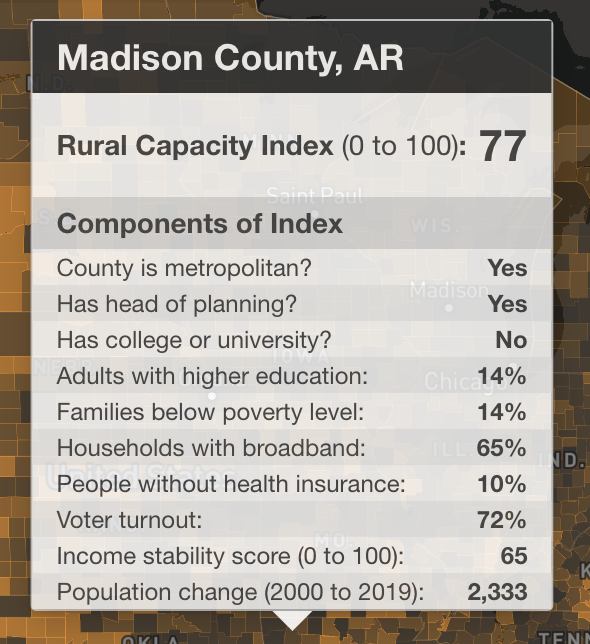
Meanwhile,  Madison County, which lies between Newton County and Washington County, is part of the Fayetteville-Springdale-Rogers metro because within commuting distance. Its index is 77. Its neighbor to the north, Carroll County, which lies between Boone and Benton counties, is not metropolitan (though it is otherwise similar to Madison County in terms of population growth, voter turnout, and broadband access, and I'm sure many of its residents also commute to the metro area) and thus scores lower, at 69.  Yet in spite of hits higher score, Madison has more families below the poverty level than Carroll County, as well as fewer adults with higher education.  This makes the metro designation look like a very influential factor in the rural capacity index.


Also of interest in all of this:  the smallest and poorest counties (Newton and Searcy) are the ones with the lowest levels of people without health insurance--presumably because Medicaid covers more of their populations.  The highest percentage of people without health insurance is in Washington County, which is otherwise quite salubrious.  

Further, income stability is highest in the less populous counties, and it's lowest in most populous, Washington, which may be related to its status as home to the flagship University of Arkansas.

Broadband is highest in Boone County (81%), than Washington County, which has the second highest rate of broadband (79%).  Benton County comes in third (71%).  The smallest and poorest (Newton and Searcy) have a broadband rate of 60%.   Carroll is at 69%, Madison at 65%.  

Finally, since this is a post about rural capacity, I'm linking to a 2008 blog post on that topic that specifically discusses Newton County's lack of human capital to help it navigate grant-seeking opportunities and otherwise plan for its future.  

Thursday, September 9, 2021

Big NYT Magazine feature on rural schools: out of sight, out of mind

Casey Parks, who has just joined the Washington Post, gets credit for this deeply reported story out of the Mississippi Delta.  The story appears in the Education issue of the magazine, and its headline is "The Tragedy of America's Rural Schools."  Many may see the word "tragedy" as an overstatement, but I'd argue it is not hyperbole with respect to many rural schools, including those in high-poverty and persistent poverty counties like Holmes County, Mississippi, where this story is set.  Holmes County's poverty rate is 33.8%.

The story centers Harvey Ellington, a high school senior in Holmes County, but the following excerpt focuses not on that compelling personal narrative, but rather on the funding schemes that undermine rural schools--and therefore rural students:  

Mississippi’s Department of Education doesn’t have any staff members dedicated to rural issues, and its most recent strategic plan doesn’t even include the word rural. But in 2016, when Ellington was in middle school, Republican lawmakers concluded that the best way to bolster Holmes was to consolidate it with Durant Public Schools, an even smaller and equally poor district 12 miles east, so that the districts could pool their resources.

Leaders from Holmes and Durant begged state lawmakers to consider alternatives. Several states have tried consolidation, and studies have consistently found that forced mergers rarely save much money and often don’t boost student achievement. What Holmes and Durant needed, their leaders said, was more money from the state.

Mississippi lawmakers have long known that rural districts can’t compete with wealthier suburban schools. In 1994, legislators even rolled out a new funding model designed to increase rural districts’ budgets. But the state has only fully funded the law three times in the last three decades, and leaders from Durant and Holmes argued that the shortfall had left both districts in a bind.

The story is worth a read in its entirety, not least because of the compelling cast of characters, including Ellington.  

I have written a great deal over the years about rural school consolidation (a lot of it based on events in my home county in the Arkansas Ozarks), and a bit about school funding.  

My recent academic work about rural school deficits, with Diana Flores, analyzes the situation, through the dual lenses of race/ethnicity and socioeconomic class, in New Mexico.   

Tuesday, August 10, 2021

My hometown is (apparently) about to blow up--in a good way

Newton County Courthouse, Jasper
Spring 2016
(c) Lisa R. Pruitt 2016

Sunday's column by Rex Nelson of the Arkansas Democrat-Gazette makes an encouraging prediction about my hometown.  The headline is "The Coming Boom," and it's about Jasper, Arkansas, the county seat of Newton County, in the Ozarks.   (You can find numerous posts about Newton County here).  It's not the first time Nelson has written about Jasper.  In fact, he seems to have a bit of a Newton County fetish.  Earlier columns are here and here, with this latter from last year repeating a lot of what this weekend's column reports.    

Nelson, a member of the paper's editorial board, predicts an ecotourism boom for Jasper, and he marshals a lot of evidence in support of his thesis.  I've written about the county's ecotourism economy here (2008) and here (2010), and I've generally kept abreast of the phenomenon of rural gentrification, usually in amenity-rich destinations, across the United States.  

Here's an excerpt from Nelson's column, which is thick on details-including details about who has the $$$ that pouring into the area to fuel this boom: 
Abandoned Dogpatch USA theme park property
(c) Lisa R. Pruitt 
The square in downtown Jasper is hopping on this Saturday afternoon. Bubba's Buffalo River Store is filled with visitors.

Opened in March 2020 by North Little Rock businessman Walter "Bubba" Lloyd Jr., who long has had a house in Newton County, Bubba's isn't like those tacky tourist shops that once dotted the Arkansas Ozarks. It's filled with high-quality shirts, caps, coffee mugs and other goods that well-heeled visitors are willing to pay for.

Jasper, which only has about 700 residents, is changing. Johnny Morris, the founder of Bass Pro Shops, purchased the Dogpatch USA property, and there's dirt work going on that's likely costing Morris millions of dollars.

Love thinking about what Dogpatch USA might become, not least because I gave that park six of the best summers of my life (1979-1984).  Also, where did Nelson get the 700 population figure?  As far as I know, Jasper's population has not been so robust for many decades, probably not in my lifetime.  The signs at the edge of town said 394 through most of my childhood, based on the 1970 and 1980 censuses.

Buffalo Theatre on courthouse square.  I worked the concession stand as a teen.
Would love to see investors do something with this old gem 
as many local initiatives to save it have failed. 
(c) Lisa R. Pruitt 

Nelson continues:  

Depending on what Morris does with the land (and all of his projects are first class), Jasper just might be Arkansas' next hot spot for tourists.

Just across East Court Street from Bubba's Buffalo River Store stands the old Gordon Motel. It recently was purchased by investors from northwest Arkansas who have big plans for the property. Harold Gordon moved to Jasper from Bogalusa, La., and purchased the motel from his uncle in 1970. In 1987, Gordon opened Buffalo Canoe. Four years later, he added a canoe factory at Spider Branch. Gordon died in 2017 at age 81.

Yes, I knew Harold Gordon and his wife Roslyn (why doesn't Rex also mention her? I assure you she had an important role in running the business), and I went to high school with their son Gary. Spider Branch is part of the farm homesteaded by my family five generations ago.  I used to catch crawdads there--the trick was getting them to back into the little nets held by my cousin, my sister and me.  We'd come out of a day of crawdad chasing with our backs and necks red with sunburn.  Sunscreen wasn't really a thing then.

Buffalo River Bunkhouse in background
with some visitors from Louisiana
(c) Lisa R. Pruitt
For more than 40 years, Gordon Motel had a partnership with the National Park Service, having obtained one of the original canoe rental permits when the Buffalo was designated by Congress as the country's first national river. Outdoor recreation such as paddling the Buffalo is now more popular than ever. That popularity, combined with Morris' Dogpatch purchase, has investors taking a look at the stone buildings around the Newton County Courthouse.

The column features much more detail still about who is spending money where and how in Newton County.  Reading the column leaves me with but one comment and one question.  The comment is this:  all of this capital is flowing in from outside Newton County--most of it from well outside the region.  Very little of it, if any, is truly local.  Not surprising in a persistent poverty county, I suppose.  There's very little wealth to invest in anything, let alone an ecotourism enterprise.  

One of the stone buildings near the 
Newton County courthouse square
(c) Lisa R. Pruitt 2012
One exception--or is it more of an illustration of my point?--is my mom.  She's definitely an oldtimer--fourth generation Newton Countian.  She's not wealthy by any means, but she owns 10 acres and the modest home she and my father builtin 1964.  It's a mile from Jasper, along the Little Buffalo River.  About 15 years ago, she turned an outbuilding--built as a large garage for truck repair--into a "bunkhouse" what will sleep about a dozen folks.  It's regularly rented by big groups who come to float the Buffalo.  She also turned a little two bedroom trailer, which similarly sits in her front yard, into a "bungalow."  It's also in great demand.  These don't command much money ($80 a night for the bunkhouse, I see, on airbnb.com) compared to other rentals in the area, but the properties contribute substantially to her income as a teacher's aide at the local school. 

Of course, outside money is better than no development at all, but it leaves me with this question:   Will these entrepreneurs from outside the region hire locals?  In particular, will they hire locals to do good jobs, like being river guides? or managers?  

Ozark Cafe, Jasper Town Square (c) Lisa R. Pruitt

I've noticed over the years that the river outfitters often have not employed locals.  Instead, they bring in college students from away.  But it's only appropriate that these outside entrepreneurs will hire local talent--that they will share the opportunities for jobs, for income--if not their wealth--with Newton County teens and young adults.  

One of the less salubrious scenes in Jasper,
not far from town square.  I use this photo when
I teach torts to illustrate "assumption of risk"
doctrine. (c) Lisa R. Pruitt

And that reminds me of this recently published book on rural gentrification, Dividing Paradise: Rural Inequality and the Diminishing American Dream (2021) by Jennifer Sherman.  It is set in central Washington, in a mountain community undergoing gentrification, with lots of Seattle-area folks moving in and pricing locals out of the market.  There, in "Paradise Valley," newcomers found themselves at odds with oldtimers, with the former tending to look down on the latter for, among other things, their lack of success in life.  They rarely saw that prospects for "local" success were undermined by lack of wealth, by which I really just mean capital (think my mother's ownership of 10 acres and some modest outbuildings as an example of someone with limited capital and making the most of it).    

If Jasper does become (more of) a boom town, I hope the community doesn't see the sort of condescension Sherman documented in "Paradise Valley."  

This reminds me of some coverage the Newton County Times has dedicated in recent months to the idea that the City of Jasper should pass a "hamburger tax," the idea being to tax things tourists buy, specifically prepared food  The revenue generated would be used to finance the Japer Advertising and Promotion Commission (JAPC).  Just one of many stories from the local newspaper is here.   Initial members of the commission include Rex Nelson's North Little Rock friend Bubba Lloyd who, for these purposes, apparently has dual citizenship in Pulaski County and Newton County.  

Here's an excerpt from the story: 

Bubba Lloyd, of Bubba's Buffalo River Store, drew the four year term, [Ernie] Yeager [of Junction One-Stop] drew the three year term, Russ Todd, of the Ozark Cafe and Blake Keeton, of Harps Food Store, both drew two year terms and Angela Slape, the commission's at large member, drew the one year term. 

Lloyd will be the commission chair.  

Although the commission was formed without the benefit of a one percent tax on the sale of prepared food in the city to provide it revenue, the city is appropriating a one time $5,000 as seed money for the commission to operate. 


Low Gap Cafe, another Newton County business 
mentioned in the Nelson column.  
(c) Lisa R. Pruitt
Postscript:  The Sept. 1, 2021 issue of the Newton County Times reports that the Jasper Advertising and Promotion Commission (JAPC) is seeking to hire a paid director who would "manage the day to day business operations of the commission.  It is a part-time position paying $12.75 an hour.  The person selected for the job must be a communicator, and be familiar with and excited about the city of Jasper,  said Commission Chairman Walter 'Bubba' Lloyd.  In addition to carrying out directives from the commission, the director must have a creative mind and be able to initiate ideas and suggest events that will benefit the promotion of the city.  These events will raise funds for the commission to use for the promotion and marketing of tourism-related businesses and recreational activities in Jasper."  

Other stories about the JAPC are here and here.  

Saturday, January 23, 2021

Biden's Executive Order on Racial Equity recognizes rural disadvantage

President Biden signed an "Executive Order On Advancing Racial Equity and Support for Underserved Communities Through the Federal Government" on January 20, 2021, his first day in office, and I was intrigued to see that it concerned a lot more than race.  Indeed, it includes "persons who live in rural areas" as well as "persons otherwise adversely affected by persistent poverty or inequality."  "Persistent poverty" is a federal government term of art for counties that have experienced high poverty (20% or more) for the last four decennial censuses, and the vast majority of those counties are nonmetro.  Thus, that last category seems also to be a nod toward rural disadvantage.  

Here's the full text of the definition section, with the salient portion highlighted.  
Sec. 2. Definitions. For purposes of this order: (a) The term “equity” means the consistent and systematic fair, just, and impartial treatment of all individuals, including individuals who belong to underserved communities that have been denied such treatment, such as Black, Latino, and Indigenous and Native American persons, Asian Americans and Pacific Islanders and other persons of color; members of religious minorities; lesbian, gay, bisexual, transgender, and queer (LGBTQ+) persons; persons with disabilities; persons who live in rural areas; and persons otherwise adversely affected by persistent poverty or inequality.

It'll be interesting to see how this is actualized.  Right now, as an executive order, this appears mostly symbolic.  

Nevertheless, it reminds me that of Guinier and Torres' suggestion in The Miner's Canary that rural whites are "political Blacks" for purposes of the Texas 10% plan.  Personally, I think it's good to try to build coalitions among disadvantaged populations.  

Wednesday, December 16, 2020

Jon Tester's Memoir "Grounded" finally gets some national publicity, along with issues of rural alienation

I read U.S. Senator Jon Tester's memoir, Grounded:  A Senator's Lessons on Winning Back Rural America a few weeks ago and liked it very much, so much, in fact, that I'm planning to write a short review of it.  That's my copy of it in the photo above--with lots of Post-It notes marking notable passages.  My "Audible" e-audiobook version is even more heavily book-marked and annotated. 

With that in mind, I looked around for reviews of the book and was surprised that not few media outlets have said anything about it.  I found only this on NPR and this from the Los Angeles Review of Books, both from September, within days of the book's publication.  

Today, however, Tester and the ideas in his book are featured in the New York Times.  Jonathan Martin leads into his interview with Montana's Senior U.S. Senator with some details that the Senator talks about a lot in the book:  Donald Trump pulled out the stops in 2018 to prevent Tester's election to a third term.  Trump was furious that Tester, who has a leadership position in Veterans Affairs, opposed the nomination of Rear Admiral Ronny Jackson to lead the department.  And Trump, in Trump style, set out to see Tester defeated, flying to Montana to hold rallies for Tester's opponent.  Trump also deployed Don Jr., to Big Sky Country as his emissary, and Tester refers to the younger Trump repeatedly as the "greasy-haired kid."  Generally speaking, Tester doesn't pull any punches in the book, and his disdain is most evident regarding the two Donald Trumps.  

Tester prevailed anyway.  Since then, however, the fates of Democrats in Montana have taken a serious turn for the worse, as Martin explains:  

But last month Mr. Tester’s Republican colleague from Montana, Senator Steve Daines, rolled to re-election against a formidable and well-funded Democratic rival, Gov. Steve Bullock.

Why did Mr. Tester prevail while Mr. Bullock lost? 

I wrote recently about that shift in Montana politics here.  It's a shift documented, up to a point, in Tester's book, which was published a few months before we knew Daines would so handily beat Bullock.  

But the bigger question is the national one of course, and it's one Tester takes up in his book:  "Why do most Democrats keep faring so poorly in rural America?"

Martin says Tester's book is part memoir, part policy manifesto, but I found it lighter on policy than I expected.  Tester talks about things like schools, which you'd expect any rural politician to talk about, but that's not an area where the federal government plays a great role, though it could.  Tester also talks about infrastructure like roads, though I found his musings very general.

Here's a quote from Martin's interview with Tester, which is well worth a read in its entirety--as is the book.  

Martin:  How do you balance support for law enforcement with accountability for police officers who break the law?

Tester:  You approach it from a standpoint that we’re going to do our level best to make sure we have the best-trained folks that we can on the beat, whether you’re in Big Sandy, or Great Falls, or wherever you’re at in the state of Montana.

And I think the whole idea about defunding police is not just bad messaging, but just insane. And I’ll tell you why. The area where we have the greatest poverty in the state of Montana is Indian Country. And where do we need more police officers than anywhere else? Indian Country. I mean, that’s a fact. Because of poverty, crime is more prevalent. We need more police officers, not less.

Indeed, Tester pays a great deal of attention to Native American issues in the book.  He notes several times that 7% of Montana is Native American, and I count the persistence and nuance with which Tester handles indigenous issues one of the book's many strengths.    

Here's another quote from the interview, this one focused on Trump:  

Martin:  Is the issue for Democrats in rural areas the appeal of President Trump, or is this a longer-term structural problem for the party?

Tester:  There’s no doubt about it, he has an appeal in rural America. I can’t figure it out, but there’s no denying it.

But I will also tell you I think there’s a long-term structural issue. And by the way, I’ve had this conversation with Chuck Schumer [the Senate Democratic leader] several times — that we have to do a better job developing a message so that rural Americans can say, “Yeah, those guys, they think like I do.” Because that’s what Trump has right now.

I can go into the list of things that might be insane about this president, but the truth is that rural people connect more with a millionaire from New York City than they do with the Democrats that are in national positions.

So that tells me our message is really, really flawed, because I certainly don’t see it that way.

We do not have a — what do I want to say — a well-designed way to get our message out utilizing our entire caucus. So we need to do more of that. You cannot have Chuck Schumer talking rural issues to rural people; it ain’t gonna sell. And quite frankly, I don’t know that you can have Jon Tester go talk to a bunch of rich people and tell them what they need to be doing.  (emphasis mine)

I'll also note that it's interesting that Martin is the journalist interviewing Tester for this story because Martin features in Tester's book.  Martin is the reporter who broke the story about plagiarism by Montana's short-term U.S. Senator, John Walsh, a Democrat appointed to finish out the term of Max Baucus when he became U.S. Ambassador to China.  After the revelation about plagiarism of Walsh's war college thesis, Walsh decided not to run for re-election, leaving a clearer path for Republican Steve Daines to take that seat in 2014.  Tester doesn't criticize Martin for exposing Walsh's plagiarism, but he does suggest that Martin should have disclosed that he was acting on opposition research about Walsh, research that (presumably Republican) outsiders furnished to him.   

Still hoping to write my own review of Grounded; certainly I have a lot more to say.

Wednesday, October 21, 2020

How the Trump administration has failed rural America

Here's a piece, now several weeks old, by Zoe Willingham, published by the Center for American Progress.  The lede follows:  

President Donald Trump has repeatedly stressed that his administration’s policies would benefit farmers and rural Americans, vowing in 2016, “We are going to end this war on the American farmer.”  His rhetoric, however, could not be further from reality. From the moment Trump took office, his administration has openly attacked rural communities by attempting to dismantle key programs and services on which they rely. The administration’s prioritization of corporate interests and profits over critical rural services and protections has only exacerbated the growing gap between rural and urban America. Since 2016, the difference in average household income between metro and nonmetro areas has increased by nearly 30 percent.
This issue brief outlines the multiple ways Trump’s policies are driving down rural opportunity and lays out pathways for restoring hope to rural America. Rural communities have been struggling for more than a decade, and they need a meaningful commitment to economic recovery from federal policymakers. With robust investment and lasting partnerships between the federal government and the diverse range of rural localities, rural America can have a bright future.

Among the items on the list: cuts to the U.S. Postal Service.   

Tuesday, March 31, 2020

Coronavirus in rural America (Part VIII): Indian Country

The Los Angeles Times reported from the Navajo nation a few days ago under the headline "No running water. No electricity. On Navajo Nation, coronavirus creates worry and confusion as cases surge."  Kurtis Lee writes from Cameron, Arizona, population 885:
Lisa Robbins runs the generator attached to her family’s mobile home for just a few hours most mornings. With no electricity, it provides heat in this rural high-desert stretch of the Navajo Nation where overnight temperatures often linger in the low 30s this time of year. 
Robbins first started hearing the whispers earlier this month — the fever, that sickness, something called coronavirus — but most people in this town of about 900 didn’t seem too worried. It was far off, neighbors told her, a world away in the big cities. 
So, Robbins, who rarely has access to the internet or TV news, continued with her daily routine, which includes helping her mother, who sometimes suffers from side effects of a surgery years ago to remove a cancerous stomach tumor.

Then came the bang on her door and a stark warning from local leaders. 
“They told us to stay inside … don’t come out because people could die,” Robbins said one evening last week. “It hit us so fast, no one knows what to do.”
The story tells of the likely spread of the virus from an evangelical church rally in Chilchinbeto, Arizona on March 7.  The Navajo Nation reported its first coronavirus case on the reservation on March 17, but within a few days the number jumped to 115.

The Navajo nation includes 175,000 residents spread over an area larger than West Virginia and served by just four inpatient hospitals.

Postscript:  Here is a hard-hitting NPR story on the coronavirus' impact on the Navajo Nation. Note the focus on water.  Forty percent of the Navajo reservation doesn't have running water, which means hand-washing is a luxury for them.