Showing posts sorted by relevance for query Del Norte County. Sort by date Show all posts

Saturday, July 27, 2019

My Rural Travelogue (XXIII): A California summer on the road

Redwood Coast Transit Schedule, Smith River (Del Norte County), California
(c) Lisa R. Pruitt 2019
Most of my travel this summer has been road-tripping through parts of the Golden State.  I'm on my third trip of the summer now, to Sonoma County.  The other two have taken me farther afield (meaning farther from my Sacramento County home), first to Del Norte County, the state's farthest northwest reaches and then to Los Angeles via the coast, back through the Central Valley.   All told, these journeys have added up to well over 2,000 miles, many of them on Highway 101.  For this post, I'm using photos of post offices and (meager) public transit systems to illustrate my journeys, though I have included in some earlier posts this summer (here) a wider array of photos from Del Norte County.

On these three trips, I have passed through 25 different counties--nearly half of the state's total.  Specifically, I have traversed some part of the following California counties (in order of my passage, and showing county seats and populations in parentheses): 
U.S. Post Office Smith River (Del Norte) County, California, July 2019
(c) Lisa R. Pruitt 2019
Trip 1:
Yolo County (population 200,849, Woodland)
Colusa County (21,419, Colusa)
Glenn County (28,122, Willows)
Redwood Coast Transit Bus, Del Norte County, California
(c) Lisa R. Pruitt 
Tehama County (63,463, Red Bluff)
Shasta County (177,223, Redding)
Trinity County (13,786, Weaverville)
Humboldt County (132,646, Eureka)
Del Norte County (28,610, Crescent City)
(then heading south again through Humboldt)
Mendocino County (87,841, Ukiah)
Lake County (64,655, Lakeport)
U.S. Post Office Cambria (San Luis Obispo County), California
(c) Lisa R. Pruitt 2019

U.S. Post Office Big Sur (Monterey County), California
(c) Lisa R. Pruitt 2019


Trip 2:
San Joaquin County (685,306, Stockton)
Stanislaus County (514,453, Modesto)
Merced County (255,793, Merced)
San Benito County (55,269, Hollister)
Monterey County (415,057, Salinas)
San Luis Obispo County (269,637,  San Luis Obispo)
Santa Barbara County (423,895, Santa Barbara)
Ventura County (823,318, Oxnard) 
Los Angeles County (10 million give or take a few, Los Angeles)
(the heading north again through Ventura, SB, SLO...)
Kern County (839,631, Bakersfield), though I just nicked the corner on that one
Kings County (151,366 Hanford)
Fresno County (994,400 Fresno)
then back through Merced, Stanislaus and San Joaquin counties to Sacramento.

Trip 3:
Yolo County (see above)
Solano County (413.344, Fairfield) 
Napa County (136,484, Napa)
Sonoma County (483,878, Santa Rosa)

So, of the 25 counties through which I traveled, only 8 are classified as nonmetropolitan (population less than 100,000), and 7 of those 8 are in far northern California.  The 8th is San Benito, between Central and Salinas Valleys.

U.S. Post Office, Los Alamos (Santa Barbara County), California
(c) Lisa R. Pruitt 2019
One striking thing about these journeys:  the incredible variety of terrain and climate across the Golden State, from mist-shrouded redwoods to parched rolling hills dotted by chaparral. 
U.S. Post Office Bodega (Sonoma Co)
California (c) Lisa R. Pruitt 2019
Then of course, there's farmland from end to end:  orchards, cattle, and row crops including broccoli, strawberries and wine grapes.  (No doubt I've also driven past some cannabis, though I wasn't aware when I did.)


Sonoma Coast Transit Bus, near Bodega Bay, California
(c) Lisa R. Pruitt 2019
Decades ago, the Republic of South Africa used the tourism slogan, "A World in One Country."  California could readily go with a similar slogan, "A World in one State."

Monday, December 23, 2019

Two sobering stories out of far northern, coastal California

Tsunami Hazard Zone sign along Highway 1 in Sonoma County, California
(c) Lisa R. Pruitt 2019
The first of the stories I want to highlight here is from today's Los Angeles Times by Hailey Branson-Potts, dateline Crescent City, California, population 7,643, county seat of Del Norte County, population 28,610.  The headline is "Tsunamis tourism: By marketing disaster, a struggling California town hopes to recover economically," and here's the lede:  
Three years into his job as a city councilman, [Alex] Fallman’s take on this Northern California harbor town was not that of a civic booster. His words unspooled like a dirge. 
“Cool, worldly things don’t happen here,” the 23-year-old said. 
Del Norte County Fairgrounds, July, 2019 (c) Lisa R. Pruitt
Crescent City is a land of wild beauty, where towering redwoods meet quiet, foggy beaches. It’s also a place of economic despair. As with many small California towns, its downtown is marked by empty storefronts. Homeless men shoot methamphetamine in the beachfront park.
To push back against these trends, some in the city are embracing tsunami tourism.  After all, 41 tsunamis have crashed into Crescent City since 1933, the most damaging of which killed 11 people and destroyed 29 city blocks in 1964.  As the story notes, these repeated disasters have stunted the city's growth, leaving many city blocks empty. 

Branson-Potts provides important socioeconomic context for Crescent City's seemingly odd approach to economic development, including the fact that nearly a third of Del Norte County residents live below the poverty line--about twice the state and national rates.  The median annual income is just over $27K, about half the state median.  The story also includes information about recent economic development investments in Del Norte County, including its designation as an opportunity zone and upgrades to the airport, which now features more flights to and from Oakland. 

Veterans Memorial Hall, Crescent City, July 2019
(c) Lisa R. Pruitt 2019
The last time I wrote about Crescent City/Del Norte County was here (and other posts mentioning it are here, here, here, and here). Another recent Los Angeles Times story about the area--specifically its majestic redwoods--is here.

This LA Times report on tsunami-oriented tourism reminded me of this October story out of neighboring Humboldt County (population 132,646), specifically the county seat, Eureka.  The story was reported in the Eureka Times-Standard by Sonia Waraich.  Here's the lede:  
Eureka has a self-esteem problem, according to the survey results of marketing firm Eddy Alexander. 
More than 3,425 city’s residents, workers, business owners and past residents out of 25,529 who were sent a survey completed the survey. The majority responded with a negative view of the city and are more likely to discourage visitors from coming to Eureka than they are to recommend it, said Jennifer Eddy, founder of the Virginia-based marketing firm. 
At the meeting revealing the results Tuesday night at the Wharfinger Building, Eddy also showed homeless, drug, dirty and crime were the words that people said first came to mind when they think of Eureka. 
“Lots and lots of cities are dealing with homelessness as a challenge,” Eddy said. “It is not unique to this community. It’s not even necessarily a detractor for tourists.” 
The respondents were most likely to be proud to be affiliated with Northern California, the redwood coast and Humboldt County, but weren’t as proud of the city and had less and less pride when it came to their specific neighborhood, Eddy said. About 10% responded “none of the above” to having pride in any of the area’s features and attractions.
As with the Del Norte County story, two themes of this Humboldt County story are homelessness and drug use.  A 2018 post on Eureka's drug and homelessness problem is here.  It's more than a little sad to see a region as beautiful as this section of far northern California have its natural beauty and amenities so eclipsed by man-made problems, though I note the negativity more associated with the city than the county and coast. 

Other somewhat more upbeat LA Times stories out of rural northern California are here and here, the first from January 2019 about a local newspaper in Sierra County (population 3,240), and the second about a "fraternal order," E Clampus Vitus, associated with the gold rush era. That latter story out of Plumas County (population 20,007), just north of Sierra County, is a few years old now but also by Branson-Potts, a talented feature writer.  Reading these stories once again leads me to appreciate the very good job the Los Angeles Times does of covering a region of the Golden State that is so very far away--in physical distance and culture--from the Los Angeles metroplex.

Thursday, February 17, 2022

A California program is working to help the rural unhoused

Anna Maria Berry-Jester reports for the Los Angeles Times reports today out of Del Norte County, in the far northwestern corner of California, about how the state's "Project Roomkey" is working to put a roof over the heads of the previously unhoused.  That program provides funds for the purchase of old motels to house those without housing.  Here's an excerpt:  
California’s spiraling housing crisis is often understood through the lens of its big cities, where the sheer number of people who need assistance can quickly capsize the programs designed to move people into housing. But before the pandemic, helping people find shelter in Del Norte had been an insurmountable problem for [Heather] Snow [county director of health and human services] and her colleagues, as well.

There’s not enough housing in general in Del Norte, let alone for people with precarious finances. Snow lived 30 minutes north, in Brookings, Oregon, when she started her job six years ago. It took years to find somewhere closer to live. And there’s never been a homeless shelter anywhere in the county, as far as she knows.

For several years, Snow has used county funds to rent rooms at a local motel to temporarily house people at risk of becoming homeless. Sometimes they’d been released from a psychiatric medical hold or were trying to get out of an abusive relationship. Sometimes they needed a temporary sober-living environment. The county spent $820,000 on those rooms from July 2015 through June 2020. “It was a public health emergency before is the truth,” Snow said. “People just didn’t see it that way.”

After the pandemic came to town, Snow and her colleagues began using the motel to house people ... who were at high risk for serious illness and had no safe place to live, as well as people who needed a safe place to quarantine after a COVID-19 exposure.

* * *
In October 2020, the state awarded Del Norte County $2.4 million to buy the 30-room motel and turn it into affordable housing through Project Homekey, a statewide initiative spearheaded by Gov. Gavin Newsom to help counties buy old motels and other buildings and turn them into permanent housing. 
Snow said there’s enough space to accommodate about 17% of Del Norte County’s homeless residents and families.The motel is nestled in a median between the north- and southbound lanes of Highway 101 and is flanked by grocery stores, fast-food restaurants, a laundromat and a drugstore. It’s not far from the police station and county health services. To Snow, it’s an ideal location for people ... who don’t have a car.

* * * 


Today, the 30 motel rooms in Del Norte are among the more than 7,000 new housing units the state says it has created through Project Homekey in two years. In late January, the Newsom administration announced that an additional $14 billion will be spent in 2022 on a mix of housing units and mental health treatment.

Some people have stayed at the Legacy, as the county renamed the motel, and then moved on to new homes after finding their footing. Others have housing vouchers and jobs but can’t find another place to live. And some...have become long-term tenants.

Would love to see a comparison of how and what Project Homekey is doing in California's urban areas. 

Monday, March 14, 2022

Small-town government run amok (Part IX): California sheriff charged with voter fraud

The Sacramento Bee reported late last week from Del Norte County, in the far northwestern part of the state under the headline, "California sheriff charged with voter fraud, perjury in vacation rental address dispute."  Here's the lede:  

Less than six months after he took the job, the sheriff of Del Norte County was charged Wednesday with felony voter fraud — the latest scandal for the small North Coast department whose previous sheriff resigned amid a flurry of staff departures and internal dysfunction. 

District Attorney Katherine Micks charged Sheriff Randall Waltz with perjury and filing false voter registration and nomination papers, court records show. Prosecutors say he knowingly listed an address that was not his permanent residence, a violation of election laws, and thus did not meet the requirements to run for sheriff. 

The address that he gave, which is listed in the documents, is for a short-term rental suite along Highway 101, a half-mile south of the Oregon border in Del Norte. Reached by phone Thursday, the property owners told The Sacramento Bee that Waltz turned in a security deposit last month, moved in shortly after that and has been living there ever since.

Given that the sheriff is from another part of the state, far away from Del Norte County, I wonder what role the rural housing shortage in places like Del Norte County will ultimately play in adjudication of this case.  That is, what if the sheriff couldn't find a place to live?  Curious to know where Waltz was living before he took this short-term rental, which he did only recently.  

A post from last fall about dysfunction in the Del Norte County Sheriff's department, which led to Waltz getting the Sheriff's job, is here.  

Saturday, August 28, 2021

Coronavirus in rural America (Part CXLVIII): cases spiking in far northern California

Hailey Branson-Potts reports in today's Los Angeles Times from Crescent City, population 6,676, the county seat of Del Norte County, where California meets Oregon and the Pacific Ocean.   Here's an excerpt:  

Cumulative coronavirus cases [in Del Norte County] have more than doubled over the last three months, from 1,380 confirmed on May 10 to 2,805 on Friday. At least 70 cases were confirmed Thursday alone.

The county of 27,800 people has one hospital, the 49-bed Sutter Coast Hospital in Crescent City. The next-closest in California is a 90-minute drive south in Humboldt County — over a stretch of Highway 101 called Last Chance Grade that is crumbling into the sea.

The state has sent extra doctors, nurses, X-ray technicians and respiratory therapists to the overwhelmed Sutter Coast Hospital, and 40 ventilators have been ordered, [State Senator Mike] McGuire said.
* * *
Like many facilities in rural regions, where it can be hard to recruit professionals, Sutter Coast struggled with staffing shortages even before the pandemic. Now, [Sutter Coast Chief Executive Mitch] Hanna said, that deficit is exacerbated by doctors and nurses falling ill with the virus.
Just 35.8% of Del Norte County's population is vaccinated, compared to 56.3% of Californians.  Meanwhile, 83% of the hospital's new COVID-19 patients have been unvaccinated.  
Earlier this month, more than 100 doctors in Del Norte and neighboring Humboldt County signed a letter pleading for residents to get vaccinated.  
The letter said:  
As your physicians, and as the people with whom you have worked, played, laughed and cried, we must admit we are tired,” it said. “We will keep working, of course. But we are tired. We are tired of the suffering, pain and death that can be avoided by getting vaccinated.

A recent post about high hospitalization rates in six rural northern California counties is here.  To this list, Branson-Potts' story adds the counties of Amador, Plumas, Shasta and Placer.  

Thursday, June 23, 2022

On the burden of the hike in gas prices for rural schools--and California's under-investment in student transportation (Part I)

Gas Station Weaverville, California
July 2018
(c) Lisa R. Pruitt 2018

McKenzie Mays reports today from Sacramento for the Los Angeles Times:  "California is richer than ever. Why is it last in the nation for school bus access?"  Here's the gist of the article as it implicates rural places: 

When the COVID-19 pandemic shut down rural Del Norte County schools, it was the buses that brought students a shred of normalcy.

Teachers and staff boarded the yellow buses and helped deliver brown bags of free meals and school supplies. They drove along winding, dilapidated back roads known for landslides, as concerns grew about students who had been shut out of classrooms.

“That school bus is a lifeline,” said Jeff Harris, superintendent of schools in Del Norte County, the northwestern corner of California. Del Norte, flush with redwood forests, is home to more than 4,000 K-12 students, a majority of whom qualify for free or reduced-price meals.

When district finances were tight in 2019, school officials considered making cuts to transportation services. But they ultimately backed off as community sentiment became clear: Buses are a necessity.

“If we do not provide transportation services, then our students’ ability to access education just becomes critically endangered,” Harris said. “There is no way that a rural school district is able to decrease chronic absenteeism and support families who are in financial stress without running transportation services.”

Unlike some other states, California does not require school districts to provide buses, even if a student lives far from campus. The state pays a fraction of transportation costs for schools — the same amount since 1981 — despite soaring inflation, increased demand, a sharp jump in gas prices and a projected record-high state budget surplus.
Some students with disabilities or those experiencing homelessness are guaranteed free transportation under federal law, but otherwise, it’s up to local districts to provide buses.
McCloud, California
Siskiyou County
July 2018
(c) Lisa R. Pruitt 2018

Mays goes on to talk about the impacts on suburban districts, like the one where I live in greater Sacramento (San Juan Unified).  Here are some of the statewide data points for context: 

California buses a smaller share of its public school students than any other state, fewer than 9% of students compared with 33% nationwide, according to the most recent National Household Travel Survey by the Federal Highway Administration in 2017.

More than two-thirds of California’s students got a private ride to school each day while 18% walked and 2% took a city bus or other public transit, according to the survey.

Those numbers fail to measure the strain placed on families as California’s vast wealth gap widens and concerns grow about students who do not have parents able to provide a daily ride.
But going back to the rural angle, I could not help be reminded of this Hailey Branson-Potts LA Times story from nearly two years ago, out of Trinity County, southeast of Del Norte.  This story makes clear  how important it is for free school buses to be available to transport rural kids.  Here's a poignant excerpt: 

After schools closed in March, many isolated students here battled apathy and anxiety, witnessed increased drug and alcohol abuse by their parents, and fought more with their stressed-out families, the county noted in its school reopening plan. As in other rural areas, the district struggled to teach far-flung students who have less access to the internet and bad cellphone service and who rely on schools to feed them.

“There’s a lot of despair,” said Sheree Beans, the school nurse for the Trinity County Office of Education who helped write the schools’ reopening plan. “I feel like COVID took away hope, and that lack of hope, it spans generations.”

* * *

The first day of school started at 5:06 a.m. Monday for bus driver Carl Treece, who drives a 104-mile round-trip mountain route on State Highway 299 — one of the longest in the state.

Treece left the Weaverville bus barn before sunrise in his own car, coasting around hairpin turns and narrowly missing two deer. In the past, his route has been obstructed by boulders and black bears.

Treece picked up Bus No. 6 at Burnt Ranch Elementary School, which recently rebuilt after it, too, was found to have toxic mold. Treece sprayed the bus seats with a bottle of pink-colored disinfectant before finishing the drive to his farthest stop.

After schools closed, Treece kept driving this route to deliver meals and homework packets. He worries about the students keeping on their masks — required for all students third grade and older, recommended for those younger — when it gets hot. There is no air conditioning onboard.

At 6:47 a.m., he made his first bus stop at a boarded-up restaurant called The Whole Enchilada in the minuscule town of Salyer, and picked up three high school boys.

Billy Atkission, a 17-year-old senior from Willow Creek, got up at 5:30 for his mom to drive him to the bus stop. He’ll have to get used to waking up early again, he said from behind a black cloth mask.

“I finally get to see these dudes after five months,” he said, nodding at the other boys. “I haven’t seen anybody at all, just because everybody I’m friends with lives so far away. I miss my friends a lot.”

He added: “I’m not really worried about the corona. Not that much.”

As the bus pulled into Trinity High School at 8:06 a.m., Treece said: “Do your part to prevent the spread. Right? Wear your masks at all times on the bus. Do your social distancing. ... Anybody wanna place any bets on how long we’ll be able to stay open?”

“A month!” one boy shouted.

“Better be forever,” yelled another.

It's worth nothing that some states do provide additional funding to rural school districts to help them defray the cost  of providing transportation to students.  Last I checked, Arkansas was one of those states, as was Montana (in form of a supplement in the state funding formula for rural students). 

Tomorrow, I'll write about the U.S. Supreme Court decision that makes providing bus service/transportation optional.  

Tuesday, April 21, 2020

Coronavirus in rural America (Part XXVI): the rural-coastal divide in California

Politico reported yesterday from the state's Central Valley under the headline, "How California’s coastal-rural divide could provide lessons for the nation."  Interesting that journalist Mackenzie Mays highlights the coastal-rural divide, rather than the urban-rural divide, though the two are largely synonymous, well excepting Sacramento and Fresno, which are the fourth and fifth largest cities in the state and both inland, and also excepting some far northern and central California coastal communities.  Now that I think about all the exceptions to the coastal-rural divide, I'm not sure it's a good proxy for rural-urban divide--not sure it's an accurate description of California geography.

In any event, Mays' report is datelined Sacramento and focuses on the heart of the Great Central Valley, the nation's most important agricultural region.  Here's an excerpt:
When California emerges from its coronavirus lockdown, the state's often overlooked rural counties could be the first to open up rather than the nationally trendsetting San Francisco Bay Area. 
Rural counties house roughly one-tenth of California's nearly 40 million residents but comprise more than half its land mass. A greater share of inland residents have continued to work in essential sectors under social isolation orders, and many think their thinly populated communities are less vulnerable to Covid-19 spread and shouldn't be held back by coastal cities. A distrust of Sacramento directives and a government helmed by liberal Gov. Gavin Newsom are also at play.
California's divide could become a harbinger for how rural and coastal states ease their restrictions in different ways with less populated areas lifting closures sooner than denser cities. Escalating frustration among conservatives over stay-at-home-orders’ impacts on the economy has led to protests across the country, and similar demonstrations have been organized in pockets of California.
* * * 
If rural counties open before densely populated coastal cities, health officials will watch closely to see whether different social distancing rules can coexist in the same state — and what health effects an isolated reopening would have locally and beyond.
Despite growing pressure to reopen, health officials worry about a lack of sufficient testing in rural communities — and the potential for disproportionate suffering due to socioeconomic barriers and health care shortages they faced pre-pandemic. 
In rural Tulare County, one of California's last Republican bastions, Supervisor Pete Vander Poel expects a “strong push” from the agricultural center to reopen as soon as possible. 
Mays quotes Vander Poel: 
We are not a highly concentrated urban area.  I believe that our businesses feel like they can accommodate social distancing and increase hygiene and sanitation much quicker and on a much more open basis.
But Tulare County, with a population of nearly half a million, is hardly rural.  So far, it's seen more than 300 cases, mostly from nursing homes.  Mays quotes Governor Gavin Newsom: 
For those that think this is just an urban construct, or densified in certain parts of the state, it exists and persists, Covid-19, throughout the state, including rural California.  None of us are immune from this disease, and if we stop taking it seriously, we will have serious consequences.
Here's a story out of Stanislaus County, also in the Central Valley, and here's a story of protests out of Del Norte County, in far northern California.  Contrary to Mays' construct, Del Norte County is coastal but very rural.  An earlier post about Del Norte County is here. 

And here's a comment from Governor Newsom's press conference today on the issue of some local governments moving to open before he gives the go-ahead:
I imagine there’ll be some examples of people just getting ahead of that collaborative spirit. And we may have to dial a little bit of that back.

Wednesday, October 13, 2021

Small town government run amok (Part VIII): Expose on nonmetro sheriff's department in rural northern California

Ryan Sabalow and Jason Pohl report in today's Sacramento Bee, out of Del Norte County, California, population 28,610, about malfeasance--or perhaps just negligence--on the part of the sheriff's office there. Here's a quote from the lengthy, front-page story:  

There’s a motto among locals in this coastal corner of Northern California, a rugged place where tourists ambling among the redwoods outnumber residents living in Crescent City. 

“There’s no law north of the Klamath,” a nod to the river at the county’s southern border with Humboldt County. 

Locals still mention the saying — which dates back to the unruly 19th-century Gold Rush — when they talk about the Del Norte County Sheriff’s Office. 

The office has been struggling with a series of departures and scandals that have some in the community questioning whether the department is so dysfunctional that it cannot safely perform its duties and protect the public. At least two dozen sheriff’s office employees have left the department since January 2020, an average of more than one a month. It’s a disproportionate number for the department that currently employs just 60 people.

This framing in terms of rural lawlessness reminds me of my theorization of these issues in relation to rural spatiality, inability to achieve economies of scale and general lack of resources, as discussed here.  

Earlier posts featuring or mentioning Del Norte County are here.  

Friday, December 2, 2011

Occupy Humboldt, drunk DAs, trucking, and pancakes

Like most people, I went home for Thanksgiving. As I posted earlier, my mother had surgery the Friday before so my family had a low key Turkey Day with just my parents, two sisters, and myself. But even with the holiday weekend, my father kept an appointment he has every Saturday morning that he is home: breakfast with my uncle Larry and their best friend Frank at Dennys. For as long as I can remember my dad would go to breakfast with Larry, Frank, and maybe a few other people on Saturdays to eat flap jacks, drink gallons of coffee, and discuss various subjects. That Saturday I went with Dad and grabbed a copy of the Times-Standard, the local newspaper, when we got there.

Dad and Larry talked about what was going on with the family trucking company. Construction projects have closed for the winter, meaning no more dirt hauling until spring. Four truck loads of crab pots were hauled down to San Francisco for the early dungeness crab season. And we had a kind of Black Friday haul, a Christmas tree seller realized on Wednesday they had underestimated their original order of trees and needed a truck load of trees by Thanksgiving night. We got some much needed extra income on that haul.

We also talked about the Occupy Wall Street protests going on. A couple of small scale protests are happening in Humboldt county. Eureka's encampment was taking place on the courthouse's lawn, where the protesters have been removed three times by police. The encampment has its supporters, but its reputation has been marred by numerous intoxicated in public arrests and one charge of assault when a woman tried to physically prevent a couple of courthouse employees from entering.

Sensing that some in the community are turning on the Eureka OWS encampment, a new group calling itself Occupy Humboldt is forming. Their goal is to move away from an encampment, and turn towards countywide community outreach and political involvement.

The Occupy Arcata encampment on the city hall lawn has self-imploded. Apparently a fight over the encampment's kitchen and partying broke the group up into two subsets. One, mostly made up of Humboldt State University students, decided to move back onto campus where other students were already protesting. The other, mostly homeless, moved into a camp in the Arcata Community Forest.

It seems like the OWS movement in Humboldt county is at a cross roads right now moving in many directions all at once. Another topic was the pepper spraying at UC Davis and the comparison to the pepper spraying incident in Humboldt during the Timber Wars in the 1990s. But that's enough material for a future post.

Another topic we talked about was the county to the north of Humboldt, Del Norte. In a "why would you do that, you know better" situation, the former Del Norte District Attorney Mike Riese was arrested in August for suspicion of DUI. Because the former DA was involved, the Attorney General sent an assistant to take over prosecuting the case from the DA's Office.

But there was a problem of what to do with the Superior Court judges of Del Norte. The AG requested that all the judges of Del Norte recuse themselves. All the judges sounds like a big deal, but Del Norte only has two, and both have presided over criminal cases involving the former DA. The judges agreed to step aside, so a retired Humboldt county judge has volunteered to hear the DA's case. Just another example of how the judicial system in very rural counties can be a real pain.

We finished up breakfast and the conversation. We went our separate ways and I left with my mind filled with plenty of local scuttlebutt to last me until Christmas time.

Monday, August 5, 2019

Rural media (Part I): A new feature reporting from the pages of small-town newspapers

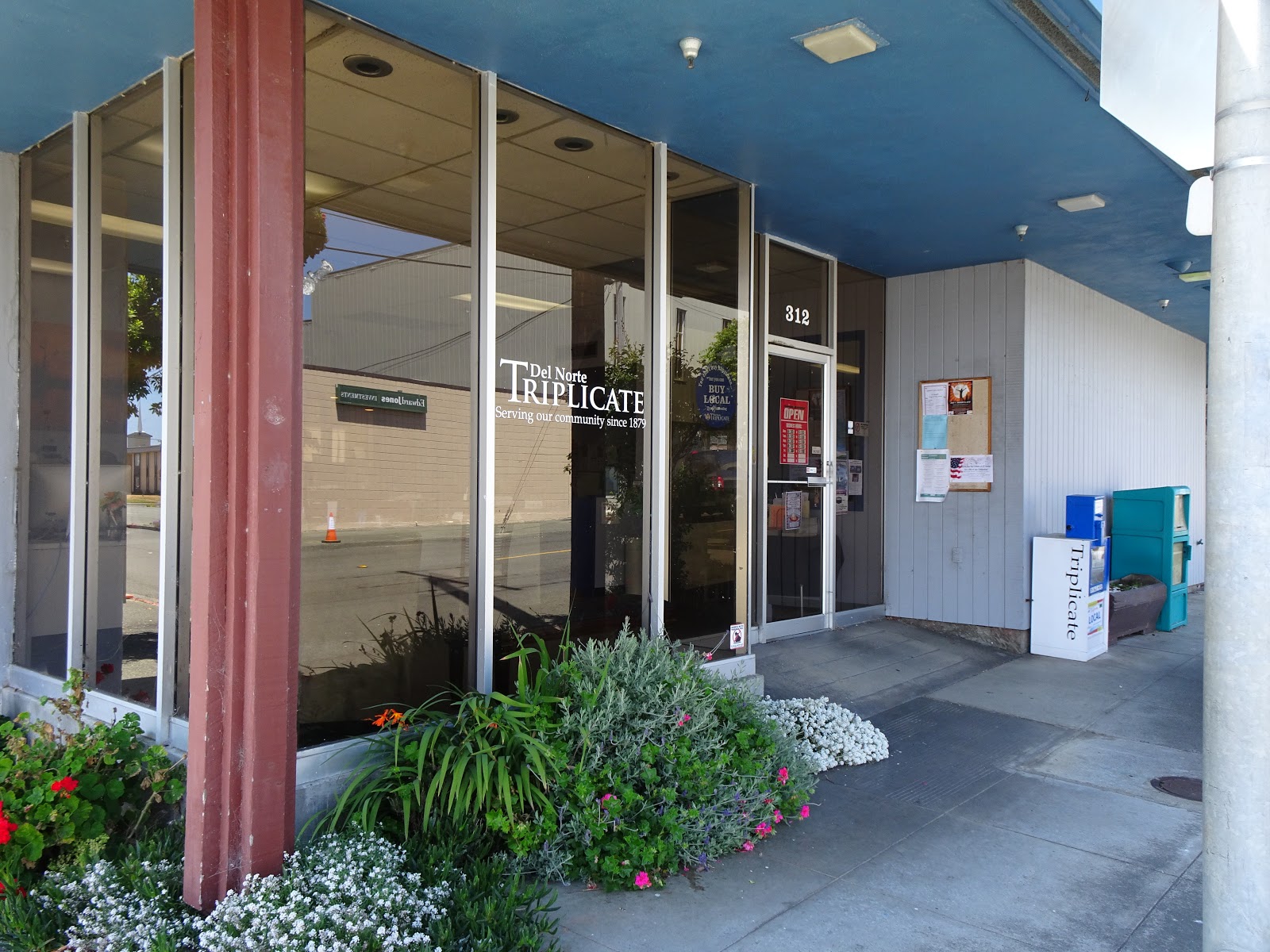
Office of the Del Norte Triplicate, a thrice-weekly paper in Crescent City, California
(c) Lisa R. Pruitt 2019
When I travel to rural places (as well as urban ones, for that matter), I make a point of reading the local news. I like to see what the issues du jour are in particular rural regions, and I blog about what I find as often as I can.  Some recent examples of that are here and here.  My travels throughout California in July have given me ample opportunity to consume several different local (county) newspapers, so I'm going to highlight some of what I read here:

The San Luis Obispo Tribune published an editorial headlined, "Reckless drivers, drunks and confederate flags don't belong on the Oceano Dunes," on July 19.  Here's an excerpt, about a recent Coastal Commission meeting in the area, which considered the fate of the popular outdoor park where six people have died this year in ATV/off-roading accidents:
Yes, the Coastal Commission agreed to maintain the status quo at the popular off-road park for at least one more year. But it also made it clear that it expects improvement. 
And if the commission takes its job to protect and enhance the coastline at all seriously — and wants to retain any credibility with opponents of the state vehicular recreation area — it will treat this as a last chance.

For as much as supporters have tried to portray the Oceano Dunes as a safe, welcoming, family-friendly place, the PR isn’t working.

It’s hard to characterize a place as safe and family-friendly when there have been six fatalities and a shooting so far this year.

And welcoming?

Sorry, but even a single Confederate flag on the back of a pickup is enough to create the impression that the entire off-roading community is a bunch of racist good ol’ boys who come over from the [Central] Valley to drink and raise hell — leaving the locals to eat their dust and clean up their mess.
* * *
For many, the [2019] deaths confirm the park is an inherently lawless, dangerous place — the term “Wild West” gets used a lot — where there’s little supervision and almost anything goes.
As we’ve said before, we don’t believe the increase in fatalities is a reason to close the park — but it definitely is a reason to figure out what the heck is going on and do whatever it takes to make the park safer.
I could excerpt more, but I think readers will get the picture. 

The (Sonoma County) Press Democrat ran this story by Julie Johnson on July 26 under the headline, "Mendocino marijuana raids reflect California’s stepped-up enforcement on illegal operators."  Here are a couple of key excerpts about what went down in what has been called the Emerald Triangle.  Specifically, the Mendocino County Sheriff's Office "cut down more than 42,000 marijuana plants on nearly 30 properties in the Eel River watershed." This is reportedly the first "major multiagency operation investigating illegal cultivation and environmental crimes to take place" in the county since the state legalized marijuana.  While the state has granted licenses to some 500 entities to grow marijuana in Mendocino County, thousands of unlicensed marijuana farms are believed to exist.
Cannabis industry leaders here said the operation was premature for an industry struggling to adapt to new regulations and that it felt like a resumption of the heavily militarized law enforcement campaigns that for decades targeted marijuana growers in these hills and valleys.
But Sheriff Tom Allman said his teams focused on sites where they spotted evidence of serious environmental crimes such as water theft and polluting the watershed with trash, fuels and pesticides. The investigations targeted properties where people had not even applied for local permits or state licenses to cultivate, he said.
“Is it marijuana enforcement or is it environmental enforcement?” Sheriff Tom Allman said. “There’s a difference, and I think the tide is turning.”
In the aftermath of legalization, marijuana industry leaders had hoped that enforcement of the state’s cannabis cultivation laws would fundamentally change. Where once they had encountered teams of camouflaged and armed peace officers investigating criminal behavior, they envisioned civil operations run by code enforcement officers using warnings, legal notices, fines and penalties to hold people accountable.
The Times-Standard (Eureka/Humboldt County) on July 6 led with this headline, "County buildings aren't up to standards."  The story by Sonia Waraich features these paragraphs: 
Humboldt County has been failing to make public facilities accessible to people with disabilities for years, according to a report from the county's civil grand jury.  
The county has been on hot water with the U.S. Dept. of Justice for over a decade because it has continuously failed to meet deadlines set by the department to bring county buildings up the the standards laid out in the Americans with Disabilities Act, according to the Humboldt County Civil Grand Jury report "Here We Go Again" released Friday morning.  The ADA states that government buildings need to be usable for people with disabilities and modifications need to be made to make them accessible.  
The following is a quote from the report: 
As the County approaches the final deadline in the Consent Decree to remediate the remaining facilities and curb ramps, it seems unlikely that work will be completed on time.  Many earlier deadlines have been missed and a number of projects are still out for bid.  
Nearly 1700 curb ramps still need to be remediated, according to the report. 

In it's July 3, 2019 issue, the Curry Coastal Pilot (Oregon) ran a front-page story announcing the paper's new ownership under the headline, "Turning a new page."  The story, which features a photo of Carol Hungerford, begins:
Hello, Brookings and Crescent City!  We're privileged to be the new owners of the Curry Costal Pilot and the Del Norte Triplicate.   
As a native Oregonian, I love this coast and its iconic smaller towns  We are excited at the opportunity to learn about and become part of the fabric of Brookings and Crescent City.   
My husband, Steve, and I have been working toward this goal of purchasing these two promising community news outlets for four months.  
Steve created Country Media nearly 20 years ago because of his passion for community news and service.  After half a century working at daily and weekly newspapers of all sizes, his zest for this business continues unabated.  
My education and work experience had been centered in the arts and arts management.  But early on I agreed to help Steve operate our newspaper company, and I've never regretted that decision.   
Over the past two decades, we've built our business to include some 15 nondaily newspapers and 15 years, associated websites serving communities of various sizes in four states.  So we have a strong background in finding a good fit between our publications and their communities.   
For now, our prime focus with these two newspapers is to make them sustainable, to ensure that Brookings and Crescent City have long-term newspapers they can rely on for non-judgmental, accurate and unbiased news coverage.  
The column then goes on to explain that Country Media bought the two papers our bankruptcy.  Curry is Oregon's most southwesterly county, and its population is 22,364.  Del Norte County, California, home of the sister paper, the Triplicate, has a population of 28,610.

Speaking of media ownership, to close out this initial post on the rural media, let me turn to this New York Times story from August 1 about the last issue of the Warroad (Minnesota) Pioneer, printed this past May.  Warroad, population 1,781, is in far northern Minnesota, a few miles south of Canada, and its paper had a distribution of about 1,100.   Richard Fausset's story notes that the Warroad paper joined some 2000 United States papers that have ceased to publish over the last decade and a half.  A study by UNC research, "The Expanding News Desert," found that “there is simply not enough digital or print revenue to pay for the public service journalism that local newspapers have historically provided.”  Fauset writes:  
In Warroad, The Pioneer was full of soft-focus features on residents, reprinted news releases, photos of fishermen with their outsize catches, and news of awards won by children and Shriners. There were the occasional stories, too, about city officials, the school board and local sports.
And so, Fauset notes, the closure of the paper leaves a big hole:
No hometown paper to print the obituaries from the Helgeson Funeral Home. No place to chronicle the exploits of the beloved high school hockey teams. No historical record for the little town museum, which had carefully kept the newspaper in boxes going back to 1897.
And what about the next government scandal, the next school funding crisis? Who would be there? Who would tell?
A prior post about Warroad, as hockey powerhouse, is here.  

Sunday, July 29, 2018

My Rural Travelogue (Part XX): The courthouses of (far) northern California

I took a multi-day journey through far-northern California a few weeks ago with the purpose of visiting as many county courthouses as I feasibly could in the time that I had.  I wanted to check out their self-help centers and law libraries (mandatory by state statute), as well as to touch base with as many UC Davis law alums and other "rural" lawyers as I could find.  I took lots of photos both inside and outside the courthouses in these counties (in this order):  Butte, Trinity, Siskiyou, Modoc, Del Norte and Mendocino.  (I missed out on Lake County only because my navigator steered me toward a Foster's Freeze and away from county seat Lakeport, and I discovered this diversion only after it was too late to recover the lost time and still make our next commitment).

Those of you familiar with California geography will realize that I covered some territory now under siege by deadly fires--including the stretch of California 299 between Redding and Weaverville and the stretch of California 20 between Ukiah and Upper Lake.

What follows are photos of the exterior of these county courthouses:
Butte County Superior Court, Chico branch, built 2015

Trinity County Courthouse, Weaverville, built 1856
Annex to Trinity County Courthouse, including security screening entrance

Siskiyou County Courthouse, Yreka.  A new Courthouse is
currently under construction. 

Modoc County Courthouse, Alturas, built in 1914.

Landscaping at the Modoc County Courthouse
was the most attractive (and water conservationist)
I saw on this trip.  

Del Norte County Courthouse, Crescent City.  I cannot find the history of this
courthouse online and wondered if the prior one (built in 1958, as best I can tell)
was destroyed by the 1964 tsunami. 

Mendocino County Courthouse, Ukiah, built 1950

Thursday, May 17, 2018

On the drug scourge in rural northern California--and state and local government responses (or lack thereof)

The New York Times reported recently about a drug scourge (heroin, opioids, fentanyl)  in Humboldt County, part of the state's Emerald Triangle, an area legendary for pot growing more than anything else in recent decades.  Jose A. Del Real reports:
The problem is exacerbated here in Eureka, the county seat, by a sizable homeless population that is growing amid an extreme lack of affordable housing and a changing, weakened economy that relies heavily on tourism. The combined ills have devastated a particularly vulnerable community that is often overlooked in the state. [Read more here and here].  Now those problems are spilling into public view, sparking grievances and anger among the town’s residents.
The opioid death rate here is five times higher than the state's average, and it rivals that of Vermont and Maine, where the issue has garnered far more attention.   

Del Real writes also of a controversial needle exchange program--a controversy driven in part because of appearances problems and the heavy reliance on tourism in the region.  He writes, too, of the struggle to provide services such as drug treatment in this remote and often forgotten part of the state.  Del Real quotes chief deputy coroner Ernie Stewart :
The state is failing miserably, and you can quote me on that.  The state is failing miserably across the board. They are not putting enough funding and resources toward rehabilitation.
Mike McGuire, the region's state senator estimates that between "500 and 700 residents of Humboldt and nearby Trinity and Del Norte counties are on a waiting list for opioid treatment services."  According to Marlies Perez, the chief of the California Department of Health Care Services’ Substance Use Disorder Compliance Division, however, local government officials often oppose treatment options in rural areas because of the stigma. Nevertheless
[t]he treatment provider Aegis is scheduled to assist in opening a center just outside Eureka by early 2019. The hub is meant to treat up to 200 patients and to serve as a center for smaller “spoke” centers in the region, including Del Norte and Trinity counties.
Stewart also observes that the rate of opioid abuse is dramatically underreported in the region--and that meth remains "king" there.   

Del Real paraphrases state senator Mike McGuire, who urges government leaders to expand rural resources, observing that "rural Californians are 'desperate' for more assistance." McGuire states:
Humboldt County is just a few hours up Highway 101, but as an individual travels further north on the highway, it’s like you take a step back in time. We need to step up to the plate and provide rural counties with the tools they need to combat this crisis.
Finally, Del Real's story takes up housing issues, initially quoting Stacy Cobine, who has been homeless in Eureka for decades.   
I don’t know why treatment and rehab and these services always have to come into play first.  If there was just affordable housing, people wouldn’t be using as much.
Again, however, local government and local residents appear to be part of the problem.  According to Sally Hewitt of the Humboldt County Department of Health and Human Services, the "inability to expand public housing options will make that far more difficult, particularly because of local resistance."  Because of state restrictions on the development of public housing, county officials "must largely deal with private landlords when seeking to house the homeless. Many of the landlords require potential tenants to have references, good credit and an income at least three times the cost of rent."

A somewhat related story was filed a few days ago by Elizabeth Zach with USC Annenberg's Center for Health Journalism.  Its dateline is Plumas County, California, and the gist is that some California counties are cooperating to deliver services in response to the opioid crisis--and it's working.  Plumas County has now brought its death rate--previously extremely  high in relation to the rest of the state--down to zero.  Here are some key excerpt from Zach's reporting on how the relatively new program works: 
The California Health Care Foundation started funding Opioid Safety Coalitions four years ago, so counties could combine opioid treatment resources. The nonprofit Center for Health Leadership and Practice, in cooperation with the foundation, has advised public health officials in 32 counties representing 24 coalitions and formed the umbrella group the California Opioid Safety Network.
* * * 
In 2015, health professionals in California’s northern Sierras formed the regional Northern Sierra Opioid Safety Coalition. The group aimed to curb the growing number of opioid-related deaths in four counties — Plumas, Lassen, Sierra and Modoc — and to expand access to treatment for those struggling with addiction. Its objective was three-fold: promote safer prescribing, increase access to naloxone, which can counteract the effects of an opioid overdose, and widen treatment options for addiction. 

Thursday, April 1, 2021

On rural lawyering--before and during the pandemic

Earlier this week, I was delighted to welcome 11 lawyers (10 of them UC Davis Law school alums) to my Law and Rural Livelihoods class to talk to the students about their careers and practices.   Four are in private practice, two work in county counsel offices, one is a tribal court judge, and the others do a range of public interest work.  They came to us (virtually, of course) from as far away as Del Norte County on the Oregon state line and as far south as San Luis Obispo County (SLO), specifically the communities of Atascadero and Avila.  

Here are just a few of the takeaways from the conversation. 

  • Physical geography matters/can be a barrier:  The "grade" b/w "north county" and "south county" in San Luis Obispo County is significant for many who live there.  Folks in "south county," e.g., San Luis Obispo, Arroyo Grande, don't like to travel the grade, for example, to reach an attorney in "north county," and vice versa.  The attorney in Ukiah, the county seat of Mendocino County, said the same phenomenon (aversion to a "grade") applied there, as between Ukiah and Willets, where there was formerly a courthouse.  
  • One attorney practicing in Avila, in SLO County, shares an office with her husband, a vineyard manager.  They have converted the office of an old plant nursery for this purpose.  
  • The pandemic brought a 3- month closure to activity in the SLO County.  Then requirements to notice everything twice were imposed.  Now more people are "showing up" for hearings because they can hop on Zoom.  Previously, they would have had to take a half a day (at least) off work to come to the court house. 
  • A big issue for estate planning attorneys in rural areas is how to divvy up farm and ranch land; what is a fair way to allocate that sort of wealth?
  • The number of appearances by out-of-county attorneys in Lake County has risen since the beginning of the pandemic. 
  • A public interest attorney working in the Sacramento Valley said she deals mostly with wage theft issues.  
  • A tribal judge talked about the resources he has to allocate to support entire families, not just to "throw the book" of punitive criminal law at them. 
  • There is no e-filing in Humboldt County, and it has only recently begun in Mendocino County.  
  • In the "emerald triangle," nearly every matter that comes in is touched in one way or another by the marijuana trade/marijuana growing business.  
  • Public interest attorneys who serve several rural and frontier counties from a relatively urban locale, e.g., Redding, Eureka, have seen some benefits from digital access to legal services for those living in more remote parts of their service area.  This is because those living hours from the legal aid office are not nudged out by those who live much closer and don't have to get up as early to get in a physical queue.  When all consultations are online, those living in remote and distant locales--assuming they have adequate internet/broadband connections--have equal opportunity for access with those living just down the street from the regional/relatively urban office.  

Sunday, April 19, 2020

Coronavirus in rural America (Part XXIV): far northern California

Here's a Los Angeles Times story out of Del Norte County, California, population  28,610, about political and public health consequences of the coronavirus crisis.  The lede of Susanne Rust's story follows:
In Del Norte County, which lies along California’s northern coast, officials are straddling a tenuous line: On the one side, they are desperate to keep their residents free of a deadly virus raging across the globe; on the other, they can’t ignore their community’s libertarian tendencies and traditions. 
“For people living here, we kind of naturally social distance already,” said the county’s sheriff, Erik Apperson, who noted that many of the county’s residents lived here precisely because they wanted to avoid the crowds and traffic found elsewhere in the state. 
“But, if we start pushing too far onto people’s civil rights and personal liberties — their ability to move freely, or get out onto the ocean to fish — well, what are we doing here?” he said, referring to his office’s role in defending and enforcing the U.S. Constitution. 
Crescent City, the county seat, is roughly 20 miles south of the Oregon border. It’s wedged between the Pacific Ocean and an expansive range of steep, densely forested mountains. Poor and remote, it is known for having experienced 41 tsunamis since 1933, and somehow coming back after each one.

Sunday, July 14, 2019

Media coverage of rural homelessness, from California to Iowa

I spent the week of July 4 in Del Norte County, California, population 27,470,  working with Sierra Service Project, based out of Smith River, population 866.  Smith River is the home of the Tolowa Dee Ni' nation.

While in the area, I noted that the region's two local papers, the Del Norte Triplicate and Curry Coastal Pilot (Oregon) had both recently run stories on homelessness in the region.  In the former, Tony Reed wrote a June 19 feature under the headline, "Police face tough issues with homelessness."  A subhead, "Court ruling allows camping, not bad behavior," refers to a recent 9th Circuit decision that permits homeless people to sleep in public spaces, in the absence of adequate alternatives.

Reed writes of recent ride-alongs with Del Norte County deputies and Crescent City (county seat) police.  Reed asked Sheriff's Commander Bill Steven what aspects of local homelessness were striking to him:
“The number of females is surprising to me, now that we have run into a pregnant female and possibly two,” he said. “If you had asked me a few years ago that we have pregnant women homeless in this county, I’d have said probably not.” 
Steven said that pretty much any area of land hidden in trees and thickets probably has or had homeless camps hidden in it. 
“We do see the problem but to be honest, homeless people don’t eat up a lot of our manpower,” Steven said. “Occasionally, physical fights will happen inside these camps, and a lot of fire department resources are used. They’ll get these burns going and they’ll burn wood and brush and trash. Generally, they just tell them to put them out or the fire department puts them out, and that eats up resources.” 
Steven said larger stores complain about shopping carts being taken, estimating that we had personally seen 40 to 50 carts in the camps that day. 
“I think they’ve been removed on occasion, so those aren’t the ones that have been there since the dawn of time,” he said. “They’ve been hauled out and they just keep coming back.” 
“As we saw today, there’s both public lands being impacted, there’s private property being impacted without permission,” he said, “but they’re not a big problem with committing crime. But that’s not to say they don’t eat up resources and time.” 
Asked if there was anything he’d like the community to know, Steven brought up the perception that officers are essentially evicting people who have nowhere else to go.
“We’re not the bad guy here,” Steven said of law enforcement personnel. “We have to go to both public and private property by request to have people moved on, but we’re not the bad guys. We’d like to think we’re part of the solution.”
Reed also quoted Crescent City police chief Ivan Minsal:
“I say 99 percent of the time, we look at the spirit of the law, rather than the letter of the law,” he said, noting that often the person who called police just wants people to clean up after themselves.
A K9 Officer explained his reason for not citing homeless people.
“They’re homeless,” he said. “It’s not like they have money to pay for a citation, which is an administrative cite for the city. They start out at like $50 and go up each time they get a citation. They’re not going to pay that. Sure, it could eventually go to civil court, but then, does the city want to spend all that extra money to fight a civil case when these people are never going to pay?” 
Passing Beachfront Park, [the officer] pointed out some people had set up a sort-of dwelling under the gazebo near the restrooms. 
“So far, since I have been on day shift, I’ve not received any calls there,” he said, noting he was unsure if the space is available for the public to use or if it could be reserved or rented. 
However, officers responded to the same location April 23 and arrested one man after an argument left another man with a stab wound to the arm. 
Noting that tents are often erected at Beachfront Park, [the officer] added people often move on when conditions turn to wind and rain.
* * *  
“Really, we treat them the same way we do any other time we contact them,” he said of campers at the park, “The court said they can be there, so we’re not going to say ‘move along.’”
The Oregon paper's headline from June 18 is "Council discusses Mill Beach homelessness."  Journalist Boyd C. Allen writes:
June Podesta began the Brookings City Council meeting June 10 by detailing problems with homeless camps on Mill Beach. She said new problems were arising with the improving weather such as increased garbage and fires. 
New camps had formed underbrush below South Coast Lumber property and the city’s wastewater treatment plant, according to Podesta. She said the transients, unlike residents and families, place their fires back in brush and risk starting wildfires. 
She asked the city to create an ordinance forbidding camping at the beach or limiting fires and said signs posted at the access stating the rules would help as well. 
“Watch ‘Seattle is Dying,’” she said. “That is what is happening at Mill Beach.”
“Seattle is Dying” is a news show shot in Seattle by KOMO TV. 
* * *  
Park rangers from Harris Beach cannot keep up with the trash at Mill Beach, according to Podesta. She said there are so many homeless moving in “there is no way to keep up.” 
Mayor Jake Pieper called the situation “an ongoing saga,” and said it was a shame because Mill Beach is a community gem. He noted the city has closed the parking area at night, but he noted the beach itself is state property.
According to the report, the city council meeting then moved on to a discussion of building department fees.

Meanwhile, I see that the Des Moines Register has a big Sunday feature story on rural homelessness today, "Rural homeless safety net sparse in places, getting stronger."  An alternative headline also running with the digital version of the story is a bit more positive, "In rural Iowa, homelessness is often an invisible issue.  Here's how Iowans are working to solve it."  Here's an excerpt featuring 34-year-old Katie Bennett of Belle Plaine, population 2,534:
Many must choose between staying in their communities, where their support networks of friends and family live, or moving to an urban center, where there are more jobs, housing options and assistance.

Bennett chose the latter. She stuffed a backpack with some clothes and caught a ride to the Shelter House in Iowa City, nearly 55 miles away. She stayed there for 45 days until she got a job, found a place of her own, and enrolled in massage therapy courses.

But the stability was short-lived.

Without a driver's license and unable to find a ride, she missed a court date back in Benton County. She was arrested and spent six months behind bars as court proceedings played out.
Among the themes in the story are attachment to place, transportation (or lack thereof), labor markets, and the criminal justice system.  It's worth a read in its entirety.

Another major newspaper's feature on rural homelessness was by the Arizona Republic about 18 months ago; I blogged about it here.

Saturday, September 1, 2018

McClatchy feature on policing in rural California echoes my theorizing of law's relation to rurality

Most Wanted Poster
Trinity County, California, Courthouse, July 2018
Photos by Lisa R. Pruitt 
The headline is "Calling 911 in rural California?  Danger might be close, but the law can be hours away," and four Sacramento Bee journalists contributed to this major feature, which has been in the works since December, 2017.

I was gratified to see the story--which documents the reality (and consequences) of lack of effective law enforcement and high per capita violent crime rates in California's nonmetro counties.  To be clear, the news is bad, but I was gratified in that the story confirms work I have been doing for more than a decade now (some of it documented in this blog since September, 2007, 11 years ago this month).  That work has been theorizing the difference that rurality makes to law's operation and people's attitudes about law.  In other words, what is the legal relevance of rurality and, thus, why should legal scholars attend to rural difference?  why should "rural" be a category of analysis in the implicitly urbanormative field of law?
Siskiyou County Sheriff's Office, Yreka, California, July 2018
photos by Lisa R. Pruitt (c) 2018

Just a few years ago, I published a chapter on this issue in a volume of legal geography essays.  Mine was titled, "The Rural Lawscape: Space Tames Law Tames Space."  My argument was that rural spatiality is in tension with law.  That is, the distance between homes and the distances that legal actors must traverse in order to exert law's authority--to make law meaningful--practically disables law.  Technology can help (that is, time can trump space), but it's costly and cannot always be a substitute for the presence of human law enforcement.  Further, rural residents' sense that they must be self sufficient is reinforced by this lived reality.  As academics express it, society, spatiality and law and all mutually constituting or co-constitutive.  If people know that legal actors such as law enforcement are effectively not present, then they know they must take care of themselves.  In a sense, the lack of efficacy of law promotes a sort of frontier justice or informal order.   

Now, the empirical work of these Bee journalists confirms my theorizing with hard data about the number of sheriffs deputies per 100 square miles in California counties--including those all across the state, not just in the northern third on which Sac Bee usually focuses.  These journalists also look at  violent crime rates, confirming that  many of the highest crime counties are "rural" according to the metric used by the reporters:  Alpine (with a population of just 1,175, the state's least populous county, in the eastern Sierra) and Lassen (in the northern Sierra) lead the pack.  Third is metropolitan San Joaquin County, home to Stockton.
Seal of Plumas County, Quincy, California
Plumas (again, northern Sierra) is next, followed by the state's most urban county, San Francisco, then nonmetro Inyo, Shasta, Lake and Modoc.  Of course with populations as low as those of many of these nonmetro counties, the violent crime count doesn't have to be very high to rise to the top of the per capita heap.  Indeed, it would be interesting to see data on deputy sheriff per 1000 residents vs deputy sheriff per 100 square miles.  How different would the map and rankings look then?  And which is the more salient metric?

The Bee story begins with information about a 2011 double murder in the Trinity County community of Kettenpom, nearer to Mendocino County than to Weaverville, the Trinity County seat.  In that case, Trinity County law enforcement asked the neighbors of a couple who called 911 to check in on that couple because sheriffs deputies coming from Weaverville were several hours away.  The incident ended badly, with the responding neighbors severely wounded and the assailant, who had killed the couple who initially called 911 by the time the responding neighbors arrived, also dead after a car chase.  The responding neighbors, Norma and Jim Gund, are suing the Trinity County Sheriff (in a case now going to the Supreme Court of California) and in the related story by journalist Ryan Sabalow observe, "Over here, we have to take care of ourselves."  Any trust they had in the sheriff's office has disappeared, the story reports.  (The separate story about this law suit is well worth a read, especially for legal eagles who will be interested in the arguments of the respective parties, including the assertion that the Gunds were effectively Posse Comitatus).

Another quote from this McClatchy feature similarly speaks powerfully to informal order.  The man quoted is one whom Modoc County Sheriff's deputies knew was growing marijuana illegally.  Yet when they stopped him in a remote locale, they made an effort to calm his anger rather than confront him with the marijuana infraction.  The story reports that the deputies planned to return later with reinforcements rather than risk the consequences of his ire when they stopped him in a vulnerable location.  The man who was stopped, identified as Roberts, told the reporter who was on a "ride along" with the deputies:
We have freedom with responsibility out here.  We can do a lot of stuff. These guys [sheriffs deputies] referee.
near North San Juan, Nevada County, July 2017 
Wow, law enforcement as referees for what residents want to do?  This is sounding like the wild west, indeed.  (As it happens, I am in the midst of reading about the wild west in Wallace Stegner's Pulitzer Prize winning Angle of Repose, which features vignettes where vigilante justice takes over, much to the dismay of eastern transplants to places like Leadville, Colorado in the 19th century).
Bieber, California (Lassen County), July, 2018

These somewhat harrowing vignettes from Trinity and Modoc County aside, what I consider to be the story's lede contrasts rural with urban:
As urban areas such as San Francisco, Los Angeles, Sacramento and Fresno grapple with discussions about use of force and the over-policing of minority communities, the state’s rural counties face a growing and no-less-serious law enforcement crisis: a severe shortage of staff that puts the public — and deputies — in danger. 
A McClatchy investigation found that large stretches of rural California — where county sheriffs are the predominant law enforcement agencies and towns often run only a few blocks — do not have enough sworn deputies to provide adequate public safety for the communities they serve.
Elsewhere the story provides this illustration, again contrasting rural and urban:
Del Norte Courthouse, Crescent City, July 2018  
While the Sacramento County Sheriff’s Department employs nearly 160 deputies for every 100 square miles it covers, the tiny sheriff’s departments in Madera, Mariposa and Mendocino counties employ about four deputies for the same amount of turf. In Del Norte and Alpine, the counties make do with two deputies per 100 square miles.
Those figures include non-patrol personnel and those who work in county jails. 
Also, consider the role that the phenomena of distance and personnel shortage played in this tragic story out of Tehama County last fall.  Perhaps these Rancho Tehama events gave the Bee journalists the idea for this story.
Tehama County Sheriff's Office, Red Bluff, California, July 2018
The McClatchy story features a color-coded map that shows the number of law enforcement officers per 100 square miles (again, what would it look like if deputies per 1000 residents?).  It reminds me of maps I have helped to produce here showing lawyers per capita in California counties.  Guess what? As with law enforcement officials, nonmetro counties have shortages of lawyers.

Another interesting theme/revelation in the story is that no deputy actively patrols in some counties, e.g., Mendocino, for some parts of the night, though deputies are on call from their homes.  When I wrote something similar on Legal Ruralism about my home town in Arkansas a few years ago (see here, here and here), students in my Law and Rural Livelihoods class were shocked to imagine a place with no law enforcement on duty 24-7, yet it is happening here in California, too.

A third interesting theme:  population churn in rural areas, partly driven by low cost of living, has had an impact on how rural communities are policed:
Tex Dowdy, the sheriff-elect of Modoc County, said an influx of transient residents drawn to the low cost of living has made identifying suspects harder for Modoc’s deputies. 
The story quotes Dowdy: 
It isn’t the same place where we used to live.  You used to recognize the bad guy walking around the street because he was in the paper every week.
Alturas, California (Modoc County) July 2018
Note the lack of anonymity theme, about which I have written a great deal in the last decade, including here and here.  The sheriff basically confirmed what I have argued:  in rural counties, the "usual suspects" is as powerful a type of profiling as racial profiling, if not more so (and, of course, the two can overlap).

A fourth interesting theme--one also  articulated in my academic writing--is that some people seek our rurality for the privacy and effective seclusion from law that it provides.  (Think Ted Kaczynski, the Unabomber, in rural Montana).  These folks are unlikely to call on law enforcement even when they need it.  Regarding this proposition, the story quotes Humboldt County Sheriff William Honsal in relation to this phenomenon:
Things go on in the hills all around us that go unreported.  We know that. Daily. It happens. It’s something that we’ve just gotten used to. There are shootings that occur in the middle of the night. ... We know that there’s kidnappings, we know there are people getting brutalized out in the hills, we know there are people getting robbed.
Honsal's quote reminded me of this feature by Reveal last fall, which I blogged about here, regarding wage theft and sexual abuse of "trimmigrants" in places like Humboldt and Trinity County.  Of course, immigration status can also make people reluctant to report a crime, a particular concern in places like the San Joaquin Valley.  The Chief Justice of California has, for that reason, criticized ICE for any presence in California courthouses.

A fifth theme relates to budgets, cuts to which have undermined a prior practice of deputizing people who lived in the remote reaches of a given county:
Until recent years, many rural departments had regional substations and hired “resident deputies” who lived in the remote areas they served. Those resident deputies knew their territories and most of the locals by name, making it harder for crime to go unnoticed, said multiple sheriffs. Resident deputies also allowed for quicker response times. 
Those in need “just come and knock on your door,” said Modoc’s Poindexter. “You just grab your gun belt and go out the door and try to fix it.”
July 2018, Bieber, California (far northern Lassen County),
a sheriff station at the local school, which is closer to Alturas, in Modoc 
County,  than to Susanville, the Lassen County seat.
Indeed, in my recent drive up California 299 from Burney (Shasta County) to Alturas (Modoc County), I saw a sign indicating such a remote outpost of the Lassen County Sheriff's office in Bieber, which is near the Modoc County line and also not far from Shasta County.   Yet it is technically in Lassen County, and how interesting that the Lassen Sheriff's substation should be at the school, of all places. (More photos from that journey are here and here with more to come in future posts on access to justice in rural California).  A few years ago, I also photographed a Siskiyou County Sheriff's substation in Dunsmuir.  Though it is at the southern edge of the county, it is hardly remote given its locale on I-5.

Siskiyou County Sheriff's
Substation, Dunsmuir July 2016
Another aspect of the economic situation is the inability of counties to tax public lands, both federal and state.  The story explains:
The state compensates counties for protected lands, too, but that funding has been controversial and even less predictable. Since the 2015-2016 budget cycle, the state has given rural counties $644,000 for payments in total each year to be divided among them, said state Sen. Mike McGuire, whose coastal district spans seven counties from Marin to the Oregon border.
 * * *  
“You can’t sustain an operating budget not knowing what is coming,” said Justin Caporusso, vice president of external affairs at the Rural County Representatives of California, an advocacy group. 
I have written previously here and here of the constraints that lack of tax revenue on federal lands place on local governments in rural areas, especially in the West, which has a much greater percentage of public lands than the rest of the country.  The impact of shrinking federal dollars on law enforcement in Southern Oregon has attracted media attention in recent years.  As for that state contribution, less than $700K/year spread among seven counties is pretty pitiful,  even in the context of a paltry rural budget. 

Sign on Sierra County Courthouse,
Downieville, California, July 2017
A sixth theme is that the state practice of re-alignment (re: prisons and local jails) has not served nonmetro counties well.  The Bee story includes a few interesting quotes to illustrate the conundrum re-alignment has created for county law enforcement.
Sierra County Courthouse and Jail, Downieveille, July 2017

A seventh theme is the lack of mental health support.
Rural counties have 0.9 psychiatrists for every 10,000 residents, about half the statewide average, according to California Medical Board data. Mariposa has been experimenting with “tele-doc” video technology to connect jail inmates with mental-health professionals in other counties.
Read more here: https://www.sacbee.com/news/state/california/article215453050.html#storylink=cpy
Of course, telemedicine is being used to provide mental health and other services in rural counties generally, and not only to incarcerated populations.
Weaverville, California (Trinity County) CHP headquarters
is adjacent to the Dept. of Motor Vehicles.  Perhaps this sign
responds to the reality that rural residents are known to
report crime at lower rates than urban residents,
even when the perpetrator is a stranger.
An eighth theme regards reliance on other law enforcement agencies, including not just California Highway Patrol, but also both federal and state game and fish officers.
USDA Forest Service vehicle, Weaverville, California, July 2018 
Back to the budget/economics note, I'll close with this stunning data point:  rookie deputies in Modoc County earn $13/hour!  I assume baristas in Los Angeles are paid better than that, especially if you take into account tips.

Cross-posted to UC Davis Faculty Blog.