Showing posts sorted by date for query Del Norte County. Sort by relevance Show all posts

Tuesday, March 10, 2026

The Grange: Community building in rural America

                      
Credit: Anderson Valley Grange

Some of my earliest memories are attending the yearly variety show at the Anderson Valley Grange in Mendocino County, California. During these performances the bustling Grange hall felt like the busiest gathering of the year, besides the county fair. The Grange gives fair warning that “this is a variety show NOT a talent show.” In catching up with my grandma about the Grange, which she was a member of for many years, she remembered most performances as “really bad,” noting affectionately that the emcee was “extremely corny.” She and her hippie friends were often among the acts of the night and may have been at least in the neighborhood of “really bad” also.

Regardless of the varying quality of the performances, the Grange provided a sense of community in a place where many people lived too deep in the woods to see their neighbors regularly. There was always some friend of my parents or grandparents who had apparently known me since I was a baby, and I likely would not see them again until the next variety show. Unbeknownst to me as a child at the variety show, the Grange had been playing a similar role in rural communities across America for almost 150 years.

The origins of the Grange

The Grange, formally known as National Grange of the Order of Patrons of Husbandry, began as an organization dedicated to agriculture when it was founded in 1867 by Oliver Kelley, a Minnesotan with an interest in reorganizing and educating agricultural workers. Kelley had been sent to the South after the Civil War by President Andrew Johnson to assess the agricultural conditions of the region and formed the Grange partially in reaction to this tour.

I Feed You All! Image Credit: Library of Congress 

The Civil War had marked the culmination of a rapid series of changes to farming communities. The draw of urban economies and the increasing efficiency of agricultural technology had steadily reduced the share of the US population engaged in farming, declining from 90% in 1790 to 42% in 1880. This demographic shift brought changes to the social fabric of rural communities.

Once, farmers had engaged in subsistence agriculture and frequently labored together if one member of the community needed help planting or with harvest. Now, innovations like the cast iron plow greatly reduced the need for farmers to work together in the fields. Additionally, most farmers had shifted from subsistence farming to commercial farming, rendering them competing market actors rather than a community with shared goals.

Kelley began the Grange with the increasing obsolescence of traditional farm life in mind, and his vision for a new farming community was a rather radical one. The National Grange claims that “[s]ince our founding in 1867, we have lived by our motto, “In essentials, unity; in non-essentials, liberty; in all things, charity.,” and that “[w]e have always welcomed and invited people of all races, creeds, religions and nationalities into our membership.”

The Grange did in fact embody principles of equality in many ways. The institution not only welcomed women, it required that at least four members elected to the board be women in order for a Grange to be chartered. Recognition of the labor that women provided in agricultural life was central to the Grange from its inception.

In addition to the social principles espoused by the Grange, the group was strongly motivated by Kelley’s longstanding interest in developing and proliferating farm technologies in an equitable manner. Kelley saw people engaged in agriculture being left behind. In his words, "Everything is progressing. Why not the farmers? The inventive genius of the country is continually at work improving tools, and farmers remain passive."

A particularly interesting feature of the Grange is their Masonic-inspired secrecy and ritual. Kelley had found that his membership in the Masons was a helpful foot in the door during his time in the South. He believed, quite correctly it would seem, that “[t]he secrecy would lend an interest and peculiar fascination.” Grangers ascended through a variety of ranks, known as “degrees”; wore sashes, badges, and regalia corresponding to their rank; and had secret handshakes and passwords. These features faded in modern Granges, but my grandmother still recalls a secret handshake and being given a “goddess name” when she joined in the 80s.

Expansion, goals, and advocacy

The Grange was a near-immediate and explosive success, with over 24,000 chartered local Granges and almost one million members within eight years of its founding. While Kelley had founded the Grange with central planning in mind, hoping to eventually incorporate the Grange into the U.S. Department of Agriculture, Grange chapters quickly became extremely independent, with the National Grange exerting little control over their operations. The Grange was focused on farmers, but were very lenient regarding who could become a member. Even from shortly after its founding, Granges members often included lawyers, judges, and educators.

The early National Grange strongly advocated for cooperative farming. While we commonly think of cooperative farming as groupings of producers, the Grange additionally endeavored to unify production and sale of agricultural products to extract greater profits, a practice known in economics and antitrust law as vertical integration. At the peak of the Grange collectivization attempts in 1877, about 30,000 co-ops existed. The Grange also operated the infrastructure necessary for these co-ops, facilities like mills, grain elevators, and warehouses.

Though the Grange is ostensibly non-political and discourages discussion of politics at their meetings, their concern for the agricultural class manifested in advocacy for a variety of political causes, especially in their early history. Perhaps most prominent was the effort of the Grange to combat the high rates charged by railroads, an effort that resulted in the Granger Laws and inspired modern antitrust law. A contribution that perhaps has the most lasting impact on rural communities is their campaign for rural free delivery of mail.

A critical view of the early Grange

While many accounts of the Grange dote over its inclusivity, Prof. Charles Postel provides a rather scathing perspective on the Grange in his book Equality: An American Dilemma. He notes that gender equality was a relatively palatable position in Washington D.C following the Civil War, where seven of the eight founding members of the Grange were working as members of the federal government at the time of the founding. While women did occupy prominent leadership positions in some Granges, many female members were relegated to secretarial roles.

Additionally, the Grange was somewhat wavering in its support for suffrage. The National Grange came out in support of suffrage in 1885, but the next year reverted to support for state rights to set suffrage policy. Granges did provide an audience for suffragettes, and the National Grange finally backed the suffrage amendment in 1915.

The Grange did not explicitly discriminate against African-Americans; it was nevertheless clear to many that they were not welcome. Kelley was a lifelong Democrat, and many Granges made quite obvious overtures to white Southern farmers. Prof. Jenny Bourne of Carleton College notes in her book In Essentials, Unity: An Economic History of the Grange Movement that the National Master of the Grange in 1873 said that admitting “colored” members was a question best left to local interests. Unsurprisingly, many communities in the South answered this question with exclusion. Black farmers responded by creating the Colored Farmers’ National Alliance near the end of the 1880s.

Many positive accounts of the Grange’s early history acknowledge and discuss the exclusion of African Americans, but the relationship of the Grange to Native Americans is often left unexplored. Prof. Postel notes that Kelley was largely disinterested in the Civil War because his “deep antipathy towards the Indians of Minnesota” motivated him to cooperate with Republicans, despite being a lifelong Democrat. While the Grange performed a variety of charitable work for Native Americans from the 1940s onwards, it must be acknowledged that the interests of white farmers were often in direct opposition to those of Native Americans during the early history of the Grange.

As aptly put by Prof. Bourne, “the history of the Patrons of Husbandry exposes the classic tension between the desires for achieving overall economic success and for dictating how the spoils are split.”

The fall, rise, and second fall of the Grange

While declining profits from farming rendered cooperative efforts very attractive, Grange efforts to collectively sell and purchase agricultural products suffered from defection by individual farmers. A lack of effective cooperation between the National Grange and local and state Granges was an additional challenge. Additionally, the cooperative methods employed by the Grange often required an upfront investment that many farmers were unable to afford as the economy became increasingly strained in the late 1800s.

Grange membership had fallen precipitously in the 1880s and 1890s, as many members found that the costs of their membership outweighed the perceived benefits. It did not help that some members apparently found the agricultural programming “dull as well as not worth the money.”

In terms of rural political advocacy, the space once occupied by the Grange had been effectively co-opted by new organizations like the Farmers Alliance, the Farm Bureau, and the Greenback Party by the late 1800s. While the Grange thus receded from national politics, it was a significant influence on these successor organizations and on modern farm interest advocacy groups, like the National Cattlemen’s Beef Association and state dairy marketing boards.

   Combined Grange and Farm Bureau Facility in Del Norte County, California
 (c) Lisa R. Pruitt 2019

While the Grange had largely withdrawn from the political stage by the early 1900s, membership had begun to rebound as Grange organizations started to offer important services to rural communities. In particular, the Grange began offering insurance and created power cooperatives in the 1930s.

While nonprofit utilities and insurance providers initiated by the Grange still serve rural communities, these enterprises are now mostly under non-Grange management and no longer exclusively serve Grange members. The fact that these services gradually stopped being linked to Grange membership and decreasing rural populations has caused a steady decline in Grange membership. Since the 1955 Grange membership has fallen from 850,000 members to 140,000.

The National Grange currently advocates on the level for relatively modest and non-partisan goals, like increased spending on agricultural research. They maintain their longstanding anti-tariff views and have generally favored immigration, but the organization seem to be tempering their language to assuage Trump voters in recent years.

The Anderson Valley Grange and the new role of Granges

The Anderson Valley Grange has a particularly Northern California themed history. This wonderful article by Lisa Morehouse, published recently by KWED, the San Francisso details the initial frictions at the Anderson Valley Grange in the 70s and 80s as the longtime residents of the area, largely loggers, apple farmers, and sheep herders, were suddenly overwhelmed by hippies hoping to use the Grange, home of the best dance floor in town.

The Anderson Valley Grange, Mendocino County, California
 (c) Lisa R. Pruitt 2022

The current head of the Anderson Valley Grange is a man known around town as Captain Rainbow who “wore a loincloth [and] lived up in the woods” when he first moved to Anderson Valley. He tells the story of how a crisis led to a reconciliation of this "old-timer" vs hippie conflict. 

In his early days in Anderson Valley, “if you were a hippie, you weren’t particularly welcome here.” He didn’t go to the local bar, nicknamed “the Bucket of Blood” for about 10 years “because it was chainsaw haircut time if you did." 

Things changed in 1985 when the old Grange hall, built in 1939, burned down. When the Grangers came together to build a new building, the hippies begged the Grangers to include a dance floor and offered to help rebuild the hall if the insurance money ran out.

Captain Rainbow recounts that even if you had a bad encounter with an old timer, “The next day, hungover, both of you would be hanging sheetrock together, and you’d find out that, hey, you’re all right.” After the hall was built, Captain Rainbow was delighted to receive an invite to join the Grange, along with the many other hippies who had been involved in the effort to rebuild the hall.

A post buried about half way down this archive of the Anderson Valley Advertiser shares a similar sentiment, noting that running out of insurance money, “was a blessing in disguise, forcing us to rely on each other, it forged new friendships and respect.”

My grandmother recalls joining after this cultural divide had somewhat mended. She joined because she wanted to find a venue for her Congolese dance teacher to offer lessons, and both were welcomed with open arms.

Today, the Anderson Valley Grange still acts as a center of community for the region. They host their annual variety show, monthly pancake breakfasts, dances, and quinceaneras. The Grange maintains ties to its agricultural roots, collaborating with Anderson Valley Brewery, using the hall for agricultural education, and hosting seed exchanges. Mendocino County Grangers also started a retirement facility that houses 170 people.

Food Bank Sign at the Anderson Valley Grange (c) Lisa Pruitt (2022)

While still lively, the Anderson Valley Grange faces the same issues as Granges nationwide. In Captain Rainbow’s words, “We need some fresh blood.” The Grange is active, but the membership is aging. “When my generation came in and became part of the Grange, the old-timers, they needed us. And [], I’m a geezer now!”

While Grange membership has been on a long downward trend, there has been some incremental growth in the last few years. The Anderson Valley Grange, like many in California, has an increasingly Latino membership. It is also making overtures to Native Americans in the area.

Conclusions

The Grange is an institution with an extremely rich and complicated history that this post has barely scratched the surface of. While its political relevance has faded, local granges still remain as a hub of community in many rural areas. Living in the city, it is easy to forget how crucial simple infrastructure like a large hall with a stage is to cultivating community. As rural communities struggle and decline, we should be mindful of the role that organizations like the Grange play in supporting them.

Thursday, October 16, 2025

More on gerrymandering and its impact on far nothern California

Several stories have been published about California's Proposition 50, which would permit re-districting immediately, between the decennial censuses.  It's a topic I first blogged about here, in late August.   

The first is Jeanne Kuang's deeply reported story for CalMatters, from mid-September.  

The headline is a telling, "These rural Californians want to secede. Newsom’s maps would pair them with Bay Area liberals."  Here's the lede: 

Over several rivers and through even more woods, flags advocating secession from California flutter above hills dotted with cattle, which outnumber people at least sixfold.

This ranching region with a libertarian streak might have more in common with Texas than the San Francisco Bay Area.

But it’s not Texas. Five hours northeast of Sacramento on an easy day, Modoc County and its roughly 8,500 residents are still — begrudgingly — in California.

And California is dominated by Democrats, who are embroiled in a tit-for-tat redistricting war with the Lone Star State that will likely force conservative Modoc County residents to share a representative in Congress with parts of the Bay Area.
Modoc County and two neighboring red counties would be shifted into a redrawn district that stretches 200 miles west to the Pacific Coast and then south, through redwoods and weed farms, to include some of the state’s wealthiest communities, current Democratic Rep. Jared Huffman’s home in San Rafael and the northern end of the Golden Gate Bridge, all in uber-liberal Marin County.

“It’s like a smack in the face,” said local rancher Amie Martinez. “How could you put Marin County with Modoc County? It’s just a different perspective.”

* * * 

Though Modoc County supervisors have declared their opposition to Prop. 50, there’s little else locals can do. Registered Republicans are outnumbered by Democrats statewide nearly two-to-one. Rural residents represent an even smaller share of the state’s electorate.

“It’ll be very hard to fight back,” said Tim Babcock, owner of a general store in Lassen County, a similar and neighboring community that’s proposed to be drawn into a different liberal-leaning congressional district. “Unless we split the state. And that’s never going to happen.”

Here are some key quotes highlighting the rural implications of the proposed redistricting.    

County Supervisor Geri Byrne said she knew it was a longshot — but thought, “when’s the last time The New York Times called someone in Modoc County?”

Byrne, who is also chair of the Rural County Representatives of California and of the upcoming National Sheepdog Finals, said the secession resolution was about sending a message.
“It wasn’t conservative-liberal,” [Byrne] said. “It was the urban-rural divide, and that’s what this whole Prop. 50 is about.”  
Even a Democratic resident running a produce pickup center in Alturas observed that her neighbors are “not that Trumpy.” Instead, there’s a pervasive general distrust of politics on any side of the aisle.
* * *
Flourishing wolves are a problem

At the moment, all anyone can talk about is the wolves.

The apex predator returned to California more than a decade ago, a celebrated conservation success story after they were hunted to near-extinction in the western U.S. Now they’re flourishing in the North State — and feeding on cattle, throwing ranching communities on edge. Federally, they’re still listed as an endangered species under the landmark conservation law signed by President Richard Nixon.
Under California rules, ranchers can only use nonlethal methods to deter the wolves, like electrifying fencing or hiring ranch hands to guard their herds at night.
* * * 
Few Republicans in the state and nation understand “public lands districts,” said Modoc County Supervisor Shane Starr, a Republican who used to work in LaMalfa’s office. “Doug’s the closest thing we’ve got.”

“This whole thing with DEI and ‘woke culture’ and stuff,” he said, referring to the diversity and inclusion efforts under attack from the right, “it’s like, yeah, we had a kid who goes to the high school who dyed his hair a certain color. Cool, we don’t care. All of these things going on at the national stage are not based in our reality whatsoever.”

At a cattlemen’s dinner in Alturas one recent evening, Martinez said she once ran into LaMalfa at a local barbecue fundraiser for firefighters and approached him about a proposal to designate parts of northwestern Nevada as protected federal wilderness. Her 700-person town of Cedarville in east Modoc County is 10 minutes from the state line.

Martinez worried about rules that prohibit driving motorized vehicles in wilderness, which she said would discourage the hunters who pass through during deer season and book lodging in town. Even though the proposal was in Nevada, LaMalfa sent staff, including Starr, to meetings to raise objections on behalf of the small town, she said.

“I know we won’t get that kind of representation from Marin County,” she said.

Reached by phone, Huffman defended his qualifications to represent the region.

Adding Siskiyou, Shasta and Modoc counties would mean many more hours of travel to meet constituents, but Huffman pointed out his district is already huge, covering 350 miles of the North Coast. And it includes many conservative-leaning, forested areas in Trinity and Del Norte counties. A former attorney for the environmental group Natural Resources Defense Council, he’s the top Democrat on the House Natural Resources Committee, where [first district congresswoman Doug] LaMalfa also sits.

Then there is this more recent story by Bloomberg's Maxwell Adler, which features the following lede: 

California’s Marin and Modoc counties lie more than 200 miles apart — and several worlds away.

Modoc, tucked into the state’s remote northeast corner, lacks a single traffic light. Many of its 8,500 residents once lost internet service after squirrels chewed through a fiber-optic cable. Ranchers fear wolf attacks on cattle.

Tech-industry wealth, meanwhile, has transformed Marin from a bohemian refuge outside San Francisco into one of California’s richest communities. Traffic regularly jams the freeway into the city, and residents fight over efforts to build more homes.

On the same day, the New York Times published this story about Kevin Kiley, a Republican congressman from greater Sacramento who represents a very rural district stretching down the eastern Sierra.  He would almost certainly lose his seat if redistricting occurs.   

Here's coverage from the California Farm Bureau, "In Rural Districts, Backlash Mounts Against Prop. 50." 

In contrast to these rural-focused stories, Politico published this September 7, 2025 piece  covering the California GOP meeting.  It does not even acknowledge the concern regarding lack of representation of rural concerns.  It includes no use of the word "rural." 

Wednesday, May 1, 2024

California counties without nearby universities struggle to recruit teachers

Diana Lambert reported for Ed Source reported a few days ago.  Here's an excerpt: 
Nine rural California counties, most struggling with student achievement and teacher recruitment, are in teacher education deserts, according to a report released Tuesday from the UCLA Center for the Transformation of Schools.

Alpine, Del Norte, Imperial, Inyo, Lassen, Modoc, Mono, Sierra and Siskiyou counties do not have teacher preparation programs within 60 miles of their county offices of education, according to the report, “California’s Teacher Education Deserts: An Overlooked and Growing Equity Challenge.”

“We know that research suggests that teachers are more likely to complete their student teaching and also secure employment close to where they receive their teacher training,” said Kai Mathews, project director for the UCLA Center for the Transformation of Schools.

As a result, six of the nine counties have a higher percentage of underprepared teachers than the state average of 4% to 5%, according to the study. Of the nine counties, Modoc and Lassen have the highest percentage of underprepared teachers at 14% and 17% respectively.

* * * 

There could be many reasons teachers are hard to find in rural areas, including fewer nearby institutions of higher education, which leads to a lower than average percentage of residents with bachelor’s degrees and therefore a smaller pool of potential teacher candidates, according to the study.

Counties that border other states and countries also have significantly higher teacher vacancy rates compared with nonborder districts, said Hui Huang, a researcher on the project. All nine of the California counties classified as teacher education deserts are bordered by either Oregon, Nevada, Arizona or Mexico.

Here's a related post about the struggle to recruit K-12 teachers in Modoc County. 

Here's a CalMatters story about the needs rural California schools have for state assistance. 

Inside Higher Ed writes here about the economic returns of a rural education.  In it, Sara Weissman writes of a report arguing that "rural-serving institutions offer meaningful benefits to their students, including quicker times to degree and lower prices." 

Thursday, August 31, 2023

New California Senate Pro Tem represents a vast rural district, along with some Bay Area suburbia/exurbia

The world of California politics appeared a bit surprised yesterday when the Democratic leadership of the State Senate announced that Mike McGuire (D-Healdsburg) would succeed Toni Atkins (D-San Diego) as President Pro Tem of the body.  McGuire lives in Sonoma County, toward the far southern (and more populous) end of a massive district that stretches along the Pacific coast from Marin County (on the northern side of the Golden Gate Bridge), up through Del Norte County at the Oregon state line.  His district is, I believe, the second largest of California's Senate districts in land area and includes vast rural areas  The largest is represented by Brain Dahle (R-Bieber) and runs from the Oregon state line south of Lake Tahoe to include Alpine county.      

Here's an excerpt from Politico's coverage of McGuire's ascension to leadership:
McGuire’s term would be brief — no more than 2 ½ years, since he’s termed out in 2026. He and Atkins are negotiating a transition that could begin as soon as January, though the exact timing wasn’t specified.

The decision came after a relatively short period of whipping votes and some brief discussions Monday. McGuire edged out other candidates, including Monique Limón; John Laird; María Elena Durazo; and Steve Padilla.
* * * 
McGuire's ascension comes after months of growing speculation about who would follow Atkins, the first woman and openly gay lawmaker to hold the post. He had pitched himself as an interim leader who can serve as a bridge between an outgoing class of veteran senators and a large group of newer members — some with future leadership aspirations of their own.

The process was devoid of the drama and prolonged leadership clash that just played out in the Assembly, where Speaker Robert Rivas pushed out Anthony Rendon in a fight that fractured the caucus. The Senate leadership contest was worked out within roughly 24 hours of McGuire telling colleagues he had secured the votes. Many senators and staffers also said they had hoped to avoid the Assembly’s fate.
Rivas represents a rural district of a somewhat different sort, one even more focused on agriculture, in the Salinas Valley in central California. 

McGuire has been on Atkins' leadership team since 2022. He has served in the state senate since 2014. He previously served as mayor of Healdsburg and was also a member of the Sonoma County Board of Supervisors.

I've followed McGuire on Twitter for years and have been pleased to see his concern and advocacy for far northern California's rural reaches, as in Mendocino, Humboldt and Del Norte counties.  Among the headlines from his Senate page are these, which are relatively rural focused: 


and 


Prior blog posts about McGuire's district, which mention the state senator, are here.

Here are some blog posts about McGuire's Republican counterpart, Brian Dahle, from that even more rural and sparsely populated district 1,  which is the inland counterpart of McGuire's and runs contiguous to it for hundreds of miles.  Dahle ran against Gavin Newsom in 2022 for the governorship of California and lost badly.  I see on his recent X (formerly known as Twitter) that Dahle is associated with an anti-crime rally on the Capitol grounds. 

Monday, August 29, 2022

A week at a rural food delivery site

A few weeks ago, I spent several days in Crescent City, California (population 6,673) as part of a service project with an organization called Sierra Service Project.  

My assignment (and that of the Sacramento youth I was working with) was to help paint the exterior of the Family Resource Center of the Redwoods, which is centrally located in the small, coastal city.  

The school district truck arrived at about 9:45 each morning to 
drop off several coolers full of bagged, single-serve meals

When we arrived late morning on Tuesday August 9, the building was thrumming with activity, mostly thanks to it being a summer food distribution center.  Cars were pulling up, kids or parents jumping out, and coming to collect individual bags of food--typically some milk, an apple or some apple sauce, some source of protein like a PBJ sandwich or a slider-size sandwich with ham and cheese.  

That morning, I watched as a pair of kids showed up on foot asking, "can we have ten?"  Another, hopping out of his parent's car asked, "Do you have six?"  No one was turned away, and all, including adults who came to the table, were given as many as they requested.  Indeed, we were there on the last day of the summer meal program, August 12, when the man delivering the lunches (apparently prepared by the school district and delivered in a school district truck) instructed the women doing the distribution, "we don't want any of these back."  So they gave two lunches for every one anyone requested.  On prior days, extras were put in the refrigerator at the center so they could be handed out to late comers or on subsequent days if the supply of about 100-120 a day ran short.  

The whole operation was very positive. Indeed, everything going on the Resources Center was positive, and I hope to write another post about the facilities and services, including a food pantry, at a later date.  For now, I'm just going to include this photo of new backpacks the center was preparing to distribute the next week. 

Meanwhile, I was reminded of my time hanging out at the Family Resource Center of the Redwoods this past week when I saw this NBC story out of Missouri about that state's decision not to allow "grab and go" delivery of the summer lunches. Instead, the state requires students to sit at the distribution center to eat the meals.  Missouri is the only state to make this decision.  In the past few years, "non-congregate feeding" had been allowed because of the pandemic.  

According to Sarah Walker, the Missouri Department of Health and Senior Services’ bureau chief of community food and nutrition assistance, "making sure to-go meals were going to the right place was another concern."

It’s very difficult to maintain program integrity when the program is not operating under normal circumstances. If the children aren’t there, you can’t always guarantee those kids are the ones getting the meals — as opposed to sitting on-site eating, you can assure that it’s the child themselves getting the meal.
Vehicles coming and going
from the Resource Center
to collect free grab-and-go lunches

And here's some information from the story on the impact that Missouri decision has had across the state, including in rural-ish places like Neosho (population 12,590)and Nevada (population 8,212):

At the Tri-State Family YMCA in Neosho, staff distributed about 9,800 meals a week last summer. That fell to just over 300 a week, a 97% drop, without the waiver extension, CEO Benjamin Coffey said.

Osage Prairie YMCA in Nevada, Missouri, went from serving 2,400 kids a week last summer to about 200 kids a week, a nearly 92% drop, CEO Jeffrey Snyder said. The drop in meals is even steeper, he said, because last summer, families received multiple grab-and-go meals at once.

These numbers likely reflect a lack of access to meals among families, not a lack of need, anti-hunger advocates say, warning that Missouri is a case study in what could happen for the rest of the country next summer.

The No Kid Hungry campaign estimates that before the pandemic, 6 out of 7 kids who may have needed summer meals were not getting them, said Lisa Davis, a senior vice president of the program at Share Our Strength, a nonprofit organization working to end hunger and poverty.

On a related note, here's a 2014 post about the creative means being used to feed rural Kentucky kids, given that they are scattered across the countryside.  And that reminds me that we saw a number of food distribution locations around Crescent City, including one at the middle school that was a relatively short distance from the Family Resource Center.  Bottom line:  no kid in Crescent City had to walk too far to get lunch this summer--and all could take them home to eat.  That's surely a good thing, though I suspect kids living in outlying areas of the county, like Gasquet, Klamath and Smith River, may not have had such easy access, though lunches were being distributed in those farther flung parts of Del Norte County, too. 

Thursday, June 23, 2022

On the burden of the hike in gas prices for rural schools--and California's under-investment in student transportation (Part I)

Gas Station Weaverville, California
July 2018
(c) Lisa R. Pruitt 2018

McKenzie Mays reports today from Sacramento for the Los Angeles Times:  "California is richer than ever. Why is it last in the nation for school bus access?"  Here's the gist of the article as it implicates rural places: 

When the COVID-19 pandemic shut down rural Del Norte County schools, it was the buses that brought students a shred of normalcy.

Teachers and staff boarded the yellow buses and helped deliver brown bags of free meals and school supplies. They drove along winding, dilapidated back roads known for landslides, as concerns grew about students who had been shut out of classrooms.

“That school bus is a lifeline,” said Jeff Harris, superintendent of schools in Del Norte County, the northwestern corner of California. Del Norte, flush with redwood forests, is home to more than 4,000 K-12 students, a majority of whom qualify for free or reduced-price meals.

When district finances were tight in 2019, school officials considered making cuts to transportation services. But they ultimately backed off as community sentiment became clear: Buses are a necessity.

“If we do not provide transportation services, then our students’ ability to access education just becomes critically endangered,” Harris said. “There is no way that a rural school district is able to decrease chronic absenteeism and support families who are in financial stress without running transportation services.”

Unlike some other states, California does not require school districts to provide buses, even if a student lives far from campus. The state pays a fraction of transportation costs for schools — the same amount since 1981 — despite soaring inflation, increased demand, a sharp jump in gas prices and a projected record-high state budget surplus.
Some students with disabilities or those experiencing homelessness are guaranteed free transportation under federal law, but otherwise, it’s up to local districts to provide buses.
McCloud, California
Siskiyou County
July 2018
(c) Lisa R. Pruitt 2018

Mays goes on to talk about the impacts on suburban districts, like the one where I live in greater Sacramento (San Juan Unified).  Here are some of the statewide data points for context: 

California buses a smaller share of its public school students than any other state, fewer than 9% of students compared with 33% nationwide, according to the most recent National Household Travel Survey by the Federal Highway Administration in 2017.

More than two-thirds of California’s students got a private ride to school each day while 18% walked and 2% took a city bus or other public transit, according to the survey.

Those numbers fail to measure the strain placed on families as California’s vast wealth gap widens and concerns grow about students who do not have parents able to provide a daily ride.
But going back to the rural angle, I could not help be reminded of this Hailey Branson-Potts LA Times story from nearly two years ago, out of Trinity County, southeast of Del Norte.  This story makes clear  how important it is for free school buses to be available to transport rural kids.  Here's a poignant excerpt: 

After schools closed in March, many isolated students here battled apathy and anxiety, witnessed increased drug and alcohol abuse by their parents, and fought more with their stressed-out families, the county noted in its school reopening plan. As in other rural areas, the district struggled to teach far-flung students who have less access to the internet and bad cellphone service and who rely on schools to feed them.

“There’s a lot of despair,” said Sheree Beans, the school nurse for the Trinity County Office of Education who helped write the schools’ reopening plan. “I feel like COVID took away hope, and that lack of hope, it spans generations.”

* * *

The first day of school started at 5:06 a.m. Monday for bus driver Carl Treece, who drives a 104-mile round-trip mountain route on State Highway 299 — one of the longest in the state.

Treece left the Weaverville bus barn before sunrise in his own car, coasting around hairpin turns and narrowly missing two deer. In the past, his route has been obstructed by boulders and black bears.

Treece picked up Bus No. 6 at Burnt Ranch Elementary School, which recently rebuilt after it, too, was found to have toxic mold. Treece sprayed the bus seats with a bottle of pink-colored disinfectant before finishing the drive to his farthest stop.

After schools closed, Treece kept driving this route to deliver meals and homework packets. He worries about the students keeping on their masks — required for all students third grade and older, recommended for those younger — when it gets hot. There is no air conditioning onboard.

At 6:47 a.m., he made his first bus stop at a boarded-up restaurant called The Whole Enchilada in the minuscule town of Salyer, and picked up three high school boys.

Billy Atkission, a 17-year-old senior from Willow Creek, got up at 5:30 for his mom to drive him to the bus stop. He’ll have to get used to waking up early again, he said from behind a black cloth mask.

“I finally get to see these dudes after five months,” he said, nodding at the other boys. “I haven’t seen anybody at all, just because everybody I’m friends with lives so far away. I miss my friends a lot.”

He added: “I’m not really worried about the corona. Not that much.”

As the bus pulled into Trinity High School at 8:06 a.m., Treece said: “Do your part to prevent the spread. Right? Wear your masks at all times on the bus. Do your social distancing. ... Anybody wanna place any bets on how long we’ll be able to stay open?”

“A month!” one boy shouted.

“Better be forever,” yelled another.

It's worth nothing that some states do provide additional funding to rural school districts to help them defray the cost  of providing transportation to students.  Last I checked, Arkansas was one of those states, as was Montana (in form of a supplement in the state funding formula for rural students). 

Tomorrow, I'll write about the U.S. Supreme Court decision that makes providing bus service/transportation optional.  

Saturday, May 28, 2022

In California, gas prices highest in rural communities

Hailey Branson-Potts reports for the Los Angeles Times, "These parts of California have the nation's highest gas prices--and residents are reeling."  Turns out "these parts" are rural.  In particular, Branson-Potts provides illustrative anecdotes from Bridgeport and Lee Vining, in Mono County (Eastern Sierra);  Weaverville and Junction City, in Trinity County (Trinity Alps/far northern California); and Blue Lake and the Yurok Reservation in Humboldt County (far north coast).  Here's an excerpt: 
This week, the five counties in California with the priciest fuel were all in its rural north: Mono, Humboldt, Del Norte, Trinity and Napa.

Mono, a county of 14,000 people where Bridgeport is located, had the most expensive gas in the U.S., according to the AAA. A gallon of regular gas cost an average $7.04 on Wednesday — nearly a dollar more than California’s statewide average of $6.07.
One Mono County resident mentioned that some are driving 45 miles to fill up in Douglas County, Nevada, where gas prices are $1.70/gallon lower.
“We’re hoping to get some relief,” said Mono County Supervisor Bob Gardner, whose constituents regularly commute 60 to 120 miles roundtrip to work, in part because of a major housing shortage.

Even in a state as vast and seemingly engineered for driving as California, the rural north can feel overwhelmingly spread out, with destinations — schools, workplaces, postal offices, hospitals, supermarkets, home supply stores — often separated by distances that would span several of Los Angeles County’s 88 cities.

These vast expanses are unkind not only to gas tanks, but also to wallets, with prices for commodities like milk and eggs higher than in more heavily populated parts of California because of the cost of trucking them there.

To cope, rural Californians have taken to rationing trips and hauling gas cans to Oregon and Nevada, where prices are cheaper. Some have resorted to stealing gas from other people’s vehicles.

The story quotes Dee Davis of the Center for Rural Strategies: 

When people are paying $6, $7, $8 a gallon for gasoline and trying to get to work, you quickly get to a point of diminishing returns.

The reality is rural economies have been struggling a long time,” forcing people to drive farther to find work. Traditional industries like farming, timbering and mining have been under intense pressure in a globalized economy ... and when we have these unplanned costs, it’s hard on everybody.

This is another excellent and deeply reported story by Branson-Potts.  It's a great explainer for anyone who wants to better understand why the cost of living in rural places is not necessarily lower than in urban ones.  The story provides concrete examples, e.g., why it makes sense to spend $100 on gas to shop at a Costco or Walmart Supercenter.  It also touches on the tribal context and how federal grants aren't stretching as far because of rising gas prices.   

Monday, March 14, 2022

Small-town government run amok (Part IX): California sheriff charged with voter fraud

The Sacramento Bee reported late last week from Del Norte County, in the far northwestern part of the state under the headline, "California sheriff charged with voter fraud, perjury in vacation rental address dispute."  Here's the lede:  

Less than six months after he took the job, the sheriff of Del Norte County was charged Wednesday with felony voter fraud — the latest scandal for the small North Coast department whose previous sheriff resigned amid a flurry of staff departures and internal dysfunction. 

District Attorney Katherine Micks charged Sheriff Randall Waltz with perjury and filing false voter registration and nomination papers, court records show. Prosecutors say he knowingly listed an address that was not his permanent residence, a violation of election laws, and thus did not meet the requirements to run for sheriff. 

The address that he gave, which is listed in the documents, is for a short-term rental suite along Highway 101, a half-mile south of the Oregon border in Del Norte. Reached by phone Thursday, the property owners told The Sacramento Bee that Waltz turned in a security deposit last month, moved in shortly after that and has been living there ever since.

Given that the sheriff is from another part of the state, far away from Del Norte County, I wonder what role the rural housing shortage in places like Del Norte County will ultimately play in adjudication of this case.  That is, what if the sheriff couldn't find a place to live?  Curious to know where Waltz was living before he took this short-term rental, which he did only recently.  

A post from last fall about dysfunction in the Del Norte County Sheriff's department, which led to Waltz getting the Sheriff's job, is here.  

Thursday, February 17, 2022

A California program is working to help the rural unhoused

Anna Maria Berry-Jester reports for the Los Angeles Times reports today out of Del Norte County, in the far northwestern corner of California, about how the state's "Project Roomkey" is working to put a roof over the heads of the previously unhoused.  That program provides funds for the purchase of old motels to house those without housing.  Here's an excerpt:  
California’s spiraling housing crisis is often understood through the lens of its big cities, where the sheer number of people who need assistance can quickly capsize the programs designed to move people into housing. But before the pandemic, helping people find shelter in Del Norte had been an insurmountable problem for [Heather] Snow [county director of health and human services] and her colleagues, as well.

There’s not enough housing in general in Del Norte, let alone for people with precarious finances. Snow lived 30 minutes north, in Brookings, Oregon, when she started her job six years ago. It took years to find somewhere closer to live. And there’s never been a homeless shelter anywhere in the county, as far as she knows.

For several years, Snow has used county funds to rent rooms at a local motel to temporarily house people at risk of becoming homeless. Sometimes they’d been released from a psychiatric medical hold or were trying to get out of an abusive relationship. Sometimes they needed a temporary sober-living environment. The county spent $820,000 on those rooms from July 2015 through June 2020. “It was a public health emergency before is the truth,” Snow said. “People just didn’t see it that way.”

After the pandemic came to town, Snow and her colleagues began using the motel to house people ... who were at high risk for serious illness and had no safe place to live, as well as people who needed a safe place to quarantine after a COVID-19 exposure.

* * *
In October 2020, the state awarded Del Norte County $2.4 million to buy the 30-room motel and turn it into affordable housing through Project Homekey, a statewide initiative spearheaded by Gov. Gavin Newsom to help counties buy old motels and other buildings and turn them into permanent housing. 
Snow said there’s enough space to accommodate about 17% of Del Norte County’s homeless residents and families.The motel is nestled in a median between the north- and southbound lanes of Highway 101 and is flanked by grocery stores, fast-food restaurants, a laundromat and a drugstore. It’s not far from the police station and county health services. To Snow, it’s an ideal location for people ... who don’t have a car.

* * * 


Today, the 30 motel rooms in Del Norte are among the more than 7,000 new housing units the state says it has created through Project Homekey in two years. In late January, the Newsom administration announced that an additional $14 billion will be spent in 2022 on a mix of housing units and mental health treatment.

Some people have stayed at the Legacy, as the county renamed the motel, and then moved on to new homes after finding their footing. Others have housing vouchers and jobs but can’t find another place to live. And some...have become long-term tenants.

Would love to see a comparison of how and what Project Homekey is doing in California's urban areas. 

Wednesday, October 13, 2021

Small town government run amok (Part VIII): Expose on nonmetro sheriff's department in rural northern California

Ryan Sabalow and Jason Pohl report in today's Sacramento Bee, out of Del Norte County, California, population 28,610, about malfeasance--or perhaps just negligence--on the part of the sheriff's office there. Here's a quote from the lengthy, front-page story:  

There’s a motto among locals in this coastal corner of Northern California, a rugged place where tourists ambling among the redwoods outnumber residents living in Crescent City. 

“There’s no law north of the Klamath,” a nod to the river at the county’s southern border with Humboldt County. 

Locals still mention the saying — which dates back to the unruly 19th-century Gold Rush — when they talk about the Del Norte County Sheriff’s Office. 

The office has been struggling with a series of departures and scandals that have some in the community questioning whether the department is so dysfunctional that it cannot safely perform its duties and protect the public. At least two dozen sheriff’s office employees have left the department since January 2020, an average of more than one a month. It’s a disproportionate number for the department that currently employs just 60 people.

This framing in terms of rural lawlessness reminds me of my theorization of these issues in relation to rural spatiality, inability to achieve economies of scale and general lack of resources, as discussed here.  

Earlier posts featuring or mentioning Del Norte County are here.  

Monday, September 20, 2021

LA Times analysis of California recall vote, across the rural-urban axis and on the basis of ethnicity

The Los Angeles Times published two stories yesterday on last week's California recall, one out of Lassen County in far northern California, the county with the largest margin for "yes" on the recall, and one out of California's Central Valley, where the "yes" vote won by a relatively narrow margin in most counties.  The first story, by Hailey Branson-Potts, dateline Janesville, population 1,408, is pretty focused on rurality.  The second story, by Maria La Ganga and Anita Chabria, reporting on Fresno and Merced counties, is not so rural-focused, though it might have been given that most of California considers the Great Central Valley rural in spite of its relative population density.  

The story out of Lassen County includes these excerpts: 

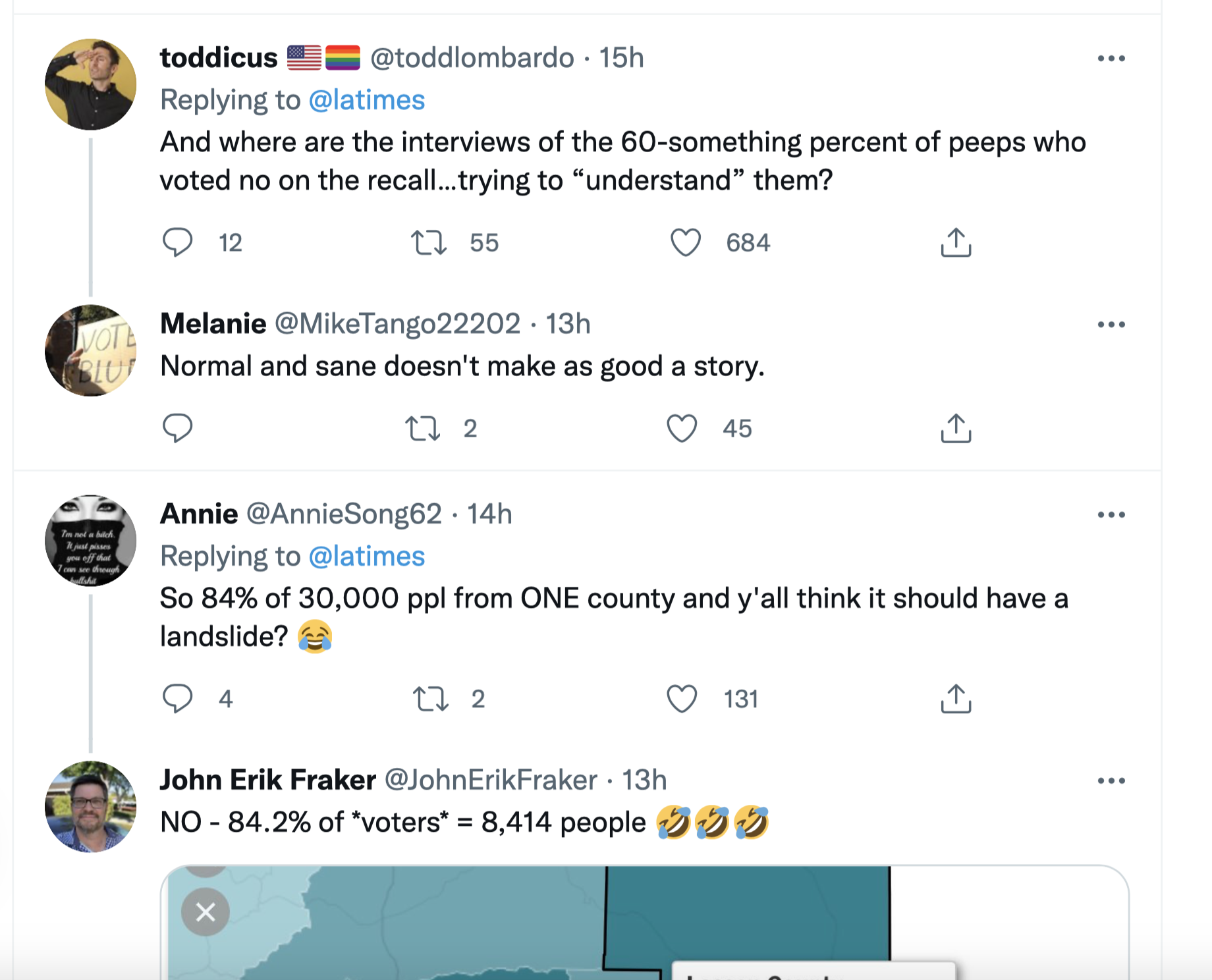
There was such fervor here in rural Lassen County — where a whopping 84% of voters supported the recall, the highest percentage in the state — that it was hard not to believe it could happen.

Then Newsom’s landslide victory landed like a kick in the shin with a steel-toed boot.
Ah, Branson-Potts is always great with the turn of (rural) phrase.  Here's more:  
“I went to bed really wanting to put a For Sale sign in front of my house,” said [Denise] Pickens, 50, as she sipped a chai tea latte outside Artisan Coffee in Janesville, population 1,400.

Once again, the votes of vast, rural Northern California, which overwhelmingly supported the recall, were drowned out by urban liberals, Pickens said.

“Part of me is just like, you know what, the Democratic progressive machine is what it is, and there’s just not enough of us,” she said.

Getting the recall on the ballot initially felt like a win here in Northern California, where conservatives have long felt they would be better off seceding to form their own state called Jefferson.

But there was no symbolic, emotional victory in forcing an election. The result was a walloping that displayed, in the harsh bright lights of a lopsided scoreboard, who is firmly in control of this state.

“The Democratic Party is the New York Yankees, and the Republican Party in this state is the Minor Leagues,” said Christopher Cole, the former chairman of the Lassen County Republican Party. “You can’t compete.”

The results — with Newsom prevailing 64% to 36% as of Friday — put California’s urban-rural divide on stark display. Every county in Southern California rejected the recall, as did the entire coast, save for tiny Del Norte County in the state’s northwest corner.

By the way, Hailey Branson-Potts' story attracted a lot of urban haters on Twitter, as you can see here and here.  I'm screen grabbing just two parts of that first thread to illustrate.  Many commenters asserted the Times should have talked to voters in San Francisco or Marin counties, where the vote against the recall mirrored Lassen County's vote in favor of it.  I admit I have no idea who the commenter (Charlee Ferry) is accusing of plagiarism and/or copyright infringement--Branson-Potts or some "yes" on recall supporter who Ferry assumes doesn't have original thoughts:


The LA Times story out of the Central Valley is focused on the LatinX.  The headline is "The Central Valley gives California a recall rarity: a squeaker of a race."  An excerpt follows: 

In 48 of California’s 58 counties, from Oregon to the Mexico border, voters either loved the guy or hated him, with double-digit differences on Saturday afternoon between the yes vote and the no.

Except for one small island in the middle of this vast state, where the recall election was a nail-biter.

Here in the agricultural heart of California, where the drought weighs heavy and the pandemic even heavier, the results were nearly 50-50.

In Merced County, the recall lost by 38 votes. In Fresno County, where the population just crested a million, it won by fewer than 2,000, according to an updated count released by local election officials Friday afternoon.

In both counties, that amounts to one percentage point or less separating yes and no.

Both sides here are claiming victory and both point to Latino voters as an important part of their success. Ballot counting continues throughout the state, and little will be known for sure until the vote is certified in just over a month. The political picture could shift at the county level.

But a few things are clear. The recall failed dramatically statewide. And demographics are destiny.

“The proportion of Latinos [in the Central Valley] is rapidly growing, and to the extent that Latinos have been showing a preference for the Democratic Party, it is an indicator of a strong future for the Democrats,” said Thomas Holyoke, a professor of political science at Fresno State University. “But the Latino vote breaks apart. ... The early returns from the recall show that a lot of Latino men backed the recall.”
Oddly, La Ganga and Chabria paid no attention to urbanization--to the fact that Fresno is the state's fifth largest city, though it did mention Clovis, Fresno's upmarket but smaller sister city.  Perhaps eventually we'll see analysis of Fresno City v. Fresno County voters.  

The journalists also paid no attention to education level.  I would also think that the presence of UC Merced, the youngest of the University of California schools, and the attendant influx of a more highly educated populace would be worthy of note regarding the vote there.  

My earlier post about the California recall vote is here.  

Wednesday, September 15, 2021

Rural-urban in the California recall

The county-level map on the California gubernatorial recall has shifted somewhat this morning compared to last night.  Two big counties that flipped over night:  Placer and Fresno counties.  

As of about 10 pm last night, Placer County, suburban and exurban Sacramento and extending east to Lake Tahoe, was "no" on the recall, but this morning it is "yes" by a margin of 51-49%.  Other counties that shifted overnight include Inyo in the eastern Sierra, with "yes" votes now at just over 50%.  With the exception of Merced County, where the vote was "no" by a margin of about three dozen votes, and San Joaquin County, just south of Sacramento County, where "no" prevailed by a margin of 56% to 44%, the entire Central Valley stretching south from Sacramento, was "yes" on the recall.  The margin in Fresno County was especially narrow, with the "yes" vote prevailing by less than 100 votes out of 180K cast.  This region, while not entirely rural in terms of population density/sparsity, is widely referred to as rural because of its ag-centric economy.  

Another notable commentary on the rural-urban divide in the California recall vote is that all of the state's coastal counties were "no" on the recall except Del Norte County, at the Oregon state line.  I suppose that suggests rural gentrification in many of these sparsely populated communities, including Humboldt and Mendocino where the margins in favor of "no" were quite robust.  That is, city folks who lean left may be moving to these places in greater numbers, driving up property prices and shifting the electorate to the left.  

The so-called Gold Country/Motherlode was consistently "yes" on the recall, which was to be anticipated.  The widest margin among these counties was Amador County, just southwest of greater Sacramento, where the margin was 63% to 36%.  The state's Inland Empire was "no" on the recall with varying degrees of strength, with more support for recalling Newsom in Riverside and San Bernardino counties than in more heavily Latino/a Imperial County.  

Regarding the recall's outcome, Jonathan Martin observed in today's New York Times,  

Mr. Newsom found success not because of what makes California different but because of how it’s like everywhere else: He dominated in California’s heavily populated Democratic cities, the key to victory in a state where his party outnumbers Republicans by five million voters.  (emphasis added).  

Tuesday, September 14, 2021

Photos of rural California in NYTimes recall coverage

I am loving that photos of Ferndale, Eureka, and Garberville, California, are all included in the New York Times rotating photos in its recall election coverage.  Ferndale and Garberville, in Humboldt County in far northern California, are particularly rural.  Eureka is the county seat of Humboldt County, population 132,000, which voted "no"on the recall.  This may defy some expectations because Humboldt is a rural region.  On the other hand, it is coastal, and the only coastal California county that voted in favor of the recall is the only one north of Humboldt, Del Norte County on the Oregon state line.  

I note that these photos were taken by Alexandra Hootnick, and I thank the New York Times for dispatching the photos or buying them from her as a freelancer.  Doing so signals rural inclusion by the "gray lady."  

Other Legal Ruralism posts about Humboldt County are here.  

Saturday, August 28, 2021

Coronavirus in rural America (Part CXLVIII): cases spiking in far northern California

Hailey Branson-Potts reports in today's Los Angeles Times from Crescent City, population 6,676, the county seat of Del Norte County, where California meets Oregon and the Pacific Ocean.   Here's an excerpt:  

Cumulative coronavirus cases [in Del Norte County] have more than doubled over the last three months, from 1,380 confirmed on May 10 to 2,805 on Friday. At least 70 cases were confirmed Thursday alone.

The county of 27,800 people has one hospital, the 49-bed Sutter Coast Hospital in Crescent City. The next-closest in California is a 90-minute drive south in Humboldt County — over a stretch of Highway 101 called Last Chance Grade that is crumbling into the sea.

The state has sent extra doctors, nurses, X-ray technicians and respiratory therapists to the overwhelmed Sutter Coast Hospital, and 40 ventilators have been ordered, [State Senator Mike] McGuire said.
* * *
Like many facilities in rural regions, where it can be hard to recruit professionals, Sutter Coast struggled with staffing shortages even before the pandemic. Now, [Sutter Coast Chief Executive Mitch] Hanna said, that deficit is exacerbated by doctors and nurses falling ill with the virus.
Just 35.8% of Del Norte County's population is vaccinated, compared to 56.3% of Californians.  Meanwhile, 83% of the hospital's new COVID-19 patients have been unvaccinated.  
Earlier this month, more than 100 doctors in Del Norte and neighboring Humboldt County signed a letter pleading for residents to get vaccinated.  
The letter said:  
As your physicians, and as the people with whom you have worked, played, laughed and cried, we must admit we are tired,” it said. “We will keep working, of course. But we are tired. We are tired of the suffering, pain and death that can be avoided by getting vaccinated.

A recent post about high hospitalization rates in six rural northern California counties is here.  To this list, Branson-Potts' story adds the counties of Amador, Plumas, Shasta and Placer.  

Friday, August 20, 2021

Coronavirus in rural America (Part CXLVI): six rural California hospitals exceed winter COVID19 surge

Kristen Hwang reports for Cal Matters:  

Hospitals in six rural California counties — all in remote, northern parts of the state — are now treating more COVID-19 patients than ever, breaking records by exceeding their winter surges.

Driven by sharp spikes in infections and low vaccination rates, COVID-19 patients hospitalized in Del Norte, Tuolumne, Lake, Humboldt, Nevada and Mendocino counties have more than tripled in the past five weeks, according to a CalMatters analysis of state data.

All six are experiencing record highs — more hospitalizations than at any other time since the pandemic began. Another three counties — Amador, Placer and Shasta — have similar numbers of hospitalized COVID patients compared to their winter surge.

These sparsely populated counties have limited hospital beds and staffing for intensive care units. Del Norte and Lake counties had zero ICU beds available as of Wednesday, according to the state data. State public health officials on Monday issued an order requiring hospitals statewide to accept transfer patients from facilities with limited ICU capacity.

Adventist Health Sonora, the only hospital serving Tuolumne County’s 54,000 residents, has already run out of room for its most severely sick patients.

Thursday, June 17, 2021

Not all of rural California has been moving rightward, at least not compared to the last gubernatorial recall

This map, published in today's Los Angeles Times, shows the Democratic vote share in the elections of  Gavin Newsom (2018) compared to that of Governor Gray Davis (2002).  The 2003 recall of Davis was successful, installing Arnold Schwarzenegger as California's first Republican governor in a while.  Golden State voters will decide this fall whether to recall Newsom. 

In any event, this map of how folks voted for Governor in 2018 compared to 2002 suggests a left-ward political migration in some surprising places in rural California.  The places that look more Democratic leaning in 2018 than in 2002 include Siskiyou County in the far north, a hub of the State of Jefferson movement.  Other places where Newsom had more support than Davis include much of the Great Central Valley, Del Norte, Trinity, Humboldt, Mendocino (the Emerald Triangle--then an illegal pot growing region, now a potentially legal one), and also the Eastern Sierra and the Inland Empire.  

The only places trending right-ward between the Davis election and the Newsom election are the Gold Country foothills east of Sacramento (El Dorado, Amador and Calaveras counties), Lake County, and a cluster of counties in far northern California including Shasta, Tehama, Plumas, Lassen and Modoc.  The latter, along with the Gold Country, have become strong holds of the State of Jefferson, as the movement has crept southward.  Again, that's in contrast to Siskiyou County, a traditional State of Jefferson stronghold.  

Thursday, April 1, 2021

On rural lawyering--before and during the pandemic

Earlier this week, I was delighted to welcome 11 lawyers (10 of them UC Davis Law school alums) to my Law and Rural Livelihoods class to talk to the students about their careers and practices.   Four are in private practice, two work in county counsel offices, one is a tribal court judge, and the others do a range of public interest work.  They came to us (virtually, of course) from as far away as Del Norte County on the Oregon state line and as far south as San Luis Obispo County (SLO), specifically the communities of Atascadero and Avila.  

Here are just a few of the takeaways from the conversation. 

  • Physical geography matters/can be a barrier:  The "grade" b/w "north county" and "south county" in San Luis Obispo County is significant for many who live there.  Folks in "south county," e.g., San Luis Obispo, Arroyo Grande, don't like to travel the grade, for example, to reach an attorney in "north county," and vice versa.  The attorney in Ukiah, the county seat of Mendocino County, said the same phenomenon (aversion to a "grade") applied there, as between Ukiah and Willets, where there was formerly a courthouse.  
  • One attorney practicing in Avila, in SLO County, shares an office with her husband, a vineyard manager.  They have converted the office of an old plant nursery for this purpose.  
  • The pandemic brought a 3- month closure to activity in the SLO County.  Then requirements to notice everything twice were imposed.  Now more people are "showing up" for hearings because they can hop on Zoom.  Previously, they would have had to take a half a day (at least) off work to come to the court house. 
  • A big issue for estate planning attorneys in rural areas is how to divvy up farm and ranch land; what is a fair way to allocate that sort of wealth?
  • The number of appearances by out-of-county attorneys in Lake County has risen since the beginning of the pandemic. 
  • A public interest attorney working in the Sacramento Valley said she deals mostly with wage theft issues.  
  • A tribal judge talked about the resources he has to allocate to support entire families, not just to "throw the book" of punitive criminal law at them. 
  • There is no e-filing in Humboldt County, and it has only recently begun in Mendocino County.  
  • In the "emerald triangle," nearly every matter that comes in is touched in one way or another by the marijuana trade/marijuana growing business.  
  • Public interest attorneys who serve several rural and frontier counties from a relatively urban locale, e.g., Redding, Eureka, have seen some benefits from digital access to legal services for those living in more remote parts of their service area.  This is because those living hours from the legal aid office are not nudged out by those who live much closer and don't have to get up as early to get in a physical queue.  When all consultations are online, those living in remote and distant locales--assuming they have adequate internet/broadband connections--have equal opportunity for access with those living just down the street from the regional/relatively urban office.