Showing posts sorted by relevance for query disability. Sort by date Show all posts

Saturday, March 5, 2022

Are findings of disability in rural areas on the decline?

The headline in the Athens (Georgia) News Courier is, "Disability claims challenging in rural areas; data shows low approval rates."  The story is from last October, though it just showed up in my Twitter timeline yesterday.  Here's an excerpt:  
Getting approved for disability payments from the Social Security Administration isn't easy, but depending on where you live, it could be even harder.

In North Alabama, for example, three of the judges who hear disability claims have the lowest approval record of any administrative law judge in the state; two of them also have among the lowest approval rate of any of the 12,000 judges nationwide.

In 2020, 39% of initial disability applications were approved nationwide, according to SSA data. August 2021 data shows that Alabama has the fourth lowest disability claim approval rating — 32.3% — while nationwide data shows a 41.7% approval rate.

Receiving disability payments isn't easy to begin with and that's by design. In the past decade, the Social Security Administration has changed the regulations to make it harder to get disability claims approved.

Social Security has a tight definition of disability: "the inability to engage in substantial gainful activity (work) due to a medically determinable physical or mental impairment that has lasted or is expected to last at least one year or to result in death," said Patti Patterson, regional communications director for the Atlanta region Social Security office, which represents Alabama and seven other Southern states.

The Social Security Disability website lists a range of impairments and disorders that could qualify for disability including mental, respiratory system, immune system and cardiovascular system if it is deemed through medical records to be severe enough to prevent one from working. 
Many disability applicants think they'll only need a letter from their doctor saying that they need to be on disability. Not only has it never been that simple, but in 2017, the Social Security Administration made it even easier to dismiss the recommendation of doctors by allowing denial due to the doctor's specialty, and length of treatment and type of treatment, among other factors.

Rachael Henderson of Georgia Legal Services Program, which represents disability clients in 155 counties outside of metro Atlanta, said access to transportation has been a longstanding barrier in rural counties where its clients have tried to get disability.

“In rural areas you will frequently not have any physicians. Over the last few years in some of our rural areas, in one or two counties, they lost the hospitals,” she explained. “You have to get to a city of significant size in order to get to a physician."

You'll find lots of other posts about disability determinations in rural places, and associated issues, here.  Certainly, this article flies in the face of the assumption that it is easier to get adjudicated as disabled in rural America than in urban America.  Specifically, here is a post focused on disability and transportation, in the context of New York.  And this is from a Washington Post series in 2017.  

Monday, June 5, 2017

So much rural news (most of it depressing), so little time to blog

National media have featured some big rural headlines in recent weeks, including the one from the Wall Street Journal that I highlighted in my last post.  Since then, the Washington Post published this piece a few days ago on intergenerational disability and intergenerational poverty.  It is part of a series by journalist Terrence McCoy on disability in rural America.  The first installment of the series is here, and in it McCoy observes:
The rise in disability has emerged as yet another indicator of a widening political, cultural and economic chasm between urban and rural America.
The family featured in this most recent piece about the intergenerational nature of the disability designation (for SSI purposes) is in rural southeast Missouri, in Pemiscot County.  The headline is "Generations, Disabled."  One compelling blurb is "a family on the fringes prays for the 'right diagnoses.'"  Indeed, in the family that McCoy depicts, the 10-year-old twins' diagnosis as disabled--or, more precisely, their retention of that diagnosis--is what will permit the family to pay the bills, which McCoy itemizes in excruciating detail (and with an implicit invitation to judgment?).   

I want to note that while McCoy suggests that academics don't pay attention to the intergenerational nature of disability, I would say it often accompanies persistent poverty (as is the case with Pemiscot County), and a number of  rural sociologists, demographers and economists do attend to those places marked by intergenerational poverty as a particular phenomenon--and, of course, a particular challenge for policy makers.  (This blog features lots of entries about persistent poverty counties, not least because my home county is one such place).   I would be interested to see a persistent poverty map overlaid by a map showing the counties with the highest rates of disability.  I suspect it would reveal a great deal of overlap.

Among many observations I might offer about McCoy's Pemiscot County piece is that it reminds me of the character Pennsatucky in "Orange is the New Black," whose childhood was depicted as one in which her mother would get her jacked up on Mountain Dew before taking her into the social services office, with the goal of getting more money for a child "with issues." Indeed, McCoy's earlier installment on disability has a Mountain Dew angle (look for it in one of the photos, as well as in the text).  

This latest disability piece (the one set in the Missouri boot-heel) is classic Terrence McCoy, who last year published this much-read and lauded piece about a child who accidentally shot his sibling in rural Alabama--but also about how the family was getting by in the aftermath.  McCoy's stories typically include lots of dialogue between/among family members (less, if any, of what they say directly to McCoy), which essentially permits them to tell their own story.  In some ways, that's a good thing, but I'm not sure the average reader is well positioned to put the dialogue in context, and I can't help wonder if McCoy's style actually invites harsher judgments from readers than if he synthesized and paraphrased more.  He certainly has an uncanny ability to get the subjects of his stories to trust him with theirs.  The end products are these raw, open books on the lives of people living tragedy, which is akin to what I recently saw referred to as "decline porn." But McCoy's revelations are at the individual and family levels, less at the community level.  Indeed, you could say these stories constitute what I've seen referred to as poverty porn.  Speaking of poverty porn, the photographer who has worked with McCoy on these disability stories, Bonnie Jo Mount, has an incredible eye; her images are nothing short of searing (though, again, I fear also damning).  The combination of McCoy's prose and Mount's photos is like taking in a documentary film.  (Indeed, this piece about inter-generational disability reminded me of the 2014 documentary, Rich Hill, set in Southwest Missouri). 

The details of the Missouri family aside, McCoy provides hard data, too, on disability as a rural phenomenon:
How to visualize the growth in disability in the United States? One way is to think of a map. Rural communities, where on average 9.1 percent of working-age people are on disability—nearly twice the urban rate and 40 percent higher than the national average—are in a brighter shade than cities. An even brighter hue then spreads from Appalachia into the Deep South and out into Missouri, where rates are higher yet, places economists have called “disability belts.” The brightest color of all can be found in 102 counties, mostly within these belts, where a Washington Post analysis of federal statistics estimates that, at minimum, about 1 in 6 working-age residents draw disability checks.
Here is a sharp critique of McCoy's reporting from Talk Poverty, which argues that it gives cover to Trump's proposed budget cuts by depicting a "culture of disability."  Here's an excerpt from Rebecca Vallas' piece, which notes that Annie Lowry, Gene Sperling (formerly of the National Economic Council), and Matthew Yglesias also sharply criticized it. 
Like the first article in The Post’s series, the latest story willfully ignores the reality of Social Security disability benefits, instead relying on flawed data and flowery writing and anecdotes to paint a cartoonish picture of rural America overtaken by a “culture of disability.” As my colleague Kate Gallagher Robbins pointed out on Twitter, the piece reads like a work of fiction. It even opens with a stage-setting mini-story practically ripped from Of Mice and Men, in which a child accidentally drops and nearly kills his new puppy.

Notably, where the piece does introduce evidence beyond richly woven anecdote, what evidence it includes contradicts The Post’s narrative.
Meanwhile, on other rural fronts, I've continued to blog about rural disadvantage and rural poverty (among other issues) as a guest blogger over at Concurring Opinions.  This post over the week-end discusses rural-proofing laws in relation to rural labor markets, with embedded links to stories about proposals in Arkansas and Maine to make receipt of Medicaid contingent on work.  Many states already make the receipt of food stamps (SNAP) contingent on work or job training or volunteerism--at least for able-bodied adults.  As I have highlighted on numerous occasions, such programs do not tend to work well in rural places, where labor markets are typically weak and the lack of economic diversification results in a narrow range of available jobs, and where child care and transportation infrastructure are inadequate to support would-be workers.  See more details in the Concurring Opinions post.  

On a more optimistic note, the New York Times published this piece by Patricia Cohen last week, "Immigrants Keep an Iowa Meatpacking Town Alive and Growing."  The story is about how immigration is remaking--and in so doing, also saving--places like this corner of northwest Iowa. The dateline is Storm Lake, population 11,000, and here's an excerpt:  
The union is long gone, and so are most of the white faces of men who once labored in the broiling heat of the killing floor and the icy chill of the production lines. What hasn’t changed much is Mr. Smith’s hourly wage, which is still about $16 an hour, the same as when he started 37 years ago. 
* * *
Fierce global competition, agricultural automation and plant closures have left many rural towns struggling for survival. In areas stripped of the farm and union jobs that paid middle-class wages and tempted the next generation to stay put and raise a family, young people are more likely to move on to college or urban centers like Des Moines. Left behind are an aging population, abandoned storefronts and shrinking economic prospects.
So, this overview excerpt is not about Storm Lake, but rather about the rural America that is suffering these ills.  Storm Lake has been kept bustling by several generations of migrant streams not only from Latin America, but from around the world. Less than half of Storm Lake's population is non-Hispanic white, though 88% of Iowa's is. 

This story, too, is accompanied by some fabulous photographs, including one of the high school soccer team, a veritable human rainbow.  Cohen notes that 18 different languages are spoken among those who attend Storm Lake High.
   
Storm Lake, by the way, is the home of the Storm Lake Times and Art Cullen, who won this year's Pulitzer Prize for Editorial writing.  Read more here.  I wonder if that is how Cohen "found" or identified it as the subject of her story.

These offerings all represent really strong reporting on rural America from some of our most important national media outlets.  

Tuesday, March 26, 2013

Rising disability as a rural phenomenon

Chana Joffe-Walt reported this week as part of NPR's week-long series on disability in America.  Her piece was called "Unfit for Work," and in it she explored the concept of disability that garners for the designee a monthly payment from the federal government.  As Joffe-Walt explains, 14 million people now get a disability check from the federal government, adding up to more than the federal government spends annually on food stamps and welfare combined.  Joffe-Walt notes that people "on disability"--as the status is often expressed--"are often overlooked in discussions of the social safety net." But, she asserts, even though those on disability are not counted among the unemployed, the who, what and why of those "on disability" is very much a story about the economy.  What Joffe-Walt makes less clear is that it is a story about local economies as much as it is a story about the national economy.  Joffe-Walt sites her story in Hale County, Alabama, population 15,388, and her investigation takes her to consideration of that county's limited labor market and how those very limitations contribute to adjudications of disability because of the candidates' inability to find the sort of job that will accommodate their physical limitations.  Yet Joffe-Walt never talks about the ways that rural economies differ from more robust and diverse metropolitan labor markets, which may feature more jobs that are less physically taxing.  Thus Joffe-Walt never expressly discusses disability as a rural phenomenon.

Here's more from Joffe-Walt's "Unfit for Work" report:
There's no diagnosis called disability. You don't go to the doctor and the doctor says, "We've run the tests and it looks like you have disability." It's squishy enough that you can end up with one person with high blood pressure who is labeled disabled and another who is not.
I talked to lots of people in Hale County who were on disability. Sometimes, the disability seemed unambiguous.
* * * 
Other stories seemed less clear. I sat with lots of women in Hale County who told me how their backs kept them up at night and made it hard for them to stand on the job. "I used to cry to try to work," one woman told me. "It was so painful." 
People don't seem to be faking this pain, but it gets confusing. I have back pain. My editor has a herniated disc, and he works harder than anyone I know. There must be millions of people with asthma and diabetes who go to work every day.
* * * 
As far as the federal government is concerned, you're disabled if you have a medical condition that makes it impossible to work. In practice, it's a judgment call made in doctors' offices and courtrooms around the country.
Joffe-Walt goes on to interview a Hale County physician, Perry Timberlake, who is associated with many of the determinations of disability there.  She puzzles about the fact that, when making a disability determination, Dr. Timberlake always asks his patient, "what grade [in school] did you finish?"

Joffe-Walt continues:
What grade did you finish, of course, is not really a medical question. But Dr. Timberlake believes he needs this information in disability cases because people who have only a high school education aren't going to be able to get a sit-down job. 
Dr. Timberlake is making a judgment call that if you have a particular back problem and a college degree, you're not disabled. Without the degree, you are.  
Over and over again, I'd listen to someone's story of how back pain meant they could no longer work, or how a shoulder injury had put them out of a job. Then I would ask: What about a job where you don't have to lift things, or a job where you don't have to use your shoulder, or a job where you can sit down? They would look at me as if I were asking, "How come you didn't consider becoming an astronaut?"
Later in the story, Joffe-Walt illustrates the point by referencing job openings in Hale County:
Occupational Therapist, McDonald's, McDonald's, Truck Driver (heavy lifting), KFC, Registered Nurse, McDonald's.
In other words, there aren't many desk jobs in this corner of Alabama, especially for those who are poorly educated. Joffe-Walt discusses the impact of education level and the changing labor economics landscape on this disability phenomenon, but she fails to grasp--or at least does not articulate--the difference that geographic context makes. (I note this oversight, even as she references one of her earlier stories about rural restructuring, featuring the closure of a lumber mill in Aberdeen, Washington, in micropolitan Grays Harbor County). 

In any event, this entire story is worth a listen, not only for what it (and the rest of the week-long series) reveals about the disability phenomenon, but for what it reveals about various aspects of rural disadvantage, most specifically education levels and job markets.

I have noted elsewhere that courts considering applications for benefits such as unemployment sometimes expect claimants to move from rural to urban areas because they are more likely to be employable in the latter.  Some cases adjudicating this and related issues include Parsons v. Employment Sec. Comm’n, 379 P.2d 57, 59, 61 (N.M. 1963) (finding that if no “labor market” exists for petitioner’s job skills in rural area, she may collect unemployment and is not required to move to an area with more work opportunities) and Mohler v. Department of Labor et al., 97 N.E.2d 762 (Ill. 1951) (holding that several elderly women in rural Illinois were not "available for employment" as required by the state's unemployment benefits scheme; court found women "detached from the labor market ... because there are no labor opportunities where they reside, but in addition there are no transportation facilities to a place of employment where opportunities exist"; the women had previously worked at a cannery in their town, but only seasonally because the cannery operated only seasonally).

I wonder if judges adjudicating claims for federal disability ever go down the path of holding the limited nature of an applicant's labor market against the applicant, implying that s/he should move to where jobs are available.  I have not seen that in a case yet ... but then I haven't gone looking for it either.

Monday, March 13, 2017

Living with a disability in rural America (Part II): adults and employment

As a follow up to my last blog post on children with disabilities in rural America, I decided to explore some of the employment challenges faced by adults with disabilities in rural areas.

This is not the first time disability and employment have been discussed on this blog. Some of you may have read Lisa Pruitt's 2013 post discussing NPR's "Unfit for Work," a piece that explored being "on disability," as the phrase is often used. Being "on disability" means that the individual no longer works, but instead, receives a monthly payment from the federal government in lieu of a paycheck. In NPR's story the reporter highlights Hale County, Alabama, a rural area where (at the time of this story) nearly 1 in 4 working-age adults received federal disability assistance.

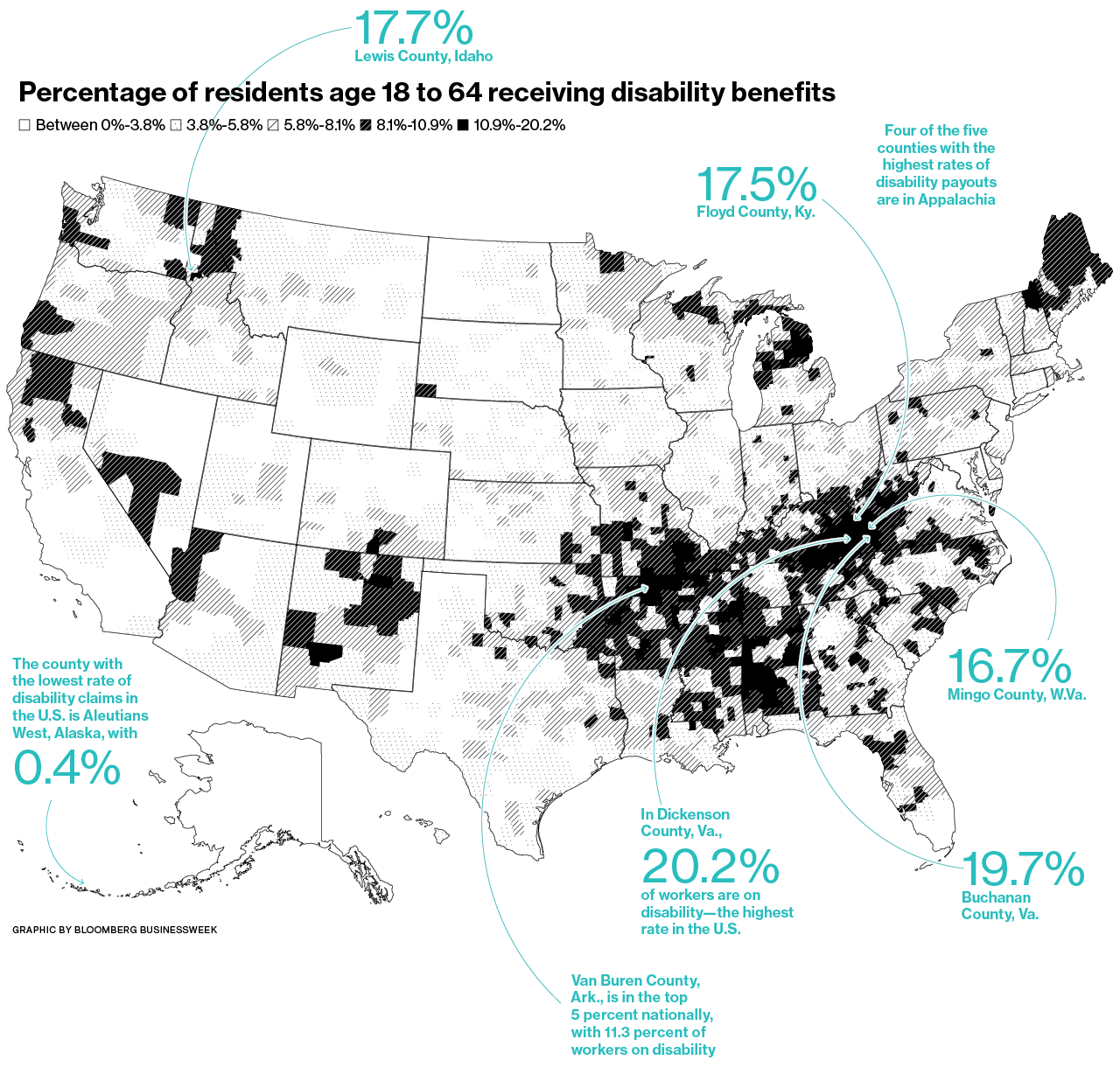
A more recent article from Bloomberg Businessweek highlights the current geographic distribution of people receiving disability benefits. This map (shown below) notes the emergence of "disability belts" in rural areas that include: Appalachia, the Deep South, and the Arkansas-Missouri border.

Credit: Bloomberg Businessweek
Another visual provided by the American Community Survey reports that for people who self-identify as having a disability (not necessarily those who receive federal disability assistance) the national disability rate is estimated to be 12.4%, while the rate in rural counties is estimated at 17.7%.
Credit: University of Montana Rural Institute 
Although an aging population may partially explain the higher disability rate in rural counties, the University of Montana's Rural Institute notes that disability rates are generally higher in rural areas across all ages and impairment types. One researcher posits that these numbers may be explained by the higher rates of injuries, limited emergency responses, and less access to preventative and primary health care in rural settings.

After reviewing these statistics, I wondered: what barriers do adults with disabilities and transitioning adults (those leaving high school) encounter in seeking employment? For some people with disabilities finding employment can be a challenging and frustrating task, but for people in rural areas, this challenge is even greater. Generally speaking, rural students transitioning from school fall behind their urban peers in rates of employment and postsecondary education after graduation. So are transitioning students with disabilities in rural areas destined to be "on disability" when they reach 18?

When a student transitions from school, he or she can pursue a few different options. These options (which are not exhaustive) might include: post-secondary education, vocational training, independent employment, supported employment, or unemployment. For this post, I am going to focus only on employment.

Vocational rehabilitation agencies (VR agencies) are the state-supported offices charged with helping people with disabilities find employment. VR agencies often work with vendors to provide rural job services. Vendors are the individuals, private agencies, or community programs who connect people with disabilities to employment opportunities.

Depending on the state and the contract, a vendor might be paid in different ways, depending on whether their consumers (people with disabilities) meet certain milestones or benchmarks in their employment plans. A milestone, for example, might include getting placed with an employer or reaching 90 days on the job.

But according to the Rural Institute, the vendor options in rural areas are typically limited and some rural regions are not served by any vendors. Another common problem in rural areas is that vendors may have to work with "mom and pop" establishments that hire few employees. Securing these job opportunities can also be a longer process because the vendor will need to establish a relationship with the employer, and there may be fewer job openings. In contrast, vendors who work in urban settings have access to larger businesses, so once they establish a relationship with an employer they can secure more job placements for people with disabilities, which makes urban areas easier and cheaper to serve.

For students transitioning out of school, VR agencies report that maintaining connections with rural schools can be difficult because of the variation in the eligible student population and the large service areas of rural communities. Some VR employees may serve between 8-22 counties, limiting the amount of contact with each transitioning student. The Rural Institute notes that in these types of situations, it is best if the VR agency and local school can share the career counseling responsibilities. For example, a VR counselor might locate the student's job site, while the school supervises the student's job experience.

A lack of access or limited access to technology - like email - can impact communication between a VR worker and a person with a disability in a rural area. In some instances, the individual may not even be capable of using email, depending on the level and type of disability.

And finally, the absence of available and affordable transportation is a huge barrier for people with disabilities who work in rural areas. Support from family, friends, and other co-workers is most frequently cited as the primary transportation option for people with disabilities who do not have their own vehicle. Without this support system in place, it can be difficult or even impossible for a person with a disability to reach their employer.

For people with disabilities in rural places, the barriers to employment may seem insurmountable. Thus, the best pathway for success might be to provide transitioning students with disabilities with job opportunities and training before they leave school. But given the lack of resources and economic state of many rural communities, it is difficult to predict where and when these opportunities will arise.

Wednesday, July 5, 2023

Census Bureau reports rural residents more likely to experience disability

The U.S. Census Bureau reported last week on rural-urban differences in disability.  Here is the introductory material:   

Where people live may impact their ability to access health care services and for those with disabilities or who require specialized care that entails more frequent attention and medical visits, location can play an even more significant role.

It is important to understand how regional and urban/rural differences in disability contribute to the unique challenge of addressing health disparities in the United States. Identifying where people with disabilities are concentrated can help inform where there may be shortages of specialized providers or limited transportation options.

Examining disability rates across geography reveals notable differences between urban and rural areas, and regions.

In 2021, nearly 42.5 million people (13%) among the civilian noninstitutionalized population in the United States had a disability, according to the American Community Survey (ACS) 1-year estimates.
And here are the key findings re: rural-urban difference:
In 2021, the U.S. population was primarily urban, with 80.2% living in urban areas; 12.6% of them reported a disability in 2021.

Rural residents — less than 20% of the U.S. population — were more likely (14.7%) than their urban counterparts to experience disability.

Rural communities may be more geographically isolated and typically have more limited transportation and access to clinics and hospitals than urban areas. As a result, coordination of care for those with disabilities may be more difficult for rural residents due to these geographic and transportation barriers.

And here is what the report had to say about regional differences: 

In 2021, the South had the nation’s highest rates of disability (13.8%), followed by the Midwest (13.1%), the Northeast (12.3%), and the West (12.1%) (Figure 2).

Regional disability rates may differ for a variety of reasons. For example, disability is often associated with age, so regions that contain states with a higher proportion of the population age 65 and over may be more likely to report higher rates of disability.

Many states in the South are part of what is known as the Stroke Belt, defined by the National Heart Lung and Blood Institute as a cluster of states (including Alabama, Arkansas, Georgia, Indiana, Kentucky, Louisiana, Mississippi, North Carolina, South Carolina, Tennessee and Virginia) that have a higher incidence of stroke than the rest of the country.

Saturday, October 7, 2017

Part V of the Washington Post's series on disability and rurality: a focus on the informal economy

The latest in Terrence McCoy's series in the Washington Post about disability as a rural phenomenon appeared yesterday.  Here's one of the most salient excerpts from a story about Donna Jean Dempsey and her brother Bobby, in Mallory, West Virginia (population 1,654), in Logan County:
And where [Donna Jean and Bobby] were going was deep into the underground American economy, where researchers know some people receiving disability benefits are forced to work illegally after the checks are spent — because they can’t hold a regular job, because no one will hire them, because disability payments on average amount to less than minimum wage, sometimes much less, and because it’s hard to live on so little.
The underground economy has long been a part of rural America, but it has become vital in counties such as this one, deprived of the once-dominant coal industry and redefined by a decades-long swell in the nation’s disability rolls that, in its aftermath, has left more than 1 in 5 working-age residents in Logan County on Social Security Disability Insurance, which serves disabled workers, or Supplemental Security Income for the disabled poor.
Here's another excerpt that provides context for the Dempseys' "place" in that community:
Five miles below, in the hollow of Mallory, is a thin road lined with junk cars and mobile homes, several of which belong to Dempsey family members, who have lived here longer than nearly anyone, through everything that has happened. Seven of the 13 children died. The family house burned down. And Donna Jean, the eighth child, underwent one misfortune after another: rape survivor at 12, mother and illiterate dropout at 13, and, after years in special education, disability beneficiary at 22, the exact reason for which she can’t recall but summarizes as, “I’m not that smart, buddy. Kids made fun of me.”
The "everything that has happened" presumably refers, at least in part, to a 1972 coal slurry dam break here.  It is often referred to as the Buffalo Creek Flood, and it killed 125.

Separately, I see, on his Twitter feed, McCoy writes that Logan County is like no other place he has ever visited.

I see that Logan County, West Virginia's 15th largest county in population, is a persistent child poverty county, though not a persistent (general) poverty county.

The entire story is well worth a read, along with others in McCoy's series (the most recent, set in Roanoke, Alabama, is here).  I blogged about another story in this disability series here, and another here

Friday, July 21, 2017

Part III of Washington Post series on rural disability: Disabled and Disdained

The third part of Terrence McCoy's series on rurality and disability was posted this morning to the Washington Post website, and this one focuses on the disdain that rural community members often feel and express towards their neighbors who are receiving disability benefits.  I blogged about the earlier installments of the series here.

The dateline for this story is Grundy, Virginia, population 1,021, in the southwestern part of the state, coal country, Appalachia.  McCoy features the McGlothlin family, the matriarch of which receives disability--a $500 check each month for her anxiety and depression.  Her 19-year-old son Tyler is the family member who panhandles at a busy intersection 30 miles away from their home.  He does that when the cupboards are bare, as on one of the days when McCoy follows him:
Tyler would hold a sign on the side of the road and beg for money. He would go to a town 30 miles down the road and stand at one of the region’s busiest intersections, where he prayed no one would recognize him, to plead for help from people whose lives seemed so far removed from his own. 
To Tyler, the collapse of the coal industry had left two kinds of people in these mountains. There are those who work. And there are those who don’t: the unemployed, the disabled, the addicted, and the people who, like his family, belonged to all three groups. Those who work rarely mix with those who don’t, except in brief encounters at the grocery store, at the schools or, for Tyler, along the side of the road, where he knew he was likely to encounter acts of generosity as well as outbursts of resentment.
The other person featured prominently in the story is Dennis Hess, who had previously confronted Tyler's dad, Dale, for panhandling.  (Dale is now in jail for selling drugs).  After the elder McGlothlin, who also received disability benefits after working for 30 years as a coal miner, declined Hess's offer of employment, Hess stood by McGlothlin with a sign that said, "I offered him a job.  And he refused."  Hess also posted about McGlothlin on Facebook and soon many were criticizing him, with comments such as:
  • He is a lazy bum.  Im sorry if he can stand there outside and hold a sign he could work in some capacity..I have cancer and I’m ill but I work yet. 
  • Why don’t his wife get off her butt and get a job?  
  • I’M JUST TIRED OF BEING RIPPED OFF BY PEOPLE!
McCoy provides some context: 
Nearly two-thirds of rural Americans say it’s more common for irresponsible people to receive government help they don’t deserve than for needy people to go without assistance, compared with 48 percent of city residents, according to a recent Washington Post-Kaiser Family Foundation poll. Rural Americans are also more apt to say poverty is the result of laziness (emphasis added).
McCoy also quotes me, along with Jennifer Sherman, author of Those Who Work, Those Who Don't:  Poverty, Morality and Family in Rural America, about which I wrote extensively here.  Indeed, the sub-head for the Washington Post piece is "In rural America, some towns are divided between those who work and those who don’t."

Media treatment of work, industry, and laziness is so important in this era when liberal elites frequently focus on "privilege" and downplay the importance of work, which might be seen as synonymous with "merit."  As for me, well, I see more "merit" in work and industry  than I do in being born into the right family, the family that can afford for its children to do an unpaid externship rather than get a paid job, the family that can afford an SAT prep course but then see their child's academic success as the product of discipline and merit.  When elites poo poo the importance of work and tell whites that they don't get ahead because they work hard but rather because of the color of their skin, they are running seriously afoul of an ethos that sees work as king.

McCoy's story is a powerful one of the potent, even vitriolic clash between those who work and those who don't in rural America, and it's one in which the lack of anonymity that marks rural communities looms large.  Here are some telling quotes of Sheila McGlothlin, Tyler's mother, about her place in the community and the role of reputation:
“Once you get a name, you always got a name,” she had said the day before to a relative who also draws disability. “You can never disappear.” 
“The only way something dies on you around here is if the people dies out,” the relative had said. “I worked in the coal mines, and my nephews won’t even give me the damn time of day. Act like I’m going to steal something off them all the time because I ain’t got much.”
The piece is well worth a read in its entirety.   As usual, McCoy lets his subjects do most of the talking for themselves, using many direct quotes.  The photos, by Linda Davidson, are searing.

Wednesday, February 23, 2022

Aging and disability services unequally distributed along rural-urban axis

Here's the policy brief from Syracuse University's Lerner Center for Public Health, authored by Claire Pendergrast (Syracuse) and Danielle Rhubart (Penn State):  
As the U.S. population ages, demand for aging and disability services will increase, but 15% of U.S. counties have no aging and disability services organizations. This brief shows that rural counties and counties with the highest rates of poverty, highest shares of older adults, and highest shares of non-Hispanic Blacks are most likely to be aging and disability services deserts. To support healthy aging across the country, policymakers should invest in aging services infrastructure and should prioritize resources for places that are aging and disability services deserts.

And here is a related paper, also about aging and rurality, just published in the Journal of Rural Social Sciences, "Support from Adult Children and Parental Health in Rural America," by Shelley Clark, Elizabeth M. Lawrence, and Shannon M. Monnat.  The abstract follows:  

Adult children are a primary source of care for their aging parents. Parents in rural areas, however, live further from their adult children than parents in urban areas, potentially limiting the support they receive and compromising their health and ability to age in place. We use two waves of the Panel Study of Income Dynamics (2013 and 2017) to investigate the relationships among geographic proximity, adult children’s instrumental and financial support, and parental health. Rural parents live further from their adult children and receive less financial support, but they are more likely to receive instrumental assistance. In addition, rural parents have worse health and more functional limitations than urban parents, and these differences persist after controlling for proximity to and support from adult children. Our findings indicate that factors beyond proximity influence the complex relationships between spatial and social boundaries and their consequences for older adults’ health and well-being.

Monday, July 9, 2018

East Kentucky fraudster/lawyer Eric Conn leaves a trail of devastation among clients, as well as a great need for pro bono assistance

Some readers may have followed the story of Eric Conn, a major disability attorney in eastern Kentucky, who was indicted in 2017 on charges of defrauding the Social Security administration.  Conn fled house arrest in late 2017 (he cut off the ankle bracelet), only to be captured in Honduras and extradited to the United States.  Read more herehere and here.

An excerpt explaining who Conn is and what he did follow, this from Bill Estep's early June, 2018 story in the Kentucky Herald-Leader:
Conn admitted he took part in a scheme to submit fabricated evidence to Social Security on behalf of clients he represented seeking disability benefits. 
The scheme would have obligated Social Security to pay more than $600 million over the life of the beneficiaries, according to the charges. 
The agency actually paid out $72.5 million on the claims before the fraud came to light. Conn could be ordered to pay that much in restitution. 
He already owes millions in restitution in various cases, as well as a $5.7 million judgment to the U.S. Department of Justice that it has not been able to fully collect. 
Officials have said Conn’s scheme was the biggest fraud in the history of Social Security, involving thousands of cases.
Conn colluded with an SSI judge (who was paid $400/case), as well as medical professionals, to achieve the disability determinations.  Others involved in the scheme have already been tried and found guilty, or they have entered guilty pleas.

Ned Pillersdorf, an attorney in Prestonburg, population 3,255, has represented a number of Conn’s former clients in the wake of discovery of the fraud.  Pillersdorf speculates that not all of the clients had "legitimate claims," though many did.  The files of some clients included false evidence that the clients likely did not know about.

Estep quotes Pillersdorf, who makes a stunning revelation about the number of clients who had never even met Conn:
Unfortunately Conn's outrageous antics has [sic] resulted in the SSA politically posturing by targeting more than 3,500 of his vulnerable former clients with loss of benefits for the crime of guilt by association. The irony is there was no association—in that in my three-year involvement in this continuing crisis, I've yet to meet the first former Conn client who met him. 
This introduces the crisis that is unfolding for many of Conn's clients.  Here's what attorney Pillersdorf wrote in an op-ed in the Kentucky Herald-Leader in mid-June, on the occasion of the Kentucky Bar Association's Annual Meeting.  Pillersdorf writes of the current state of affairs re: Conn:
The Social Security Administration intends to put another 1,950 former clients of Conn — who pleaded guilty to fraud this month — through another set of grueling mass hearings. 
The first set of hearings have been brutal, in that more than 800 of the 1,500 hearings resulted in our neighbors losing their subsistence benefits and being told they each had to pay back about $100,000 for alleged over-payments. We’ve had suicides, attempted suicides, panic attacks, spikes in homelessness, etc. The new round of hearings is equivalent to a nuclear bomb hitting the mountains. 
The challenge throughout this ongoing humanitarian crisis is that the SSA prevents lawyers from earning attorney fees for doing the hearings. Indeed accepting a fee can have negative consequences for your ability to practice before the SSA. We have been blessed in the first round of hearings that we found more than 100 volunteer lawyers to represent more than 1,000 former Conn clients. 
Without being asked, should the powers that be in the Kentucky Bar Association have contacted the volunteer lawyer network and asked what they could do to help? It is an interesting question. 
Regardless, we did not wait for them to ask. We requested, and thanks to KBA President Bill Garmer, we have been granted a session at this week’s convention to train and recruit lawyers. This is the good. 
The not-so-good is the reaction of the bar to the recent stunning revelation that thousands of former client files still sit in Conn’s law office that was seized a year ago. The association has the discretionary authority to request that the Supreme Court appoint a special commissioner to distribute the files to the clients prior to mass hearings. The response to our request for such an appointment was that we need to make other arrangements. So much for looking out for the rights of the least among us in their time of crisis. 
I can’t help but think that the unwillingness to assist the former clients was fueled by negative stereotypical views about those who collect Social Security benefits as well as their unfortunate association with the notorious Conn.  [On that theme, read more here]
Indeed, it is not only disabled folks in Eastern Kentucky who are subject to negative stereotypes.  The region is one of the most densely persistent poverty region in the nation, perhaps second only to the Mississippi Delta, as illustrated by this map.

And I, for one, have come to conclude that we have no more empathy--and perhaps less--for poor whites than for poor Blacks.

An e-mail plea that recently went out via a Kentucky lawyer friend of mine reads:
I am writing you as the past Director of Appalred in Kentucky, and of counsel to a local Prestonsburg, KY firm (Pillersdorf, De Rossett and Lane).

I am writing for volunteer attorney help. 
You may remember that local attorney Eric Conn has pleaded guilty to engaging in a fraudulent scheme with ALJ Daugherty to approve several thousand applications for Social Security Disability benefits. As a result, all the affected individuals were/are being noticed for hearings to review their disability status. In the first round we (Appalred, NOSSCR, and various other helpers) recruited 153 volunteer attorneys around the country to help these claimants with their hearings. The hearings were conducted by video. It was a huge effort. Appalred took over 200 of these cases. And several attorneys took 25 or more. About half of the claimants “won” their hearings and so about half lost. The “win” percentages of those who were represented was substantially higher than those who were not. 
The “first round” of these hearings involved about 1900 cases. The SSA has announced that there will be about 2000 more in Round 2 . We are hopeful that the lawyers who helped us in Round 1 will help in Round 2, but there is a fair amount of work involved in preparing these cases, so some of the lawyers may drop out. Additionally, there is currently an appeal pending in the 6th Circuit Court of Appeals which challenges the limitation on the evidence that was permitted to be introduced at the hearings. Based on the reaction of the Judges at the oral argument, we feel somewhat confident that the appellants (our clients) will win and that this will result in a remand of several hundred cases for new hearings, so the lawyers who handled those hearings the first time around will have plenty to do. 
There are Training Videos on the Appalred website, www.ardfky.org (Legal Information and social Security tabs) 
The result is that we need your help in recruiting more volunteer lawyers for the next round of hearings, currently slated to start in July and August, and to continue on probably throughout the next year or so. I will be glad to talk with any of you to discuss this further, and to obtain your suggestions for how to recruit more lawyers successfully. Or you can contact Appalred’s Pro Bono Coordinator, Mary Going, directly by calling 606-886-3876 Ext. 1315, or by email, maryg@ardfky.org or with me by phone at (606) 886-8851 (preferred); 606-422-4484 (cell); or e-mail, jandjrose@suddenlink.net. Thanks in advance. John Rosenberg
If this doesn't illustrate the need for more rural lawyers generally, as well as good rural-urban attorney networks, then I don't know what does.  Here is my prior post on that very topic.

Sunday, February 26, 2017

Living with a disability in rural America (Part I): children

In this series of blog posts, I will highlight a few of the many challenges faced by individuals with disabilities who live in rural areas. This post will focus on children with disabilities.

A Brief History of Disability in Schools
Prior to 1975, children with disabilities were often absent from public school settings. In 1970, schools educated only 1 in 5 children with disabilities and many states had laws preventing children with specific types of disabilities - like deafness, blindness, cognitive, and emotional disabilities - from attending public schools.

In 1975, the Education for All Handicapped Children Act was the first federal statute enacted to ensure that children with disabilities had access to education and due process rights. Today, federal laws like the Individuals with Disabilities Education Act (IDEA) and the Americans with Disabilities Act (ADA) (although not without their own flaws) provide children with disabilities important rights, including the right to receive a free and appropriate education and the opportunity to physically access and participate in a school setting.

But even though the United States has come a long way in providing civil rights for children with disabilities, these children still face many challenges, some of which are unique to rural areas.

Access to Treatment and Intervention
Recently, The Atlantic touched on some of the challenges that families of children with autism face in small towns. In the article, reporter Ann Griswold focuses on a family who lives in rural Madrid, Iowa. The family's daughter, Izzy, was diagnosed with autism at age 3 and has behavioral difficulties both at school and at home. Because Izzy's family lives in central Iowa, they have fewer options for services like therapy, school, and pediatricians. For example, applied behavioral analysis (ABA) therapy is often recommended to improve behavior for children with autism. But ABA therapy requires frequent contact between the therapist and child, and these providers may be located hours away, as they are for Izzy's family.

Under the IDEA, schools are responsible for providing the educational services and supports that children with disabilities need. But in reality, this may not be possible if there aren't any service providers (like speech therapists, occupational therapists, or psychologists) available.

Some universities, like the University of Iowa, are researching the effects of telehealth services (interactive video conferencing) to deliver therapy services to children and families with autism. The results are promising, but it is too early to tell whether this will prove to be a truly rural option over time.

Funding for Medical Services
Even though children with disabilities may be able to access some therapies and medical services through their local schools, these services alone may not be enough, or the child may be too young to receive the services through their district. So many families rely on in-home intervention services for their infants and toddlers with disabilities. Some states cover the costs of these treatments through Medicaid, but when these programs are cut - like they recently were in Texas - rural families are often left without alternatives.

Facilities like the North Texas Rehabilitation Center, which serviced 10 north Texas counties for 30 years, have been forced to close their early childhood intervention programs because they cannot continue to operate without Medicaid reimbursements. Moreover, if the Affordable Care Act is repealed, the children with disabilities who live in states where home therapies and early interventions are currently covered may also be left without alternatives.

Community and Social Support
Even though children with disabilities are likely to attend their local school district and often have the opportunity to participate in community activities, these families and their children may still feel like outsiders in their own community. As Griswold writes:
[a]lthough getting a diagnosis [of autism] has helped, it does not change one brutal fact of geography: People in the small town have little experience with autism....Izzy's erratic behavior has left the family feeling emotionally disconnected from their community.

A rural child with a disability, like autism, may be the only one in her grade or even in her school. Izzy's mother says that sometimes she thinks about moving to a place where there are more opportunities for her daughter and chances to meet other families in similar situations. But Izzy's father likes the fact that in Madrid, people know who they are and the family feels safe in their surroundings.

And it does not help families like Izzy's when national political leaders like Jeff Sessions publicly attack the federal law that affords children with disabilities these civil rights, or when Besty DeVos reveals that she does not fully understand what the IDEA is. These statements do not set an example of inclusion, tolerance, or understanding for people with disabilities.

This discussion leads me to my next question: given the challenges that rural children with disabilities face, what kinds of opportunities will be available to them when they become adults? My next blog post will examine the historical treatment of adults with disabilities in rural areas and the challenges they face today.

Friday, June 27, 2014

Persistent (rural) poverty featured in the NY Times Magazine

Annie Lowery's report in this week-end's Magazine is headlined "What's the Matter with Eastern Kentucky?" In it Lowery fingers Clay County, Kentucky as "dead last"…"statistically speaking" among all counties in the United States.  As Lowery expresses it, Clay County "might as well be a different country."  Here's the lede:
There are many tough places in this country: the ghost cities of Detroit, Camden and Gary, the sunbaked misery of inland California and the isolated reservations where Native American communities were left to struggle. But in its persistent poverty, Eastern Kentucky — land of storybook hills and drawls ­ — just might be the hardest place to live in the United States. 
Clay County, population 21,634, only slightly edges out five other Eastern Kentucky counties for last place.  Those other counties are Breathitt (population 13,545), Jackson (population 13,427), Lee (population 7,260), Leslie (population 11,019) and Magoffin (population 12,950).

Here are some of the sobering metrics about Clay County:
  • Median household income:  $22,296, which is just above the poverty line and just over half the nationwide median. 
  • Percentage of population with a bachelor's degree or higher:  7.4% 
  • Disability rate:  11.7%, compared to a national figure of 1.3%
  • Life expectancy:  six years shorter than the national average
  • Obesity rate:  nearly half
Lowery doesn't mention that the county's poverty rate is 34.5%.  Nor does she note that the county's population is 92.7% non-Hispanic white and just 4.4% African American.  In other words, this story is a different spin not only on place and poverty, but also--at least implicitly--on race and poverty. (I have occasionally complained on these pages about media failure to depict white poverty and to collapse the poverty problem into the racism problem.  See also this post on The Root making a similar point).

I do appreciate Lowery calling attention to rural poverty which, as she notes, is so often overlooked.  
The public debate about the haves and the have-nots tends to focus on the 1 percent, especially on the astonishing, breakaway wealth in cities like New York, San Francisco and Washington and the great disparities contained therein. But what has happened in the smudge of the country between New Orleans and Pittsburgh — the Deep South and Appalachia — is in many ways as remarkable as what has happened in affluent cities. In some places, decades of growth have failed to raise incomes, and of late, poverty has become more concentrated not in urban areas but in rural ones.
Lowery's story is very much about rural restructuring and how it has left places like Eastern Kentucky worse off in many ways than 50 years ago, when President Lyndon Johnson went there to declare his "War on Poverty." But beyond the rural restructuring backdrop--which in Appalachia is largely about the decline of coal (read more here, here and here)--Lowery also queries what should be done about, in, and for places like Clay County:  
[R]ural poverty is largely shunted aside in the conversation about inequality, much in the way rural areas have been left behind by broader shifts in the economy. The sheer intractability of rural poverty raises uncomfortable questions about how to fix it, or to what extent it is even fixable.
And, she gives material spatiality its due:
In many cases, a primary problem in poor rural areas is the very fact that they’re rural — remote, miles from major highways and plagued by substandard infrastructure. Think about the advantages of urban areas, described by thinkers going back to Jane Jacobs and beyond. Density means more workers to choose from, more potential customers, more spillover knowledge from nearby companies. As such, cities punch above their weight, economically speaking. 
In light of that, Lowery queries whether it makes sense to focus on investments in people rather than in places?  Lowery suggests that it does, acknowledging that one challenge is the immobility of the poor.  (That was an issue in this blog post from earlier in the month…) Then, too, there's the tricky politics of promoting and facilitating out-migration.
Imagine Senator Mitch McConnell running for re-election on the campaign slogan: “I’ll get you out of this moribund area and up to the wilderness of North Dakota!”
And that, at least implicitly, acknowledges rural attachment to place … which brings us to Lowery's quote from Jeff Whitehead, who helps retrain laid-off coal miners through the Eastern Kentucky Concentrated Employment Program.
There’s just very limited opportunity for the people who were working in the region. …[Moving away is] a really hard pill to swallow. People are really connected to place here. For a lot of people, it’s the last thing they’re doing. They’re holding off until they have no other choice.
Whitehead says he has helped 220 families move away from the region in recent years.

A story related to Lowery's report is "Where are the Hardest Places to Live in the U.S.?" from the New York Times Upshot.  There, Alan Flippen lists the four other counties rounding out the nation's "bottom ten."
I have included the demographic information from the U.S. Census Bureau showing that each of these counties--in contrast with those in Eastern Kentucky--is predominantly African-American.

Flippen's story also features a cool interactive, county-level map. Like Lowery, Flippen provides some explicit rural-urban contrast by comparing Clay County with Wayne County, Michigan, home of Detroit: 
Not a single major urban county ranks in the bottom 20 percent or so on this scale [of six metrics], and when you do get to one — Wayne County, Mich., which includes Detroit — there are some significant differences. While Wayne County’s unemployment rate (11.7 percent) is almost as high as Clay County’s, and its life expectancy (75.1 years) and obesity rate (41.3 percent) are also similar, almost three times as many residents (20.8 percent) have at least a bachelor’s degree, and median household income ($41,504) is almost twice as high.
But Flippen also does a rural-rural comparison--or more precisely a nonmetrolitan-to-nonmetrpolitan one--between Clay County and Los Alamos County, New Mexico, the top county based on the combination of metrics.  Los Alamos County is home of Los Alamos National Laboratory and just 18,000 residents, and its poverty rate is just 4.9%:
Only 7.4 percent of Clay County residents have at least a bachelor’s degree, while 63.2 percent do in Los Alamos. The median household income in Los Alamos County is $106,426, almost five times what the median Clay County household earns. In Clay County, 12.7 percent of residents are unemployed, and 11.7 percent are on disability; the corresponding figures in Los Alamos County are 3.5 percent and 0.3 percent. Los Alamos County’s obesity rate is 22.8 percent, while Clay County’s is 45.5 percent. And Los Alamos County residents live 11 years longer, on average — 82.4 years vs. 71.4 years in Clay County.
It's an interesting contrast between two types of rural places--one reflecting a sort of gentrification (Los Alamos County is contiguous to upscale Santa Fe and Sandoval counties …but also not that far from Rio Arriba (19.3% poverty rate), San Juan (20.4% poverty), and McKinley (33.5% poverty) counties, for which the metrics are not very favorable) and the other reflecting old-fashioned rural poverty in a resource/extraction dependent county where the jobs have moved on.  Ironically, though, both counties are highly dependent on the federal government--Los Alamos County for jobs (1 in 5 residents are employed at the national lab) and Clay County for disability, Medicaid, and other federal and state benefits.  Indeed, the USDA ERS classifies the economies of both as "federal-state government dependent."  Hmmm.  In one, the government provides good jobs, and people with good educations move to the place for those jobs.  In the other, the government provides something of a handout, even as it fails to address structural deficits or invest in rural economic development.  Clearly, the latter is not a strategy that's working for Clay County.

Friday, November 27, 2009

Law and Order in the Ozarks (Part XLI): A sheriff on both sides of the law

A front-page headline in the November 19, 2009 issue of the Newton County Times reads, "Former sheriff sentenced," and it reports that 60-year-old Jerry Lynn Jones, formerly the county sheriff, will serve eight months in a federal prison for receiving disability benefits while failing to disclose earnings from self-employment between 1997 and 2007. The federal judge handling the matter also ordered Jones to pay restitution of almost $109,000, as well as a $3,000 fine. The story does not indicate whether the period during which the fraud was committed coincided with the time that Jones was Newton County Sheriff, though it presumably did not given Jones's receipt of disability payments. It would be interesting to know whether Jones's position as sheriff or former sheriff had anything to do with bringing this fraud to the attention of federal authorities.

In other law enforcement news, a story on the back page reports that a big rig stolen in Missouri wound up in Newton County after the man who stole it led law enforcement officers on a chase that ended there. Even after the truck became disabled, the driver fled on foot but was soon apprehended.

The November 5, 2009, edition of the Newton County paper reports on another alleged criminal's efforts to elude law enforcement. The headline is "Manhunt ends with arrest," and it tells of David Middleton's escape from custody. Apparently Middleton and his wife were both handcuffed and placed in custody while law enforcement officers (a multi-agency effort) executed a search warrant at their residence in Mt. Judea (not even a Census Designated Place). Middleton, who at the time was free on $5,000 bond in connection with previous criminal charges, escaped unnoticed during the search. He was located several hours later. Meanwhile, the search resulted in confiscation of firearms and vehicles with VIN numbers that appear to have been altered. Middleton and his wife are also facing new charges of methamphetamine delivery.

Wednesday, June 12, 2019

On access to transportation and health (and jobs, poverty and disability) in rural America

NPR reports today from upstate New York on the intersection of disability, rurality, poverty, and employment, with something of a focus on transportation as another feature of that cycle of poverty.  Here's the excerpt I wish to highlight: 
Having good access to transportation — or not — has a huge impact on the health of people living in rural parts of the country, says Dr. Kirsten Bibbins-Domingo, a professor of epidemiology and biostatistics at the University of California, San Francisco who studies the health of vulnerable populations. 
The story, by Selena Simmons-Duffin, quotes Bibbins-Domingo: 
If you go to less populated areas — rural areas — access to a car that functions well [and] the costs for gas becomes such an essential element.  Both to drive to seek medical care, as well as to drive to access the other resources that are necessary to pursue good health. 
Simmons-Duffin goes on to quote Bill Erickson of Cornell re: employability of people with disabilities.
Since the Great Recession, rural counties really haven't seen as much employment growth as urban counties. Also just the types of jobs that are available to those sorts of communities may be tending toward, you know, requiring people to be able to move things physically or whatever. 
And the limitations that the individual with disabilities may have may be preventing them from being able to do those particular types of jobs — or employers can't provide the accommodations that may be necessary.
On that latter point, see this excellent NPR story from 2013.   

Sunday, September 12, 2021

Looking out for the rural disabled in the midst of natural disasters

The New York Times published a big story today on the challenges of protecting people with disabilities amidst natural disasters like the recent wildfires in California.  Amanda Morris reports from the Dixie Fire, including Plumas County.  

As wildfires burn with greater size and intensity across the American West, forcing thousands of people to evacuate their homes each year, communities in the danger zone are struggling to protect their disabled and older residents.

This is a particular problem in Northern California, where some of the biggest blazes are now burning, including the Dixie fire, the second largest in state history. The region is home to a significant population of people with disabilities — the percentage in the area is roughly twice the state average — many of whom live in largely rural areas that lack the critical infrastructure and resources needed to support them during disasters.
The Camp fire wiped out the town of Paradise in 2018, killing at least 85 people — the majority of whom were older or disabled, according to Butte County data. The next year, a state audit found that the county, which includes Paradise, had not adequately prepared to protect people with “access and functional needs,” and that the California Governor’s Office of Emergency Services had not provided enough guidance to local officials about how to develop emergency plans for them.

Since then, a growing number of California communities have partnered with local disability organizations to develop better plans to alert, evacuate and shelter vulnerable populations. But plenty of weak spots remain, and officials acknowledge that many people could still find themselves in danger. 

Other posts about the Dixie Fire are here, and other posts about disability issues are here.   

Friday, May 26, 2017

Wall Street Journal: "Rural America Is the New 'Inner City'"

Janet Adamy and Paul Overberg report in today's Wall Street Journal under that very sobering headline.  Further, here's the most sobering excerpt from the story (in bold below), IMHO, in some historical perspective:  
For more than a century, rural towns sustained themselves, and often thrived, through a mix of agriculture and light manufacturing. Until recently, programs funded by counties and townships, combined with the charitable efforts of churches and community groups, provided a viable social safety net in lean times.

Starting in the 1980s, the nation’s basket cases were its urban areas—where a toxic stew of crime, drugs and suburban flight conspired to make large cities the slowest-growing and most troubled places.

Today, however, a Wall Street Journal analysis shows that by many key measures of socioeconomic well-being, those charts have flipped. In terms of poverty, college attainment, teenage births, divorce, death rates from heart disease and cancer, reliance on federal disability insurance and male labor-force participation, rural counties now rank the worst among the four major U.S. population groupings (the others are big cities, suburbs and medium or small metro areas). 
In fact, the total rural population—accounting for births, deaths and migration—has declined for five straight years.
The story quotes--well, paraphrases--me:
Although federal and state antipoverty programs were not limited to urban areas, they often failed to address the realities of the rural poor. The 1996 welfare overhaul put more city dwellers back to work, for example, but didn’t take into account the lack of public transportation and child care that made it difficult for people in small towns to hold down jobs, said Lisa Pruitt, a professor at the University of California, Davis School of Law.
To some extent, I'm referring to my 2007 article on how welfare reform was not a good fit for rural America because of poor transportation infrastructure and lack of child care, in addition to limited labor markets that leave few places for would-be welfare recipients to "work" (or even volunteer) to earn their TANF.

On the decline of the family (high divorce rates) in rural America, see this report from the NY Times in 2011.  

One other quote/nugget I gave journalist Adamy that she didn't use:  there has always been a rural underclass (think in terms of those widely thought of as "white trash"), and in this era of downward mobility, that underclass has drawn many more victims (a term I use advisedly) into its net.

And if you are not feeling empathetic and think it's those rural folks' own darn fault, consider this question:   How do you think you would fare if what you were facing were downward prospects for yourself and your children, less than you or your parents had?  It's not a situation most liberal/coastal elites face, and we have a hard time empathizing.  Indeed, we have a hard time responding with anything other than disdain.

(This story by Terrence McCoy in the Washington Post is something of a post-script to this WSJ story, coming one week after the latter and focusing on disability benefits).

Thursday, August 27, 2020

Rural poverty and disability as peril in the California wildfires

The Los Angeles Times today ran a feature story about the three civilians (by that I means not fire fighters or PG & E employees) killed in the LNU Complex Fire spanning Solano, Napa, Sonoma and Lake counties as fires have raged there for the past 8 days.  This is the fire that's been declared the second largest in California history.

The dateline for this story is Lake Berryessa, but that is not even a Census Designated Place.  It is just a lake.  The lake is, however, surrounded by some settlements, not all even Census Designated Places, including Spanish Flat, one of the communities hardest hit by the recent wildfire.  That is where this iconic photo was taken, and here's an excerpt from the New York Times description of what happened to the folks who live there:
Much of the lakefront community of retirees and young families who commute to landscaping, winery and service jobs in wealthier corners of Napa County had been reduced to a thicket of tangled steel and ash.
In any event, the LA Times story by Anita Chabria (formerly of the Sacramento Bee) features, compassionately, these rural fire victims, their precautions and their demise.  (They are also named but described in much less detail in the New York Times coverage.)  What I also see here, though, is a depiction of rural vulnerability intersecting with other vulnerabilities:  disability, low-income, elderly, spatial isolation.  Here's an excerpt from Chabria's story:
Normally, there is no cellphone signal in these parched hills that form the basin for Lake Berryessa, a reservoir that runs 15 miles across Napa County’s Vaca Mountains. But that evening, [70-year old Mary Hintemeyer] was able to reach her oldest child, Robert McNeal, who lives 13 miles away in the closest town, Winters. He told her to get out. 
As they spoke, she turned back toward the mobile home where she lived with her disabled boyfriend, Leo McDermott, and his son, Thomas. Behind it, on the ridge that loomed above her, she saw smoke — another fire coming out of nearby Wragg Canyon, which she thought had been contained. 
“She said, ‘Oh my God, it’s coming over the other side toward me,’” said McNeal, remembering his last conversation with his mother. “‘I have to go.’”
Among other things, this story is a reminder that places thought of as rich in the national imaginary--Napa Valley, for example--are also home to low-income folks, sometimes eking out a living in their own little slice of the American dream.   Hintemeyer had worked the customer service desk at the Vallejo Times Herald, but also cleaning homes.  Belly dancing was a hobby.  Her 71-year-old boyfriend, Leo McDermott, was wheelchair bound.

As for many rural residents in California, there was no effective system to warn them of the wildfire danger.  These are also the themes from the 2017 and 2018 wildfires in, among other places, Mendocino, Butte, and Sonoma counties. 

Saturday, March 21, 2026

A modest proposal: Leaving

Torn down building in Shiloh Mountain area, Arkansas
© Lisa R. Pruitt, 2011

The Washington Post's 2017 article "Disabled and Disdained" tells the story of the McGlothlins, residents of Grundy, Virginia, who have fallen on hard times. The patriarch of the family is in jail after struggling with addiction. One of his sons shared the same fate. Sheila, the matriarch, lives on $500 a month in disability payments. Tyler, her 19-year-old son, lives in the household with his wife Morgan. Neither works. Tyler panhandles to supplement his mother's income. The article wants the readers (or at least that it is my impression) to feel sympathy for Tyler. Tyler did things right. He graduated high school, stayed clean, avoided unwanted pregnancies, got financial aid, enrolled in community college, and bought a car. Then, he lost his license as the result of a car accident, and as a result was unable to keep going to school. The article also describes a man named David Hess. Hess is an almost absurd character. He crossed paths with the McGlothlins when Tyler's father was out on the streets panhandling. Hess offered McGlothlin a job, but the McGlothlin patriarch refused on account of his work injuries. Outraged, Hess proceeded to chastise him (both in person and online) for his idleness. And yet, by the end of the article, I found myself sympathizing with Hess more than I did with Tyler.

Being 19 years old

In 2018, I was 19 years old, just like Tyler. I had been in the country for a couple of years by then. I rented the living room floor of a relative's apartment for $350 a month. I say floor because I slept on the floor. I did not have to, but doing so was more comfortable than sleeping on the couch, and so that's what I did. In those days, I worked full time as a shift leader at Carl's Jr. (although, due to my coworkers' chronic absenteeism, I often worked overtime), and I was simultaneously enrolled full time at Sacramento City College. I took the bus to both, spending several hours a day on it. I met a lot of curious characters on those buses (e.g. a man, who by my best guess was from Panama, who had made it routine to tell me he was going to kill me). I thought life was pretty good. One of my classes that semester was English Composition II. The class was taught by a professor whose name I have unfortunately long forgotten. The professor was a South African woman, advanced in years, and clearly well read. She taught us how to make proper use of the English language. She taught us about how we were not supposed to say "terrorist," since "freedom fighter" was the correct term. When asked whether Osama Bin Laden was a terrorist or a freedom fighter, she said he was a terrorist. English is a complicated language. The overarching assignment for the semester was an essay on a book titled Nickel and Dimed by Barbara Ehrenreich.

Shepard's job of choice in Scratch Beginnings
© Aim 2 Please Moving

Ehrenreich and Shepard

Nickel and Dimed follows journalist Barbara Ehrenreich as she goes undercover working a variety of minimum-wage jobs. In the book, Ehrenreich describes her experience in those jobs as difficult, injury-inducing, and soul-crushing. The wages she earned were not enough to cover her basic needs, and Ehrenreich, despite her best efforts, ate into the modest amount of savings she set aside for the experiment. The book's conclusion is grim: the American working poor are trapped, with very little-to-no hope of escaping despite their best efforts.

I was not convinced. My task that semester was to write a four- or five-page essay on the book. On account of a flare up of chronic contrarianism, I set out to find a book which was the antithesis to Nickel and Dimed, one which I could wield as a club against it in my essay writing process. I did not have to look for very long. Scratch Beginnings, by Adam Shepard (who, according to his LinkedIn page, is the co-founder of a brand named "Practice Empathy"), is a direct response to Ehrenreich. Shepard, a 23-year-old recent college graduate, started from scratch in Charleston, SC (a city he was unfamiliar with) with nothing but $25 in his pocket. He deliberately avoided using his degree, his connections, or any advantage not available to the general public. Ten months later, he had bought a truck, saved over $5,000, and by his account made friends and even gotten physically stronger. I echoed Shepard's criticisms of Ehrenreich in my essay and got a B. Curiously, I was not docked for the blatant contrarianism or lack of effort, but for using male pronouns a bit too much (such as when saying "if he did so..." instead of "if she did so..."). I explained to the professor that I only wrote that way because my own inner voice was male, and that was being reflected in my writing, but such an explanation was not sufficient. My core criticism of Ehrenreich, then and now, is that her experiment was unrealistic. Sixty-year-old women do not spawn into the world with nothing. In sixty years, a person accumulates skills, connections, and at least the opportunity to save. Her starting point was not a true starting point. Almost every story is a tragedy when the only thing you write is the final chapter. 

Who keeps Tyler home?

Tyler is the opposite of a 60-year-old woman. His story has really just begun; at 19, he has just entered the "agency" part of the human experience. And yet, throughout the article, I couldn't avoid the feeling like I was reading the last chapter of a story, not the first. What exactly could be the reason for that? My main suspect is the town of Grundy itself. Grundy has a population of 875 residents, distributed among 300 households and a bit under 200 families. Of these households, only about one-fifth have children at home. In the last decade, Grundy lost almost 15% of its population. With such conditions, it is not entirely unexpected that there is a lack of good jobs there. Explaining why there are no good jobs is harder. It certainly is at least partially caused by a variety of policy choices made by people far away from the McGlothlins (deindustrialization, climate policy, trade, and many more). Maybe it's just bad luck.

But a lack of good jobs cannot be the end of the inquiry. Tyler's life was more or less on rails before a few events derailed it. He lost his job at McDonald's after missing a shift due to a snowstorm, and he lost his ability to go to school after losing his license as the result of a car accident. Perhaps I am being a bit too cynical, but I doubt that a simple snowstorm and a "car accident" is all that happened. To be clear, I am not accusing Tyler of anything. However, these descriptions do not match at all with my lived experience. What kind of employer fires an employee over missing work once because of a snowstorm? I have worked a variety of jobs in food and retail, and I cannot remember even a single instance of someone being fired due to one episode of (justified) absenteeism. In all the jobs that I have had, when a person missed work due to other commitments, forgetfulness, or just being too busy doing drugs, nothing happened. At worst, they got a write-up. Businesses generally don't like to get rid of  good (or even mediocre) employees for minor absences or tardiness. Training new employees is a cost that most businesses would rather not bear too frequently. Similarly, it seems unusually harsh to take away a person's license over an accident in which they had little fault. Virginia is perhaps harsher than California in this regard, but this is still suspect. Here we come to two policies that could help a person such as Tyler, but which I am unconvinced would do the trick: (1) more stringent laws against wrongful termination, and (2) more lenient penalties for traffic infractions that result in accidents.

But even the lack of any jobs and a driver's license cannot be the end of the inquiry either. If the idea is that rural areas have a high density of acquaintanceship, was there truly not a single person in Tyler or his family's entire social network who could get him closer to a bus, or to school, or a place with jobs? Is Grundy really so far from everything? A quick search reveals that the closest metro area to Grundy is Kingsport, TN (population ~55,000), about a 2-hour-drive. This is a significant (but not insurmountable) distance, and it may explain the lack of opportunities. There are seemingly no public transportation options that would cover that trip either. Here we arrive at yet another policy that could help Tyler's situation: more extensive public transportation options. Admittedly, I have not seen a "commuter" route that stretches as far as the one Tyler would need, so its feasibility is debatable.

Rural people, immigrants, and subsidies

Venezuelan immigrants in Ecuador.

Assuming, for the sake of argument, that there isn't a single job available in Grundy; and, assuming also, that Grundy is simply so remote that it is literally impossible to commute by any means (whether public or private) to any other place where a job might be found, that raises the final question: why not move? How could things be worse anywhere else? I have looked for a satisfying answer to why people in economically depressed areas resist moving, and I have not found one.

As an immigrant, I find the resistance to moving genuinely difficult to understand. If life is so bad where you are and economic prospects are better elsewhere, why stay? I understand loving a place. Most immigrants from my country to the United States that I have met have expressed that they would like to go back some day. Many have expressed that, even if not possible during their lives, they would like to at least be buried back at home (it almost never happens, but it is a really nice sentiment). However, even with attachment considered, isn't leaving and returning with more resources a more productive approach? From my perspective, the McGlothlins' situation resembles something close to the natural, baseline state of things. What historically propels families out of such circumstances is a willingness to take risk, usually when things cannot get any worse. Usually, one member, often male, ventures somewhere harder and less comfortable, lives cheaply, saves aggressively, and slowly creates a foothold for others to follow. It is usually not pretty, but it's also a practice not unique to international migrants.

What I cannot relate to, in terms of my own lived experience, is the $500 in disability payments. Sheila's disability payment is also a policy choice. So is every other federal and state subsidy or program that flows into a place like Grundy. I want to be careful with my words, lest the spirit of David Hess fully take over me. I am not arguing that the government should abandon people in hard circumstances in order to force a sink-or-swim outcome. If the government did, a lot of people would undoubtedly just sink. I am asking whether support sometimes functions as an anchor. Tyler is not facing a choice between certain misery (staying) and possible misery (leaving). He is facing a choice between possible misery (leaving) and a small, predictable share of $500 (staying). There is a Spanish refrain which roughly translates to: "A bird in your hands is worth more than 100 in the sky."

Conclusion

Which brings me to a question that has loitered in my mind for the entire time I spent writing this post: at what point does subsidizing rural and remote areas just become subsidizing misery? Maybe the "death" of places like Grundy (or in less scary terms, their transformation) would benefit everyone, especially the people who live there. And maybe, what is slowing that transformation down is the accumulated weight of everyone's personal share of $500. I did not mean for this post to sound so negative. I do not think the McGlothlins are contemptible people. But perhaps there is something to the contempt that the David Hesses of the world display.