Showing posts sorted by relevance for query Greenville. Sort by date Show all posts

Sunday, August 8, 2021

Remembering Greenville, California--and awaiting its rise from the ashes


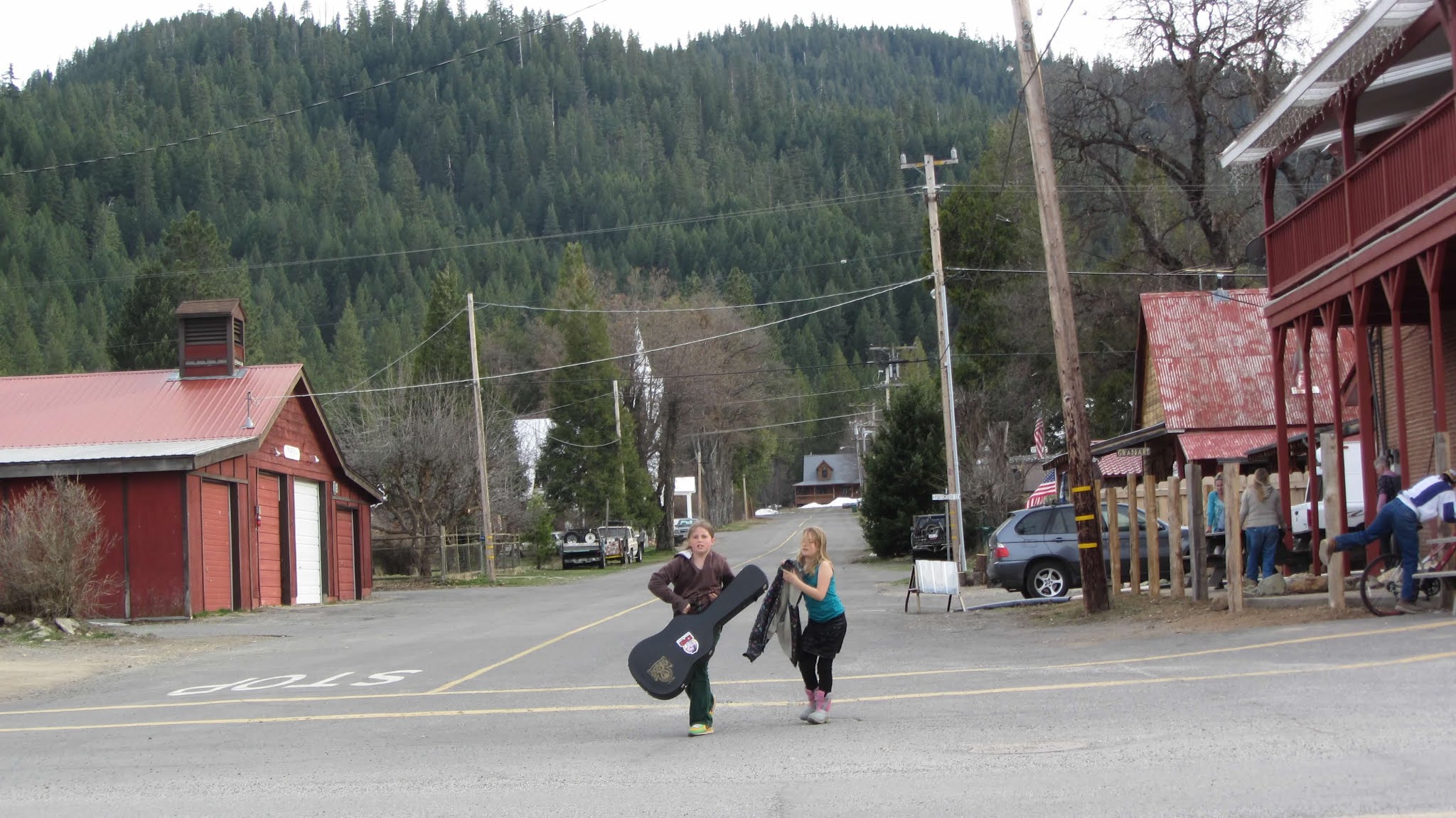
Young musicians
Downtown Greenville, California, March 2013

I spent several days of the 2012-2013 academic year in Plumas County, California.  A good bit of that time was in Greenville, a town of about a thousand folks in an area called Indian Valley, less than an hour north of the county seat, Quincy.  Plumas County is about the size of Delaware, but it's sparsely populated, with just about 20,000 residents.  

Village Pharmacy (left) in a building dating to the 1860s,
was destroyed in the Dixie Fire Wednesday night.  
(c) Lisa R. Pruitt 2013

The year I spent working off and on with my law students in Plumas County is documented in this report that my students and I produced.  We were conducting what is called "participatory action research" in collaboration with Legal Services of Northern California, which had a grant to do do early outreach related to the Affordable Care Act's implementation.  

Historically Mountain Maidu territory, Greenville is one of the poorest parts of the county--and, indeed, one of the poorest places in California.  I took many photos (all (c) Lisa R. Pruitt 2013), and I'm going to share some here as a reminder of what Greenville was--and might be again.  

Anna's Cafe, Greenville

Downtown Greenville, March 2013, with 
Way Fair Tavern and Anna's Cafe in 
background behind the flag

I say "might be again" because on Wednesday evening, Greenville was largely destroyed in the Dixie Fire, now the second largest fire burning the United States, and one of the largest fires ever in California.  As the crow flies, Greenville is not many miles from where the Camp Fire destroyed the town of Paradise in 2018.  Indeed, the Camp Fire and the Dixie Fire started in the same area, both in the Feather River Canyon.  The Camp Fire burned west and north from there, while the Dixie Fire burned mostly south and east.  Also threatened is the Plumas County town of Chester, which borders Lassen County, and the fire is now also burning into Lassen National Park.  

I'm featuring here a sampling of the photos I took in 2013 in and around Greenville.  (I took many, many more, so may do a few additional posts featuring different aspects of Greenville and Indian Valley).

Indian Valley Chamber of Commerce and a bookkeeping service,
Greenville, California, Spring 2013 


Hotel in Downtown Greenville.  The building whose
corner you can see on the right is the Village Pharmacy, pictured above. 


Lutheran church, 2013.  You can see after-fire photos 
of the church at the links below, where just the sign remains.

Music studio
Greenville, 2013


You can read more about what happened in Greenville on Wednesday here, here, here, and here.  You'll see there photos of what's left of some of the buildings I photographed in 2013. 

Hunter Ace Hardware, Greenville, Spring 2013

Greenville Rancheria Tribal Medical Center, Spring 2013

Greenville Library, Spring 2013
Way Station Tavern, which sat right across from Village Pharmacy 
and across Hwy 89 from Anna's Cafe.  You can see after-fire 
photos of the tavern at the links below 

This latest, by Anita Chabria for the Los Angeles Times, features the story of Kevin Goss, a pharmacist in Greenville and also a long-time member of the County Board of Supervisors. (As a county supervisor and business owner, Goss is mentioned in the report my students and I produced).  You can see a photo of his Village Pharmacy above, from 2013.  He was in escrow to sell the business to a pharmacist in Quincy when the Dixie Fire destroyed it.  

A woman was selling goat's milk-based products out of an 
outbuilding behind her home, on a residential street, Feb. 2013

Here's a Eulogy for Greenville, written by resident Meg Upton and published in the Plumas News.  It talks about politics--though it puts a good spin on how community spirit overrides politics in Greenville because they're too small and need each other too much to alienate one another.  And it reminds me of this very memorable photo I took in Greenville in 2013: 

Greenville, California, Spring 2013

Speaking of politics, Governor Gavin Newsom visited Greenville yesterday and posted this video on Twitter.  Mostly, Newsom focused on climate change's role in this disaster, but he also said the Dixie Fire and the disaster in Greenville is "about people's culture, their identity, lifestyles, a sense of place, memories that are attached to this, one of the oldest communities in California.  This is about our families, our kids ... we have a deep responsibility to rebuild." 

More photos to follow in a future post.  

Post script:  You can see after-fire photos of some of these places, including the Greenville public library, the Greenville Rancheria Medical Clinic, and the Way Station Tavern in this August 12 story from the Los Angeles Times.

Saturday, August 14, 2021

Remembering Greenville, California (Part II): the public sector

Sign on Grenville High School, 2013
The message now seems ironic

Last week, I posted some 2013 photos of Greenville, California (all (c) Lisa R. Pruitt 2013).  I shared them because Greenville, one of the four population centers in Plumas County, California, was nearly entirely destroyed by the Dixie Fire about 10 days ago.  In this post, I'm going to share more photos of Greenville, taken in 2013, with a focus on public infrastructure--schools, the sheriff's substation, the fire department, the community center, the Indian education center.  

Greenville Fire Truck, 2013

Roundhouse Indian Education Center, Greenville, 2013

Greenville High School 2013
Interesting that Future Farmers of America is the co-brand

A sign at the Greenville school complex, 2013
Indian Valley Elementary School, Greenville, 2013

Ambulances at Greenville, 2013

Public transit in Greenville, 2013


Greenville Substation, Plumas County Sheriff, 2013

On the side of the old jail, pictured below, which sits behind Sheriff's Substation


These next photos are the Indian Valley Community Center, which featured a range of modest facilities.    

Scholarship guidelines for classes at 
Indian Valley Community Center, 2013

Indian Valley Community Center, 2013

Indian Valley Community Center, 2013

The Indian Valley Recreation Scholarship Fund flyer above states that it "helps ensure all people, regardless of ability to pay, have access to programs that enrich lives and teach life-long lessons.  Donations to the fund help a child learn to swim, play on a team, practice life skills or discover a new talent."  The chart below that language shows the amount of discount/scholarship, pegged to Health and Human Services Poverty Guidelines or WIC Guidelines.  

When my students and I were working in Plumas County in 2013, we visited with the man responsible for trying to sell the Indian Valley Hospital building.  The facility had then recently closed, with folks channeled to either Quincy, Chester, or Susanville, the latter in neighboring Lassen County.  

Interior of Indian Valley Hospital, then recently closed, March 2013

Helicopter pad for Indian Valley Hospital, 2013

For Sale Sign at Indian Valley Hospital, 2013 

Some post-fire photographs of these places are in this series posted August 12 by the Los Angeles Times.  The after-fire photos include one of the Greenville fire station.   I have seen photos on other websites that suggest the school complex at Greenville survived.  

Today's Los Angeles Times update on the Dixie Fire is here.  

Wednesday, September 28, 2022

Whether to re-build rural towns destroyed by wildfire

That is the subject of two stories in yesterday's Los Angeles Times, one focused on the economics and sustainability of doing so, the other framed--at least by its headline--in terms of rural climate change skeptics.  Both are written by Anita Chabria and Erika Smith.  The dateline for both stories is Greenville, California, which was destroyed by the Dixie fire last summer, an event I wrote about here and here.  

The thesis of the first column is pretty clear from the headline, "California spends billions rebuilding burned towns. The case for calling it quits."  Here's an excerpt: 
Most days, Ken Donnell steals a moment to gaze at the forested valley that surrounds this remote grid of streets in the mountains.

Before the Dixie fire came barreling through the Sierra Nevada last year, leveling everything here but a few houses, businesses and a school, this was a charming — if dying — Gold Rush-era town that about 800 people called home. Now, much of the charm is gone along with most of the residents, replaced by the skeletal remains of conifer trees and the deathly silence of block after empty block.

But even as Donnell has mourned, his mop of gray hair a fixture at community meetings on how to bring the town and the surrounding Plumas County valley back to life, he has become grateful.

It’s good that Greenville burned down when it did, he believes. Sooner rather than later. Because one day, in a not-so-distant future ravaged by climate change, many of Northern California’s far-flung rural towns — founded in another time and for another economy — might not get rebuilt at all.

Gone could be the political and public will to spend hundreds of millions of dollars — with Southern California taxpayers footing a big chunk of the bill — to replace homes and businesses for a small number of people, knowing that it’s all likely to burn down again as extreme heat and drought keep decimating unmanaged forests.

* * * 

Something must change.

What California is doing is dangerous and unsustainable, yet it continues down a well-trodden path, never hesitating to rally around people who have lost their livelihoods to a disaster, whether it be a mudslide or an earthquake — but especially a wildfire.

We are #ParadiseStrong, #SantaRosaStrong, #GrizzlyFlatsStrong and now #GreenvilleStrong. And we’ve spent billions in taxpayer dollars to prove it, along with ensuring that Pacific Gas & Electric, responsible for sparking far too many of these destructive conflagrations, is on the hook to pay billions more and to help rebuild.

The framing for the other column is even more provocative and political.  It is titled, "Rural climate skeptics are costing us time and money. Do we keep indulging them?" An excerpt follows:  

This is the part of the state where climate change has become a full-fledged existential threat. Sure, Southern California is prone to its fair share of disasters, but it is in Northern California where catastrophic wildfires aren’t just likely but are certain to destroy remote small towns for decades to come.

Greenville, which burned down in last year’s Dixie fire, should serve as a potent reminder of this risk. But maddeningly, the people who love living in these rural wildlands don’t see it that way. Instead, they look at it as just one more challenge to overcome, like spotty cellphone service and far-off grocery stores and hospitals.

It’s a belief so widespread, so divorced from the terrifying reality of climate change, that the rest of us in California can’t keep ignoring it. Doing so is simply costing too many lives and too much money, and wasting too much time. Soon, living in rural Northern California won’t be as safe, as sustainable or even as beautiful as it once was. The Dixie fire was just the beginning.

* * *

Why the Dixie fire was able to enter Greenville at all, tucked away in the Indian Valley about 100 miles northeast of Lake Tahoe, has become the stuff of conspiracy theories. But what it left behind is undisputed fact.

Streets of empty lots where homes and businesses once stood. A non-functioning sewer system. Soil so contaminated that millions of dollars in environmental restoration will be needed. Stumps where trees once provided shade from the sun.

* * * 

[One] line of thinking veers into grievance politics, insisting that catastrophic conflagrations wouldn’t be happening if left-leaning, big-city environmentalists hadn’t killed the logging industry in their right-leaning rural small towns. From there, the victimhood can morph into extremism, isolationism and paranoia.

Of course, the truth is a lot more complicated, given that forest mismanagement started with industrial logging of big — more resilient — trees from our forests. But these residents do have a point.

Hundreds of millions of dollars have been allocated for prescribed burns and mechanical thinning projects. And yet the treatment work is still being done far too slowly — an average of three to five years from conception to implementation. In some cases, it can take as many as seven years.
* * *
Are taxpayers who live in lower-risk cities willing to subsidize people who live in higher-risk rural towns, even if those people don’t have the means to live somewhere safer? And which is the fairest, most equitable use of public resources?
* * *
At some point, Californians must decide: Are we willing to pay more to maintain the status quo and rebuild every small rural town that burns down? Or do we want those who live there to pay more or even retreat to safer places?
* * *
For all of the anti-government, Trumpian rhetoric in Northern California about residents breaking away to form a right-wing State of Jefferson, most of their towns wouldn’t exist without massive public investment from liberal cities. And yet, if these same residents are forced to take on more financial responsibility for the risk of rural living, there will almost certainly be pushback.

Obviously, both of these columns are well worth reading.  Other prior posts on Legal Ruralism that mention Greenville or Plumas County can be found here.  

Postscript:  In the wake of Hurricane Ian, don't miss this column asking the same question about rebuilding in coastal Florida, some of which is highly urban.  

Saturday, October 16, 2021

Rural Californians struggle to keep homeowners insurance in wake of wildfires

PBS reported a few days ago from Greenville, California, destroyed by the Dixie Fire in early August.  Here's an excerpt from the story, Cat Wise being the journalist and Kevin Goss a pharmacist and member of the County Board of Supervisors, whose pharmacy was destroyed:

The state of California has issued a moratorium that will prevent insurers from dropping homeowners in wildfire-scorched areas over the next year. And the California FAIR Plan is supposed to ensure that all homeowners, including high-risk ones, have some basic fire insurance. But barriers remain.

Kevin Goss:

Insurance is always a problem, homeowners insurance. And some of these folks could not afford the higher rates that these insurance companies are having to charge to insure these homes.

Cat Wise:

It's only the beginning of a long process of cleaning up, but Kevin Goss says that, so far, they have gotten the help they need because this small town sits at a crucial waterway.

Kevin Goss:

They are actually moving at a pace that is urgent, as we are the headwaters to the Feather River that feeds Oroville, which is one of the main water sources for the state of California.

So, this debris, they do not want to go into that water system.

Cat Wise:

These green wattles are supposed to keep that debris from contaminating the water system.

Still, Chad Hermann says the aftermath of a wildfire in a rural community like Greenville is a far different picture than when fire strikes wealthier California enclaves

Chad Hermann:

When you look at the fires that they had down in Sonoma, you have an infrastructure with a fantastic money base, between the wineries and industry. In the real mountain communities, you don't have that.

We're not a rich county. So, when you have a group of people who have very little to begin with, and they lose everything, it makes it very difficult to come back from that. And we still have people without adequate housing. So we have people that are still in tents and travel trailers.

Cat Wise:

Kevin Goss is hopeful that the town he's known all his life will rise again with better fire-wise planning and more resilient construction materials to prevent the town from burning again.

Kevin Goss:

Some folks, the trauma is going to be too much for them to come back. And it's just — it's permanently seared in their brain and they don't want to go through that again. Folks like myself and others are going to say, hey, you know what? We're going to build this thing back to where it can survive a fire like this.

Most folks want to come back to their home. I mean, even though it looks like this, it's still their home. It's their piece of property. It's their — where they grew up or where they have had all these memories.

Note the contrast with Sonoma County, where wine country interests ensure more resources for fighting fires.  

Earlier posts about the Dixie Fire and the destruction of Greenville are here.  

Thursday, January 6, 2022

Legal consequences of state investigators' finding that PG&E equipment involved in start of Dixie Fire

The Los Angeles Times is just one of many outlets reporting Tuesday on PG&E's role in the ignition of the Dixie Fire in July, 2021, one of the largest in California history.  Here's an excerpt from Gregory Yee's story:

State investigators have determined that a Pacific Gas & Electric Co. power line was responsible for sparking last year’s massive Dixie fire, which torched more than 960,000 acres in five Northern California counties as it burned clear across the Sierra Nevada.

According to a statement by the California Department of Forestry and Fire Protection, investigators found that the fire “was caused by a tree contacting electrical distribution lines owned and operated by Pacific Gas & Electric located west of Cresta Dam.”

The department’s investigative report was forwarded to the Butte County district attorney’s office, according to Tuesday’s statement.

Cal Fire officials referred all questions regarding the report to prosecutors. The district attorney’s office could not be reached for comment Tuesday night.
This, from Scott Rodd of Capital Public Radio, provides further context on the utility's fire-related legal woes:
The utility giant said in a statement that it “will continue to be tenacious in our efforts to stop fire ignitions from our equipment and to ensure that everyone and everything is always safe.” Those efforts include a multi-billion dollar undertaking to bury 10,000 miles of powerlines and to keep cutting off power in areas where there’s high wind.

The announcement is not a total surprise. In July, PG&E reported to the California Public Utilities Commission that its equipment may have caused the Dixie Fire. One of the utility’s employees responded to a power outage reported at Cresta Dam and found blown fuses and a tree leaning into PG&E equipment, with fire burning at the tree’s base.

At the time, Cal Fire investigators took several pieces of PG&E equipment.

Last year, Cal Fire investigators concluded the utility started the Zogg Fire, which burned 56,000 acres and killed four people. The Shasta County District Attorney’s Office charged the utility with manslaughter and other crimes in September.
In 2018, PG&E’s equipment started the deadly Camp Fire in Butte County. The fire leveled the town of Paradise and killed 85 people. PG&E later pleaded guilty to 84 counts of manslaughter. In the following months, the company sought bankruptcy protection as it faced tens of billions of dollars in potential liability for wildfires it caused.

Here's a follow up from Rodd today focusing on a newish wildfire liability fund:  

Pacific Gas & Electric could be the first company to access a wildfire liability fund established by the state over two years ago, intended to keep utilities solvent after causing major wildfires.
* * *
Gov. Gavin Newsom established the liability fund by signing AB 1054 in the summer of 2019, as PG&E faced tens of billions of dollars in potential liability for wildfires it caused. The bill established a $21 billion liability fund to help utilities cover the cost of major wildfires started by their equipment.

At the time, PG&E — the state’s largest utility — had already filed for bankruptcy protection and faced uncertainty about its future.

The state’s three largest utilities — PG&E, Southern California Edison and San Diego Gas & Electric — will pay for half of the $21 billion fund, and their customers will cover the other half through rate increases. Currently, the fund has about $11 billion, according to a report released last week by the California Catastrophe Response Council, which oversees the fund.

Utilities must pay $1 billion in claims before being able to access the fund. PG&E’s liability for the Dixie Fire is expected to surpass that threshold.

Michael Wara, a senior research scholar at Stanford University’s Woods Institute for the Environment, is on the council. He said claims tied to the Dixie Fire could be a useful test of the fund’s responsiveness, and see where there’s room for improvement.

Also today, The Guardian has published a feature on Greenville, the Plumas County town destroyed by the Dixie Fire.  The photos by Rachel Bujalski are powerful, as are the stories collected by journalist Dani Anguiano.  

Prior posts about the destruction of Greenville are here and here.  

Wednesday, August 11, 2021

On the behavior of rural neighbors in the face of the Dixie Fire

The Dixie Fire is now the second largest in California history, the largest being the August complex fire from last summer.  I've noticed an interesting preoccupation that some reporters have with the behavior of rural folks in the face of the fire.  The New York Times featured this headline a few days ago, "Despite Dixie Fire's destruction, some residents aren't evacuating."  Here's the salient excerpt:  

As the Dixie Fire ravaging Northern California became the state’s second largest on record over the weekend, efforts to save tinder dry land, towns and homes from being destroyed have been complicated by residents who aren’t heeding one order: evacuate.

Oddly, the short update makes no other reference to the refusal to evacuate.  That is, the complications are not expanded on in the story. 

The Los Angeles Times, however, fills that gap with this August 7 headline, "As Dixie fire tears through communities, some refuse evacuation orders with guns in hand." Yet the journalists didn't get to the "guns in hand" part of the story until the 8th paragraph:

Greg Hagwood, a Plumas County supervisor, said that in the last 72 hours, as fire has swept through or threatened small mountain towns including Greenville, the evacuations have grown tense — in some cases, residents have met law enforcement with weapons.

“They are met with people who have guns and [are] saying, ‘Get off my property and you are not telling me to leave,’” he said.

In response to those who flatly refused to evacuate, he said, deputies were asking for next-of-kin information so they would have someone to notify if the holdouts died.

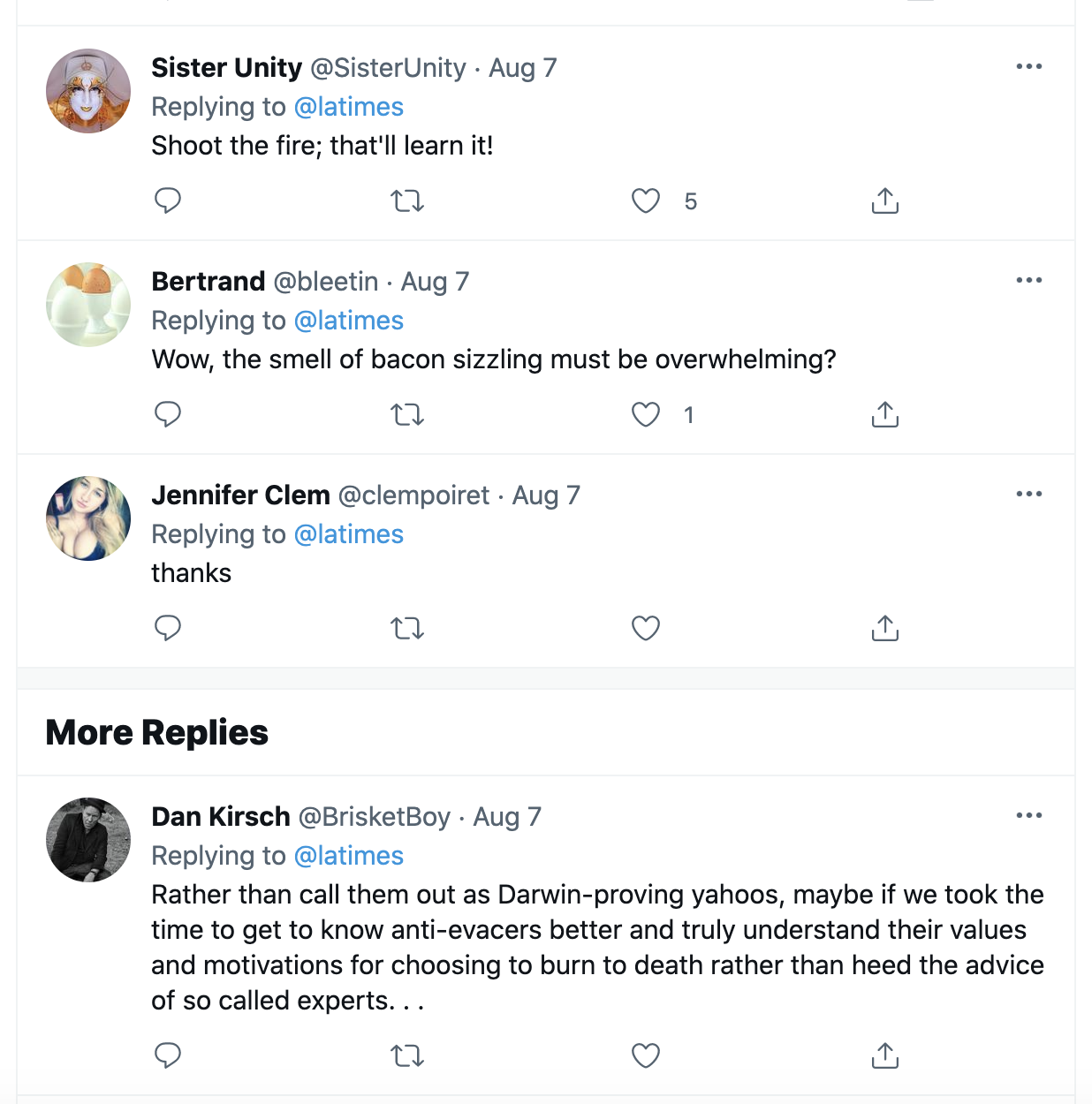
I saw some rural California folks on Twitter responding to that LA Times headline by explaining that rural folks tend to look out for one another--including each other's property.   In other words, staying behind to fight the fire--and fight to save their homes and those of their neighbors--is logical for them.  Here's a screenshot of one such tweet responding to the LA Times tweet of the story above:  


And here's a more positive spin on rural neighborliness, this from a New York Times story (dated August 9, 2021) about how some of these Plumas County communities are functioning right now: 

In the remote mountain communities that dot Plumas County, a thinly populated county near the border with Nevada, choking smoke hangs thick in the air. The power is out, and in some places water is scarce both for firefighting and drinking. Residents who have decided not to evacuate are collecting meat and groceries from their neighbors’ fridges. Others are isolated, holding out for deliveries from community firefighters of food, medicine and gas.

* * * 

Around Taylorsville, a tightly-knit community, people​ have been preparing for the fire​ for weeks, helping one another dig trenches with bulldozers, set up irrigation lines and spray homes​. Many ranchers have packed their​ most precious​ belongings and stored them in cattle trailers in​​ irrigated fields​ where they hope they will be safe if the fire comes down from the mountains​. ​People’s ​days revolve around tracking the fire’s every move​. ​The sound of generators fill the air.

Finally, here's a tweet about solidarity and self-sufficiency within Plumas County as it has faced the Dixie Fire: 


 A post from a few days ago, about the fire's destruction of Greenville, is here.   

Just thinking that it would be interesting to contrast coverage of the behavior of rural folks who stay behind in the wake of fire with that of urban (and other) folks who stay behind as hurricanes approach.  Are there similarities and differences in how these folks are depicted?  as rational or not?  

Tuesday, August 16, 2022

A plan to revive Sierra-Nevada towns with a new hiking trail to draw eco-tourists

That is the gist of Jessica Garrison's story out of Portola, California, population 2104, in nonmetro Plumas County.  The headline is "‘We have to remake ourselves’: Can a new trail help revive this crest of the Sierra?" Here's an excerpt that provides the economic background on this initiative to remake the "Lost Sierra Route" trail, which would bring more tourism to towns that have been experiencing population loss.  
Yard by dusty, backbreaking yard, workers have set out to build 600 miles of trails to connect remote mountain towns such as Sierra City and Chester that once flourished because of gold mining or logging but now are withering. Downieville, for example, was once one of California’s most populous towns; as of the 2020 census, its population was less than 500.

The project — dubbed “Connecting Communities Through the Lost Sierra Route” — aims to reverse the decline. If all goes as planned, mountain bikers, off-road bikers and hikers would flood in, drawn by the opportunity to traverse from town to town a la the Swiss Alps. They would exult in the stark beauty of the landscape, spend oodles of money in local restaurants, bars and hotels, and then go home again — hopefully without driving up housing prices too much.

* * *  

“We had an economy based first on gold and then on timber, and both of those have waned,” said Lee Adams, who sits on the board of supervisors for Sierra County, which had a population of just 3,200 people according to the 2020 census.

“We have to remake ourselves,” added Plumas County Supervisor Kevin Goss, who represents Greenville, the town that was burned to the ground last year by the Dixie fire. Included in the wreckage was Goss’ business, a pharmacy. “I am looking for … anything to create a little more tourism.”

Goss spoke of bringing high-speed internet, food trucks, luxury camping, “anything and everything” that might boost the economy. Even before the Dixie fire incinerated Greenville last summer, Plumas County was already seeing its population decline.

But, of course, there are downsides:  

Already, some locals are fed up because of a lack of parking on weekends. And they think they know who to blame: all those cars with bike racks on the back, and other accouterments that seem to scream “Bay Area Driver.” Not to mention a housing crisis that already feels dire.

Sierra City, mentioned above, is a place where the Pacific Crest Trail pass through a town.  I've written about it here.  And here's a post about Downieville, also in Sierra County.  Posts about Plumas County are here and here.  And here's a post about the so-called "Lost Sierra," also out of Plumas County which, by the way, is the size of Delaware with a population of about 20,000.

Thursday, March 19, 2015

"Ornery Artist's Hand-Written Screeds" in rural Missouri now subject of major art exhibition

Greenville, California, March 2013
NPR ran this story last month about Jesse Howard's 20-acre compound of hand-painted signs, which he called Sorehead Hill, in Fulton, Missouri, population 12,790.  Here is the lede of C.J. Janovy's story:
By all accounts, self-taught artist Jesse Howard was cantankerous. In middle of the last century, it wasn't unusual to see hand-painted signs on country roads advertising a traveling fair or a farm sale. But Howard's signs offered Bible verses. They proclaimed his anger at his neighbors and the government, and his disappointments with the world around him. "Every word I'm saying's the truth," the artist said of his work. "Every word." 
Seen in Madison County, AR, May, 2010
Howard's work hangs in the Smithsonian American Art Museum, the American Folk Art Museum in New York and the American Visionary Arts Museum in Baltimore. Now, the Contemporary Art Museum St. Louis has opened the first comprehensive survey of his work.

Court Street, Jasper, Arkansas 2011
Leslie Umberger, the Smithsonian folk art curator, explains the significance of Howard's work—and the work of others who built such environments in the 1940s and 1950s, including Sam Rodia in California and Fred Smith in Wisconsin.  Umberger says Sorehead hill was an
"art environment," or a personal space that's "built or constructed by an individual who, for whatever reason, decides to kind of reshape his or her corner of the world."  
According to Umberger, well-known artists like Roger Brown and Jasper Johns ultimately took note of what Howard, Rodia and Smith were doing.  Umberger continues:
And it makes a big difference because people start to really equate this radicalism with having a strong voice, a strong opinion, being truly original, for standing up for what you believe in and fighting for it.
Janovy reports, too, that Howard had to fight neighbors who "tore down his signs and vandalized his property," even seeking in 1952 "to have committed to an asylum," a fate he was able to avoid.


Hwy. 7 South, Jasper, Arkansas, November, 2011
All of this reminded me of some of the hand-painted screeds I have seen in rural places in recent years.  One is from Greenville, California, population, 1,129 (top), and the other near the community of Marble in Madison County, Arkansas, population 15,701.  These are similar to Howard in the sense of protesting against the government—or in the case of the Madison County sign, another individual--in one way or another.   

Hwy. 7 South, Jasper, Arkansas 2011; sign reads "Not Responsible for Accidents
The bottom photos are from Jasper, Arkansas, population 466, county seat of Newton County, Arkansas, population 8,330.  The first of these photos is of old fashioned junk shop and the last two, photographs of a ????? (outdoor junk shop?) taken two years apart.

Whatever it is, the owner is concerned about fending off liability because the latter version, two years after the first, features  sign that says "NOT RESPONSIBLE FOR ACCIDENTS." (Very interesting for the torts professor in me).  While perhaps not political, all seem fairly artistic to me.  In particular, the last two photos of the same place two years apart show the proprietor becoming more artistic (and perhaps less entrepreneurial—less interesting in selling stuff than in displaying cultural artifacts in an interesting, even pleasing way) over time … 

Friday, April 30, 2021

Coronavirus in rural America (Part CXXIX): More on vaccine hesitancy, religion, and adjacent themes

The dateline for this New York Times story is Greenville, Tennessee, population 15,062, in the eastern part of the state, and Jan Hoffman reports under the dateline, "Faith, Freedom and Fear:  Rural America's Vaccine Skeptics."  Here's an excerpt:  

[A] week here in Greene County reveals a more nuanced, layered hesitancy than surveys suggest. People say that politics isn’t the leading driver of their vaccine attitudes. The most common reason for their apprehension is fear — that the vaccine was developed in haste, that long-term side effects are unknown. Their decisions are also entangled in a web of views about bodily autonomy, science and authority, plus a powerful regional, somewhat romanticized self-image: We don’t like outsiders messing in our business.

Hoffman provides the demographic profile up front--overwhelmingly white, conservative and Christian.  This description of the place is also quite interesting: 

People scrape by on subsistence farming, jobs in small factories, welfare checks and cash flow from retirees who are moving onto the cheap, vista-blissful land. Drug busts for heroin and methamphetamine sustain a humming cottage industry of lawyers and bail bonds services.

And then there's this reference to rural lack of anonymity: 

What’s also lacking is a groundswell that might encourage the hesitant to make the leap: Many people who have gotten vaccinated are remaining tight-lipped.

And this, which highlights the peer pressure angle on what is happening, presumably in urban communities as well as rural ones:

“A lot of times I have to temper my opinions in order to fit in,” Ms. Hayes said, tears welling in her eyes. “I’m walking a line between people refusing to socialize with me or not.”

Ms. Hayes grew up here, left, and returned to care for her mother. Late in 2019, while teaching English online to students in China, she noticed that some were disappearing from her computer monitor. They were succumbing to a mysterious virus.

Later, when her family went into lockdown, neighbors dismissed her fears.

And note this regarding the centrality of work: 

“Appalachians were raised to believe they must work and can’t get sick, no matter what,” said Ms. Hayes, who has a graduate degree in Appalachian studies. She wept in frustration as familiar names appeared on her prayer chain, deathly ill from the virus.

P.S.  Don't miss the complimentary podcast to this story on The Daily, dated May 10, 2021.  Great audio of a local Greenville doctor coaching his patients to get the vaccine.   

Friday, April 17, 2020

Coronavirus in rural America (Part XXIII): more on "the South"

Here's an excerpt from the essay by physician and writer Edwin Leap in The Atlantic, under the headline, "A Doctor’s Warning From the Rural South: Small community hospitals already operate on the very edge of disaster every day."
Life in the rural South is tied closely to nature. Live here long enough and you can tell that a storm is rising by the way the leaves roll in the wind. A strange silence can precede bad weather, as the birds shelter on the ground and the air pressure changes throughout the house. In my part of rural South Carolina, we are experiencing a new kind of silence: a kind of breath-holding, sky-watching, prayer-whispering pause as we wait for COVID-19 to arrive in earnest. 
Dr. Leap works in rural South Carolina, where he reports that his county has 15 cases so far.  His short (but important) essay concludes:
If COVID-19 strikes rural America with the fury it has unleashed in more populous places, many more lives will be lost, especially if the resources are already committed elsewhere. If this happens, rural southerners will do what they always have done in times of trial: Band together, do their best, and try to survive. Then bury the dead in family plots, weep, and carry on. 
Rural hospitals have been limping along for decades. The rural South—rural America in general—deserves a robust medical system, including a series of small hospitals intentionally located to mitigate disaster and save lives. Pandemic or not.
Postscript:  The State newspaper out of Columbia, South Carolina, posted this story on April 19.  It's deeply reported, but still a standard rural angle on the coronavirus crisis.  An excerpt with some data on rural counties versus urban ones (as measured by a county population of 70K) follows:
A lack of adequate testing and protective equipment, poverty that discourages trips to the doctor, relatively few doctors and nurses, higher percentages of people in poor health and limited information about the dangers of COVID-19, the disease caused by the novel coronavirus, are among the issues affecting rural areas dealing with the coronavirus.
But as the disease takes its toll, these challenges need addressing, say advocates for the state’s rural areas. Often neglected, rural South Carolina faces a problem like none it has seen before. 
The impact of the virus, increasingly well documented in bigger counties like Richland, is now being felt in rural, smaller counties that in some cases are underequipped to handle the crisis. Three of the top five counties in rates of infection have populations of under 70,000, according to the S.C. Department of Health and Environmental Control. 
Those are Clarendon, Lee and Kershaw, where the outbreak first was identified in large numbers. Sumter County, also in the top five, has just over 100,000 people, but large swaths of rural areas. 
The journalists quote Rep. Lonnie Hosey, D-Barnwell: 
Do you want us to give up our territory and move to metro Columbia, Charleston or Greenville?  No? Then why don’t you help us? We don’t have the amenities you have. But we are still part of America.

Monday, May 5, 2008

"Designated Ambassador to the Smaller Parts of the Country"

That's the title Bill Clinton has given himself as he campaigns in places like Zebulon, Morganton, and New Bern, North Carolina, even as Hillary campaigns in the more populous Cary and Greenville. Read the New York Times story by Adam Nagourney here. He speculates that Clinton may have gotten his "campaign groove back" because of where he's campaigning:

One explanation is rooted in where Mr. Clinton is spending his time: 21 small communities in North Carolina and Indiana between Saturday morning and Monday night. Mr. Clinton spoke wryly about the “big East Coast writer” who had suggested that Mr. Clinton had been relegated by his wife’s campaign to the boonies.

“I love it here,” he said.

The truth is that some of Mr. Clinton’s best moments in 1992 were on bus tours that brought him to small towns and villages where people lined the street to see a potential future president, much the way they were lined outside the high school waiting to see him here.

Seems plausible. The man from Hope and all that. I wonder if his Arkansas accent has made a come back, too.

Saturday, March 28, 2020

Coronavirus in rural America (Part VI): Small-town grit and preparedness in Oklahoma

Annie Gowan and Juliet Eilperin report for the Washington Post out of Bristow, Oklahoma under the headline, "Small town battled coronavirus on its own, as outbreak spread in a red state."
Epidemiologist Mark Brandenburg saw the threat months ago: The data coming out of China signaled that this could be "the pandemic we had feared for a long time."

The chief medical officer of a small hospital in this town of 4,200 people, Brandenburg didn't wait for orders from the federal government or direction from the statehouse. By mid-February, he had launched a citizens' response team to prepare the community for the novel coronavirus's arrival. Local leaders organized a phone chain. Teams of teenagers and college students were formed to deliver groceries to seniors.

Long before schools around the country started closing their doors, the Bristow school system readied a program to feed kids if it shut down — a must in a city with a 25 percent poverty rate.

Meanwhile, Oklahoma Gov. Kevin Stitt (R) was resisting health officials' recommendations to close schools and restaurants and was allowing medical centers to continue elective procedures, even as other hospitals reported shortages of masks and protective equipment.
The story quotes Brandenburg, a veteran of Hurricane Katrina and the Oklahoma City bombing:
There was no guidance on how small towns should prepare well in advance. And my experience allowed me to know this and get in early and get our town up and running.
Bristow is in Creek County and part of the Tulsa Metro area. 

Other stories about small towns and small cities being hit hard by the coronavirus crisis are here (noting Greenville, MS and Pine Bluff, AR, among others), here (Springfield, Oregon), and here (Albany, Georgia).

Monday, July 6, 2009

Serial killer dead after spree in nonmetropolitan Cherokee County, SC

Read the latest from the New York Times here.

Gaffney, South Carolina, where the five killings occurred, has a population of 12,968 and is part of the Greenville-Spartanburg-Anderson Statistical Area. Gaffney is in Cherokee County, which appears to be micropolitan, with a population of about 54,000.

The news reports of recent events seem to reflect the vulnerability associated with rural places. Here's an excerpt from an AP report on 5 July:
An 83-year-old woman and her daughter were shot to death on Wednesday, and a 63-year-old peach farmer was found dead at his home a week ago.

The killings have alarmed residents, who canceled Independence Day holiday plans and armed themselves.

Sheriff Blanton warned people selling door to door to stop knocking, and he cautioned anyone who broke down on the county’s rural roads to wait instead of walking to a house for help because he worried “people are going to start shooting at shadows.”
In this short excerpt are rural themes of self reliance/self help--specifically involving guns, as well as vulnerability due to spatial isolation and the attendant limited presence of law enforcement.

Friday, July 22, 2022

Yet another story on Democrats' woes in rural America, this one with a focus on religion

Searcy County, Arkansas
(c) Lisa R. Pruitt 2012

Alan Greenblatt reported this week for Governing, which "provides news, analysis and insights for the professionals leading America’s states and localities."  The headline is "How Rural America Learned to Love the Republican Party."  

It’s not only economic issues that have pushed voters in Muhlenberg County, along with much of rural America, away from Democrats and into the arms of Republicans. “I’ve seen so many people that were strong Democrats but changed because they felt that Democrats were not Christian,” says Greenville Mayor Jan Yonts. (She’s a Democrat but her office is nonpartisan.) “They feel that Democrats are baby killers.”

Along a commercial corridor in Central City, which is the most populous city in Muhlenberg County, a Baptist church is fronted by a 50-foot tall lighthouse with the name “Jesus” spelled out in enormous black letters along two sides. Churchgoers in Central City have plenty of other choices for places to worship. “Religion makes a big impact here,” says Jack Reno, who chairs the Muhlenberg County Democratic Party. “Rural Kentucky is very much religion first, guns second.”

Reno credits Republicans with doing “a fantastic job” of tying all Democrats to national party figures such as Joe Biden and Nancy Pelosi who don’t play well in rural Kentucky. Just under 31,000 people live in Muhlenberg County, making it possible for local candidates to make themselves known and liked by enough voters to win office. But it’s become increasingly difficult for them to carve out identities that separate them enough from national Democrats to win.

“I’ve had a lot of discussions with my neighbor and he was actually surprised I was a Democrat,” says Brittney Hernandez-Stevenson, the party’s candidate for state House seat in the county. “Some of the support that I think I would get, I may not, unless they pay attention to me as a person and the things I’ve done, versus my party.”

Thursday, November 24, 2022

More analysis of the rural vote, this time from Mr. Rural

"Mr. Rural" is the Twitter handle of Matt Barron, a political consultant based in western Massachusetts.  He published this reflection on the 2022 Midterms a few days ago in the Daily Yonder.  A few highlights follow:  

First, on John Fetterman, who won the U.S. Senate seat from Pennsylvania:
Fetterman’s “Every county, every vote” strategy involved his repeated trips to all 48 rural counties in the Keystone State. Although he only won two rural counties, Centre County (home of Penn State University) and Monroe County, that candidate face time paid off as Fetterman moved the needle by improving on President Biden’s rural vote in the state by three points – from 26 to 29%.

The Pittsburgh Post Gazette said it best: “Mr. Fetterman’s victory could offer the Democratic Party a new pathway to assembling a winning coalition in an electorate that’s undergone fundamental shifts since Mr. Trump’s surprise win in the 2016 presidential election. He has long advocated campaigning in deep-red areas full of white, working-class voters that have shifted toward the GOP in recent decades, not to win majorities there but to cut into Republican advantages by splitting their voting coalitions.”

Of course, I wrote about Fetterman's rural strategy several months ago, here and here.   

Barron continues with another example of a "good" rural strategy:

North Carolina Democratic Party Spotlights Representative Budd’s Anti-Rural Record

Many state Democratic parties don’t lift a finger to expose the voting records of Republicans with respect to how they screw over rural constituencies in their states and districts. This is important because most county-level parties and rural caucuses lack the specific information with which to write informed letters to the editor or post cool memes to social media platforms or lob-biting calls to talk radio shows that can skewer these GOPers for these votes.

But the North Carolina Democratic Party issued a series of press releases that shadowed Representative Ted Budd, the Republican nominee for Senate, as he fundraised across the state, like this one in Greenville that slammed him for voting against a series of programs and projects aimed at rural needs in the area.

Barron then turns to the bad, highlighting a blunder by Congresswoman Susan Wild in Pennsylvania, who faced a "tough re-election after rural and Republican leaning Carbon County was added to her Lehigh Valley district centered in Allentown:
During a virtual meet and greet on July 18, Wild said “Carbon County has many attributes, but it is a county that – although it was once an Obama county – it since has become a Trump county,” she said. “I’m not quite sure what was in their heads because the people of Carbon County are exactly the kind of people who should not be voting for a Donald Trump, but I guess I might have to school them on that a little bit.”

Ouch.

In playing the elitist card, Wild might as well have told her audience that her favorite perfume is Eau de I’m-better-than-you. But these kinds of intemperate cracks go viral very fast and contribute to the continuing damage of the Democratic brand across rural America. Wild wound up winning her race by 1.6% or just over 4,700 votes and (full disclosure) I produced digital and print ads for My Rural America Action Fund as an independent expenditure which were all targeted at voters in Carbon County and three rural hamlets in southwest Monroe County to try and keep her losing margin manageable in the new turf.
This part, "the bad," also includes vignettes from Texas and Taiwan (yes, Taiwan). 

And then there's "the ugly," which focuses on Wisconsin and Democrat Mandela Barnes failed attempt to oust Republican Ron Johnson, who had plenty of liabilities--including a July 4 spent in Moscow several years ago.  Here's Barron's analysis: 
The Senate race in the Badger State offered Democrats their best chance to unseat a sitting Republican – two-term incumbent Ron Johnson, who won his 2010 and 2016 races over Russ Feingold by margins of 51.9 and 50.2%. Lt. Governor Mandela Barnes emerged from the Democratic primary as the nominee carrying all kinds of baggage from his stands on defunding police and abolishing ICE. September was a pivotal month for Barnes as he was napalmed by an onslaught of attack ads from the Senate Leadership Fund (the super PAC allied with Senate Minority Leader Mitch McConnell). Barnes never recovered and Ron Johnson eked out a 50.4% win.

Barnes swept the vote in large and medium metro areas, rolling up margins of two to one or more in those urban demographics. But Johnson dominated in the suburbs and got his highest vote share of more than 61% in the rural counties which comprise a third of the state’s voters. Democrats would have been smart to clear the field for Tom Nelson a former state legislator and county executive from Outagamie County who had all the progressive bona fides without Barnes’s liabilities.

Most of the Barnes attacks on Johnson were centered on abortion and saving democracy with some chunks of red meat on Social Security and Medicare. Like Feingold before him, Barnes failed to prosecute Johnson’s abysmal record on issues of concern to rural communities such as the fact that Johnson voted against the Farm Bill three times in 2012-2013, opposed reforming federal milk marketing orders so important to “America’s Dairyland,” and voted against reauthorizing the Secure Rural Schools Act to provide full funding for Payments In-Lieu of Taxes for the Chequamegon-Nicolet National Forest which covers more than 1.5 million acres of Wisconsin’s Northwoods.

Barnes also never hit Johnson on his record with veterans.

Finally, there's this out of North Carolina, where Barron's focus is on the failure of Cheri Beasley's campaign to call out her opponent Ted Budd's failures to support the state's rural communities: 

But Beasley never laid a glove on Budd for a series of votes with a profound impact on rural North Carolinians. Some examples would be Budd’s 2019 vote against the Farm Workforce Modernization Act, a big deal as agriculture is the Tarheel State’s largest economic sector. Budd also voted against funding in 2019 for disaster aid for the victims of Hurricane Florence, which ravaged much of the eastern part state in late summer 2018. PFAS has contaminated drinking water supplies in Pender, Harnett, Chatham, and other rural counties but Beasley never made an issue of Budd’s 2020 vote against the PFAS Action Act to deal with these “forever chemicals.” In the last few years, North Carolina has received almost $53 million from USDA’s ReConnect rural broadband grant and loan program which has served more than 13,800 households for high-speed broadband infrastructure.