Showing posts sorted by date for query State of jefferson. Sort by relevance Show all posts

Saturday, December 27, 2025

NYT feature on the consequences of California redistricting on rural northstate

Kellen Browning reports for the New York Times under the headline, "They Wanted a Conservative State. They Might Get a Democratic Representative Instead."  The story is a richly textured look at how the residents of far northern California feel about the November passage of Proposition 50, which adopted new congressional districts that will temporarily override the decisions of the state's independent redistricting.  As I've written about previously here, here, here and here, this means residents of the current District 1, an inland district stretching from Butte County, about 80 miles north of Sacramento, all the way to the Oregon state line, are likely to be represented by a Democrat after the 2026 midterm elections.  This is because parts of current District 1 will be combined with a strip of coastal wine country stretching down into Marin County, just north of San Francisco.   The current 1st District is shown in lavender in the map below.  Much of it will be subsumed into a new 2d District, outlined by the dotted orange line. 

Source: We Draw the Lines California, California Legislature
Credits: Jeremia Kimelman, CalMatters

Excerpts from Browning's story follow.  Some highlight rural-urban difference and others highlight the feelings of rural voters in California' north state.  

For decades, residents in the rural north have longed for a political earthquake that would cleave their region out of California and allow them to create their own fabled “State of Jefferson” with conservatives in Southern Oregon. They have increasingly felt underappreciated and misunderstood by the liberal Democrats who run California and dominate the congressional delegation — who, in their telling, siphon away their water and prioritize environmental regulations that undercut farmers’ livelihoods.

Now, they not only lack a conservative State of Jefferson, but their entire region is also likely to lose its Republican congressman and have him replaced by a Democrat after next year’s midterm elections. 

“People in the cities don’t have a clue what it takes to survive out here,” said Terry Williams, a 75-year-old rice and walnut farmer who moved to Richvale in 1974. “I don’t think people that were born and raised in the cities can represent us to the same extent.”
Here's a quote from Gene Lifur, a 52-year-old from Orland, population 8,2998, which claims to be the "Queen Bee Capital" of North America for its role in raising the pollinators:  
There was definitely a feeling of throwing up your hands.  You’re going to lose a lot of the interest for voting in the North State.

Another resident, DaNell Millerburg, 62, who manages the Richvale Cafe, "said the idea of her small town being represented by someone from the Bay Area was 'scary.' ...'They want to save the opossums and the beavers and the snakes.  But it’s not good for the farmers, because those animals dig holes in their ditches.'"

Browning meet many of those he interviewed at the cafe, "a nonprofit kept afloat by locals, who wanted to ensure that the area’s solitary farmers had a place to meet."  Richvale, population 234, is the home of current District 1 Congressperson Doug LaMalfa who asserted, "I understand people here far better than a Bay Area interloper."
Rural residents, Mr. LaMalfa said, grew crops enjoyed by California’s cities but were scorned by those living in cities. He said that Democrats were passing expensive pollution regulations, tearing down crucial dams in the name of protecting salmon populations and introducing wolf packs that attacked their herds. Proposition 50 was the latest affront.

“Their voice is being silenced on how they feel about the issues here, because Newsom and the three-to-one ratio of Democrats wanted to see if they could steal five seats,” Mr. LaMalfa said of the governor and state lawmakers.
* * *
“I’m furious,” [LaMalfa] added, “because I’ve had my people kidnapped from me.”
* * *
The Democrats running against Mr. LaMalfa agreed that rural Californians have been neglected by many in their party. But they also argued that Republicans like Mr. LaMalfa have hurt farmers and agrarian communities with their policies.

Those Democrats include Mike McGuire of Geyserville, in Sonoma County, who until recently was president pro tem of the California Senate, and Audrey Denney, who grew up on a coastal cattle farm but has lived and worked for 20 years in Chico, a college town in the same county (Butte) as Richvale.  Denney has already run twice, unsuccessfully, against LaMalfa.  McGuire's California Senate district stretches from Sonoma County all the way to the Oregon state line, but hugs the coast, a more progressive region.  I have observed over the years that he takes the needs of his region's very rural reaches very seriously.  Read about that here and here.  Denney will presumably vie to represent the new 1st District, and McGuire will seek to represent the new 2d District.  

I'll close with this quote from another resident, Chris Culp, 62, a retired Navy officer, who Browning found at the Last Stand Bar and Grill:  
Somebody from Santa Rosa, Oakland, they’re not going to understand, and honestly I don’t think they’re going to take the time to get educated about what’s going on up here.  We’ve got different needs than the people in the dense cities and the coast.

Other posts highlighting the different needs of rural and urban California and long-standing agitation related to the would-be State of Jefferson are here.   

Tuesday, November 19, 2024

WSJ speculates on rural bits of Illinois and California seceding from cities

Joe Barrett writes under the headline, "The Rural Areas Pushing for Divorce From Democratic Cities."  The subhead is, "Across Illinois and California, more red counties that feel steamrolled by blue-led governments are trying to split off."  

 Here's an excerpt: 
A burgeoning breakup movement is gaining momentum across Illinois, California and other states where vast swaths of red, rural counties are dominated by a few blue cities. More residents are pushing to break off and form new states. Or as a group called New Illinois State—which has declared itself independent from actual Illinois and last weekend passed the first draft of a new constitution—puts it: “Leave Illinois Without Moving.”
* * *
73% of voters in predominantly rural Iroquois County...on Election Day backed the idea of forming a new state with every Illinois county except Cook, home to Chicago and more than 40% of the state’s population. The nonbinding resolution also passed in six other counties, bringing the total to 33 of Illinois’s 102 counties.

“There’s a lot of people in Chicago, and I think that they make a lot of decisions that affect people downstate,” said Gioja, who doesn’t expect a New Illinois soon. “It’s just sending a message that, ‘Hey, you know, there’s people that would like to be part of the conversation, and often aren’t.’ ”
This reminds me of the disgruntlement that rural voters have expressed about not having their views heard in both state and federal government.  Kathy Cramer wrote about this in the context of Wisconsin in 2016, and others have since written about it, if only to ridicule it.  (See various columns by, among other, Paul Krugman in the NYTimes).

As a related matter, here's a story from The Guardian this weekend analyzing why eight California counties shifted from Biden (2020) to Trump (2024), and here's an LA Times story about Inyo County, which shifted to Biden by just 14 votes in 2020.   Needless to say, Inyo and many of these other counties aer the ones where lots of folks would like to secede from California--or have urban cities in the Golden State peel off and go their own way.  There are lots of prior stories on the blog about secession, including those about the would-be State of Jefferson.  

Thursday, February 22, 2024

Literary Ruralism (Part XLV): Heather Cox Richardson's Democracy Awakening

Here's an excerpt from Heather Cox Richardson's 2023 book Democracy Awakening:  Notes on the State of America, about rural and urban power in relation to the founding of the United States and the structures the "founding fathers" put in place:  

States ratified the Bill of Rights on December 15, 1791, and the framework for the United States of America was in place. The principles behind it were democratic—that every citizen should have an equal say in the government and that every citizen would be equal before the law—although its practice was almost exclusively limited to white men.

It was a “great experiment,” as first president George Washington called it shortly after he took the oath of office, but it had a crucial flaw: the Framers did not foresee the rise of political parties. They figured that, having thrown off monarchy, Americans would all agree on their form of government. To the degree that they disagreed, Framer James Madison argued in the famous essay “Federalist No. 10,” they would break into small factions and so cancel each other out, much—as the presence of many religious sects in the country ensured that none gained the upper hand over the others.

But partisanship appeared almost immediately. Southern leaders opposed Washington’s policies, conceived by Treasury secretary Alexander Hamilton, that strengthened the hand of northern businessmen in the national government. Virginians like Madison and Thomas Jefferson maintained that their opposition to such national power made them the true defenders of the Constitution.

Partisanship turned out to be an important innovation. It engaged ordinary voters and provided oversight of lawmakers, but it also weakened the nation’s framework, hampering representation and many of the checks the Framers had built into the system

The first thing to go was fair representation. By 1796, political leaders had divided into two camps, and Jefferson saw that he would have won the presidency if only Virginia's electors had all voted as a bloc in the Electoral College rather than splitting their votes between him and John Adams of Massachusetts. Jefferson urged Virginia to adopt a winner-takes-all system that would give all of the state’s electoral votes to whichever candidate got a simple majority. It was a stunning change and one that appalled Madison, who wanted to amend the Constitution to prevent it. He died before he could get such an amendment ratified, and other states quickly followed Virginia, manipulating the new system to give their own top candidates a leg up. Today, only Maine and Nebraska still split their electoral votes, with the result that candidates campaign almost exclusively in states with large electoral vote counts.

The Framers also did not foresee—although this, perhaps, they should have—that eventually, politicians desperate to keep their party in power would add new, sparsely populated states to the Union, as the Republican Party did when it brought six new states into the country between 1889 and 1890. They were quite open that their goal was to make sure they controlled the Senate in order to stop legislation they didn’t like, even if the American people wanted it.

The Framers also did not foresee the growth of vast cities, possible thanks to modern industry—including steel—and transportation. They could never have imagined the astounding size differences that would develop in the modern era between states like California, which according to the 2020 census has almost forty million people, and Wyoming, which has fewer than six hundred thousand.

Living in small, largely rural states, the Framers put a lower limit but no upper limit on representation. When the 1920 census revealed that urban Americans outnumbered rural Americans for the first time, the House in 1921 capped its numbers at 438 to keep power away from those urban dwellers, including immigrants, whom lawmakers considered dangerous, thus skewing the Electoral College in favor of rural America. Today, the average congressional district is 761,169 individuals, which both makes representation less effective and reduces the power of states with more people.

The government that the Framers designed, hammered out by fifty-five young white men sweltering in Philadelphia in summer 1878 to permit individuals to have an equal say in their government without succumbing to tyranny, was an astonishing feat, but it was not perfect.

Fortunately, the Framers recognized that their work would need adjustment. They wrote into the Constitution that future generations could amend it.
(pp. 185-186; emphasis mine).

Monday, December 25, 2023

Are rural places getting more than their fair share from metros? A report from Minnesota

That's the gist of this Minnesota Reformer piece headlined, "Twin cities metro sends money to rural counties."  Madison McVan reports: 
A common refrain from Minnesota Republicans goes something like this: Rural communities are overtaxed, underfunded and ignored by legislators. Greater Minnesota sends their tax dollars to the Twin Cities, where metro residents benefit from government programs.

At a Nov. 15 event in New Ulm, Republican State Sen. Gary Dahms repeated the sentiments that have fueled the kinds of outstate Republican campaigns that helped them win the Minnesota House a decade ago:

“If you look at the money that’s collected in rural Minnesota, for gas tax and things like that, we do not get our fair share for transportation. If you look at health care, we do not get our fair share for health care,” Dahms said, according to the New Ulm Journal. “It really shows up in education, when you see what we get per student, versus what the seven-county metro area … there is a major, major difference there.”

It’s a sweeping argument that plays into the state’s often bitterly divided partisan and geographic politics, which have become deeply intertwined during the past decade, with Republicans dominating greater Minnesota while the Democratic-Farmer-Labor Party has locked down the metro. It also simplifies a complicated web of tax and revenue distributions — and it’s factually untrue.

Department of Revenue data show that the Twin Cities metro is the state’s biggest driver of tax revenue, and rural counties benefit more than the metro area from government aid.

Twin Cities metro residents paid an average of $4,362 in taxes and received $3,252 in aid and credits per capita in 2019, according to analysis by the Minnesota House Research Department. In the non-metro area counties the same year, residents paid an average of $2,871 per person in taxes and received $3,423 in state aid and credits per capita.

That the 7-county metro would contribute more to Minnesota’s overall tax base isn’t surprising, nor complicated: The metro has more people, its jobs pay more, and the property values are higher. Because both income and property taxes are progressive — the more you make and the more your house is worth, the more you pay — the metro’s contribution is larger.

Kelly Asche of the Center for Rural Policy and Development speaks to the higher costs facing rural programs, which tend to be "less efficient when people are spread out."  She said, 

In a rural area, we are fighting against the economies of scale. It is the rural enemy to be efficiently run.

Read more analysis of what rural Minnesota needs here, with accompanying map here.

This is, of course, an old debate.  In California, for example, we hear it in relation to the would-be State of Jefferson when people ridicule the notion that Jefferson would be better off separate from California, given that these rural counties get more from the state coffers than they pay in.

We usually see this rural v. urban funding debate play out at the federal level--that is, which states get more than their fair share.  I wrote about that most recently here.   

Tuesday, July 18, 2023

New (sub)-California secession movement rises in exurban Sacramento

Eric Ting reports for the San Francisco Chronicle under the headline,  'This state is under tyranny': Scenes from California's latest secession movement.  Some excerpts follow:  
Sharon Durst, leader of the secessionist El Dorado state movement, knows people don't take attempts like hers seriously. Past efforts to split rural California counties off from the rest of the state have accomplished little beyond inspiring ridicule — which the former rancher, now in her 80s, experienced directly as an early supporter of the infamous state of Jefferson.

But Durst also knows that something has to change, if rural counties like El Dorado are going to have a fair say in how they’re governed. On July 10, she and former county Supervisor Ray Nutting co-hosted a town hall to explain to their neighbors why the solution is peeling the county off from California and forming a new state.

It’s true that California has a unique problem of representation in state government. No state in the country has fewer state legislators per capita; the problem is especially stark in rural areas like El Dorado County, population 192,000. In the state Senate, El Dorado is represented by a legislator who also represents voters in 12 other counties; in the state Assembly, the county is split between two legislators, each responsible for voters across several counties, with widely diverging industries and demographics. Not one of the three legislators responsible for representing El Dorado County actually lives there.

The story features a long quote from Professor Isaac Hale of Occidental College, who teaches politics: 

This has long been an ongoing problem in California politics.  There are nearly 500,000 Californians per assemblymember and a million Californians per state senator, and that’s pretty out of whack.

You could double the size of the Assembly, and we’d still have the highest number of people represented by district.  And there are serious consequences to this.

Ting explains the consequences for rural folks in the Golden State:  they feel disenfranched--disenfranchised enough to show up at long town halls to talk about secession.  That said, Ting reports that 25 people showed up for a July 10 gathering held by Durst and Nutting.  And that doesn't sound like a very robust group in the context of a county with nearly 200K residents.  Also, interestingly, the meeting was held at a Raley's Supermarket in El Dorado Hills--the posh planned community at the western edge of the county, just over the Sacramento County line.  In other words, El Dorado Hills is the part of the county one would expect to be least amenable to a secession movement.  (Here is a prior post about El Dorado Hills as magnet for Bay Area migrants during the pandemic.)  Still, here is Ting's description of the crowd: 

The political leanings of those in attendance were on full display. One attendee wore a shirt that helpfully defined the word “patriot.” Another wore a shirt reading “Save the Children” on the front and “WE RIDE AT DAWN” in all caps on the back. Durst’s introduction was punctuated by audience member comments, including “California is red, we all know it,” and “Trump won.” When she mentioned that a reporter was in the audience, the room broke out into groans, like someone had just offered the restive crowd Bud Light from the supermarket outside the meeting room.

Here's what Ting has to say about the current movement's approach to change, including its legal theory: 

Durst and Nutting concede California lawmakers would never go along with it, so Durst is gambling on what she described as a “backdoor” maneuver to go to Congress directly.
In a 7,000-word Substack post published in May, Durst argues that El Dorado County is technically not a legitimate piece of California and is instead “other property” of Congress (though she cites no legal scholars or historians who have promulgated this view). Therefore, she wrote, Congress alone could vote to turn El Dorado County into El Dorado state, without California’s approval.
Durst refused to discuss procedural steps at the meeting. Ting quotes her:
To try to speculate, ‘What if this? What if that? Blah blah blah?’ No. You know what? We’re going to just move forward, do our thing, hope for the best and see where the people take it.

Durst was also uninterested in alternative paths to improve rural representation, including those that might garner bipartisan support because they also afflict metropolitan areas.  Professor Hale provided this illustration as an urban counterpart to what is annoying this small band of folks in El Dorado County: 

Consider Mia Bonta’s East Bay Assembly district.  Why are wealthy homeowners in Piedmont linked with renters in east and west Oakland? They have wildly different interests, and you could make the argument that they each should have their own form of representation. This is a systemic problem.

The story closes with this quote from Durst:  

I’m not going to petition anyone in California. I’m going to absolutely ignore California, as if there’s a barrier between our border and California.

Don't miss this entire, deeply reported San Francisco Chronicle story, not least for its rich descriptions of some other El Dorado County residents who attended the meeting, as well as a bit of backstory on Nutting. (Read more here from a 2014 court adjudication against him).  

Prior posts about secession from California are here, here, here (featuring many photos, including one taken in El Dorado County), here, here (speaking specifically to representation issues, from 2015), here (based on a story in Harper's Magazine), here (comparing the State of Jefferson movement to the Jasmine Revolution in Tunisia), and here (reporting on a 2018 decision by the U.S. Supreme Court that rejected a legal theory that Californians are underrepresented because of the too-small size of the late legislative body).  Another post regarding frustration over lack of representation, this one out of Siskiyou County in the traditional State of Jefferson territory, is here.

Other posts featuring El Dorado County more generally are here (coronavirus pandemic), here (a food sovereignty movement post from 2012), here (suburban sprawl), and here (resisting the siting of a Dollar General Store).   This is about a Tea Party Meeting in the county in 2012.  This, also from 2012, features a campaign sign for a member of the El Dorado County Board of Supervisors that uses the slogan "Protecting Rural Values."). Another 2012 photo from El Dorado County is here--this one of a sign advertising a Gold Prospecting Summit at the county fairgrounds. 

Posts about other proposals to divide California are here and here.  

Tuesday, May 30, 2023

Reaching farmworkers with reporting that reveals realities of their lives

Charles Ornstein of the non-profit news organization Pro Publica wrote last week under the headline, "How We Reached Workers While Reporting on Dairy Farm Conditions."  Here's an excerpt:   

Spanish-speaking dairy farm workers in Wisconsin, many of them undocumented immigrants, are not regular readers of our website. Most have never heard of ProPublica, let alone formed a trusting relationship with us. Some have low levels of literacy and poor internet connections because the farms they work on are remote. Connecting with them, both to conduct our reporting and to share our findings, is a challenge.

For months, Melissa Sanchez and Maryam Jameel have been reporting on conditions at these farms. But one of their earliest missions was crucial. They needed to find out how the workers got their news and make sure ProPublica’s reporting reached them and their communities. The reporters’ process underscores one of our central beliefs at ProPublica: Publishing a story about injustice isn’t enough if we don’t reach the people who are directly affected.

Back in February, when we released the tragic story of a child’s death on a Wisconsin dairy farm, we knew we had to do more than translate it into Spanish.

Sanchez and Jameel are both fluent Spanish speakers; they are both the daughters of immigrants and grew up speaking the language. ... Early on in their reporting, they learned that dairy farm workers regularly use TikTok, sometimes making humorous videos of themselves dancing in dairy milking parlors. So the reporters, too, became active on the platform, chronicling their reporting trips to Wisconsin and documenting what they saw. 

* * * 

The team also identified businesses in these rural communities that serve Spanish-speaking customers — the spots where immigrants wire money to their families, buy groceries or do their laundry. They visited more than 60 businesses across the state and hung up flyers seeking sources. At one business, a small store a few miles from where Jefferson [the boy] died, Sanchez and Jameel connected with community members and learned how the official version of the child’s death did not match the account the community knew to be true.

The story we published after months of reporting showed how the sheriff’s deputy who responded to the scene mistranslated a key phrase and blamed Jefferson’s father for running him over with a piece of farm equipment rather than understanding that another worker had been driving the machine. Their search for the truth prompted local and state officials to call for police to use more effective translation practices when responding to scenes at which people only spoke a language other than English.

The story appeared on our website and on the front pages of nearly a dozen Gannett-owned newspapers in Wisconsin. We translated the story into Spanish and developed relationships with several Spanish-language publishing partners in Wisconsin and Central America, where many of the immigrant workers are from. These outlets included Mi Wisconsin and El Faro. We also commissioned an audio version of the story in Spanish. Jefferson’s father, who has a first-grade education, said he listened to the audio version several times. Hearing our story, he told the reporters, helped him finally understand how his son died, and how law enforcement so completely failed to understand what happened.

* * * 

In Sparta, near the Mississippi River, the team spent about an hour at the Supermercado Guerrero. They watched a young Nicaraguan woman take a booklet and tuck it into her purse. They asked her if she’d heard of the story, and she said she had read it in Mi Wisconsin, one of the websites that republished the article. 

Wednesday, April 12, 2023

Law and Order in the Ozarks (Part CXXXVII): Recent developments in the reach of Newton County law enforcement

It's been a while since I've blogged about issues out of Newton County, Arkansas (population 7,225) where I grew up, but I want to catch up here primarily on recent news regarding law enforcement staffing in the county.  My focus here is on two stories about beefing up security/law enforcement presence in two places--one a school and the other the courthouse.  

First, a Newton County Times story from October, 2022, reported that the Deer/Mt. Judea School District was hiring a school resource officer.  Here's an excerpt:   

The board has been discussing the possibility of hiring an SRO the last couple of months as the need for on campus security has become a growing concern of school staff and students' parents.

Superintendent Brenda Napier said the cost to the school district would be meeting the officer's salary which has been estimated between $34,000 and $40,000 per year depending on the officer's amount of training and experience.

The actual interviewing and hiring process will be done by the Newton County Sheriff's Office.

The scope of the officer's duties and how the officer would be assigned to cover both campuses will have to be determined by the school board, Napier said.
Nothing in the story indicates why an SRO is needed--that is, whether safety issues have arisen.  
In other news, the board accepted the resignation of the district's school nurse and approved a list of transfers into the school district. All will be enrolled in the district's Digital Education Program. One student is transferring out of the district. The board also accepted the annual legislative audit report.
I have not seen any update on the hiring of an SRO, and meanwhile, in March 2023, the Jasper School District Board of Education applied for a $120K School Safety Grant from the State of Arkansas Division of Elementary and Secondary Education. The application notes that the school district has not conducted a comprehensive school safety audit or assessment, but it has done the following:
• Conducted an annual lockdown (active shooter) drill at each school
• Provided current floor plans and pertinent emergency contact information to appropriate first responders
• Developed a School Safety Plan for each school and provided annual training for all staff
• Identified an individual in the district responsible for overseeing school safety
• Implemented strategies to increase the presence of trained law enforcement officers or commissioned school security officers on school campuses.

Safety measures not yet in place on all campuses include:

• Electronic access controls for high frequency use exterior doorsCovers for vision panels on classroom doors that prevent viewing into the classrooms and allow students a blind area to hide during a lockdown
• Temporary door stoppers or blockers for doors that need additional security may also be purchased, but must comply with current state Fire Prevention Code and ADA standards for accessible design
• Numbers on classroom interior and exterior surfaces easily identifiable to first responders so they can reference the position of students and or intruders.
• District campuses should have fencing that limits access to the school entrances, especially the main entrance.
Other priorities include security cameras, shatter resistant film or other reinforcement for glass windows and physical barriers to prevent access at the main school entrance.

More recently, the Newton County Times reported on March 13 that the Quorum Court has created a courthouse security officer position.  Here's an excerpt: 

The Newton County Quorum Court met Monday night, March 6, and created a position and the budget for a courthouse security officer. Now, all that is needed is for interested, but certified, individuals to apply for the job.

County Judge Warren Campbell said having a courthouse security officer isn't required by state or federal laws. However, he and other courthouse officials feel times being what they are additional security in the courthouse would benefit county employees as well as the public who comes here to do business or attend court. Over the years, the courthouse security has been beefed up with closed circuit monitors, electronic locks on the entry doors and stronger interior doors.

Rarely is there an officer from the sheriff's office in attendance at quorum court meetings.
The security officer would be required to attend all county courthouse functions upon the request of the county judge at the same pay scale that is approved. "No extra pay." 
This is a full-time position with an annual salary of $28,080. The county would also pay the officer's health insurance, $7,476; noncontributory retirement, $4,301.86; Social Security matching, $2,148.12; Workmen's Compensation, $500 and Unemployment Compensation, $300.

Some of the Justices of the Peace (members of the Quorum Court, like a County Board of Supervisors) noted that the county insurance alone would be attractive to prospective employees.  Still, Donnie Davis, County Clerk, said that although the position has been discussed openly around the courthouse, no one has yet to inquire about it.  The lack of inquiries may be due to the requirement that the employee must have graduated from the Arkansas Law Enforcement Academy, and the cost of the training is not included in the county budget.  

That same issue of the paper includes this story about a man who accuses the federal park rangers with the Buffalo National River of abusing their authority.  Thomas Jefferson, a  U.S. Army veteran and resident of Marion County, is accusing National Park Service rangers of abusing their authority.  He is seeking to make the public aware that these rangers' authority applies only within national park boundaries.  An excerpt from the story follows: 

Johnson appeared before the Newton County Quorum Court at its March 6 meeting and asked for time during the part of the meeting when JPs open the floor for public comments.

He called attention to NPS Director's Order #9 - 2005, a copy of which he distributed to the court members.

Johnson contends,  

[T]he park service doesn't want you to know about the[se limits on their power].

The information he submitted defines more in detail park service rangers' law enforcement limitation. They may request local, county or state law enforcement personnel to assist with law enforcement actions within the boundaries of a national park. Rangers cannot be deputized by local or state law enforcement authorities for any law enforcement action that occurs outside a national park boundary.

NPS park ranger assistance can be obtained by outside law enforcement only in cases of emergency. Emergency is defined for use only in response to an unexpected occurrence the requires immediate attention and to the administration of the park such as fire, accidents, local/state law enforcement assistance or actions that place the public in harm's way. NPS law enforcement park rangers cannot assume law enforcement authority outside the national park boundaries.

Johnson cited the National Park's Reference Manual 9-2015, which defines the scope of the rangers' jurisdiction, and he took questions from the Justices of the Peace.  Johnson explained, 

If a violation occurred within the boundaries the ranger can pursue and make a stop outside the park boundaries. But if the ranger is making a stop for a violation outside the park boundaries he has no authority to do so. Johnson said to let the ranger know the limitations of the ranger's authority.

Johnson argues there is a conflict between state and federal laws and courts are allowing this to happen, apparently for the revenue collected through fines.

Johnson concluded: 

I've exposed it and I'm not shutting up.

Also in that issue of the paper is this story about a man sentenced for leading unauthorized hiking tours on the Buffalo National River.  Here's a prior post about the man working as a guide without the permission of the Buffalo National River authorities. 

The February 15 issue of the paper reports that the Jasper Police Department purchased a 2023 Dodge Durango with a USDA Rural Development Grant.  That issue of the paper also reminds readers that Newton County is served by Sanctuary, Inc., a "temporary shelter and extended assistance, support and education to victims of domestic violence."  This information was shared at a meeting of the Newton County Hometown Health Coalition.  Sanctuary, Inc. is located in Harrison, 20 miles from Jasper.  

The February 22 issue of the Newton County Times reports that the Sheriff's office has been awarded $62,673.51 by the Arkansas Department of Public Safety to purchase equipment, including 16 tasers, taser certification and required software and warranties. 

In other news reported March 1, the Newton County Sheriff's office has signed a Mutual Aid Protection Agreement with the sheriffs departments in Boone, Searcy Carroll and Marion counties.  It also includes the Harrison Police Department.  The March 22 issue of the paper reports that the Sheriff's Office got a new roof at a cost of $13,700, replacing the one that was 20 years old.  COVID-19 relief funds were used for the project.  Additional work is scheduled on the interior.  

The March 15 issue reported on cases adjudicated in the Circuit Court.  

In non law enforcement news, lettuce grown in a greenhouse on the campus of Jasper School is being served in the school cafeteria, and the Jasper School Board has declared the day of the 2024 eclipse a "professional development day."

Thursday, November 10, 2022

On the success of Fetterman's rural strategy

Rural Organizing
The Philadelphia Inquirer's Julia Terruso and Jonathan Tamari report under the headline "How John Fetterman Won Pennsylvania's Senate Race."  Here's the lede: 
It was the strategy from the very beginning: Get John Fetterman, the former mayor of a tiny struggling steel town, into rooms with people from similar places and from rural red pockets of Pennsylvania.

Fetterman’s first campaign event after declaring his run for Senate in 2021 was in bright-red Mercer County in Western Pennsylvania. And in the nearly two years since, he has stopped at union halls and VFWs from Clinton to Venango to Westmoreland, emphasizing an “every county, every vote” strategy.

It paid off. With more than 90% of the results in Wednesday, Fetterman led Republican Mehmet Oz by 3 points, a surprisingly large margin made possible in part by cutting the Democratic margin of defeat in areas where the party typically loses big.

They quote Fetterman's comments early Wednesday morning, after he claimed victory at a rally in Pittsburgh: 

I never expected that we were going to turn these red counties blue, but we did what we needed to do.  And we had those conversations across every one of these counties.
Here's the New York Times coverage headlined, "What Many Pennsylvanians Saw in Fetterman," by Trip Gabriel.  This story is big on Fetterman's relatability to the working class, even how his stroke recovery inspired them.  Here's a quote from a 71-year-old retired hospital cook in Pittsburgh:  
John overcame a lot of obstacles...John is for the people, and it doesn’t matter if you’re rich, poor, white, Black.

The only mention of Fetterman's 67-county strategy comes at the end of the story, and it quotes Michelle McFall, the Democratic chair of Westmoreland County, east of Pittsburgh, 

When results were announced, she described realizing that his victory came not only because he racked up votes in Pittsburgh and Philadelphia, but, she said, “because of Westmoreland and Erie and Washington and Fayette and Butler and Beaver and Indiana” — all rural counties in western Pennsylvania. Many were Democratic strongholds in the past but have swung hard for Republicans in recent years.

Ms. McFall cited the Fetterman campaign slogan — “Every county, every vote.”

“Those words were the anthem of this cycle,” she said, “but they must become the model we use in every statewide election. This is how we win elections in Pennsylvania.”
In August, I wrote about Fetterman's rural strategy for Politico, and here's my complimentary essay in the Daily Yonder on the same topic.


Post script from Nov. 11, 2022:  
Postscript from Nov. 12, 2022 in the Philadelphia Inquirer, "John Fetterman Outperformed Biden all across Pennsylvania": 
To understand Fetterman’s win and compare it with prior elections, The Inquirer grouped Pennsylvania’s counties into five categories based on past voting patterns and population size:
  • Big urban counties
  • The Philly suburbs
  • Counties with small- and medium-sized cities
  • Exurbs and medium-sized rural counties
  • Small rural counties
Here are some screenshots of the data presented in the story: 
And here are some excerpts about the particular geographies

Exurbs and medium-sized rural counties: 
This group of counties contains small population centers as well as the exurban overflow from big cities. It includes the southwestern counties of Washington, Beaver, Butler, Fayette, and Mercer, none of which have a major urban center but share a Pittsburgh-area industrial heritage; Cambria and Blair Counties, which encompass the small city of Altoona; Lycoming in the north; and the southeastern exurbs of Monroe, Schuylkill, Lebanon, Adams, and Franklin Counties.

This cluster also includes Centre County, which contains the left-leaning Penn State campus and its surroundings but is otherwise rural.

With the exception of Centre and Monroe, this grouping is solidly Republican. But Democrats have put up respectable showings in strong wave years such as 2018, when formerly Democratic strongholds in the southwest helped re-elect Casey to the Senate.

Those southwestern exurbs also swung heavily toward Fetterman: Armstrong and Fayette Counties saw some of the state’s heaviest Democratic swings.
Small rural counties:
The largest group of counties consists of Pennsylvania’s most rural and least populous places. These are the tiny counties of the Appalachians and the rural north: Armstrong, Bedford, Bradford, Cameron, Carbon, Clarion, Clearfield, Clinton, Columbia, Crawford, Elk, Forest, Fulton, Greene, Huntingdon, Indiana, Jefferson, Juniata, Lawrence, McKean, Mifflin, Montour, Northumberland, Perry, Pike, Potter, Snyder, Somerset, Sullivan, Susquehanna, Tioga, Union, Venango, Warren, Wayne, and Wyoming Counties.

This long list hardly forms a monolith. Some counties are agricultural, others post-industrial, some like Pike are exurban, and others are mostly wilderness. But they are united in being heavily Republican. And while each county is individually small, they together comprise 12% of the statewide vote, and nearly a fifth of the statewide Republican vote.

That means they are also united in having the most ground for Republicans to give up — and on a percentage-point basis, that’s what happened. Although Fetterman lost these counties handily, he kept his losses contained. His biggest improvements compared with Biden came from this group of counties.

Wednesday, September 28, 2022

Whether to re-build rural towns destroyed by wildfire

That is the subject of two stories in yesterday's Los Angeles Times, one focused on the economics and sustainability of doing so, the other framed--at least by its headline--in terms of rural climate change skeptics.  Both are written by Anita Chabria and Erika Smith.  The dateline for both stories is Greenville, California, which was destroyed by the Dixie fire last summer, an event I wrote about here and here.  

The thesis of the first column is pretty clear from the headline, "California spends billions rebuilding burned towns. The case for calling it quits."  Here's an excerpt: 
Most days, Ken Donnell steals a moment to gaze at the forested valley that surrounds this remote grid of streets in the mountains.

Before the Dixie fire came barreling through the Sierra Nevada last year, leveling everything here but a few houses, businesses and a school, this was a charming — if dying — Gold Rush-era town that about 800 people called home. Now, much of the charm is gone along with most of the residents, replaced by the skeletal remains of conifer trees and the deathly silence of block after empty block.

But even as Donnell has mourned, his mop of gray hair a fixture at community meetings on how to bring the town and the surrounding Plumas County valley back to life, he has become grateful.

It’s good that Greenville burned down when it did, he believes. Sooner rather than later. Because one day, in a not-so-distant future ravaged by climate change, many of Northern California’s far-flung rural towns — founded in another time and for another economy — might not get rebuilt at all.

Gone could be the political and public will to spend hundreds of millions of dollars — with Southern California taxpayers footing a big chunk of the bill — to replace homes and businesses for a small number of people, knowing that it’s all likely to burn down again as extreme heat and drought keep decimating unmanaged forests.

* * * 

Something must change.

What California is doing is dangerous and unsustainable, yet it continues down a well-trodden path, never hesitating to rally around people who have lost their livelihoods to a disaster, whether it be a mudslide or an earthquake — but especially a wildfire.

We are #ParadiseStrong, #SantaRosaStrong, #GrizzlyFlatsStrong and now #GreenvilleStrong. And we’ve spent billions in taxpayer dollars to prove it, along with ensuring that Pacific Gas & Electric, responsible for sparking far too many of these destructive conflagrations, is on the hook to pay billions more and to help rebuild.

The framing for the other column is even more provocative and political.  It is titled, "Rural climate skeptics are costing us time and money. Do we keep indulging them?" An excerpt follows:  

This is the part of the state where climate change has become a full-fledged existential threat. Sure, Southern California is prone to its fair share of disasters, but it is in Northern California where catastrophic wildfires aren’t just likely but are certain to destroy remote small towns for decades to come.

Greenville, which burned down in last year’s Dixie fire, should serve as a potent reminder of this risk. But maddeningly, the people who love living in these rural wildlands don’t see it that way. Instead, they look at it as just one more challenge to overcome, like spotty cellphone service and far-off grocery stores and hospitals.

It’s a belief so widespread, so divorced from the terrifying reality of climate change, that the rest of us in California can’t keep ignoring it. Doing so is simply costing too many lives and too much money, and wasting too much time. Soon, living in rural Northern California won’t be as safe, as sustainable or even as beautiful as it once was. The Dixie fire was just the beginning.

* * *

Why the Dixie fire was able to enter Greenville at all, tucked away in the Indian Valley about 100 miles northeast of Lake Tahoe, has become the stuff of conspiracy theories. But what it left behind is undisputed fact.

Streets of empty lots where homes and businesses once stood. A non-functioning sewer system. Soil so contaminated that millions of dollars in environmental restoration will be needed. Stumps where trees once provided shade from the sun.

* * * 

[One] line of thinking veers into grievance politics, insisting that catastrophic conflagrations wouldn’t be happening if left-leaning, big-city environmentalists hadn’t killed the logging industry in their right-leaning rural small towns. From there, the victimhood can morph into extremism, isolationism and paranoia.

Of course, the truth is a lot more complicated, given that forest mismanagement started with industrial logging of big — more resilient — trees from our forests. But these residents do have a point.

Hundreds of millions of dollars have been allocated for prescribed burns and mechanical thinning projects. And yet the treatment work is still being done far too slowly — an average of three to five years from conception to implementation. In some cases, it can take as many as seven years.
* * *
Are taxpayers who live in lower-risk cities willing to subsidize people who live in higher-risk rural towns, even if those people don’t have the means to live somewhere safer? And which is the fairest, most equitable use of public resources?
* * *
At some point, Californians must decide: Are we willing to pay more to maintain the status quo and rebuild every small rural town that burns down? Or do we want those who live there to pay more or even retreat to safer places?
* * *
For all of the anti-government, Trumpian rhetoric in Northern California about residents breaking away to form a right-wing State of Jefferson, most of their towns wouldn’t exist without massive public investment from liberal cities. And yet, if these same residents are forced to take on more financial responsibility for the risk of rural living, there will almost certainly be pushback.

Obviously, both of these columns are well worth reading.  Other prior posts on Legal Ruralism that mention Greenville or Plumas County can be found here.  

Postscript:  In the wake of Hurricane Ian, don't miss this column asking the same question about rebuilding in coastal Florida, some of which is highly urban.  

Sunday, September 18, 2022

More excellent reporting on rural and exurban California, from Joshua Tree to the State of Jefferson

I've written several blog posts here about the gentrification of Joshua Tree and surrounding environs in Southern California, in what we call the "Inland Empire."  I've written even more about the would-be State of Jefferson in the far northern part of the Golden State, with a focus on the region's metropolitan hub, Shasta County, where political turmoil has run (especially) rampant in recent months.  Now, two big features in the last few days echo those themes.  The first is in The Guardian, by Lois Beckett with photos by Alex Welsh.   The second is by Shawn Hubler for the New York Times, titled, "The California County Where MAGA Took Control."  Both stories are well worth a read in their entirety--especially by and for Californians.  

Monday, July 25, 2022

The Guardian reports on recent unrest in far northern California

Dani Anguiano's story is titled, "Inside the remote California county where the far right took over: ‘Civility went out the window.’"  Here's an excerpt of the story out of Shasta County, which is metropolitan with a population of 180,000, but which is largely viewed as reflecting a rural culture: 

Political tensions intensified across the US during the pandemic. But the ferocity of the conflicts in Shasta county surprised much of California.

Anger over Covid-19 restrictions and vaccine mandates culminated in rowdy public meetings and vicious threats against officials. Both Donald Trump’s campaign to overturn the results of the 2020 election and the recall effort against California’s Democratic governor the following year found widespread support. And in February, voters threw their weight behind a recall campaign against one of the five county supervisors, effectively giving control of the local government to a majority backed by the area’s thriving far-right movement.

Since then, the new majority has embarked on what it considers a badly needed “course correction”.

The board has fired the county health officer. The county CEO, under pressure from a conservative supervisor, has resigned. Amid the chaos and political division, the director of the health and human services agency retired.

The bitter tensions and the departures of top officials leading agencies responsible for child welfare, county management and the pandemic response have fueled concerns among some residents.

Other posts about Shasta County are here, here and here. Search also "State of Jefferson" here on Legal Ruralism. 

Wednesday, July 13, 2022

Two northern California counties settle election disputes

Nevada County Courthouse (California)
(c) Lisa R. Pruitt 2022
Two stories in the past few days discuss election disputes in far northern California.  Both counties that are home to these disputes are technically "metropolitan," meaning they have more than 100K residents each, but they (and the entire region between Sacramento and the Oregon state line) are popularly thought of as rural.  

First, Hailey Branson-Potts reports under the headline, "Conservative activist calls off his request for a recount in an election won by a landslide."  Here's the lede for the story, which is out of Nevada County, California, population 102,241: 
A conservative activist who sought a hand recount of a rural Northern California election that his candidate lost in a landslide defeat called it off Monday, one day before it was set to begin.

Randy Economy — a leader of the unsuccessful Republican-backed effort to recall Gov. Gavin Newsom last year — requested a recount last week in the race for Nevada County clerk-recorder and registrar of voters, part of a right-wing movement to take control of local and state election apparatuses across the nation.

Natalie Adona won the race last month with 68% of the vote. She was nearly 15,000 votes ahead of Jason Tedder, who came in second place.

Economy requested the recount in a July 4 letter to the county registrar, saying he was doing so on behalf of Tedder, a Navy veteran who was endorsed by the local Republican party.

Economy called off the recount Monday afternoon, the day The Times published an article about it.

* * * 

“The purpose here was disruption, and it’s all designed to muddle trust in our office,” said Gregory Diaz, the Nevada County clerk-recorder and registrar of voters, who is retiring.
Courthouse Annex, Nevada City, California
(c) Lisa R. Pruitt 2018

Here's the prior story, which provided this detail about the recount:  

It is expected to take 38 days, cost more than $82,700, and require the hiring of temporary workers to count nearly 38,000 ballots.
And it is being funded by Randy Economy, a leader of the unsuccessful Republican-backed effort to recall Gov. Gavin Newsom last year.

Economy spoke vaguely about his motivations, saying “something doesn’t smell right” about the county registrar’s race.

“We have a crisis here in this state of who’s in charge of democracy, and it ain’t the county clerks, and it’s not the local city clerks. It’s the people,” Economy said.

The second story is out of Shasta County, the most populous county in the region with 182,155 residents.  Jessica Garrison reports for the Times under the headline, "Shasta County OKs election results that turned back a far-right revolt."  Here's the gist of the story: 

After an expensive and often combative campaign, voters in a bellwether Northern California county have mostly turned away a slate of far-right candidates who had sought to take control of local government.

On Tuesday, after hours of debate that featured references to questions about the validity of Dominion voting machines, allegations of miscounted ballots and members of the public saying they feared for their safety at public meetings, the county Board of Supervisors voted 3-2 to accept the results of a June election that was bitterly contested.

The two dissenting board members, Patrick Jones and Tim Garman, had proposed instead a forensic audit of the county’s entire elections process, including, as Jones put it, “not just recounting ballots, but taking a look at the paper, the folds, the software.”

Backers of the far-right candidates had consulted with a pro-Trump data analytics company and claimed there were “irregularities” about Shasta’s election — which they did not detail — deserving further examination. One person in the audience referred to the effort as a “coup attempt.”

The certification represents a victory for mainstream Republicans in the county, who have long held power in government but have been roiled in recent years by a populist flank to their right, including members of a local militia, furious about coronavirus restrictions and seeking to remake government.

The most recent post about Shasta County and its election is here (also discussing the primary in Nevada County).  Many more posts about Shasta County and the broader State of Jefferson movement are here.   

Thursday, June 9, 2022

Republican-Democrat, rural-urban divide in California's statewide races

This is a striking feature of the New York Times county-level maps reporting on California's state-wide races in Tuesday's primary.  A cluster of counties in northeast California went for Republican candidates, while the rest of the state went for Democratic candidates.  How far south the rural/Republican bit stretched depending on the candidate.  Oh, and it's worth noting that California is a top-two primary; the top two vote getters advance to the general election, regardless of party.  

Here's the map for the Governor's race, with Republican Brian Dahle's counties (17% of total vote) shown in yellow and incumbent Democratic Governor Gavin Newsom's (56.2% of total vote) counties shown in purple: 

The yellow counties coincide roughly with the would-be State of Jefferson, a region that has long sought to form its own state, with parts of southern Oregon.  Read more here.  Oh, and that's where Republican candidate Brian Dahle is from, specifically Lassen County. This is also the least racially/ethnically diverse part of California.  And it's interesting that the Central Valley, often thought of as rural, though it's more densely populated than the far north, skewed Democratic.  

Here's the map for the Attorney General's race, with Democrat Rob Bonta's (54.4) in purple and Republican Eric Early's (16.9%) in yellow--fewer counties than the Republican gubernatorial candidate won, but all in the same region.


Here's the map for the Secretary of State's race, showing Democrat Shirley Weber (58.7%) in purple and Rob Bernosky's (19.5%) in lime green.   


After this, down to the Controller's race, the pattern breaks.  In that race, much of the Bay Area voted for the leading Democrat, Malia Cohen; one Bay Area County went for Steve Glazer; and the rest of the state voted for the Republican, Lanhee Chen, a Stanford Professor.  

Will be interesting to see how things play out in the General Election, when loyalties get re-allocated based on candidates no longer in the top two. 

Friday, June 3, 2022

An update on alleged insurrection plans in far northern California

Jessica Garrison reports under the headline, "A far-right insurrection aims to take over this Northern California county, at the ballot box," for the Los Angeles Times.  This story follows up on a number of reports from January and February this year, when a local militia supported the successful recall of a Republican member of the County Board of Supervisors.  (You can find those and earlier stories about the county's and region's politics here, here, here and here, among others).

Here's the gist of the new story, which features something of a focus on gender and a faction's desire to keep women out of positions of authority in the county:

Far-right activists, including members of a local militia, led a successful recall campaign in February against a Republican supervisor. Now the newly formed "Liberty Committee" is backing a June 7 election slate of Crye and five other candidates to further consolidate power. The group’s website declares that “our country is under assault. It’s time to take it back, one state, county and city at a time.”
In recent months, county government has been in near chaos. Board meetings have been raucous, with anti-establishment activists screaming and threatening violence. Some county workers say they fear for their safety. Amid it all, an astronomical amount of money has flooded into local politics. Reverge Anselmo, a former Hollywood filmmaker turned vintner who abandoned the county after a bitter land-use dispute, donated hundreds of thousands of dollars to the recall and has given hundreds of thousands more this spring, including to the Liberty Committee, according to records.

In May, the new conservative majority on the Board of Supervisors fired the county’s health officer, Dr. Karen Ramstrom. Shortly after that, the county’s chief administrator, Matt Pontes, announced that he was leaving — but not before he told the local paper that one of the pro-recall supervisors, gun-store manager Patrick Jones, had been "blackmailing" him." Pontes could not be reached for comment. Jones said the allegation was a "total" lie, adding: "I asked him to take a polygraph, and he won’t do it."

The county’s voters now face a stark choice between the Liberty Committee's slate and the traditional Republican establishment. Though Shasta County is home to just 180,000 people, the election is being watched as a harbinger of rising radicalism in local government, particularly because the recall contingent has touted their playbook as a national model.

* * *  

Last month, Anselmo told a reporter from the Redding Record Searchlight that it was no accident that the committee is only backing men. Women tend to be too emotional and “squishy,” the paper reported Anselmo as saying. He did not respond to an email asking him to elaborate.

Shasta County is the second most populous county between Sacramento and the Oregon state line.  Though it's a metropolitan county, Shasta County covers a lot of territory and is sparsely populated; it's surrounded by nonmetro counties.  The region has long been referred to as the "State of Jefferson" based on its desire to secede from California and Oregon, an impulse that dates back to the days before WWII.  

Thursday, March 24, 2022

Harper's Magazine on California's would-be State of Jefferson

James Pogue writes "Notes from the State of Jefferson," from Shasta County, California.  The following passage address the rurality of the would-be secessionist state:  
I asked Jones [member of Shasta County board of supervisors who supported the recent recall of Leonard Moty] whether he thought things would calm down after the pandemic, or if something larger had snapped. “This is going back to the 1850s,” he said. “You have this tension, those two different groups.” I assumed he was talking specifically about California, and the regional differences that helped build the Jefferson movement. But he was referring to a national gulf between the centers of globalized cosmopolitanism and the rest of the country. “The people in the rural areas—we’re different from the city areas. Because we want our freedoms and they want more controls,” he said. “You know, if I were living back in the 1850s, I’d think that this was probably what led up to the Civil War.”
 
I was still a bit hazy about what Jones wanted to accomplish in office. Everyone seemed to be talking about issues far bigger than anything that could get sorted out by a county board. And he didn’t have a majority to support his plan to pull out of the state’s COVID protocols. I asked whether he was involved in the movement to recall the governor, Gavin Newsom, which was then gaining momentum. Jones gave me a mischievous look and leaned over the counter. “You might want to check back on that here soon,” he said. “We haven’t announced it yet, but there’s going to be a recall here too.” I found the idea hard to take seriously—a sitting board member leading a recall against his fellow members in a fight that was more a clash of values than policy—but Jones looked serious. “Check back,” he said. “It’s going to get interesting.”

That local recall did happen, of course, earlier this year.  The next passage in the Harper's story refers to two men, Clendenen and Zapata, members of the so-called Cottonwood militia, who loomed large in that recall.  You can learn more about them and that recall of a Republican county supervisor here. 

The next day, I dropped by Woody Clendenen’s barbershop for a haircut. I had been having trouble contacting some of the key figures in the crusade to take over the county—Terry Rapoza, one of the Jefferson movement’s highest-profile leaders, had flatly declined to meet with me, and I couldn’t get Zapata to return my calls—so I figured I’d just show up as a paying customer. “You must be the one Terry told me about,” Clendenen said as I walked in. “I’d been thinking you might come by.” He was a graying, fit fifty-five-year-old, wearing a polo shirt over a slight paunch and chatting jovially with a row of customers. I asked how he knew who I was. “You don’t look like you’re from Cottonwood,” he said. A chorus of guffaws rose up. “You don’t smell like horseshit,” someone called out.

The shop was packed, its walls covered in the trappings of defiant rural patriotism: Jefferson flags, framed photos of young men in uniform, Confederate insignia, flyers advertising horse trailers for sale. Clendenen exuded an air of avuncular authority. He was a barber in the way that Tony Soprano was the owner of Satriale’s Pork Store. As he cut hair, he was constantly interrupted by calls from Zapata or Jones, and by people wandering in to ask favors or talk militia business. Just after I sat down, a hefty trucker in a black hoodie walked in. “Well, the FBI just came by,” he announced. Clendenen invited him to go on. “I just told them that I am a legally armed American in my home, I’m happy to talk to them, but they can’t come in the house. They weren’t too bad or nothing.” Clendenen barely looked up from the haircut he was giving to a boy who looked to be about eight years old. “You did good,” he said.

You can find more on the would-be State of Jefferson in the series of posts here.  

Tuesday, November 2, 2021

Strange bedfellows in California redistricting

That's what the initial California redistricting maps showed, placing the uber-blue City of Davis (as in UC Davis) in the same district as the would-be State of Jefferson, meaning far northern California.  Here are the comments of Nicole Nixon of Capital Public Radio on that clustering, quoting Paul Mitchell, a redistricting consultant.  

Perhaps the biggest head-scratcher according to Mitchell is the state’s northeastern-most district, currently represented by Republican Rep. Doug LaMalfa. Under the commission’s visualization, the district remains a sprawling mass covering Redding, Chico and other rural inland areas, but it also includes a piece that reaches down to encompass Yolo County’s Clarksburg wine region and liberal college city Davis.

“There's going to be a lot of lefty vegetarian, latte-drinking Davisites calling into the commission, I think, to tell them that they do not want to be put into that district,” Mitchell said.
Indeed, several Davis residents called into the commission’s public comment period Thursday evening and asked to be grouped with communities in Yolo and surrounding counties, citing shared transportation, water sources and interests with those areas.

Some commission members also questioned why Butte County was separated from neighboring Yuba and Sutter counties, which also have shared interests.

Ultimately, Mitchell predicts the proposed district will change significantly before final drafts are released later this year.

By Tuesday, November 2, the situation had shifted:   

New “visualization” drafts released late Monday show slight changes in the Sacramento region’s potential congressional maps.

Davis has been moved out of a district encompassing rural northeastern California and into a district that includes parts of Yolo, Solano and Contra Costa counties.

West Sacramento is also in that district, now separated from the city of Sacramento. San Joaquin County is split between two congressional districts, rather than three.

And while the maps still contain a district that combines northeast Sacramento County communities with cities in western Placer County, the city of Folsom has been moved to a district that includes most of the Sierra and the far eastern reaches of the state.

Stay tuned for more details.  In the interest of full disclosure, I applied two years ago to be on California's Redistricting Commission, but I was disqualified in the first round, almost certainly because of my record of contributions to Democratic Party candidates.   

Monday, September 20, 2021

LA Times analysis of California recall vote, across the rural-urban axis and on the basis of ethnicity

The Los Angeles Times published two stories yesterday on last week's California recall, one out of Lassen County in far northern California, the county with the largest margin for "yes" on the recall, and one out of California's Central Valley, where the "yes" vote won by a relatively narrow margin in most counties.  The first story, by Hailey Branson-Potts, dateline Janesville, population 1,408, is pretty focused on rurality.  The second story, by Maria La Ganga and Anita Chabria, reporting on Fresno and Merced counties, is not so rural-focused, though it might have been given that most of California considers the Great Central Valley rural in spite of its relative population density.  

The story out of Lassen County includes these excerpts: 

There was such fervor here in rural Lassen County — where a whopping 84% of voters supported the recall, the highest percentage in the state — that it was hard not to believe it could happen.

Then Newsom’s landslide victory landed like a kick in the shin with a steel-toed boot.
Ah, Branson-Potts is always great with the turn of (rural) phrase.  Here's more:  
“I went to bed really wanting to put a For Sale sign in front of my house,” said [Denise] Pickens, 50, as she sipped a chai tea latte outside Artisan Coffee in Janesville, population 1,400.

Once again, the votes of vast, rural Northern California, which overwhelmingly supported the recall, were drowned out by urban liberals, Pickens said.

“Part of me is just like, you know what, the Democratic progressive machine is what it is, and there’s just not enough of us,” she said.

Getting the recall on the ballot initially felt like a win here in Northern California, where conservatives have long felt they would be better off seceding to form their own state called Jefferson.

But there was no symbolic, emotional victory in forcing an election. The result was a walloping that displayed, in the harsh bright lights of a lopsided scoreboard, who is firmly in control of this state.

“The Democratic Party is the New York Yankees, and the Republican Party in this state is the Minor Leagues,” said Christopher Cole, the former chairman of the Lassen County Republican Party. “You can’t compete.”

The results — with Newsom prevailing 64% to 36% as of Friday — put California’s urban-rural divide on stark display. Every county in Southern California rejected the recall, as did the entire coast, save for tiny Del Norte County in the state’s northwest corner.

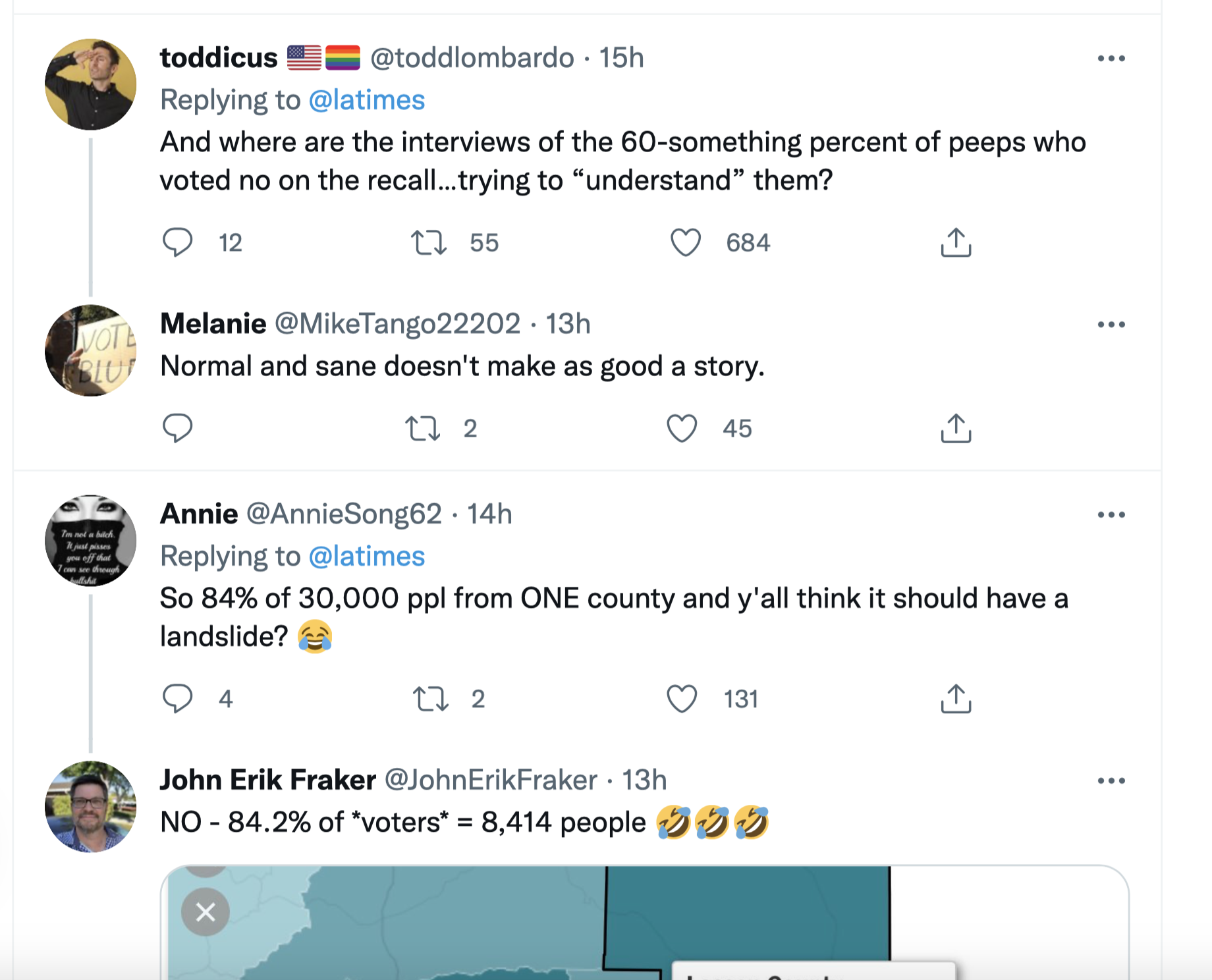
By the way, Hailey Branson-Potts' story attracted a lot of urban haters on Twitter, as you can see here and here.  I'm screen grabbing just two parts of that first thread to illustrate.  Many commenters asserted the Times should have talked to voters in San Francisco or Marin counties, where the vote against the recall mirrored Lassen County's vote in favor of it.  I admit I have no idea who the commenter (Charlee Ferry) is accusing of plagiarism and/or copyright infringement--Branson-Potts or some "yes" on recall supporter who Ferry assumes doesn't have original thoughts:


The LA Times story out of the Central Valley is focused on the LatinX.  The headline is "The Central Valley gives California a recall rarity: a squeaker of a race."  An excerpt follows: 

In 48 of California’s 58 counties, from Oregon to the Mexico border, voters either loved the guy or hated him, with double-digit differences on Saturday afternoon between the yes vote and the no.

Except for one small island in the middle of this vast state, where the recall election was a nail-biter.

Here in the agricultural heart of California, where the drought weighs heavy and the pandemic even heavier, the results were nearly 50-50.

In Merced County, the recall lost by 38 votes. In Fresno County, where the population just crested a million, it won by fewer than 2,000, according to an updated count released by local election officials Friday afternoon.

In both counties, that amounts to one percentage point or less separating yes and no.

Both sides here are claiming victory and both point to Latino voters as an important part of their success. Ballot counting continues throughout the state, and little will be known for sure until the vote is certified in just over a month. The political picture could shift at the county level.

But a few things are clear. The recall failed dramatically statewide. And demographics are destiny.

“The proportion of Latinos [in the Central Valley] is rapidly growing, and to the extent that Latinos have been showing a preference for the Democratic Party, it is an indicator of a strong future for the Democrats,” said Thomas Holyoke, a professor of political science at Fresno State University. “But the Latino vote breaks apart. ... The early returns from the recall show that a lot of Latino men backed the recall.”
Oddly, La Ganga and Chabria paid no attention to urbanization--to the fact that Fresno is the state's fifth largest city, though it did mention Clovis, Fresno's upmarket but smaller sister city.  Perhaps eventually we'll see analysis of Fresno City v. Fresno County voters.  

The journalists also paid no attention to education level.  I would also think that the presence of UC Merced, the youngest of the University of California schools, and the attendant influx of a more highly educated populace would be worthy of note regarding the vote there.  

My earlier post about the California recall vote is here.