Saturday, October 21, 2023

The many hats of a rural child welfare attorney

I've dedicated my three previous posts (here, here, and here) to exploring rural child welfare systems. My own research spanning law review articles, child welfare journals, news articles, and legislative reports, however, took me nearly everywhere except the realm of attorney-specific reforms.

Attorneys can play vital roles in furthering child welfare; it was an attorney, working pro bono, who emancipated one of my own family members, saving them from a situation that would have satisfied any child welfare agency's criteria for removal.

So stories like Gabriel Fernandez's hit too close to home and shook me to my core. The death of eight-year-old Gabriel, at the hands of his own mother and her boyfriend, became the subject of a 2022 Netflix limited series documentary that exposed the shortcomings of the child welfare system.

So many adults failed Gabriel, and there were reports that the Los Angeles County Department of Children and Family Services falsified records of child abuse and kept him with his abusers.

If an urban child welfare agency had these glaring flaws, I wondered how such agencies managed in rural communities.

Casey Family Programs highlights some of the rural-specific barriers to child welfare: higher rates of child poverty, geographic spread that impedes access to social services and family members, limited infrastructure, fewer community-based services, and difficulties recruiting and retaining professional staff.

I wondered where attorneys fit into the child welfare equation and how they could better serve at-risk rural children in their day-to-day work.

Child welfare scholars Paul Johnson and Katherine Cahn provide a generalized approach in their article "Improving Child Welfare Practice Through Improvements in Attorney-Social Worker Relationships."Johnson and Cahn push for cross-training between attorneys and social workers to develop better working relationships for more effective and efficient child welfare outcomes.

The child welfare system requires engagement of several different professionals, including social workers, lawyers, judges, mental and public health professionals, and educators. Johnson and Cahn stress “patience, flexibility, and sacrifice” when sharing knowledge across these professional boundaries.

However, Johnson and Cahn found that attorneys and social workers often diverge on who is responsible for deciding if the child should testify in court; who should recommend a disposition to the court; and who should interpret the court’s orders to the parents. They also reported a “wide range in the levels of consultation between attorneys and social workers” in court cases, with attorneys “generally ha[ving] less social service training than social workers ha[ve] legal training.”

Johnson and Cahn discuss the “Children Can’t Wait” cross-training seminar. The 1988 seminar was designed by the Northwest Resource Center for Children, Youth, and Families to address the conflicts between social workers and attorneys. The seminar included attorneys, public agency social workers, judges, court commissioners, court personnel, guardians ad litem, citizen advocates, child welfare administrators and supervisors, community treatment-resource professionals, volunteer citizen board review members, foster parents and other community professionals from schools, members of local indigenous tribes, and law enforcement officials.

At this seminar, social workers recommend that attorneys “participate in more child welfare training from elementary concepts to advanced practice.” They also suggest that attorneys “respect and understand[]” social workers’ limitations. Social workers also underscored the need for attorneys to be “less adversarial and more trusting, while providing more time for consultation and more consistency in their appointments.”

The lack of anonymity in rural areas amplifies both the need to build this gap and the ability to do so. Given the shortage of attorneys and social services in rural areas, rural attorneys are likely to interact with the same social workers on several occasions.

At the end of the day, better relationships between rural attorneys and social workers provides a unified advocacy effort that is more effective and efficient.

As already noted, social workers are not the only other force at play. The American Bar Association (“ABA”) finds isolated rural courts and government agencies have a scarcity of services which may lower the court's expectations and have detrimental effects for child welfare: lowered expectations may take the form of “decreased visitation, phone-only court appearances, greatly expanded timelines for removal and adjudication findings, significantly limited discovery, denial of expert requests, lowering the bar for reasonable and/or active efforts, increased pro se representation, and so on.”

"Advocating for Parents in Rural America: A Best Practices Approach" provides the ABA’s best approach for rural attorneys representing parents to combat this harmful two-tiered system.

Attorneys representing parents must employ a knowledge-based approach, which revolves around a strong understanding of the rural communities they work in.

This knowledge can help rebut the “cookie cutter” case plans that courts often impose, without any concern for the availability of the services they are mandating, nor the parents’ ability to access those services. A knowledgeable rural attorney will have a better idea of what services are available and advocate a case plan consistent with the parents’ capacities—one that doesn’t set the parents up for failure. A further discussion on rural parent’s limitations and their impact in the termination of parental rights can be found here.

This knowledge-based approach also enables better working relationships with the community’s social service hubs and the people within them, including social workers, judges, and other involved professionals

Furthermore, rural attorneys can and should go a step further to help parents access these resources through both informal and on-record means. These extra measures are vital to ensuring parents can meet case plan requirements in spite of any personal and community limitations.

Child welfare is a team effort, and large-scale and long-term reforms are necessary to overhaul the system. In the meantime, rural attorneys can shape their practice habits and working relationships to provide the immediate assistance that at-risk rural children and families require.

Thursday, October 19, 2023

Literary Ruralism (Part XLII): The Injustice of Place

I've read several books about the impact of place on who gets ahead in life--and who does not.  I assign excerpts of many of these, for example, Sheryll Cashin's Place Not Race, to students in my seminar courses, Law and Rural Livelihoods and The First-Gen Experience in Scholarly and Popular Literature.  The famous economist Raj Chetty has also focused on zipcode as destiny.  

So I was particularly interested to see coverage in the Daily Yonder (a news source oriented to rural issues) of a new book by a famous sociologist who studies poverty and inequality, Kathryn Edin, and colleagues Timothy Nelson and Luke Shaefer:  The Injustice of Place:  Uncovering the Legacy of Poverty in America.  Here are some excerpts from early in the book that mention rural places specifically.  Indeed, what follows are the book's opening paragraphs:   

IT IS HARD TO SAY exactly when we first noticed the pattern. Just before we hit the outskirts of a Cotton Belt town, the fields would give way to a string of gleaming white antebellum homes with large lawns, old-growth trees, and grand entrances framed by columns reaching two or three stories high. Merging onto the majestic arterial boulevards leading into town, we would see more imposing homes presiding over meticulously manicured grounds. 

In Sparta, a rural hamlet near Augusta, Georgia, it appears as though someone has invested millions to restore an elegant Greek Revival home. New windows and shutters gleam. Yet just across the street lies a dilapidated shack, one room deep, with a sagging roof. Over in Demopolis, Alabama, sits the venerable Gaineswood, a massive structure known for its elaborate interior suites, including domed ceilings, remarkable decorative arts, and original antebellum furnishings. Left out of the photos on Gaineswood’s website and tourist brochures are the aging wood cottages in varying states of disrepair, the tumbledown trailers, and the sagging modular houses that flank the historic home.  (page 1) 

The scholars undertook in this book to study poor places, whereas they had previously studied poor people.  They also decided to study health in addition to income.  Here's more on their methodology:

To assess the level of disadvantage in a community, such as a county or a city, we combined traditional income-based measures with other markers, including health. Especially in the United States, health outcomes vary tremendously by race, ethnicity, and income. In 2008, life expectancy for highly educated white males was eighty years, but only sixty-six for low-educated Black men, whose average life span resembled numbers seen in Pakistan and Mongolia. In 2011, the infant mortality rate for Black mothers in the United States was comparable to that in Grenada and just a bit better than that in Tonga. The rate for non-Hispanic whites was much closer to that in Germany and the Netherlands. Meanwhile, a tidal wave of new research was showing that a person’s health is shaped more by their context—their income, family circumstances, and community characteristics, for example—than by their genetic profiles or the medical care they receive. 

Ultimately, as the scope of our study of place-based disadvantage grew, we chose to incorporate two well-measured health outcomes, one that captured conditions at the start of life and the other at the end. In a particular community, what were a baby’s chances of being born with low birth weight, which is closely associated with infant mortality and other threats to children’s health? In that community, how long could the average person expect to live? 

We also recognized the importance of measuring whether disadvantage in a particular place persisted for children growing up there. Especially in the American context, it is almost an article of faith that kids should have the opportunity to do better than their parents. Recently, a team of economists employed confidential IRS data to create a measure of intergenerational mobility (the chance that children born low-income could rise up the economic ladder) for every city and county in the nation. These researchers used tax records to follow children born in the 1980s through adulthood to see where they stood on the income ladder compared to their parents. It was already understood that there were big differences in intergenerational mobility by parental income, ethnicity, and race, but the most stunning revelation of this new research was how much variation there was by place. In some communities, a child born into poverty would probably stay low-income as an adult. Yet in others, they had a much better chance of reaching the middle class. It seemed clear to us that to measure the depth of disadvantage in a community, it would be important to include the rate of mobility from one generation to the next. (pp. 3-4) 

This follows several pages later--and reveals a rural surprise to the authors:  

Immediately, we could see from the rankings that the geographical pattern was stark. The first surprise—especially for three professors who had spent our careers studying urban poverty—was that the “most disadvantaged” places on our index were mostly rural. There is considerable poverty in cities like Chicago, Los Angeles, and New York. But in our apples-to-apples comparison, none of those cities ranked even among the 600 most disadvantaged places in the nation. For the most part, the only cities and urban counties to find themselves among the most disadvantaged were a relatively small number of industrial municipalities in the Northeast and Midwest, such as Cleveland, Detroit, and Rochester. 

Among the rural counties at the top of the list, what we found didn’t fit what most people think of as “rural.” While some of these were majority-white, many, indeed most, were communities of Black and Hispanic Americans. We could see, too, that many places with large Native American populations ranked among the most disadvantaged in the nation (19 of the top 200). Beyond these, though, not one community in the western part of the United States registered among the “most disadvantaged” (those in the top fifth). While some might say we ought to have considered the impact of the high cost of living on poverty—those costs are higher in some places—there are trade-offs. Although people pay more for housing in those places, there are at the same time structural advantages in those areas of the country, such as good health care systems, a more generous safety net, public transportation, and higher-quality schools. This, we think, is why some high-cost big cities like San Francisco and Seattle fall further down our index than expected. We also found that those living in the 200 most disadvantaged places on our index were just as prone to have major difficulties paying for housing as those in America’s 500 largest cities. 

Apart from predominantly Native American communities, the places that our index identified as “most disadvantaged” most often are found in three regions—Appalachia, South Texas, and the vast southern Cotton Belt running across seven states. (pp. 5-6) 

* * * 

Across rural America, monuments, celebrations, and museums are markers of local pride. Indeed, Crystal City has vigorously defended its claim to the title “Spinach Capital of the World” against upstart Alma, Arkansas—also a former spinach mecca that has erected multiple statues of Popeye. Yet in South Texas, the vast Cotton Belt, central Appalachia, and the Pee Dee region of South Carolina, these symbols celebrate a past that is fraught, to say the least. They commemorate the very industries that, for a century or more, spelled misery and hardship for thousands, if not millions, while profiting only a few. They memorialize the intensive resource extraction and resulting human exploitation that made these places America’s internal colonies. 

How did the identities of these communities become so bound to the economic legacies of the past? (p. 21) 

And, skipping to much later in the book, this is especially intersting regarding the diploma divide and how higher education is increasingly seen as a culprit: 

Most often, emerging leaders trying to set a new course have the odds stacked against them—as was the case with Cornejo’s coalition and later with the slate of La Raza candidates who came into office in South Texas in the early 1970s. People at every level are hoping for their failure: when they stumble, it is all the easier to blame the community for its own problems. Universities could certainly play a role in helping to equip local leaders with the tools needed to succeed, perhaps through a model like the USDA’s community- and university-based Cooperative Extension System. Recently, one community leader told us that while his state’s flagship university is not beloved in most rural towns, the extension service is immensely popular because it provides knowledge and resources the community values. Using university extension programs as a conduit for equipping local leaders might help higher ed prove its worth in many far-flung communities. (p. 237) 

Altogether, the book uses the word "rural" 67 times, many of which are in footnotes/end notes.  Here's a WHYY segment on the book.    

Edin's prior books did not pay particular attention to rural poverty or other rural issues.  She is perhaps most famous for Promises I Can Keep:  Why Poor Women Put Motherhood before Marriage (2005) (with Maria Kefalas); Doing the Best I Can:  Fatherhood in the Inner City (2013) (also with Nelson) and $2.00 a Day:  Living on Almost Nothing in America (2015) (also with Shaefer). 

Cross-posted to FirstGenCourse Blog.  

Tuesday, October 17, 2023

Banking deserts and the reliance on costly capital in rural America

 As online banking has steadily increased, many banks have decided to permanently close a number of their branches. Given that banks are choosing to close their less profitable branches, it is unsurprising that rural communities are amongst the hardest hit by the closures. (The tendency for rural banks to make less profit is partly due to the government crackdown on costly overdraft fees.)

The lack of banking access more keenly affects rural residents than those in urban and suburban areas. First, rural residents are more likely to visit a physical bank. According to the Federal Deposit Insurance Corporation, more than 40% of rural customers visited a bank at least ten times in 2019. Banks are also more likely to close their branches in rural areas, forcing residents to travel further, often to the next town, to access a bank. Lastly, rural residents may not have access to spectrum or broadband which then limits their access or use of internet banking. 

Banks serve not only as financial institutions in rural communities but as social ones as well. Darrin Williams, CEO of Southern Bancorp, told NPR, "In a lot of the rural communities we serve, the bank branch is a part of the social fabric. If you go to Truman, Arkansas, on a payday Friday, there are going to be 10 people deep in line. People want to come to that bank branch because it's social."

With the exodus of in-person banking services, rural communities have essentially become located in banking deserts which are defined as census tracks in which there are no bank branches located within a 10-mile radius of the tracts' centers. In a study conducted by the Federal Reserve, 1,500 of 2,100 existing and potential banking deserts are located in rural areas, and the counties most affected are those with a greater proportion of African-American residents. 

Living in a banking desert perpetuates the number of unbanked rural residents. People who are unbanked, meaning that they do not have a checking or savings account at a bank or credit union, reported the lack of branch access as one of the major hurdles to them becoming banked. 

Communities in banking deserts also become vulnerable to predatory lenders. When rural consumers do not have access to traditional sources of credit during times of financial distress, they may turn to pawnshops and payday lenders. Loans from such places tend to have much higher interest rates and it can be a gateway to a cycle of debt. 

In fact, rural residents are more likely to not have any credit established at all. Rural areas have the highest rates of people without a credit history from the top three consumer reporting agencies: Equifax, Experian, and Transunion. This is due to the inaccessibility of banks, the inability to meet the minimum balance requirements, and the mistrust in banks. The lack of usable credit history makes it more difficult to receive an extension of credit during financial hardship and this increases dependency on costly nontraditional sources of credit. 

Another factor affecting access to traditional credit is unpaid medical bills. Almost one in five households in the U.S. have past-due medical bills and these numbers are greater in rural areas. (Read more about the rural healthcare crisis here.) This has a negative impact on credit reports and ultimately limits access to credit, housing, and employment. Unpaid medical bills also fuel costly borrowing. 

Rural areas have the highest utilization of non-bank credit. These loans can have devastating consequences such as the risk of eviction or foreclosure. The reality is that payday loans are not quickly paid off and tend to result in several additional loans within a short timeframe. The typical payday loan borrower takes out eight loans in a year and is in debt for more than six months. Interest rates are also astronomically high. In the end, borrowers pay an average of $520 in interest on a $375 loan. 

The rising financial crisis in rural communities led to the development of the Rural Initiative under the Consumer Financial Protection Bureau (CFPB) in 2022. The goals of the Rural Initiative are to conduct research to increase access to credit, develop effective ways for residents to file complaints with the CFPB, conduct roundtables with rural stakeholders, and work with federal agencies to ensure adequate financial resources. 

The Rural Initiative is a step in the right direction, but it is clear there needs to be a drastic shift in how financial institutions operate in rural communities and the resources available there. Steven Jackson, a parish commissioner in Shreveport, Louisiana, told NPR, "When you have young boys and girls riding by and seeing empty buildings, or that building which was once a bank is turned over to a payday lender, what message are we sending? Is my neighborhood not a priority?" 

Read more about rural banking here and here. 

Tribal co-management of National Parks (Part III): Grand Portage National Monument

The Grand Portage Band of Lake Superior Chippewa call the Grand Portage area Gichi-Onigaming. The Grand Portage Band are Ojibwe or Anishinaabe people. The Band's website refers to their people as Ojibwe, so that is the term I use throughout this article. It is worth noting that not all Anishinaabe people prefer to be called Ojibwe.

Jeff Rosenthal/Wikimedia Commons

Grand Portage National Monument is on the northwestern shore of Lake Superior, seven miles south of the United States-Canada border, and 36 miles north of Grand Marais, Minnesota. The Grant Portage National Monument lies within the Grand Portage Indian Reservation, the sovereign territory of the Grand Portage Band of Lake Superior Chippewa.

Of all the parks I am covering in this series, this is the one that is closest to my home, in Chicago. (See Part I here, and Part II here) For these posts, I rely heavily on the Administrative Histories of the parks that the National Park Service (NPS) puts out. So far, Grand Portage is the only one with a very recent (2023) administrative history that prioritizes Indigenous history and viewpoints. Check it out here.

Grand Portage National Monument is a long, skinny piece of land with two larger land bases on either end. The majority of the park is the Grand Portage trail, a valley that connects lake superior to the Pigeon River. If you've never been to Minnesota, you might not know that it is the "Land of 1,000 Lakes." This refers primarily to the literally thousands of lakes that make up the boundary waters between the United States and Canada. The Grand Portage Trail enabled Indigenous peoples and fur travelers to portage their canoes and cargo from the Great Lakes to the Boundary Waters, facilitating travel west. 

Grand Portage National Monument was established in 1958, on land that was largely granted to the Grand Portage Band of Lake Superior Chippewa through treaty in 1845. However, the Grand Portage Trail had been important to both European and Ojibwe people for hundreds of years. The French began using the trail to bring their fur trade farther west at the end of the 17th century. The Ojibwe traded with the French— fur for guns. They used those weapons to expand their territories. When the French territories in North America passed to British control, the Grand Portage Trail became increasingly important. It was the most practical avenue for fur traders coming from Montreal to access the west. Eventually, the fur trade moved farther north, and left the Grand Portage Trail. 

The late 19th century saw several rounds of treaties ratified between Ojibwe peoples and the United States. The Grand Portage Reservation was established in 1854. The reservation protected that portion of Ojibwe lands from mining prospectors and logging companies until allotment. In the 1920s, the Minnesota historical society took an interest in the Grand Portage trail as part of Minnesota's fur trading history. They attempted to buy several sites, but could not do so because the land was on the Grand Portage reservation. 

Conservation efforts picked up speed in the 1930s, after the passage of the Indian Reconstruction Act (IRA), which ended allotment, promoted self-governance, and established a loan program to promote Tribal business. To receive the benefits of the IRA, Tribes had to opt-in by adopting a constitution. Minnesota Ojibwe peoples opted in and adopted a constitution and bylaws, becoming the Minnesota Chippewa Tribe. The larger Tribe also adopted separate charters for each band, including Grand Portage. 

Also in the 1930s, the United States protected more than a million acres of land in northern Minnesota as the Boundary Waters Canoe Area Wilderness (BWCAW). Nearby Isle Royale was made a national park not long after to act as a jumping-off point for tourists visiting the area. After WWII, the NPS revisited an old idea of establishing a protected site in the Grand Portage area to connect Isle Royale and the BWCAW. The Grand Portage Tribal Council was initially reticent, as they were struggling to undo the creation of two areas of protected wilderness on the Reservation that were impeding development. Eventually they were convinced to embark on the project with the National Park Service. The Tribe's interest was in attracting revenue and jobs to the Reservation, while the Park Service sought to preserve the wilderness and fur trading sites.

The final agreement retained Tribal ownership of the land but granted the NPS a covenant to that land for purposes of a national historic site. The land was designated a national historic site in 1951. However, President Truman ordered spending on the development of the site to be capped at $2,200 (approximately $26,000 today) per year because the federal government did not own the land. In 1953, the Tribal Council reluctantly agreed to cede the land to the Federal Government. The agreement was not finalized until 1958 because it took that long to get the required agreement among tribal members for the land transfer. In 1958, Congress passed Public Law 85-910, establishing the Grand Portage National Monument. The law expressly provided for the co-management of the National Monument, even including a reversion to the Tribe if the NPS ever abandoned the park. 

Throughout the 1960s, however, the NPS failed to develop the monument to the extent that it would attract tourists and improve the Grand Portage economy. In 1969, a fire destroyed a number of buildings in the monument, including a reconstruction of the Great Hall that had once stood in Grand Portage. 

In the 1970s, the Park Service and the Tribe adopted an ambitious development plan. Parts of the plan were completed, but the coordinators ran into funding issues once the Reagan administration took office. Park development stalled, and the Department of Interior even briefly listed Grand Portage as a Park that should be removed from the Park Service's holdings (this idea was quickly scrapped after Congressional protest).

 Meanwhile, the Tribal Council turned to gaming in a continued effort to bring revenue and jobs to the community. They opened a resort complex in 1975, and added a casino in 1990. The success of the casino spurred economic growth and employment opportunities on the Reservation. The NPS applauded the growth, but worried that the casino would clash with the historic and environmental conservation projects. After failing to provide for real economic growth for twenty years, the Park Service looked bad complaining when the Tribe found a different way.

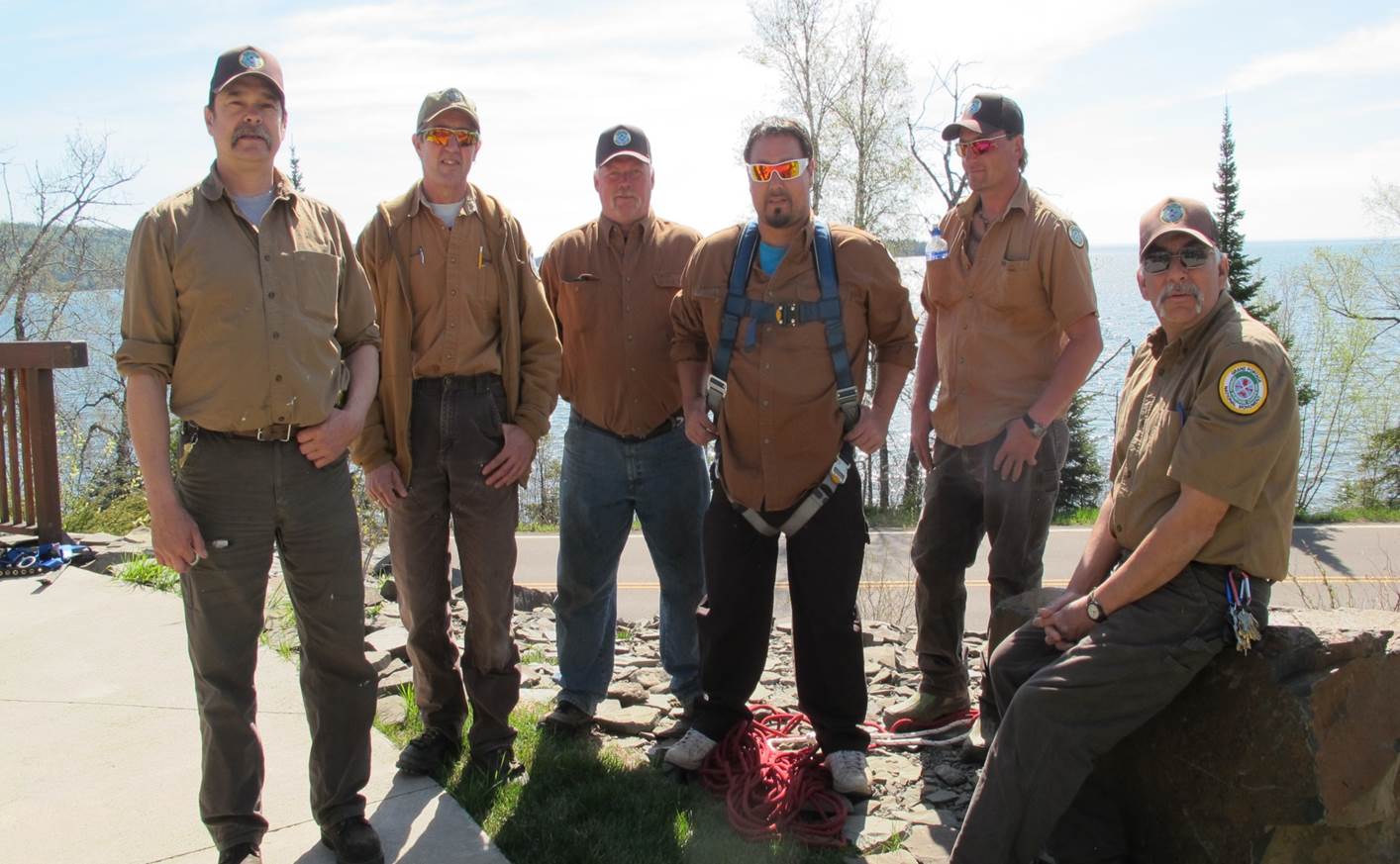
In 1998, the NPS and the Grand Portage Band entered into a co-management agreement, the first co-management agreement to involve primary operations at a national park. The Grand Portage Band was put in charge of all maintenance work at the monument. The Band's workers are allowed to dress in their Band uniform, as opposed to the NPS's green and grey uniforms. The co-management agreement has also led to the development of programming for teen Tribal members to learn how to build birch bark canoes, plant traditional gardens, and repair bridges. 

In 2021, Heather Boyd was appointed Superintendent of Grand Portage National Monument. She is  a member of the Red Cliff Band of Lake Superior Chippewa and the first Anishinaabe woman to manage the National Monument. Though Grand Portage is not her Tribe, moving there felt like a homecoming. Speaking to Minnesota NPR, Boyd said:

When I first started with the Park Service, I wasn’t promoting my heritage and my culture because it didn't feel right. Here, I feel like I’m empowered to do that. It feels awesome.

Monday, October 16, 2023

Despite renaming efforts, Indigenous slurs persist in rural jurisdictions

 In January 2023, the federal government removed a common slur that is both racist and sexist towards Indigenous women in nearly 650 locations nationwide. A few months earlier, Governor Gavin Newsom signed a bill removing the word sq**w  from public spaces in California. 

One of these uses was in Yokuts Valley in Fresno County, California. Yokuts Valley, population 3,511, is a small community located at the foothills of the Sierra Nevada Mountains on State Route 180, just south of Kings Canyon National Park. According to the USDA's definition, the Yokuts Valley is rural. 

The federal name-change movement was led by Roman Rain Tree. Rain Tree is a member of the Dunlap Band of Mono Indians and Choinumni People and is the founder of the Rename Squ**w Valley Coalition. 

In January of 2022, Rain Tree filed a petition with the U.S. Board of Geographic Names, saying that the region "deserved a respectable name, one that, at the very least, does not degrade the people indigenous to the Sierra Nevada foothills." This petition ultimately resulted in the January 2023 federal name change. 

Before we look at this rural place's decision in refusing to comply with these changes, we should dive into the history of the term first. 

History of the S-Word

The term sq**w (now referred to as the "S-Word") has been historically problematic. It is understood by Indigenous peoples (like the Nimíipuu community) as "an alien non-Indian term." The term does not have an indigenous linguistic equivalence, and was never translated into the Nez Perce language.

Moreover, the phase was created by Lewis and Clark in 1805 and was later used by early fur traders and trappers who came to Idaho. The University of Idaho's Lewis & Clark rediscovery project studied the word's significance and found that while Lewis and Clark attached a neutral meaning to the term, it is still derogatory: 
Lewis and Clark perhaps attached a more neutral meaning to the term's use in their day, not deliberately intending it to be offensive. In daily verbal discourse today Indians generally understand the term in a highly negative fashion, referring to a range of derogatory and demeaning significances.
Scholars have historically debated the origins of the term. In 2000, linguist William Bright at the University of Colorado published a research paper in A Journal of Onomastics called "The Sociolinguistics of the “S–Word”: Squaw in American Placenames" where he defines the S-Word and its origins in the paper's abstract (NOTE: quote has been edited for political correctness): 
Placenames containing the word [“sq**w”] are numerous throughout the United States, but have recently become controversial. American Indian groups and individuals have presented three kinds of argument against the use of the term. The first argument is that it is derived from an Mohawk word for the female genitalia. Linguistic data show, however, that it is actually a New England Massachusett word for ‘woman'. [sic] A second argument presented is that “sq**w” has been, and is still, used derogatorily by whites toward Indian women. This argument is supported only weakly by literary documents, but more strongly by frontier memoirs and journalistic writing. The third argument is that [“sq***w”] is offensive to Indians, in the same way that [“n****r”] is offensive to African Americans.
Regardless of its origins, the term is considered universally offensive by Indigenous peoples in America and Canada. It is considered to be so offensive that even prior to 2023, businesses have been renaming things that mention S-Word an effort to condemn America's colonial and oppressive history. In June of 2020, Palisades Tahoe (a ski resort formerly known as S-Word Valley) committed to changing its name and stopped using the derogatory term in September of 2021.

Rural Places Hesitancy to Correct Our Problematic Past via Renaming

This month, Fresnoland published an article detailing how Fresno County is refusing to acknowledge both the S-Word's offensive history and even the existence of the name change in general. 

While the majority of these places honor the name change, Fresno County has refused to accept and comply with this name change. In an interview with Fresnoland, County Supervisor Nathan Magsig said that: "“Fresno County recognizes [Sq**w] Valley as [Sq**w] Valley.” In a Facebook video, Magsig can be seen using the derogatory term. 

Unfortunately, Magsig and Fresno County do not have to comply with the federal name change mandate regarding the S-Word because the federal 2023 removal of the S-Word applies only to federal jurisdictions, even though the petition was started by a member living in the Yokuts Valley. 

Magsig and Fresno County continue to fight to keep the S-Word around. The Fresno County Board of Supervisors’ rebuked the federal name-change mandate, and refuse to acknowledge the change ever existed. 

The Fresno County Board of Supervisors also voted in March to sue the state of California based on the bill Newsom signed. The lawsuit claims that the County "never intended [the term]. . . to be derogatory or racist in its intent or cultural meaning in that Community" and should remain because of the First Amendment. 

My question is: why are local governments so committed to opposing name changes that correct offensive nomenclature? More broadly, why are rural places more hesitant to embrace social change?

One reason could be political orientations. A 2018 Pew Research Center poll found that rural voters are increasingly tilting Republican, with 54 percent of survey rural respondents surveyed identifying as "Republican or Republican-leaning" and 36 percent identifying as "Democrat or Democrat-leaning." 

Among the Republican respondents, the study found that rural Republicans had more favorable views of former President Donald Trump than urban or suburban Republicans. 

Former president Donald Trump certaintly does not stand for political correctness. In a 2016 article, NPR quoted Trump who denounced political correctness:
I think the big problem this country has is being politically correct," Trump tells the moderator, Fox News' Megyn Kelly. "I've been challenged by so many people and I don't, frankly, have time for total political correctness. And to be honest with you, this country doesn't have time, either. 
Trump has also been known to be an offensive name-caller. He has called Senator Elizabeth Warren "Pocahontas," U.S. representative Adam Schiff "Pencil Neck," and even made fun of the appearance of Senator Ted Cruz's wife, comparing her to his wife Melania.

Polls also show that Republicans are more likely to oppose changes that make place names politically correct.  Last year, the Washington R*dsk*ns changed their name to the Washington Commanders because the team name was "offensive to many Indigenous people who viewed the name and branding as both a slur and a disparaging stereotype grounded in America's history of violence against Native peoples," according to NPR. 

While many people praised the Commander's name change, 90 percent of Republicans surveyed in a 2014 study said a name change was unnecessary. While that survey was almost ten years old, not much had changed by the time the switch to Commanders was made. In 2021, Native groups demanded that the Atlanta Braves eliminate the "Tomahawk chop" symbol on the team's logo, saying that it perpetuates racist stereotypes. As of today, the MLB team logo remains. 

One reason besides political affiliations as to why rural communities could be adverse to name changes is because they are more focused on what they see as greater, more significant problems. To use a rural colloquialism, they have "bigger fish to fry." 

A 2022 Pew Research Study found that rural Americans are more worried about drug addiction compared to their urban and suburban counterparts. The poll found that 44 percent of rural Americans believe drug overdose is a major problem in their communities compared to 33 percent of suburban folks and 34 percent of urban folks surveyed. 

Further, rural Americans are less likely to have reliable health care services compared to their counterparts. They also have higher rates of poverty than those in metropolitan areas. The incidence of disability is also greater in rural areas than metropolitan areas.

Regardless, both rural and urban governments should prioritize the renaming of landmarks, sports teams, and rivers. This is a great first step toward denouncing America's racist and oppressive past. 

As a society, we have a large responsibility to do better to honor Indigenous peoples and denounce the injustice associated with the founding of this country. A recent Australian ballot initiative that would have given Indigenous People greater political rights failed. While this is disappointing, it is hard to imagine a comparable initiative even appearing on a ballot in the United States. Unfortunately, some local governments won't even rename things that are offensive, let alone give Indigenous People more political rights. 

You can read more about Indigenous issues in rural places here, here and here. 

Ring of fire brings floods of tourists: hundreds of thousands travel across the American West to see an annular eclipse

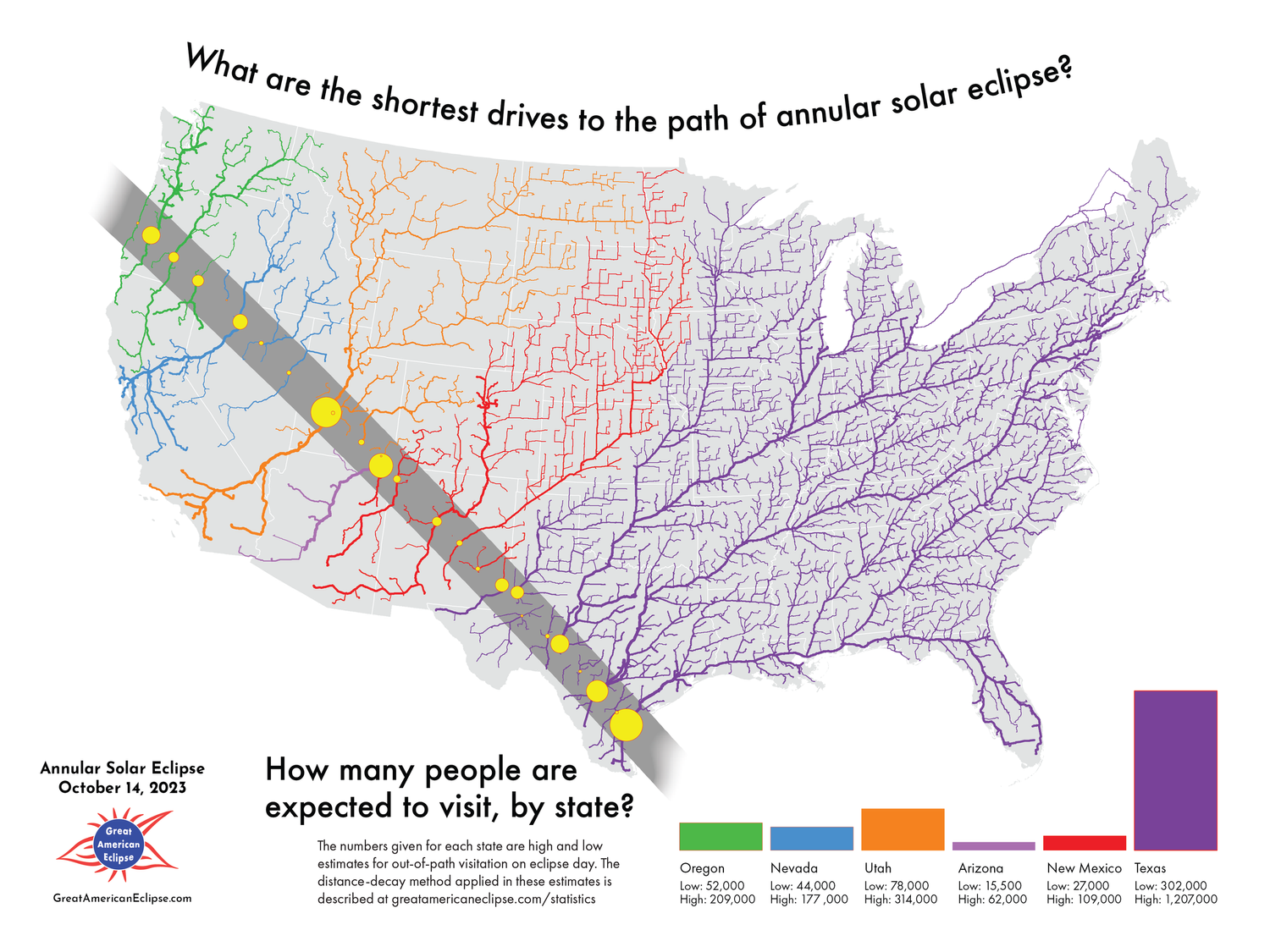
This weekend, a rare annular eclipse crossed over the Americas. Beginning in Oregon around 9 am local time on October 14, the eclipse cut through the American Southwest and Yucatan Peninsula in Mexico before traveling over Central America, Columbia, and Brazil. States within the path of annularity prepared for an onslaught of ecotourists coming to experience the once-in-a-generation event. In the United States alone, an estimated half a million to two million people were expected to travel for the eclipse.

Travel Oregon, the state’s tourism agency, advertised the many opportunities for businesses along the path. Klamath County organized a week-long Eclipse Fest to celebrate. County officials issued a travel advisory on Saturday and collaborated with more than a dozen federal, state, and tribal agencies to handle a wave of ecotourists that were expected to temporarily double the county’s population.

Remote Modoc County, California, expected tourists to outnumber residents as Californians flocked to the only county in the state in the path of the eclipse. Hotels in the small town of Alturas, population 2,715, booked out for the weekend.

In neighboring Nevada, Great Basin National Park welcomed visitors with guided viewings, astronomy programs, and guest speakers from NASA, while the nearby town of Ely, population 3,924, hosted a 4-day Ring of Fire Eclipse Festival. Meanwhile, the state’s tourism agency directed visitors to the best viewpoints and state energy officials prepared for a temporary shift as the eclipse dampens solar energy production, which accounts for over a third of the power supply for the state.

The Utah Department of Transportation warned visitors and residents alike of heavy traffic, as an expected 300,000 travelers drove across central Utah roads and highways. Thousands of visitors flocked to Bryce Canyon National Park for clear skies to view the eclipse.

While other parks were filled with crowds, the Monument Valley Navajo Tribal Park was closed in keeping with sacred tradition. For the Navajo people, or Diné, as they call themselves, solar eclipses are a time for reflection and tranquility. The Navajo practice solemnity, not spectacle, out of reverence for the rebirth of the sun, which they regard as a father figure. Tribal educators instructed their people to pray in their homes and to avoid eating, drinking, sleeping, or looking at the eclipse, following centuries of tribal practice.

Just north of the Navajo Nation, the Bear Ears National Monument, which is co-managed by the Bureau of Land Management and indigenous tribes such as the Hopi and Ute, prepared for as many as 20,000 visitors. The Bear Ears Partnership informed tourists of the different beliefs held by those tribes, who view the area as sacred and encouraged them to visit with respect.

While the West relishes in the increased tax and travel revenues and returns to normal life, the Northeast, Midwest, and South prepare for future crowds of their own. A total eclipse will cut a path from Texas to Maine on April 8, 2024. While Indiana gets ready for what is expected to be the single largest tourist event in the state’s history, Ohio anxiously awaits the estimated $23 to 94 million in economic benefits that it hopes to gain from eclipse tourism.

You can read more about preparation efforts in Newton County, Arkansas, here. You can read about eclipse tourism during the last solar eclipse in 2017 here.

Unleashing the river: The Klamath dam removal project

The Klamath River, flowing through California and Oregon, is not just a waterway but a lifeline for people and wildlife. For decades, the river has faced numerous challenges, including water diversions, pollution, and four hydroelectric dams that have significantly altered its natural flow. Now, however, a remarkable endeavor is underway to restore the Klamath River to its former glory: The Klamath dam removal project is the largest dam removal in the world. You can read prior posts about the Klamath dams here and here.  

The Klamath River holds deep cultural significance for indigenous tribes, particularly the Yurok, Karuk, and Hoopa Valley tribes. These tribes have relied on the Klamath for thousands of years to provide salmon, steelhead, and suckers. However, the river’s ecosystem began to deteriorate in the 20th century with the construction of four hydroelectric dams: Iron Gate, Copco 1, Copco 2, and J.C. Boyle. The four dams were built for power generation and disrupted fish migration, sediment transport, and nutrient cycling. Annelia Hillman, a traditional food coordinator for the Yurok tribe, commented,

This river is our lifeline. It’s the foundation to our people, for our culture.

In 2001, two cases brought national attention to issues between farmers who relied on the dam’s water for irrigation and the Coho salmon listed under the Endangered Species Act: Kandra v. United States and Pacific Coast Federation of Fishermen’s Associations v. U.S. Bureau of Reclamation. In these cases, locals and agencies fought over who deserved water during a historically dry year. The Bush administration ultimately sided with the irrigators, diverting water to farmers during the drought year. These water diversions drained critical river habitats, culminating in salmon populations plummeting during the 2002 Fish Kill. Outrage over the 34,000 dead salmon supercharged the campaign to remove the dams (See also Yurok Tribe v. U.S. Bureau of Reclamation and Baley v. United States).  

Iron Gate Dam (Photo: Katie Eng, September 29, 2023)

Last month, I had the privilege of hearing from the CEO of the Klamath River Renewal Corporation, Mark Bransom. Bransom spoke about FERC’s decision to decommission and acknowledge the social and cultural impacts of the dams  for the first time. FERC also banned the Klamath’s hydroelectric license. For more about FERC’s approval of the four dams, see this blog post. 

Today, the Klamath River Renewal Corporation is working to blast holes through the base of the dams, dredging out the accumulated sediment and flushing the sediment and accumulated algae (muck) into the ocean. When I visited the dam last month, Bransom commented, 

The river needs to go through a little more pain before it heals again.

Meanwhile, the Klamath River Renewal Corporation is working closely with indigenous tribes to cultivate seeds from over 90 species of native vegetation. They hope to plant over 19 billion seeds over 8,000 acres. With such aggressive efforts, the Renewal Corporation anticipates a 24-month timeline for the project to be complete, with returning adult salmon inhabiting the river by next October. 

It would be surprising, of course, if a project of this size had zero opposition. In fact, Bransom says the Renewal Corporation has struggled with balancing the interests of environmentalists and local property owners —he calls them the “way of life” people versus the “quality of life” people. 

Driving along the roads of rural Hornbrook, California, where Iron Gate Dam lives, it is typical to see signs protesting the dam’s removal. Bransom says locals are worried about the noise, the future lack of a lake for recreational activities, and the impacts on property values. He spoke about the difficulties in telling senior locals, whose retirement money is wrapped up in their waterfront property, that the removal will affect their estates for the next decade. Bransom believes that ten to fifteen years from now, the Klamath River’s restored wildlife and salmon populations will positively impact property values and the lives of those that’s live beside it.

J.C. Boyle Dam (Photo: Katie Eng, September 30, 2023)

The possibility of salmon returning to the Upper Klamath raises questions about whether the dam removal project could inspire other changes in Oregon and California. One such place a dam removal project may be warranted is the Snake River, where tribes and farmers suffer from water shortages and related environmental issues. Under the direction of his legal team, Bransom was unable to comment on whether he thinks similar efforts would be successful in California. However, Bransom has hope that the lessons learned from the Klamath dam removal project will be used for years and decades to come—including in other locales facing similar quandaries.

Saturday, October 14, 2023

Moving backwards - Australia votes no for the indigenous voice to parliament

On Saturday 14 October, Australia was faced with a monumental opportunity to amend their Constitution with the nation's 45th referendum. The proposal was to recognise Australia's indigenous people - Aboriginal and Torres Strait Islanders - through a constitutionally enshrined body that provides non-binding advice to Parliament. This body is known as 'The Voice'. 

The Voice has been a project in the works since 2017, when the Uluru Statement from the Heart was presented to Australian's. The Statement was devised by a 16-member Referendum Council that travelled around Australia to consult with indigenous Australian's in regional areas, about what they believed would be the best step forward in creating a more equal future. The purpose of the Statement is for indigenous Australian's to actually be given the opportunity to have input over policies that directly effect on them. 

In the Referendum Council's final report released in 2017, they put forward two recommendations:
1. Constitutional reform to implement an advisory body that represents Aboriginal and Torres Strait Islanders; and
2. An extra-constitutional Declaration of Recognition enacted by legislation. 
After seven years of discussion, the first recommendation has finally been acted upon - but not in the way it was intended.

For what could ultimately be deemed as the most important referendum in Australian history, the 'Yes' campaign has been provided an immensely disappointing lack of promotion by the Australian government, while also having to battle against a wave of false information disseminated through various media platforms. The failure to adequately promote The Voice has left a frightening portion of the Australian population completely unaware of what it is, where it came from and most importantly, why it's desperately needed. 

To my absolute shock and horror, an alarming number of those unaware to The Voice are indigenous Australian's living in rural and remote areas. Yes, you read that correctly. The knowledge of The Voice that has been devised as an incredibly important mechanism to represent indigenous Australian's, has not been provided to Indigenous Australian's in remote areas. If this doesn't illustrate the inequality of the urban- rural divide, I really don't know what will. 

For a population that is already disadvantaged with basic, fundamental human rights such as access to health care and education, it appears that the remote Indigenous population is being further discriminated against based on their geographical location. While it can be argued this is not an intentional form of discrimination, it also demonstrates the lack of access to basic resources that rural populations face. 

Paul Kabai, an environmental activist based in Torres Strait, explained that access to any source of reliable information regarding The Voice was an extreme challenge.  
Nothing has been explained to the elders here on the [Sabai] Island ... talking with people about voting, it's all 'what is this referendum vote all about? What is the no, what is the yes?' Voting is just around the corner and there is nothing. 
The burden of seeking information was placed upon the remote communities, but with some of these areas not even having knowledge of The Voice's existence in the first place, there wasn't even the option to self-educate. As a young, white woman, with both a tertiary and private school education, I have come to realise the absolute privilege I have to be informed about national politics. For what I thought was just a factor of everyday life, is actually something I have taken completely for granted - and for this I feel completely ashamed and embarrassed. 

The idea that a constitutionally recognised body, devised to represent me, as an attempt to create a more equal future after centuries of intergenerational trauma and discrimination, was not even brought to my knowledge is simply beyond comprehension. This is not only an example of geographical discrimination, this is a shameful representation of Australia and its care towards remote populations. 

The result of the referendum was released in the late hours Saturday evening - an overwhelming 60.05% vote against The Voice resulted from a majority no vote within all six states and one territory. The one territory to have a majority vote for yes was the Australian Capital Territory (ACT), the home to the seat of the Australian government, and Australia's capital city, Canberra. 

I think it would be completely ignorant to believe that this is merely coincidental. At this point, it is well known that The Voice was not well promoted by the government and the push from the Yes campaign came far too late. The fact that the ACT has the easiest access to any parliamentary based information - with more than half of the population within the ACT are government workers - speaks volumes about what could have happened if every state and territory received the same amount of education. 

The ACT is known as Australia's only city-state. Almost all of its 472,000 population live within urban areas and its agricultural industry provides an insignificant input to the economy. As can be seen below, geographically, information doesn't have very far to travel within the ACT, which places them in a serious point of advantage when it comes to being educated on governmental based issues and incentives. 


Australian Capital Territory marked out on an Australian map. 
Image sourced from Getty Images.

While I strongly believe that self-education is the responsible thing to do when it comes to exercising your right to vote, the reality is, the majority of Australian's are lazy. If they are not spoon fed exactly what they need to know, they simply will not attempt anything further. The fact that the ACT voted yes isn't because they are most progressive out of all states and territories, its because they have the easiest access to all the relevant information.

A further factor of concern around the dissemination of information to rural areas, is that indigenous Australian's make up the majority of rural and remote populations. The lack of engagement with these remote communities has been expressed by Mulgyin Jaru-Kitja and Gooniyandi woman, Corina Martin, in what can only be described as an accurate, yet heart breaking summary:
That's a problem with anything to do with Aboriginal people, we are the last lot to get information on ourselves.
While there are strong arguments that The Voice wasn’t the best solution to centuries of abuse and oppression, it was going to be a step in the right direction and the platform for future development. The Australian government and politics has never been a perfect system. So why all of sudden are we wanting a perfect solution? 

As explored in a previous blog post, the theory of 'interest convergence' coined by an American law professor seems to be applicable in this circumstance. Black people only achieve civil rights victories only where white and black interests converge. White Australia has demonstrated in this referendum, that indigenous rights are not within their interests. 

Australia is allegedly the country of giving everyone a ‘fair go’; but this decision has showcased anything but. Just like the kangaroo and emu (our national animal and bird, which can only physically move forwards, not backwards) on the coat of arms, we are meant to be a nation that has the ability to only move forwards. Yet here we are, running back to our white, conservative origins.

Wednesday, October 11, 2023

Rural responses to corporate utility disasters (Part III): Building local power through community choice aggregation and microgrids

In this series on rural responses to corporate utilities, I have used the August 10 Butte Creek PG&E canal failure as a spring board for examining both investor-owned utility harms and community response. My first post talks about the failure’s devastating ecosystem impacts and the immediate community response. In my second post, I examined how the Klamath Dam removal project could provide a blueprint for Butte Creek Canyon and Chico community members to succeed in removing the Centerville dam and associated hydroelectric project. In this third and final installment, I turn to the topic of local electricity options.

Residents of Butte Creek Canyon and others in the Chico area frequently express justified frustration with PG&E, the large investor-owned utility that serves Butte County and much of the rest of California. After looking at local alternatives to PG&E, I see a path forward via community choice aggregation (CCA) and microgrids.

Butte County residents’ feelings, largely spurred by PG&E-caused fires, ecosystem threats, and blackouts, are not unique. In 2019, when PG&E was more frequently in the news, public dissatisfaction throughout the utility’s service areas rose from 49% to 61% in just 9 months. Around the same time, some state leaders, including Gov. Gavin Newsom considered replacing PG&E with a large public utility (you can read more about the debate to do so here). However, the state ultimately approved PG&E’s reorganization plan, more or less ending the immediate chance of a state government takeover.

This has largely left PG&E alternatives in the hands of regional and local governments.

Public utility districts are one option for local governments.They are municipalities or municipal corporations that provide and distribute energy for their residents.

While public utilities operating their own distribution infrastructure can offer community members a high level of oversight and energy resiliency, as well as lower energy rates, creating them can be time and resource intensive. The history of the Sacramento Municipal Utility District (SMUD) is illustrative of this. Voters elected to create SMUD as a customer-owned, not-for-profit electric service in 1926, but operation didn’t begin until 20 years later. This Courthouse News Service article explains the sequence of events:
In 1934, Sacramento voters approved a $12 million bond to acquire PG&E's assets. What followed was a 12-year legal battle. The Railroad Commission, predecessor to the California Public Utilities Commission [CPUC], approved Sacramento's bid to take PG&E's wires and equipment by eminent domain for $11.6 million. PG&E challenged that decision in federal and state court, eventually losing when a state appeals court ruled against it in 1946.
PG&E’s resistance to public utilities didn’t end in the ’40s. In 2006, it spent millions of dollars to defeat a Yolo County ballot measure that would have allowed SMUD to take 77,000 customers from PG&E; and it has met San Francisco with significant resistance over its ongoing efforts to purchase PG&E’s power infrastructure within the city.

The barriers to creating a public utility district are high even for larger cities. They are exacerbated in rural places, where voters are less likely to approve local bond measures and communities often have less capital and fewer legal resources. It can also place the burden of improving poorly maintained infrastructure on communities. Enter community choice aggregation.

CCAs are local, not-for-profit programs through which communities can purchase their own electricity in place of investor-owned utilities. The existing investor-owned utility still operates the transmission lines and provides customer service. While this doesn’t give the community full electric autonomy, it can make local power more feasible in rural places. Under this model, communities don’t enter costly legal battles to acquire PG&E’s equipment and don’t take on the liability and costs of managing an aging grid that requires extensive maintenance and repair.

Communities in Humboldt County launched a CCA program through Redwood Coast Energy Authority (RCEA) in 2017. Their model is one that Butte Creek Canyon and Butte County residents might look to. (For another example of rural microgrids, see this blog post.)

In this episode of the Local Energy Rules podcast, RCEA Executive Director Matthew Marshall talks about the authority’s climate resiliency projects, which include using local logging byproducts of biomass to create renewable energy in the region and solar microgrid projects.

The Blue Lake Rancheria, a federally recognized tribe and member of the RCEA created a solar microgrid in 2018. In 2020, its microgrid allowed the tribe to continue providing onsite power during a county-wide public safety shut-off. This increased energy resiliency directly benefited community health as the tribe provided hotel rooms with continued access to power to community members who relied on electric medical equipment.

In 2022, RCEA opened the state’s first 100% renewable, multi-customer microgrid. The microgrid powers the regional airport and U.S. Coast Guard Air Station, both important facilities during emergencies. In the podcast episode, Marshall said this first multi-customer project can lead the way for other microgrid opportunities:
One of the things that’s very exciting about this, and we’ve gotten a lot of support and funding for this project from the California Energy Commission, is the opportunity to do this kind of a multi-customer microgrid setup [that] really opens up the opportunity to look at neighborhoods or areas where maybe there’s multiple hospitals or other kinds of situations where [... we may] be able to operate a whole section of the grid that includes multiple customers. [That] really will hopefully broaden the range of opportunities where you could deploy micro grids to provide resiliency and emergency response capabilities.
As another rural(ish), northern California region that also faces wildfire and other natural disaster threats, Butte Creek Canyon and Butte County as a whole could greatly benefit from implementing CCA and microgrids in a similar way. While obtaining full control of the grid would also be beneficial (and could still be pursued down the road), a CCA and microgrids offer a more immediate opportunity to create energy resiliency during wildfires and make more renewable energy-based choices within the community. 

And, the community might be able to obtain substantial assistance with funding a project like this. As I finished writing this, I discovered that just today, PG&E launched its portion of a CPUC Microgrid Incentive Program, which will provide grants to disadvantaged and vulnerable communities for installation of clean-energy microgrids. 

Tuesday, October 10, 2023

Amtrak: carrying more than passengers

Last week, Tony Pipa spoke at the UC Davis School of Law in a talk titled "Creating Sustainable, Equitable Rural Prosperity in the U.S.: Opportunities and Challenges for Federal Policy." Part of the conversation was about transportation to rural communities. You can read more about rural transportation here and here.

Transportation inequality is stark for those living in rural places in the U.S. "Federal transportation policy and funding programs heavily favor new highway and interchange construction." While this type of investment can make it easier for people to get to rural places and engage in ecotourism, for example, it doesn't encourage spending time in the rural communities themselves. 

Those living in rural communities are more reliant on cars to get around compared to those living in urban places. For instance, in 2019 rural residents drove 33% more miles than urban residents as 1,200 counties in the U.S. do not have access to public transportation. As a result, rural fatalities accounted for 49% of all traffic fatalities nationwide. 

Since airlines and bus companies have been cutting services to small towns for decades, the value of Amtrak in these rural communities cannot be overstated. Amtrak provides numerous benefits to residents and travelers regarding ease of use, safe transport, and economic prosperity. In 2015, Amtrak's long-distance services transported 4.5 million passengers, many of whom lived in places without other reliable transportation options. Over 2.5 million people say they can only travel with Amtrak services. 

From 1972 (Amtrak's first full year of operation) to 2019, passenger numbers went from 16.6 million to 32.5 million, even with route mileage shrinking by 1600 during the same period. Recently, Amtrak trains serving rural Virginia have had a 13% increase in riders between 2013 and 2019. In 2019, Montana mayors were asked what effect losing their Amtrak service, the Empire Builder, would have on their people, and all responded "devastating." 

Previously, Amtrak considered a plan to break up their Southwest Chief Service (which travels from Chicago to Los Angeles over a 40-hour journey). If the plan to break up this service had gone through, 32 universities would have lost train service along with 47 hospitals. Another way of expressing the impact is to note that 130,000 auto trips would have been added— and on roads four times more dangerous than the national average. These roads run alongside rural and small communities with the lowest median income across the entire corridor. 

Amtrak services often benefit rural communities economically. A Rail Passengers Association study reported in 2019 that the Southwest Chief brings in $180 million in direct and indirect activity to Kansas, Colorado, and New Mexico.   

In Cut Bank, Montana, population 3,056, all together, residents pay $12,000 via federal income tax for their Amtrak service. That $12,000 investment results in $327,000 in benefits for the town.

This economic prosperity is partly due to the jobs Amtrak brings to rural places. Amtrak directly employs thousands of workers who reside in rural areas, which in turn provides millions of dollars in wages. Amtrak also employs subcontractors in these areas for manufacturing, equipment, and infrastructure work. 

In addition to employment, Amtrak services allow people to visit isolated places like those in Northwestern Montana, which boosts these regions' tourism economy. Even if people are just traveling through small towns on their way from Chicago to Los Angeles, for example, the nature of train service draws people towards new areas where passengers can wander around during long stops, supporting local vendors. 

Rural towns are aware of the benefits train travel has on their small communities and have invested in it. Meridan, Mississippi, population 39,000, invested $7.5 million on a new Amtrak station with another $200 million invested within the 3 blocks surrounding the station in the last 20 years. In Normal, Illinois, a $49.5 million grant created $220 million. However, due to shortages in funding for grants, "the burden frequently falls on towns for infrastructure and station costs."

Providing rural towns with reliable public transportation has ripple effects that benefit people in them, the economic health of the area, and even those living in urban areas who have an opportunity to visit places they might not have ever heard about. While Amtrak service in the U.S. has a long way to go before its positive impact can reach all of America, it currently provides a lifeline to many rural communities. 

Monday, October 9, 2023

UAW leader conflates rural and working class as he declares class warfare

I was fascinated to hear over the weekend an audio clip by Shawn Fain, leader of the United Auto Workers Union, that did something you hear more and more these days:  a conflation of working class--specifically the striking UAW workers--with rural concepts like rednecks.  Here's what Fain said:  
"They look at me and they see some redneck from Indiana," he added. "They look at you and see somebody they would never have over for dinner or let ride on their yacht or fly on their private jet." ....

Fain was also eager to reassure UAW members that the union's unprecedented strike strategy is working. The union struck all three companies at once, but started with just a handful of plants.

"They think they know us, but us autoworkers know better," he said. "We may be foul mouthed, but we're strategic. We may get fired up, but we're disciplined. And we may get rowdy. But we're organized."

While making these comments, Fain was wearing a t-shirt that said "Eat the Rich."

I very much appreciate what some would characterize as Fain's open class warfare.  I think it's necessary.  And I think it's honest.  And I believe he is accurate in stating that the corporate leadership of GM and the other automobile manufacturers would not, in fact, rub elbows with the UAW's rank and file.   

Cross-posted to Working-Class Whites and the Law.