Tuesday, February 17, 2026
The importance of pharmacies in rural areas
Monday, February 9, 2026
NYS Agricultural Resiliency Against Tariffs Program: Is it enough to support the dairy and specialty crop sectors in New York?
According to the press release, these payments are intended to provide financial support that the USDA’s national relief programs fail to deliver, especially for specialty crops and dairy farms, which the announcement notes receive “no meaningful support.”
This statement likely references the Farmer Bridge Assistance (FBA) Program, a one-time federal relief program announced on December 8, 2025. While the FBA provides $12 billion in one-time direct payments to farmers nationwide, assistance is not available to dairy farms and merely $1 billion is available to specialty crops and sugar nationwide. Additionally, the FBA payments are capped at $155,000 per producer, limiting assistance for mid-size and large farms. With this context, Governor Hochul’s program attempts to fill a noticeable gap for New York farmers…but is $30 million enough to make a meaningful difference?
According to the New York State Tariff Disruptions Report, over 20% of a farmer’s income typically depends on exports. The report also highlights that more than 80% of agrochemical imports and 70% of farm machinery are imported from countries subject to the administration’s tariffs. Farmers income reliance on exports may lead to heightened revenue volatility and retaliatory tariffs may raise production costs through raising the price of importing machinery, seeds, fertilizer, and other necessary equipment. Smaller farms that operate on thin margins often with less access to capital are left particularly vulnerable. If tariffs persist, these pressures could accelerate consolidation even further, leaving fewer, larger farms controlling even more of the state’s dairy sector.
To provide context for the Agricultural Resiliency Against Tariffs Program, currently approximately 2,800 dairy farms operate in New York state, excluding specialty crop growers. When the proposed $30 million in direct payments is divided amongst just the dairy farms, each operation would receive roughly $10,000. Once specialty crop growers are factored in, the assistance will be significantly lower per farm. While the assistance will likely be welcomed by farmers, will it be enough to make a meaningful impact? It may provide temporary relief in the industry, but any long-term benefits seem unlikely, especially with no end in sight of the tariff war.
Beyond immediate financial relief, the Agricultural Resiliency Against Tariffs Program demonstrates tension between state-level intervention and federal trade policy. Negative impacts from tariffs, such as increased input costs, are often disproportionately felt on individual producer or small producer levels. While direct payments from the government can temporarily offset losses caused by retaliatory tariffs or increased import costs, they do not address underlying structural pressures. Smaller farms continue to face rising input costs, labor shortages, and operational challenges that may not be alleviated by one-time or short-term payments.
The central policy question is not merely whether $30 million is sufficient in the short term to bolster the dairy, livestock, and specialty crops sectors in New York, but also whether state-level relief can bolster industry resilience without broad reforms. Ultimately, state-level measures to support farms can mitigate, but not fully counteract, the effects of federal trade decisions.
Tuesday, June 17, 2025
Trump administration flip flops again on immigration enforcement in the agriculture sector
I wrote late last week about Trump's moratorium on immigration enforcement in the agriculture and hospitality sectors, and he has already reversed that position. The Washington Post reports:
Officials from Immigration and Customs Enforcement, including its Homeland Security Investigations division, told agency leaders in a call Monday that agents must continue conducting immigration raids at agricultural businesses, hotels and restaurants, according to two people familiar with the call. The new instructions were shared in an 11 a.m. call to representatives from 30 field offices across the country.
Here are some quotes from a story in the Wall Street Journal yesterday re: what's a stake with raids on food producers and related sectors. The headline is "Trump Struggles to Press Deportations Without Damaging the Economy," and some excerpts related to the agricultural sector follow. The first is what Secretary of Agriculture Brooke Rollins wrote on X (formerly Twitter) on Sunday:
Severe disruptions to our food supply would harm Americans. It took us decades to get into this mess and we are prioritizing deportations in a way that will get us out.
The journalists use the illustration of a Sackets Harbor, New York farmer whose diversified farm operation (which includes agri-tourism) was raided in March:
Ron Robbins, who runs a family farm in Sackets Harbor, N.Y., has been short-handed since March, when he says around 45 immigration agents showed up.
ICE agents searched the 8,000-acre operation that milks 1,500 cows and grows corn, soybeans and some produce, then arrested eight people they said were in the country illegally. One of the detainees was a Guatemalan man who worked as the top assistant to the farm’s tourist business, Robbins said.
Since the raid on his property, Robbins, a 4th-generation farmer, said family members are working 18-hour days to keep the operation going, except for the strawberry patch. “We don’t have enough people to do this work,” he said. “It’s a no-win situation.”
Meanwhile, the WSJ reports that an Omaha meatpacker that was raided a few weeks ago is functioning at just 20% of capacity following the raid.
Here's some helpful data from the WSJ on the extent to which our workforce is staffed by undocumented immigrants:
Immigrants living in the U.S. illegally account for about 4.4% of the U.S. workforce, according to a Goldman Sachs analysis of 2023 census data. But their share of the workforce in some industries is much higher, the analysis found: 19% in landscaping services, 17% in crop production, 16% in animal slaughtering and processing and 13% in construction.
Roughly 12 million people immigrated to the U.S. from 2021 to 2024, according to the Congressional Budget Office, many of them either illegally or through an emergency process set up by the Biden administration. Many now have some kind of temporary permission to stay in the country and work, though they could ultimately face removal. Others sneaked into the country or overstayed visas.
The newcomers provided the economy with an infusion of working-age people eager for jobs. Immigration boosted economic growth in recent years and helped cool a job market that was in danger of overheating by “rebalancing the tightest parts of the labor market, where wage and price pressures were most extreme,” Goldman Sachs economists wrote in a note last year.
Trump has recently been given the nickname TACO--"Trump always chickens out"--in relation to trade negotiations. I can't help think the same applies to his recent quick change of mind on immigration enforcement priorities.
Postscript. Politico Magazine published this on the topic yesterday, but I just became aware of it. A few key excerpts follow:
For now, Trump appears to be siding with the farmers. He responded last week with a vague Truth Social post acknowledging that his immigration policy was hurting farmers and vowed that “change was coming.” He followed with another post late Sunday, directing immigration officials to “FOCUS on our crime ridden and deadly Inner Cities, and those places where Sanctuary Cities play such a big role. You don’t hear about Sanctuary Cities in our Heartland!”
For months, farmers and ranchers across the United States operated with a cautious understanding that Trump’s deportation spree would not touch their workforce, with some lawmakers saying the White House had promised to spare the industry from aggressive enforcement — until last week.
House Agriculture Chair G.T. Thompson (R-Pa.) said the raids on agriculture producers were “just wrong” and suggested the president agrees — but it “must be somebody a little lower in the food chain that’s making those mistakes.”
“They need to knock it off,” Thompson told reporters Thursday. “Let’s go after the criminals and give us time to put processes in place so we don’t disrupt the food supply chain.”
Rep. Dan Newhouse (R-Wash.) said he was told “straight to my face” that the Trump administration was “not going after agriculture.”
White House spokesperson Anna Kelly said Trump has “always stood up for our farmers” and will continue to “strengthen the agricultural industry and boost exports” while also enforcing the country’s immigration laws and removing undocumented immigrants.
Trump’s statements on protecting the farm workforce came as a relief to the ag sector. Zippy Duvall, president of the American Farm Bureau, said in a statement he looks “forward to working with the President on solutions that ensure continuity in the food supply in the short term.” On Saturday, Michael Marsh, president of the National Council of Agriculture Employers, sent a letter expressing his willingness to collaborate with the Trump administration on a solution that “enhances national security and simultaneously recognizes that America’s ability to feed itself is integral to our national security.”
Postscript 2: NPR's Politics podcast on June 17 is about this issue. And WSJ has just published a brief story about Chobani Yogurt CEO's statement that the U.S. food system cannot function under current immigration enforcement strategies.
Thursday, June 12, 2025
Trump's immigration enforcement spreads to rural America, the agricultural sector
Until this week, California’s agricultural sector had largely escaped the large-scale raids that the Department of Homeland Security has deployed in urban areas, most recently in Los Angeles and Orange counties. California farmers — many of them ardent supporters of Donald Trump — have seemed remarkably calm as the president vowed mass deportations of undocumented workers.
Many expected that Trump would find ways to protect their workforce, noting that without sufficient workers, food would rot in the fields, sending grocery prices skyrocketing.
But this week brought a different message. Asked about enforcement actions in food production regions, Tom Homan, Trump’s chief adviser on border policy, said growers should hire a legal workforce.
“There are programs — you can get people to come in and do that job,” he said. “So work with ICE, work with [U.S. Citizen and Immigration Services], and hire a legal workforce. It’s illegal to knowingly hire an illegal alien.”
The Los Angeles Times also reported on raids earlier in the week. That story says that half of California's 256,000 farmworkers are undocumented, according to a report from UC Merced.
President Trump acknowledged on Thursday that his immigration policies are hurting the farming and hotel industries, making a rare concession that his crackdown is having ripple effects on the American work force.Here is a further quote from Trump:
Mr. Trump, who has made mass deportation a centerpiece of his presidency, said on social media that “changes are coming.” And while there was no sign of any significant modification to his policies, Mr. Trump’s statements suggested the scale of his crackdown may be alienating industries he wants to keep in his corner.
Our great Farmers and people in the Hotel and Leisure business have been stating that our very aggressive policy on immigration is taking very good, long time workers away from them, with those jobs being almost impossible to replace.
Our farmers are being hurt badly by, you know, they have very good workers, they have worked for them for 20 years. They’re not citizens, but they’ve turned out to be, you know, great. And we’re going to have to do something about that. We can’t take farmers and take all their people and send them back because they don’t have maybe what they’re supposed to have, maybe not.
We can’t do that to our farmers and leisure, too, hotels. We’re going to have to use a lot of common sense on that.
Read more about Trump's relationship with farmers, including during his first term, here and here. This story is about a recent raid on a meatpacking plant in Omaha, Nebraska. Here is an April NYT story about detention of a mother and her children from a dairy farm in upstate New York.
In addition to these reports from the coasts, the New York Times has covered the story of a Hong Kong national who has lived and worked in rural Missouri for decades, here and here, with a focus on how the boot-heel community rallied around the mother of three who worked as a server at a local diner. She was recently released; it is unclear if her community's efforts to gain her release influenced the outcome of the matter.
Postscript: One June 13, NPR spoke to the president of the United Farm Workers, Teresa Romero, about these issues.
Friday, April 12, 2024
Literary Ruralism (Part XLVI): American Spirits
Reviewers have been mostly positive about Russell Banks' last book, American Spirits, which was published posthumously a few months ago, and I recently got around to reading it and found the insights regarding rural folks, including their attachment to place and to the land, quite compelling. The book is comprised of three stories, each set in Sam Dent, a fictional small town in New York's Adirondacks.
This excerpt is from the first of the book's three stories, "Nowhere Man," which involves a man, Doug Lafleur, who, with his sisters, sold their interest in the land they inherited from their father (Guy Lafleur) in the rural Adirondacks to a man from New Jersey, Yuri Zingerman, a mysterious figure.
Zingerman’s shooting range was a half mile farther up the narrow gravel lane that passed in front of [Doug’s] and Debbie’s ranch house. When he and Debbie got married, Doug’s father, Guy Lafleur, sold him the eight-acre lot for one dollar as a wedding present, and on weekends over the next three years Doug and his brothers-in-law, Roy and Dave, built their house where the lane ended and their land began. After Doug’s dad died, Doug and his two sisters, Nina and Tracy, and their husbands, Roy and Dave, his brothers-in-law and hunting companions, sold off the rest of the old man’s land, all 320 acres. It was the last large tract of undeveloped forested land inside the town limits. They sold it to Yuri Zingerman from New Jersey. He said he wanted it for a private hunting preserve, but promised Doug that he and Roy and Dave could continue to hunt on the property. Zingerman said he was a veteran of the IDF, the Israel Defense Forces, but he talked with a regular American accent. He ran a company in New Jersey that provided security for celebrities and professional athletes and business executives. It was impressive when he named who they were.
Doug, who worked as a full-time caretaker for summer residents and a part-time handyman in the winter months, spent his share of the cash sale of his dad’s land on a new Dodge Ram pickup and paid off the mortgage on the house. Without the mortgage hanging over them, he figured he could support the family with his caretaking and seasonal work as a handyman, and maybe in a year or two he could build a third bedroom onto the house and the two-car garage Debbie wanted. They could get off food stamps and buy health insurance. When the twins were old enough for Debbie to go back to waitressing full time instead of part time, which should be soon, they’d be sitting pretty. That’s how he put it to anyone who’d listen, with his lips pursed in an air kiss. Sitting pretty. (pp. 10-11)
This is after Zingerman orders Doug not to hunt on the family property, Lafleur Woods, any longer. Doug is speaking initially to his wife, Debbie, who pushes back against his plan to continue hunting:
“He can go straight to hell if he thinks I’m not hunting on Pop’s land.”
“Who? It’s not Pop’s anymore, remember?”
“No. It’ll always be Pop’s. Just like it’ll always be Grandpop’s. That’s why people call it Lafleur’s Woods. Those two old boys, Pop and Grandpop, they’d roll over in their graves if they thought me and Roy and Dave couldn’t hunt that land. Max, too. Max’s gonna get his chance to hunt those woods, just like I did when I was his age. And my dad before me. And Grandpop. That sonofabitch Zingerman, he can have his hunting camp out there if he wants, he paid for that right, but he can’t keep me from tramping across those ridges and creeks that I know like the lines of my own hand and killing a deer once a year and busting up a few coveys of partridges and quails. It’s my goddamn birthright.”
She was silent for a moment. She knew that he’d had three gin and tonics and had been publicly humiliated by Zingerman, but even if he were stone-cold sober and Zingerman had managed to be polite and had apologized for posting the land and barring him from hunting it, Doug would be threatening to kill his deer over there anyway. He was a man. That’s what men do. She knew that by tomorrow he’d be trying to talk Zingerman out of his decision, and by Monday he’d be grumbling about Zingerman’s decision, and when hunting season opened, he’d meet up early with Dave and Roy, and they would hunt on somebody else’s land, not Zingerman’s. Not Pop’s and Grandpop’s. (p. 22)
* * *
“We’ll just go in there early the first day of the season and take out our deer, and the hell with him,” he told Debbie. “He’ll never even know we done it.”
“Doug, that’s about as dumb a thing as you’ve ever thought of doing.”
“Sometimes you got to do a foolish thing in order to do the right thing,” he said.
“I’m not letting Max go with you.”
“Whoa. When it comes to educating the boy to hunting, I’ll say when he’s ready. It’s a lifelong process, and it starts now for him. He’s ready to drive the deer, or at least watch how it’s done. He won’t carry a gun for four more years, but he’s got a lot he can learn before then. I started carrying a gun a lot younger than that, y’know. Of course, that was before the government started chipping away at the Second Amendment,” he added.
“Please, don’t start,” she said.
“What if Zingerman…?” “What if Zingerman what? Worst he can do is call the state police, and by the time they arrive, we’re back here at the house butchering a deer we can say we shot in the yard from the deck in our stocking feet.”
“What’s that going to teach Max? That it’s okay to lie to the police?”
“The staties all know me and Roy and Dave. They don’t care where we shot our deer. They don’t like Zingerman any more than we do. Actually, the one I want to be teaching is Zingerman. He’s the one needs a lesson. Coming into our town like this and snatching out of circulation three hundred twenty acres of prime hunting grounds. And I want Max to know we aren’t gonna let him get away with it. I want the whole damn town to know it. And the state police, too.”
“You’re the one who sold him the land. You and your sisters.”
“Yeah, but we had a deal. It’s him who changed the rules. And I’m just saying no, that’s all. No, dammit. No.”
* * *
[Debbie] didn’t buy Doug’s sudden sentimental attachment to his father’s and grandfather’s land. Where’d that come from? He’d been all too happy to join his sisters, Nina and Tracy, when they had the chance to sell the land to Zingerman, and they would have done it even if Zingerman hadn’t promised not to subdivide or develop it and hadn’t given them permission to hunt there. Doug wanted the money. He needed the money, not the land. They all did. (p. 24)
Then there is this powerful passage about Doug's attachment to the property:
For seventy-some years this forest was the Lafleur family’s private hunting preserve. Before that, for a hundred years it was a Boston-based timber company’s wilderness cache of uncut trees, part of the land across the region that got auctioned off in the 1930s and ’40s for pennies an acre when the company shifted operations south, and in 1947 Doug’s grandfather had bought a chunk of it. Before that, before the American settlers and the British and the French Canadians and the Dutch, for ten thousand years it was the Mohawks’ and Mi’kmaqs’ home ground. Doug liked thinking about that. He liked calling up that long line of woodsmen and hunters. He liked to believe that he was descended from them, that his relation to this piece of the earth matched theirs, that he knew in all seasons its streams and brooks and swamps, its glacial forests changing from hardwoods to dark conifers to ferny sunlit patches, that he knew it fully as well as those old-time hunters did, and he knew the man-made trails and paths laid down over centuries on top of the trails and paths followed for millennia by the animals before the humans made their way here, and he knew the behavior and habits and needs and desires of all the animals and birds that lived in the forest.
Without that ancient connection to the land, who was Doug Lafleur, anyhow? No one. Nothing. Just a not very talented amateur musician hanging around this small town for a lifetime, finding easy ways to house and feed his wife and kids and spending too much time at the local tavern amusing his neighbors with tall tales and dumb songs, a man with no good reason to be living and working here instead of somewhere else. Christ, anywhere. And no matter where he lived and worked, wouldn’t it be the same?
A nowhere man, that’s what he’d become. Like the guy in the Beatles’ song.
It was a mistake to sell the land to Zingerman, he said to himself. A mistake to sell it to anyone. He and his sisters should have clung to it for another generation for Max and his cousins to grow up on. It wasn’t fair to blame the old man, but Doug’s father had started the process by selling Doug the eight-acre pie-shaped corner adjacent to Route 50. The old man at first didn’t want to sell off the flat, birch-covered stretch of ground, but Doug, newly married, wanted to build his own house, even if he had to borrow fifty thousand from the bank to do it. He talked the old man into signing over the eight acres for a dollar an acre so he could use the appraised value of the land, a thousand times what he’d paid for it, to guarantee the bank loan. Doug and his father thought they were outsmarting the bankers.
They never should have done it, though. No one outsmarts the bankers. With help from his brothers-in-law over the next three years he built the one-story, two-bedroom bungalow with a full basement, and though he knew he could have done it cheaper with a double-wide set on cinderblocks, he wouldn’t have been able to expand on a double-wide, someday adding a third bedroom and a two-car garage with a tool room, the same as he could on a regular house. With his meager income from caretaking the homes of summer residents and handyman work over the winter, the mortgage payments turned out to be more than he could afford—several years into it and he was still paying mostly interest, and the principal was down barely seven hundred dollars from the fifty thousand he’d borrowed, and recently he’d been falling behind and was being charged penalties for late payments.
After the old man died he never should have agreed with Nina and Tracy to sell the rest of the land in order to pay off the bank loan with his third of the inheritance. He could have somehow figured out a way to make the mortgage payments by taking a night shift at one of the resort hotels or a factory job in one of the larger towns downstate. Or he and Debbie could have sold the house instead and rented an apartment or a house in town. They might have saved enough that way to afford health insurance. And after they sold their father’s land, he shouldn’t have bought the new pickup.
He could have squeezed a couple more years’ use from his old rust bucket of a truck. He and his sisters would still own the Lafleur Woods, the headwaters of Blackstone Kill, the sedimented shale slabs cut crosswise by the kill and the ridges and gullies, the moraines and eskers and erratics and the rock-strewn till left behind by the retreating glaciers ten thousand years ago. He’d still be able to hunt on his ancestors’ land. This love of the land, this irrational claim on it, was Doug’s strength, and it was his weakness. (pp. 28-31)
Then (spoiler alert!) there is a show down between Doug and Zingerman, each wielding a gun:
Zingerman said, “Lafleur, you’re a fucking dead man.”
Doug said, “I’m a nowhere man.” (p. 60)
Wednesday, January 31, 2024
Rural New York prisons closing, too
Earlier this week, Governor Hochul released her proposal for the 2024-2025 budget. In it, she proposed closing up to five state correctional facilities.
Local North Country politicians on both sides of the political aisle have expressed dismay and frustration over the proposed closures.
Democratic Assemblyman Billy Jones told the Plattsburgh Press-Republican that he was “highly disappointed” by the governor’s decision to close more correctional facilities, and said the closures would not “mitigate the rise in crime or increase safety in prisons.”
Jones also expressed concern about how closures could impact communities in the North Country “who support these correctional facilities and depend on them.” State prisons provide hundreds of good-paying jobs to North Country communities.
In his own statement, Republican State Senator Dan Stec echoed similar concerns. “I represent several correctional facilities and the men and women that work there,” said Stec. “Closing them [correctional facilities] would mean a loss of good-paying jobs and have a devastating effect on our community.
There are 44 prisons in New York. Eleven of them are in the North Country.
That’s a lot fewer than there used to be. Since 2009, the state has closed eight correctional facilities in the region.
Wednesday, January 3, 2024
New podcast examines links between far-right militias and law enforcement in rural upstate New York
Far-right extremism is thriving in small, rural communities across the country, gaining the support of mainstream voters and local law enforcement. In this podcast from North Country Public Radio, reporters Emily Russell and Zach Hirsch investigate extremist groups and militia movements in northern New York State, why they’re drawing support, and what kinds of threats they pose at a pivotal moment for democracy in the United States.
Thursday, December 28, 2023
Rural teacher shortages afflict New York (too)
Just ten years ago, when Stan Maziejka was a superintendent in Saratoga County, he says they almost under-advertised open jobs.
"We didn't want to have to sift through 1000 applications," he said. "So it was easier just to put an ad in the paper or on the website and deal with 100 or 200 applications."
These days, he says they’d be grateful for 10 applications.
This is a nationwide problem. According to a recent study by the National Center for Education Statistics, 86% of public schools report that they are still struggling to hire educators.
And they've been struggling with staffing since the fall of 2020, because of COVID-era retirements, and fewer new teachers entering the field.
That means everyone is fighting for a smaller pool, and inevitably luring teachers away from other districts.
"Unfortunately, it turns into a bidding war," said Maziejka. "You know, if I have a math opening, and two other districts have a math opening, that person's probably going to go where they can make the most money."
That’s driving starting teacher salaries up across the North Country.
But often, districts are competing with a suburban or urban district outside Northern New York. In that case, Maziejka says the richer district almost always wins. "Not all districts are alike. Some districts have greater capacity to pay higher wages than other districts."
That tracks with what the Education Statistics survey found, which is that overall, poorer, rural districts are having a harder time with hiring.
Most North Country Districts fall into that camp.
Monday, August 21, 2023
A story of rural-urban detente in upstate New York
Across the U.S., we live in an era when school board meetings often erupt into battlegrounds, where church congregations unravel over flashpoint issues of race and gender.
But a few weeks ago, when a conservative town councilman named Gerry Delaney spoke at a public meeting about environmental issues in New York's Adirondack Park, he sounded a very different tone.
"There's different interests between the environmental groups and local government, but we all have a job to do and we all have to live together," said Delaney. "When there's a flood, a fire, a bad accident, we come together."
The audience in Elizabethtown, New York, which included local residents, environmental activists and government regulators, applauded.
What makes this peaceable moment remarkable is that it's increasingly common here. Once, New York's sprawling 6-million acre state-managed Adirondack Park was a battleground.
Warring interests squared off across familiar fault lines: urban versus rural and development versus the environment, people looking for compromise versus people itching for a fight.
But while much of the U.S. has grown more fractious and divided, communities and interest groups in this conservative-tilting region of small towns have found a way to build bridges.
Elsewhere, Mann notes that Republican Elise Stefanik, the congresswoman given to conspiracy theories, represents the district in the U.S. Congress. He also credits former governor George Pataki, also a Republican, with the collaborative problem-solving vibe dominating the region now, where Pataki lives in the town of Essex.
Thursday, May 4, 2023
Rural(ish) folks, from New York to California, resist letting go of Native American names and symbols
Two recent stories, one from New York and the other from California, tell of rural-ish communities who are resisting letting go of Native American names and symbols in the face of state-wide mandates that such names and symbols be relinquished.
The first story was this one by Jesse McKinley reporting from upstate New York for the New York Times under the headline, "Native American Mascots Are on Their Way Out. Some Schools Aren’t Happy." This excerpt regards Salamanca, population 5,529, which lies within the Seneca nation in the western part of the state:
Mark Beehler, the superintendent, said that school officials and the Senecas were in discussions to keep their mascot — also the Warriors. He noted that the school had both a link to tribal traditions and a large number of Native children enrolled.
Indeed, Dr. Beehler said that an informal survey of the student body had found that “the preponderance of students” wanted to keep the logo and mascot. He said that some Native parents and students had suggested that getting rid of the Warriors was an act of eliminating Native American symbols and Native American heritage.
Here's a direct quote from Beehler:
They clearly articulated at one point that, ‘We’ve been pushed off our land, our history has been changed, and now we’re faced with having even symbols and identity pushed out of the school that we send our children to.’”
This could very well be one of those baby-with-the-bath-water-type circumstances.
Beehler added, "that while he understands the Education Department’s position, he understood sentiment inside his school, too." He continues,
If our district decides that we want to continue to keep the logo and the Seneca Nation agrees and is comfortable with that then we wholeheartedly believe that we should have that option.
On the other hand, Rickey Armstrong, Sr., President of the Seneca Nation "hailed the [New York Education] department's letter in November, calling it 'a positive step whose time has long since come.'"
The second story, from Fresno Bee, is about the efforts of some in the community formerly known as Squaw Valley, in Fresno County, to reverse its recent renaming as Yokuts Valley. Melissa Montalvo reports:
[T]he Fresno County Board of Supervisors has filed a lawsuit against California as part of their latest effort to preserve the name of a foothill community now called Yokuts Valley.
In the lawsuit, Fresno County alleges that a new state law violates the community’s right to free speech. Some Fresno County and Yokuts Valley residents criticized as “frivolous.”
At the heart of the conflict is a new state law that removes the term “squaw” from over 100 geographic features and place names in the state because it’s widely considered a racist and sexist slur. The community, which had been called Squaw Valley for over 150 years, had its name formally changed to Yokuts Valley by the federal government in January. In 2021, the U.S. Department of the Interior declared the term as derogatory.
The lawsuit, filed earlier this month in Fresno County Superior Court, also alleges the state has no authority to order the name change.In an interview with The Bee/Fresnoland last month, Supervisor Nathan Magsig, who represents the foothill community, said the board decided to sue the state, rather than the federal government, due to the specific requirements the state law places on counties. The law requires local agencies and governing bodies to ensure that map updates and sign replacements use the new name.
Monday, November 21, 2022
A rural-urban food fight on Twitter
Tuesday, October 11, 2022
Rehabilitating vacant housing in the Adirondacks
NPR picked up this story by Northstate Public Radio yesterday, "Demand for housing is high in the Adirondacks. So is the number of Vacant homes." Emily Russell reports from Saranac Lake. Here's an excerpt that describes a sort of "rural blight" phenomenon--and what can be done about it:
The housing crisis in Saranac Lake and throughout the Adirondacks is complex. Vacant homes are just part of the problem, but Allan Mallach, a national housing expert at the Center for Community Progress, says it’s a delicate one that can start with just one abandoned home in a neighborhood.
“People start to say, ‘if this property is being neglected, why should I bother?’ And it sort of creates a chain reaction.”
Franklin County, which includes Saranac Lake, is applying to create its own land bank. Jeremy Evans is the CEO of the Franklin County Economic Development Corporation.
“When a town or village comes and asks the land bank for help with a problem property, the land bank has the resources, the technical expertise, the financial resources to say, ‘Yes we can help with that.’”The land bank can then decide whether to invest in the property and eventually put it back on the market or demolish it. Ogdensburg has its own land bank and Essex County is in the midst of a pilot project this fall. There are dozens of other land banks across the state.
This story is part of a series on the housing shortage in the region.
Thursday, September 22, 2022
On Chuck Schumer's rural exposure
Schumer’s actions as paterfamilias of Senate Democrats are often informed by his New York sensibilities. A lifelong Brooklyn resident with the accent to prove it, Schumer is pleased by any suggestion that some of his high-touch, extroverted style is at least partially attributable to his cultural ethos as a New Yorker. He visibly brightened when I mentioned his home state in our first interview, and claimed that he can recognize the exact location of any patch of New York just by looking out a plane window. Schumer was quick to note that New York’s large rural population had given him a lot of insight into how to find common ground for relationships with senators across the country.
I'd been told previously by a political consultant that, although Schumer has been known to say knuckle-headed things about rural America, he visits every New York county during each election cycle (presumably referring to the six-year Senate election cycle). That said, for the record, this is one of the knuckle-headed things Schumer said, in 2016, about the rural vote (at least implicitly):
For every blue-collar Democrat we lose in western Pennsylvania, we will pick up two moderate Republicans in the suburbs in Philadelphia.
Ironic, huh, that he'd be dismissive of the rural vote in Pennsylvania--and presumably also nationally--but understand the need to cultivate it in his home state to secure his own staying power in the Senate.
Wednesday, July 20, 2022
More rural-urban contrast in the context of gerrymandering
For a tidy snapshot of our messy country, you could do worse than North Carolina’s newly redrawn 13th Congressional District, where suburb yields to exurb and fields of tobacco and sweet potatoes somehow hold their ground. I had to drive only 15 miles of it to see two versions of America — and to see them at war.
I began in Garner, on the edge of Raleigh, at the Full Bloom coffee shop. The barista had rainbow-colored hair. The menu advertised a vegan bagel sandwich and a “From the Hive” selection of drinks — an orange blossom latte, a lavender blossom latte — made with local honey.
Garner is in Wake County, a Democratic stronghold, and I headed south and crossed into Johnston County, a Republican one. I passed lyrically named residential developments (Annandale, Avery Meadows) that had just gone up or were about to rise. I spotted the C3 megachurch (“real hope for real people in a real world”). And then, just beyond it, I saw the signs, a little thicket of them, positioned proudly in front of someone’s house in the town of Clayton.“Wake Up People.” “Trump Robbed.” The complaints went on in that dyspeptic vein, and above them fluttered several flags, including one each for two saviors: Jesus Christ and Donald Trump.
But there was also something else, a retort scrawled in white spray paint across the busy two-lane road. “I Love Joe Biden,” it said. To make that declaration, its authors must have taken great pains, working very late at night or very early in the morning. Otherwise, they’d be roadkill.
Bruni reveals in the piece that he moved to North Carolina recently, from Manhattan. He also mentions that he attended UNC as a college student. He writes:
A year after moving here from the People’s Republic of the Upper West Side, I realize that I didn’t so much turn my back on New York City as turn my gaze toward a broader, truer portrait of America right now.
I guess by broader, truer portrait, he's not saying North Carolina is "real" or "ordinary" America--something that seems always to get the backs of city folks up. Instead, I think Bruni is saying the conflict and contrast is broader and truer--and I suppose more evident--once you're outside New York City.
Sunday, June 12, 2022
Coronavirus in rural America (Part. CLXXXI): Undark Magazine features upstate NY physician
Before COVID-19, there were no doctors in the village of Otego in central New York. Now there is one. During the pandemic, Mark Barreto quit his job at the Veterans Affairs hospital 89 miles away in Albany and opened a family medicine practice in his basement.
Just 910 people live in Otego, which sits along the Susquehanna River in Otsego County, a pastoral landscape of rolling hills and narrow creek valleys. Barreto lives on a dead-end road, a single street with pastureland on both sides. The downstairs waiting room looks like it could be anywhere in rural America — a row of identical burgundy chairs against a pale beige wall, kids’ art hanging above.
* * *
New York State has an estimated 20.2 million residents. Two years into the pandemic, over one quarter of the population has had Covid — more than 5 million cases and more than 71,000 deaths, according to the state department of health. In the first six months of the pandemic, New York hospitals were overwhelmed with more Covid patients than beds. While they’ve continued to be overstretched, the limiting factor is staffing. A similar situation has played out across the country: Medical personnel have quit in record numbers, according to the U.S. Bureau of Labor Statistics. Turnover rates were four times higher for lower-paid health aides and nursing assistants than physicians, peaking in late 2020, JAMA reported in April.
The problems are most acute in rural areas that were already chronically understaffed. “We have a health care shortage in the county, in the region,” says Amanda Walsh, director of public health for Delaware County, just across the river from Otego. Walsh and her nursing staff averaged 12 hour days, seven days a week, for all of 2020. “It was an insane amount of time,” she says. The hours only eased after the state established phone banks with remote contract tracers, and Walsh started sending her team home by six, even though the work wasn’t done.
Saturday, June 11, 2022
Rural gentrification impacting Hudson Valley farms
The Hudson Valley is a prime agricultural region stretching from New York City to Albany, N.Y., home to an eclectic mix of tractor dealerships, twee specialty food shops, dollar stores and high-end furniture boutiques. It has long been a popular destination for second-home buyers in search of a pastoral lifestyle. But since the pandemic, demand for properties there, especially farms, has surged.
The median listing price for farms, ranches and undeveloped land in Columbia County, an agricultural stronghold in the heart of the Hudson Valley, shot up 62 percent between January 2020 and January 2022, according to data from Realtor.com. Rental homes are also pricier, in part because so many of them have become Airbnbs, a mounting crisis for both farmhands and beginning farmers who don’t have places to live. A recent one-bedroom rental unit in Coxsackie, N.Y., in neighboring Greene County, drew over 260 inquiries and 130 applications, said Tracy Boomhower, a local real estate agent.
As a result, farmers are getting squeezed out. Some have tried leasing land from owners new to the area, but those alliances are more challenging than they might appear, farmers said, since many of the new owners don’t know what it takes to run a farm.
Sophie Ackoff, an executive director of the National Young Farmers Coalition, a nonprofit that supports the interests of beginning farmers, is no stranger to the issue. “We’ve seen a surge in interest from non-farmer buyers in the Hudson Valley,” she said, adding that such bidders often have a buyer’s advantage over farmers just starting out. That includes access to speedier loan options, whereas beginning farmers largely rely on slow-moving loans through the United States Department of Agriculture.
Access to affordable farmland is a major challenge nationally, particularly for people of color, who today make up 2 percent of farmland owners. To address this, the coalition has started the One Million Acres for the Future campaign, which calls for Congress to invest $2.5 billion in the 2023 Farm Bill to facilitate equitable access to land.
According to Holly Rippon-Butler, the land campaign director for the coalition, farmland near cities is especially desirable for small livestock operations and fruit and vegetable growers, because of the greenmarkets and farm-to-table restaurants nearby. Competition is the worst in “places where there’s a lot of money and the agricultural land is high quality and aesthetically attractive.”
Thursday, June 2, 2022
A rural student's quest for a college scholarship, disappointed
Denni Fealy wanted to go to college far away from home. Not because she disliked Palouse, Wash., a small town where she and all her friends grew up within a four-block radius and pedaled their bikes everywhere. She loved the farming community where time fastened people together and neighbors depended on one another. And she always could feel her “second family” encircling her.The high-school senior longed to leave despite her fondness for Palouse — and in some ways because of it. She needed to experience a different place and learn how to live on her own: “I want to assemble within myself the ability to be self-reliant.” She wanted to prove that she could thrive in another place and then be able to say, “I did this.”So she researched colleges several hundred miles from the two-story converted double-wide trailer with tan siding that she shares with her parents, grandmother, and a black labradoodle named Max. She let herself imagine heading to California, to Texas, or across the continent to upstate New York.
Fealy, a reflective young woman who plans to study actuarial science, knew her family didn’t have much money to put toward college. Her father works in the information-technology division of an engineering laboratory. Her mother is the primary caregiver for her own mother. They had socked away all their savings for retirement in regular bank accounts, Fealy says: On paper they appeared much wealthier than they really were.
Don't miss the rest of the story, which is rich indeed, and a real education about rural America (to the extent it can be generalized). Also, Fealy's attitude about the Washington State campus nearby, which is where she'll be enrolled this fall, is super interesting in and of itself; indeed, it's consequential that Fealy lives so close to a good college. Many rural high school graduates don't get the benefit of that, yet data show the vast majority of those who go to college attend an institution close to where they grew up.
Monday, May 16, 2022
On the rurality of the man accused in the Buffalo supermarket massacre
This is from a New York Times report about the shooter in the Buffalo, NY supermarket massacre Saturday, which is being investigated by state and federal authorities as a hate crime.
The person quoted here is a former classmate of the accused man, who comes from the southern tier of New York, in Conklin, a town of about 5,000, on the Pennsylvania state line, along the Susquehanna River:
Ms. Williams said the last time she had seen Mr. Gendron was at graduation. She said she was shocked when a friend texted her after the shooting Saturday to tell her that Mr. Gendron had been arrested.
“He was just a quiet, smart kid that I wouldn’t think would be able to do anything like what he did yesterday,” said Mr. Twitchell. “It just blows my mind.”
Kolton Gardner, 18, who attended middle school and high school with Mr. Gendron, described him as “definitely a little bit of an outcast.”
“He just wasn’t that social,” Mr. Gardner said. “I knew he had an interest in guns, but where we grew up that wasn’t uncommon. That’s just kind of the thing in rural New York, people like guns.” (emphasis added)
Earlier in the story, Ms. Williams had said:
Ms. Williams, 19, said Mr. Gendron favored online coursework even as his classmates returned to campus.
“He was always very quiet and never much said anything,” said Ms. Williams, who added that Mr. Gendron was “book smart” but had grown more reclusive over the years since she met him in elementary school.
“We were just so shocked. We can’t even wrap our heads around it still,” she said.
Thursday, May 12, 2022
Another tale of rural gentrification, this one out of upstate New York
The “situation” is a contentious real estate project that has roiled this rural enclave of 2,700 in Greene County: Ninety-five acres of woods, wetlands and stone outcroppings are set to be converted into a dozen luxury homes, and not everyone is happy about it.
The historic preservation committee, led by Mr. Ciccone, had wanted to do a more in-depth environmental study on the project before it proceeded, but that didn’t happen. What happened instead were public meetings dragging on past midnight, tempers lost, a lawsuit and, lastly, Mr. Ciccone’s dismissal. Following the firing, three others on the commission quit in protest, leaving Durham’s preservation group toothless.
As city dwellers have flocked to this area of rural New York, several ambitious developers have taken notice, as have local governments in need of broader tax bases. This has put intensifying pressure on the historic preservation commissions of these towns and small cities. Commissions can be scrupulous when reviewing development proposals. Lately, their requests to slow down and study certain projects before jumping into construction have pitted them directly against the local governments they serve.
So far, the commissions seem to be on the losing side, with several vocal leaders either being relieved of their positions or quitting out of frustration.
Some supporters of the development cite the tax revenue and young families it is likely to bring to the area.
Saturday, April 30, 2022
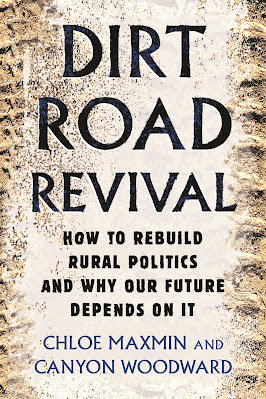
More on cultivating the rural vote, from Maxmin and Woodward's Dirt Road Revival
[The national Democrats] totally abandoned grassroots organizing in these spaces and that was reflected at the highest level of party leadership. But, you know, folks like the chair Tom Perez, that you can't door knock in rural America and Chuck Schumer's that, you know, for every blue collar that we lose in Western Pennsylvania will pick up two in the suburbs of Philadelphia and largely Democratic leaders were nowhere to be seen in rural America.
We weren't listening. We weren't cultivating relationships of trust. We were not telling a story that spoke to the sharp pain and struggles of the rural working-class and. So that just created a huge void and into that the young, contested battlefield crushed right wing activist groups, media personalities and that's what led to the rise of Donald Trump and the capture of state legislatures that we're experiencing today.
To this, I'll just note that ceding door knocking in rural America is like saying we can't be bothered to provide broadband or a quality education or a rural hospital because you can't achieve economies of scale in places with sparse population.
And on that note, second, I was interested in Maxmin's estimate that you can knock on about 100 doors a day in rural Maine, where she won a state senate seat that included the place she grew up, Nobleboro, in Lincoln County:
I think you know it sounds so basic, but it's the most human and humane thing we can do is just go talk to people, go have an honest conversation about why we're failing, why people don't believe in us and see if there's any space to repair that relationship.
It's simple in theory. You know, putting it to practice can be tricky because it has been under 200 doors a day and it's easy and are distracting, not to take away our drive from end to end and you know 100 doors a day is what someone can manage. So, it requires more time. It requires more investment, more volunteers, more resources. But we just can't take the easy way out. We keep doing that for too long, we are facing incredibly dire consequences. So, we just got to go talk to folks and make sure that what we hear is being reflected and how we campaign, how we message, how we serve and office.
Third, there is this, connecting to what is happening in other states:
And I think of Beto in Texas and Stacey Abrams in Georgia are key examples of that where it's all about people power campaigns and building these huge communities of volunteers that feel excited and motivated to go out into their communities and do this. Not all canvassing is created equal.
You know, I think oftentimes when we've seen, you know, the party establishment come out in the rural areas and with clipboard wielding very generically trained folks or kind of whacking people over the head with policy and reading a script that that doesn't resonate and so not. It's not all created equal, but it is really all about having strong grassroots people powered campaigns.
I like to say that things move at the speed of relationship in rural America. And that's just like an essential part of life and our culture. And it's got to be in the central part of our organizing. If we're going to succeed, if the Democrats of all kinds appear to agree that the party is in need of some very serious soul searching.
Don't miss the interview, which you can hear in its entirety here.
Related posts are here and here--and really every post under the "rural vote" (422 posts in 15 years!) or "rural politics" label.
Postscript: On May 2, this essay by Maxmin and Woodward appeared in the New York Times. The headline is "How Two Democrats Fought and Won in Rural America" and "What Democrats Don't Understand About Rural America." I'm going to excerpt here some of the more practical aspects of the piece.
In our two campaigns, we turned down the party consultants and created our own canvassing universe — the targeted list of voters whom we talk to during the election season. In 2020, this universe was four times larger than what the state party recommended. It included thousands of Republicans and independents who had (literally) never been contacted by a Democratic campaign in their entire time voting.
Our campaign signs? Hand-painted or made of scavenged wood pallets by volunteers, with images of loons, canoes and other hallmarks of the Maine countryside. Into the trash went consultant-created mailers. Instead, we designed and carried out our own direct mail program for half the price of what the party consultants wanted to charge while reaching 20 percent more voters.
Volunteers wrote more than 5,000 personal postcards, handwritten and addressed to neighbors in their own community. And we defied traditional advice by refusing to say a negative word about our opponents, no matter how badly we wanted to fight back as the campaigns grew more heated.
Also of interest are some of the voice memos Maxmin made to herself as she canvassed. Here's that context:
Chloe has knocked on more than 20,000 doors over the last two cycles, listening to stories of loss and isolation. One man told her she was the first person to listen to him; most campaigns, he said, didn’t even bother to knock on his door — they judged him for what his house looked like.
When we first embarked down this road, the path was rocky. Chloe came home from canvassing distraught one day and dictated a voice memo to herself: “I talked to a lot of people I’ve known my whole life, and they wouldn’t commit to vote for me.” They knew she was a good person; the only reason they refused to support her was that she was a Democrat.
Another day she met a couple who thought people should be able to snowmobile and hunt and fish and ride ATVs on protected lands. Chloe told them she agreed; while she considers herself extremely progressive, there are some things she thinks the left is too rigid on.
Here's another interesting observation:
What much of the party establishment doesn’t understand is that rural life is rooted in shared values of independence, common sense, tradition, frugality, community and hard work.