Saturday, August 14, 2021

College lecturer arrested for arson in northern California

Bill Chappell reports for Capital Public Radio under the headline, "A Former College Professor Accused Of Serial Arson Is Denied Bail In California."  Here's part of the story:  
Firefighters battling the Dixie Fire have also been facing a second enemy: a serial arsonist who went on a spree of setting fires in July and August — and who sought to trap fire crews with his fires, according to agents from the U.S. Forest Service. They allege former college professor Gary Maynard is the culprit, citing their tracking of his movements and other evidence.

"Where Maynard went, fires started. Not just once, but over and over again," the government said in a court memorandum arguing for Maynard to be denied bail.

A judge agreed to that request during a brief hearing Wednesday, saying there are no "conditions or combination of conditions that would provide the necessary level of safety to this community should the defendant be released."

He added: "Based on that finding, the defendant will be detained as a risk of non-appearance and a danger to the community."

Maynard's next court appearance is scheduled for Aug. 24, a representative of the U.S. attorney's office in Sacramento told NPR.

While court documents allege that Maynard is connected to more than a half-dozen dangerous fires in Northern California, he is currently charged with starting only the Ranch Fire. That blaze broke out on Saturday morning in a remote area where, according to court records, Maynard had just camped for the night. It's one of three fires that officials said Maynard set in recent days — all of them close to the Dixie Fire's northeastern footprint.

* * *

Maynard, 47, is a former professor who has taught at colleges in New York and California, according to online records. Last fall, he taught in the criminology and criminal justice department at Sonoma State University, which says in its official bio for Maynard that he has a doctorate in sociology and three master's degrees.

His teaching and research, the school said, focuses on topics that include the "sociology of health, deviance and crime" and environmental sociology. Maynard also has connections to other schools, from Stony Brook University in New York (where he received his doctorate) to Santa Clara University, where he also taught.

The details about tracking Maynard's movements--as well as the judge's concern that it would be too difficult to keep tracking  his movements--reminds me of my "The Rural Lawscape:  Space Tames Law Tames Space."  It's hard to police rural areas because of the vast distances implicated, which is certainly the case in the area where Maynard was allegedly operating.  

Friday, August 13, 2021

Big NYT/Marshall Project/Kentucky Center for Investigative Reporting feature on police killings in rural America

Alysia Santo and R.G. Dunlop report for the Marshall Project and the Kentucky Center for Investigative Reporting, under the headline, "Where Police Killings Often Meet with Silence:  Rural America."  The journalists "spent a year examining ... little publicized" police shootings in rural America. Here's an excerpt from their story:

Officers in rural areas fatally shot about 1,200 people from 2015 through 2020, while in cities there were at least 2,100 such deaths, according to the news organizations’ analysis of data compiled by The Washington Post; no comprehensive government database exists.

The data analysis found that, although the rate of rural police shootings was about 30 percent lower than the urban rate when adjusted for population, the rural incidents mirrored many of the dynamics of police shootings that have come under scrutiny in cities.

And even as deadly police shootings decreased overall during this time, according to the data, the decline in rural communities was more modest than in cities: about 9 percent versus 19 percent.

My own thinking about this is that there are just fewer checks and balances in rural communities, fewer watch dogs and a less robust tradition of protest.  

High-profile urban police shootings such as the killing of Breonna Taylor in Louisville, Ky., have set off protests, prompted widespread calls for change and led to new policies in some law enforcement agencies. But rural deaths seldom attract attention from the public or the national press. Police shootings in isolated areas are rarely captured on video, and many rural officers don’t wear body cameras.

Police and sheriff’s departments that each had a single deadly shooting account for hundreds of the rural fatalities. But in a handful of states, including Kentucky, Pennsylvania and Texas, state troopers are responsible for many of the deaths.

Rural shootings by the Kentucky State Police, the agency with the largest number of such deaths in the six-year period, illustrate both what distinguishes these encounters from other police killings and how they fit within broader patterns nationwide.

Kentucky state troopers shot and killed at least 41 people during that period, including 33 in rural areas. To examine these deaths, reporters interviewed more than 100 people and reviewed dozens of court cases and thousands of pages of police investigative reports, in addition to conducting the data analysis.
One big difference was that most of the people killed in the rural shootings, in Kentucky and elsewhere, were white. White people make up the rural majority in nearly every state, and two-thirds of the people fatally shot by law enforcement in rural areas across the country were white, the data analysis shows; about 10 percent were Black. (In cities, 37 percent were Black and 31 percent white.)

Nevertheless, in some states, a disproportionately high number of Black people were shot and killed by the police relative to their share of the rural population, according to the data. These include Alabama, Virginia and — the starkest example — Louisiana, where Black people accounted for about 20 percent of rural residents but almost 37 percent of rural police shootings.

Other characteristics of the rural Kentucky incidents were closely aligned with both rural and urban police shootings across the country. Most of the people shot in rural Kentucky were men, and two-thirds were armed with guns, according to police records.

The story also includes several compelling vignettes about people who've been killed by rural law enforcement.   The opening vignette, for example, out of Pippa Passes, Kentucky, population 533, features rural lack of anonymity--in this case between a man killed by a police officer and the officer who killed him:  they'd gone to school together, and the officers had previously saved the man's life with Narcan.  

My earlier posts taking up the issue of police shooting civilians in rural areas--including the shootings of unarmed whites--often low-status, low-income whites-are here and here.  As my prior posts have noted, it's interesting that media reports like this New York Times story do not lead with the problem of cops shooting unarmed, low-status white folks.  Instead, it uses "rural" as a proxy for that demographic, though this story co-reported by the Marshall Project does eventually get to an express discussion of racial difference among those killed. 

The rural-urban divide in Oregon, and implications for ecotourism and rural development

Leah Sottile's headline in the High Country News last month was "How a trail in rural Oregon became a target of far-right extremism."  It's a fascinating read, and I'm just excerpting here part of it that relates to the rural-urban divide in the West.  

In 2018, Kulla was elected one of Yamhill County’s three commissioners, besting the conservative incumbent. Over the last 40 years, this county in western Oregon’s Willamette Valley has become one of the world’s premier wine-growing regions, bringing an influx of money and visitors. Kulla, who is unusually liberal for a conservative county, ran on a platform of smart planning for inevitable growth and protecting vulnerable people in the community. At the time of his election, he was also a cannabis farmer.

Philip Higgins, the son of Quaker back-to-the-landers in Yamhill, met Kulla at the cemetery. Higgins, who is a commercial real estate broker, grew up understanding “that when you don’t have a lot of spare money, the government doesn’t seem like it’s there to help you.”

Kulla pointed to a metal tab on Higgins’ pants pocket. “See the little clip on it?” Higgins smiled and pulled out a Kershaw folding knife. Kulla, in turn, fished out a grafting knife from his pocket, well-worn from harvest.

The two men joked about how they contradict the rural stereotypes they seem to signify: Kulla wore Vivobarefoot shoes, Higgins wore a Rolex. “This,” Higgins said, rolling up his sleeve to display it, “is the urban-rural divide.” The men cracked up laughing.

But as they walked down the hill toward the old railroad right of way — the unlikely source of so much local anger — their tone changed. “Yamhill County is the urban-rural divide personified,” Higgins said.

In Oregon, as in other Western states, “urban-rural divide” is shorthand for the cultural, political and economic tensions between the few urban centers — Portland, Eugene, Salem, Bend — and the many rural communities. That divide, Kulla said, is fundamental to understanding the place. He wishes it wasn’t real, he said, “but it is.”

Thursday, August 12, 2021

An optimistic account of rurality, from downeast Maine

Here's an excerpt from Gigi Georges' recent essay, "What a Rural Corner of America Can Teach Us All About Community and Resilience," in Time Magazine:

This celebration [of rural downeast Maine, north of Acadia National Park] starts with a wealth of social capital. Even in the toughest of circumstances—including childhood poverty, limited economic opportunities and opioid addiction—rural-dwellers in these parts sustain themselves and each other through robust community networks, deep connections to the land and sea around them, and optimism about the future of their hometowns. They’ve built community technical education centers to address shortages of boat mechanics, nurses, and aquaculture workers. Their lives are based on a common understanding of the need to support each other—as frequently happens when, if a lobsterman is injured, others step up to pick up his hauls, or when at the end of a grueling day, residents routinely rush home from their fishing boats and workplaces to cheer their high school girls’ basketball team.

Georges formerly worked in the White House and in academia.  She now lives partly in New Hampshire and partly in Downeast Maine.  Her forthcoming book is called Downeast:  Five Maine Girls and the Unseen Story of Rural America (Harper Collins).   

My prior posts from south of Downeast Maine, in the coastal area around Acadia National Park and south of there, are here and here.  

Wednesday, August 11, 2021

On the behavior of rural neighbors in the face of the Dixie Fire

The Dixie Fire is now the second largest in California history, the largest being the August complex fire from last summer.  I've noticed an interesting preoccupation that some reporters have with the behavior of rural folks in the face of the fire.  The New York Times featured this headline a few days ago, "Despite Dixie Fire's destruction, some residents aren't evacuating."  Here's the salient excerpt:  

As the Dixie Fire ravaging Northern California became the state’s second largest on record over the weekend, efforts to save tinder dry land, towns and homes from being destroyed have been complicated by residents who aren’t heeding one order: evacuate.

Oddly, the short update makes no other reference to the refusal to evacuate.  That is, the complications are not expanded on in the story. 

The Los Angeles Times, however, fills that gap with this August 7 headline, "As Dixie fire tears through communities, some refuse evacuation orders with guns in hand." Yet the journalists didn't get to the "guns in hand" part of the story until the 8th paragraph:

Greg Hagwood, a Plumas County supervisor, said that in the last 72 hours, as fire has swept through or threatened small mountain towns including Greenville, the evacuations have grown tense — in some cases, residents have met law enforcement with weapons.

“They are met with people who have guns and [are] saying, ‘Get off my property and you are not telling me to leave,’” he said.

In response to those who flatly refused to evacuate, he said, deputies were asking for next-of-kin information so they would have someone to notify if the holdouts died.

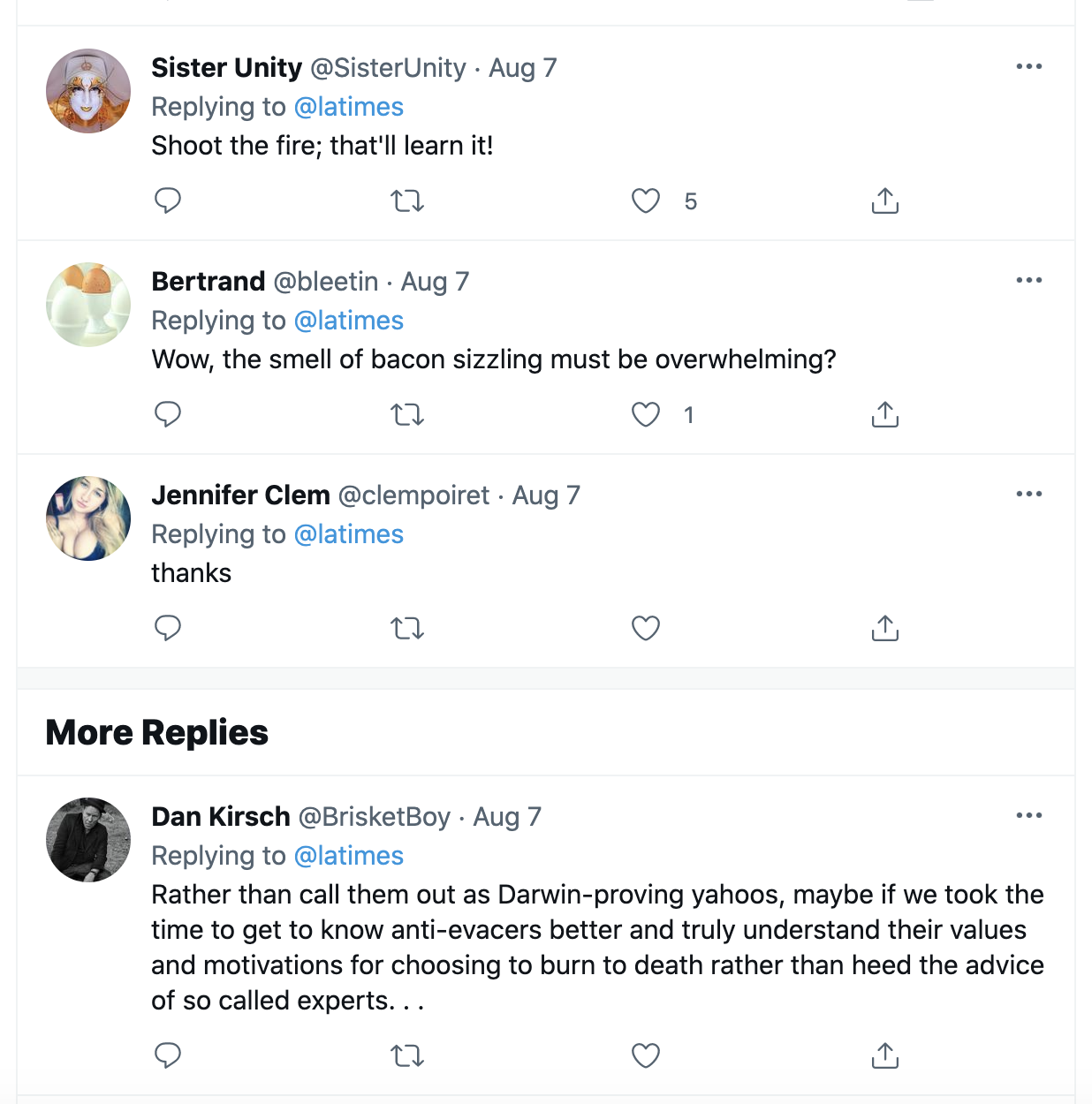
I saw some rural California folks on Twitter responding to that LA Times headline by explaining that rural folks tend to look out for one another--including each other's property.   In other words, staying behind to fight the fire--and fight to save their homes and those of their neighbors--is logical for them.  Here's a screenshot of one such tweet responding to the LA Times tweet of the story above:  


And here's a more positive spin on rural neighborliness, this from a New York Times story (dated August 9, 2021) about how some of these Plumas County communities are functioning right now: 

In the remote mountain communities that dot Plumas County, a thinly populated county near the border with Nevada, choking smoke hangs thick in the air. The power is out, and in some places water is scarce both for firefighting and drinking. Residents who have decided not to evacuate are collecting meat and groceries from their neighbors’ fridges. Others are isolated, holding out for deliveries from community firefighters of food, medicine and gas.

* * * 

Around Taylorsville, a tightly-knit community, people​ have been preparing for the fire​ for weeks, helping one another dig trenches with bulldozers, set up irrigation lines and spray homes​. Many ranchers have packed their​ most precious​ belongings and stored them in cattle trailers in​​ irrigated fields​ where they hope they will be safe if the fire comes down from the mountains​. ​People’s ​days revolve around tracking the fire’s every move​. ​The sound of generators fill the air.

Finally, here's a tweet about solidarity and self-sufficiency within Plumas County as it has faced the Dixie Fire: 


 A post from a few days ago, about the fire's destruction of Greenville, is here.   

Just thinking that it would be interesting to contrast coverage of the behavior of rural folks who stay behind in the wake of fire with that of urban (and other) folks who stay behind as hurricanes approach.  Are there similarities and differences in how these folks are depicted?  as rational or not?  

Tuesday, August 10, 2021

My hometown is (apparently) about to blow up--in a good way

Newton County Courthouse, Jasper
Spring 2016
(c) Lisa R. Pruitt 2016

Sunday's column by Rex Nelson of the Arkansas Democrat-Gazette makes an encouraging prediction about my hometown.  The headline is "The Coming Boom," and it's about Jasper, Arkansas, the county seat of Newton County, in the Ozarks.   (You can find numerous posts about Newton County here).  It's not the first time Nelson has written about Jasper.  In fact, he seems to have a bit of a Newton County fetish.  Earlier columns are here and here, with this latter from last year repeating a lot of what this weekend's column reports.    

Nelson, a member of the paper's editorial board, predicts an ecotourism boom for Jasper, and he marshals a lot of evidence in support of his thesis.  I've written about the county's ecotourism economy here (2008) and here (2010), and I've generally kept abreast of the phenomenon of rural gentrification, usually in amenity-rich destinations, across the United States.  

Here's an excerpt from Nelson's column, which is thick on details-including details about who has the $$$ that pouring into the area to fuel this boom: 
Abandoned Dogpatch USA theme park property
(c) Lisa R. Pruitt 
The square in downtown Jasper is hopping on this Saturday afternoon. Bubba's Buffalo River Store is filled with visitors.

Opened in March 2020 by North Little Rock businessman Walter "Bubba" Lloyd Jr., who long has had a house in Newton County, Bubba's isn't like those tacky tourist shops that once dotted the Arkansas Ozarks. It's filled with high-quality shirts, caps, coffee mugs and other goods that well-heeled visitors are willing to pay for.

Jasper, which only has about 700 residents, is changing. Johnny Morris, the founder of Bass Pro Shops, purchased the Dogpatch USA property, and there's dirt work going on that's likely costing Morris millions of dollars.

Love thinking about what Dogpatch USA might become, not least because I gave that park six of the best summers of my life (1979-1984).  Also, where did Nelson get the 700 population figure?  As far as I know, Jasper's population has not been so robust for many decades, probably not in my lifetime.  The signs at the edge of town said 394 through most of my childhood, based on the 1970 and 1980 censuses.

Buffalo Theatre on courthouse square.  I worked the concession stand as a teen.
Would love to see investors do something with this old gem 
as many local initiatives to save it have failed. 
(c) Lisa R. Pruitt 

Nelson continues:  

Depending on what Morris does with the land (and all of his projects are first class), Jasper just might be Arkansas' next hot spot for tourists.

Just across East Court Street from Bubba's Buffalo River Store stands the old Gordon Motel. It recently was purchased by investors from northwest Arkansas who have big plans for the property. Harold Gordon moved to Jasper from Bogalusa, La., and purchased the motel from his uncle in 1970. In 1987, Gordon opened Buffalo Canoe. Four years later, he added a canoe factory at Spider Branch. Gordon died in 2017 at age 81.

Yes, I knew Harold Gordon and his wife Roslyn (why doesn't Rex also mention her? I assure you she had an important role in running the business), and I went to high school with their son Gary. Spider Branch is part of the farm homesteaded by my family five generations ago.  I used to catch crawdads there--the trick was getting them to back into the little nets held by my cousin, my sister and me.  We'd come out of a day of crawdad chasing with our backs and necks red with sunburn.  Sunscreen wasn't really a thing then.

Buffalo River Bunkhouse in background
with some visitors from Louisiana
(c) Lisa R. Pruitt
For more than 40 years, Gordon Motel had a partnership with the National Park Service, having obtained one of the original canoe rental permits when the Buffalo was designated by Congress as the country's first national river. Outdoor recreation such as paddling the Buffalo is now more popular than ever. That popularity, combined with Morris' Dogpatch purchase, has investors taking a look at the stone buildings around the Newton County Courthouse.

The column features much more detail still about who is spending money where and how in Newton County.  Reading the column leaves me with but one comment and one question.  The comment is this:  all of this capital is flowing in from outside Newton County--most of it from well outside the region.  Very little of it, if any, is truly local.  Not surprising in a persistent poverty county, I suppose.  There's very little wealth to invest in anything, let alone an ecotourism enterprise.  

One of the stone buildings near the 
Newton County courthouse square
(c) Lisa R. Pruitt 2012
One exception--or is it more of an illustration of my point?--is my mom.  She's definitely an oldtimer--fourth generation Newton Countian.  She's not wealthy by any means, but she owns 10 acres and the modest home she and my father builtin 1964.  It's a mile from Jasper, along the Little Buffalo River.  About 15 years ago, she turned an outbuilding--built as a large garage for truck repair--into a "bunkhouse" what will sleep about a dozen folks.  It's regularly rented by big groups who come to float the Buffalo.  She also turned a little two bedroom trailer, which similarly sits in her front yard, into a "bungalow."  It's also in great demand.  These don't command much money ($80 a night for the bunkhouse, I see, on airbnb.com) compared to other rentals in the area, but the properties contribute substantially to her income as a teacher's aide at the local school. 

Of course, outside money is better than no development at all, but it leaves me with this question:   Will these entrepreneurs from outside the region hire locals?  In particular, will they hire locals to do good jobs, like being river guides? or managers?  

Ozark Cafe, Jasper Town Square (c) Lisa R. Pruitt

I've noticed over the years that the river outfitters often have not employed locals.  Instead, they bring in college students from away.  But it's only appropriate that these outside entrepreneurs will hire local talent--that they will share the opportunities for jobs, for income--if not their wealth--with Newton County teens and young adults.  

One of the less salubrious scenes in Jasper,
not far from town square.  I use this photo when
I teach torts to illustrate "assumption of risk"
doctrine. (c) Lisa R. Pruitt

And that reminds me of this recently published book on rural gentrification, Dividing Paradise: Rural Inequality and the Diminishing American Dream (2021) by Jennifer Sherman.  It is set in central Washington, in a mountain community undergoing gentrification, with lots of Seattle-area folks moving in and pricing locals out of the market.  There, in "Paradise Valley," newcomers found themselves at odds with oldtimers, with the former tending to look down on the latter for, among other things, their lack of success in life.  They rarely saw that prospects for "local" success were undermined by lack of wealth, by which I really just mean capital (think my mother's ownership of 10 acres and some modest outbuildings as an example of someone with limited capital and making the most of it).    

If Jasper does become (more of) a boom town, I hope the community doesn't see the sort of condescension Sherman documented in "Paradise Valley."  

This reminds me of some coverage the Newton County Times has dedicated in recent months to the idea that the City of Jasper should pass a "hamburger tax," the idea being to tax things tourists buy, specifically prepared food  The revenue generated would be used to finance the Japer Advertising and Promotion Commission (JAPC).  Just one of many stories from the local newspaper is here.   Initial members of the commission include Rex Nelson's North Little Rock friend Bubba Lloyd who, for these purposes, apparently has dual citizenship in Pulaski County and Newton County.  

Here's an excerpt from the story: 

Bubba Lloyd, of Bubba's Buffalo River Store, drew the four year term, [Ernie] Yeager [of Junction One-Stop] drew the three year term, Russ Todd, of the Ozark Cafe and Blake Keeton, of Harps Food Store, both drew two year terms and Angela Slape, the commission's at large member, drew the one year term. 

Lloyd will be the commission chair.  

Although the commission was formed without the benefit of a one percent tax on the sale of prepared food in the city to provide it revenue, the city is appropriating a one time $5,000 as seed money for the commission to operate. 


Low Gap Cafe, another Newton County business 
mentioned in the Nelson column.  
(c) Lisa R. Pruitt
Postscript:  The Sept. 1, 2021 issue of the Newton County Times reports that the Jasper Advertising and Promotion Commission (JAPC) is seeking to hire a paid director who would "manage the day to day business operations of the commission.  It is a part-time position paying $12.75 an hour.  The person selected for the job must be a communicator, and be familiar with and excited about the city of Jasper,  said Commission Chairman Walter 'Bubba' Lloyd.  In addition to carrying out directives from the commission, the director must have a creative mind and be able to initiate ideas and suggest events that will benefit the promotion of the city.  These events will raise funds for the commission to use for the promotion and marketing of tourism-related businesses and recreational activities in Jasper."  

Other stories about the JAPC are here and here.  

Monday, August 9, 2021

Coronavirus in rural America (Part CXLIV): Sarah Smarsh on vaccine anger and blame

 In Sunday's New York Times: 

In the spring, I received my Covid-19 vaccination shots from county health workers in an old building on the main street of a tiny Kansas town.
* * *
Fellow county residents waited their turn in muddy boots and faded work jackets while the April wind stirred their fields of early wheat. There was corn to plant, but they had found time to make long drives to what was then the only vaccination site in 500 square miles. Our ages, politics and backgrounds varied, but we were mostly white, rural people who wanted to live.
Yet vaccination rates are still low in Kansas. Smarsh continues:
I cringe when I see the rampant stereotypes on social media painting the unvaccinated as rural white folks, by now a frequent scapegoat for our country’s ills. “Spreadnecks,” I’ve seen them newly termed (as in, “rednecks” spreading the virus). Never mind that, per the C.D.C., the daily case rates in urban and nonmetropolitan areas closely track one another.

The column is well worth a read in its entirety.  

The part about "the only vaccination site in 500 square miles" reminded me of something else I've been fretting about:  the lack of easy availability of the coronavirus vaccine in my home county.  COVID-19--the Delta variant in particular--has been raging in the Ozarks for six weeks.  I wrote this last month, based on a feature out of Baxter County, two counties over from Newton County, where I grew up.   And I wrote this a week before that regarding places where cases were spiking--including the Missouri and Arkansas Ozarks.   

Everyday I get an email from the New York Times with COVID data--including that regarding vaccine rates--about the places I've regularly searched for the Times interactive website.  These include Newton county, where the vaccination rate has remained a stubborn 23% for weeks--in spite of the spike in cases in the area.  

I was thus very frustrated to see in the July 28, 2021 issue of the weekly Newton County Times that the first vaccination clinic scheduled in Newton County, sponsored by the regional hospital (North Arkansas Regional Medical Center in Harrison/Boone County) and Jasper School, is this Friday, August 13.  That's the Friday before the public school convenes for the new school year and a week into the school staff in-service.  That's not particularly helpful if we want to make vaccination easy, stem the spread of coronavirus, and save lives.  By the way, the headline is also interesting, "Jasper to host open house Pfizer Clinic."  The use of "Pfizer" but not "COVID 19" or "coronavirus" is interesting.  Also, the headline says "open house," but the story details indicate that an appointment is necessary.  

Sunday, August 8, 2021

Remembering Greenville, California--and awaiting its rise from the ashes


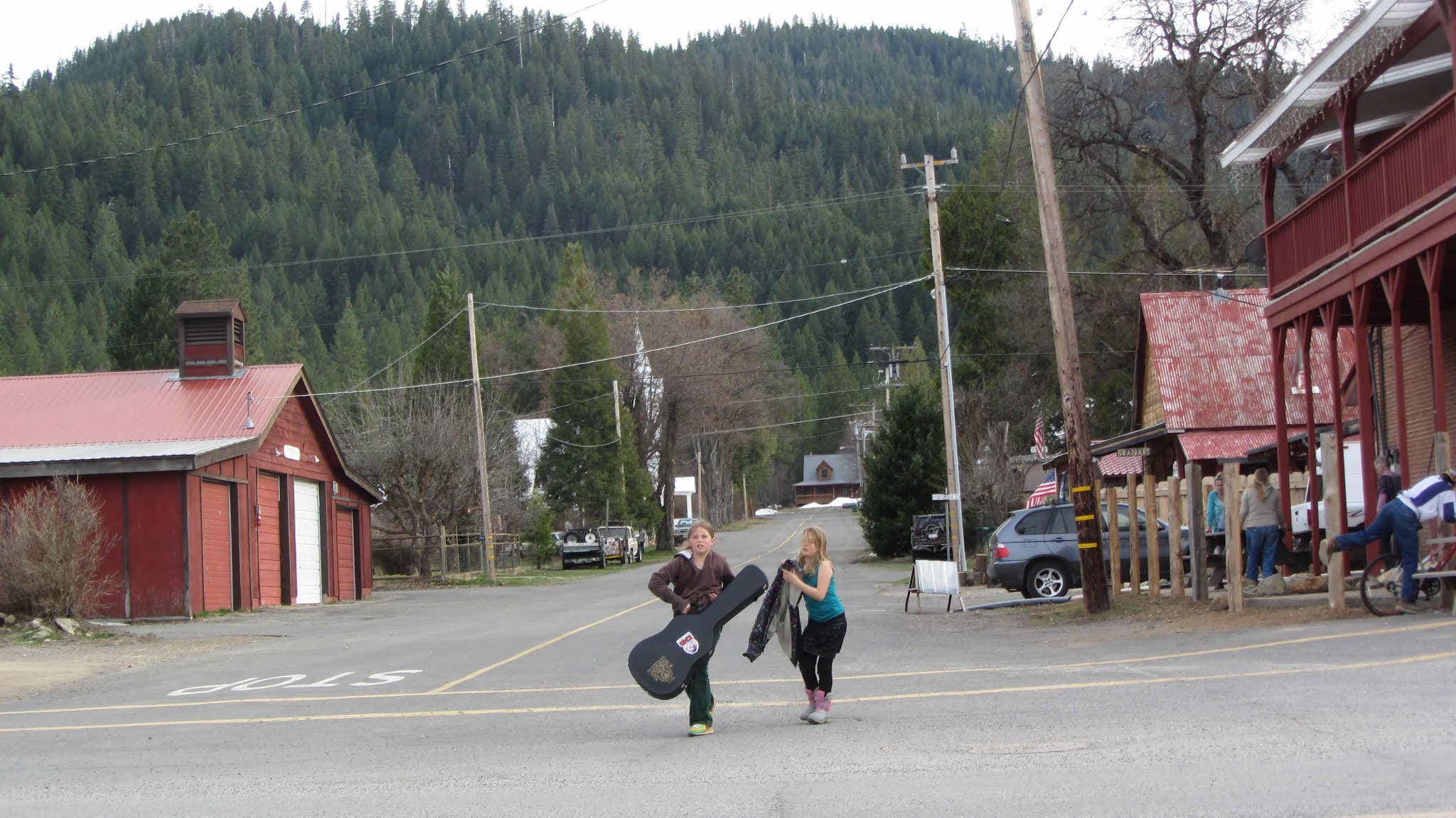
Young musicians
Downtown Greenville, California, March 2013

I spent several days of the 2012-2013 academic year in Plumas County, California.  A good bit of that time was in Greenville, a town of about a thousand folks in an area called Indian Valley, less than an hour north of the county seat, Quincy.  Plumas County is about the size of Delaware, but it's sparsely populated, with just about 20,000 residents.  

Village Pharmacy (left) in a building dating to the 1860s,
was destroyed in the Dixie Fire Wednesday night.  
(c) Lisa R. Pruitt 2013

The year I spent working off and on with my law students in Plumas County is documented in this report that my students and I produced.  We were conducting what is called "participatory action research" in collaboration with Legal Services of Northern California, which had a grant to do do early outreach related to the Affordable Care Act's implementation.  

Historically Mountain Maidu territory, Greenville is one of the poorest parts of the county--and, indeed, one of the poorest places in California.  I took many photos (all (c) Lisa R. Pruitt 2013), and I'm going to share some here as a reminder of what Greenville was--and might be again.  

Anna's Cafe, Greenville

Downtown Greenville, March 2013, with 
Way Fair Tavern and Anna's Cafe in 
background behind the flag

I say "might be again" because on Wednesday evening, Greenville was largely destroyed in the Dixie Fire, now the second largest fire burning the United States, and one of the largest fires ever in California.  As the crow flies, Greenville is not many miles from where the Camp Fire destroyed the town of Paradise in 2018.  Indeed, the Camp Fire and the Dixie Fire started in the same area, both in the Feather River Canyon.  The Camp Fire burned west and north from there, while the Dixie Fire burned mostly south and east.  Also threatened is the Plumas County town of Chester, which borders Lassen County, and the fire is now also burning into Lassen National Park.  

I'm featuring here a sampling of the photos I took in 2013 in and around Greenville.  (I took many, many more, so may do a few additional posts featuring different aspects of Greenville and Indian Valley).

Indian Valley Chamber of Commerce and a bookkeeping service,
Greenville, California, Spring 2013 


Hotel in Downtown Greenville.  The building whose
corner you can see on the right is the Village Pharmacy, pictured above. 


Lutheran church, 2013.  You can see after-fire photos 
of the church at the links below, where just the sign remains.

Music studio
Greenville, 2013


You can read more about what happened in Greenville on Wednesday here, here, here, and here.  You'll see there photos of what's left of some of the buildings I photographed in 2013. 

Hunter Ace Hardware, Greenville, Spring 2013

Greenville Rancheria Tribal Medical Center, Spring 2013

Greenville Library, Spring 2013
Way Station Tavern, which sat right across from Village Pharmacy 
and across Hwy 89 from Anna's Cafe.  You can see after-fire 
photos of the tavern at the links below 

This latest, by Anita Chabria for the Los Angeles Times, features the story of Kevin Goss, a pharmacist in Greenville and also a long-time member of the County Board of Supervisors. (As a county supervisor and business owner, Goss is mentioned in the report my students and I produced).  You can see a photo of his Village Pharmacy above, from 2013.  He was in escrow to sell the business to a pharmacist in Quincy when the Dixie Fire destroyed it.  

A woman was selling goat's milk-based products out of an 
outbuilding behind her home, on a residential street, Feb. 2013

Here's a Eulogy for Greenville, written by resident Meg Upton and published in the Plumas News.  It talks about politics--though it puts a good spin on how community spirit overrides politics in Greenville because they're too small and need each other too much to alienate one another.  And it reminds me of this very memorable photo I took in Greenville in 2013: 

Greenville, California, Spring 2013

Speaking of politics, Governor Gavin Newsom visited Greenville yesterday and posted this video on Twitter.  Mostly, Newsom focused on climate change's role in this disaster, but he also said the Dixie Fire and the disaster in Greenville is "about people's culture, their identity, lifestyles, a sense of place, memories that are attached to this, one of the oldest communities in California.  This is about our families, our kids ... we have a deep responsibility to rebuild." 

More photos to follow in a future post.  

Post script:  You can see after-fire photos of some of these places, including the Greenville public library, the Greenville Rancheria Medical Clinic, and the Way Station Tavern in this August 12 story from the Los Angeles Times.

Wednesday, August 4, 2021

Child tax credit will have an outsized benefit for rural America

Greg Sargent of the Washington Post wrote a few days ago about a new report by the Niskanen Center on the consequences of the new federal child tax credit on rural economies.  

It has long been central to Republican mythology that Democrats have nothing but seething contempt for the rural and small-town inhabitants of the Real American Heartland. Republicans sometimes pair this with vile lies about Democratic proposals that would deliver economic benefits to those regions, turning their residents against them.

An important new study of the distribution of benefits from a major new policy from President Biden and Democrats — the expanded child tax credit — illuminates the repulsiveness of this scam with unusual clarity.

The new analysis from the Niskanen Center finds that the expanded child allowance — which has started delivering up to $300 per child per month to most U.S. households with children — will shower outsize benefits on residents of rural and less populous states and will deliver a disproportionately large relative boost to their local economies.

Tuesday, August 3, 2021

Rural America in the infrastructure bill

A story from Progressive Farmer, by Chris Clayton, features this lede:  

USDA's rural watershed and flood prevention program is just one area that will see an injection of funds under the Infrastructure Investment and Jobs Act (H.R. 3684) as the Senate continues to debate the bill.  
* * *

 The bill has dozens of provisions that set aside specific funds for rural projects such as roads, bridges, waterways and broadband.

Among the road provisions, the bill includes the Rural Surface Transportation grant program, which authorizes $2 billion over five years. A separate bridge restoration fund would spend $3.26 billion over five years. Certain rural areas will see the federal government match on community projects to as much as 90%. 

For electric infrastructure upgrades in rural America, as much as $1 billion is authorized to help improve the electric grid in towns or unincorporated areas with 10,000 people or fewer. Another $1 billion is set aside for rural water grants.

Monday, August 2, 2021

FEMA limitations in sparsely populated regions?

This line from a story in the New York Times today triggered a lot of questions about how FEMA (Federal Emergency Management Agency) works when disaster strikes in sparsely populated places, aka #rural America.  The story is about the massive Bootleg fire in rural southeast Oregon.  More than 160 homes have destroyed there.  But given that it's the biggest fire in the country right now at 413,000 acres burned, that could be stated as just 160 homes.  And that ratio of homes to land area illustrates how sparsely populated the region is.  The story's dateline is Beatty, Oregon, a Census Designated Place in Klamath County. 

Here's what got me thinking about what seems perversely wrong with FEMA--perversely wrong given the correlation between wildfire and rurality: 

In the aftermath of the fire, Mr. Valens and Ms. Golden are uncertain whether they and others who lost their homes will receive any state or federal aid. In a meeting with President Biden and a group of governors on Friday, Gov. Kate Brown of Oregon asked the president for flexibility in using federal disaster-relief money in sparsely populated areas, which are currently ineligible for Federal Emergency Management Agency funding, a spokesman said.

Mr. Valens is Marc Valens, a retired environmental attorney.  Ms. Golden is his wife, Anne Golden, a business consultant.  Lucky for them, they have a second home a few hours away in Ashland.  

Why would the status quo be a lack of flexibility "in using federal disaster-relief money in sparsely populated areas"?  This seems illogical given the association of disaster with rural places.