Tuesday, August 20, 2019

Small-town government run amok (Part VII): county officials ask sheriff to investigate Oregon newspaper for calls, emails to county officials

Just when I thought nothing would surprise me, this story came across my Twitter feed last night, dateline Vale, Oregon.  The headline is, "Malheur County officials ask sheriff to assess whether Enterprise reporters broke laws." Here's an excerpt from Pat Caldwell's story for the Enterprise.
Malheur County officials have asked Sheriff Brian Wolfe to assess whether the Malheur Enterprise has engaged in criminal conduct in its reporting. 
County Counsel Stephanie Williams confirmed last week that she contacted Wolfe recently with allegations about emails and phone calls to the county’s economic development officials. 
Wolfe verified the contact and said he hasn’t decided whether to open a criminal investigation. 
Greg Smith, director of Malheur County Economic Development Department, told the Enterprise in an email last week that “we were instructed to turn over your emails to the Malheur County Sheriff’s Office.”
Smith said the newspaper was sending emails to personal email addresses of economic development officials. He said he has asked the newspaper to “limit your requests to office hours” and to a single county email address. 
“It is not appropriate that you are sending emails to employees using their personal email accounts on the weekends,” Smith wrote. 
Smith said the newspaper has been asked “to not have our employees contacted outside of their work place.” 
He said in a subsequent public statement that he and his staff have been subjected to emails “at all hours of the day.” 
Williams said in an interview that she sought the sheriff’s involvement to determine “if there is a violation to investigate when a county employee’s phone numbers and email addresses are being used when we’ve asked someone to stop calling or communicating on county business on a personal phone or email.” 
Williams said that “we are looking into whether or not there was a violation, especially when Mr. Smith previously asked it not be done and it was disregarded.” 
Smith is a private contractor and not a county employee. His Ontario aide, John Braese, works for Smith’s private company and also is not a county employee.

Smith uses two emails in his conduct of county business. At a government meeting last fall, he gave the public what he described as his “personal” cell phone number He told the audience: “At any time that anyone has any questions or concerns, please call me directly.” He said he was available “24/7.” 
He has listed that number on press releases from Malheur County and in his role as a state legislator. 
The suggested crime is telephonic harassment, though the definition stated of that crime seems hardly to fit:  “'a telephone caller commits the crime of telephonic harassment if the caller intentionally harasses or annoys another person' by calling a number they have been forbidden to use."

Caldwell also quotes Les Zaitz, the Enterprise's editor and publisher, who said "the newspaper staff were alarmed by the possible criminal investigation."
Our news staff has sought information from county officials concerning important public business using standard and professional methods.   
At no time has anyone from the Enterprise abused any personal cell number of a government official.
An earlier blog post about the Malheur Enterprise is here. 

Monday, August 19, 2019

Eighth Circuit rules against voting rights, with a likely profound impact on Native Americans in North Dakota

Here is coverage of the decision, earlier this month, by Rewire, and here is what High Country News wrote about the North Dakota law, which will require citizens of that state to present state-issued identification cards showing their residential street address in order to vote (a post-office box will not suffice).  Here is an excerpt from the Rewire report by Imani Gandy:
The Eighth Circuit Court of Appeals last week upheld a law that strips nearly 10 percent of all voting-age Native Americans living in North Dakota of their right to vote.
The case is as much about local infrastructure and lack of regard for North Dakota’s indigenous population as it is about voter suppression and a state forcing voters to comply with a requirement that the state itself has made impossible to follow. 
Thousands of Native Americans who do not have residential addresses through no fault of their own have been affected by the law, HB 1369. What’s worse is that these Native voters may be disenfranchised permanently should HB 1369 remain in place—something the three-judge panel that ruled on the lawsuit challenging the law seems OK with. That should trouble us all.
The Native American Rights Fund initially filed the lawsuit, Brakebill v. Jaeger, in 2016 on behalf of Turtle Mountain Band of Chippewa tribe members. The lawsuit alleges the law discriminates against Native American voters in violation of the Equal Protection Clause and Section 2 of the Voting Rights Act.
Gandy further explains the significance of the decision here:
Well, most identification cards do not require a residential street address, but rather a mailing address. North Dakota is the only state to require a residential street address for a voter ID card to be valid. And since many Native Americans in North Dakota don’t have residential addresses—they have their mail delivered to a post office box—North Dakota’s requirement puts them at a disadvantage.
I clerked for a judge on the Eighth Circuit nearly three decades ago, and I'm embarrassed by this decision.   I've also written here about the struggle local governments face in providing addresses in rural contexts.  As I was driving through rural far northern California earlier this summer, I noticed signs in a few communities that urged residents to ensure that their addresses are visible to emergency personnel.

P.S.  A NYT op-ed published nearly a week later on the Native American vote, and how Democrats are increasingly realizing its importance. 

Friday, August 16, 2019

Literary Ruralism (Part XVI): My Antonia

A few weeks ago, Bret Stephens of the New York Times columnist, compared the depiction of European immigrants in Willa Cather's My Antonia (1918) to contemporary immigrants and the current controversy surrounding them.  Under the headline, The Perfect Antidote to Trump:  Willa Cather Knew What Made America Great, Stephens described the central character, Antonia Shimerda, whose family had emigrated to the plains of Nebraska from what is now called the Czech Republic:
Ántonia’s family sets out to make the country, alongside immigrants named Pavel and Peter, Otto and Ole, Lena and Yulka. In 1888, the Nebraska State Journal noted that “the great west has received the largest share of the immigration which has poured into this country since the last census was taken,” roughly doubling populations in the Western states.
These were the people who made the Midwest great. Their English, on arrival, was generally poor or nonexistent. Their skills were often ill-suited to the needs of the places to which they came. Their religious beliefs were not those of their American neighbors. They were accused of being clannish, and they were not always grateful to be here.
“He not want to come, nev-er!” Ántonia says of her father, after the young American narrator in the story opines, “People who don’t like this country ought to stay at home.” That sounds familiar. 
The immigrants came, for the most part, because they were fleeing hard circumstances, much as immigrants from Central America do today. But they also came because our borders were practically open until 1882, when the Chinese Exclusion Act was shamefully passed.
Stephens column prompted me to get out an excerpt I'd pulled from My Antonia last summer, when I re-read it with my then 14-year-old son. I, too, was struck by Cather's depiction of the immigrants--and the attitudes toward immigrants of those who had been in the country longer--if only a relatively short time longer.  Here I am quoting Chapter 9, which is so revealing about immigrants (yes, white ones, too), as both discriminated against and hyper-industrious--not unlike what we see today with immigrants, who now tend to be people of color.   Black Hawk was the fictitious Nebraska country town where much of the story takes place.  Jim Burden, the narrator, moved there from his family's nearby farm so he could go to school, and Jim's grandparents arranged for his childhood friend and neighbor, Antonia, to work for the family next door.
IX 
There was a curious social situation in Black Hawk. All the young men felt the attraction of the fine, well-set up country girls [immigrant girls] who had come to town to earn a living, and, in nearly every case, to help the father struggle out of debt, or to make it possible for the younger children of the family to go to school.
            Those girls had grown up in the first bitter-hard times, and had got little schooling themselves. But the younger brothers and sisters for whom they made such sacrifices and who have had “advantages,” never seem to me, when I meet them now, half as interesting or as well educated. The older girls, who helped to break up the wild sod, learned so much from life, from poverty, from their mothers and grandmothers; they had all, like Antonia, been early awakened and made observant by coming at a tender age from an old country to a new.
            I can remember a score of these country girls who were in service to Black Hawk during the few years I lived there, and I can remember something unusual and engaging about each of them. Physically they were almost a race apart, and out-of-door work had given them a vigour which, when they got over their first shyness on coming to town, developed into a positive carriage and freedom of movement, and made them conspicuous among Black Hawk women.
            That was before the day of high-school athletics. Girls who had to walk more than half a mile to school were pitied. There was not a tennis-court in the town; physical exercise was thought rather inelegant for the daughters of well-to-do families. Some of the high-school girls were jolly and pretty, but they stayed indoors in winter because of the cold, and in summer because of the heat. When one danced with them, their bodies never moved their clothes; their muscle seemed to ask but one thing-not to be disturbed. I remember those girls merely as faces in the schoolroom, gay and rosy, or listless and dull, cut off below the shoulders like cherubs, by the ink-smeared tops of the high desks that were surely put there to make us round-shouldered and hollow-chested.
            The daughters of Black Hawk merchants had a confident, un-enquiring belief that they were 'refined,' and that the country girls, who 'worked out,' were not. The American farmers in our county were quite as hard-pressed as their neighbours from other countries. All alike had come to Nebraska with little capital and no knowledge of the soil they must subdue. All had borrowed money on their land. But no matter in what straits the Pennsylvanian or Virginian found himself, he would not let his daughters go out into service. Unless his girls could teach a country school, they sat at home in poverty.
The Bohemian and Scandinavian girls could not get positions as teachers, because they had had no opportunity to learn the language. Determined to help in the struggle to clear the homestead from debt, they had no alternative but to go into service. Some of them, after they came to town, remained as serious and as discreet in behaviour as they had been when they ploughed and herded on their father's farm. Others, like the three Bohemian Marys, tried to make up for the years of youth they had lost. But every one of them did what she had set out to do, and sent home those hard-earned dollars. The girls I knew were always helping to pay for ploughs and reapers, brood-sows, or steers to fatten.
One result of this family solidarity was that the foreign farmers in our county were the first to become prosperous. After the fathers were out of debt, the daughters married the sons of neighbours — usually of like nationality — and the girls who once worked in Black Hawk kitchens are to-day managing big farms and fine families of their own; their children are better off than the children of the town women they used to serve.
I thought the attitude of the town people toward these girls very stupid. If I told my schoolmates that Lena Lingard's grandfather was a clergyman, and much respected in Norway, they looked at me blankly. What did it matter? All foreigners were ignorant people who couldn't speak English. There was not a man in Black Hawk who had the intelligence or cultivation, much less the personal distinction, of Ántonia's father. Yet people saw no difference between her and the three Marys; they were all Bohemians, all 'hired girls.'
I always knew I should live long enough to see my country girls come into their own, and I have. To-day the best that a harassed Black Hawk merchant can hope for is to sell provisions and farm machinery and automobiles to the rich farms where that first crop of stalwart Bohemian and Scandinavian girls are now the mistresses.
The Black Hawk boys looked forward to marrying Black Hawk girls, and living in a brand-new little house with best chairs that must not be sat upon, and hand-painted china that must not be used. But sometimes a young fellow would look up from his ledger, or out through the grating of his father's bank, and let his eyes follow Lena Lingard, as she passed the window with her slow, undulating walk, or Tiny Soderball, tripping by in her short skirt and striped stockings.
The country girls were considered a menace to the social order. Their beauty shone out too boldly against a conventional background. But anxious mothers need have felt no alarm. They mistook the mettle of their sons. The respect for respectability was stronger than any desire in Black Hawk youth.
Our young man of position was like the son of a royal house; the boy who swept out his office or drove his delivery wagon might frolic with the jolly country girls, but he himself must sit all evening in a plush parlour where conversation dragged so perceptibly that the father often came in and made blundering efforts to warm up the atmosphere. On his way home from his dull call, he would perhaps meet Tony and Lena, coming along the sidewalk whispering to each other, or the three Bohemian Marys in their long plush coats and caps, comporting themselves with a dignity that only made their eventful histories the more piquant. If he went to the hotel to see a travelling man on business, there was Tiny, arching her shoulders at him like a kitten. If he went into the laundry to get his collars, there were the four Danish girls, smiling up from their ironing-boards, with their white throats and their pink cheeks.
The three Marys were the heroines of a cycle of scandalous stories, which the old men were fond of relating as they sat about the cigar-stand in the drugstore. Mary Dusak had been housekeeper for a bachelor rancher from Boston, and after several years in his service she was forced to retire from the world for a short time. Later she came back to town to take the place of her friend, Mary Svoboda, who was similarly embarrassed. The three Marys were considered as dangerous as high explosives to have about the kitchen, yet they were such good cooks and such admirable housekeepers that they never had to look for a place.
The Vannis' tent brought the town boys and the country girls together on neutral ground. Sylvester Lovett, who was cashier in his father's bank, always found his way to the tent on Saturday night. He took all the dances Lena Lingard would give him, and even grew bold enough to walk home with her. If his sisters or their friends happened to be among the onlookers on 'popular nights,' Sylvester stood back in the shadow under the cottonwood trees, smoking and watching Lena with a harassed expression. Several times I stumbled upon him there in the dark, and I felt rather sorry for him. He reminded me of Ole Benson, who used to sit on the drawside and watch Lena herd her cattle. Later in the summer, when Lena went home for a week to visit her mother, I heard from Ántonia that young Lovett drove all the way out there to see her, and took her buggy-riding. In my ingenuousness I hoped that Sylvester would marry Lena, and thus give all the country girls a better position in the town.
Sylvester dallied about Lena until he began to make mistakes in his work; had to stay at the bank until after dark to make his books balance. He was daft about her, and everyone knew it. To escape from his predicament he ran away with a widow six years older than himself, who owned a half-section. This remedy worked, apparently. He never looked at Lena again, nor lifted his eyes as he ceremoniously tipped his hat when he happened to meet her on the sidewalk.
So that was what they were like, I thought, these white-handed, high-collared clerks and bookkeepers! I used to glare at young Lovett from a distance and only wished I had some way of showing my contempt for him.

* * * 
Now, back to Bret Stephens' column, which summarized the big picture on immigrants then and now:
What hasn’t changed is that immigrants, on the whole, succeed. “Foreign farmers in our county were the first to become prosperous,” Cather’s (grown-up) narrator notes. “After the fathers were out of debt, the daughters married the sons of neighbors — usually of like nationality — and the girls who once worked in… kitchens are to-day managing big farms and fine families of their own.” Yet many of the locals saw them as “ignorant people who couldn’t speak English.” That sounds familiar, too.

Thursday, August 15, 2019

From Axios: The rural American death spiral

Now that is a very bracing headline.  I'm not sure whether to see this as simply depressing, or a necessary tonic to inform those not in the know on rural challenges, those who would dismiss rural concerns.  Here are some highlights--or should I say lowlights--from the piece by Stef W. Kight and Juliet Bartz, and I have put in bold the big takeaway about the 46 million people "being left behind in the middle of America," apparently simply because they live in "the middle of America"
Many of the nation's current pathologies are taking a heavy toll on the majority-white population living in rural America, which was severely impacted by the opioid crisis and has dealt with falling populations, job losses and rising suicide rates. 
Why it matters: The malaise and discontent that President Trump has tapped into goes beyond the racism we've seen over the past few weeks and includes anger at a changing world and frustration at dwindling opportunities close to home. These trends are further entrenching the rural-urban schism that came to light in the 2016 election.

The big picture: Political and economic power is shifting to the cities, and 20% of the population — 46 million people — is being left behind in the middle of America. These communities face increasingly difficult barriers to education, wealth and health.  (emphasis added)
And if you're African American or Hispanic, your chances of success and survival at every turn are even worse.
Many of the facts listed in this piece were not new to me, facts about relative health of rural people compared to their urban counterparts, as well as the relatively poor educational and job opportunities. But here's one of the facts I had not yet heard:
If you keep working in your hometown, your job is more likely to be taken over by AI, according to a study by the Brookings Institution — especially if you live in Indiana, Kentucky, South Dakota, Arkansas or Iowa.
Depressing as this is, the piece does a nice job of linking to lots of sources that will be of interest to folks interested in rural people and places. 

Wednesday, August 14, 2019

Request for Articles: Growing Up in Rural America

See full details here of call from the Russell Sage Foundation.  Here's a brief excerpt:
It is well established that childhood conditions have profound and lasting influence on children’s wellbeing (Duncan et al. 1998). Yet, much of what we know comes from studies of urban children or national databases, which are dominated by urban samples (Duncan and Magnuson 2011; Brooks-Gunn et al. 1997). Consequently, surprisingly little is known about how the social and economic conditions in which rural children are raised are related to their outcomes and life chances. Such analyses are important as the experience of growing up in rural America has changed over the past several decades and varies considerably across rural communities, leading to contrasting images of what it is like to grow up in rural America. Some depictions emphasize its positive dimensions including strong social support among neighbors, opportunities for learning the disciplines of hard work and personal integrity, and developing a deep attachment to the land and natural environment (Stegner 1992; Howarth 1995). Other accounts detail the hardships experienced during childhood, where good job opportunities are limited, incomes are low, housing is dilapidated, and racial discrimination is deeply entrenched (Duncan 2015; Edin and Schaefer 2015; Tickamyer et al. 2017). Even within a given rural area, its image may change over time. In his book Our Kids, Putnam (2015) described how the small town where he grew up has changed from a relatively classless place, where children from all socio-economic levels studied and played together, to a town with sharp class divisions and rigid segregation. These dramatic changes and contrasting images highlight the growing need for a deeper and more nuanced understanding of how rural environments may shape the immediate and longer-term wellbeing of children and youth. 
Existing studies, which often rely on simple dichotomous measures of rural and urban areas, further highlighting the need for additional research by revealing sharp differences in the lives of rural and urban children across multiple important life domains, including family, education, economic security, and health. For example, rural households are more likely to experience joblessness as unemployment rates remain significantly higher in rural than in urban counties (Economic Research Service, 2019). The experience of poverty also differs in rural areas as rural children are more likely than urban children to live in poverty, rural workers are more likely to be poor, and poverty is more persistent across generations in rural areas (Lichter and Graefe 2011; Lichter et al. 2004; Lichter and Schafft 2016; Rothwell and Thiede 2017; Thiede et al. 2018a; Thiede et al. 2018b; Thiede et al. 2017)1. Historically, rural children were more likely to be raised in stable two-parent households, although recent data show that rural children are now as likely as urban children to live with single-parents, and more likely to live with cohabiting adults (MacTavish and Salamon 2004; McLaughlin et al. 1999; O’Hare et al. 2009).
* * * 
To advance academic knowledge of the implications of growing up rural and to develop policies that promote greater geographic equality, this volume will examine how being born and raised in rural America shapes the immediate and longer-term wellbeing of children and youths. The issue will feature original qualitative and quantitative research that focuses on four key life domains: family dynamics, education, economic security, and health. We are particularly (but not exclusively) interested in studies that expand our current knowledge by 1) examining the links between specific rural contextual characteristics and the wellbeing of children and youth and/or 2) assessing the cumulative or longer-term outcomes for those born and raised in rural areas. We also invite studies that provide a synthesis of person- and place-based policies designed to improve outcomes for rural youths. We encourage proposals from a range of social sciences including economics, education, demography, geography, public health, social work, and sociology.
Bruce Weber of Oregon State (Applied Economics) and McGill University professors Shelley Clark (Sociology) and Sam Harper  (Epidemiology, Biostatistics and Occupational Health) will edit the volume.

Saturday, August 10, 2019

ICE raids poultry plants in six central Mississippi communities, arresting hundreds

Immigration and Customs Enforcement raided seven poultry processing plants in central Mississippi this week, arresting some 680 undocumented workers.  Read coverage here, here, here, here and here.  My first thought when I heard of the raids was, "this is Postville redux," referencing the 2008 raid in Postville, Iowa, in which 400 employees of the Agriprocessors meat packing plant were arrested.  One similarity is that the communities were rural and many of those whose parents were seized were at school when the raids occurred, leaving the children involuntarily abandoned.  The raids are being covered as the largest single-state immigration raids in history.

The locations where the raids occurred were Morton, (population 3,482, two plants raided), Carthage (population 5,075), Canton (population 13,189), Pelahatchie (population 1,461), Walnut Grove (population 1,911) and Bay Springs (population 1,786).

The Washington Post quoted Mike Hurst, U.S. attorney for the Southern District of Mississippi, about the raids. 
To those who use illegal aliens for a competitive advantage or to make a quick buck, we have something to say to you: If we find you have violated federal criminal law, we are coming for you.
Yet this story suggests that the owners of the plants have not suffered consequences for employing undocumented workers.  Some of the plants were owned by Koch Foods, others by Alabama-based Peco Farms.  Subsequent reporting indicates that the employers knew they were hiring undocumented workers.

A Mississippi Today story discusses the state's labor crunch, particularly in the food processing sector, quoting Andy Gipson, the state's agriculture commissioner.
It probably means those plants are going to be shutting down for some period of time until they can fill those positions with legal workers.  I think that it should cause everyone to stop and think about the future of agriculture workforce in this state.
The story, by Anna Wolfe, continues:
The resulting decline in the labor force affects a low-paying sector already struggling to recruit and retain employees to work in some of the most dangerous jobs in the country. One day last month, there were 1,964 in-state job openings on the Mississippi Works job search engine for “meat, poultry and fish cutters and trimmers” — the single most common job opening on the website. 
Mississippi is now the fifth largest poultry-producing state in the nation.

In the wake of the raid, Scott Horsley's NPR story queried what impact the multiple raids would have on the industry, noting, "you can still buy a rotisserie bird at your local supermarket tonight for less than $10."
So far, the government crackdown has had little effect on the wider food processing industry, a dangerous business that is heavily reliant on immigrant labor.

The Trump administration says its crackdown helps discourage illegal immigration. But workers' advocates warn it leaves vulnerable employees open to exploitation and unsafe working conditions.
Horsley quotes Debbie Berkowitz who directs a health and safety program at the National Employment Law Project.
Americans really need to think about where their chicken and where their beef and their pork comes from and really demand that the industry raise labor standards.
A former head of OSHA under the Obama administration, Berkowitz also said:
The industry is totally dependent on finding workers who will not raise issues and who, to a degree, live in fear of the company and they'll just keep their head down and do the work.  For the last 30 years that's been immigrant labor.
One Washington Post story about the recent raids quoted 49-year-old, Elizabeth Iraheta, a U.S. citizen from El Salvador, who works at the poultry plant in Morton.  She had taken home the 12-year-old daughter of an arrested co-worker.
We came here to work, and [the agents] are not looking for criminals.  They’re looking at work sites for people who came to this country to work, who came to fight for their family.
The Washington Post also quoted Marc Perrone, president of the United Food and Commercial Workers International Union, who said the immigrants in the raided plants, represented by the union, now live in fear.
Workers across this country are too scared to stand up for their rights and to report wage theft, dangerous work conditions and other workplace issues.  We urge the President and Congress to work together to fix our country’s broken immigration system, and to honor the due process that these workers and their families deserve.
Interestingly, Tony Horwitz, then writing for the Wall Street Journal, won the Pulitzer Prize in 1994 for reporting out of Morton, Mississippi.  The headline was "9 To Nowhere -- These Six Growth Jobs Are Dull, Dead-End, Sometimes Dangerous: They Show How '90s Trends Can Make Work Grimmer For Unskilled Workers."  Horwitz is more famous for his book Confederates in the Attic and, published just this year, Spying on the South.  

Friday, August 9, 2019

Who fights wildfires out west?

Wildfires in the west get a lot of media coverage, especially now that fire season is upon us.  One angle of some of this news coverage is who's doing the firefighting, and I'm going to summarize some of that coverage in this post.

I first started collecting stories on this topic a few months ago when the Trump administration laid off more than 1000 workers in the Rural Job Corps program.  Lisa Rein reported in the Washington Post that this Forest Service program, which "trains disadvantaged young people for wildland fire fighting and other jobs in rural communities."
The Job Corps Civilian Conservation Centers enroll more than 3,000 students a year in rural America. The soon-to-close centers — in Montana, Wisconsin, Arkansas, Virginia, Washington state, Kentucky, North Carolina and Oregon — include hundreds of jobs in some of President Trump’s political strongholds. In Congress, members of both parties objected to the plan. 
The drawdown of the program, starting in September, will result in the largest layoffs of civil servants since the military’s base realignment and closures of 2010 and 2011, federal personnel experts said. Nine of the centers will close and another 16 will be taken over by private companies and possibly states.
The thousands of young people aged 16 to 24 who participate in the program are from low-income communities.
Politico reported this same story under the headline, "USDA ends long-standing Forest Service job training program for at-risk youth."  Catherine Broudreau, writing for Politico, quotes Forest Service Chief Vicki Christiansen who told staff,
[Secretary of Agriculture Sonny] Perdue has a goal of efficient and effective government.... This was a high-level policy discussion and decision. It in no way reflects on your excellent work and dedication.  
Noting that the Department of Labor will take on oversight of the remaining program, such as it is, the Washington Post story paraphrased the efficiency point this way:
Officials said many of the Forest Service operations are low-performing, with inefficiencies and high costs, and that a reboot was necessary.
This echoes a common theme of my writing about rurality:  doing most anything in rural areas is inefficient because it is hard to achieve economies of scale in sparsely populated places.  I wish the stories had more to say on the privatization angle, which is barely mentioned.   

In California news, the Sacramento Bee reported on July 31 that Gov. Gavin Newsom has hired hundreds of additional fire fighters with fire season looming.  Wes Venteicher and Sophia Bollag write:
California will hire 393 more firefighters in anticipation of an upcoming wildfire season that has the potential to be even worse than last year’s, Gov. Gavin Newsom announced Wednesday. 
The long rainy season promoted heavy growth of grass and other underbrush in which fires can start and spread once the vegetation dries out. Cal Fire and the state firefighter union have said the state needs more firefighters to face the escalating threat.
Newsom signed an executive order Wednesday authorizing more seasonal firefighters to boost staffing on a third of Cal Fire’s 340 engines.
* * *  
The newly announced hires will add to the state’s force of about 6,000 firefighters, a number the Cal Fire Local 2881 union has pointed out is lower than the department’s peak staffing in 1975, when fire seasons were shorter and the state was responsible for less territory. 
Newsom is quoted:
I think that’s going to help morale, it’s going to help with rotation, it’s certainly going to help with women and man power as it relates to suppression efforts and mitigation efforts.
High Country News just published this piece on the use of prison labor to fight wildfires in Arizona.
[Prison] wildfire crews are a rare spark of hope in a dark system. Arizona’s prisons are notoriously callous: According to Corene Kendrick, a staff attorney with the nonprofit Prison Law Office, as other states move toward restorative justice, Arizona is locking up ever more people — even first-time offenders — under mandatory sentencing laws for nonviolent offenses, such as drug use, shoplifting or drunk driving, with little possibility of time off for good behavior. Kendrick said that’s despite plenty of research showing that “extremely tough and long sentences, especially for low-level offenses, don’t reduce crime.” 
Arizona’s draconian policies mean that its state prisoners and county jail inmates have faced unusual mental and physical hardships — fewer than three meals a day, for example, or lack of access to menstrual products. 
* * * 
But even amid these chaotic and oppressive conditions, participants in Arizona’s Inmate Wildfire Program come to believe that they, and their future lives, can be different. It’s the rare program supported by prisoners and correctional officers alike, notwithstanding the exploitative system of which it’s a part.
Be sure to read the entire story for a full account of what is cast as an empowering prison program--apparently a win-win. 

Meanwhile, two magazines just ran big features on California's fire season and the Camp Fire of November, 2018, which destroyed the small city of Paradise.  Read Los Angeles Magazine's story here and the New York Times Magazine story here.  The former is by Mark Arax, who has just published a book on the history of California's quest to control nature, The Dreamt Land.  On the post-wildfire gentrification of Paradise, don't miss this.

And on the subject of wildfires and their aftermath, let me mention again this policy brief recently released by the California Commission on Access to Justice which discusses legal needs and challenges in the wake of disasters.

P.S.  Here's another High Country News piece on fighting wildfires, this on the three months of training wildland firefighting recruits gets.  This is dated August 5, 2019 and precedes the date of this post, but I'd missed it when I wrote this post last month.

Wednesday, August 7, 2019

On SNAP work requirements as a mismatch for rural America

Rebecca Williams, UC Davis Law Class of 2019, and I have just published a chapter in Holes in the Safety Net:  Federalism and Poverty (Ezra Rosser, ed, 2019).  Our chapter is titled "States Rights and State Wrongs:  Supplemental Nutritional Assistance Program Work Requirements in Rural America."  We use Maine as a case study for these work requirements because Paul LePage was an early adopter of them, permitting us to begin to see the consequences of the work requirements a few years on.  Maine also proved a good case study because the state has a significant rural population.   

Here is an abstract for the chapter:
A resurgence in work requirements for safety net programs, including the Supplemental Nutrition Assistance Program (SNAP), has marked the early years of the Trump administration. Some lawmakers at both the federal and state level have moved to revive and expand SNAP’s work requirements, despite evidence that such work requirements do little to increase self-sufficiency or improve long-term economic outcomes among those living in poverty. This chapter takes up the issue of work requirements in the context of rural communities, where the need for safety net programs and food system supports is acute. Indeed, data suggest that rural communities are more reliant on SNAP and that the program, like other safety net programs, has greater positive, poverty-alleviation benefits for rural recipients than for urban ones. At the same time, work requirements are particularly poor fits for rural communities, which tend to be characterized by weak labor markets; lack of economic opportunity; and other structural deficits such as geographic isolation, lack of access to transportation, and insufficient childcare. Such factors make it especially difficult for rural residents to satisfy work requirements and thus retain access to SNAP. 
This chapter takes up the issue of SNAP work requirements in the context of rural America. We begin with a brief overview of SNAP and examine the recent push to make SNAP work requirements more strict. We then turn to an overview of the need and current state of use of the social safety net in rural America. If work requirements are to be effective—and, indeed, appropriate—work opportunities must be available. We therefore consider employment data and information on safety net use across the rural-urban axis. Finally, we present a case study about the results of relatively early efforts to impose work requirements on SNAP receipt in Maine. While safety net work requirements are politically popular, in practice they often fail to achieve their goals of promoting self-sufficiency and in fact worsen the plight of those already suffering the ill-effects of poverty and food insecurity.
My earlier article (2007) on work requirements in relation to Temporary Assistance to Needy Families (TANF) is here. 

Monday, August 5, 2019

Rural media (Part I): A new feature reporting from the pages of small-town newspapers

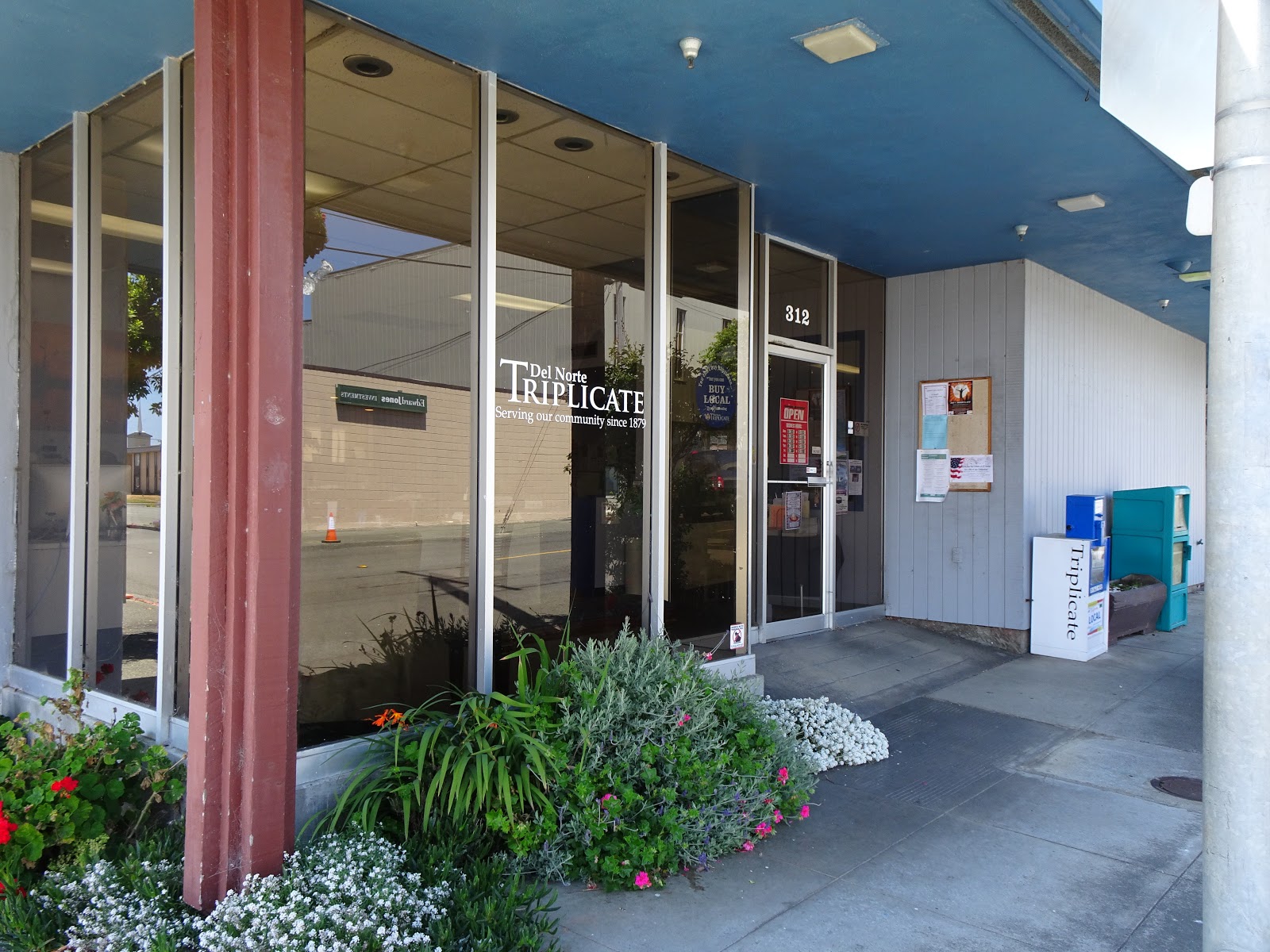
Office of the Del Norte Triplicate, a thrice-weekly paper in Crescent City, California
(c) Lisa R. Pruitt 2019
When I travel to rural places (as well as urban ones, for that matter), I make a point of reading the local news. I like to see what the issues du jour are in particular rural regions, and I blog about what I find as often as I can.  Some recent examples of that are here and here.  My travels throughout California in July have given me ample opportunity to consume several different local (county) newspapers, so I'm going to highlight some of what I read here:

The San Luis Obispo Tribune published an editorial headlined, "Reckless drivers, drunks and confederate flags don't belong on the Oceano Dunes," on July 19.  Here's an excerpt, about a recent Coastal Commission meeting in the area, which considered the fate of the popular outdoor park where six people have died this year in ATV/off-roading accidents:
Yes, the Coastal Commission agreed to maintain the status quo at the popular off-road park for at least one more year. But it also made it clear that it expects improvement. 
And if the commission takes its job to protect and enhance the coastline at all seriously — and wants to retain any credibility with opponents of the state vehicular recreation area — it will treat this as a last chance.

For as much as supporters have tried to portray the Oceano Dunes as a safe, welcoming, family-friendly place, the PR isn’t working.

It’s hard to characterize a place as safe and family-friendly when there have been six fatalities and a shooting so far this year.

And welcoming?

Sorry, but even a single Confederate flag on the back of a pickup is enough to create the impression that the entire off-roading community is a bunch of racist good ol’ boys who come over from the [Central] Valley to drink and raise hell — leaving the locals to eat their dust and clean up their mess.
* * *
For many, the [2019] deaths confirm the park is an inherently lawless, dangerous place — the term “Wild West” gets used a lot — where there’s little supervision and almost anything goes.
As we’ve said before, we don’t believe the increase in fatalities is a reason to close the park — but it definitely is a reason to figure out what the heck is going on and do whatever it takes to make the park safer.
I could excerpt more, but I think readers will get the picture. 

The (Sonoma County) Press Democrat ran this story by Julie Johnson on July 26 under the headline, "Mendocino marijuana raids reflect California’s stepped-up enforcement on illegal operators."  Here are a couple of key excerpts about what went down in what has been called the Emerald Triangle.  Specifically, the Mendocino County Sheriff's Office "cut down more than 42,000 marijuana plants on nearly 30 properties in the Eel River watershed." This is reportedly the first "major multiagency operation investigating illegal cultivation and environmental crimes to take place" in the county since the state legalized marijuana.  While the state has granted licenses to some 500 entities to grow marijuana in Mendocino County, thousands of unlicensed marijuana farms are believed to exist.
Cannabis industry leaders here said the operation was premature for an industry struggling to adapt to new regulations and that it felt like a resumption of the heavily militarized law enforcement campaigns that for decades targeted marijuana growers in these hills and valleys.
But Sheriff Tom Allman said his teams focused on sites where they spotted evidence of serious environmental crimes such as water theft and polluting the watershed with trash, fuels and pesticides. The investigations targeted properties where people had not even applied for local permits or state licenses to cultivate, he said.
“Is it marijuana enforcement or is it environmental enforcement?” Sheriff Tom Allman said. “There’s a difference, and I think the tide is turning.”
In the aftermath of legalization, marijuana industry leaders had hoped that enforcement of the state’s cannabis cultivation laws would fundamentally change. Where once they had encountered teams of camouflaged and armed peace officers investigating criminal behavior, they envisioned civil operations run by code enforcement officers using warnings, legal notices, fines and penalties to hold people accountable.
The Times-Standard (Eureka/Humboldt County) on July 6 led with this headline, "County buildings aren't up to standards."  The story by Sonia Waraich features these paragraphs: 
Humboldt County has been failing to make public facilities accessible to people with disabilities for years, according to a report from the county's civil grand jury.  
The county has been on hot water with the U.S. Dept. of Justice for over a decade because it has continuously failed to meet deadlines set by the department to bring county buildings up the the standards laid out in the Americans with Disabilities Act, according to the Humboldt County Civil Grand Jury report "Here We Go Again" released Friday morning.  The ADA states that government buildings need to be usable for people with disabilities and modifications need to be made to make them accessible.  
The following is a quote from the report: 
As the County approaches the final deadline in the Consent Decree to remediate the remaining facilities and curb ramps, it seems unlikely that work will be completed on time.  Many earlier deadlines have been missed and a number of projects are still out for bid.  
Nearly 1700 curb ramps still need to be remediated, according to the report. 

In it's July 3, 2019 issue, the Curry Coastal Pilot (Oregon) ran a front-page story announcing the paper's new ownership under the headline, "Turning a new page."  The story, which features a photo of Carol Hungerford, begins:
Hello, Brookings and Crescent City!  We're privileged to be the new owners of the Curry Costal Pilot and the Del Norte Triplicate.   
As a native Oregonian, I love this coast and its iconic smaller towns  We are excited at the opportunity to learn about and become part of the fabric of Brookings and Crescent City.   
My husband, Steve, and I have been working toward this goal of purchasing these two promising community news outlets for four months.  
Steve created Country Media nearly 20 years ago because of his passion for community news and service.  After half a century working at daily and weekly newspapers of all sizes, his zest for this business continues unabated.  
My education and work experience had been centered in the arts and arts management.  But early on I agreed to help Steve operate our newspaper company, and I've never regretted that decision.   
Over the past two decades, we've built our business to include some 15 nondaily newspapers and 15 years, associated websites serving communities of various sizes in four states.  So we have a strong background in finding a good fit between our publications and their communities.   
For now, our prime focus with these two newspapers is to make them sustainable, to ensure that Brookings and Crescent City have long-term newspapers they can rely on for non-judgmental, accurate and unbiased news coverage.  
The column then goes on to explain that Country Media bought the two papers our bankruptcy.  Curry is Oregon's most southwesterly county, and its population is 22,364.  Del Norte County, California, home of the sister paper, the Triplicate, has a population of 28,610.

Speaking of media ownership, to close out this initial post on the rural media, let me turn to this New York Times story from August 1 about the last issue of the Warroad (Minnesota) Pioneer, printed this past May.  Warroad, population 1,781, is in far northern Minnesota, a few miles south of Canada, and its paper had a distribution of about 1,100.   Richard Fausset's story notes that the Warroad paper joined some 2000 United States papers that have ceased to publish over the last decade and a half.  A study by UNC research, "The Expanding News Desert," found that “there is simply not enough digital or print revenue to pay for the public service journalism that local newspapers have historically provided.”  Fauset writes:  
In Warroad, The Pioneer was full of soft-focus features on residents, reprinted news releases, photos of fishermen with their outsize catches, and news of awards won by children and Shriners. There were the occasional stories, too, about city officials, the school board and local sports.
And so, Fauset notes, the closure of the paper leaves a big hole:
No hometown paper to print the obituaries from the Helgeson Funeral Home. No place to chronicle the exploits of the beloved high school hockey teams. No historical record for the little town museum, which had carefully kept the newspaper in boxes going back to 1897.
And what about the next government scandal, the next school funding crisis? Who would be there? Who would tell?
A prior post about Warroad, as hockey powerhouse, is here.  

Sunday, August 4, 2019

More conflation of rurality with whiteness in national media

I wrote about this a few days ago in relation to Paul Krugman's recent column, and now Eli Stokols of the Los Angeles Times reports: 
Trump’s denigration of cities is part of an effort to animate a base of rural, mostly white supporters while depressing minority turnout in places like Milwaukee, Detroit and Philadelphia — a repeat of the two-pronged strategy that helped him to a surprising electoral college victory in 2016 and could be determinative again four years later.
* * * 
In reality, the country’s largest urban areas are major engines of the national economy and generate more tax money than they receive from the federal government. By contrast, most rural areas receive more from Washington than they generate.
Stokols' highlighting Trump's dog-whistling is fair enough, but I'd like to see writers with national platforms like his and Krugman's do more to acknowledge the racial diversity in rural America. 

Saturday, August 3, 2019

California Commission on Access to Justice Rural Task Force publishes two policy briefs

The California Commission on Access to Justice has published two policy briefs which, I will admit right here, I played a major role in drafting over this past year.  The first, titled "Disasters in Rural California:  The Impact on Access to Justice," highlights the need for legal assistance in the aftermath of disasters.  Because disasters like wildfires disproportionately impact rural areas--areas already underserved by both legal aid and other attorneys (see more below re: California Attorney Deserts), the post-disaster need in rural areas tends to be greater.  Here's the opening excerpt:
California faced ten federally-declared disasters in 2018, and then-Governor Brown declared an additional two. These disasters disproportionately struck rural parts of the state, including the November 2018 Camp Fire that decimated the town of Paradise in Butte County. That fire was the deadliest and most destructive wildfire in California history, claiming 86 lives, destroying or damaging some 18,000 structures, and causing $16.5 billion in damage. Map 1 illustrates the rural impact of the Camp Fire and other recent wildfires, including the Klamathon Fire in Siskiyou County, the Ferguson Fire in Mariposa County, and the Ranch and River fires in Mendocino County. (See Map 1 and Table 1). The 2015 Valley Fire in Lake, Sonoma, and Napa counties caused $1.5 billion in damage, while that from the Butte fire in Calaveras and Amador counties tallied $450 million.
Low-income neighborhoods and communities of color are typically the slowest to recover from disasters, in part due to income-based differences in FEMA assistance. Ten million people with incomes below 125% of the federal poverty level live in rural places in the United States. Indeed, rural areas often have higher poverty rates than urban ones.
This means that areas most affected by wildfires are often burdened by poverty even before disaster strikes, as illustrated by the poverty rates in Lake County (25%); Mendocino County (20%); and Shasta County (17.5%).8 Disasters aggravate poverty, as those who already have few resources face loss of homes, personal possessions, and livelihoods. Those who can afford to leave a wildfire-impacted area often do, while low-income residents are more likely to remain. Major disasters typically increase a county’s poverty rate by an average of 1%.
* * * 
The intensity and frequency of such disasters demand unparalleled levels of resources and support for affected communities, and those resources must include legal assistance. Legal aid attorneys work in coordination with attorneys offering pro bono services to assist low-income and modest means rural populations with the many civil legal issues that arise in the wake of a disaster. These include housing, employment, and consumer fraud, as well as securing FEMA assistance and other public benefits. 
* * *  
Legal aid and pro bono assistance are vital aspects of any disaster recovery process. Legal assistance to low-income Californians is critical when they are facing illegal actions by landlords, scammers, and employers. In the aftermath of disaster, this legal assistance is critical if disaster survivors are to regain a sense of normalcy and stabilize their lives. Legal aid must have the funding and resources to provide wide-ranging services that protect low-income and vulnerable Californians after a disaster. These populations disproportionately reside in rural areas, where both legal aid lawyers and attorneys generally are in short supply. Rural deficits in access to legal services are nothing new.
The second brief, California Attorney Deserts:  Access to Justice Implications of the Rural Lawyer Shortage, essentially summarizes the California data presented in the six-author law review article, "Legal Deserts:  A Multi-State Perspective on Rural Access to Justice," published earlier this year by the Harvard Law and Policy Review.  This policy brief also discusses possible solutions to the rural lawyer shortage, and most of these are applicable in the Golden State and elsewhere.  We highlight roles law schools and other stakeholders can play.  And, we include some colorful maps depicting where the state's lawyers are.  Here's a short excerpt:
One measure of access to the legal system is access to an attorney. Massive parts of rural California are attorney deserts, where residents must drive many miles to reach an attorney who can represent them. This brief presents the geography of 2016 California attorney data to illustrate where attorney deficits exist throughout the state.

Many parts of California lack sufficient numbers of attorneys to serve their population, a situation that is particularly acute in many rural areas.
* * * 
Some of the disparities in lawyer availability are best revealed not by comparing counties or regions, but by looking at where lawyers are within a particular county. Fresno County makes an interesting case study because it represents a blend of urban, rural, and frontier: Fresno (City), California’s fifth largest city, is surrounded by rural areas, with the Sierra Nevada mountains rising to the east and central valley farms stretching south and west from the county seat. The county covers some 6,000 square miles, of which 98% is classified as rural or frontier under the MSSA scheme. While 37% of the population lives in those rural and frontier areas, just 5% of Fresno County attorneys have addresses there. Thus, each lawyer in an urban part of Fresno County serves around 417 people and about 1/20 of a square mile, while each rural lawyer serves around 2,887 people and 48 square miles.
The brief features a number of maps visually depicting where California's lawyers are, as well as which are the state's highest poverty counties.