
I have never been to Maine in the winter, but I don’t think I’m going very far out on a limb when I say that it is brutally cold. A working heating system is an absolute life necessity for residents of Maine. Maine residents who cannot afford a good system have relied on federal assistance in the past. Many of these residents may not be able to do so anymore.
According to the New York Times, President Obama has proposed major cuts to the Low Income Home Energy Assistance Program (LIHEAP) and Maine is “expecting less than half of the $55.6 million that it received last winter, even as more people are applying.” With rising oil prices, an increasing number of applicants, and significantly less federal funding available, many lower income Maine residents are potentially facing a winter with no heat.
There are a few different solutions that politicians and community leaders are exploring. Maine Governor Paul LePage (R) is targeting Efficiency Maine- a quasi-state agency that promotes energy efficiency by offering incentives to home and business owners – as a potential replacement source of funding. LePage views cuts to LIHEAP as posing an immediate emergency threat whereas Efficiency Maine is geared towards a more long-term solution. Efficiency Maine will have an estimated $53.5 million in funding over the next two years gained through electricity bill surcharges along with some federal funding. However, there is opposition from the Democratic Minority, who say that LePage is against efficient energy.
According to the New York Times article, Lepage is also trying to cut “heating oil consumption in half by 2014, partly by bringing more gas lines into the state.” However, this would not do much to solve the immediate potential crisis. A letter sent to the Kennebeck Journal reveals the true scope of the problem from one citizen’s point of view. She claims that low-income and elderly residents will now have to choose between “fuel and food, fuel and medicine, fuel and rent.” She ultimately urges Maine citizens to support LePage’s plan to transfer Efficiency Maine funds to help fund heating for Maine residents.
Wednesday, November 30, 2011

Organic farming: the wave of the future?
When I was growing up in south Orange County, California, my mom would exclusively buy organic produce for our family to eat. She insisted that organic food was healthier and safer and she was willing to pay extra money to ensure that we were eating what she thought were the best quality fruits and vegetables. We were the only family that I knew of at that time who did this (my mom often engaged in fervent debates on the subject with friends and family members). Due to the higher prices of organic food, the seemingly harder work that farmers have to do to grow produce without pesticides, and my perceived low demand for organic produce, I have always assumed that organic food was a sort of luxury that was less profitable and more of a holistic enterprise for farmers. Apparently, this isn’t necessarily the case.
As "The Rural Blog" reports, a 13 year study by researchers at Iowa State University recently concluded that organic farms can see much higher economic returns than ordinary farms. According to the study, organic farms can produce the same amount as ordinary farms without the high overhead costs that pesticides and synthetic fertilizer require. Additionally, organic crops sell at a premium rate. The study found that “organic systems return roughly $200 per acre more than conventional crops.”
Moreover, the study found that the benefits of growing organic go beyond the monetary returns; organic farms produce healthier soil. Organic farms don’t use synthetic herbicides or synthetic fertilizer- only natural manure. This increases the nitrogen level in the soil by over 33% and other nutrients such as carbon, potassium, phosphorous, magnesium and calcium were more bountiful as well. The higher quality of soil can increase growing efficiency.
If organic farming is more profitable, efficient, and better for the environment, why doesn’t every farm become organic? As one might imagine, it’s not quite that simple. For a farm to be considered organic, it cannot use synthetic chemicals for three years and the transition from one method to the other can be difficult and time-consuming. However, the study showed that if the transition is done the right way, transitioning farms can stay competitive with other farms even during the transitioning years.
The Iowa State findings complement the findings of the Rodale Institute, which lists even more environmental and economic benefits of organic farming. This website also lists what are typically thought of as the pros and cons of organic farming and opines on the merits of these pros and cons.
Tuesday, November 29, 2011
A hypothesis for a cure to the brain drain
Young farmers, or the lack thereof, has come up several times in class. First, we discussed the rural brain drain and its affects on the farm industry. Recently, we talked about young people choosing farming as a career--even in cases where they had no prior exposure to the industry. While the Federal government does provide a certain amount of assistance to these farmer-hopefuls, they clearly have a steep learning curve to till. South Africa, however, seems to have the right idea in addressing that problem.
A recent NY Times article, Sowing the Seeds of Food Security, discusses a South African education policy that uses growing crops as a teaching device. It's called the Organic Classroom Program and for three years it is part of the primary education curriculum in Cape Town. Operated by Schools Environment Education and Development, the program uses organic gardens to teach students science, geography, and economics. The school cafeteria then actually uses the food grown by the students.
While the interdisciplinary benefits are intriguing, the program specifically does what US primary education has not for many years: it teaches young people the principles of agriculture. While South Africa might not be a perfect analog for the United States, the lack of horticulture, agriculture, and similar courses in primary education could be why people just aren't interested in farming. More obviously, it explains why so many young farmers don't know what their doing.
Currently 45% of American farmers are over 55, and experts speculate the average age to only rise. Although the South Africa Department of Agriculture did not have age statistics (at least that I could find), one case study speculates their average age at around 40 years old. A full 15 years younger. While there are certainly different factors at play, it isn't unreasonable to think that the emphasis South Africa puts on agriculture is partly responsible. Of course SEED is relatively new, but a program doesn't become a mandatory part of primary education without some significant societal backing.
And maybe there is a larger sociological aspect here. If primary education is supposed to be the state's device for the inculcation of values, then it places value on more "cosmopolitan" subjects. When I was a high school senior I took AP Calculus BC, AP English, AP Physics, and similar classes that I can't recall. Advanced Horticulture was not offered. Students are indoctrinated with the value of a college education--in fact the need for a college degree. And while there are many college agricultural classes (especially on a campus like UC Davis), the modern idea of education is not one based on farming. Rather, students value AP tests and SAT scores not soil and seed.
Moreover, the law of most states makes primary education mandatory. It takes up about eight hours of their day, even more where they are involved in extracurricular activities. School is the center of their respective universes. If it doesn't include classes on growing, farming, and similar subjects then how can we ever expect people to be interested in the subject.
Quenching India's thirst
When I first arrived at Beijing one summer for a study abroad program, my program advisor offered me a quizzical piece of advice: stay away from the bottled water sold on the streets. It wasn't until I actually walked by one of these water stands that I understood why. Perched on plastic stools and shirtless, the "vendors" had tubs of plastic water bottles that they were refilling with a water hose that connected to who knows where. From the few feet away where I stood, stunned by the disparate scene, I could see the water was murky -- clearly not fit for drinking. Even more unsettling was the fact that the vendor had customers, albeit none American tourists. When I asked one customer why they were buying that water they answered, "I'm thirsty and this water is better than what I have at home."
My firsthand exposure to a small piece of the water problem in China is even more of an issue in India. According to World Bank estimates, China has been able to store five times more water than India does per person. A past New York Times series examines India's water crisis on a national level. A large part of the problem is the nationwide water distribution network, which insufficiently provides water from the public tap "more than a few hours a day." For rural India, where water is often contaminated with pesticides and agricultural waste, access to clean drinking water presents even more of a challenge. One article indicates:
With the entire nation suffering from this problem, some might think resources are best allocated towards urban areas, the centers of water distribution. According to a recent NPR article, however, one incentive for providing rural areas with clean water is that it is actually profitable. Situated in the rural town Rajiana, Healthpoint Services is a company whose goal is to bring clean water and healthcare to rural communities on a "global scale." Since it's inception two years ago, the company's model combines inexpensive videoconferencing, diagnostic tests, and water in one building to bring affordable healthcare and water to low-income people.
By condensing the resources into one building, visits to the hospital could be whittled down to a single visit, which means less transportation costs. While videoconferencing allows patients to meet with doctors two hundred miles away, they are still satisfied because they still personally interact with clinical assistants at the site.
And with eighty percent of all diseases in the region directly or indirectly triggered by drinking contaminated water, Jain has found that providing clean drinking water eliminates the vast majority of health problems in the area. Many households in the region subscribe to Healthpoint's clean water, which comes directly from the clinic's filtration plant. For $1.50 a month, a family could receive 600 liters of water.
The model is also profitable, according to Healthpoint Services CEO Amit Jain. It's a matter of meeting demand -- "even low-income Indians spend money on health care," and for too long, companies "ignored that opportunity to make a profit meeting the needs of people at the bottom of the economic pyramid." Healthpoint Services currently has eight pilot clinics and hopes to expand globally. Reaching out to social-minded investors internationally, the company has raised an additional $3 million. Company projections estimate services will reach 7.5 million people in India within the next four years. Pilot clinics will also expand to the Phillippines and Mexico.
Jain's goal in establishing Healthpoint Services was primarily based on his social mission and secondarily, on his financial return. While not all companies will necessarily share Jain's benevolent motive, perhaps the profitability of the model might nudge them in the right direction.
My firsthand exposure to a small piece of the water problem in China is even more of an issue in India. According to World Bank estimates, China has been able to store five times more water than India does per person. A past New York Times series examines India's water crisis on a national level. A large part of the problem is the nationwide water distribution network, which insufficiently provides water from the public tap "more than a few hours a day." For rural India, where water is often contaminated with pesticides and agricultural waste, access to clean drinking water presents even more of a challenge. One article indicates:
Conflicts over water mirror the most vexing changes facing India: the competing demands of urban and rural areas, the stubborn divide between rich and poor, and the balance between the needs of a thriving economy and a fragile environment.The exposure to high levels of dangerous chemicals from the water also leads to health issues requiring medical care. Equally challenging is the issue of getting adequate health care and treatment in rural areas. The problem is largely infrastructural. Professor Pruitt's law review article applies a capabilities-model analysis when discussing India's infrastructural deficits, also briefly summarized in this blog post.
With the entire nation suffering from this problem, some might think resources are best allocated towards urban areas, the centers of water distribution. According to a recent NPR article, however, one incentive for providing rural areas with clean water is that it is actually profitable. Situated in the rural town Rajiana, Healthpoint Services is a company whose goal is to bring clean water and healthcare to rural communities on a "global scale." Since it's inception two years ago, the company's model combines inexpensive videoconferencing, diagnostic tests, and water in one building to bring affordable healthcare and water to low-income people.
By condensing the resources into one building, visits to the hospital could be whittled down to a single visit, which means less transportation costs. While videoconferencing allows patients to meet with doctors two hundred miles away, they are still satisfied because they still personally interact with clinical assistants at the site.
And with eighty percent of all diseases in the region directly or indirectly triggered by drinking contaminated water, Jain has found that providing clean drinking water eliminates the vast majority of health problems in the area. Many households in the region subscribe to Healthpoint's clean water, which comes directly from the clinic's filtration plant. For $1.50 a month, a family could receive 600 liters of water.
The model is also profitable, according to Healthpoint Services CEO Amit Jain. It's a matter of meeting demand -- "even low-income Indians spend money on health care," and for too long, companies "ignored that opportunity to make a profit meeting the needs of people at the bottom of the economic pyramid." Healthpoint Services currently has eight pilot clinics and hopes to expand globally. Reaching out to social-minded investors internationally, the company has raised an additional $3 million. Company projections estimate services will reach 7.5 million people in India within the next four years. Pilot clinics will also expand to the Phillippines and Mexico.
Jain's goal in establishing Healthpoint Services was primarily based on his social mission and secondarily, on his financial return. While not all companies will necessarily share Jain's benevolent motive, perhaps the profitability of the model might nudge them in the right direction.
Farmville (Part VIII): Got water?
This past summer, the United States Bureau of Reclamation pledged 1 million dollars towards a water conversion program in the South San Joaquin Irrigation District (SSJID). The federal money comes at a time when Central Valley farmers have been experiencing a dry spell, costing them up to 1.5 billion in lost income. This dry spell resulted from drought and the lack of water.
The Delta Smelt receives a substation portion of water allocation. The smelt is a fish protected by the Endangered Species Act. Conservationists argued that the Smelt were dying in irrigation pumps. Consequently, a judge ruled that the pumps must be shut off for the growing season.
Historically farmers in the Central Valley have irrigated using flood irrigation. Flood irrigation involves building ridges around the land and flooding (or nearly flooding) the crops with water. Though a locally common method of irrigation, it requires large volumes of water. The use of flood irrigation, paired with water droughts and water allocation to the Delta Smelt, has caused competition for groundwater and has put pressure on the water table. Additionally, the water has become increasingly salty, causing lower crop production.
To combat the water scarcity problem, SSJID has been working on an irrigation enhancement project for the past three years. The project will increase the efficiency of water delivery and reduce reliance on groundwater pumping by replacing the current open channel system with a state-of-the-art pressurized irrigation system. In addition to allocating 1 million dollars to the program, the US Bureau of Reclamation has pledged another 5 million to farmers who make related improvements.
Growers in Division 9 of SSJID have already signed onto the program, which will add roughly 100,000 feet of new pipe to deliver water to farmers adopting drip and sprinkler irrigation. these methods allow water to drip slowly to the roots and use less water than traditional flood irrigation. The system is expected to provide better quality surface water while reducing demand on the aquifer. Additionally, the project incorporates automated water delivery controls and updated metering technology. This allows for precise measurement and accounting of water. When completed, the project will also include two seven-acre storage basins and several pump stations. The new system will capture irrigation runoff and divert water into the storage basins for conservation in cases of drought or shortages. SSJID officials project that the project with conserve 3,498 acre-feet of water per year, resulting in energy conservation, reduced air emissions, and improved water quality. Because of these efforts, SSJID staff estimates a 50% reduction in agricultural water use and a 30% boost in farm production. SSJID plans to complete the project by March 2012.
Proponents of the project have touted it as a triumph of improved technology and smart water management in an area plagued by salinity and water supply programs. The project aims to solve an agricultural water shortage problem in the Central Valley, while still conserving water and energy. If the water saving technology is successfully incorporated into SSJID's water delivery program, the project could establish a benchmark for similar projects throughout the Central Valley.
Monday, November 28, 2011
Farmville (Part VII): The golden state experiences a new gold rush
This weekend my dad received an offer to lease some of our ranches. The offer was atypical because the lessee will not use the land for farming. Instead, the lessee wants to remove the trees and plant solar panels, turning the ranch into a solar farm. Many farmers in California are given similar offers to convert or lease their land for solar farms. The State of California needs an estimated 100,000 acres of solar arrays employing modern technology to meet its mandate requiring one third of its energy be renewable by 2020. This coupled with tax breaks and stimulus dollars for solar panels has caused the State of California to experience a "Solar Gold Rush".
In Fresno County, the country's most agricultural county, there are thirty-two proposals for solar powered generation facilities. One of the proposals concerns Williamson Act land. Another post on the Williamson Act can be found here. The Williamson Act lowers tax assessments for farmers who contract with the county to use their land for agriculture for ten years. A large quantity of California farmland is governed by the Williamson Act. The state reimburses counties for this program. However, due to the budget crisis, the state has failed to pay, which has forced counties to make up the difference. Consequently, county planners and supervisors favor land for solar farming rather than agricultural farming purposes under the Williamson Act. In August, the Fresno County Board of Supervisors voted to cancel land under the Williamson Act to make way for a 90-acre solar project. Although favorable to the county budget, this cancellation has not been warmly embraced by farmers.
The California Farm Bureau Federation (CFBF) is suing the board of supervisors. CFBF alleges that the board overstepped its authority when it determined that nixing the Williamson Act contract in favor of the utility scale solar project was in the public's interest. The CFBF is now in a precarious situation, arguing for farm conservation over private property rights. CFBF lawyer, Chris Scheuring commented,
"Every farmer's got to make his own decision about what to do which his property. We're not here to stand in the way of any farmer taking advantage of the opportunities his property affords him. But in this case...the landowner voluntarily promised to keep his land in agricultural production for 10 years and wants to break that promise now. Just because the developer is waving cash at him and the county, we don't think that's the way Williamson Act was meant to be administered."
As in Fresno County, Kern County planners are also flooded with solar facilities requests. Of the requested 17,000 acres, a potential 9,000 acres are considered prime farmland - or nutrient rich soil. Local farmers are upset that such a substantial amount of farmland is going out of production, especially since crops need this nutrient rich soil, whereas solar farms can exist in areas unsuitable for crops.
A joint policy paper released by UCLA and UC Berkeley law schools argues that the balancing of farmland preservation and sustainable energy production must be a top priority for our State's future. The paper suggests that the two can co-exist by building the solar farms on marginal farmland or areas with limited water.
The Fresno case was recently filed. It will be interesting to see whether this case sets a precedent for future solar initiatives in the Central Valley, particularly in light of Fresno's large agricultural sector and its increase in green initiatives.
Militias on the rise
It seems the topic of militias pop up only when the media picks up a sensational story. Stories like the Ruby Ridge raid, the Branch Dividian siege, the Oklahoma City bombing, and the Hutaree arrests draw and hold our attention for a brief time. As the story wears on the topic of militias fades into the background and is largely forgotten until another sensational story arises. As a new story emerges of militias we often see similar themes between the stories. The militias are often survivalist types, frustrated and angry with the government, pro gun, militaristic, and rural.
Professor Pruitt briefly looked at militia's propensity to be formed in rural areas in a blog post concerning the Hutaree militia. The access to relatively large open spaces and isolation seem to make sense for a group looking for privacy and room to practice "live fire" military drills, but there are other reasons. Author and reporter Joel Dyer's book "Harvest Of Rage: Why Oklahoma City Is Only The Beginning" offers a different analysis.
According to Dyer, the increased number of anti-government militias is attributed to the farm crisis of the 80's. Dyer argues that the increase in globalization, corporate farms, the use of technology in farming, and perception that the American dream is lost has driven many into the ranks of militias as the seek out some sort of support. Agricultural expert A.V. Krebs shares Dyer's thoughts concerning the pressures placed on rural communities and believes the militias view the rural inhabitants as vulnerable targets of "hate propaganda and phony schemes of a surprisingly strong, organized right-wing element." Dyer and Krebs argue that rural inhabitants feel their problems are a result of the government's lack of support or laws set against them and in turn find others of common thinking in militias.
Dyer published his book in 1998, after the Oklahoma City bombing. His book goes through the ideology of many American militias as he interviewed as many members from several different groups as were willing. At the time he published the book he stated that people like Timothy Mcveigh weren't going away and as rural areas faced additional pressure and hardship that similar incidents were likely to occur.
Fortunately we have been relatively safe from domestic terrorists since the Oklahoma City bombing. In early 2010, the Hutaree militia was arrested for conspiring to kill multiple law enforcement officers. They were arrested and stopped before putting their plans into place. Dyer may be right in his assessment, but up to this point local and federal law enforcement agencies have been successful in preventing any further incidents.
What the future holds is anyone's guess though. Since 2009 the numbers of militias and militia members has significantly grown across the nation. According to the Southern Poverty Law Centre (SPLC),the number of right-wing militias has risen almost 250% since President Obama was elected. According to the same SPLC report, the number of "patriot groups" rose from 147 in 2006 to 512 in 2009. Mark Potok, a spokesman for the SPLC has stated,
Professor Pruitt briefly looked at militia's propensity to be formed in rural areas in a blog post concerning the Hutaree militia. The access to relatively large open spaces and isolation seem to make sense for a group looking for privacy and room to practice "live fire" military drills, but there are other reasons. Author and reporter Joel Dyer's book "Harvest Of Rage: Why Oklahoma City Is Only The Beginning" offers a different analysis.
According to Dyer, the increased number of anti-government militias is attributed to the farm crisis of the 80's. Dyer argues that the increase in globalization, corporate farms, the use of technology in farming, and perception that the American dream is lost has driven many into the ranks of militias as the seek out some sort of support. Agricultural expert A.V. Krebs shares Dyer's thoughts concerning the pressures placed on rural communities and believes the militias view the rural inhabitants as vulnerable targets of "hate propaganda and phony schemes of a surprisingly strong, organized right-wing element." Dyer and Krebs argue that rural inhabitants feel their problems are a result of the government's lack of support or laws set against them and in turn find others of common thinking in militias.
Dyer published his book in 1998, after the Oklahoma City bombing. His book goes through the ideology of many American militias as he interviewed as many members from several different groups as were willing. At the time he published the book he stated that people like Timothy Mcveigh weren't going away and as rural areas faced additional pressure and hardship that similar incidents were likely to occur.
Fortunately we have been relatively safe from domestic terrorists since the Oklahoma City bombing. In early 2010, the Hutaree militia was arrested for conspiring to kill multiple law enforcement officers. They were arrested and stopped before putting their plans into place. Dyer may be right in his assessment, but up to this point local and federal law enforcement agencies have been successful in preventing any further incidents.
What the future holds is anyone's guess though. Since 2009 the numbers of militias and militia members has significantly grown across the nation. According to the Southern Poverty Law Centre (SPLC),the number of right-wing militias has risen almost 250% since President Obama was elected. According to the same SPLC report, the number of "patriot groups" rose from 147 in 2006 to 512 in 2009. Mark Potok, a spokesman for the SPLC has stated,
"There has been a stunning expansion in these groups. In addition, there was an 80 per cent rise in hardline anti-immigration groups and hate groups like the Klan and neo-Nazis."
So with the farm crisis of the 80's long past, what's the cause for the substantial increase in militia numbers? According to Johnny Cochran, a member a Texas militia named Fireteam Diamondback, its due to the fear that America is turning away from it's traditional values and that the US government is set to become a tyrannical force. Cochran believes there will eventually be a showdown between patriot militia groups and the federal government. He even goes as far to say,
Mark Potok of the SPLC believes the growth of such groups are due to three factors: a depressed economy, changing racial demographics, and the election of President Obama who many militia groups feel does not accurately represent traditional American values based on the constitution.
I'd disagree with Potok concerning his thoughts that President Obama's election is a deciding factor. It seems too narrow a cause and more appropriate to simply state the President's politics. If Hillary Clinton had been elected, I think the rise in militias would be similar due to the similarities in politics and ideas. The rest seems to be an accurate guess as to why militias are gaining in numbers and strength. With a weak economy, hard times, and problems seemingly on the horizon, it's human nature to look for the cause and to pass blame. It appears the militias find it easy to place it on the government who they feel already has too much control and power over their lives.
Will it all come to a head next November as Cochran suggests? Will we see another extremely violent and disgusting act as the Oklahoma City bombing? Or will we let the ideas of militias drift into the background again? Time will tell but lets hope law enforcement agencies will continue to have the success they had with the Hutaree militia.
Mark Potok of the SPLC believes the growth of such groups are due to three factors: a depressed economy, changing racial demographics, and the election of President Obama who many militia groups feel does not accurately represent traditional American values based on the constitution.
I'd disagree with Potok concerning his thoughts that President Obama's election is a deciding factor. It seems too narrow a cause and more appropriate to simply state the President's politics. If Hillary Clinton had been elected, I think the rise in militias would be similar due to the similarities in politics and ideas. The rest seems to be an accurate guess as to why militias are gaining in numbers and strength. With a weak economy, hard times, and problems seemingly on the horizon, it's human nature to look for the cause and to pass blame. It appears the militias find it easy to place it on the government who they feel already has too much control and power over their lives.
Will it all come to a head next November as Cochran suggests? Will we see another extremely violent and disgusting act as the Oklahoma City bombing? Or will we let the ideas of militias drift into the background again? Time will tell but lets hope law enforcement agencies will continue to have the success they had with the Hutaree militia.
Sunday, November 27, 2011
(Comically?) conflating the rural with the less privileged
This cartoon strip in today's New York Times, Lifestyles of the Stealthy Wealthy, was good for a laugh. The premise is that the Occupy Wall Street movement has made the "1%" uncomfortable, so they are passing (or attempting to do so) as less affluent than they really are. Cartoonist Brian McFadden calls it a "clandestine approach to living in luxury," and one of the screens shows a man wearing a "novelty t-shirt" that says, "I'm with stupid (who legacied into Yale)."
The strip was good for a chuckle, but one thing that gave me pause was how McFadden collapsed that which is downmarket into that which is rural. Of course a lot of "downmarket" (a/k/a socioeconomically disadvantaged) folks live in rural areas, but a lot of them also live in urban and suburban areas. Here, McFadden poked fun at efforts of the rich--depicted as essentially urban--to blend in the hoi polloi by depicting them taking on rural trappings. These include pick up trucks (used to conceal private jets) and house trailers used to disguise penthouse homes. In one of the panels, McFadden shows a posh woman holding her dog in an opossum costume, with the caption, "This is my pet 'Possum, you know, from the woods." The heading on that one is "Even pets aren't immune to class camouflage."
I have argued elsewhere that the working class--especially the white working class--are increasingly conflated with the rural (a/k/a rednecks, clods and those living in flyover states) in political commentary. So, it was interesting to see McFadden's visual affirmation of this (especially the image of the literal flyover of a farm by the pickup truck turned jet), though I still regret this phenomenon and believe it disserves rural interests.
Saturday, November 26, 2011
Southern Cooking in our hearts, stomachs and city
Recently, NPR released a story about the Food Network’s celebrity chef Paula Deen. The story explores why people love Paula and her southern cooking so much. The story opens with a questioning of what is healthy food and asks if southern cooking fits into this picture. Unfortunately, the story drops this thread and continues to explore Deen's fanfare.
Fried chicken, buttered biscuits with honey, and collard greens are often thought of as Southern comfort food. Diabetes,obesity and heart failure are also associated to a strict soulful diet. Deen's southern cooking has been criticized by other celebrity chefs. Anthony Bourdain had the following to say about Deen:
The worst, most dangerous person to America is clearly Paula Deen. She revels in unholy connections with evil corporations and she's proud of the fact that her food is f---ing bad for you. If I were on at seven at night and loved by millions of people at every age, I would think twice before telling an already obese nation that it's OK to eat food that is killing us. Plus, her food sucks.Although the personal attacks are unwarranted, Bourdain brings up a good point about marketing butter to a nation struggling to keep its weight in check. What is the role of popular figures like Paula Deen, or Anthony Bourdain for that matter, in educating Americans about food and healthy lifestyles?
It seems Bourdain is putting a lot of pressure on Deen to lead the masses to a better food choices. The NPR story revealed how a lot of people are fans of Deen because her cooking reminds them of home. Has Deen’s cooking become a symbol of something beyond comfort food? Bourdain’s critique can be read as somewhat elitist and gendered because he focuses on female chefs and their “low quality foods.” Maybe the reason why so many can connect to the Southern chef’s style is because it speaks to the reality of people’slives—people have to make do with what they got. After all, saffron isn’treadily available in a supermarket store for a reasonable price.
For a culinary cuisine that is often deemed as simple, non-exotic, cheap, or unhealthy, Southern comfort food is increasingly becoming more popular in cities across the country. Aunt Mary’s café is drawing in hordes of people for Sunday morning brunches or the Mac n’ Cheese restaurant serves up sides of cole slaw or crackling cornbread with your specialty mac n’ cheese dish. This is not to say that Southern cuisine has never had a niche in the city. However, instead of the humble mom and pop cafes that existed before, neo-southern offerings exist with special ingredients that you wouldn’t find in your traditional Paula Deen shows. I would even go as far to say that there’s an attempt to give southern cooking a “modern twist” to fit the urban lifestyle.
Its interesting to see that while there is an overall critique of southern cooking and often a cautionary ‘danger-to-health’ note attached to following chefs like Paula Deen or even eating her dishes (gasp!), the process of making Southern cooking exotic or foreign-likein the cities occurs with the same frequency. So, are American audiences being condemned for watching cooking shows like Deens’ and commended when they go to hip southern bistros in the city?
An article in The Economist also discusses the link between the South's love for comfort food and the rising numbers on the scales. The article highlights a 2007 study from the Center for Disease Control and Prevention that marked mainly southern states with having high percentages of obesity. There is growing body of cookbooks that seek to address the gap between home-cooked southern food and health, arguing,that this does exist and people don’t have to pay for expensive meals at hip joints for a “healthy southern dish,” activist-chef Bryant Terry offers different nutritious recipes that are based on his family and community’s traditional southern cooking. Terry says this about his work:
[H]e felt called to engage a diverse national audience to confront the racial, economic, and geographic differences among eaters; recognize their own privileges; and reverse the negative impact the industrial food system has on our health, other animals, local economies, and the environment.The reality is that Americans are tipping the scale. However, that doesn't mean we should either exoticisize or dismiss an American tradition because it does not easily fit into healthy or unhealthy diet picture. Southern food is all American (with African, French, Caribbean, Native American and Spanish roots) and if people can connect to that in whatever ways ( t.v. or expensive cafes) then what's wrong with that? Chef Terry demonstrates new alternatives to reclaim the southern diet while addressing the real inequities that exist in making those food choices (health, immediate expense, traditions, etc).
Friday, November 25, 2011
Rethinking mobility in rural areas: a bus for the folks
A few years ago my mother fell from a ladder while picking fruit in our backyard and broke her hip. Fortunately, the doctor determined the injury would heal in half a year, but during the interim period my mother would be limited to a wheelchair and eventually, crutches. Usually an independent individual, the new handicap was understandably frustrating. Unable to make the drive for a quick grocery stop or to even make it up the stairs without relying on someone else, my mother felt trapped.
When thinking about the lack of accessible transportation in rural areas, I am reminded of my mother's frustration with her immobility. It is a handicap, but unlike my mother's temporary condition, it is a permanent one with crippling effects beyond mere inconvenience -- it is a cost to livelihood. For instance,without transportation to medical facilities, forty percent of veterans living in rural areas report lower health of quality of life scores than those living in urban areas. Without transportation to after-school sports programs, rural kids are twenty-five percent more likely to be obese. Without easily accessible transportation, seniors are less likely to visit family and friends or participate in society.
And with the economic downturn, local governments will only continue cutting transit options and resources. Previous blog posts discussed budget-driven cutbacks of air routes and post offices. A recent NPR article reports Indiana districts are also cutting free school buses to meet the bottom line. With no sidewalks on rural roads, walking is not an option. Students must rely on their parents to drive them to school, which could take up to half an hour. For some families, their best option is to pay between $40 to $50 monthly to ride the school bus.
With limited funding, what options are there for mobilizing rural residents? In her New York Times piece "Thinking Outside the Bus," Lisa Margonelli, director of the New America Foundation's Energy Policy Initiative, examines different transportation programs and whether they offer viable solution models. On this basis, she suggests the better approach to the transit deficit is to view potential riders as customers rather than as just a part of an infrastructure problem.
One of the models featured is the Brunswick Explorer implemented in the rural town of Brunswick, population 21,000. The program features two small fourteen-seat hybrid buses that travel a seven-mile route every hour that can make detours outside the set stops. Riders (ranging from the elderly, mentally ill, disabled, homeless, to college students) pay a nominal fair, but a combination of federal and local sources also fund the Explorer. The executive director, Lee Karker, had worked on two other unsuccessful rural bus systems that based bus routes on "traffic patterns" and not "input from users." When setting up the Brunswick explorer, Karker readjusted his approach to cater to the community needs and letting the program grow "more organically."
With ridership increasing by fifty percent in the past year, the Brunswick Explorer has thrived on meeting these community desires: the bus runs hourly, is environmentally friendly, accommodates those with mobility issues, and goes where the riders want to go, even pulling up to the doors of a supermarket. Nearby towns have also started their own Explorer programs modeled after this one. The challenge, according to Margonelli, will be to expand the route according to passenger desires "rather than to accomplish abstract goals of local government."
While the Brunswick Explorer model has worked for the town of Brunswick, its success raises an interesting notion of how to approach the problem of insufficient transit options in rural areas. In rural areas, schedules change according to ridership patterns and bus stops become infrequent and inconvenient. In turn, ridership further drops and with a bottom line to meet, local governments must cut the buses altogether. But if rural transportation planners approach the problem by catering to the community's needs, perhaps there is a much greater likelihood of successfully getting more out of transit dollars. Given the current state of the economy, it's something worth looking into.
When thinking about the lack of accessible transportation in rural areas, I am reminded of my mother's frustration with her immobility. It is a handicap, but unlike my mother's temporary condition, it is a permanent one with crippling effects beyond mere inconvenience -- it is a cost to livelihood. For instance,without transportation to medical facilities, forty percent of veterans living in rural areas report lower health of quality of life scores than those living in urban areas. Without transportation to after-school sports programs, rural kids are twenty-five percent more likely to be obese. Without easily accessible transportation, seniors are less likely to visit family and friends or participate in society.
And with the economic downturn, local governments will only continue cutting transit options and resources. Previous blog posts discussed budget-driven cutbacks of air routes and post offices. A recent NPR article reports Indiana districts are also cutting free school buses to meet the bottom line. With no sidewalks on rural roads, walking is not an option. Students must rely on their parents to drive them to school, which could take up to half an hour. For some families, their best option is to pay between $40 to $50 monthly to ride the school bus.
With limited funding, what options are there for mobilizing rural residents? In her New York Times piece "Thinking Outside the Bus," Lisa Margonelli, director of the New America Foundation's Energy Policy Initiative, examines different transportation programs and whether they offer viable solution models. On this basis, she suggests the better approach to the transit deficit is to view potential riders as customers rather than as just a part of an infrastructure problem.
One of the models featured is the Brunswick Explorer implemented in the rural town of Brunswick, population 21,000. The program features two small fourteen-seat hybrid buses that travel a seven-mile route every hour that can make detours outside the set stops. Riders (ranging from the elderly, mentally ill, disabled, homeless, to college students) pay a nominal fair, but a combination of federal and local sources also fund the Explorer. The executive director, Lee Karker, had worked on two other unsuccessful rural bus systems that based bus routes on "traffic patterns" and not "input from users." When setting up the Brunswick explorer, Karker readjusted his approach to cater to the community needs and letting the program grow "more organically."
With ridership increasing by fifty percent in the past year, the Brunswick Explorer has thrived on meeting these community desires: the bus runs hourly, is environmentally friendly, accommodates those with mobility issues, and goes where the riders want to go, even pulling up to the doors of a supermarket. Nearby towns have also started their own Explorer programs modeled after this one. The challenge, according to Margonelli, will be to expand the route according to passenger desires "rather than to accomplish abstract goals of local government."
While the Brunswick Explorer model has worked for the town of Brunswick, its success raises an interesting notion of how to approach the problem of insufficient transit options in rural areas. In rural areas, schedules change according to ridership patterns and bus stops become infrequent and inconvenient. In turn, ridership further drops and with a bottom line to meet, local governments must cut the buses altogether. But if rural transportation planners approach the problem by catering to the community's needs, perhaps there is a much greater likelihood of successfully getting more out of transit dollars. Given the current state of the economy, it's something worth looking into.
Thursday, November 24, 2011
Rurality Then and Now, Here and There (Part IX): Limestone, Arkansas and its one-time post office

Today is Thanksgiving, which seems a good excuse to let myself be openly nostalgic (or more nostalgic than usual anyway). Today I'm going to be nostalgic about post offices as remnants of earlier eras, of communities now bygone.
Of course, Legal Ruralism has featured many posts about post offices this summer and fall, a period in which many rural post offices have come under threat of closure in response to huge budget deficits facing the U.S. Postal Service. You can read some of them here and here.
In this post in March, I summarized a story from the Newton County Times about the history of post offices in Newton County. As noted there, while Newton County's population has never exceeded 11,000 (as far as I am able to determine; the 1940 Census shows a population of 10,881), about 50 different post offices have been located in the county over the nearly two centuries since the first was established in 1827. Of course, the county has probably had no more than 15 post offices--20 most--at any one time.

Driving through the county recently, I passed through some communities that previously boasted post offices. Among these were Boxley, Mount Sherman, Fallsville, Mossville and Nail. All of these communities are now served by paved state highways (two-lane highways, that is). One community I came across that previously had a post office was much more remote. Limestone is 6-8 miles down a dirt road (County Road 29) that descends into a scenic valley from Highway 16, not far south of Deer.

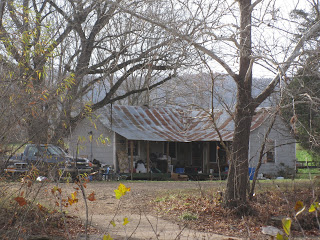
Someone in the community had apparently mourned the loss of its post office so much that s/he put lettering on the building indicating what the building--a small wooden shack--had once been. The photo of this post office is at the top of this blog. It's hard to make out against the gray of the building, but it features adhesive lettering that says: LIMESTONE P.O. 72646. Interestingly, the little shack looks like an outbuilding for the most centrally located home in Limestone, that of the Spradley family, which you can see behind the former post office. Just across the road is what presumably was once Limestone's general store (second photo from top). Also of interest is that when I looked up Limestone's ZIP code on the Internet, I found that it is 72628, the same as that for neighboring Deer, from whence mail to Limestone is no doubt currently delivered. So, the folks who labeled the little shack with the ZIP 72646 seem to be defiantly clinging to a time when Limestone enjoyed greater autonomy and status, and was not merely a outpost of Deer.

Limestone might be a case study of a community that once thrived--sufficiently so to merit a post office anyway, when the standards for having one were lower--but is now a shadow of its former self. The only structures in Limestone these days are a couple of houses--not even situated particularly close to one another. A dozen or so other houses/farms line the roads in and out of the valley that is the community Limestone, apparently named because of the high limestone bluffs visible for at least 180 degrees, as you look up from the valley floor that is Limestone and the adjacent community (a forerunner to a suburb, one might say) of Home Creek. (Third photo from top is of the limestone bluffs, and the photo at bottom right is of an inhabited homestead on Home Creek). I didn't see a single church in Limestone or during our descent into the valley; that's unusual in this part of the world, where churches are often the only bricks and mortar places for folks to gather.
I've been hearing about Limestone my whole life because my paternal grandmother was born there--or more precisely, on Home Creek--but this was my first trip into the valley. I had hardly been aware until a year ago of where it was on the map.
 Indeed, Blanche Lulu Robinson Pruitt was born in 1918 to Mae Ogden Robinson and Willis Robinson in the homestead that formerly sat behind the rock wall in the photo above left. The existence of old stone fences like these is one of the ways you can tell the community was formerly more substantial: the farmers invested a lot in infrastructure. Another way you know that more folks used to live at Limestone is that the community features six cemeteries--that's right, six! (Photo of Ogden Cemetery is below left). Plus, given the nature of the cemeteries and their upkeep, the folks in Limestone valley must have made decent livings--at least relative to the broader economic conditions in what has been a persistent poverty county since records began to be kept in 1960. I suppose most of them raised cattle on the rich bottom land along Big Piney Creek, as the cattle we saw suggest is still the case. Some residents of Limestone own businesses in Deer and Jasper, commuting there on a daily basis. Others may commute to points south for work, perhaps in neighboring Pope and Johnson counties.
It would be an exaggeration to say that Limestone has dried up and blown away. Clearly, a number of families still live there, their children bussed the 10-15 miles (mostly on dirt roads) to Deer School. But Deer school--which educates children from various communities along Highways 7 and 16 (Cowell, Nail, Swain and Walnut to name a few) has been fighting for its life for a few years now (read more here and here) in the face of a shrinking student body. This and the current state of Limestone suggest that this lovely valley is unlikely to experience a resurgence any time soon.
Going back to the current debate over rural post offices for a moment, I can't say which came first at Limestone: the loss of the post office or the waning of the community.
Wednesday, November 23, 2011
Town missing local grocer
The term ‘food desert’ is often associated with urban neighborhoods lacking access to healthy food markets. These neighborhoods are ridden with corner liquor stores. This phenomenon has a lot to do with the fact that during the height of urban redevelopment in post-WWII Americas many insurance companies and city planners red lined whole communities, deeming them too risky to insure. This translated into grocery stores not willing to set up shop because they were unable to get insurance for their stores in certain neighborhoods. Unfortunately, this redlining was based on racist and classist stereotypes, the neighborhoods most affected by these redlining policies were populated by poor working class people and people of color. To this day, these policies have severely affected the communities’ abilities to access healthy food.
Many rural communities are experiencing a growing problem similar to that of the urban ‘food desert.’ As rural population numbers continue to dwindle (as discussed in this PBS article), services like the local grocer are also skipping town, leaving communities hungry for their business. According to a 2007 study by the Rural Sociological Society, lack of access to healthy food in the rural context is defined by the following
Rural areas risk becoming “food deserts” as young families move away and market pressures continue to squeeze small grocers and retailers. Food deserts are defined as counties in which all residents must drive more than 10 miles to the nearest supermarket chain or supercenter.The 2007 study also identifies communities that are more likely to be food insecure. They are more likely to have a larger percentage of people who do not have high school degrees; higher individual and family poverty rates; greater percentage of people living in sparsely populated areas; and are more likely to be older populations. In addition, the study looked at all of U.S. counties marking 418 as food deserts, 98% located in non-metropolitan areas, most in areas with towns or cities of fewer than 10,000 people.
This NPR story looks at the case of Ogana, a Kansas town of 700 that lost its grocery store to a fire. The previous grocers decided not to rebuild, and the community was left without its sole grocer. People had to drive more than 25 miles to the nearest grocery store. No one in town had the financial capability to build a new grocery store. City officials stepped in and decided to foot the bill, an investment they claim they had to make. Mayor Gary Holthaus commented
"I feel you need to do those things in rural communities if you want to survive," Holthaus said. "You can't just ignore the issue and say it'll be alright . . . it won't be."The city of Ogana decided to take a road less traveled, the private-public partnership to set up a business to provide this basic service for its community. This model is a familiar site in urban settings. Taking cues from the urban food security movement, the Rural Grocery Store Initiative explores various models and strategies available to bring back a thriving local grocer to small towns otherwise left without those services.
However, unlike their urban counterpart, rural communities find themselves in a unique spatial setting that begs a questioning of this concept of food desert. Does this food insecurity dilemma manifest in the same ways in both the urban and rural settings? One factor that needs to be considered in some rural communities is that they may have access to land to grow their own food or hunt. Taking into account the rising cost of food in supermarkets, families will often grow subsistence gardens or farms. The alternative could also be to turn to fish and game to supplement. Another indicator of food insecurity in rural communities is the distance a person may be from a supermarket. These markets are becoming major chains like Walmart. Should we hold food insecurity measures on the distance a person has to drive to the closest Walmart, Target, or Safeway?
People in rural areas may not have access to these supermarket chains, but it doesn't mean they should be lumped entirely under the food insecure category. As the vice president of a local bank in Ogana, Kansas, Dan Peters, indicated, investing in a local grocer (even a small business) will also ensure the livelihood of the whole community.
"People now [think], 'I have to drive and get my groceries . . . so instead of coming to the local hardware store I'll just stop at Home Depot or some hardware store out of town while I'm there," Peters said. Without a grocery store, he says, it's hard to keep residents."When you start losing population, you start losing the ability to keep your infrastructure in town going," Peters said. "Property valuations go down and it just snowballs until what's left of the town? There's not much there."Looking at distance, mobility (as discussed in this blog post), cultural relativism, and poverty may give us better indicators to understand the lack of access to healthy food in rural areas than the same existing measures set up for urban areas. Overall, I think "food insecurity" or healthy food scarcity should be measured differently in rural areas as there is a world of a difference in why people eat what they eat or what they cannot or will not eat.
Tuesday, November 22, 2011
Solving rural gang problems with rural solutions
I used to think of gangs as a city problem. Movies like Boyz 'N the Hood and even West Side Story help to reinforce this idea that gangs are urban. As Legal Ruralism has documented here and here, however, gangs are increasingly present in rural Native American communities. In California, gangs have expanded beyond the reservations to other rural communities.
According to an FBI report, the 2011 National Gang Threat Assessment – Emerging Trends, urban gangs have gained influence and members in rural communities. According to the FBI, gangs have also been using rural communities to "expand their drug distribution territories, form new alliances, and collaborate with rival gangs and criminal organizations for profit and influence." The drugs that the gangs bring into rural areas come from Mexican cartels, and thus rural communities have an extensive network to confront when they try to combat these expanding gangs.
One Central Valley town in California, Woodlake, has fallen victim to gang influence, as an Associated Press article describes here. Woodlake's population is 7,280. It has twelve documented gang members and many youth affiliate themselves loosely with the Norteno and Sureno gangs. While this amount may seem negligible when compared to urban numbers, for small towns, having even one gang member is abnormal, problematic, and troubling. Due to the rate of poverty in Woodlake (30 percent of its families live in poverty), it is less surprising that gangs have gained some support.
The focus of the Associated Press article mentioned above is a Woodlake resident who recognized the gang problem and decided to create a solution. Manuel Jimenez works as a small farm adviser for UC Cooperative Extension, an agricultural support organization from the University of California. When the city bought a railroad right of way seven years ago, Jimenez saw an opportunity and asked the city if he could convert the land into a permanent garden. With the garden, he created Woodlake Pride, a volunteer program that gives young Woodlake residents the opportunity to cultivate 14 acres of agricultural land under Jimenez's guidance. Jimenez hoped the program would keep local children out of gangs and away from violence.
The project was a community effort. Jimenez was the impetus, but the city of Woodlake gave him land, water, and insurance for the project. A local farmer provided money for irrigation, while local companies donated plants, fertilizer, and tubing.
Once they had the supplies, Jimenez and local youth laid down the irrigation pipes and started planting. First, there were banana trees and roses. Then came 20,000 zinnias that spelled Woodlake, and beautiful gardens with sunflowers. Recently, the garden had roses, grapes, stone fruit, cacti, guava, mango, papaya, and rare purple walnut trees. The gardens attracted over 800 visitors for this year's berry tasting. Some visitors cry when they see the beauty of the garden.
What is most impressive about the garden is not the crops it grows, but the lives it changes. Jimenez and his wife act as surrogate parents to the children that volunteer in the garden. They do not allow any demonstration of gang affiliation. If someone comes to volunteer wearing gang colors, they send him or her home to change. Jimenez also instructs the children and teenagers on the dangers of gangs and encourages them to go to college. The local police chief says the garden has reduced youth violence.
The gardens have allowed many volunteers to gain marketable skills and confidence. They learn about agriculture and give tours and presentations. They also see their hard work turn into something beautiful. Most of the teenagers that volunteer at the garden go to college and some have become farm managers, teachers, and engineers. One young man who volunteered at the garden in middle school and high school now works for the UC Cooperative Extension as a field assistant, and a current volunteer wants to be an agricultural engineer.
For his efforts, the California Wellness Foundation awarded Jimenez the California Peace Prize earlier this month. The award honors heroes of violence prevention. As a recipient, Jimenez received $25,000. This money will hopefully allow Jimenez to realize his dream to expand the project into a larger garden with a U-pick feature and an interpretive center.
What can rural communities learn from Woodlake Pride? Sometimes rural problems need solutions that relate to the values and culture of the rural community. A garden might not work to reduce gang violence in an urban setting due to a lack of space and a decreased emphasis on agriculture in urban culture. In a small, rural community, however, it works. A community garden can create a sense of belonging in a more positive manner than a gang can. A garden can also have cultural and familial significance in a rural area that is reliant on agriculture. Woodlake is located in one of the most important agricultural centers in the world, and many of the youths' parents work in the industry. Other rural communities should follow suit and use their creativity and local resources to find similar solutions to prevent rural youth from dropping out of school, using drugs, or resorting to gangs and violence.
Woodlake Pride is also an example of rural autonomy and self-sufficiency. As Jimenez said, "You can't wait for somebody else, like the government, to do things for you. You need to get up and fix the community yourself." When local or state government cannot or will not step in to solve a problem, you have to find a way to solve it on your own. Jimenez is a model other rural residents should look to for inspiration on how to solve the social and legal problems their communities face, including gang violence. Jimenez is truly a rural hero.
According to an FBI report, the 2011 National Gang Threat Assessment – Emerging Trends, urban gangs have gained influence and members in rural communities. According to the FBI, gangs have also been using rural communities to "expand their drug distribution territories, form new alliances, and collaborate with rival gangs and criminal organizations for profit and influence." The drugs that the gangs bring into rural areas come from Mexican cartels, and thus rural communities have an extensive network to confront when they try to combat these expanding gangs.
One Central Valley town in California, Woodlake, has fallen victim to gang influence, as an Associated Press article describes here. Woodlake's population is 7,280. It has twelve documented gang members and many youth affiliate themselves loosely with the Norteno and Sureno gangs. While this amount may seem negligible when compared to urban numbers, for small towns, having even one gang member is abnormal, problematic, and troubling. Due to the rate of poverty in Woodlake (30 percent of its families live in poverty), it is less surprising that gangs have gained some support.
The focus of the Associated Press article mentioned above is a Woodlake resident who recognized the gang problem and decided to create a solution. Manuel Jimenez works as a small farm adviser for UC Cooperative Extension, an agricultural support organization from the University of California. When the city bought a railroad right of way seven years ago, Jimenez saw an opportunity and asked the city if he could convert the land into a permanent garden. With the garden, he created Woodlake Pride, a volunteer program that gives young Woodlake residents the opportunity to cultivate 14 acres of agricultural land under Jimenez's guidance. Jimenez hoped the program would keep local children out of gangs and away from violence.
The project was a community effort. Jimenez was the impetus, but the city of Woodlake gave him land, water, and insurance for the project. A local farmer provided money for irrigation, while local companies donated plants, fertilizer, and tubing.
Once they had the supplies, Jimenez and local youth laid down the irrigation pipes and started planting. First, there were banana trees and roses. Then came 20,000 zinnias that spelled Woodlake, and beautiful gardens with sunflowers. Recently, the garden had roses, grapes, stone fruit, cacti, guava, mango, papaya, and rare purple walnut trees. The gardens attracted over 800 visitors for this year's berry tasting. Some visitors cry when they see the beauty of the garden.
What is most impressive about the garden is not the crops it grows, but the lives it changes. Jimenez and his wife act as surrogate parents to the children that volunteer in the garden. They do not allow any demonstration of gang affiliation. If someone comes to volunteer wearing gang colors, they send him or her home to change. Jimenez also instructs the children and teenagers on the dangers of gangs and encourages them to go to college. The local police chief says the garden has reduced youth violence.
The gardens have allowed many volunteers to gain marketable skills and confidence. They learn about agriculture and give tours and presentations. They also see their hard work turn into something beautiful. Most of the teenagers that volunteer at the garden go to college and some have become farm managers, teachers, and engineers. One young man who volunteered at the garden in middle school and high school now works for the UC Cooperative Extension as a field assistant, and a current volunteer wants to be an agricultural engineer.
For his efforts, the California Wellness Foundation awarded Jimenez the California Peace Prize earlier this month. The award honors heroes of violence prevention. As a recipient, Jimenez received $25,000. This money will hopefully allow Jimenez to realize his dream to expand the project into a larger garden with a U-pick feature and an interpretive center.
What can rural communities learn from Woodlake Pride? Sometimes rural problems need solutions that relate to the values and culture of the rural community. A garden might not work to reduce gang violence in an urban setting due to a lack of space and a decreased emphasis on agriculture in urban culture. In a small, rural community, however, it works. A community garden can create a sense of belonging in a more positive manner than a gang can. A garden can also have cultural and familial significance in a rural area that is reliant on agriculture. Woodlake is located in one of the most important agricultural centers in the world, and many of the youths' parents work in the industry. Other rural communities should follow suit and use their creativity and local resources to find similar solutions to prevent rural youth from dropping out of school, using drugs, or resorting to gangs and violence.
Woodlake Pride is also an example of rural autonomy and self-sufficiency. As Jimenez said, "You can't wait for somebody else, like the government, to do things for you. You need to get up and fix the community yourself." When local or state government cannot or will not step in to solve a problem, you have to find a way to solve it on your own. Jimenez is a model other rural residents should look to for inspiration on how to solve the social and legal problems their communities face, including gang violence. Jimenez is truly a rural hero.
Will federal austerity measures bankrupt timber counties?
Congress' so-called super committee failed this week to reach a deal on deficit reduction. This means $1.2 trillion in automatic spending cuts are scheduled to go into effect in 2013. Program-specific cuts haven't been identified, but an almost certain casualty will be federal subsidies provided through the Secure Rural Schools and Community Self Determination Act.
Congress created the subsidy program in 2000 to help counties whose cash flows were hurt by policies limiting timber harvests on federal forests. The program was extended in 2008, as part of the bank bailout legislation, at a cost of $3.3 billion over the past four years. While the savings from this program will have a minimal impact on the national deficit, it will have huge ramifications for Oregon counties, which received the lion's share of this subsidy.
A recent study by researchers at Oregon State University suggest nine Oregon counties will lose more than a quarter of their general fund revenues, while another 11 will lose at least half of their road funds. This roughly translates to layoffs in the order of 3,800 to 4,400 for all of Oregon's rural counties.
One of the counties likely to take a drubbing is Curry County, with a population of 22,364. At a Oregon legislative committee meeting last week, Commissioner Dave Itzen said Curry County faces a $3 million budget gap, even after making severe cuts to programs like public safety.
Oregon's representatives are talking about revisiting national forest policy, with an eye toward "sustainable management" as Rep. Peter DeFazio explained in a press release. But with new housing start numbers stagnant, it's questionable whether opening federal forests to greater harvest would bring in revenues at a level that could replace the discontinued subsidies.
At this point, counties are probably best served by finding ways to consolidate services with each other and/or the state. While the federal government may own much of the land in these counties, it doesn't seem too concerned about the people on it.
Congress created the subsidy program in 2000 to help counties whose cash flows were hurt by policies limiting timber harvests on federal forests. The program was extended in 2008, as part of the bank bailout legislation, at a cost of $3.3 billion over the past four years. While the savings from this program will have a minimal impact on the national deficit, it will have huge ramifications for Oregon counties, which received the lion's share of this subsidy.
A recent study by researchers at Oregon State University suggest nine Oregon counties will lose more than a quarter of their general fund revenues, while another 11 will lose at least half of their road funds. This roughly translates to layoffs in the order of 3,800 to 4,400 for all of Oregon's rural counties.
One of the counties likely to take a drubbing is Curry County, with a population of 22,364. At a Oregon legislative committee meeting last week, Commissioner Dave Itzen said Curry County faces a $3 million budget gap, even after making severe cuts to programs like public safety.
We have one deputy on patrol in any given time in the entire county, and there's four hours [a day] where no one is on patrol. The jail was so cash-strapped that the county recently had to issue long underwear to prisoners when its 25-year-old heating system failed.These counties aren't faultless. When Congress reauthorized the timber subsidies in 2008, it did so with a plan to scale down the subsidies. But the counties have few other options for raising funds. Unemployment in many of these counties still remains above 10 percent, so county commissioners are reluctant to raise taxes. New industries have been stymied by environmental regulations and the tourism economy has languished.
Oregon's representatives are talking about revisiting national forest policy, with an eye toward "sustainable management" as Rep. Peter DeFazio explained in a press release. But with new housing start numbers stagnant, it's questionable whether opening federal forests to greater harvest would bring in revenues at a level that could replace the discontinued subsidies.
At this point, counties are probably best served by finding ways to consolidate services with each other and/or the state. While the federal government may own much of the land in these counties, it doesn't seem too concerned about the people on it.
Monday, November 21, 2011
Sometimes hospitals make me sick
This past Friday my mother went in for surgery at UCSF for a specialized operation only performed at elite teaching hospitals. She wouldn't want me to reveal what surgery she had, but she wasn't going to get the care at Mad River Hospital in Arcata or St. Joseph's Hospital in Eureka. She need to come south. Both of the major local hospitals in Humboldt County are just fine for general care, and have made forays into heart surgery and health, but they are well behind in specialty operations and cancer treatment.
It's just a hard reality for most people in out of the way areas; to get advanced medical help they need to travel. This is not the first trip to San Francisco for my family to get medical treatment. We go to tri-monthly appointments for my sister at UCSF's children's hospital to keep control of her type one diabetes (the kind that you are born with and diet changes don't get rid of). None of the doctors in Humboldt are entirely comfortable monitoring my sister's health without the help of specialists in either the Bay Area or Sacramento. Before that my late aunt need to go to Stanford and UCSF hospitals to receive treatment for her brain cancer, as no local doctor on the North Coast would even think of monitoring my aunt, let alone cutting her open.
While making these trips are painful enough, the attitudes of many of the doctors and specialists in the city can be even more excruciating. For example, when one of the doctors released my mother from the hospital he warned her to come back immediately if she started bleeding again as this would be a sign that the operation had failed and needed to be fixed. My father made the offhand comment that he was happy that they'd be staying in Davis with me rather then going home right away in case something did go wrong.
The doctor looked at him quizzically and asked why were they driving all the way out to Davis. My dad informed him that they lived in Arcata, and rather than make the five and a half hour drive up curvy 101, we all decided it'd be best for mom to make the hour and a half drive on straight I-80 to rest a few extra days in Davis before going home for Thanksgiving. The doctor was even more surprised. He had assumed we were locals and would only be a few minutes drive from the hospital rather than hours away.
"You should have just got a hotel room," he replied. Gee, thanks Dr. Personality, we'll just put an additional three night stay on our Platinum card along with the giant bill we're going to get for this little hospital stay. No biggie. I wish I could say that was the only time I heard a doctor in the city say something along those lines to rural patients that have come to the city for treatment. It's an attitude we have to constantly deal with.
Almost every time my sister has to talk to a new doctor in the diabetes clinic, they preach at her how she needs to come to weekly workshops at the hospital. And every time we inform them that my parents, already feeling guilty they can't do everything for their baby, cannot take the time off for an 11 hour round trip for a one hour meet and greet every week.
Luckily there are alternatives open to my family. There are diabetic support groups for my sister to visit with in Humboldt, and the internet is a godsend allowing her to hook up her diabetic meter to the computer to send a weeks worth of readings to her doctors at UCSF in minutes. My aunt was also able to participate in a few cancer support groups when she was still alive. And fortunately my father's physician has agreed to work with my mother's doctors in San Francisco to monitor the progress of her operation.
But these aren't always options open to all rural people. Trinity County has only one "medical center" to service over 3,000 miles of territory, to service less than 14,000 people. Funding that medical center has been a real problem. Areas don't have enough patients of certain types to have support groups, or if they did, the patients are too spread out to meet regularly with each other. And being able to make regular trips to places like San Francisco? Not easy.
This is just one of many problems of living in less accessible areas. It is a royal pain when medical professionals don't take a sympathetic approach to their patients from the boondocks. But it's a pain we'll probably have to put up with for quite awhile.
Related Posts:
Legal Ruralism: Mercy Mount Shasta to close skilled nursing facility
Legal Ruralism: Improvements to rural medicine?
Legal Ruralism: Obamacare's implications on the southern Oregon coast
It's just a hard reality for most people in out of the way areas; to get advanced medical help they need to travel. This is not the first trip to San Francisco for my family to get medical treatment. We go to tri-monthly appointments for my sister at UCSF's children's hospital to keep control of her type one diabetes (the kind that you are born with and diet changes don't get rid of). None of the doctors in Humboldt are entirely comfortable monitoring my sister's health without the help of specialists in either the Bay Area or Sacramento. Before that my late aunt need to go to Stanford and UCSF hospitals to receive treatment for her brain cancer, as no local doctor on the North Coast would even think of monitoring my aunt, let alone cutting her open.
While making these trips are painful enough, the attitudes of many of the doctors and specialists in the city can be even more excruciating. For example, when one of the doctors released my mother from the hospital he warned her to come back immediately if she started bleeding again as this would be a sign that the operation had failed and needed to be fixed. My father made the offhand comment that he was happy that they'd be staying in Davis with me rather then going home right away in case something did go wrong.
The doctor looked at him quizzically and asked why were they driving all the way out to Davis. My dad informed him that they lived in Arcata, and rather than make the five and a half hour drive up curvy 101, we all decided it'd be best for mom to make the hour and a half drive on straight I-80 to rest a few extra days in Davis before going home for Thanksgiving. The doctor was even more surprised. He had assumed we were locals and would only be a few minutes drive from the hospital rather than hours away.
"You should have just got a hotel room," he replied. Gee, thanks Dr. Personality, we'll just put an additional three night stay on our Platinum card along with the giant bill we're going to get for this little hospital stay. No biggie. I wish I could say that was the only time I heard a doctor in the city say something along those lines to rural patients that have come to the city for treatment. It's an attitude we have to constantly deal with.
Almost every time my sister has to talk to a new doctor in the diabetes clinic, they preach at her how she needs to come to weekly workshops at the hospital. And every time we inform them that my parents, already feeling guilty they can't do everything for their baby, cannot take the time off for an 11 hour round trip for a one hour meet and greet every week.
Luckily there are alternatives open to my family. There are diabetic support groups for my sister to visit with in Humboldt, and the internet is a godsend allowing her to hook up her diabetic meter to the computer to send a weeks worth of readings to her doctors at UCSF in minutes. My aunt was also able to participate in a few cancer support groups when she was still alive. And fortunately my father's physician has agreed to work with my mother's doctors in San Francisco to monitor the progress of her operation.
But these aren't always options open to all rural people. Trinity County has only one "medical center" to service over 3,000 miles of territory, to service less than 14,000 people. Funding that medical center has been a real problem. Areas don't have enough patients of certain types to have support groups, or if they did, the patients are too spread out to meet regularly with each other. And being able to make regular trips to places like San Francisco? Not easy.
This is just one of many problems of living in less accessible areas. It is a royal pain when medical professionals don't take a sympathetic approach to their patients from the boondocks. But it's a pain we'll probably have to put up with for quite awhile.
Related Posts:
Legal Ruralism: Mercy Mount Shasta to close skilled nursing facility
Legal Ruralism: Improvements to rural medicine?
Legal Ruralism: Obamacare's implications on the southern Oregon coast
Sunday, November 20, 2011
Photographing rural America
Luceo Images, a photographer-owned cooperative, recently funded a group documentary project on rural American called "Few and Far Between." The group project focuses on industrial and population changes in rural America. They write on their website that "[t]his change in industry, however, does not represent an overall repurposing of rural communities. Instead there has been a slow population decline in farming-based counties throughout the middle states of America offset by significant growth in Western states that boast alternative economies."
The photographers describe their work as challenging the preconceptions about a dwindling rural America. They acknowledge the shift in rural industry away from agriculture, but do not believe this indicates that rural America is losing its population. They seek to show through their photographs that this shift in industry has resulted in slow growth, fueled by an increasingly decentralized economy.
The project began in early 2010 during a photography trip to Lebanon, Kansas (population 218). You can see the photographs from the trip to Lebanon here. In late August of this year, the same five photographers continued to document life in rural America while traveling through Colorado, Wyoming, Montana, and Nevada in a rented RV.
The photographs taken during this trip show a real sense of joy that is present in rural America. The photographs are colorful and depict an active working community where the subjects are often smiling. These images are a stark contrast to most rural photography, which typically depicts vast, empty landscapes or "hillbillies" seeming especially unhappy.
Shelby Lee Adams, a photographer who is best known for his images of rural Appalachia, is often criticized for his portrayal of life in Appalachia. Critics argue that his photography perpetuates negative stereotypes of rural America. The photograph below, called "The Hog Killing," is often used as an example of how Adams exploits rural stereotypes. In his blog, Adams admits to staging the slaughtered pig in the background. He also admits to sometimes staging the facial expressions of his subjects.
In a film about Adams' photography, entitled The True Meaning of Pictures: Shelby Lee Adams' Appalachia, Adams argues:
Lucero is hoping to continue documenting life in rural America are is trying to raise additional funds for the project by selling a handmade book that they describe as "one part travel scrapbook, one part personal documentation, one part fine art assemblage." The book contains artifacts and instant camera photographs compiled by each member during the road trip. It is a beautiful collection of found objects and other relics, displaying a very personal look at each member's experience traveling in the RV this past August. With a price tag of $3,500, it's tempting to schedule my own road trip to photograph rural America myself.
The photographers describe their work as challenging the preconceptions about a dwindling rural America. They acknowledge the shift in rural industry away from agriculture, but do not believe this indicates that rural America is losing its population. They seek to show through their photographs that this shift in industry has resulted in slow growth, fueled by an increasingly decentralized economy.
The project began in early 2010 during a photography trip to Lebanon, Kansas (population 218). You can see the photographs from the trip to Lebanon here. In late August of this year, the same five photographers continued to document life in rural America while traveling through Colorado, Wyoming, Montana, and Nevada in a rented RV.
 |
| Photograph from Luceo's Few and Far Between Project |
Shelby Lee Adams, a photographer who is best known for his images of rural Appalachia, is often criticized for his portrayal of life in Appalachia. Critics argue that his photography perpetuates negative stereotypes of rural America. The photograph below, called "The Hog Killing," is often used as an example of how Adams exploits rural stereotypes. In his blog, Adams admits to staging the slaughtered pig in the background. He also admits to sometimes staging the facial expressions of his subjects.
 |
| Photograph from Adams' Napier Family Portfolio |
I'm photographing from a culture I'm from, I know about and I'm trying to express myself with that culture. So it's not an objective document, it's not an object. It's me, it's life and it's my subjects' lives who are my friends, who I love and care about.Regardless of Adams' good intentions, Lucero and other rural communities are working to challenge these stereotypes. The University of Kentucky's Appalachian Center hosted a photography contest earlier this year, called "Re-Imaging Appalachia." The Center was looking for photographs that challenge the stereotype of Appalachia, perhaps in response to Adams's work. The finalists submitted photographs of bustling communities that are full of life and much less solemn than the Appalachia as depicted by Adams.
Lucero is hoping to continue documenting life in rural America are is trying to raise additional funds for the project by selling a handmade book that they describe as "one part travel scrapbook, one part personal documentation, one part fine art assemblage." The book contains artifacts and instant camera photographs compiled by each member during the road trip. It is a beautiful collection of found objects and other relics, displaying a very personal look at each member's experience traveling in the RV this past August. With a price tag of $3,500, it's tempting to schedule my own road trip to photograph rural America myself.
Subscribe to:
Posts (Atom)